International Journal of Education
in Mathematics, Science and
Technology (IJEMST)
www.ijemst.com
A Case Study of E-tutors’ Teaching
Practice: Does Technology Drive
Pedagogy?
Hsueh-Hua Chuang1
1 National Sun Yat-sen University, Taiwan
To cite this article:
Chuang, H. (2013). A case study of e-tutors’ teaching practice: Does technology drive
pedagogy?
International Journal of Education in Mathematics, Science and Technology,
1
(2), 75- 82.
This article may be used for research, teaching, and private study purposes.
Any substantial or systematic reproduction, redistribution, reselling, loan, sub-licensing,
systematic supply, or distribution in any form to anyone is expressly forbidden.
Authors alone are responsible for the contents of their articles. The journal owns the
copyright of the articles.
Volume 1, Number 2, April 2013, 75-82
ISSN: 2147-611X
A Case Study of E-tutors’ Teaching Practice: Does Technology Drive
Pedagogy?
Hsueh-Hua Chuang1*
1
National Sun Yat-sen University, Taiwan
Abstract
This article presents a case study of e-tutoring teaching practice during a 20-week e-tutoring program aimed at improving the English proficiency of targeted students. The study revealed what and why certain online tools were used by e-tutors and investigated how different technological proficiency and face-to-face (f2f) teaching experience shaped e-tutors’ teaching practices in cyberspace. Data were collected through transcriptions of each recorded synchronous Skype teaching session, interviews of e-tutors, project artefacts, and e-tutors’ weekly memos. Results showed that use of Skype establishes a social presence in e-tutor and e-tutee instructional relationships and that online broadcasting is often equivalent to online teaching for e-tutors who are comfortable and familiar with face-to-face teaching environments. In addition, technology has shaped the teaching practice of tutors. This finding implies an adapted framework of technological pedagogical content knowledge for e-tutors to maximise the benefits of the designed online tutoring environments.
Keywords: E-tutoring, TPACK
Introduction
Web-based instruction has gained widespread recognition among researchers and educators because it is able to provide learners with distant, interactive, and individualised learning activities (Miller & Miller, 2000; Roblyer & Doering, 2010). In particular, the characteristics of individualised learning activities in web-based instruction address the need for one-on-one tutoring support in a cost-effective method called e-tutoring. E-tutoring is often called online tutoring because e-tutors interact directly with learners to support their learning processes via the Internet even though they may be separated by both time and place (Denard, 2003; Flowers, 2007). E-tutoring features instructional practices that range from highly-structured individualised support to occasional responses to specific homework questions or assignments. Traditional face-to-face (f2f) personal tutoring is often not cost-effective and not available to many children of low social economic status (SES) families (Flowers, 2007). Thus, the concept of e-tutoring has become a viable option to replace traditional f2f tutoring. To make tutoring accessible to more learners, recent web technology to accommodate individual choices has been developed, featuring personal options and mutual interactions rather than a one-way delivery mode, making the implementation of e-tutoring more feasible.
Pyle and Dziuban (2011) noted that web technology has driven online pedagogy in such a way that instructors need to learn its use to assist their teaching in cyberspace. After reviewing the related e-tutor literature, Denis, Watland, Pirotte, and Verday (2004) proposed competencies of e-tutors encompassing content and metacognition and identities such as process facilitator, adviser, assessor, technologist, resource provider, administrator, designer, co-learner, and even researcher as a reflective practitioner. They also addressed the importance of the pedagogical and communication-related competencies of e-tutors. These roles and competencies of e-tutors echo the recently advocated technological pedagogical content knowledge (TPCK) framework for depicting a teacher’s professional practice in teaching using technology (Mishra & Koehler, 2006). Specifically, within online web environments, Lee and Tsai (2010) suggested that online instructors should acquire technological pedagogical content knowledge-web (TPCK-W) competence as a sub-strand of the overarching TPCK framework, to better address the requirements of online teaching practice.
76 Chuang
Most of the e-tutoring literature focuses on the increased demand for personal e-tutors because of their cost-effectiveness compared with traditional personal tutors (e.g., Flowers, 2007). Descriptions of the design of e-tutoring models (e.g., Barker, 2002), the implementation of e-e-tutoring programs, and the ability of these programs to improve identified skill deficiencies (e.g., Johnson & Bratt, 2009) have been well documented. However, few studies have looked profoundly into how e-tutors conduct teaching practice in cyberspace and how different technological proficiencies and f2f teaching experience are reflected in teaching or tutoring in cyberspace. Thus, this study investigated the teaching practice of e-tutors with various degrees of technological knowledge and face-to-face teaching experience. Specifically, we sought to
understand what and why certain online learning tools were utilized by e-tutors; and
identify characteristics of instructional practice of e-tutors with various degrees of technological proficiency and face-to-face teaching experience.
Methods
Project background
Globalisation has made English an essential language in the global village. However, English-achievement test results at elementary and secondary schools in Taiwan show that most students with low socioeconomic status (SES) backgrounds are at the low end of the achievement scale (Chang, 2002). To bridge this achievement gap, e-tutoring has been proposed, given the established effectiveness of online support for learning (Denard, 2003). An e-tutor program sponsored by Taiwan’s National Science Council was initiated in 2009 to provide remedial support for low SES students with the hope of improving their academic English proficiency.
The Moodle-based Internet course management system provided tutors and tutees with both synchronous and asynchronous tools. E-tutors relied heavily on Skype’s video-conferencing tools to conduct synchronous teaching and real-time text communication and used other asynchronous tools such as discussion boards and email for communication purposes. Links to other online English learning resources and four modules of Flash-based multimedia courses, starting from basic phonics up through beginning- and intermediate-level reading, were also embedded in the course management system. The design of these four multimedia English learning modules reflected the standards set by Taiwan’s Ministry of Education (MOE). The wide range of course content was intended to provide individualised support based on e-tutees’ progress and current English proficiency so that each e-tutee could progress at his or her own pace.
Project procedure
Volunteering e-tutors were recruited from a national university. The screening process included expression of interest, ability at a specified English proficiency level, and group interviews to explain the program’ initiation and implementation procedures. Given the voluntary nature of the program, we particularly emphasised the participating e-tutors’ commitment to the program. E-tutors had to commit at least two hours a week to the program, consisting of synchronous interaction via Skype as well as additional time spent on asynchronous interactions such as e-tutee learning portfolios and discussion forums to make e-tutoring functional. Technical and instructional support was provided to both e-tutors and e-tutees by full-time technical support personnel, an educational technology professor, and a teacher of English as a foreign language (EFL). All e-tutors signed informed consent documents and were informed that their teaching would be recorded and observed. In total, 10 e-tutors were selected to tutor 10 children who were recruited from an elementary school in a metropolitan area in southern Taiwan. The particular elementary school was selected because it had appropriate available technology and the school principal expressed willingness to provide computer lab access to the selected elementary school children during designated times when school was in session. The school EFL teachers identified 10 children, who, in their collective professional opinion, would benefit from supplementary e-tutoring support but would be unable to afford the high cost of personal e-tutoring. The participating 10 elementary school students were all fifth graders. The program thus targeted students in need of support without the usual concern of providing each student with the individual access necessary to resolve the access issue of the digital divide. Unfortunately, from the 10 dyads of tutor and tutee, four of the 10 initially recruited e-tutors withdrew from the project due to personal reasons. We recruited another four e-e-tutors and were left with six complete cases of e-tutoring.
Participants in this study
We selected as study participants the six e-tutors who stayed throughout the program and completed a 20-week e-tutoring session. We requested and received permission for the research from all e-tutors and e-tutees in the program. To better understand these e-tutors technology backgrounds, during the first meeting we asked them to complete a form describing their experiences with email, Skype video conferencing, MSN chat, and online learning platforms. In addition, participants had to have demonstrated a level of English proficiency equivalent to passing the General English Proficiency Test (GEPT) at a high to intermediate level, indicating the ability to handle a broad range of topics with English capability roughly equivalent to that of a non-English-major Taiwanese university graduate. The results of the technology background surveys showed that two of the male e-tutors were more technology proficient than two female e-tutors in terms of more frequency and experience in navigating information and communication technology (ICT) tools. Although the other two e-tutors also did not have the highest level of technological proficiency, they had practical classroom experience in teaching English face-to-face as a foreign language as well as tutoring experience that the two technology-proficient e-tutors lacked.
Data sources and data analysis
We collected data from transcriptions of each recorded synchronous Skype teaching session, interviews with e-tutors, project artefacts from the Moodle course website, project meeting memos, and e-tutors’ weekly memos. Data collection and analysis occurred throughout the study and sometimes occurred simultaneously. At the initial stage of data analysis, a preliminary data analysis was conducted to check and track the data to identify areas requiring further questioning and inquiries (Grbich, 2007). For example, when we observed less frequent use of the online discussion forum, we interviewed e-tutors regarding this specific matter.
In addition, we also conducted frequency counts of each activity on the course website to rank the tools used during e-tutoring. For example, if an e-tutor used Skype, email, and a learning portfolio in one teaching session, each of these activities was counted. We conducted frequency counts of the six selected e-tutors who used the various tools during the 20-week e-tutoring process.
78 Chuang
course website, project meeting memos, and e-tutors’ weekly memos provided confirmatory data for triangulation purposes. A careful examination of the data collected identified themes elaborated in the following section.
Results and Discussion
The dominant use of synchronous tools
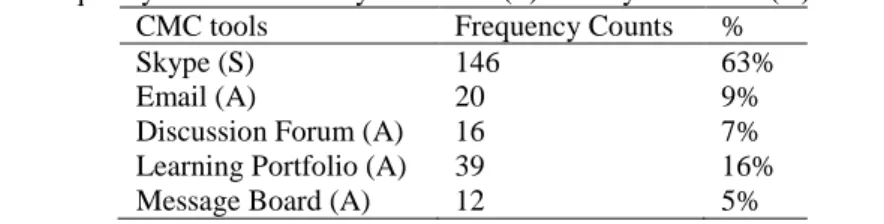
Although the design of the e-tutoring course site incorporated a computer-supported collaborative learning concept, it was also intended to create a shared knowledge corpus with external resources through tools for synchronous support (i.e., Skype conferencing/chat) and asynchronous support (i.e., email, lesson unit discussion boards, learning passport assessment). The majority of teaching practice was conducted using synchronous tools such as Skype conferencing and chat sessions (see Table 1). Barker (2002) viewed electronic mail and computer conferencing as the two most widely used resources in online communication because, when an individual externalises knowledge through these two resources, the cognitive processes employed by the individual are emphasised. In this e-tutoring situation, email was not as widely used as computer conferencing, specifically the use of video conferencing via Skype. Two possible explanations for this result involve the nature of tutoring and the limited Internet access on the student side.
Table 1. Frequency counts of each synchronous (S) and asynchronous (A) CMC tool used
CMC tools Frequency Counts %
Skype (S) 146 63%
Email (A) 20 9%
Discussion Forum (A) 16 7%
Learning Portfolio (A) 39 16%
Message Board (A) 12 5%
The challenge of tutoring and asynchronous interactions
The concept of tutoring is to offer individual guidance and attempt to attain each individual’s learning goals at his or her own pace. The act of tutoring has a very high association with the degree of social presence. Heilbronn and Libby (1973) proposed that technological immediacy can promote social presence because the maximum amount of information is transmitted and social immediacy is conveyed through speech and verbal and non-verbal cues. Thus, from the perspective of technological immediacy, e-tutoring creates a togetherness of geographically-distant persons connected through a telecommunication medium. Among CMC tools, asynchronous tools such as email are regarded as having a lower level of social presence than are synchronous tools such as Skype video conferencing. Several e-tutors mentioned that their e-tutees expressed loss of contact and great frustration when they had Skype problems and failed to meet each other online. Inability to use Skype video conferencing during e-tutoring created a loss of immediacy in the e-tutor and e-tutee relationship. Thus, the extensive and intensive use of Skype in e-tutoring can help support the establishment of social presence for both e-tutors and e-tutees by providing additional verbal and visual cues that email and other CMC tools cannot accomplish. Johnson and Bratt (2009), in their study of e-tutoring of school children by technology education students, also described the crucial role of video conferencing in cultivating the tutor-tutee’s instructional relationship. In our study, one of the e-tutors mentioned a case in which she had a schedule conflict and missed a Skype meeting session; she felt that she did not engage in tutoring that day, although she did email the e-tutee a worksheet and reviews of lesson units.
McMann (1994) reported that the roles an e-tutor assumes in conducting teaching practice do not differ much from those of traditional f2f instruction. However, Mason (1991) noted that the roles of e-tutors involved reasonability at both the technical and educational levels. In terms of technical role requirements, Berge (1995) proposed that the e-tutor should be familiar, comfortable, and competent with ICT systems, and Baker (2002) focused on competence in navigating various CMC tools in a web-based learning system. Therefore, the challenge of transferring f2f tutoring to Skype video conferencing tutoring usually involves providing technical guidance and feedback on technical problems. From the recorded teaching transcripts, we observed that e-tutors in the beginning stage spent most of their time guiding the students in familiarisation and navigation of the course platform and computer video-conferencing Skype functions such as text chat, sending files, and adjusting the web camera and microphone volume. We noticed that the two e-tutors with higher technological skills used a shared desktop so that they and their tutees could see each other’s desktop activities. When interviewed as to why they utilised the shared desktop function, they gave two reasons: to share their teaching aids and resources with the e-tutee and, more importantly, to prevent the tutee from multi-tasking by, for example, visiting gaming websites during the e-tutoring session. Most of the other e-tutors later followed this example and adopted the shared desktop model as a method of monitoring e-tutees.
Being free from the physical constraints of traditional f2f on-site tutoring, e-tutoring faces the challenge of an effective attention-monitoring mechanism in cyberspace. This challenge was addressed in a previous study on the design of e-learning environments for supporting students and tutors through the use of shared desktops and shared applications (Odeh & Ketaneh, 2007). The two tech-savvy e-tutors who initiated the use of shared desktops shared their experiences in an e-tutor meeting after which most of the other e-tutors also adopted the shared desktop approach.
The impact of students’ limited access to the Internet
The e-tutees were mostly from low SES families and only three of the 10 participating tutees had home Internet access. The students took advantage of the noon session in the school computer lab to meet with their e-tutors and sometimes to conduct other online learning activities if their e-tutors were not simultaneously available on Skype. E-tutors were aware of the access issue for most of the e-tutees and made efforts to be simultaneously available online during the noon session when e-tutees were allowed access to the school computer lab. This resulted in a majority of teaching practice (85%) conducted through synchronous tools such as Skype conferencing. For those dyads that had email interactions, e-tutees had home Internet access. A previous study (Chuang, Yang, & Liu, 2009) regarding the influence of digital divide factors on the motivation of low-SES elementary school students in Taiwan to use technology to learn English found that the existence of computer and Internet resources at schools or in the community was a significant predictor of learners’ motivation to utilise technology to learn English. Creating a fair technological opportunity for everyone by removing restrictions of region, education, and economic status through public access to ICT is a key to rectifying the digital divide, particularly as e-tutoring has increasingly become a cost-effective technique for providing remedial support to improve schoolchildren’s academic achievements.
Online broadcasting
80 Chuang
The impact of technological proficiency
On the other hand, the two e-tutors with more sophisticated technological skills and fluency in navigating in cyberspace were more comfortable in utilising online resources to teach the same content. For example, one e-tutor found a YouTube video to show to his e-tutee to illustrate how the mouth and tongue muscle should coordinate when pronouncing an English word. They integrated an online dictionary into their program while teaching reading using an online interactive multimedia book. They combined the benefits of interactive multimedia with enhanced interactivity and access to an extensive body of Internet-connected teaching-learning resources. In addition, they transferred electronic files more often and more frequently used other asynchronous tools such as email, the discussion forum, and learning portfolios than the other two e-tutors with more f2f teaching experience and less technological proficiency. One interesting observation is that they could still conduct tutoring via other CMC tools when Skype conferencing encountered technical problems such as webcam disconnection or slow Internet speed. In a similar situation, the other group with less fluency in ICT tools would usually give up and reschedule another Skype tutoring session.
Although the mere presence of technological knowledge does not guarantee good online teaching, based on the findings from this study on online tutoring, we would argue that proficient technical skills are the grounds on which pedagogical knowledge and content knowledge can be combined to form online teaching technological pedagogical content knowledge. Otherwise, online learning is just a cyber version of the physical world, breaking only the space boundary but failing to address the issue of online learning as a way to actually transform teaching and learning as advocated by most educational technology experts (Salmon, 2004).
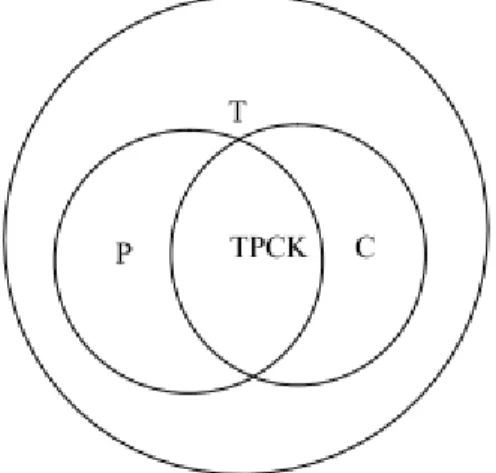
McPherson and Nunes (2004) mentioned that, among the four roles of an e-tutor (i.e., pedagogical, social, managerial, and technical), the technical roles are for academics the most daunting and challenging. We propose that an e-tutor’s technological knowledge is the fundamental basis and could even be the primary criterion for success as an online tutor. This is reflected in Barker’s (2002) emphasis on the technical skills required to be an online tutor. IT skills and fluency imply a hierarchical qualification. Thus, in the context of the one-on-one tutoring in a cyber teaching and learning environment, we propose this adapted diagram (Figure 1) of TPCK to reflect the capability of an e-tutor to explore and maximize the benefits of online tutoring environments. This adapted diagram, different from the original diagram that presents three equivalent circles of technology, content, and pedagogy, stresses the importance of interactions among the three components T (Technology), P (Pedagogy), and C (Content), while stressing that technology must be the base on which the other interactions occur. In articulating the essence of TPCK, Koehler and Mishra (2008), when addressing the advent of new technology, stated that the arrival of technology forced educators to think about core pedagogical issues such as how to represent content on the web and further proposed that “It is the advent of technology that drives the kinds of decisions we make about content and pedagogy, by highlighting or revealing previously hidden facets of the content, by enabling connections between diverse domains of knowledge, or support newer forms of technology” (p. 19). In fact, two of the initially-recruited e-tutors dropped out of the e-tutoring program because that they did not feel comfortable teaching within a cyber environment due to their lack of IT fluency.
Conclusion
This case study revealed two possible reasons for the incompatibility of tutoring and asynchronous interactions. First, the use of synchronous video-conferencing tools such as Skype established a social presence in e-tutor and e-tutee instructional relationships. Second, online broadcasting was often equivalent to online teaching for those e-tutors who are comfortable and familiar with a face-to-face teaching environment. In addition, we also found that technology shaped the teaching practices of e-tutors. This process, originating from technological knowledge, encompasses what was once referred to as communication literacy and now falls under the broader term of media literacy that includes recognising information needs, distinguishing ways of addressing gaps, constructing strategies of locating, accessing, comparing, and evaluating information, and organising, applying, and synthesising information (Livingstone, 2004). In addition, an adapted TPCK is proposed to support and frame an e-tutor’s ability to understand the constraints and abilities of various technologies, along with the pedagogical and content knowledge necessary for further adaptations if successful instructional practices are to take place between e-tutors and e-tutees. This study provides insight into the instructional practice of e-tutoring and contributes to the existing literature on the recruitment and training necessary to become a successful online tutor.
References
Barker. P (2002): On being an online tutor. Innovations in Education and Teaching International, 39(1), 3-13. Berge, Z.L. (1995). Facilitating computer conferencing: Recommendations from the field. Educational
Technology, 35(1), 22-30.
Biocca, F., Harms, C., Gregg, J. (2001). The networked minds measure of social presence: Pilot test of the factor structure and concurrent validity. Paper presented at Presence 2001, October 9-11, Philadelphia, USA.
Chang, W.-C. (2002). Causes of the bimodal phenomena of basic competence test for junior high school students. Entrance Exam Committee News 16. Taiwan: Taipei.
Chuang, H.-H., Yang, Y.-F., & Liu, H.-C. (2009). What digital divide factors matter in the motivation to use technology to learn English? A case of low SES young learners in Taiwan. Advanced Distance Education Technologies, 2009, 721-725.
Denard, H. (2003). E-tutoring and the transformations in online learning. Interactions, 7, 2. Retrieved September
3, 2010, from
http://www2.warwick.ac.uk/services/cap/resources/pubs/interactions/archive/issue20/denard
Denis, B., Watland, P., Pirotte, S., & Verday, N. (2004). Roles and competencies of the e-tutor [WWW
document]. Retrieved September 3, 2010, from
http://www.networkedlearningconference.org.uk/past/nlc2004/proceedings/symposia/symposium6/deni s_et_al.htm
Flowers, A. T. (2007). NCLB spurs growth in online tutoring options. School Reform News, January 1. The Heartland Institute, Chicago, IL. Retrieved July 3, 2007, from http://www.heartland.org/Article.cfm?artId=20426.
Grbich, C. (2007). Qualitative data analysis: An introduction. London: Sage.
Heilbronn, M., & Libby, W. (1973). Comparative effects of technological and social immediacy upon performance and perceptions during a two-person game. Paper presented at the annual convention of the American psychological association, Montreal.
Johnson, G. M., & Bratt, S. E. (2009). Technology education students: e-tutors for school children. British Journal of Educational Technology, 40(1), 32-41.
Koehler, M.J., & Mishra, P. (2008). Introducing tpck. AACTE Committee on Innovation and Technology (Ed.), The handbook of technological pedagogical content knowledge (tpck) for educators (pp. 3-29). Mahwah, NJ: Lawrence Erlbaum Associates.
Lee, M., & Tsai, C. (2010). Exploring teachers’ perceived self-efficacy and technological pedagogical content knowledge with respect to educational use of the World Wide Web. Instructional Science, 38(1), 1-21. Lincoln, Y., & Guba, E. (1985).Naturalistic inquiry. New York: Sage.
Livingstone, S. (2004). Media literacy and the challenge of new information and communication technologies. The Communication Review, 7, 3-14.
Mason, R. (1991). Mason, R. (1991). Moderating educational computer conferencing. DEOSNEWS, 1(19). Retrieved October 7, 2008, from http://www.emoderators.com/papers/mason.html.
82 Chuang
opportunities (pp.159-166). College Station, TX: Department of Educational Human Resource Development, Texas A & M University.
McPherson, M. A., & Nunes, J. M. B. (2004). The role of tutors as an integral part of online learning support. European Journal of Open and Distance Learning. Retrieved July 29, 2010, from http://www.eurodl.org/materials/contrib/2004/Maggie_MsP.html
Miller, S. M., & Miller, K. L. (2000). Theoretical and practical considerations in the design of web-based instruction. In B. Abbey (Ed.). Instructional and cognitive impacts of web-based instruction (pp. 156– 177). Hershey, PA: Idea Group Publishing.
Mishra, P., & Koehler, M. J. (2006). Technological Pedagogical Content Knowledge: A Framework for Teacher Knowledge. Teachers College Record, 108(6), 1017-1054.
Odeh, S., & Ketaneh, E. (2007). Collaborative Working Learning Environments Supported by RulBased e-Tutor. International Journal of Online Engineering (iJOE), 3(4).
Pyle, R. C., & Dziuban, C. D. (2001). Technology: Servant or master of the online teacher? Library Trends, 50(1), 130-144.
Roblyer, M. D., & Doering, A. H. (2010). Integrating educational technology into teaching (5th edition). Boston MA: Ally & Bacon.
Salmon, G. (2004). E-moderating: The key to teaching and learning online: Routledge.