Saonli Jha IJSRE Volume 06 Issue 10 October 2018 Page 8029
Volume||06||Issue||10||October-2018||Pages-8029-8036||ISSN(e):2321-7545 Website: http://jsae.in
Index Copernicus Value- 76.10 DOI: http://dx.doi.org/10.18535/ijsre/v6i7.04
“Effectiveness of planned audio teaching program on menstrual hygiene in terms of
knowledge among visually challenged adolescent girls, in selected blind school, West
Bengal.”
Author Saonli Jha
College of Nursing, Asia Heart Foundation, Rabindranath Tagore International Institute of Cardiac Sciences The west Bengal University of Health Sciences, 2014
ABSTRACT
Menstruation is an event of life that can transit a girl from childhood to womanhood. The differently abled girls also face the changes; specially the visually challenged girls who needs help in their activities of daily living. It is very difficult for the visually challenged adolescent girls to manage the menstruation. The investigator conducted a research studyto find out theEffectiveness of planned audio teaching program on menstrual hygiene in terms of knowledge among visually challenged adolescent girls in selected blind school, West Bengal. She adopted pre experimental research design with 42 visually challenged adolescent girls by convenience sampling technique. Structured interview schedule was used to collect data. Audio teaching programme was given in between structured interview schedule. Result showed that the obtained‘t’ value (13.15) is significantly higher than the table value at 0.05 level of significance. Hence the planned audio teaching programme increased the knowledge regarding menstrual hygiene among visually challenged adolescent girls.The result also showed that there is no association between pretest knowledge score and selected variables with all other demographic characteristics. This planned audio teaching programme could be implicated to educate the large sample size of visually challenged adolescent girls and it will also meet the need of right to information.
BACKGROUND OF THE STUDY
There is an estimated 45 million blind people and 135 million visually impaired worldwide. The global prevalence of childhood blindness is thought to be around 0.07% or approximately one tenth of the prevalence of blindness in adults as per World Health Organization, 1997. Young disabled people are the most marginalized and vulnerable in the world’s young people.Blindness is regarded as the most severe and traumatic physical disability. The Global blindness - a preventable tragedy state that every 5 seconds a person in the world goes blind. Every minute a child in the world goes blind. Two out of three blind people in the world are women and young girls.
Ninety percent of the world’s blind people live in developing countries. In India; an estimated 236,900 children up to the age of eighteen are visually impaired, which is around 11 percent of the total visually impaired population of India. Of these children, around 7 percent are in the adolescent age group.
The period in which the principal changes occur in life is the adolescent period. The adolescent stage in a girl is recognized as a special period, which signifies the transition from girlhood to womanhood. The onset of menstruation or menarche is the hallmark of female pubertal development. The menstrual cycle is a very
Saonli Jha IJSRE Volume 06 Issue 10 October 2018 Page 8030
isolation and discrimination. While all individuals with disability may be affected by this lifelong cycle of stigma and prejudice, visually impaired young people, especially girls, are particularly at risk.
NEED OF THE STUDY
The visually challenged girls have limitations to perform their activities due to loss of vision, and also reduced their ability to learn from observing and performing self care activities. A visually challenged girl, either from birth or from early childhood, adjusts to the world of seeing, a world that is in its visual aspects not experimentally known to them. The early intervention should be provided for imparting adequate knowledge and training on personal hygiene and reproductive health, enable them to perform tasks independently
Problem statement
“Effectiveness of planned audio teaching program on menstrual hygiene in terms of knowledge among visually challenged adolescent girls,in selected blind school, West Bengal.”
GENERAL OBJECTIVES
To determine the effectiveness of audio teaching program on knowledge regarding menstrual hygiene among visually challenged adolescent girls.
Specific objectives
To develop planned audio teaching programme.
To assess the knowledge regarding menstrual hygiene before and after exposure to planned audio teaching program among visually challenged adolescent girls in selected blind school.
To evaluate the effectiveness of planned audioteaching programme on menstrual hygiene in terms of knowledge score between pretest and posttest.
To find out the association with pre test knowledge on menstrual hygiene and demographic variables. Variables
Independent variable – Planned audio teaching programme on menstrual hygiene. Dependent variable - Knowledge on menstrual hygiene.
Assumption of the Study
The visually challenged adolescent girl is willing to participate in the study. The visually challenged adolescent girl gives free and frank responses.
Response of the visually challenged adolescent girl reflects theirexisting knowledge about menstrual hygiene.
Hypothesis
H1–After administration of planned audio teaching programme on menstrual hygiene the mean post test
knowledge score of visually challenged adolescent girls is different from their mean pretest knowledge score at 0.05 level of significance.
H2 – There is significant association between the pretest knowledge score regarding menstrual hygiene and
demographic variables at 0.05 level of significance. Delimitation
The present study limited to –
Visually challenged girls within 10 years –19 years of age. Visually challenged girls studied in selected blind schools. Visually challenged girls can speak and hear.
Theoretical Framework
Saonli Jha IJSRE Volume 06 Issue 10 October 2018 Page 8031
Review of literature
Studies related to ability of visually challenged girl to perform activities of daily living. Studies related to effectiveness of planned teaching program on menstrual hygiene. Studies related to practice and problem on menstrual hygiene.
Studies related to theoretl framework.
RESEARCH METHODOLOGY Research Approach
A pre- experimental research approach Research Design Research design:
The schematic representation of the research design is: K1 X K2
K1– Pretest assessment of knowledge related to menstrual hygiene
X - Administration of planned audio teaching programme K2 - Posttest assessment
Setting
Pilot study – Light house for the blind, Kalighat. Final Study – Calcutta Blind School, Kolkata Bakaima School for the Blind, Kolkata Population
In this study all visually challenged adolescent girls who were under 10 years – 19 years of age. Sample of the study
In final study, visually challenged adolescent girls were selected. Sample size
Total 42 visually challenged girls were selected from the blind schools. Sampling technique
Samples were selected by convenience sampling technique to obtain sample from the selected blind school. Inclusion criteria
Visually challenged adolescent girls who have menarche.
Visually challenged adolescent girls who are willing to participate. Visually challenged adolescent girls who could follow the instruction.
Visually challenged adolescent girls who have no hearing and verbal response problem. Visually challenged adolescent girls who are available during the study period.
Visually challenged adolescent girls who understand Bengali. Table 1: Data collection tool, variables and techniques-
Sl no Tools Variables Techniques
1.
Tool 1 Section A-
Semi structured interview schedule on background information
Section A—
Background data— In this study the socio demographic variables refers to the age, educational status of the visually challenged girls, previous information about menarche, age of menarche, source of information, their parent’s occupational status .
Interview
Section B-
Structured interview schedule on background information
Section B-
Type of material used, disposal process of cloth, storage of cloth, disposal process of sanitary napkin, cleaning of external genitalia, hand washing.
Interview
2. Tool 2
Structured interview schedule of knowledge on menstrual hygiene
Saonli Jha IJSRE Volume 06 Issue 10 October 2018 Page 8032
Development of tool
Development of structured interview schedule of knowledge on menstrual hygiene
Development and description of the semi- structured interview and structured schedule for background information of the visually challenged adolescent girls related to menstrual hygiene.
The semi-structured and structured interview schedule was developed by extensive and vigorous review of the both research and non-research articles and after taking of opinion of experts in related field. The following steps were carried out for the development of the tool. This will be applied by predetermined face to face responses to a set of questions asked verbally to get background information on menstrual hygiene. Step -I – Planning for the semi-structured and structured interview schedule for background information of visually challenged girls on menstrual hygiene.
Step II – Development of the first draft Step III – Establishment of content validity Step IV – Development of second draft Step V – Try out
Step VI – Establishment of reliability Step VII – Development of final draft Analysis and Interpretation
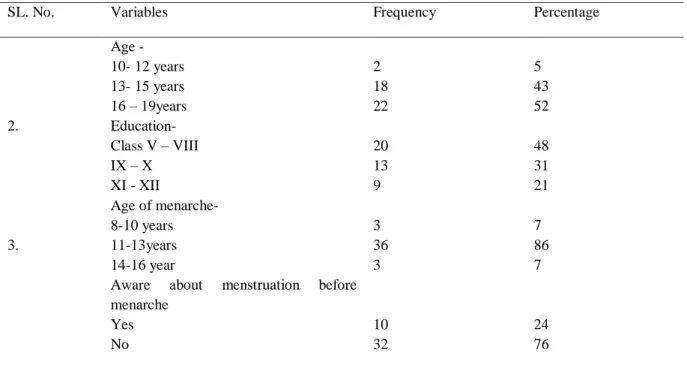
Table of Frequency percentage distribution of the visually challenged adolescent girls in terms of age, educational status of the participants, age of menarche, education level, aware about menstruation before menarche. N=42
Table of Frequency percentage distribution of the visually challenged adolescent girls in terms of
occupation of father and mother, residence, material used in menstruation N=42
Serial number
Variables Frequency Percentage
1. Father’s occupation-
Selfemployed Service Not applicable 32 8 2 76 19 5
2. Mother’s occupation
House wife Self-employed 30 8 71 19
SL. No. Variables Frequency Percentage
Age - 10- 12 years 13- 15 years 16 – 19years
2 18 22 20 13 9 3 36 3 10 32 5 43 52 48 31 21 7 86 7 24 76 2. 3. Education- Class V – VIII IX – X XI - XII
Age of menarche- 8-10 years 11-13years 14-16 year
Aware about menstruation before menarche
Saonli Jha IJSRE Volume 06 Issue 10 October 2018 Page 8033
Service Not applicable
1 3
3 7
3. Residence
Home Hostel
4 38
10 90 4. Material used during menstruation
Sanitary napkin Cloth
Sanitary napkin and cloth
8 7 27
19 17 64
Findings related to effectiveness of audio teaching program in terms of changed knowledge score from pretest and posttest.
N=42
Figure: Frequency polygon for comparison between participants pretest and posttest knowledge score. Figure 8the frequency polygon in figure shows the distribution of pretest and posttest knowledge score with depicted mean, median. The pretest knowledge score ranges from10 – 20 with mean 15.2 and median 15.5 and standard deviation 2.3. The posttest knowledge score ranges from 16 – 24 with the mean 20.14, median 20 and standard deviation 1.66.The standard deviation of posttest knowledge score of visually challenged adolescent girls (1.66) seemed to be less distributed than the pretest knowledge score indicating more homogeneity in the respondents compared to pretest knowledge score (2.3). Figure depicts that the mean pretest knowledge score lies to the right to the median, so distribution is positively skewed is 0.39showing the scores are normally distributed. The mean post test knowledge score lies to the left side of the median, so distribution is negatively skewed and skewness is -0.25 which is negligible indicating the scores are normally distributed. This indicates that there is considerable changes in knowledge score and suggests the effectiveness of planned audio teaching programme.
0 5 10 15 20 25 30
4.5 7.5 10.5 13.5 16.5 19.5 22.5 25.5 27.5
Fr
e
q
u
e
n
cy
Knowledge Score
Pretest
Saonli Jha IJSRE Volume 06 Issue 10 October 2018 Page 8034
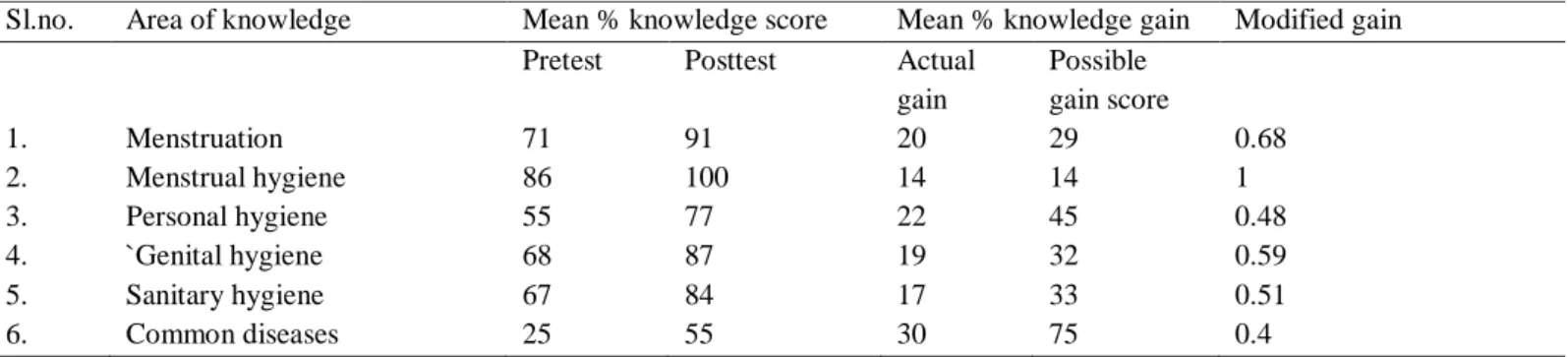
Table shows Area wise knowledge gain between pretest and posttest in visually challenged adolescent girls. N= 42
Actual gain = Posttest mean % – Pretest mean % Possible gain = 100 (Possible score) – Pretest mean % Modified gain = Actual gain / Possible gain
Table reveals that maximum mean knowledge gain 1 in the aspect of about menstrual hygiene and minimum 0.4 mean knowledge gain in the aspect of common infection due to improper maintenance of menstrual hygiene. This indicates that audio teaching program have increased knowledge among the participant
Table : Findings related to participants pretest and post test knowledge score on menstrual hygiene. N =42
df-t 41 = 2.02 p< 0
DISCUSSION Major findings
The study was conducted with 42 visually challenged adolescent school girls from Calcutta Blind School, Behala, Kolkata and voice of World, Kolkata.
Description of demographic characteristics-
52% of visually challenged girls belong to 16-19 years of age. 48% visually challenged girls are to class V-VIII.
86% girls had their menarche at the age of 11- 13 years of age. 76% did not aware about menstruation before menarche.
50% visually challenged adolescent girls first got information about menstruation and its care from their family member.
76% fathers of the participants are self –employed in occupation. 71% of the mothers of the participants are housewife.
90 % students are belonging to hostel.
64% students both use sanitary napkin and old cloth during menstruation.
50% disposed the cloth after use and 41% wash the cloth with soap and water and dry it under the shade. Only 41% store the used cloth in the corner place of the house.
83% of visually challenged girls disposed the sanitary napkin in routine waste and 17% disposed in sanitary latrine and open space.
45% clean the external genitalia with soap water and 42% clean the external genitalia with only water.
Sl.no. Area of knowledge Mean % knowledge score Mean % knowledge gain Modified gain
Pretest Posttest Actual
gain
Possible gain score
1. Menstruation 71 91 20 29 0.68
2. Menstrual hygiene 86 100 14 14 1
3. Personal hygiene 55 77 22 45 0.48
4. `Genital hygiene 68 87 19 32 0.59
5. Sanitary hygiene 67 84 17 33 0.51
6. Common diseases 25 55 30 75 0.4
Mean Mean difference Median SD df ‘t’
Pretest
Posttest
15.2
20.1
5
15.5
20
2.3
1.66
Saonli Jha IJSRE Volume 06 Issue 10 October 2018 Page 8035
64%, visually challenged girls clean the external genitalia after each micturation, 95% after defecation, and 76%after changing of pad.
55% alwayswash hands after each micturation, 95% always wash hands after changing of pad 86% never wash hands before touch the material of menstruation and 97% always wash hands after changing of pad.
Findings related to knowledge difference between pre test and post test.
In area wise knowledge gain the maximum mean knowledge gain in the aspect of about menstrual hygiene (1) and minimum (0.4) mean knowledge gain in the aspect of common infection due to improper maintenance of menstrual hygiene. This indicates that audio teaching program is effective in knowledge gain in the area of menstrual hygiene.
The pretest knowledge score ranges from10 – 20 with mean 15.2 and median 15.5 and standard deviation 2.3. The posttest knowledge score ranges from 16 – 24 with the mean 20.14, median 20 and standard deviation 1.66.
Mean posttest knowledge score ( 20.14) is higher than mean pretest knowledge score ( 15.2) At 0.050 level of significanceand ‘t’ value of pre test andpost test knowledge score is 13.15which indicates that the audio teaching programme is effective to enhance knowledge about menstrual hygiene.
Findings related to association between pre test knowledge score and selected variables.
There is no association between pre test knowledge score and selected variablesexcept wash hands after cleaning of external genitalia. So, there is significant association between pre-test knowledge score and wash hands after cleaning of external genitalia 0.05 level of significance.
CONCLUSION
On the basis of the findings of the present study the following conclusion can be drawn.
Knowledge on menstrual hygiene of visually challenged adolescent girl in selected blind school is not adequate as evident by administration of structured interview schedule.
Audio teaching programme is effective in enhancing the knowledge among visually challenged adolescent girls.
There is no association between pretest knowledge scores and demographic characteristics of visually challenged adolescent girls.
Implication
The findings of the study have implications to Nursing Education, Nursing Administration and Nursing Research.
Limitation
As the study is conducted at selected blind school, in South 24 Parganas, West Bengal, and sample size was small, the scope of generalizations of findings is limited. The study is conducted with non-probability purposive sampling technique which is also limit the scope of generalizations.
The study was only limited to visually challenged adolescent girl who are studying in blind school.
exposure to planned audio teaching programme. If it is conducted on later date it would be given more accurate information on retention of knowledge
Recommendation
On the basis of the findings the following recommendations can be offered for future research. A similar study can be done by using a large sample size.
A similar study can be done by using Braille teaching strategy.
A similar study can be done on the adolescent girl with developmental delay.
A comparative study can be conducted between normal and visually challenged girl.
Saonli Jha IJSRE Volume 06 Issue 10 October 2018 Page 8036
A similar study can be done on maintenance of personal hygiene among visually challenged adolescent girls.
REFERENCES
1. Unite for Sight, Inc. - Global eye health statistics. - Retrieved from www. Uniteforesight. Org. /eye.1/29/14.
2. Moshi, Kilimanjiro, Tanzania. Global Blindness - A Preventable Tragedy. Available at: URL:www.Sociometry.net.
3. Insight plus issue 5-towards The Right to Information: Addressing the reproductive health needs of visually impaired adolescent girls. Available at: www.sightsavers.org.
4. Effectiveness of an audio teaching programme on reproductive health among visually challenged women in selected institution at Agulvizhli, Madurai. 2013 August; 20: Available from: http//www.ukessay.com/ essay/health/ reproductive. health. among-visually challenged women-health.
5. Dhingra R, Kumar A, Kour M. Knowledge and practices related to menstruation among Tribal (Gujjar) adolescent girls: ethno-med 2009; 3(1):[43-48] . Available from: htt://www.krepublishers.com/02-journals/s-EM.
6. Christopher ST. Adolescent health medicine. Children’s health information. Available from: http://www.stchristophershospital.com/children-health-in formation/adolescent-medicine.Nov2 2011. Bibliography:
1. Basavanthappa.B.T.‘Textbook Of Midwifery And Reproductive Health Nursing’.New Delhi: Jaypee Brothers Medical Publishers (p) ltd.;
2. Dawn C.S. Textbook of Obstetretrics And Neonatology. Revised fourth edition. Calcutta: Gipidi Box Co.; 2000.
3. Dutta.D.C. ‘Textbook Of Obstetrics Including Perinatology and Contraception’. 6th Edition. Kolkata: New central Book Agency (p) ltd; 2004.
4. Dutta.D.C. ‘Textbook Of Gynaecology Including Contraception’. 5th Edition. Kolkata: New central Book Agency (p) ltd; 2004.
5. Jacob.A. ‘A Comprehensive Textbok Of Midwifery And Gynaecological Nursing’.3rd Edition. New Delhi: Jaypee Brothers Medical Publishers (p) ltd.2009.
6. Lewis L. Sharon. ‘Medical Surgical Nursing’. 7th edition. New Delhi: Elsevier;
7. Marlow D R. Textbook of pediatric Nursing. 6th Ed. New Delhi: Elsevier; 2001. P.163, 166.
8. Mitra Samarendra. Anatomy.Volume -1.6th Edition. Kolkata: Bimal Kumar Dher of academic publishers; (2001).
9. . Polit F. Denise, Nursing Research: Generating and assessing Evidence for Nursing Practice, 8th edition. Lippincott, New Delhi, P 757.