www.ijemst.com
The IMPPACT Project: A Model for
Studying How Preservice Program
Experiences Influence Science Teachers’
Beliefs and Practices
John W. Tillotson, Monica J. Young Syracuse University
To cite this article:
Tillotson, J.W. & Young, M.J. (2013). The IMPPACT project: A model for studying how
preservice program experiences influence science teachers’ beliefs and practices.
International Journal of Education in Mathematics, Science and Technology, 1
(3), 148-161.
This article may be used for research, teaching, and private study purposes.
Any substantial or systematic reproduction, redistribution, reselling, loan, sub-licensing,
systematic supply, or distribution in any form to anyone is expressly forbidden.
Authors alone are responsible for the contents of their articles. The journal owns the
copyright of the articles.
Volume 1, Number 3, July 2013, 148-161
ISSN: 2147-611X
The IMPPACT Project: A Model for Studying How Preservice Program
Experiences Influence Science Teachers’ Beliefs and Practices
John W. Tillotson*, Monica J. Young Syracuse University
Abstract
If the true efficacy of preservice programs in the overall development of science teachers is to be accurately assessed, researchers and practitioners must work toward establishing a solid research base that critically examines the linkages between teacher preparation, classroom instruction, and pupil learning, to act as a lens to guide practice and feed information back into existing teacher education programs to improve their quality. The U.S. NSF-funded IMPPACT Project represents a multi-university, collaborative research study that was developed in response to the need for empirical evidence regarding the efficacy of science teacher preparation programs. The purposes of this longitudinal, mixed methods study were to: 1) better understand secondary science teachers’ learning of content and pedagogy over time as a result of key interventions within these preparation programs; 2) assess the subsequent impact of this learning on their classroom teaching and student achievement; and 3) determine what factors significantly influenced these teachers’ beliefs and classroom practices following graduation. Interdisciplinary research teams at each university were responsible for collection and analysis of data, while a panel of experts provided the research team with technical assistance. Key research findings and their implications for preservice teacher education programs are highlighted.
Key words: Science Teacher Preparation Programs, Teacher Beliefs and Practices, Longitudinal Research, Mixed-Methods Research
Introduction
At the heart of the debate over how to reform the K-12 education system in the United States is the issue of teacher quality. Teachers are perceived by many to play the most crucial role in the overall reform effort, yet educators and policymakers have failed to reach common ground when making recommendations for the preparation of new teachers. According to Tobias (2010), the failure of teacher educators to design and implement systematic feedback mechanisms that “close the loop” on our understanding of the effectiveness of preservice teacher education programs in preparing highly-qualified teachers has left the field vulnerable to widespread criticism. In fact, many education reformers and policymakers in the United States contend that preservice teacher education programs should be abolished altogether. If the true efficacy of traditional teacher education programs in the development of science teachers is to ever be accurately determined, researchers and practitioners must work toward establishing a solid research base that critically examines the linkages between teacher preparation, classroom instruction, and pupil learning. A better understanding of these connections among teaching, learning, and the K-12 school environment could act as a powerful lens to guide practice and feed information back into existing teacher education programs to improve their overall quality (Schalock, 2004; Tobias, 2010).
In response to the rising controversy over the perceived effectiveness of teacher education programs, the U.S. Department of Education charged the National Research Council (NRC) to conduct a study of science, mathematics and reading teacher preparation in the United States to address four overarching questions:
1. What are the characteristics of the candidates who enter teacher preparation programs?
2. What sorts of instruction and experiences do teacher candidates receive in preparation programs of various types?
3. To what extent are required instruction and experiences consistent with converging scientific evidence?
*
4. What model for data collection would provide valid and reliable information about the content knowledge, pedagogical competence, and effectiveness of graduates from various kinds of teacher preparation programs? (NRC, 2010, p.1)
The NRC (2010) report concluded that in spite of the long history of teacher preparation programs in the United States, much of the research fails to examine the relationships between key learning experiences within teacher education programs and the influence they have on the beliefs and practices of beginning science teachers (Clift & Brady, 2005; Sleeter, 2001; Wilson, Floden, & Ferrini-Mundy, 2001). Other researchers have cited the specific need for more longitudinal, comprehensive studies of science teacher preparation programs from a nationally representative sample of universities that investigate: 1) how specific features and elements of preservice programs impact science teacher beliefs and practices (Luft, 2007); 2) what teachers learn about content and pedagogy and how this learning ultimately plays out in schools (Cochran-Smith & Zeichner, 2005); and 3) how beginning science teachers learn about schools, communities, and norms regarding state and national education standards (Davis, Petish, & Smithey, 2006). The overall lack of research in this arena suggests that many current science teacher education programs are not empirically grounded and more investigation is needed to understand the role preservice programs play in shaping science teacher development throughout each stage of their professional career (Adams & Tillotson, 1995; Craven & Penick, 2001; Luft, Roehrig, & Patterson, 2003; Schalock, 2004; Zeichner, 2005).
The IMPPACT Project
Recognizing the pressing need for a study of science teacher education programs, a team of science educators representing three geographically diverse universities in the United States came together in 2005 to develop a research project that would specifically respond to the need for more empirical evidence regarding the efficacy of science teacher education programs. Building on the strong foundation established as a result of the Salish Research Projects (Salish I Research Project, 1997; Robinson, & Yager, 1998; Simmons, et al, 1999), the IMPPACT Project (Investigating the Meaningfulness of Preservice Programs Across the Continuum of Teaching in Science Education) was funded through a $2.48 million grant from the U.S. National Science Foundation to collect extensive teacher, pupil, and teacher education program data over a three-year period from 2006-2009. IMPPACT research teams gathered data from approximately 150 teacher graduates of these three secondary science teacher education programs who were teaching in 7-12 grade science classrooms all across the United States. The purpose of our research investigation was: 1) to better understand secondary science teachers’ learning of content and pedagogy over time as a result of key interventions within these three preservice science teacher preparation programs; 2) to assess the subsequent impact of this learning on their classroom teaching; and 3) to determine what factors significantly influenced these secondary science teachers’ beliefs and classroom practices following graduation from our preservice programs. Specifically, our study targeted the longitudinal impact of preservice science teacher education program learning experiences on secondary science teachers and their students (grades 7-12) across four critical stages of a teacher’s career continuum.
Our IMPPACT researchers have been examining how formal and informal learning experiences in science teacher education—in both pedagogy courses and science content courses— have affected science teachers’ knowledge, beliefs and classroom practices, as well as the student learning outcomes for pupils in their 7-12 grade science courses. As part of our investigation, we have paid careful attention to the developmental process that occurs during the preservice, induction, and post-induction years related to teacher behaviors and beliefs, as well as how skills, beliefs, and knowledge are interconnected. We have further examined how the enculturation process for beginning science teachers within U.S. secondary schools influences their beliefs and actions over time as they make the difficult transition from the controlled environment of a preservice program to the often unpredictable environment of today’s diverse classrooms.
science teacher educators, scientists and doctoral research associates at each participating university were responsible for collecting and analyzing a broad spectrum of data from teachers, 7-12 grade pupils, and teacher education program faculty in both the sciences and education courses. In addition, a Panel of Experts comprised of nationally renowned scholars, researchers, classroom teachers, and school administrators with expertise in teacher education, professional development, large-scale qualitative and quantitative research design, cognitive sciences, and the natural sciences provided us with technical assistance.
The three preservice programs selected for inclusion in the IMPPACT study universities were chosen as research sites for a number of important reasons. First, the project investigators chose to focus on large, doctoral-granting institutions that were similar in size, characteristics, and preservice program features, yet located in different geographic regions of the U.S. In doing so, the researchers were able to investigate how these program interventions impact science teacher development in the broadest range of secondary school settings possible. The range of preservice program features included both undergraduate and graduate certification degree programs, varying amounts of science content coursework, varying numbers of science methods courses, variable field placements at multiple grade levels in socio-economically and culturally diverse schools, specialized courses in technology, assessment, and/or science-technology-society applications, and differing levels of emphasis on the nature of science within each program. The rich array of program features across these three institutions allowed for strategic within- and cross-site comparisons to be made related to each of our primary research questions.
The IMPPACT Project researchers used the following broad research questions to focus our investigation: 1. How do specific interventions within preservice science teacher preparation programs (e.g. multiple
science methods courses, diverse field placements, nature of science coursework, science research experiences, advanced science content coursework, specialized applications courses, the creation of a research-based rationale for teaching, and the systematic and extensive use of appropriate technology to enhance learning) impact the development of secondary science teachers’ content and pedagogical knowledge?
2. What impact do these specific interventions have on secondary science teachers’ beliefs about effective instruction as they progress through the stages of the teacher professional continuum?
3. To what extent do secondary science teachers demonstrate classroom practices that are consistent with their beliefs about effective instruction as they advance through the preservice preparation program and into full-time teaching?
4. How closely do the knowledge, beliefs and practices of secondary science teacher graduates of these preservice programs correlate with the science achievement gains of their 7-12 grade students?
5. What changes occur in secondary science teachers’ beliefs and practices when they are confronted with external factors (e.g. standardized testing, state-mandated curricula, school culture) during the early stages of their careers, and how do these factors influence ongoing professional development needs and retention rates?
Theoretical Framework
induction period (first 1-3 years of teaching) where the influence of preservice program experiences are often confounded by a number of contextual factors (Simmons, et al, 1999; Salish I Research Project, 1997). The literature on the role that science teachers’ beliefs play in shaping knowledge, understandings and practices within a science classroom setting also directly informed the IMPPACT Project efforts. Several studies have shown the strong influence of teachers’ beliefs on classroom practices and the overall teacher change process (Forbes & Davis, 2010; Jones & Carter, 2007; Nespor, 1987; Pajares, 1992; Richardson, 1996; Roehrig, et al, 2007). Richardson (1996) argues that teachers’ beliefs are an important consideration in understanding teacher behaviors, as well as designing robust teacher education programs that assist teachers in refining their thinking and practices. A large number of studies show that the beliefs of preservice and inservice teachers strongly affect both what and how they learn to teach (Adams & Krockover, 1997; Haney, Czerniak, & Lumpe, 1996; Hashweh, 1996; Lortie, 1975; Luft, 2009; Richardson, 1994; Richardson, 1996; Roehrig & Luft, 2003; Wilson, Floden, & Ferrini-Mundy, 2002).
To further guide our work on the IMPPACT study, we operationalized reform-based science teaching and learning according to the central themes of the National Science Education Standards documents (NRC, 1996 & 2000) which promote inquiry-based science teaching and reflect a constructivist orientation to how students learn science. In particular, the NRC (1996, p. 52) standards call for science teachers to place greater emphasis on:
Understanding and responding to individual student’s interests, strengths, experiences, and needs;
Selecting and adapting curriculum;
Focusing on student understanding and use of scientific knowledge, ideas, and inquiry processes;
Guiding students in active and extended scientific inquiries;
Providing opportunities for scientific discussion and debate among students;
Continuously assessing student understanding (and involving students in the process);
Sharing responsibility for learning with students;
Supporting a classroom community with cooperation, shared responsibility, and respect; and
Working with others to enhance the science program.
The standards for the professional development of science teachers are also explicitly defined by the National Science Education Standards. Preservice and inservice teacher education programs are expected to provide professional development experiences for science teachers that include: 1) learning essential science content through the perspective and methods of inquiry; 2) integrating knowledge of science, learning, pedagogy and students and applying that knowledge to teaching; 3) building understanding and the ability for lifelong learning; and 4) coherence and integration of program components (NRC, 1996). Thus, meaningful science teacher preparation programs should be carried out based on what teachers need to know, care about, and be able to do to promote meaningful learning for all students (Nemser, 2001). We opted to use Feiman-Nemser’s (2001) central tasks of learning to teach as a guiding framework for examining preservice science teachers’ evolving beliefs and practices during the IMPPACT study (See Table 1). This framework enabled us to categorize our findings within various cells contained in the matrix which proved to be helpful in managing the vast array of data gathered over the course of the IMPPACT study.
Table 1. Central tasks of learning to teach
Preservice Induction Continuing Professional
Development
1.Examine beliefs critically in relation to vision of good teaching
1.Learn the context – students, curriculum, school community
1.Extend and deepen subject matter knowledge for teaching 2.Develop subject matter knowledge
for teaching
2.Design responsive instructional program
2.Extend and refine repertoire in curriculum, instruction, and assessment
3.Develop an understanding of learners, learning, and issues of diversity
3.Create a classroom learning community
3.Strengthen skills and
dispositions to study and improve teaching
4.Develop a beginning repertoire 4.Enact a beginning repertoire 4.Expand responsibilities and develop leadership skills 5.Develop the tools and dispositions
to study teaching
Research Design
In order to empirically investigate each of the research questions posed in the IMPPACT study, we chose to utilize a concurrent, mixed methods design (Creswell, 2003). The rationale for this type of design was that it allowed us to better understand the overall impact of these preservice programs by triangulating both broad numeric trends from the quantitative data with the rich, in-depth detail provided by the qualitative component of the study. The quantitative measures in this project provided information concerning patterns and trends in the pools of data, while the qualitative measures allowed for a careful and detailed analysis of individual teacher, student, and program outcomes. Multiple, repeated surveys, in-depth interviews, classroom and field observations, artifact collection, and samples of both teacher and student work provided the bulk of the research data we needed to systematically and thoroughly answer our research questions.
The project investigators used a combination of random and purposeful sampling techniques to select cohorts of preservice and inservice science teachers at each university that represented the key stages of the teacher career continuum. The overall sample consisted of approximately ten randomly selected teachers in each experience cohort at each research site (40 teachers per university x 3 universities= 120 total science teachers in the overall study; however we purposely oversampled and had nearly 150 participants complete the study). The specific stages of the career continuum included: 1) entry into science teacher education; 2) the candidacy stage of science teacher education programs (including the associated field experiences); 3) the early induction years as a new science teacher (years 1-4); and 4) the post-induction stage of teaching (years 5+). From this large sample, a smaller sub-sample consisting of teachers at each University were purposefully chosen in each experience level cohort to be in-depth participants who were then targeted for additional data collection throughout the duration of the study. IMPPACT Project researchers also gathered information on preservice program learning experiences (in both content and pedagogy courses) and the influence they had on science teacher development. A collection of quantitative and qualitative instruments was used to gather data from all of the various stakeholders in the IMPPACT study. This study reports on the results gleaned from the specific instruments discussed in the following sections. A more detailed list of instruments can be found on the IMPPACT Project website at http://imppact.syr.edu.
National Survey of Teacher Education Program Graduates (NSTEPG) (Loadman, et al, 1999)—The NSTEPG survey queried the respondents about their teaching position (if they were currently teaching), their views of teaching, their career satisfaction and professional development, and asked them to rate the overall quality of their preservice program experiences. Specific items related to each of the key preservice program interventions at each research site were added to the survey instrument.
Reflections on Preservice Program Experiences (RoPPE) Interview (Tillotson, Penick, & Yager, 2007)—This interview protocol asked participants’ to describe how experiences within their science teacher preparation program influenced their beliefs and practices. It was developed as an exit-interview to gain perspective on specific program features, as well as informal learning experiences that were influential in shaping their instruction. The questions focused on four areas: teacher education /science education experiences; field experiences/student teaching; school contextual factors; and general reflections on teaching.
Beliefs-Nature of Science Interview (BNOS)—Based on the comprehensive Teachers’ Pedagogical
Philosophy Interview (TPPI) (Richardson & Simmons, 1994), this interview protocol asked participants to describe their evolving beliefs about effective science instruction, their philosophy on learning and how students learn science, and their views on the nature of science. The interview consisted of seventeen questions, eight of which deal with beliefs and are used in the current analysis. The interview was rated using an Interview Map (Luft et al., 2003) rubric using a five-point scale ranging from “Teacher-focused” to “Student-focused.”
Reformed Teaching Observational Protocol (RTOP) (Sawada, et al, 2002) — The RTOP instrument consists of 25 items split evenly among five sections: lesson design & implementation; propositional content knowledge; procedural content knowledge; communicative interactions; and student/teacher relationships. The rubric uses a five-point scale where a rating of “0” means the action never occurred and “4” means it is very descriptive of the classroom. The items on the RTOP instrument are all designed to reflect the reformed teaching practices identified in the National Science Education Standards (National Research Council, 1996, 2000).
on science. The SWEPT survey includes items that fall in four categories: past experiences with science, both in and out of school; attitudes about science; views about career opportunities in science; and, educational levels and professions of parents/guardians.
Findings from the IMPPACT Study
For the purposes of this study, findings related to the first four research questions noted above are presented and they are discussed using data from five of the instruments that were used during the IMPPACT Project. These findings are clustered around preservice teacher education program outcomes, science teacher outcomes, and pupil outcomes.
A. Preservice Teacher Education Program Outcomes
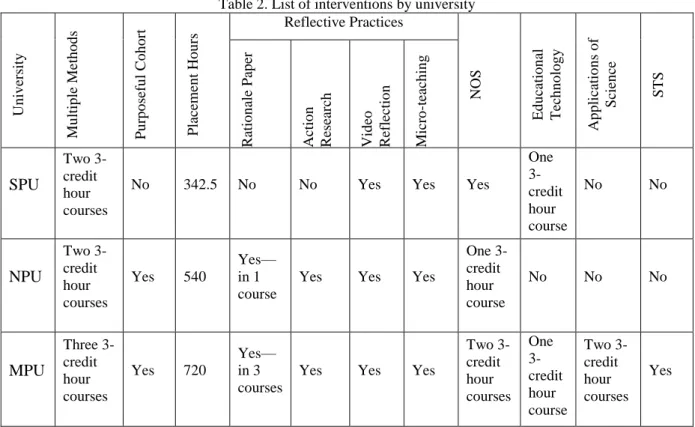
The three university-based preservice teacher education programs selected for the IMPPACT study each contained a number of unique features, as well as several common features, that made them ideal for this investigation of the influence of various program interventions on science teachers’ evolving beliefs and practices. Each university has been assigned a pseudonym based on their geographic location within the United States (Northeast Private University (NPU), Midwest Public University (MPU), and Southeast Public University (SPU). Table 2 provides an overview of the key features contained in each of these three preservice science teacher preparation programs.
Table 2. List of interventions by university
Un iv er sity Mu ltip le Me th o d s Pu rp o sef u l Co h o rt Placem en t H o u rs Reflective Practices NOS E d u ca tio n al T ec h n o lo g y Ap p licatio n s o f Scien ce STS R atio n ale Pap er Actio n R esear ch Vid eo R ef lectio n Mic ro -teac h in g
SPU
Two 3-credit hour coursesNo 342.5 No No Yes Yes Yes
One 3-credit hour course
No No
NPU
Two 3-credit hour courses
Yes 540
Yes— in 1 course
Yes Yes Yes
One 3-credit hour course
No No No
MPU
Three 3-credit hour courses
Yes 720
Yes— in 3 courses
Yes Yes Yes
Two 3-credit hour courses One 3-credit hour course Two 3-credit hour courses Yes
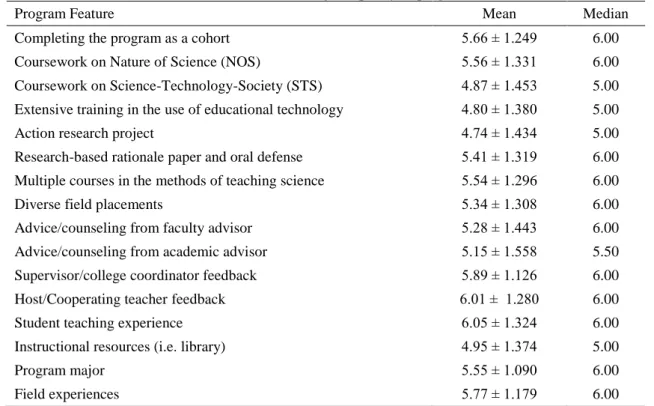
Table 3. Mean and median ratings of quality of program features
Program Feature Mean Median
Completing the program as a cohort 5.66 ± 1.249 6.00
Coursework on Nature of Science (NOS) 5.56 ± 1.331 6.00
Coursework on Science-Technology-Society (STS) 4.87 ± 1.453 5.00
Extensive training in the use of educational technology 4.80 ± 1.380 5.00
Action research project 4.74 ± 1.434 5.00
Research-based rationale paper and oral defense 5.41 ± 1.319 6.00 Multiple courses in the methods of teaching science 5.54 ± 1.296 6.00
Diverse field placements 5.34 ± 1.308 6.00
Advice/counseling from faculty advisor 5.28 ± 1.443 6.00
Advice/counseling from academic advisor 5.15 ± 1.558 5.50
Supervisor/college coordinator feedback 5.89 ± 1.126 6.00
Host/Cooperating teacher feedback 6.01 ± 1.280 6.00
Student teaching experience 6.05 ± 1.324 6.00
Instructional resources (i.e. library) 4.95 ± 1.374 5.00
Program major 5.55 ± 1.090 6.00
Field experiences 5.77 ± 1.179 6.00
The IMPPACT teacher participants rated each of the sixteen program features on the NSTEPG survey as being greater than “4” indicating they felt that all of these interventions were of high quality.
When asked to rate the overall quality of their preservice science teacher education program, 58.5% of the teacher respondents rated the quality as “above average” and 21.1% rated their program quality as “exceptional.”
The teacher respondents were asked to report whether they would enroll in a preservice teacher education program to obtain certification if they had to do it over again, and the vast majority of respondents (89.7%) reported that they would indeed do so indicating that the preservice program experience was valuable to them in their overall professional training.
When asked to consider their knowledge, skills, and abilities as a science teacher as a result of their preservice preparation, 93.4% of the teacher participants said they would recommend their preservice teacher education program to others.
1
2
3
4
5
6
7
Field-based ExperiencesProgram Major Instructional Resources Student Teaching ExperienceHost Teacher Feedback Supervisor Feedback Advice From Academic AdvisorAdvice From Faculty Advisor Diverse Field Placements Multiple Courses in Methods of TeachingResearch-Based Rationale & Defense Action Research Project Extensive Training in Use of Ed. Technology Coursework on STS Coursework on NOS Completing Program As A Cohort
In the final year of the IMPPACT Project, all participants were offered an opportunity to be interviewed using the RoPPE protocol (Tillotson, Penick, & Yager, 2007). Seventy-two participants agreed to be interviewed and an analysis of twenty-nine of those interviews is reported on in this paper. Seven of the respondents were from Southeast Public University, twelve were from Northeast Private University, and ten were from the Midwest Public University. The IMPPACT teacher participants were interviewed about the key interventions within their preservice program and how they perceived those experiences influencing their beliefs and teaching practices. Our data suggest:
At all three universities, the IMPPACT teachers consistently reported that their undergraduate and graduate science content courses provided poor instructional models of reform-based science teaching and learning that were of little value in preparing them as science teachers beyond simply disseminating factual knowledge about the biology, chemistry, physics, and earth science concepts contained in their science textbooks.
The duration of preservice programs, the number of science methods courses, and completing the program as a member of a cohort were all interventions that had a profound impact on the science teacher graduates of these three programs in terms of their pedagogical beliefs and instructional practices.
Science teacher graduates of programs that featured three sequential science methods courses taken during a two-year preservice program were more likely to hold reform-based beliefs about science teaching and learning than graduates of preservice programs that were shorter in duration and had fewer science methods courses.
Science teacher graduates of preservice programs requiring two years of study and featuring multiple, sequential science methods courses were more likely to identify the specific learning progressions associated with each science methods course in helping them design and implement inquiry-based science lessons.
In contrast, science teacher graduates of preservice programs that were shorter in duration and had fewer science methods courses often held more teacher-centered pedagogical beliefs and indicated that their methods course experiences taught them “how to” strategies for organizing instruction with little attention paid to how these strategies connected to student learning outcomes.
Nearly all of the science teacher participants who completed their preservice program as a member of a cohort noted that this cohort experience had a positive influence on the development of their beliefs and classroom practices and that they would have liked an even greater emphasis to have been placed on this facet of their preservice program. It is important to note that the cohort experience varied significantly across the three programs with regard to the intentionality of the cohort formation and how members of each cohort interacted with one another during and after their preservice program.
In preservice programs where the formation of the preservice teacher cohort was merely incidental, participants discussed how they received “comfort” from one another as they progressed through the program experiences, yet they rarely described the cohort experience as having any direct influence of their teacher beliefs or classroom practices.
In the preservice programs where the formation of preservice science teacher cohorts was intentional and spanned multiple semesters, the IMPPACT participants were more likely to describe how these shared experiences influenced their beliefs and actions in the classroom because of the diversity of perspectives and classroom situations experienced by members of the group over time.
Preservice teachers who were members of a peer cohort for two full years during their teacher education program were far more likely to continue utilizing members of their peer cohort for professional advice, even following graduation, than graduates of the other programs.
In comparing these three preservice programs there was considerable variability in the overall number and diversity of field placements, the total number of classroom hours associated with each field placement experience, and the grade levels to which preservice science teachers were assigned in the field placements.
While preservice teachers from all three programs indicated that the field experiences were influential in shaping their beliefs about the “practical” aspects of teaching science, those teachers who graduated from programs that featured multiple, diverse field placements in classrooms ranging from elementary through secondary grades were more likely to indicate a readiness to teach on their own, had a greater awareness of the diversity of students, and had more recognition of how their instructional practices impacted student learning outcomes.
science instruction than graduates of programs where there was a disconnect between the goals of the preservice program and the beliefs held by cooperating field placement teachers.
Science teachers who graduated from preservice programs that featured dedicated coursework and explicit instruction in the nature of science, the applications of science, and Science-Technology-Society (STS) were more likely to hold pedagogical beliefs and describe classroom practices that incorporated the nature of science than participants who graduated from preservice programs where these types of preservice interventions did not occur.
All three preservice programs contained a number of key interventions designed to promote reflective thinking practices in beginning science teachers. While the teacher participants from all three sites described their beliefs about the importance of engaging in reflective practices, few acknowledged making it a central part of their daily instructional practices and these practices were often viewed as “extra things” that if done at all, were typically done in an informal manner.
When asked about the overall influence of their preservice program experiences, the IMPPACT participants described this influence on their teaching practices in one of two ways, either “piecemeal” or “integrated.”
IMPPACT teachers who graduated from preservice programs that were shorter in duration, had fewer science methods courses, and had fewer field placement experiences generally described their classroom practices in a “piecemeal” fashion. They typically viewed research-based teaching strategies as “idealized” and “too theoretical” for beginning science teachers who are often operating in “survival mode” in the first few years in the classroom.
IMPPACT teachers who graduated from preservice programs that featured multiple, sequential science methods courses, who participated in numerous diverse field placements, and who received explicit coursework in the nature of science, applications of science, and S-T-S, generally described their classroom practices in a more “integrated” fashion. They typically viewed research-based teaching strategies as part of effective teaching, considered inquiry and the nature of science to be the foundation for all science teaching and learning activities, and were more likely to describe the actions of students, as opposed to only the teacher, in the overall education process.
B. Science Teacher Outcomes
Much of our IMPPACT analysis related to teacher outcomes has explored the beliefs of secondary science teachers who ranged in experience level from preservice to five or more years of teaching. Twenty-six in-depth teachers from our study met these criteria - nine from the MPU, nine from NPU, and eight from SPU. These in-depth teachers completed the Beliefs/Nature of Science (BNOS) interview for all three years of our study. The beliefs portion of the transcribed interviews were rated using an Interview Map (Luft, et al, 2003) by multiple raters on a 5-point scale ranging from “teacher-focused” to “student-focused” where 1 = Traditional; 2 = Instructive; 3 = Transitional; 4 = Responsive; and 5 = Reform-based. The average beliefs scores from the BNOS instrument across all three years of the study were used for each participant. Belief profiles were created for all in-depth participants for each year of the study and analyzed for trends over time (Luft & Roehrig 2007). The following trends emerged:
A majority of the teachers held instructive beliefs; the second largest group held transitional beliefs. Over the three years of our study, the overall percentage of teachers who held instructive beliefs increased, while those holding transitional beliefs decreased indicating a general trend toward more teacher-centered beliefs and practices when looking at the IMPPACT participants as a whole over time.
Teachers who held an instructive vision of good teaching focused on providing experiences for students and tended to maintain a focus on what the teacher did and teacher decisions (Luft & Roehrig, 2007). When asked to describe their role as a teacher, though many of the IMPPACT teachers use terms such as “guide,” “facilitator,” or “reference person,” their main focus still revolved around what the teacher does and how the teacher disseminates information to the students. The instructive vision held by these teachers included viewing the students as having a deficit with regards to learning and teachers control the classroom to fill this deficit. All of these teachers also made mention of the importance of a classroom environment that was “positive and nurturing” and “fun,” but did not mention how the environment could impact or aid in student learning.
of these visions for the classroom environment was creating a space in which students are more at ease and eager to learn. These teachers frequently mentioned they believed that all students learn differently and can learn on their own, but also discussed the need for directly instructing students to address what the teacher felt was most important.
The teachers who were coded as having a responsive/reform-minded view of good teaching represented the minority. For these teachers there was more of a focus on collaboration, feedback, or knowledge development as well as a focus on mediating student knowledge (Luft & Roehrig, 2007). There was a distinct difference in their view of the need for students to be actively involved in their own learning. The role of the teacher came across very differently as these teachers talked about the planning and preparedness necessary to allow students to be engaged in their understanding of science. This involved the teacher focusing less on controlling what to “give” students and more on planning or experiencing learning with the students.
The intersection of teachers’ expressed beliefs about their visions of good teaching and the description of the enactment of that vision were not always aligned.
Several of the IMPPACT teachers expressed student-centered beliefs about good teaching consistent with the national reform agenda, yet their descriptions of how they enact this type of vision were very teacher-centered in nature.
Moving from preservice to inservice teaching lead to a restructuring of the participants’ vision of good teaching. As teachers gained more experience in the classroom their visions about the structure of the classroom, the role of the teacher, and the role of the student were either modified or rationalized to account for the instructional decisions made by that teacher.
The extent to which teacher education programs influence visions of good teaching varied among the graduates of the three teacher education programs. Comparing the beliefs of good teaching across the three universities revealed notable differences between the teachers from the three preparation programs. Of the teacher participants selected for this study, SPU graduates typically held the most teacher-centered beliefs, followed by NPU graduates with less teacher-centered beliefs and some student-centered beliefs, and lastly MPU graduates who held mostly student-centered beliefs which suggests the combination of program features and field experiences with the MPU program were more effective in preparing reform-based science teachers overall.
C. Secondary Student Outcomes
As part of the IMPPACT study, data were collected from secondary students in classrooms of many of our participating teachers during the 2008-2009 academic year. In this paper, we will focus on data gathered using the SWEPT student attitudes survey (www.sweptstudy.org) to explore how gender, parental attitudes toward school, and student grades influenced attitudes toward “being good at science.” In addition, our team investigated the relationship between the instruction experienced by secondary students as measured by the Reformed Teaching Observation Protocol (RTOP) (Sawada, et al, 2002) and their attitudes toward science. The SWEPT survey results were based on responses from 1,685 grade 7-12 students for whom we had previously gathered videotapes of lessons taught by their IMPPACT Project science teacher. Our analysis indicated the following patterns:
There was a statistically significant, negative relationship between gender and student attitude score (t= -6.459, p<0.001) indicating that male participants were more likely to have a higher attitude score than female students and reported greater confidence that they are good at science.
There was a significant positive relationship between students’ perceptions of their parents attitudes toward science class and student attitude score (t= 10.5, p<0.001), however, the relationship between students’ perceptions of their parents’ attitudes toward school and student attitude was not significant.
When gender is controlled for, students who report that their parents are more supportive also report more positive attitudes toward being good at science.
When gender and student perception of parents’ attitudes are held constant, there is a significant relationship between students’ self-reported grades and their attitude toward being good at science (F=81.25, p< 0.001).
Implications
While this article only provides a glimpse of what was learned from the overall IMPPACT study, there are several important implications that can be drawn about the role of preservice science teacher preparation programs in the education reform process. The National Research Council (NRC, 2010) report Preparing Teachers: Building Evidence for Sound Policy suggests there are two competing premises about how to improve teacher quality and preparation. The first premise suggests all that is necessary for effective teaching is for one to be well-educated in their particular content area and that teacher preparation programs are of little value. The alternative premise is that teachers require coherent and comprehensive preparation experiences that are focused on the teaching and learning process. In the case of the former, advocates are calling for policymakers to minimize the requirements necessary to obtain teacher certification while in the latter case, the implication is that policies should be enacted to require even more stringent requirements to obtain teacher licensure.
The results of our three-year IMPPACT investigation suggest that a university-based science teacher education program does matter in the preparation of high-quality, reform-based science teachers. More specifically, the overall coherence, duration, and type of learning interventions within preservice preparation programs can have a profound influence on the extent to which science teacher education graduates develop reform-based teaching beliefs and practices. In examining our findings, several key indicators are worth noting. When examining the visions of good teaching articulated by preservice teachers, we determined teachers’ beliefs to be consistent within preservice programs rather than between these programs. The ideas expressed in the teachers’ visions of good teaching consistently sorted the teachers into three main groups which ended up reflecting the teacher preparation program from which they graduated. Thus, the set of interventions within each program influenced the preservice science teachers in different ways and resulted in graduates who had varying skill levels and beliefs systems with regard to reform-based science teaching and learning described in the National Science Education Standards (NRC, 1996, 2000). Based on our findings and the notable differences between the teacher graduates of these preparation programs, we suggest that both the structure of experiences and the very nature of those experiences within the teacher preparation program can influence the types of beliefs and visions of effective teaching that secondary science teachers develop. Programs structured in a manner that creates strong coherence between program interventions and coursework, and that integrate reflective practices throughout the entire preservice experience, can best serve preservice teachers in their efforts to connect theory to practice and to integrate this knowledge into their classroom practice (Darling-Hammond, 2006). Programs that contain purposeful interventions such as: 1) a developmental sequence of multiple science methods courses integrated with multi-grade level field placements; 2) extensive field experiences across diverse settings in classrooms where the cooperating host teachers promote the instructional practices modeled within the preservice program; and 3) numerous interventions designed to foster reflective thinking such as writing theory-based rationales for teaching with an associated oral defense appear to be most promising. Teacher preparation programs structured with these experiences may provide the coherence and opportunity for reflection necessary to enable teachers to develop beliefs and understandings of teaching aligned with reform-based science education.
Similarly, preservice science teacher education programs must take an active role in establishing learning cohorts that provide preservice teachers with a purposeful and supportive group of peers with whom to collaborate throughout the duration of the program. Our data suggest these informal peer networks provide both emotional support as well as the opportunity for group collaboration, debate, and peer learning. The cohort experience can also be instrumental in establishing a professional culture of reflective practice where developing teachers learn the value of engaging in an ongoing discourse about the effectiveness of various teaching and learning approaches in a range of classroom contexts.
Given the trend in our data that suggests some preservice teachers regress toward more teacher-centered practices once they begin full-time teaching, there is a pressing need for university preservice programs and K-12 schools to form lasting partnerships to better facilitate the transition into the teaching profession. Joint mentoring programs involving both inservice teachers and university science teacher educators would provide a more supportive network to assist novice teachers in establishing their instructional agenda. Previous research has shown that school culture and the classroom context can be particularly challenging for new science teachers to navigate during the first few years in the profession after leaving the mentored environment of their preservice program which often results in them reverting to more traditional, didactic instructional methods as they struggle to manage all of the responsibilities associated with being an inservice teacher.
learning experiences that built sequentially upon one another. Programs that emphasized the nature of science, and the application of science to everyday problems in society, and that connected on-campus learning experienced with a series of field placements in elementary, middle and secondary grade levels produced more reflective teachers whose teaching was more likely to emulate the types of teaching behaviors advocated for in the National Science Education Standards (NRC, 1996, 2000). With that said, one area of weakness that must be addressed is the poor modeling of reform-based science teaching offered by the science content faculty in each of the three preservice programs we studied. Given the difficulties associated with making sweeping changes in the reform of undergraduate science teaching, perhaps preservice science teacher education programs would be wise to develop their own science content courses that stress the application of science concepts through inquiry-based teaching and learning activities where the instructors actively model research-based science teaching and learning strategies for future K-12 science teachers.
While our presentation of data related to 7-12 grade student outcomes is rather limited in this paper, the evidence is clear that science teachers who exhibit more reform-based teaching practices can have a powerful effect on improving students’ attitudes toward science, their likelihood of considering a career in science, and how they envision science influencing their everyday life. This is in stark contrast to science classroom where teachers rely on a dissemination model of teaching with an emphasis placed on memorizing factual information that results in students seeing few connections between science and their everyday life. As the need for a highly technical workforce increases (NRC, 2010), it becomes more imperative for secondary science teachers to exhibit reform-based science teaching practices that will help promote the importance of lifelong science learning with secondary students and hopefully encourage them to enter STEM careers.
Conclusion
Using an innovative research design and a comprehensive, layered data analysis approach, IMPPACT researchers are striving to better understand the role that formal and informal science teacher education program experiences—in both subject matter courses and pedagogy courses—play in shaping science teachers’ beliefs and practices at various stages of professional development along the teacher continuum. This information can be used to make informed decisions concerning effective strategies for recruiting, preparing, and supporting science teachers based on their changing professional development needs as they progress through preservice programs and into full-time teaching.
We offer the following ideas for improving science teacher education:
Stressing the nature of science and how it affects daily living, problem resolutions, and continuing active involvement.
Stressing the meaning of STEM education efforts- beyond the individual four disciplines.
Science teachers must learn to practice science and use it as a basis for teaching, i.e., start with student questions, their proposed answers, means of collecting evidence to support ideas, and sharing the results of the whole process with others.
Preparation of exemplary science teachers is a collaborative enterprise and continues throughout a lifetime.
Acknowledgments
This work has been supported by the National Science Foundation (ESI Grant # 0455819). Any findings or opinions expressed in this document are those of the authors and do not necessarily reflect the views of the National Science Foundation.
References
Adams, P.E., & Krockover, G.H. (1997). Beginning science teacher cognition and its origins in the preservice secondary science teacher program. Journal of Research in Science Teaching, 34(6), 633-653.
Adams, P.E., & Tillotson, J.W. (1995). Why research in the service of science teacher education is needed.
Journal of Research in Science Teaching, 32(5), 441-443.
Ball, D.L. (2000). Bridging practices: Intertwining Content and pedagogy in teaching and learning to teach.
Journal of Teacher Education, 51(3), 241-247.
Bransford, J.D., Brown, A., & Cocking, R. (1999). How People Learn: Mind, Brain, Experience, and School.
Washington, DC: National Research Council.
Clift, R., & Brady, P. (2005). Research on methods courses and field experiences. In M. Cochran-Smith & K. Zeichner (Eds.), Studying Teacher Education: The Report of the AERA Panel on Research and Teacher Education (p. 309-424). Mahwah, NJ: Lawrence Earlbaum Associates.
Cochran-Smith, M., & Zeichner, K. (2005). Executive summary. In M. Cochran-Smith & K. Zeichner (Eds.),
Studying Teacher Education: The Report of the AERA Panel on Research and Teacher Education (p. 1-36). Mahwah, NJ: Lawrence Earlbaum Associates.
Craven, J.A., & Penick, J. (2001). Preparing new teachers to teach science: The role of the science teacher educator. Electronic Journal of Science Education, 6(1).
Creswell, J.W. (2003) Research Design (2nd ed). Thousand Oaks, CA: Sage Publications.
Darling-Hammond, L. (2006). Assessing teacher education: The usefulness of multiple measures for assessing program outcomes. Journal of Teacher Education, 57(2), 120-138.
Davis, E., Petish, D., & Smithey, J. (2006). Challenges new science teachers face. Review of Educational Research, 76(4), 607-651.
Feiman-Nemser, S. (2001). From preparation to practice: Designing a continuum to strengthen and sustain teaching. Teachers College Record, 103(6), 1013-1055.
Forbes, C., & Davis, E. (2010). Beginning elementary teachers’ beliefs about the use of anchoring questions in science: A longitudinal study. Science Education, 94(2), 365-387.
Gunstone, R.F., Slattery, M., Baird, J.R., & Northfield, J.R. (1993). A case study exploration of development in preservice science teachers. Science Education, 77(1), 47-73.
Hand, B., & Peterson, R. (1995). The development trial and evaluation of a constructivist
teaching and learning approach in a science teacher education program. Research in Science Education, 25(1), 75-88.
Haney, J.J., Czerniak, C.M., & Lumpe, A.T. (1996). Teacher beliefs and intentions
regarding the implementation of science education reform strands. Journal of Research in Science Teaching, 33(9), 971-993.
Hashweh, M.Z. (1996). Effects of science teachers’ epistemological beliefs in teaching. Journal of Research in Science Teaching, 33, 47-64.
Jones, M.G., & Carter, G. (2007). Science teacher attitudes and beliefs. In Abell, S.K., & Lederman, N.G. (Eds.), Handbook of Research on Science Education (p. 1067-1104). Mahwah, NJ: Lawrence Earlbaum. Loadman, W.E., Freeman, D.J., Brookhart, S.M., Rahman, M.A., & McCague, G.J., (1999). Development of a
national survey of teacher education program graduates. Journal of Educational Research, 93(2), 76-89. Lortie, D. (1975). Schoolteacher: A Sociological Study. Chicago, IL: University of Chicago Press.
Luft, J. (2007). Minding the gap: Needed research on beginning/newly qualified science teachers. Journal of Research in Science Teaching, 44(4), 532-537.
Luft, J. (2009). Beginning secondary science teachers in different induction programs: The first year of teaching. International Journal of Science Education, 31(17), 2355 – 2384.
Luft, J.A., Roehrig, G.H., & Patterson, N.C. (2003). Contrasting landscapes: A comparison of the impact of different induction programs on beginning secondary science teachers’ practices, beliefs, and experiences. Journal of Research in Science Teaching, 40(1), 77-97.
National Research Council. (2000). Inquiry and the National Science Education Standards. Washington, DC: National Academy Press.
National Research Council. (2010). Preparing Teachers: Building Evidence for Sound Policy. Washington, DC: National Academy Press.
National Science Foundation. (1996). Shaping the Future: Strategies for Revitalizing Undergraduate Education. Proceedings from the National Working Conference held July 11-13, 1996, Washington, DC. Nespor, J. (1987). The role of beliefs in the practice of teaching. Journal of Curriculum
Studies, 19(4), 317-328.
Pajares, M. (1992). Teachers’ beliefs and educational research: Cleaning up a messy construct. Review of Educational Research, 62(3), 307-332.
Richardson, V. (1994). The consideration of beliefs in staff development. In V. Richardson (Ed.), Teacher change and the staff development process: A case in reading instruction. New York: Teachers College Press.
Richardson, V. (1996). The role of attitudes and beliefs in learning to teach. In J. Sikula (Ed.), The handbook of research in teacher education (2nd ed., pp. 102-119). New York: Macmillan.
Robinson, J., & Yager, R.E. (1998). Translating and using research for improving teacher education in science and mathematics. Final report from the OERI-funded Chautauqua ISTEP Research Project (Salish II). Supported by the Office of Educational Research and Improvement, US Department of Education (Grant No. R168U60001).
Roehrig, G.H., & Luft, J.A. (2004). Constraints experienced by beginning secondary science teachers in implementing scientific inquiry lessons. International Journal of Science Education, 23, 3-24.
Roehrig, G., & Luft, J. (2007). Capturing science teachers’ epistemological beliefs: The development of the Teachers’ Belief Interview. Electronic Journal of Science Education, 11(2) 38-63.
Salish I Research Project Final Report. (1997). Secondary Science and Mathematics Teacher Preparation Programs: Influences on New Teachers and their Students. Iowa City, IA: Science Education Center, The University of Iowa.
Sawada D., Piburn, M.D., Judson, E., Turley, J., Falconer, K., Benford, R., & Bloom, I. (2002). Measuring reform practices in science and mathematics classrooms: the reformed teaching observation protocol.
School Science and Mathematics, 102(6), 245-253.
Schalock, D. (2004). Connecting teaching, teacher preparation, and student learning: The importance of theory development. Teachers for a New Era Quarterly, 1(4), 1-2.
Simmons, P.E., Emory, A., Carter, T., Coker, T., Finnegan, B., Crockett, D., Richardson, L., Yager, R., Craven, J., Tillotson, J., Brunkhorst, H., Twiest, M., Hossain, K., Gallagher, J., Duggan-Haas, D., Parker, J., Cajas, F., Alshannag, Q., McGlamery, S., Krockover, J., Adams, P., Spector, B., LaPorta, T., James, B., Rearden, K., & Labuda, K. (1999). Beginning teachers: beliefs and classroom actions. Journal of Research in Science Teaching, 36(8), 930-954.
Sleeter, C. (2001). Epistemological diversity in research on preservice teacher preparation for historically underserved children. In W.G. Secada (Ed.), Review of Research in Education (Volume 25, p. 209-250). Washington, DC: AERA.
Stofflett, R.T. (1994). The accommodation of science pedagogical knowledge: The application of conceptual change constructs to teacher education. Journal of Research in Science Teaching, 31(8), 787-810. Tillotson, J.W., Yager, R.E., & Penick, J. (2007). Reflections on Preservice Program Experiences.
(Unpublished Interview Protocol), Syracuse, NY: Syracuse University.
Tobias, S. (2010). Science teaching as a profession: Why it isn't. How it could be. Keynote presentation to the Association of Science Teacher Educators Annual International Meeting, Sacramento CA, January 14-16, 2010.
Wilson, S.M., Floden, R.E., & Ferrini-Mundy, J. (2001). Teacher preparation research: An insider’s view from the outside. Journal of Teacher Education, 53(3), 190-204.
Yager, R.E., & Apple, M.A. (1993). Linking Teacher Preparation Outcomes and Teacher
Performance. (A proposal prepared for the U.S. Department of Education.) Iowa City, IA: The University of Iowa, Science Education Center.
Zeichner, K. (2005). A research agenda for teacher education. In M. Cochran-Smith & K. Zeichner (Eds.),