TECHNICAL UNIVERSITY OF CLUJ-NAPOCA
ACTA TECHNICA NAPOCENSIS
Series: Applied Mathematics, Mechanics, and Engineering Vol. 61, Issue I, March, 2018
THE DYNAMIC ISOLATION PERFORMANCES ANALYSIS
OF THE VIBRATING EQUIPMENT WITH ELASTIC LINKS
TO A FIXED BASE
Polidor BRATU, Adriana STUPARU, Sorin POPA, Ovidiu VOICU, Nicolae IACOB, Gianina SPÂNU
Abstract: The paper presents the results of researches carried out for constructions base isolation technical solutions with dissipative elastic devices rheological modelled as a viscous-elastic compound system. In this context, there are analysed the conditions for the achievement of the equivalent viscous-elastic connection, based on the coupling of elastic and viscous devices in a Newton -Voigt -Kelvin structure. On this basis, the dynamic analysis highlights the level of the dynamic response by the significant amplitudes of the instantaneous displacements to dominant spectral frequency of the seismic excitation. In the end, there are presented the parametric variation curves which allow the assessment of the dynamic isolation level and the efficiency of the viscous – elastic link, used as construction base isolation system (buildings, bridges, viaducts) located in seismic prone areas.
Key words: Base isolation, rheological dissipative elastic devices, Newton-Voigt-Kelvin structure, dynamic isolation level assessment.
1. INTRODUCTION
The paper highlights the results of the applicative researches regarding the mitigation of the vibrations transmitted to the bearing support, by the industrial dynamic equipment. In this case, the industrial dynamic equipment for granular materials sorting or for the fine milling of the friable materials granules use, as a functional principle, the vibrations generated by a rotating system with eccentric masses of dynamic imbalance.
Thus, the rotating disturbing force is the inertial centrifugal force of the equivalent eccentric mass m0 placed at the distance r in
relation to the geometric rotation axis, in such a manner that the rotating disturbing force can be
expressed as 2
0 0 m r
P = ω , where
ω
is the angular frequency the mass m0. The industrial equipmentin this category are realized as rigid metallic structures, interconnected, so that the rigid body model can be adopted. The bearing system consists of four identical elastic linking groups
in relation to the fixed supporting base of the equipment. Each elastic group consists of four elastomeric devices mounted two by two symmetrically at 60o in relation with the local vertical axis parallel to the axis Cz.
The conceptual problematic of the technological parameters correlation of the, expressed by the equipment amplitudes, with the vibrations isolation parameters transmitted to the base. This consists in the dynamic regime analysis with the identification of the resonance states, as well as of the functional states, with minimal transmissibility of vibrations at the base, simultaneously with the ensuring of the technological vibrations level for the same excitation frequency in the post-resonance.
2. DYNAMIC RESPONSE ANALYSIS
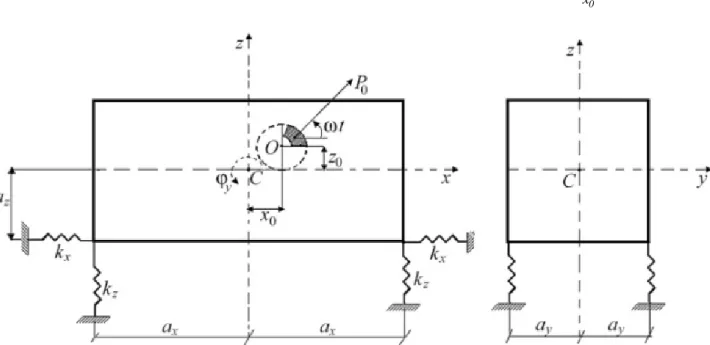
In figure 1 it is schematically presented the calculus model, which is characterized as follows:
- The dynamic equipment is modelled as a rigid with two vertical symmetry planes, Cxz and Cyz;
- The bearing consists of four elastic groups, each group being characterized by the orthogonal rigidities kx and kz , in relation with
the axis Cx and respectively Cz;
- The dynamic excitation is of inertial type, expressed by the force 2
0 0 m r
P = ω , placed in the median longitudinal plane of the equipment, with the origin in the point O(x0, 0, z0). The rotating force P0 generates perturbatory
excitations, expressed as: Fx(t)=P0cosωt; 0
) t (
Fy = ; Fz(t)=P0sinωt; MCx(t)=0;
0 0
0
Cy(t) (z cos t x sin t)P
M = ω − ω ; MCz(t)=0. The excitation moment MCy(t) can be expressed as MCy(t)=M0sin(ωt−α), where M0 =m0rω2l,
with 2
0 2 0 2
z x
l = + and
0 0
x z arctg
=
α .
Fig. 1. The schematically model calculus
2.1 Parameters of dynamic response
The geometrical configuration and the mass distribution with the symmetries previously defined, as well as the elastic bearing, symmetric in relation with the longitudinal and transversal median vertical planes, ensure the motion in three degrees of freedom X, Z, ϕy. Of these, two movements are coupled X, ϕy), and the translation motion, on vertical axis Y is independent.
In this case, the differential equation of the motion can be expressed as:
= +
− =
− +
+ ℑ
= −
+
t sin r m Z k~ Z m
) t sin( l r m X a k ~ ) a k ~ a k~ (
t cos r m a k ~ k ~ X m
2 0 z
2 0 z x y 2 z x 2 x z y y
2 0 y z x x
ω ω
α ω ω ϕ
ϕ
ω ω ϕ
& &
& & & &
(1)
In stabilized regime, the dynamic response, depending on the angular frequency
ω
, is expressed by the linear amplitudes Ax(ω),Az(ω) and the angular amplitudesA ( )y ω
ϕ . Thus, based on the expressions (1), and taking into account the shape of the excitation harmonic functions, in stabilized regime, results:
D
(
)
)
(
B
k
~
r
m
)
(
A
z 2 0 x
ω
ω
ω
ω
=
(2)where Ax(ω) is the linear vibrations amplitude, in the axis Cx direction.
DC(( ))
k~ r m ) ( A
y z
2 0
y
ω
ω
ρ
ω
ω
where A ( )
y ω
ϕ is the angular amplitude of the sway vibrations, around the axis Cy.
2 z 2 z 2 0 z 1 1 k~ r m ) ( A
ω
ω
ω
ω
− = (4) ) (ω
zA is the amplitude of the translational
vibrations, in the axis Cz direction.
In the previous expressions, the following relationships were used:
m k~ ; k 4 k~ ; k 4
k~x = x z = z
ω
2z = z y2 y
m
1
ℑ
=
ρ
or 2 z 2 y z 2 y y k ~ m
ω
ρ
ρ
= = ℑwhere
ρ
y is the mass m rotation radius in relationto the axis Cy:
ℑy- the moment of inertia in relation to the
axis Cy
ω
z – the vibrations natural frequency inrelation to the axis Cy.
The expressionsB(ω), C(ω)andD(ω)are:
4 y 2 0 2 0 2 z 2 x 2 2 z 2 2 y 2 x 0 z 2 y z z
x x z
k~ k~ a ) z a ( a k~ k~ ) ( B ρ ω ω ρ ρ ω + − + −
= (5)
2 2 z 2 z x 2 y 2 0 2 2 z 2 y 0 0 z 2 y z x k~ k~ x z ) z a ( 1 k~ k~ ) (
C
− + − + − = ω ω ρ ω ω ρ ρ
ω (6)
2 y 2 x z x 2 z z x 2 y 2 z x z 2 y 2 x 2 z a k~ k~ k k a k k a ) ( D ρ ω ω ρ ρ ω ω
ω +
+ + −
= (7)
For the coupled vibrations amplitudes
A
x(
ω
)
, A ( )
y ω
ϕ there are two states of resonance for
0 ) (
D ω = , and the post-resonance amplitude
)
(
A
xω
tends to a constant and stable value mr
m0
, while the amplitude A ( )
y ω
ϕ tends to zero.
Also, the in post-resonance amplitude Az(
ω
)has a constant and stable value m
r
m0
.
3. INSULATION CAPACITY OF THE TRANSMITED VIBRATIONS
The maximum transmitted force (forced amplitude) in the direction Cx is expressed as:
) cos( A A a 2 A a A k~ ) ( F y y
y z x x
2 2 z 2 x x max
z ω = + ϕ − ϕ Ψ −Ψϕ (8)
where Ψxand Ψϕy are the dephasings resulting
from the expressions:
(
)
− + − = 2 z 2 2 y 2 x 0 z 2 y z z x 0 y x y x z x a z a a k~ k ~ x a k~ k~ tan ω ω ρ ρ ρ ρΨ (9)
(
)
+ − − = 2 z 2 0 0 z z x 2 z 2 z x 0 z z a k~ k~ k~ k~ x 1 tan y ω ω ω ωΨϕ (10)
The maximum transmitted force in the direction Cz is expressed as:
z z
max
z
k
A
~
)
(
F
ω
=
(11)The maximum torque transmitted to the fixed support (base) is expressed as:
Mymax(
ω
)= k~zax2Aϕy (12)The transmissibility coefficients associated to the forces which are transmitted to the base can be defined as:
z 2 0 max y 2 0 max z z 2 0 max x x a r m M T ; r m F T ; r m F T y
ω
ω
ω
= ϕ =Fig.2. Txvariation with ω
Fig.3. Ty variation with ω
Fig.4. Tz variation with ω
For a dynamic equipment with the mass m =
6500 kg and the parameters kx
~
= 1,22⋅106 N/m;
z
k~ = 106 N/m ; ρy= 2,38 m; ax= 2,17 m; az=
0,6 m; x0 = 0,03 m; z0= 0,01 m; m0r= 26 kgm; and the variation of ω∈
(
0,120)
rad/s there wereplotted the variation curves for the transmissibility coefficients (Figures 2, 3, 4).
The experimental results obtained for the dynamic equipment with the above presented characteristics were highlighted by the measured amplitudes of the vibrations, by the values of the forces measured at the bearing point and by the values of the frequency measured in post-resonance. The measured values were compared with those determined by the analytical method, with maximum deviations of 3%.
The bearing system is composed of identical elastomeric anti-vibration devices, grouped by four by four, for each bearing point. Based on the variation curves of the transmissibility coefficients T, respectively by determining the
dynamic isolation coefficientsI=1−T, there were designed and manufactured the anti-vibration elastomeric devices with the following parametric characteristics:
– Geometrical shape: cylinder – Diameter/ height, mm: 170/170 – Shape coefficient s: 0,25
– Coefficient of elasticity, N/m, compression/shear: 8,2⋅104/5,1⋅104
– Maximum admissible deformation, mm compression/shear: 25/68
– Maximum loading force, N,
compression/shear: 2⋅103/3,5⋅103 – Elastomer: hardness, ShA: 45 modulus G, Mpa: 0,54
4. CONCLUSIONS
The industrial needs and the current technical solutions highlight the dynamic equipment, harmonically excited with rotating inertial disturbing forces, whose resulting force has the direction contained in a longitudinal median plane. They have symmetrical geometric configuration and symmetrical distribution of the component elements masses, with identical elastic bearings, symmetrically disposed in longitudinal and transversal plans, in four linking points to the fixed base.
isolation requirements, the following conclusions can be summarized:
a. Determination of the rigid model with the geometric, mass and elastic bearing symmetries, defined in accordance with the structural configuration of the vibratory dynamic equipment ensures the conformity with the real physical models;
b. Bearing system consists of four elastic groups, each group having of four elastomeric devices arranged two by two at an angle of 60o with respect to the local vertical axis of symmetry;
c. Dynamic calculus model allows the determining the dynamic response in stabilized regime, in analytic mode, of the amplitudes of the excited movements
(
X,ϕy)
and Z;d. Transmissibility degree and, respectively the dynamic isolation degree, for each significant movement, can be determined analytically. The associated variation curves provide the dynamic isolation efficiency assessment for different angular frequency, by variation domains;
e. Parametric experimental verification on industrial vibratory equipment, which is mass production, in Romania, ensured the coherence of the analytical results with those obtained in the tests.
Taking into account the above statements, results that the dynamic model selected for the vibratory dynamical equipment, from the category of the presented ones, can be efficiently used in the designing, manufacturing and maintenance activities.
5. REFERENCES
[1] Bratu, P., Analiza structurilor elastice: comportarea la actiuni statice si
dinamice, Editura Impuls, Bucuresti,
România, 2011
[2] Bratu P., Mecanica sistemelor
deformabile, Ed. Impuls, Bucuresti,
România, 2006.
[3] Bratu P. - Damping Characteristic for the Anti-seismic Systems consisting of
Elastomers having Hysteretic
Behaviour, 10th biennial International
Conference on Vibration Problems, ICoVP-2011, September 5-8, 2011, PRAGUE, Czech Republic.
[4] P. Bratu,”Rheological Model of the Neoprene Elements Used for Base Isolation against Seismic Action”, Rev.
Materiale Plastice nr. 3/2009, pag 288 ISSN 0025/5289, Bucuresti, România [5] G.-R. Gillich, P.-P. Bratu, M. Raduca, D.
Amariei, V. Iancu, „Behaviour of Composite Bearings Used in Bridge Isolation”, The 5th International Vilnius
Conference and EURO Mini Conference “Knowledge-Based Technologies and/or Methodologies for Decisions of Sustainable Development” (KORSD-2009) held on September 30–October 3, 2009, Vilnius, Lithuania.
[6] Bratu P., Physical instability and functional uncertainties of the dynamic
systems in resonance. Applied
mechanics and materials. Vol 430 (2013). Pg. 33-39. Trans Tech Publications, Switzerland
[7] Mitu, A.M., Popescu, I., Sireteanu, T.,
Comportarea dinamica a sistemelor cu caracteristici de tip histeretic, Editura
MATRIX ROM, Bucuresti 2012
[8] Alexandru C., Influence of Position Angle of Elastic Anti-Vibration Elements
on the Transmissibility, Romanian
Journal of Acoustics and Vibrations, RJAV, vol. XI, issue 1/2014, pag. 59-62 [9] Bratu P., Mitu A.M., Vasile O.,
"Dissipation Capacity Evaluation for Neoprene Anti-Seismic Isolators Under
Harmonic Dynamic Excitations", RJAV,
vol. 8 (1), 2011, pp.67-71, ISSN 1584-7284.
[10] Gillich G.R., Bratu P., Frunzaverde D., Amariei D., Iancu V., Identifying mechanical characteristics of materials
with non-linear behavior using
statistical methods, Proceedings of the
computer engineering and applications (CEA 10), pp: 96-103, Published: 2009.
[11] *** Regulation (EU) No
305/09.03.2011 – Harmonised
conditions for the marketing of
construction products and repealing
Council Directive89/106/EEC;
[12] *** EN 1337-3:2005, Structural bearings – Part 3: Elastomeric bearings;
[13] *** EN 15129:2009, Anti-seismic devices
Analiza performanţei de izolare dinamică a echipamentelor vibratoare cu legături elastice la baza fixă
REZUMAT. Lucrarea prezintă rezultatele cercetărilor efectuate pentru soluţiile de izolare a bazei a construcţiilor
realizate cu dispozitive elastice disipative reologice modelate ca un sistem compozit vâscos-elastic. În acest context, sunt analizate condiţiile de realizare a unei conexiuni elastice vâscoase echivalente, bazate pe cuplarea dispozitivelor elastice şi vâscoase într-o structură Newton -Voigt-Kelvin. Pe această bază, analiza dinamică evidenţiază nivelul răspunsului
dinamic prin amplitudinile semnificative ale deplasărilor instantanee la frecvenţa spectrală dominantă a excitaţiei
seismice. În final, sunt prezentate curbele parametrice de variaţie care permit evaluarea nivelului de izolare dinamicăşi a
eficienţei legăturii vâsco-elastice utilizate ca sistem de izolare a bazelor de construcţie (clădiri, poduri, viaducte) situate
în zonele predispuse la seism.
Polidor BRATU, Prof.dr., President, ICECON SA, Dynamic Behaviour of Structural Systems, [email protected], +40212025500
Adriana STUPARU, Drd. ,Scientific researcher, IMSAR, ICECON SA, Dynamic Behaviour of Structural Systems, [email protected], +40212025500
Sorin POPA, Drd., Scientific researcher, IMSAR, ICECON SA, Dynamic Behaviour of Structural Systems, [email protected], +40212025500
Nicolae IACOB, Drd., Scientific researcher, IMSAR, ICECON SA, Dynamic Behaviour of Structural Systems, [email protected], +40212025500
Ovidiu VOICU, Drd., Scientific researcher, IMSAR, ICECON SA, Dynamic Behaviour of Structural Systems, [email protected], +40212025500.