TECHNICAL UNIVERSITY OF CLUJ-NAPOCA
ACTA TECHNICA NAPOCENSIS
Series: Applied Mathematics, Mechanics, and Engineering Vol. 61, Issue III, September, 2018
COMPARATIVE STUDIES OF INDICATORS DEFINING
ENTREPRENEURSHIP CULTURE IN ROMANIA
Constantin BUNGAU, Adriana BORZA, Aurel CAUS
Abstract: Numerous indicators show the level of development of the entrepreneurial culture. Despite the perceived entrepreneurial education deficit, the rate of entrepreneurial intent in Romania is significantly higher in relation to the rates in the countries in the study group. If in France and Italy this rate varies a little over the last 5 years, Romania has large variations (with a maximum in 2014. The high level of entrepreneurial intent can be related to the positive perception of the regional business environment and the increased opportunities for the development of entrepreneurial skills in the educational environment. The ability to maintain the highly qualified labour in the country is related to the good growth of the Romanian economy and the positive perception of entrepreneurial opportunities. Romania becomes a highly skilled European player on the labour market, and the migration of specialists indicates the need for a specific set of public policies.
Key words: Entrepreneurial culture, education, qualified labour, indicators
1. CULTURE AND ENTREPRENEURIAL TRADITION IN EASTERN EUROPE
Peter Drucker [1] insists that the term entrepreneur originates in the French economy of the seventeenth and eighteenth centuries, being used to indicate that person who initiates a project or activity with a social impact. The one, who literally invented the term, around 1800, was French economist Jean Baptiste Say. The entrepreneur, according to Say, can be defined as the person who "transfers resources from a lower productivity area to one with higher productivity and higher profit", thus creating value. The term "entrepreneur" was originally used in the classical economic theory to designate the founder of a business enterprise whose essential role was to decide what quantities to produce and at what prices to obtain profit.
However, the original meaning of the term was changed by the contribution of economists, but also by non-economists.
Enterprise culture is defined in Gibb's terms as "a set of common values, beliefs and attitudes shared within a society and supporting a
desirable formula to live in an entrepreneurial manner that favours the pursuit of effective entrepreneurial behaviour of individuals and groups of individuals" [2].
Entrepreneurial culture appears to be a culture of projects. It aims is to make changes, to build and create innovation. It should be noted, however, that in the modern sense of the term, entrepreneurial culture should not be considered as a conceptual framework that encourages the creation of new enterprises but mainly as a daily attitude of individuals that has become defining for a certain society.
2. ENTREPRENEURIAL CULTURE AND THE SUCCESS OF ENTREPRENEURIAL EDUCATION IN FORMER COMMUNIST COUNTRIES IN EASTERN EUROPE
There are a number of major reasons that support the need for education and entrepreneurial culture in Romania and generally in any developed society. Some of the most important are:
a. Stimulating competitiveness, innovation, productivity and growth;
b. Improving the capacity of members of a company to change life with uncertainty and to respond positively to risk situations;
c. Compensation for over-inform - in terms of employability, valorisation of wealth taking into account its role in the process of economic and social development (social entrepreneurship).
The triggering of a necessary process of change at the level of the entrepreneurial culture in Romania implies the mobilization of a complex set of personal resources. These are emotional resources, cognitive resources, and increasingly important for globalized societies, interactive resources [5,6]. If emotional resources are the engine of action and depend to a large extent on the personality of individuals, cognitive and interactive resources can be
developed and cultivated through
entrepreneurial education. Such education can lead to increased awareness of the core values of entrepreneurial culture: self-reliance, leadership, team spirit, sense of responsibility, motivation, solidarity, effort, initiative, perseverance, and creativity.
3. COMPARATIVE STUDY: ROMANIA,
BULGARIA, HUNGARY, POLAND,
ITALY, FRANCE
There are a number of significant indicators that show the level of development of the entrepreneurial culture in the reference countries for our study. Italy and France obviously have other economic history and, unlike the countries of Eastern Europe, have benefited from the development opportunities offered by the democratic political system. If Italy and France can only be indicative - they are significant for a tendency of the period under discussion;
post-communist countries in Eastern Europe can show at a real comparative level the stage of development of entrepreneurial culture in Romania. The first indicator analysed is presented in Figure 1 [7].
Fig. 1. Country capacity to retain talent, Index 1-7 (best) [7]
Does your country retain talented people? (1 - the best and brightest leave to pursue opportunities in other countries; 7 - the best and brightest stay and pursue opportunities in the country).
Romania is the country with the lowest capacity to retain highly qualified labour force in the past two years; statistics show that Bulgaria has made significant progress. Hungary's position at the bottom of the ranking should be interpreted contextually; the relative decrease in recent years may be linked to the political and social measures of the Orban government (Figure 1).
Elżbieta Bieńkowska, which has the portfolio of the internal market, industry, entrepreneurship and SMEs.
Unlike the countries with similar history, Romania recorded a steady decline (since 2014), and data on the Romanians who chose to leave the country varies (depending on the source) between 3 and 5 million people. The outflow of highly qualified workforce is based on a particular context salary, but it should be noted here that the costs allocated to Romania for research and development are under one quarter of the European average and half of those in Bulgaria, and this makes our country be the most modest innovative economy of the European Union. The problem was at the highest institutional level, but the quality of the solutions does not have the desired practical value [9]. For the time being, no relevant public policies have been developed to answer realistic solutions to this issue. The second indicator analysed is depicted in Figure 2 [7].
Fig. 2. Basic-school Entrepreneurial Education and training, Index (1-9) [7] The extent to which training in
creating or managing SMEs is incorporated within the education and training system at primary and secondary
levels. Source: TCdata360 – worldbank.org
Developing and promoting entrepreneurship education remains one of the key policy objectives of EU institutions and Member States. The increased need for entrepreneurial education in Romania is revealed by the growth of the training field opportunities in recent years. To this end, entrepreneurial education needs a large number of qualified staff (teachers) in the
pre-university education system. They must have competences in teaching subjects related to entrepreneurship. Unlike the Nordic countries (Finland, Norway, Denmark) - countries in our research group did not elaborate a specific strategy on entrepreneurship education through clear public policies [10]. As the indicators show, the inclusion of different categories of learning outcomes related to entrepreneurship education (entrepreneurial attitudes, entrepreneurial skills and entrepreneurial skills) in the curriculum is unequal in Europe. However, we can identify, starting in 2014, a general tendency of a marked increase in the interest for entrepreneurship education - perhaps with the exception of France. In 2015, Romania is experiencing spectacular growth, the highest in relation to the countries in the studied group.
Despite the perceived entrepreneurial education deficit, the rate of entrepreneurial intent in Romania is significantly higher in relation to the rates in the countries of the study group (Figure 3) [7].
Fig. 3. Entrepreneurial Intention, % of 18-64 population [7] % of 18-64 population (individuals involved in any stage of entrepreneurial activity excluded) who are latent
entrepreneurs and who intend to start a business within three years.
Source: TCdata360 – worldbank.org
assume that a high rate of entrepreneurial intent can be attributed to a positive perception of the entrepreneurial environment.
There is also an explanation for the increased rate of entrepreneurial intent during the crisis and post crisis: In 2011-2012, entrepreneurial intention remains significant in Romania - and is manifested (as a "pushing effect") as a possible solution: rising unemployment appears (with a delay of 3 years) as a cause of the increase in entrepreneurial intent [7,11].
In the case of Romania and Bulgaria, we notice a marked discrepancy and significant variations between the share of entrepreneurial intent and the perception of the opportunities for setting up a firm. This discrepancy leads to a large drop-out rate for potential entrepreneurs (Figure 4) [7].
Fear of failure and bureaucracy in Romania partly explains this phenomenon. Entrepreneurs initially tend to perceive external factors and the business environment as crucial for the success of their initiative.
There is a high degree of distortion of the perspective of the business environment, especially among young people who are trying to become entrepreneurs. A good education and a strong entrepreneurial culture demonstrate that the success of a business or of an institution is related to few factors: the active entrepreneurship (in a significant proportion), the innovation capacity (the ability to find solutions in a particular situation), but also the implementation of modern techniques of management [12-19].
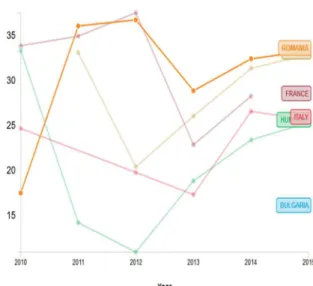
Percentage of 18-64 population who agree with the statement that in their country, most people consider starting a business as a desirable career choice is presented in Figure 5 [7].
A business career appears as an option for a relatively constant percentage of the population. We notice a significant discrepancy in the case of Hungary with the lowest index in 2012. Except for Romania (which increased until 2013 and has a stabilization trend in 2014 and 2015) in all the other countries from the study group the intention to make a career in business there is a general downward trend (minor variations occur in Hungary and France, but this is manifested after strong falls between 2012 and 2013).
Fig. 4. Perceived Opportunities, % of 18-64 population % of 18-64 population who see good opportunities to
start a firm in the area where they live. Source: TCdata360 – worldbank.org
Fig. 5. % of 18-64 population who agree with the statement that in their country, most people consider
starting a business as a desirable career choice [7]. Source: TCdata360 – worldbank.org
4. HYPOTHESES
The high level of entrepreneurial intent in Romania can be linked to a positive perception of the regional business environment and increased opportunities for the development of entrepreneurial skills in the educational environment.
product, attractiveness for investors) and the positive perception of entrepreneurial opportunities.
5. CONCLUSIONS. INTERPRETATION OF DATA
Romania becomes a European player on the highly qualified workforce market. Migration of specialists shows an educational potential whose management implies a different set of public policies. The fact that the level of wages in Romania remains low represents a decisive factor in the failure of the regional economic environment to take advantage of the innovative potential of young people with higher education. It is supposed that public policy measures that offer entrepreneurial facilities and more attractiveness to the Romanian business environment would help reduce the number of specialists that decide to work abroad. There are already well-documented studies that reveal concerns about legislation or the high level of bureaucracy. A major role in the process of disseminating the elements of entrepreneurial culture at the national level is attributed to universities. At the regional level, the University of Oradea is a significant provider of entrepreneurial education. The quality of entrepreneurial culture represents a major economic and social development factor.
6. ACKNOWLEDGMENTS
Ministry of National Education for Financing through the Institutional Development Fund for State Universities - FDI 2018, Subchapter: Establishing and Supporting the Activities of Student Entrepreneurial Societies (SAS) within the University of Oradea, CNFIS-FD1-2018-0240.
7. REFERENCES
[1] Peter, Drucker, Innovation and
Entrepreneurship, Harper & Row eds., New York, USA, (1985).
[2] Allan, Gibb, Creating Conducive
Environments for Learning and
Entrepreneurship; living with, dealing with,
creating and enjoying uncertainty and complexity, Industry and Higher Education Vol.1, No.3, pp. 135-147, (2002).
[3] Dan, Badulescu, Constantin, Bungau, Alina Badulescu, Sustainable development through sustainable businesses. An empirical research among master students, Journal of Environmental Protection and Ecology, Vol.16, No.3, pp. 1101-1108, (2015).
[4] Paul-Arthur, Fortin, La culture entrepreneuriale, un antidote à la pauvreté, Les Éditions Transcontinental, Montréal, Canada, (2002).
[5] Lucian Ionel, Cioca, Roland Iosif, Moraru, The importance of occupational health and safety in the framework of corporate social responsibility, Management of Sustainable Development, Vol.2, No.2, pp. 71-77, (2010). [6] Elena Simina, Lakatos, Lucian-Ionel, Cioca, Viorel, Dan, Alina Oana, Ciomos, Oana
Adriana, Crisan, Ghita, Barsan,
Sustainability, Vol.2018, No.10, pp. 865, (2018).
[7]https://tcdata360.worldbank.org/indicators/in n.retain.talent?country=ROU&indicator=57 5&countries=BGR,HRV,HUN,POL&viz=li ne_chart&years=2013,2017 (accessed on 18.02.2018)
[8]http://www.zf.ro/suplimente/polonia- dezvoltare-economica-si-prosperitate-prin-inovatie-16263709 (accessed on 18.03.2018) [9]http://www.acad.ro/bdar/strategiaAR/doc13/
StrategiaIII.pdf. (accessed on 18.03.2018)
[10]http://europedirect.cdimm.org/wp-content/uploads/2016/03/EC0216111RON_0 02.pdf
[11] Clive William John, Granger,
Econometrica, Vol.37, No.3, pp. 424-438, (1969).
[12] Constantin, Bungau, Florin, Blaga, Cosmin, Gherghea, Proceedings of the 2nd Review of Management and Economic Engineering Management Conference: Management of Crisis or Crisis of Management?, pp. 36-47, Cluj Napoca, Romania, (2011).
[13] Constantin, Bungau, Ioan Cosmin, Gherghea, Mariana, Prichici, Twenty Years after: How Management Theory Works, Proceedings, Review of Management and
Management Conference, pp. 188-198, Cluj-Napoca, Romania, (2010).
[14] Constantin, Bungau, Florin, Blaga, Cosmin Gherghea, International Conference on Production Research - Regional Conference Africa, Europe and the Middle East and 3rd International Conference on Quality and Innovation in Engineering and Management (Icpr-Aem 2014), pp. 55-58, Cluj Napoca, Romania, (2014).
[15] Lehel Szabolcs, Csokmai, Radu Catalin, Tarca, Constantin, Bungau, Geza, Husi, International Journal of Computers Communications and Control, Vol.10, No.1, pp. 30-37, (2015).
[16] Sunhilde, Cuc, Constantin, Bungau, Management between profit and social responsibility, Review of Management and
Economic Engineering International
Management Conference, pp. 186-196, Cluj Napoca, Romania, (2014).
[17] Sunhilde, Cuc, Sanda, Tripa, Constantin, Bungau, 5th Review of Management and
Economic Engineering International
Management Conference, pp. 100-+, Cluj Napoca, Romania, (2016).
[18] Luminita, Giurgiu, Ghita, Barsan, Danut
Mosteanu, The 9th International
Management Conference Management and Innovation for Competitive Advantage, pp. 506-512, Bucharest, Romania, (2015). [19] Benoni, Sfarlog, Ghita, Birsan, Danut,
Mosteanu, Daniel Constantin, The 9th International Management Conference Management and Innovation for Competitive Advantage, pp. 67-73, Bucharest, Romania, (2015).
Studii comparative ale indicatorilor care definesc cultura antreprenorială în România
Rezumat: Au fost identificați o serie de indicatori care arată nivelul dezvoltării culturii
antreprenoriale în țările de referință incluse în studiul nostru. În ciuda deficitului educațional antreprenorial înregistrat, rata intenției antreprenoriale în România este semnificativ mai mare în raport cu ratele din țările din grupul de studiu. Dacă în Franța și Italia această rată variază puțin în ultimii 5 ani, România are variații mari (cu un maxim în anul 2014) care corelează proporțional cu rata de creștere economică înregistrată. Nivelul ridicat al intenției antreprenoriale poate fi legat de percepția pozitivă a mediului de afaceri regional și de oportunitățile sporite pentru dezvoltarea abilităților antreprenoriale în mediul educational. Abilitatea de a menține forța de muncă înalt calificată în țară este legată de buna creștere a economiei românești și de percepția pozitivă a oportunităților antreprenoriale. România devine un jucător european de înaltă calificare pe piața muncii, iar migrarea specialiștilor indică necesitatea unui set specific de politici publice
Constantin BUNGAU, Department of Management and Engineering, University of Oradea, 1 Universitatii St., Oradea, Bihor, Romania
Adriana BORZA, Department of Counseling and Career Services, University of Oradea, 1 Universitatii St., Oradea, Bihor, Romania
![Fig. 1. Country capacity to retain talent, Index 1-7 (best) [7]](https://thumb-us.123doks.com/thumbv2/123dok_us/7997551.2120574/2.892.447.767.234.508/fig-country-capacity-retain-talent-index-best.webp)
![Fig. 2. Basic-school Entrepreneurial Education and training, Index (1-9) [7] The extent to which training in](https://thumb-us.123doks.com/thumbv2/123dok_us/7997551.2120574/3.892.506.823.608.902/basic-school-entrepreneurial-education-training-index-extent-training.webp)