TECHNICAL UNIVERSITY OF CLUJ-NAPOCA
ACTA TECHNICA NAPOCENSIS
Series: Applied Mathematics, Mechanics, and Engineering Vol. 60, Issue IV, November, 2017
ASSESSMENTS ON SHOCK ABSORPTION PROPERTIES OF
FOAM-FORMED LOW DENSITY CELLULOSE COMPOSITES
Silviu NASTAC, Carmen DEBELEAC, Petronela NECHITA
Abstract: This work deal with the foam-formed composites based on low density cellulose (LDC) and using the procedure of air dried foam fibre (ADFF). The authors present some assessments about shock insulation properties of such materials taking into account different types of base fibrous material starting with cellulose fibres with high purity and mixed in various percentages with fibres from recycled paper. Using a pendulum-based experimental setup for impact tests and acquiring the impact force and the striker acceleration signals respectively, it was evaluated the sample deformation, the impact bending strength, and the force – deformation diagram. Finally, it was performed a comparative analysis based on the restoring and the dynamic amplification coefficients, the sample total and residual deformations, and the maximum values of impact strength in respect with the first striking cycle.
Key words: shock protection, low density cellulose, foam-formed composites, experimental analysis.
1. INTRODUCTION
This study takes into account a feasible solution for shock absorption applications based on foam-formed low density cellulose (LDC) composites using air dried foam fibre (ADFF) procedure. Supposing the recycled paper as a potential source of cellulose fibres, results that this research has framed into the area of environment friendly materials intended for various science and engineering fields. Obviously, the area of shock and vibration protection permanently requires innovative solutions based on new materials with high isolation performances and strongly dissipative characteristics. Consequently, researchers all over the world deal with this problems taking into account the large area applications including cushioning, packaging, falling and/or rolling-on protection etc.
Results within paper [1] describes that, in the case of a small transportation package of a cylindrical shape, the shock absorbing effects were evaluated by utilizing the compression properties of the PU (rigid Polyurethane) and EPS (Expanded Polystyrene) foams. Mojzes et al. [2] treat the possibility to apply new and possible environmental friendly packaging
(EFP) materials based on its cushion characteristic, and investigate a possible predicting to make easier its testing method in the development process. Into his paper [3] Dunno summarizes the theory and recent work applying the stress-energy method and different curve fit models to these type systems to generate cushion curves. In addition, he compares stress-energy predicted deceleration values to actual ASTM D4168 deceleration values as a method of determining whether the stress-energy method is a viable alternative for generating curves for these cushion systems. The purpose of the article [4] is the evaluation
on the dynamic shock cushioning
characteristics and vibration transmissibility of a new type of corrugated paperboards by a series of experimental studies on the drop shock tester and vibration tester, the establishment of experimental formulas of dynamic cushioning curves, and the analysis of peak frequencies, vibration transmissibility and damping ratios. The research paper [5] presents the authors investigations on packaging device, which is the foam based move damping or cushioning system based on new EFP materials.
polymeric foams, in both static and impact loading conditions. The energy absorption characteristics have been examined both through the energy-absorption diagram method and through the efficiency diagram method. The handbook of Sek and Kirkpatrick [7] provides the packaging engineer with information on how to utilize corrugated fiberboard as a cushioning medium in protective packaging systems, wherein the hazards of distribution environment, particularly shock, and the impact they have on cushion design are reviewed. In the paper [8] the cushioning properties of honeycomb paperboards are studied by means of experimental analysis, with interesting results regarding both the mono- versus multi-layer paperboards properties, and the effects of the height of honeycomb on its cushioning properties. Some additional technical aspects regarding the use of an impact pendulum in order to capture the material responses induced by instantaneous loads were presented in the paper [9].
In addition, within the field of fibre-based composites, the available scientific literature provides a large view regarding the basic fibre source, the matrix materials and the technological procedures. Composites of polypropylene polymers as a matrix, filled with the fibers of wheat straw and paper mill sludge, were considered by Khademieslam & Kalagar [10], and the results reveal that using of paper mill sludge had a higher contribution than wheat straw fiber, in terms of impact strength. Boran et al. [11] had produced and analyzed HDPE/ultrafine cellulose (UFC) composites using different compounding methods and characterized them to evaluate mechanical, thermal and rheological properties.
Within this context, this study was based on the idea of easier manufacturing procedure of a composite using the environmental friendly LDC fibre from the recycling paper and with higher shock absorption capabilities or even comparable with nowadays available polymeric materials. Taking into account a set of main parameters being able to characterize the dynamic protection capacity, the authors provide into this paper a comparative analysis
of four proposed composites with two reference polymeric samples.
2. EXPERIMENTS BACKGROUND
Within this study, the authors had proposed some foam-formed composites based on LDC, produced in foam laid media, air dried freely at the room temperature for a time period between 24...48 hours [12, 13], without any pressing procedure applied. The samples and their microphotographs were reported in Figure 1 as follows: (p1) denotes the air dried foam fibre (ADFF) composite from 100% cellulose fibres with high purity–see Fig.1(a), (p3S) denotes the ADFF composite based on 100% fibres from recycled paper–see Fig.1(b), (p4) denotes the ADFF composite with equally cellulose fibres and fibres from recycled paper–see Fig.1(c).
(a)
(b)
(c)
(d) Fig. 1. The samples with their microphotographs of the materials used for experimental tests (reflex photo, magnification 20x): (a) sample p1, (b) sample p3S, (c)
Fig. 2. Experimental setup used for impact tests
The fourth proposed LDC-based composite, coded (p2C) – see Fig.1(d), is a cellulose material produced by traditional papermaking process (formation and dewatering) and based on 100% fibres from recycled paper. The reference polymeric samples were EPS (Expanded Polystyrene) and HDPU (High Density Polyurethane) respectively.
It had to be mentioned that some estimative experimental approaches regarding both the noise insulation [13], and shock absorption [14] properties respectively, of these composite materials, were previously performed by the authors.
For experimental impact tests, a pendulum-based setup depicted in Figure 2 was used [14]. The laboratory equipment provides the capability of synchronously acquiring of the impact force and of the striker acceleration signals. Acquiring and pre-processing procedures were done with the NI-LabVIEW© software, and typical computations and analyses were performed within the Matlab© software.
3. EXPERIMENTAL RESULTS
The striker acceleration and the impact force measured between the samples support and the fixed equipment base were acquired, and the striker velocity was computed by numerical integration procedure. The results according with the proposed composites were depicted in Figures 3...6.
For convenience, only the zoomed diagrams of the firstly two impact cycles were considered and the local extreme values were marked on graphs, because these data had provided useful information for the latest computations and analyses respectively.
Fig. 3. Timed signals of acceleration, velocity and impact force acquired for the sample p1; circle symbols on graphs denote the local extremes
according with first cycles
Fig. 4. Timed signals of acceleration, velocity and impact force acquired for the sample p3S; circle symbols on graphs denote the local extremes
Fig. 5. Timed signals of acceleration, velocity and impact force acquired for the sample p4; circle symbols on graphs denote the local extremes
according with first cycles
Fig. 6. Timed signals of acceleration, velocity and impact force acquired for the sample p2C; circle symbols on graphs denote the local extremes
according with first cycles
(a)
(b)
(c)
(d) Fig. 7. Coherence graphs for testing cases of materials p1 (a), p3S (b), p4 (c) and p2C (d)
Diagrams in Figure 7 depict the coherence signals between the striker acceleration and the impact force for each tested sample. A briefly analysis of these graphs reveals the perfect correlation between the input and the output within the useful low spectral range.
evaluated (both instantaneous and total values were considered).
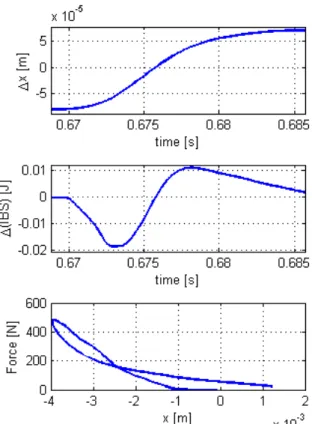
Fig. 8. Instantaneously evolutions of deformation and impact bending strength respectively, and the force –
deformation diagram for the sample p1
Fig. 9. Instantaneously evolutions of deformation and impact bending strength respectively, and the force –
deformation diagram for the sample p3S
Fig. 10. Instantaneously evolutions of deformation and impact bending strength respectively, and the force –
deformation diagram for the sample p4
Fig. 11. Instantaneously evolutions of deformation and impact bending strength respectively, and the force –
The diagrams in Figures 8...11 depict the timed evolutions of instantaneous values of the deformation and, respectively, the impact bending strength (as work exerted). In addition, the force – deformation diagram, in respect with the strictly first impact cycle, was plotted – third graph in Figures 8...11. An analysis of this last diagram puts into the evidence the hysteretic evolution of each composite under the shocking load, and reveals the dissipative component of its characteristic.
4. DISCUSSIONS
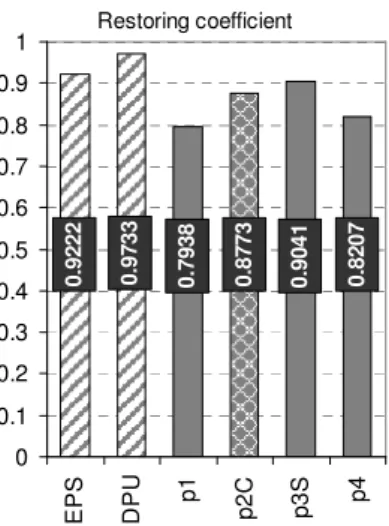
Taking into account the restoring coefficient expression, in respect with the case of fixed wall impact, a comparative analysis between the composite samples and the references were done. The final result was reported as the diagram in Figure 12, where it was distinctively marked both the reference samples (EPS and HDPU), and the classical LDC material (p2C). It was observed that proposed composites provide a range of 0.8 ... 0.9 for restoring coefficient, meaning approx. 90% average value from the references, which frame the initial purpose of this study.
Evaluating the apparent mass supported by the samples during the first impact cycle, as a ratio between the extreme values of the impact force and the striker acceleration respectively, it was computed the dynamic amplification coefficient. The final values were depicted as the bar diagram in Figure 13. The references and the classical LDC sample were also marked apart. A comparison between the composites and the references values dignifies proper behaviour of the proposed materials and a good correlation with the restoring capacity.
Taking into account the instantaneous values of the samples deformation and the impact strength, it was evaluated the cumulative evolutions of these parameters and the maximum values were compared. The total impact strength was depicted in Figure 14, and the total and residual deformations respectively were depicted in Figure 15.
Comparative analyses of provided parameters put into the evidence a good capability of proposed composites related to the shock absorption.
Hereby, the reduced values of restoring coefficients and correlated values of dynamic amplification denote the availability of these materials to be used within shock effect reduction applications. In addition, the impact strength and the residual deformation underline the previous remark.
Restoring coefficient 0 .9 7 3 3 0 .9 2 2 2 0 .7 9 3 8 0 .8 7 7 3 0 .9 0 4 1 0 .8 2 0 7 0 0.1 0.2 0.3 0.4 0.5 0.6 0.7 0.8 0.9 1 E P S H D P
U p1
p
2
C
p
3
S p4
Fig. 12. Comparative analysis of restoring coefficient – reference samples and classical LDC samples were
distinctively marked
Dynamic amplification coefficient
1
.3
0
4
6 1.3
5 9 0 1 .2 9 9 5 1 .4 3 3 6 1 .3 4 1 7 1 .2 8 8 3 1.00 1.05 1.10 1.15 1.20 1.25 1.30 1.35 1.40 1.45 E P S H D P
U p1
p
2
C
p
3
S p4
Fig. 13. Comparative analysis of dynamic amplification coefficient – reference samples and classical LDC
samples were distinctively marked
Impact Bending Strength [J]
0.8861 0.8377 0.7970 0.6383 0.0 0.2 0.4 0.6 0.8 1.0
p1 p2C p3S p4
Fig. 14. Maximum values of the impact bending strength in respect with the first impact cycle - classical LDC
Sample Deformation [mm]
8.5988
4.4344 7.8193
3.9679
0 2 4 6 8
p1 p2C p3S p4
(a)
Residual Deformation [mm]
0.8403 1.9155
0.7124 1.9146
0.0 0.5 1.0 1.5 2.0
p1 p2C p3S p4
(b) Fig. 15. Maximum values of the samples total deformation (a) and of the residual deformation (b) in respect with the first impact cycle - classical LDC sample
was distinctively marked
Regarding the fibre composition of proposed composites and the correlation between this and the final performances, the comparative analyses reveal that p3S and p4 materials provide higher insulation capability. This remark also sustains the initial purpose of this study, because these two composites contain from 50% (p4) up to 100% (p3S) fibres from recycled paper.
5. CONCLUSION
The authors proposed four types of foam-formed LDC composites for shock absorption applications and the experimental results were sustained this purpose. In addition, the opportunity of higher range using of recycled paper was also sustained by the final results. Freely air dried procedure was used to obtain all the proposed materials. Hereby, the final conclusion is that the proposed composites supply a feasible solution for shock protective solution and impact effect reduction applications.
Based on the experimental results and the comparative analyses and discussions, it can
formulate the future directions for this research as follows: doing performance tests for a large range of different percentages of fibres from recycled sources, analysis of material thickness influences on the global insulation capability, optimization of final solution in order to provide higher protection against fire and weather conditions.
6. REFERENCES
[1] Ki Seog Seo, Ju Chan Lee, Kyung Sik Bang, Hyon Soo Han, Sung Hwan Chung, Byung Il Choi, Jong Hyun Ha, Shock absorbing evaluation of the rigid polyurethane foam and Styrofoam applied to a small transportation package, Proc. of the 14th International Symposium on the Packaging Transportation of Radioactive Materials (PATRAM 2004), Paper #240, Berlin, Germany, September 20-24, 2004. [2] Mojzes, Á., Földesi, P., Böröcz, P., Define
cushion curves for environmental friendly packaging foam, Annals of Faculty Engineering Hunedoara – International Journal Of Engineering, Tome X (Year 2012). Fascicle 1. ISSN 1584–2665.
[3] Dunno, K.D., Application of the Stress-Energy Method to Evaluate Enclosed Air Cushion Systems, International Journal of Advanced Packaging Technology 2016, Volume 4, Issue 1, pp. 216-225, ISSN 2349-6665, Article ID Tech-644.
[4] Yanfeng Guo, Wencai Xu, Yungang Fu, Hongtao Wang, Dynamic shock cushioning characteristics and vibration transmissibility of X-PLY corrugated paperboard, Shock and Vibration 18 (2011) 525–535, DOI 10.3233/ SAV-2010-0559.
[5] Mojzes, Á., Böröcz, P., Földesi, P., Possibble method to define cushion characteristic on new type of environmental friendly foam, Proc. of the 1st International Conference on Sustainable Intelligent Manufacturing, H.Bartolo et al. (Eds.), Leiria, Portugal, June 28-july 1, 2011. [6] Avalle, M., Belingardi, G., Montanini, R.,
Characterization of polymeric structural foams under compressive impact loading by means of energy-absorption diagram, International Journal of Impact Engineering 25 (2001) 455-472.
Ver.1.2, Copyright © 2001 Victoria University of Technology and Amcor Research and Technology, ISBN 1-86272-598-5.
[8] Wang, D.M., Wang, Z.W., Experimental Investigation into the Cushioning Properties of Honeycomb Paperboard, Packaging Technology and Science, Packag. Technol. Sci. (2008), Published online in Wiley InterScience (www.interscience.wiley.com). DOI: 10.1002/pts.808.
[9] Bučar & Merhar (2015), Impact and Dynamic Bending Strength Determination of Norway Spruce by Impact Pendulum Deceleration, BioResources 10(3), 4740-4750.
[10] Khademieslam & Kalagar (2016), Evaluation of the Bending Strength, Impact Strength, and Morphological Properties of Wheat Straw Fiber / Paper Mill Sludge / Polypropylene Composites, BioResources 11(2), 3914-3922.
[11] Boran et al. (2016), Characterization of Ultrafine Cellulose-filled High-Density Polyethylene Composites Prepared using Different Compounding Methods, BioResources 11(4), 8178-8199.
[12] Nechita P., Nastac S., Ionescu S.M., Foam-formed cellulose-based composite materials for
use in cushioning and insulation applications, Proc. of the 9th National Conference on Chemistry Science and Technology for Better Life, the 18th National Symposium on Polymers,
September 29 – October 1, 2016, Union of Chemists in Bulgaria.
[13] Nechita, P., Năstac, S., Foam-formed cellulose
composite materials with potential applications in sound insulation, Journal of Composite Materials, First published date: June-20-2017,
DOI: https://doi.org/10.1177/
0021998317714639
[14] Nastac, S., Debeleac, C., Nechita, P., Experimental Analyses Of Shock Protection Availability For Low Density Cellulose Composites, Proc. of the 40th International Conference on Mechanics of Solids, Acoustics and Vibrations and the 6th International Conference on “Advanced Composite Materials Engineering”, Academy of Technical Sciences of Romanian, Romanian Society of Theoretical and Applied Mechanics, Romanian Acoustic Society, Transilvania University of Brasov, Brașov, Romania, 24-25 November 2016, ISSN
1844-9336, pp.284-288.
Evaluarea capabilității de protecție la acțiuni impulsive pentru materiale compozite pe bază de spumă celulozică de joasă densitate
Rezumat: Această lucrare abordează problematica compozitelor pe bază de spumă celulozică de joasă densitate, cu
formare prin procedeul de uscare liberă în aer la temperatura camerei. sunt prezentate rezultatele unor evaluări
dinamice referitoare la capabilitatea acestor materiale de izolare a acțiunilor impulsive de tip șoc și posibilități de
înglobare în aplicații destinate izolării dinamice. Au fost considerate diverse rețete pe bază de fibre celulozice cu
puritate ridicată combinate în proporții variate cu fibre obținute din hârtie reciclată. Testele dinamice au fost
efectuate cu ajutorul unui sistem pendular, cu posibilitatea evaluării accelerației impactorului și a forței de lovire. Pe
baza semnalelor achiziționate au fost evaluați parametrii de deformare a probelor și lucrul mecanic de impact, iar în
final au fost realizate analize comparative pe baza valorilor coeficienților de restituire și a celor de amplificare
dinamică, precum și pe baza valorilor maximale ale deformațiilor totale și reziduale ale probelor considerate.
Silviu NASTAC, Dr.hab.eng., Associate professor, “Dunarea de Jos” University of Galati, Engineering and Agronomy Faculty in Braila, Research Center for Mechanics of Machines and Technological Equipments, E-mail [email protected], Calea Calarasilor 29, 810017, Braila, Romania.
Carmen DEBELEAC, Dr.hab.eng., Associate professor, “Dunarea de Jos” University of Galati, Engineering and Agronomy Faculty in Braila, Research Center for Mechanics of Machines and Technological Equipments, E-mail [email protected], Calea Calarasilor 29, 810017, Braila, Romania.