Dwiana Estiwidani et al IJSRE Volume 05 Isuue 03 March 2017 Page 6246 Volume||5||Issue||03||March-2017||Pages-6246-6253||ISSN(e):2321-7545 Website: http://ijsae.in Index Copernicus Value- 56.65 DOI: http://dx.doi.org/10.18535/ijsre/v5i03.01
The Influence of Parent’s Blood Type Towards Jaundice on Neonates in Sadewa
Hospital 2016
Authors
Dwiana Estiwidani1, Yuni Kusmiyati2, Waryana3, Hani Asmarani4
1,2,3,4
Poltekkes Kemenkes Yogyakarta
Email: [email protected]. [email protected], [email protected], [email protected]
ABSTRACT
Neonatorum Pathological jaundice caused the death of 6% of neonatal deaths. The incidence of jaundice is in 50% of aterm infants and 75% of preterm infants. Incompatibility of blood type is one of the most common cause of neonatal hyperbilirubinnemia. The purpose of this research is to determine the influence of parent’s blood type with the incidence of neonates jaundice. This study used prospective cohort design with purposive sampling techniques. Samples taken were grouped into two groups: risky blood type and not risky blood type;, each groups contain 57 respondents. Retrieved data used blood type test and observation. Analysis used chi-square and Cox regression. Statistical analysis shows the variable which related with the incidence of jaundice in neonates isparent’s blood type (p = 0,002), birth weight (p = 0,003) and parturition type (p = 0,008) while unrelated variable is gestation (p = 0,27) and breastfeeding status (p = 0,503). Multivariate analysis relates with the incidence of neonates jaundice isparent’s blood type (p = 0,013) and birth weight (p = 0,026). For conclusion, there is significant parent’s blood typewith the incidence of neonatal jaundice. Parent’s blood type increase the risk2.5 times the occurrence of neonates jaundice (RR=2.5 CI95%1,407-4,606). Neonates born to couple who hasrisky blood type has the opportunity for jaundiced 2.4 times compared with neonates born to couple who does not have risky blood type after controlled for other variables.
Keywords: Blood Type, Jaundice, Neonates
INTRODUCTION
The infant mortality rate ( IMR ) in Indonesia still quite high compared to other developing countries. IMR in Indonesia on 2012 is32 deaths per 1.000 live births,this number is still targetless of Millennium Development Goals (MDGs), 23 deaths per 1000 live births in 2015. IMR is one of health measurein one area.The majority of infant mortality in Indonesia is occurred during neonates.Attention to reduce neonates mortality rate efforts ( 0-28 day ) is important because neonates mortality contribute to 59 % infant mortality1.
Dwiana Estiwidani et al IJSRE Volume 05 Isuue 03 March 2017 Page 6247 Incompatibility blood type systemis caused by mother blood type O which naturally has anti-Aantibodies and anti-B on its circulation.If fetus has blood typeA or B, eritoblastosys may occurred becauseIgGpassed plasenta4. Incompatibility blood type system is the cause of kernikterus.Neonates age, gestational age, birth weight, and maternal paritywhich has influence tojaundice continuation5.
The highest approximate of neonates complication is in Sleman, 2.120 cases6.Jaundice is one of neonates complication and if not treat properly can cause morbidity and mortality on neonates.Sadewa Hospital which located in Sleman is one of the particular hospital formaternal and child as refferal hospital particularly in the case of obstetrics.Based on preliminary studies in Sadewa Hospital,its found a rate as much 300 parturition in a month. There is 342 jaundice cases in 2016. Blood type incompatibility has an important role in jaundice however it can’t be certainly counted7.Based on its background, researcher intereststo research further if there’s any influence of parent’s blood type with jaundice on neonates .
The purpose of this study is to know the influence of parent’s blood type with jaundice on neonates in Sadewa Hospital 2016. The benefits of this research is expected useful to add reference, input , planning prenatal screening program about the influence of parent’s blood type toward jaundice on neonates so it can be early detected.
METHOD
This wasobservational analytic research with prospective cohort design.The study was conducted in Sadewa Hospital on November- December 2016.Population of this research was all married couple whomhad born their baby in Sadewa Hospital. Sampling technique used purposive sampling.The subject of study consisted of risky blood type group and not risky blood type group. Inclusion criteria is baby born which biologically from married couple. Exclusion criteria is mother with DM.Each groups was taken 57 subjects, so that the whole sample weres 114 subjects. Collecting data was conductedby testing mother blood typewhom gave birth in November - December 2016, followed until the second day of infant to observing jaundice in neonates with kremer formula, and assessingthe age of pregnancy, born weight, parturition type and breastfeeding status.
Data processing technique with editing, coding, transfering, and tabulating. Data analysis used chi-square, cox regression using computer software with trust level 95%.
RESULT
Bivariat Analysis
The Impact of Parent’s Blood Type towards Jaundice on Neonates
Table 1. Intersection Table of Parent’s blood Type with Jaundice on Neonates in Sadewa Hospital 2016
Parent’s Blood
Type
Jaundice
P RR
(95%CI)
Jaundice Not Jaundice
N % N %
Risky 28 49,1 29 50,9
0,002 2,5 (1,407-4,606)
Not Risky 11 19,3 46 80,4
Based on table 1,there’s meaningful impact between parent’s blood type with jaundice on neonates with p-value 0.002 (p<0.05).The size of the rr is 2.5 ( 95 % ci 1,407-4,609 ) , this means of neonates born of the blood group parents risky have risk scene jaundice 2.5 times higher than neonates born of the blood group parents whom are not risky.
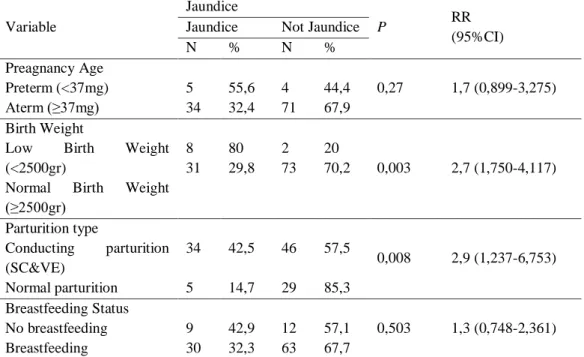
Dwiana Estiwidani et al IJSRE Volume 05 Isuue 03 March 2017 Page 6248 Table 2. Intersection Tableof The Impact of Pregnancy Age, Birth Weight, Parturition Type and Breastfeeding Status with Jaundice on Neonates in Sadewa Hospital 2016
Variable
Jaundice
P RR
(95%CI)
Jaundice Not Jaundice
N % N %
Preagnancy Age Preterm (<37mg) Aterm (≥37mg) 5 34 55,6 32,4 4 71 44,4 67,9
0,27 1,7 (0,899-3,275)
Birth Weight
Low Birth Weight
(<2500gr)
Normal Birth Weight
(≥2500gr) 8 31 80 29,8 2 73 20
70,2 0,003 2,7 (1,750-4,117)
Parturition type
Conducting parturition
(SC&VE) Normal parturition 34 5 42,5 14,7 46 29 57,5 85,3
0,008 2,9 (1,237-6,753)
Breastfeeding Status No breastfeeding Breastfeeding 9 30 42,9 32,3 12 63 57,1 67,7
0,503 1,3 (0,748-2,361)
Based on statistical tests result based on pregnancy age, birth weight, parturition type and breastfeeding type on neonates whichhassignificance impact on jaundice on neonates i.e. birth weight variable with p-value 0,003 and parturition type with p-value 0,008 ( p<0.05 ).The size of RRfor birth weight towards jaundice on neonates is 2.7 ( 95 % CI, 750-4.177 ), which means that neonateswith low birth weight has higher risk 2.7 to jaundice than neonates which born with Normal birth weight. RR for parturition type towards jaundice on neonates is 2.9 (95% CI 1.237-6.757), which means that neonates born with conducting parturition (SC and VE) has risky 2.9 times higher to jaundice on neonates than those who was born normally.While on the variable of gestational age has no significance relationship to jaundice with p value 0.27 (RR 1.7 95% CI 0.899-3.275). Breastfeeding status also has no significance relationship towards jaundice in this research with p value 0.503 ( RR 1.3 95% CI 0.748-2.361 ).
Analisis Multivariat Analysis
Multivariate analysis used was cox regresion , which tested in multivariate analysis with the value of p<0.25 in bivariat test.
Table 3. The Table of Multivariate Anlysis Result of Parent’s Blood Type, Birth Weight and Parturition Type with Jaundice on Neonates in Sadewa Hospital 2016
Dependent Variable
Independent Variable
Coef P RR CI 95%
Jaundice Parent’s Blood Type 0,885 0,013 2,422 1,204-4,874
Birth Weight 0,888 0,026 2,431 1,112-5,313
Parturition Type 0,878 0,069 2,406 0,935-6,190
Dwiana Estiwidani et al IJSRE Volume 05 Isuue 03 March 2017 Page 6249 DISCUSSION
The Impact of Parent’s Blood Type towards Jaundice on Neonates
The majority of neonates that experienced jaundice comefrom couplewhom had impact between parent’s blood type towards jaundice on neonates. Neonates which born from parents that have risky to jaundice 2.5 times higher than neonates that born from not risky parent’s blood type.
Parent’s blood type gives contribution in compatibility of blood type system, i.e. incompatibility blood type between the mother and infant which cause blood hemolysis on infant, so cause hyperbilirubin. Jaundice that caused by bllod type system incompatibility in the first 24 hour 35.2%, while in 1st-3rd 42.5%8. This research also shows that risky parent’s blood type whose mother blood type O and husband is not O, more potentially caused jaundice on neonates than neonates which born from not risky parent’s blood type. Research in Hermina Hospital pandanaran Semarang shows that there’s increasing significance differences between bilirubin level with neonates blood type A, B, and O from the mother with O blood type9
It is similar with Michael Kaplan and friends research 2010 in Israel where heterospesific blood type system (the mother with O blood type andinfant with A/B blood type) can increase hemolysis and risks hyperbilirubinemia in neonates10.Research in Iran conducted Baskobadi and friends shows that from 237 neonates has jaundice and 56% of it has incompatibility blood type system. 38 neonates cases which had kernikterus and 12 cases in incompatibility blood type system11. faskobadi dkk shows that of 237 neonates experienced jaundice and inkompatiblitas abo contributed as many as 56 % .Or 38 cases of neonates that experienced kernikterus and 12 cases where subdistricts in the group inkompatibilitas abo
Research conducted in Mecca 2013 explain that Coombs’ test has positive result as many as 16.1% shows that if Coomb’ test is positive on neonates with A/B blood type from the group of mother with O blood typecan increase significance risk on hyperbilirubinemia. Incompatibility blood type system and deficiency G6PD is the cause hyperbilirubinemia or jaundice on neonates in Mecca12.
Research conducted in Taiwan by Valsami et al in 2012 about direct antigloblunin test (DAT) or Comb’s test shows that from 70/2695 had DAT positive case. In 64/70 (91.43%.) DAT postive is contribution from incompatibility blood type system. Incompatibility blood type system is the important factor from DAT (+)13. Incompatibilty blood type system caused by the mother O blood type which naturally has antibody anti-A and anti-B on the circulation. If fetus has A/B blood type, eritoblastosys can be happened because igG (mother’s antibody) passing through placenta meet with its antigen of fetus erythrocytes, so that the hemolysis in infants resulting hyperbilirubin in infants4.
The proportion of jaundice in a group of couples with risky parent’s blood type had jaundice 49.1% while had not jaundice 50.9%. Although its only has little differences, but there’s differences, there are which hadn’t jaundice is higher compare with whom had jaundice, whereas they come from the same group of coupple with risky factor on blood type. It is accordance with Hasan and Alatas ( 2007 ) which states that there’s hemolysis impact on smaller infants. This is because isoaglutinin anti -A and anti-Bon mother’s serum most of which is shaped 19-S gamablobulin-M that cannot be through the placenta and called natural isoaglutinogen.Just smattering of the mother who had O blood type, had antibodies 7-S namely gamaglobulin-G (immune isoaglutinogen) is high and can be through the placenta so that result in hemolysis in infants14.
Dwiana Estiwidani et al IJSRE Volume 05 Isuue 03 March 2017 Page 6250 The Impact of Gestational Age, Birth Weight, Parturition Weight and Breastfeeding Status towards Jaundice on Neonates
Based on the research results show that the majority of infantwith enough month(aterm≥37mg ) as many as 105 infants.It known that Gestational age has no significance correlation towards jaundice and gestational age cannot be concluded as a risk factor to jaundice.According to Behrman (2006) that premature infants more often find hiperbilibin than baby enough months. It is caused by ripeness hepar factors so indirect billirubin conjugation be rudimentary direct billirubin15.
But on an infant by the gestational age 37-38 mg that could be said of aterm also have characteristic of premature and mature.Usually, it weigths like mature infant and managed like mature infant, but often occurance problematic as it is experienced in premature infants , for example respiratory disorders syndrome, hyperbilirubinemia, weak power induction, so the infant needs to be monitored carefully16.
Infant maturity can affect jaundice. Jaundice is on 50% of enough monthsinfants (aterm) and 75 % of less month infants ( preterm ) 2.If seen the proportion then there will be more many preterm infants that experienced jaundice than enough months infants.But if seen from the results of the bivariat analysis between gestational age with jaundice there’ssignificance corelation because p<0.05, the result can be caused of the other factors that participate and can because of the sample of gestational age variable related to an jaundice is not representative.
Based on the research results shows that the majority of infantwhich born with normal weight (≥2500 grams ) are 104 infants ( 91.2 % ) while the rest born with low weight (<2500 grams ) are 10 infants ( 8.8 % ). It’s known that there is significance corelation between infant weight with jaundice in neoantes.Neonates which born in low weight 2.7 times higher to had jaundice compared with neonates born heavier.
Many infants, especially infant with low weight (<2500 grams or gestasion age <37 weeks) experienced jaundice in the first weeks of his life16.In low weight, the formation of hepar is rudimentary (immaturity hepar) so it cause indirect bilirubin conjugation to direct bilirubin in rudimentary hepar 17.
This result accordance with the research conducted by Saputra 2016 that there’ssignificance differences between premature infant than enough months infant on an infant with low weight towardsneonates jaundice in PKUMuhamadiyah Hospital Surakarta18.
Based on the research shows that the majority of infants were born by conducting partirition (SC and VE) as 80 infants (80.2 %.) and the remaining 34 infants (29.8%) was born normally. It’s known that there is significance corelation between parturition type with jaundice on neonates.Neonates with conducting parturition (SC and VE) has risk 2.9 times higher to jaundice compared with neonates born normally.
Cephalhematoma that extends can rise anemia and hiperbilirubibemia in infants, chephalhematoma can be caused by the pull or pressure at the time of parturition process like vacum extraction (VE)19.Although asphyxia , trauma , and meconium aspirations can be reduced with SC, the risk of secondary respiratory distress until transient takipneu, quaternary deficiency, pulmonic and hypertension would rise. It can the occurrence of hepar hypoperfusion and led to the process by obstructed conjugation bilirubin15.
It accordances with research that conducted in Diustra Hospital Cimahi 2009 that there’ssignificance impact between parturition type with hyperbilirubinemia, the results of statistical tests shows p value 0.01421. Parturition type is dominant variable that corelate with hyperbilirubinemia and neonates which born from unspontaneous parturition has a chance to hyperbilirubinemia 50.193 times higher than neonates which was born through spontaneously parturition after controlled by the prematurity22.
Based on the results of research shows that majority of infant that born and get breastfeeding by his mother is 93 (81.6 %). It’s known that of statistical tests does not obtain the significance correlation between breastfeeding status with jaundice on neonates .In this research, factors that studied is that breastfeeding cannot be concluded as risk factor to jaundice .
Dwiana Estiwidani et al IJSRE Volume 05 Isuue 03 March 2017 Page 6251 usually are physiologic which probably because of infant doesn’t get breastfeeding21. Lactogenesys phase II started about 30 or 40 hours after they born, the volume of colostrum and breastfeeding started to rise.At first it is a lot of that experienced difficult breastfeeding, few moments after they born, but after that breastfeeding will come out with smoothly.Although breastfeeding doesn’t out for a moment after born, infantcan be able to survive without intake in the first 72 hours23.
This research assess jaundice on neonates until the 2ndof infant born, while for jaundice because of a lack of breastfeeding begin after the 2nd or 3rd as after infant born. Because of that, it can be concluded that jaundice in this case,just a little caused by breastfeeding but more because of other factors.
The Impact of Parent’s Blood Type towards Jaundice on Neonates after Controlled by other Variable
According to Sukadi (2002) the cause of hyperbillirubin is still predisposition factor. The cause of hyperbilirubin often found are maternal factors like pregnancy complication (incontability blood type system and Rh), and breastfeeding, perinatal factors like infection, and birth trauma (cephalhermaton), and neonates factorlike prematurity, the low of breastfeeding, hypoglycemia, and genetic factor.In addition, risk factor of hiperbillirubin in infant with low weight and parturition type17.
From multivariate analysis, known that parent’s blood type and birth weight are risk factor of jaundice on neonates. The influence of parent’s blood type contribute 2.4 times towards jaundice after controlled by other variables.Neonates which born from couple with risky blood type, 2.4 times had jaundice compare with other which born from couple with no risky blood type after controlled by variables of gestational age, birth weight, parturition type and breastfeeding.
It’s explained that incompatibility blood type system is the important cause of encephalopathy bilirubin (kern-jaundice), while neonates age, gestational age, birth weight, parturition corelate in giving contribution on seriousness level of jaundice5.It can be concluded that the blood type of mother and infant which derived from the contribution of parent;s blood type ( conjugal ) is important risk factorto jaundice on neonates, in addition to other risk factor.Although can be said that not all mothers with O blood type have antibodies ( IgG ) that can be passed through the placenta , but mother with O blood type and her husband doesn’t have O blood type is a risk factor to jaundice than neonates which come from mother with no O blood type.Because of that, it’s important to pay atttention on parent’s blood type, especially mother blood type in judging the cause of jaundice on neonates.
CONCLUSION
Based on the research result and discussion on the impact of parent’s blood type with jaundice in Sadewa Hospital 2016, it can be conclude that there’s significance correlation between parent’s blood type with jaundice on neonates. Risky parent’s blood type (Mother with O blood type and husband with no O blood type) can increase jaundiceon neonates than not risky parent’s blood type. For variables of gestatitional age, birth weight, parturition type and breastfeeding type, which impacting in jaundice on neonates is variables of birth weight and parturition type. For variable of gestational age and breastfeeding, there’s no impact in jaundice on neonates.
The influence of parent’s blood type contribute 2.4 times toward jaundice after being controlled by oteher variable, neonates which born from a couple with risky blood type had jaundice 2.4 times compare with which born from not risky blood type. Parent’s blood type is risk factor which very impacting towards jaundice, followed by birth weight variable, while for parturition type doesn’t give impact after multivariate tested.
SUGGESTION
Dwiana Estiwidani et al IJSRE Volume 05 Isuue 03 March 2017 Page 6252 early detecting the risk factors of jaundice on neonates. For a midwife in Sadewa Hospital is expected to make the prenatal screening program relates with parent’s blood type as risk factor of jaundice.
BIBLIOGRAPHY
1. Kementrian Kesehatan RI. 2014. Profile Kesehatan Indonesia Tahun 2006. Jakarta: Departemen Kesehatan Indonesia.
2. Wiknjosastro, H. 2007. Ilmu Kebidanan. Jakarta: Yayasan Bina Pustaka Sarwono Prawirohardjo. 3. Mansjoer, A. 2010. Kapita Selekta Kedokteran. Jakarta: Media Aescupalius
4. Hoeffbrand, A.V.J.E. (2006). Kapita Selekta Hematologi. Jakarta: EGC.
5. Hammed, N. A, Jehad, H. N., Salih, A.A. 2011. ABO Incompatibility in newborn babies. J Fac Med
Baghdad Vol.53, No4, 2011. Diunduh tanggal 28 Juli 2016 dari
http://www.comed.uobaghdad.edu.iq/uploads/Lectures/journal/summary%20vol.53,no.4,2011.pdf 6. Dinas Kesehatan DIY. 2016. Profil Kesehatan Provinsi D.I.Yogyakarta Tahun 2015.
Yogyakarta:Dinas Kesehatan DIY.
7. Rekam Medik RSKIA Sadewa. 2016. Rekapan Jumlah Persalinan. Yogyakarta: RSKIA Sadewa 8. Al-Swaf, F.B.,Jumaa, Rekan S., Saeed, Isam S.. 2009. Hemolytic Disease Of Newborn Due To ABO
Incompatibility.Tikrit Medical Journal 2009;15(2):70-78.
9. Khusna, N. 2013. Fator Risiko Neonatus Bergolongan Darah A atau B dari Ibu Bergolongan Darah O terhadap kejadian Hiperbiirubinemia Tahun 2013. Universitas Diponegoro. Diunduh tanggal 30 Juni 2016 dari http://download.portalgaruda.org/article.php?article.
10.Kaplan, M., Hammerman, C., Vreman,H.J., Wong, R.J., Stevenson, D.K. 2010. Hemolysis And Hyperbilirubinemia In ABO Blood Group Heterospecific Neonate. J Pediatric. 2010; 157(5):772-7. Diunduh tanggal 18 Juli 2016 dari www.ncbi.nlm.nih.gov/pubmed/20598320
11. Baskobadi, H., Maamouri, G., Shahin M., Rezagholizadeh, F.. 2011. Clinical Course and Prognosis of Hemolytic Jaundice inNeonates in North East of Iran.Macedonian Journal of Medical Sciences.
2011 Dec 15; 4(4):403-407.Diunduh tanggal 16 Juli 2016 dari
http://dx.doi.org/10.3889/MJMS.1857-5773.2011.0177
12.Alkhotani, A., Eldin, E.E.M.N, zaghloul, A, Mujahid, S. 2014. Evaluation of neonatal jaundice in
the Makkah region. Diunduh tanggal 22 Desember 2016 dari
https://www.ncbi.nlm.nih.gov/pmc/articles/PMC3999454/pdf/srep04802.pdf
13.Valsami, S., Politou, M,. Boitsikou, Briana, D., Papatesta, M., Puchner-Malamitsi, Ariadne,. 2014. Importance of Direct Antiglobulin Test (DAT) in Cord Blood: Causes of DAT (+) in a Cohort Study. Pediatrics and Neonatology (2015)56, 256-260. Diunduh tanggal 26 Desember 2016 dari www.sciencedirect.com
14.Hasan, R., Alatas, H. 2007. Buku Kuliah 3 Ilmu Kesehatan Anak. Jakarta: Infomedika jakarta 15.Behrman, R.E. Kliegman, R.M., Arvin, A.M.,. 2006. Nelson : Ilmu Kesehatan Anak. Jakarta: EGC. 16.Saifuddin, A. B. 2009. Buku Acuan Pelayanan Kesehatan Maternal dan Neonatal. Jakarta: Yaysan
Bina Pustaka Sarwono Prwiroharjo.
17.Kosim, M.S., Yunanto, A., Dewi, R., Sarosa, G., Usman, A. 2012. Buku Ajar Neonatologi. Edisi Cetakan 3., Jakarta : Ikatan Dokter Anak Indonesia (IDAI)
18.Saputra, Reza Gusni. 2016. Perbedaan Kejadian Ikterus Neonatorum Antara Bayi Prematur Dan Bayi Cukup Bulan Pada Bayi Dengan Berat Lahir Rendah Di Rs Pku Muhammadiyah Surakarta. Diunduh tanggal 26 Desembber 2016 dari
http://eprints.ums.ac.id/41639/1/NASKAH%20PUBLIKASI%20.pdf
Dwiana Estiwidani et al IJSRE Volume 05 Isuue 03 March 2017 Page 6253 20.Mauliku, Ade E., dan Nurjanah, Ade. 2010. Faktor-Faktor Pada Ibu Bersalin Yang Berhubungan Dengan Kejadian Hiperbillirubin Pada Bayi Baru Lahir Di Rumah Sakit Dustira Cimahi Tahun 2009.
21.Roselina, E., Pinem, S., dan Rochimah. 2013.Hubungan Jenis Persalinan dan Prematuritas dengan Hiperbilirubinemia di RS Persahabatan. Jurnal Vokasi Indonesia Volume 1, Nomor 1, pp 74-81. Diunduh tanggal 27 Desember 2016 dari http://jvi.ui.ac.id/index.php/jvi/article/download/8/7
22.Widagdo. 2012. Tatalaksana Masalah Penyakit Anak Dengan Ikterus. Jakarta: CV Sagung Seto 23.Ari dan Adriani, F.R., 2015. Membesarkan Anak hebat dengan ASI. Yogyakarta: Citra medika