Abhilash Gade et al IJSRE Volume 06 Issue 02 February 2018 Page 7835 Volume||6||Issue||02||February-2018||Pages-7835-7840||ISSN(e):2321-7545 Website: http://jsae.in
Index Copernicus Value- 76.10 DOI: http://dx.doi.org/10.18535/ijsre/v6i2.05
Assessment of Learning Preferences Among Dental Students in Andhra Pradesh: A
Cross-sectional Study
Authors
Abhilash Gade1, Viswa Chaitanya Chandu2, Vikram Simha3, Bommireddy4, Raghudeep Darisi5, Sneha Maguluru6, Mounika Duddukuri7,
1,4,5,6
BDS SIBAR Institute of Dental Sciences,
2
Assistant Professor, Department of Public Health Dentistry,SIBAR Institute of Dental Sciences.
3
Associate Professor, Department of Public Health Dentistry,SIBAR Institute of Dental Sciences. Email: [email protected]
ABSTRACT
Introduction: Teaching is a process of knowledge presentation while learning is a process of acquiring new knowledge or modifying the existing knowledge, behaviors, skills, values or preferences and is many times multifactorial and depends on the mind-set of each individual student. Aiding the students to recognize their learning style would make them better learners. Knowledge of learning preferences of the students can also help educators to know more about the students’ learning preferences and also help them to develop effective instructional strategies to accommodate to their students’ learning needs, and promote better teaching.
Materials and Methods: A descriptive cross-sectional study was conducted in mid- December 2017 among
students of a dental institution in the neo capital region of Andhra Pradesh.A total of 310 out of 380 students at a response rate of 81.5% participated in this study.
Results: The common preferred choice of teaching aid was audio-visual, closely followed by LCD projection, blackboard. Most of the students opined that multiple choice questions are the most beneficial method of evaluating the students understanding of the subject.Demonstrations of video clippings in the class, conducting small group discussions, short quizzes were among the top innovative methods of teaching as opined by students. Increased duration of the class was reported as the main reason for disinterest in a class followed by boring content and unimpressive presentation. Conducting class during morning sessions was thought to be a good practice by the students with no difference based on gender.
Conclusion: It is time that dental institutions focus on the learning preferences of students and develop suitable teaching modalities rather than exceedingly rely on conventional teaching techniques. Adoption of multiple modes of teaching does not only have the advantage of keeping the students engaged in the learning process, but also provides an excellent opportunity to develop a good rapport between teachers and students thus leading to a collaborative learning experience.
Keywords: Dental education; Learning preferences; multimodal learning
INTRODUCTION:
Abhilash Gade et al IJSRE Volume 06 Issue 02 February 2018 Page 7836
particular learning habit. If the method of information delivery suits the learning habit of a learner, the process of learning becomes more easy and the retention of the learned topic enhances (1). Aiding the students to recognize their learning style would make them better learners. Knowledge of learning preferences of the students can also help educators to know more about the students’ learning preferences and also help them to develop effective instructional strategies to accommodate to their students’ learning needs, and promote better teaching. This would eventually lead to improved pedagogic effectiveness and personality devolvement among the dental academicians (2). Adult learning is more self-directed than a dependent form of teaching-learning. In order to encourage student’s active involvement in their own education, tools can be provided to help them become better learners (3).
The undergraduate dental education, as with any other educational program, needs ongoing improvements to meet the changing demands of the dental practice in the 21st century. Although the complexities of the dental care have increased dramatically over the last century, the method of teaching the specialty has hardly changed. Recently, there is a widespread interest in the evaluation of the learning techniques adopted. Educational researchers have postulated that each individual has a unique learning style. It becomes the responsibility of health educators to be aware of the learning styles of our students. The knowledge on the learning styles may help the educators in identifying and solving the learning problems among the students, thus helping their students to become more effective learners. While doing so, it may be possible to reach out to more students because of the better match between the teacher and the learner styles (4).
Keefe defines learning style as the “composite of characteristic cognitive, affective, and physiological characters that serve as relatively stable indicators of how a learner perceives, interacts with, and responds to the learning environment.” Reiff and Keefe noted that a better understanding of learning styles by faculty can help reduce the students’ level of frustration and improve instructional delivery methods. Suskie suggests that instructors should attempt to alter their methods of teaching to give students with differing learning styles an opportunity to learn in an environment more conducive to their preferences (5). The aim of the present study was therefore, to gain an understanding of the learning style preferences of dental students, to find out the most preferred instructional methods which could be helpful in formulating teaching strategies for improving the learning experience (6).
MATERIALS AND METHODS:
Abhilash Gade et al IJSRE Volume 06 Issue 02 February 2018 Page 7837
identification of the poly modal learning. A total of 310 out of 380 students at a response rate of 81.5% from all the years through non probability convenient sampling participated in this study. Completed questionnaires were scored and tabulated to determine the distribution of preferences (7). Collected data was subjected for analysis using SPSS Software version of 16. [SPSS, Inc., Chicago, IL, USA]. Descriptive statistics, Chi Square test was used. P < 0.05 was considered as statistically significant.
RESULTS:
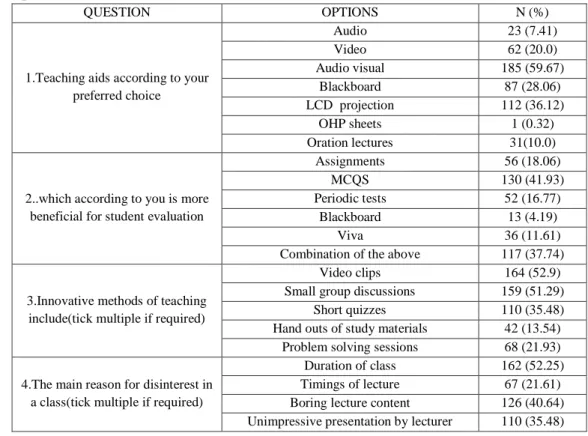
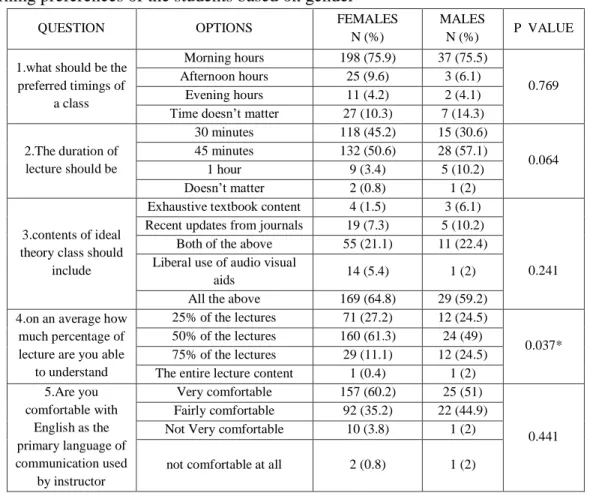
The study consisted of 15.8% males and majority of them belonged to 2ndBDS [24.19%]. Table 1, table 2 and table 3 shows descriptive statistics, learning preferences of the students based on gender and academic years respectively.
The common preferred choice of teaching aid was audio-visual, closely followed by LCD projection, blackboard. Most of the students opined that multiple choice questions are the most beneficial method of evaluating the students understanding of the subject. However a combination of assignments, multiple choice questions, periodic tests, viva was also opined to be a good evaluation strategy by considerable majority as well. Demonstrations of video clippings in the class, conducting small group discussions, short quizzes were among the top innovative methods of teaching as opined by students. Increased duration of the class was reported as the main reason for disinterest in a class followed by boring content and unimpressive presentation. Conducting class during morning sessions was thought to be a good practice by the students with no difference based on gender. However, there was significant difference in this regard between students from the different academic years. The opinion of duration of a lecture as reported by the students was 45 minutes. There was significant difference in the preferences for opinion duration of lectures based on academic years with students from higher academic years showing interest towards shorter classes.
An ideal theory class was opined to be inclusive of textbook content, recent updates from journals, liberal use of audio visual aids. Though there was no significant difference in this regard based on gender, significant difference was observed based on academic years of the students. Males reported understanding higher percentage of the lecture compared to the females. No pattern was identified in this regard based on academic years of the students. Most of the students reported being very comfortable/fairly comfortable hearing English as the language of communication.
Table 1: Descriptive Statistics
QUESTION OPTIONS N (%)
1.Teaching aids according to your preferred choice
Audio 23 (7.41)
Video 62 (20.0)
Audio visual 185 (59.67)
Blackboard 87 (28.06)
LCD projection 112 (36.12)
OHP sheets 1 (0.32)
Oration lectures 31(10.0)
2..which according to you is more beneficial for student evaluation
Assignments 56 (18.06)
MCQS 130 (41.93)
Periodic tests 52 (16.77)
Blackboard 13 (4.19)
Viva 36 (11.61)
Combination of the above 117 (37.74)
3.Innovative methods of teaching include(tick multiple if required)
Video clips 164 (52.9)
Small group discussions 159 (51.29)
Short quizzes 110 (35.48)
Hand outs of study materials 42 (13.54) Problem solving sessions 68 (21.93)
4.The main reason for disinterest in a class(tick multiple if required)
Abhilash Gade et al IJSRE Volume 06 Issue 02 February 2018 Page 7838 Table 2: Learning preferences of the students based on gender
QUESTION OPTIONS FEMALES
N (%)
MALES
N (%) P VALUE
1.what should be the preferred timings of
a class
Morning hours 198 (75.9) 37 (75.5)
0.769 Afternoon hours 25 (9.6) 3 (6.1)
Evening hours 11 (4.2) 2 (4.1) Time doesn’t matter 27 (10.3) 7 (14.3)
2.The duration of lecture should be
30 minutes 118 (45.2) 15 (30.6)
0.064 45 minutes 132 (50.6) 28 (57.1)
1 hour 9 (3.4) 5 (10.2)
Doesn’t matter 2 (0.8) 1 (2)
3.contents of ideal theory class should
include
Exhaustive textbook content 4 (1.5) 3 (6.1)
0.241 Recent updates from journals 19 (7.3) 5 (10.2)
Both of the above 55 (21.1) 11 (22.4) Liberal use of audio visual
aids 14 (5.4) 1 (2)
All the above 169 (64.8) 29 (59.2) 4.on an average how
much percentage of lecture are you able
to understand
25% of the lectures 71 (27.2) 12 (24.5)
0.037* 50% of the lectures 160 (61.3) 24 (49)
75% of the lectures 29 (11.1) 12 (24.5) The entire lecture content 1 (0.4) 1 (2) 5.Are you
comfortable with English as the primary language of communication used
by instructor
Very comfortable 157 (60.2) 25 (51)
0.441 Fairly comfortable 92 (35.2) 22 (44.9)
Not Very comfortable 10 (3.8) 1 (2)
not comfortable at all 2 (0.8) 1 (2)
chi square test; p≤0.05 considered significant
Table 3: Learning preferences of the students based on academic year
QUESTIONS OPTIONS
I BDS N (%) II BDS N (%) III BDS N (%) IV BDS N (%) Interns N (%) P VALUE
1.what should be
the preferred
timings of a class
Morning hours 65
(91.5) 63 (84) 45 (78.9) 31 (51.7) 31 (66) 0.000* Afternoon hours 0 (0) 1
(1.3)
2 (3.5) 16 (26.7)
9 (19.1)
Evening hours 3
(4.2) 0 (0) 2 (3.5) 5 (8.3) 3 (6.4)
Time doesn’t
matter 3 (4.2) 11 (14.7) 8 (14.0) 8 (13.3) 4 (8.5) 2.The duration of
lecture should be
30 minutes 4
(5.6) 30 (40.0) 26 (45.6) 45 (75)
28 (59.6)
0.000*
45 minutes 59
(83.1)
37 (49.3)
30 (52.6) 15
(25)
19 (40.4)
1 hour 5 (7) 8
(10.7)
1 (1.8) 0 (0)
0 (0)
Doesn’t matter 3
(4.2)
0 (0)
0 (0) 0 (0)
0 (0) 3.contents of ideal
theory class
should include Exhaustive textbook content 2 (2.8) 0 (0)
1 (1.8) 3 (5)
1 (2.1)
0.022*
Recent updates
from journals
5 (7) 5 (6.7)
5 (8.8) 6 (10)
3 (6.4)
Both of the above 15
(21.1)
10 (13.3)
Abhilash Gade et al IJSRE Volume 06 Issue 02 February 2018 Page 7839
Liberal use of
audio visual aids
1 (1.4)
3 (4)
4 (7)
7 (11.7) 0 (0)
All the above 48
(67.6)
57 (76)
35 (61.4) 24 (40)
34 (72.3)
4.on an average
how much
percentage of
lecture are you able to understand
25% of the lectures 5 (7)
22 (29.3)
12 (21.1) 29 (48.3) 15 (31.9)
0.000* 50% of the lectures 49 (69) 43
(57.3)
35 (61.4) 30 (50) 27 (57.4)
75% of the lectures 17 (23.9)
8 (10.7)
10 (17.5) 1 (1.7) 5 (10.6)
The entire lecture content
0 (0)
2 (2.7)
0 (0)
0
(0) 0
(0)
5.Are you
comfortable with
English as the
primary language of communication used by instructor
Very comfortable 50
(70.4)
42 (56)
26 (45.6) 41 (68.3) 23 (48.9)
0.003* Fairly comfortable 20
(28.2)
29 (38.7)
29 (50.9) 17 (28.3) 19 (40.4)
Not Very
comfortable
1 (1.4)
4 (5.3)
2 (3.5) 2 (3.3) 2 (4.3) not comfortable at
all
0 (0)
0 (0)
0 (0)
0 (0)
3 (6.4)
DISCUSSION:
In our study the learning style preferences were divided into four categories. They are unimodal, bimodal, trimodal, multimodal (greater than three) modes of learning. In our study, of 310 students, majority of the them (61.93%) preferred the unimodal instruction. Nearly 22.25% of the students preferred to use bimodal learning, followed by nearly 12% students who preferred trimodal learning. The audiovisual modality was the most preferred unimodal learning style among both male (49%) and female (60.9%) students, followed by the LCD projection (40.8% males and 35.2% females). Contrary to this, a study conducted by Nandita Shenoy et al reported that majority of the participants (70.7%) preferred the multimodal learning. Nearly 38.3% preferred quad modal learning followed by 24.3% preferred unimodal learning, bi and trimodal learning were preferred by 20% each (4). In accordance to the previous studies (3), most of the learning preferences were multimodal, however, our study showed that least number of the students preferred using multimodal learning. Among the unimodals, many of them preferred visual (34%) followed by aural (26%) where as in our study 20% of them preferred video and 7.41% voted for aural. This may be due to the fact that in our study, these students might be at learning the benefits of conventional and customary instructive lectures. Earlier the Lectures by using chalk and board and discussions were the instructional methods used for teaching the dental students. However, recently the colleges have been observing other modes of instructions. Few studies on learning styles have been conducted among medical students in other countries and the results have shown variations, may be due to the use of different teaching methodologies at the premedical level .The students' preference for different teaching- learning methods had been attributed in the past to a number of reasons such as familiarity with the method, a positive outcome, etc. Having knowledge on the learners' learning styles is a vastly underutilized approach towards an improvement in the classroom instructions. One of the most serious challenges that dental educators face today is improving the level of student satisfaction with the curriculum and learning environment.
Abhilash Gade et al IJSRE Volume 06 Issue 02 February 2018 Page 7840
all the studies that the preference for increased modes of learning also increase with increase in academic year.
Although integration of science with clinical practice is a key objective of any dental curriculum, st udents often perceive that the mantra of survival in school is to pass the science courses by rote memorization and to discover the relevance of this material in actual practice. A substantial number of dental school students have a preference for several learning styles, yet dental faculty teach overwhelmingly in a single mode: the lecture. Lecturing is essentially a passive learning method that encourages rote memorization and note-taking as the means of assimilating knowledge. It is important for dental educators to recognize that students have different learning styles, to reflect on the effectiveness of their methods of instruction, and to consider accommodating other learning preference modalities. Students are generally aware of their learning strengths and weaknesses, and want relevant, useful information presented in a way that is comfortable, intellectually challenging, and time efficient. In addition, they seek a collaborative learning process with their instructors.
CONCLUSION:
It is time that dental institutions focus on the learning preferences of students and develop suitable teaching modalities rather than exceedingly rely on conventional teaching techniques. Adoption of multiple modes of teaching does not only have the advantage of keeping the students engaged in the learning process, but also provides an excellent opportunity to develop a good rapport between teachers and students thus leading to a collaborative learning experience.
REFERENCES:
1. Nagesh Raju G, Manjunath S.M, Dharmaraj B, Shrish Patil. A comparative evaluation of the learning styles among 1st, 2nd and final year MBBS students. International Journal of Basic and Clinical Pharmacology 2016; 5(6).
2. Runki Saran, Saurabh Kumar, Kalyana Chakravarthy Pentapati. Assessment of learning preferences among dental students using Visual, Aural, Read-Write, Kinesthetic questionnaire: An institutional experience. Journal of Dental Research and Review 2015; 2(1): 10-12.
3. Vaibhav Nayak J, Indudhara Pyati B, Girish Huchhakklla O, Yenni Veerabhadrappa V. Assessment of preferred learning modalities of undergraduate medical students using the visual-aural-read/write-kinesthetic questionnaire and the impact of gender. Journal of Advanced Research and Clinical Insights 2015.
4. Nandita Shenoy, Ashok Shenoy K, Ratnakar UP. The perceptual preferences in learning among dental students in clinical subjects. J Clin Diagn Res 2013; 7(8): 1683-85.
5. Robert J Murphy, Sarah A Gray, Sorin R Straja, Meredith C Bogert. Student learning preferences and teaching implications. J Dent Educ 2004; 68(8): 859-66.
6. Narayana Murthy C, Ramesh VL, Gowramma R. A study on VARK learning styles of SJM Dental college and hospital students Chitradurga. Journal of Educational Research and Medical Teacher 2014; 2(1): 33-36.
7. Randa Fathi Abidia, Bridget Stirling, Ambreen Azam, Ahmed El-Hejazi, Shaikha Al-Dukhail. Assessing female dental students learning style preference. Journal of Health Communications 2016; 2(1).