TECHNICAL UNIVERSITY OF CLUJ-NAPOCA
ACTA TECHNICA NAPOCENSIS
Series: Applied Mathematics, Mechanics, and Engineering Vol. 61, Issue IV, November, 2018
SMART DIE CASTING FOUNDRY ACCORDING TO
INDUSTRIAL REVOLUTION 4.0
Ali Serdar VANLI, Anil AKDOGAN, Kai KERBER, Sahin OZBEK, M. Numan DURAKBASA
Abstract: Nowadays, there are reports in the specialist media of so-called Industrial Revolution 4.0. According to this industrial revolution, the production is increasingly digitized and even component-driven production is mentioned. Additionally, production machines exchange extensive process data with one another and enormous amounts of data are analyzed for production optimization. These challenges will also be faced by the die casting industry. A smart die casting foundry, according to the definition of Industry 4.0, is a highly flexible production system that is able to produce small lot sizes and even single parts. To realize this foundry, various tools and concepts need to be adapted. The use of modern information technology and the flexibilization of machines and processes are necessary to achieve this goal. If machine and process data are accessible without barriers, there are lots of possibilities to link these and to carry out comprehensive optimization along the process chain of die casting. The logistics and processes of the foundry should be transparent and can be tracked at any time. The point of consumption of energy and resources are need to be visible, the material flows can be analyzed and optimized in detail. Complex interactions can also be deciphered and the entire system can be adjusted to an optimum operating point. To realize this vision there is still some challenges. Within the scope of this paper, practical potentials of different technologies and tools are presented with the adaption of Industry 4.0 to the die casting technology and production.
Key words: Industrial Revolution 4.0, Die Casting, Smart Foundry.
1. INTRODUCTION
The naming and concept of “Industry 4.0” was a part of the so-called “High-Tech Strategy” [1] which defines the focus of the research policy of the German government [2]. It was defined by a joint expert group of representatives from science, politics and business. Their aim was to define scientific goals which address the current and future challenges of society and industry.
The main challenges for the manufacturing industry today is the advancing globalization, a strong trend towards customized products and increasing disruption of established markets and technologies by destructive business models and new emerging technologies [3]. Mass production, which was prevailing over the last decades, is increasingly displaced by the
production of product variants and of individually customized single parts.
A second aspect that comes into play is the lack of utilization of modern information technologies in the manufacturing industry. The information technology (IT) that is used for production machines, the production infrastructure and the plant management usually is outdated, compared to the state of the art of modern IT products and consumer electronics.
Industry 4.0 is the use modern IT technology in manufacturing systems [4].
2. SMART FOUNDRY
The so-called “Smart Foundry” is intended to be the solution for the named challenges of the manufacturing industry. A “Smart Foundry” is a highly flexible production system, which is capable of producing single individual parts with highest precision, best quality and economic efficiency. Beside highly flexible production systems and processes, a component-driven logistic system is necessary to achieve this task. In order to meet the complexity of the given challenge, a far-reaching digitalization of the systems and its sub-systems is essential.
In the course of Industry 4.0 and the vision of a Smart Foundry a set of systems and concepts were defined. Well known are “The Internet of Things” and “The Analysis of Big Data”. In a direct context but less known are "Cyber-Physical Systems", surely because of the complexity of their definition. In the general public almost unmentioned, as too specific, are “Flexible Production Systems” and “The Component-Driven Production”.
Within the following chapters an interpretation of the systems and concepts adapted to the foundry industry and in particular to high pressure die casting (HPDC) is attempted.
3. CYPER-PHYSICAL SYSTEMS
A “Cyber-Physical System” (CPS) is a physical object or a process that is connected and interacting with a digital representation of that object or process [5].
A digital or virtual representation of a physical object or a process itself is not an innovation. For example process simulation has been used in the foundry industry in different variations and degrees of accuracy already for decades.
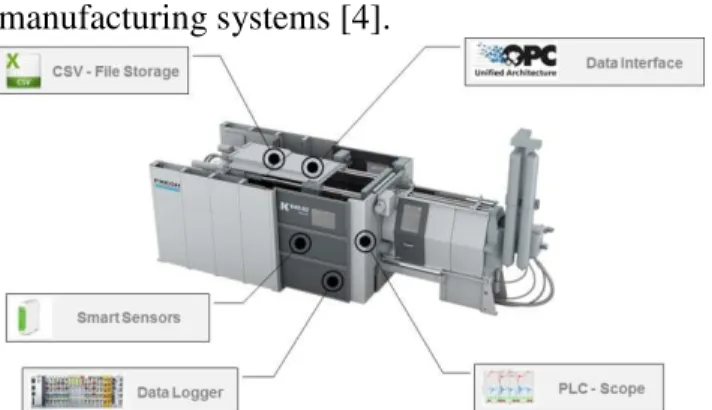
The definition of CPS includes a permanent digital interaction of the object from the physical world and the virtual representation. A permanent flow of data and information between both is the core of the CPS definition (Figure 1).
Fig. 1. Data flow of a modern HPDC machine.
In a foundry a permanent data transfer of machines, measuring systems and logistics components towards a modular virtual model of the foundry should take place. According to this data, which is representing the current situation of the production system and the processes, a modular networked simulation of the foundry permanently searches for possibilities to optimize the production and adjusts machines, processes and planning towards a multi-criteria (Figure 2).
Fig. 2. Networked CPS of a HPDC production cell.
especially quality data is not present as digital information.
It is essential that these gaps in data acquisition and the possibility of a response are closed, because only in this case a realization of a foundry CPS is possible. One of the most important steps towards a functional CPS and a challenge today is to digitize and network non-digital machines and processes.
4. INTERNET OF THINGS
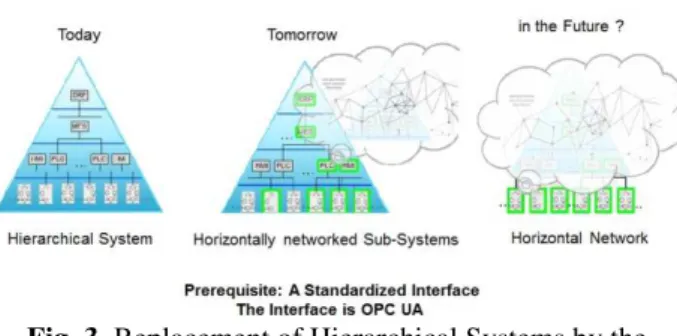
The idea behind the name “The Internet of Things” is to enable every device and even every sensor and actor in a production- or logistics-system to communicate with each other over a common digital network [6]. It is obvious, that this is a requirement to simplify the efforts that have to be made to realize a CPS network on one hand, and on the other hand to open up a large number of optimization potentials that is present by connection the so-called “information islands” of today's production and allow “Big Data Analysis” (Figure 3).
Fig. 3. Replacement of Hierarchical Systems by the Internet of Things.
According to the vision of a Smart Foundry, it is not only internally digitally connected but also with the external supply chain for the product to be produced. In the case of a foundry or die-casting plant it is conceivable that, according to the needs of current production of the foundry, casting alloys are ordered automatically by the Enterprise-Resource-Planning System (ERP) from alloying suppliers via a data connection between both ERP systems. Information about the different processing steps as well as the quality of processes and the part to be produced can be
transferred internally and externally between the single processes of the supply and process-chain allowing to individually adjusting machines and processes to achieve quality and best possible economic efficiency.
In order to gain benefits from a physical Internet of Things, a common way of information exchange is essential. No major improvements can be achieved, if a standardized information interface is not established in addition to the physical standardization that aims for an ethernet network.
Within the vision of Industry 4.0 the standard for digital information exchange between devices had been determined and is OPC-UA (Open Platform Communications Unified Architecture). OPC-UA is a platform independent protocol and interface as well as a modeling language for digital information [7]. It is secure and encoded and widely accepted and more and more implemented into various PLC systems and software products. With so called “Companion Specifications” industrial standards for information interfaces for production machines and consumer devices are defined.
A Smart Foundry and even Smart Factories in a networked supply chain is a network of hundreds or thousands of cyber-physical systems, which are connected to a common ethernet network exchanging data and information via OPC-UA.
5. ANALYSIS OF BIG DATA
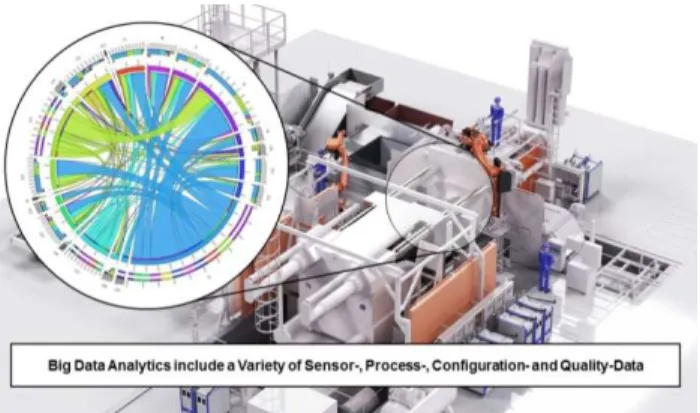
Algorithms and software tools for the analysis of big amounts of data and machine learning are available for many years. There is no need to develop new analysis tools for the manufacturing industry and as well not for the foundry industry. The same tools and algorithms used for other industrial applications, the IT industry, or commercial and non-commercial projects can be applied for analysis and control tasks for the foundry production and foundry processes (Figure 4). None the less one huge challenge must be overcome before machine learning and big data analysis can be integrated into the day to day work of the foundry industry.
Fig. 4. Big data analytics of a HPDC production cell.
A far-reaching problem is the quality data acquisition in the manufacturing industry. The definition of quality and rating systems are highly individual and often various ratings and quality definitions are present in a foundry, individually for each product. In addition, automated quality data acquisition of cast parts can only be realized with high effort and in many cases can’t be automated. A second problem is the linking of data from post casting processes and the different quality data acquisition processes to the casting production parameters. Only a minority of castings are marked with unique codes for identification and linking of data. The marking of many castings is not feasible for economic reasons. Nearly all machine learning algorithms need a quality feedback for learning purposes and can only be successfully used if detailed data is available. Since CPS depend on the formulation of a virtual model of the physical object or process, the so-called “Digital Twin”, and machine learning depend on the marking of cast parts
and extensive quality data acquisition, which both are not present today, it is very likely that for the foundry industry, and many other manufacturing industries, a step-by-step knowledge-based approach will be necessary to include data-driven systems into the control of foundry processes (Figure 5).
Fig. 5. Step-by-step knowledge-based approach.
6. FLEXIBLE PRODUCTION SYSTEMS
The major task of Industry 4.0 is to realize a highly flexible production system that is capable to produce casting parts with small lot sizes. Cyber-Physical Systems, The Internet of Things and Machine Learning Systems are support systems to archive this goal. The main manufacturing systems still have the function to carry out the production and therefore need to be as flexible and adaptable as physically and technically possible.
Many foundry processes are designed for mass production. In particular, casting processes with permanent molds are only economically profitable, if high production unit numbers can be calculated against the tool expenses. Since a complete individualization of consumer products is not very likely, more and more modular designs will be used to fulfill the costumer’s individualization requirements. Using a die casting process to produce a single part will most likely never be economical. But for small lot sizes and product variants, various new and common tool technologies can be used already today.
change-over process. Special technologies and trainings for a fast change-over are rarely to be found in today’s die casting plants. This situation is amplified by target values such as the maximization of the OEE (Overall Equipment Effectiveness), which often leads to specialization and the loss of flexibility of the personal and production systems. The Smart Factory, and in particular the Smart Foundry, has to deal with smaller and smaller lot sizes and an increasing number of change-over process during the day to day work. Therefore, equipment and personal needs are prepared in order to cope with the flexibility requirements of the future. It is very likely, that many rigid automation concepts are going to be replaced by manual work again, until automation technologies reach another flexibility level.
7. COMPONENT-DRIVEN PRODUCTION
Many manufacturing industries are subject to a constantly increasing variety of products and product variants. The same time lot sizes are decreasing. With this background it is very complex and error-prone to plan the production even today. A smart factory produces small lot sizes and single individual parts. This leads to a situation, where planning nearly is impossible. Having this situation in mind the so-called concept “Component-Driven Production” has been formulated. The idea of this concept for production control is actually stop actively planning and controlling the process chain of a product inside of the production. To achieve this, components needs to carry their construction plans and other information for manufacturing. The components then are left to a networked system of production machines (CPS in The Internet of Things) and a connected flexible logistics system. According to the actual situation and availability in the production facility, as well as the next construction step, the component are handed over by the logistics system to the production elements that are capable of performing the intended production steps. This way the components are taking individual paths towards the production plant without complex planning. In a manufacturing system like this, flexibility
and availability are getting more important than OEE for a specific production element. The overall OEE of the facility still is vital to produce economically but the monitoring of the lead time may be more of importance.
If it comes to primary shaping industries like the foundry industry, this concept obviously lets some questions arise. In a casting plant and in particular a die casting plant, there is no component to begin with. A component-driven production is only possible for the post casting processes of the plant. But there is an asset that is bound to the casting part to be produced, the die casting tool. It is possible to turn a die casting tool into a CPS carrying all information that is needed to realize a “tool-driven production”. Therefore a feasible solution for the production control of a Smart Foundry seems to be a tool-driven production for the foundry itself and a component-driven production for the post casting processes.
8. CONCLUSIONS
A Smart Foundry, according to the definition of Industry 4.0, is a highly flexible production system that is able to produce small lot sizes and even single parts. To realize this, various tools and concepts need to be adapted. The use of modern information technology and the flexibilization of foundry machines and foundry processes are necessary to achieve this goal. Traditional objectives and technologies could become less prosperous in the future. It is vital for many manufacturing industries and as well the foundry industry to participate in the change to come and to benefit from the substantial optimization potentials created by the new technologies and concepts.
9. REFERENCES
[1] The Federal Government,
High-Tech-Strategy
(https://www.hightech- strategie.de/de/The-new-High-Tech-Strategy-390.php), Berlin, (2017).
[2] Federal Ministry of Education and Research, Future Vision Industry 4.0,
BMBF, Berlin, (2013).
[3] Porter M., Heppelmann J., How Smart,
Competition, Harvard Business Review,
Vol. 92, No.11, pp. 65-88, (2014).
[4] Durakbasa N.M., Bauer J., Poszvek G.,
Advanced Metrology and Intelligent Quality Automation for Industry 4.0-Based Precision
Manufacturing Systems, Solid State
Phenoma, Vol. 261, pp.432-439, (2017). [5] Colombo A., Bangemann T., Karnouskos
S., Delsing J., Stluka P., Harrison R., Jammes F., Lastra J.L., Industrial
Cloud-Based Cyber-Physical Systems: The
IMC-AESOP Approach, Springer Verlag, Berlin,
(2014).
[6] Chui M., Loffler M., Roberts R., The
Internet of Things, McKinsey Quarterly,
Vol. 47, No. 2, pp. 1-9, (2010).
[7] Mahnke W., Leitner S.H., Damm M., OPC
Unified Architecture, Springer Verlag,
Berlin, (2009).
Turnatorie inteligenta in conformitate cu revolutia industriala 4.0
Rezumat: În zilele noastre, există rapoarte în mass-media de specialitate a așa-numitei Revoluții
Industriale 4.0. Conform acestei revoluții industriale, producția este din ce în ce mai digitizatăși se
menționează chiar producția bazată pe componente. În plus, mașinile de producție fac schimb de
date extinse despre proces și se analizează cantități enorme de date pentru optimizarea producției.
Aceste provocări se vor confrunta, de asemenea, în industria turnării sub presiune. O turnătorie de
turnătorie inteligentă, conform definiției industriei 4.0, este un sistem de producție extrem de
flexibil, capabil să producă loturi mici și chiar părți individuale. Pentru a realiza această turnătorie,
trebuie să fie adaptate diverse instrumente și concepte. Utilizarea tehnologiei informaționale
moderne și flexibilizarea mașinilor și a proceselor sunt necesare pentru atingerea acestui obiectiv.
Dacă datele mașinilor și proceselor sunt accesibile fără bariere, există o multitudine de posibilități
de a le lega și de a realiza o optimizare cuprinzătoare de-a lungul lanțului de procesare a turnării sub
presiune. Logistica și procesele turnătoriei trebuie să fie transparente și pot fi urmărite în orice
moment. Punctul de consum al energiei și resurselor trebuie să fie vizibil, fluxurile materiale pot fi
analizate și optimizate în detaliu. De asemenea, interacțiunile complexe pot fi descifrate, iar întregul
sistem poate fi ajustat la un punct optim de funcționare. Pentru a realiza această viziune există încă
unele provocări. În cadrul acestei lucrări, potențialul practic al diferitelor tehnologii și instrumente
este prezentat prin adaptarea Industriei 4.0 la tehnologia și producția de turnare sub presiune.
Ali Serdar VANLI, Yildiz Technical University, Department of Mechanical Engineering, 34349,
Istanbul, Turkey, [email protected]
Anil AKDOGAN, Yildiz Technical University, Department of Mechanical Engineering, 34349,
Istanbul, Turkey, [email protected]
Kai KERBER, Oskar Frech Gmbh & Co. KG, Schorndorfer Straße 32, 73614 Schorndorf,
Germany, [email protected]
Sahin OZBEK, Oskar Frech Gmbh & Co. KG, Schorndorfer Straße 32, 73614 Schorndorf,
Germany, [email protected]
M. Numan DURAKBASA, Vienna University of Technology, Department of Interchangeable