Original Research Article
Reliability and validity of the Mizo-version of neck disability index for
non-specific neck pain in the rural North-East Indian population
Andrew Lalchhuanawma
1*, Divya Sanghi
2INTRODUCTION
Non-specific neck pain is one of the most common complaints occurring among the middle aged, estimated to affect about two-thirds of the general population at some point in their life.1,2 Neck pain is a musculoskeletal
disorders often characterized by symptoms of muscle spasm, muscle weakness, joint stiffness, decrease range of motion, point tenderness, hypersensitivity etc.3,4
Prevalence rate increases with increasing age and females have higher incidence rates than that of males.2,4 Due to
its multi-factorial etiology, non-specific neck pain is often times link not only with the physical but the emotional and psychological disorders like depression and anxiety.5
There are several self-reported assessment tool for evaluating non-specific neck pain, and among them is the
1Department of Physiotherapy, 2Department of Faculty of Applied Sciences, Manav Rachna International Institute of
Research and Studies, Faridabad, Haryana, India
Received: 17 November 2019
Revised: 04 December 2019
Accepted: 10 December 2019
*Correspondence:
Dr. Andrew Lalchhuanawma,
E-mail: [email protected]
Copyright: © the author(s), publisher and licensee Medip Academy. This is an open-access article distributed under the terms of the Creative Commons Attribution Non-Commercial License, which permits unrestricted non-commercial use, distribution, and reproduction in any medium, provided the original work is properly cited.
ABSTRACT
Background: The Neck Disability Index (NDI) is an important self-assessment tool used extensively worldwide, in clinical practice with implications into scientific research fields. It is used to assess the extent of pain and levels of functional disability associated with neck pain. The NDI consists of 10 items where each item was scored from a scale of 0 to 5 giving the maximum score possible to 50. Though proven to be a reliable instrument in the English-speaking population, the NDI has never been validated and culturally adapted in the Mizo language among the rural north-east Indian region where English is not spoken as means of communication. The aim is to translate and cross culturally adapt the NDI into Mizo tawng (official language of Mizoram) with the objective of establishing reliability and validity of the M-NDI in patients with non-specific neck pain.
Methods: A total of 49 subjects participated voluntarily from the rural primary health care, Lunglei district, Mizoram. Subject having chronic non-specific neck pain lasting more than 3 months were included after taking a written formal consent.
Results: The internal consistency determined by Cronbach alpha, and the Intraclass Correlation Coefficient (ICC) using the test-retest reliability showed a good and an excellent reliability respectively (α=0.82, ICC=0.97, 95% CI= 0.95-0.98). Construct validity was determined between the variables-Numerical Pain Rating Scale (NPRS) and NDI by Pearson’s correlation coefficient and found to have a good correlation r=0.89 and significant difference at p<0.001.
Conclusions: The study results concluded the Mizo version of NDI to be easy to understand, reliable and valid instrument for measuring disability and functional limitations of daily activities in non-specific neck pain in the Mizo speaking population.
Keywords: Neck disability index,Neck pain, Reliability, Validity
Neck Disability Index (NDI) Questionnaire. The other instruments commonly employed for assessing neck pain includes the Neck Pain and Disability Scale (NPDS), the Neck Bournemouth Questionnaire (NBQ) and the Core Outcome Measures Index (COMI). These instruments measure the extent of disability and functional limitation with high psychometric properties in subjects with non-specific neck pain.6 The NDI instrument is employed in
this study as it is the most commonly used and widely accepted tool for assessing neck pain.
Most of the existing patient reported outcome measures today were developed to assess the English-speaking populations. Cross cultural adaptations and translations into different languages with standard protocol is required to validate the assessment tool. Keeping in mind the gold standard for selecting an appropriate self-reported questionnaire, the accountability of certain properties includes; the content of the construct measured and the feasibility of psychometric properties, the reliability and construct validity, sustainability and measurability of scores, and the quality of linguistic translation and adaptation.6,7
Though proven to be a reliable instrument, the psychometric properties of the NDI has never been culturally adapted or translated into Mizo tawng (official language of Mizoram). Currently, there are no available self-reporting questionnaires for assessing non-specific neck pain for the Mizo speaking population. The cultural adaptation and linguistic translation of the Mizo version (M-NDI) would provide an appropriate analysis and diagnosis. The successful interpretation would greatly be benefitted by the rural Indian population of Mizoram state where English is not spoken as means of communication.
The study aimed to translate and culturally adapt the patient reported outcome measure of NDI into Mizo language (an official language of Mizoram). The objective of the study is to establish the reliability and construct validity of the Mizo version in patients with non-specific neck pain. The present study will help eased future researchers and clinicians by providing an appropriate translated and culturally adapted assessment tool for non-specific neck pain patients.
METHODS
A sample for the study consisted of 66 consecutive community dwelling citizens from a period of first week of June to September 2019. The study was conducted at the outpatient department of the rural primary health care settings at Lunglei District, Mizoram. Individuals having non-specific neck pain lasting more than 3 months duration, who were in the age group between 18-55 were included in the study. Individuals who were non-cooperative, not willing to sign consent, illiterate, and with a history of cervical injury and recent surgery were excluded from the study. Subjects having lesions around
the cervical region, disk pathology with cervical radiculopathy and, other chronic diseases were also excluded from the study. Data wise 17 patients did not meet the eligibility criteria and were excluded from the study. A total of 49 subjects participated voluntarily for the study after taking a formal written consent. This study was approved by the Institutional Ethical Committee, Manav Rachna International Institute of Research and Studies, Faridabad. The socio-demographic data, anthropometric data, as well as the clinical parameters of the M-NDI was completed and re-assessed after a period of 1 week with inter-changing the itemized order format. The study followed the Belmont code of basic ethical principles, and the study subjects were briefed about the five pillars of basic research ethics viz. informed consent, confidentiality, anonymity, beneficence and privacy.8
Instruments
Neck Disability Index (NDI)
NDI is a type of self-evaluating survey used extensively for assessing the extent of pain and levels of functional disability due to neck pain. Based from the adaptation of Oswestry Low Back Pain Disability Questionnaire, the NDI is popularly used in clinical practice with implications into scientific research fields. NDI consists of 10 items; pain intensity, personal care, lifting things, reading books, headache, concentration, work, driving, sleeping, and leisure activity. Each item is scored on a 6-point rater Likert scale starting from 0 (Normal) to 5 (Maximum disability).9
The maximum total score possible is 50 which get standardized to 100 in terms of percentile. Subjects were asked to tick or circle the one choice from the given sections which most closely describe their problem. Some of the subjects found some items not applicable to their lives and this study allowed one missed item as suggested by Vernon.9 Each individual’s item score as well as the total items average score was then evaluated and recorded.
Numerical Pain Rating Scale (NPRS)
NPRS is the most widely used scale that is used for evaluating the intensity of pain. It consists of 11 sub points on a Likert Scale, measuring from 0-10. A score of 0 denotes no pain, whereas a maximum score of 10 signifies the worst type of pain imaginable. Subjects were instructed to circle/ mark on the 11 pointer Likert Scale that best described their pain.
Data analysis
Validity testing of psychometric properties
Data for all the variables were analyzed using SPSS software packages version 24.0. For reliability testing, Cronbach’s alpha and Intraclass Correlation Coefficient (ICC) using test-retest reliability were used for determining internal consistency. For determination of construct validity, the relationship between the items scored on the Numerical Pain Rating Scale (NPRS) and NDI was analyzed using Pearson’s correlation coefficient.
Procedure
Guidelines for cross-cultural adaptation
A report on the recent scientific journal doesn’t support the formation and development of new questionnaires, but rather stating the need to gather more information on the ones already standardized and validated in the English language.11,12 Beaton and his associates developed the
recommended guidelines for references to any linguistic translation and cross-cultural adaptation.12 This study
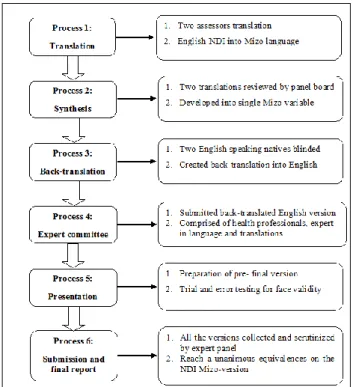
followed the standard protocol developed by Beaton et al. for linguistic translation of the Mizo-NDI, which comprised of 6 main processes (Figure 1). They are as follows;
• Process 1: The English version of the self-reported outcome measures of NDI was translated into Mizo language by two assessors or translators.
• Process 2: The two translated variables were reviewed by an external expert committee, following which it was adapted and compiled into a single Mizo variable.
• Process 3: Two independent expertise English orator and natives of Mizoram were asked to perform a backward translation, for adaptation of the unclassified Mizo NDI into English NDI. Both the translators were blinded to the original NDI English version.
• Process 4: The two versions of the backward language translations were submitted to the experts committee. The panel board was comprised of health professionals, expert in linguistic translations and scientific researchers.
• Process 5: The pre-final version of the NDI-Mizo was prepared by the expert committee. This tool underwent a trial and error sample testing for determination of face validity at face value. Female individuals usually found driving to be incoherent and opt to sit out item number eight from the questionnaire.
• Process 6: Submission of all the reports to the
committee is the last step in the adaptation process. The expert panel reached equivalence on the essential four broad areas as described by Beaton et al,: semantic equivalence (ensure equivalent
word-by-word translation), idiomatic equivalence
(ensuring similar colloquial expressions),
experiential equivalence (making sure that the experiential activities of daily living capture the intended cultures), and conceptual equivalence (making sure the item stays on course with the main concept).12
Figure 1: Processes of linguistic translation and cultural adaptation.
RESULTS
The demographic data- age and gender, and descriptive statistics of the variables- NPRS and NDI are provided in (Table 1 and 2).
Table 1: Demographic data.
Variables Mean SD
Age (yrs)
Minimum- 19
34.96 9.43
Maximum- 55
Gender
Frequency Percentage
Male 17 34.7
Female 32 65.3
Table 2: Descriptive statistics.
Variables Mean SD
NPRS 4.59 2.12
NDI 25.20 11.98
Reliability
reliability with α=0.82. All the total item scores for the samples were positively correlated and found to have a statistically significant difference (p<0.001) which means each of the items contributed significantly for the M-BDI score. The test-retest intra-rater reliability using Intraclass Correlation Coefficient (ICC), two-way mixed effects
model, absolute agreement definition was found to have an excellent reliability with ICC=0.97, 95% confidence interval (0.95-0.98). Table 3 represents the Intraclass correlation coefficient including the 95% Confidence Interval (CI) with a significant value.
Table 3: Intraclass correlation coefficient.
Intraclass
correlation
95% Confidence interval F test with true value 0
Lower bound Upper bound Value Df1 Df2 Sig
Single measures 0.97 0.95 0.98 84.398 48 48 0.000
Average measures 0.98 0.97 0.99 84.398 48 48 0.000
Two-way mixed effects model where people effects are random and measures effects are fixed.
Validity
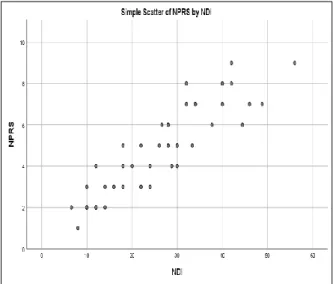
The Pearson’s Correlation Coefficient analyzed the P value and indicates a slight relationship (r=0.89) and a statistically significant correlation (p<0.001) between NPRS and M-NDI. The correlation between NPRS and NDI with significant level at 0.01 is given in (Table 4), and their correlation is represented by a simple scatter graph (Figure 2).
Table 4: Correlations between NPRS and NDI.
NPRS NDI
NPRS
Pearson correlation 1 0.89*
Sig. (2-tailed) 0.000
N 49 49
NDI
Pearson correlation 0.89* 1
Sig. (2-tailed) 0.000
N 49 49
*correlation is significant at the 0.01 level (2-tailed).
Figure 2: Simple scatter of NPRS by NDI.
DISCUSSION
This study was carried out with the aim to provide cultural adaptation and linguistic translation, and the objective of determining the reliability and validity of the M-NDI. Samples for the study consisted of individuals who visited the out-patient department with complaints of neck pain associated symptoms. The selected candidates were asked to rate the level of their pain using the NPRS variable which is a 11-pointer scale. A total of 49 subjects (17 males and 32 females) participated for the study, with the mean age of 34.96±9.43 (minimum 19 and maximum 55 years). The mean score for the variables NPRS and NDI was 4.59±2.12 and 25.20±11.98 respectively. Other study on the German NDI revealed a slightly higher mean value of 32.75±13.09.13
The study result ruled out biasing from ceiling/ floor effects which could influence the M-BDI as the
maximum and minimum possible scores from
respondents did not exceed the 15% barrier. The psychometric property of the particular item (No 8: driving) in NDI was literally translated to driving (2 or 4 wheelers) in the M-NDI. Still, it is the most missed item of the NDI (18.4%, N=9, 7 females and 2 males) which is still consistent with previous studies.14,15
The Intraclass Correlation Coefficient (ICC) is extensively used for test-retest reliability analysis and, intra-rater and interrater reliability analysis.17 ICC values
<0.5, 0.5 to 0.75, 0.75 to 90, and >90 indicates poor, moderate, good, and excellent reliability, respectively. The ICC value of the M-NDI after 1-week interval was 0.97, 95% CI (0.95-0.98) suggestive of an excellent reliability and a significant correlation with the total BDI score. Findings from this study are also consistent with the German, Arabic, Urdu and Greek version of the NDI.11,13,14,16
Construct validity is designed to measure what the construct item actually claimed to measure. Tests construct that claims to have a correlation, indeed, related are called convergent validity. On the other hand, test construct that doesn’t claim to have a relation, in fact, unrelated are divergent validity.18 The correlation
between NPRS and M-NDI was determined by Pearson’s correlation coefficient ‘r’ and found to have good correlation (r=0.89) and a statistically significant difference (p<0.001). Based upon the observed findings on the internal consistency, test-retest reliability and construct validity, study indicates the M-NDI to be reliable, consistent, easily adaptable and valid assessment tool for the Mizo culture.
CONCLUSION
The Mizo version of the NDI is found to be reliable, easy to comprehend, consistent and valid instrument tool for measuring disability and functional limitations of daily activities in non-specific neck pain in the Mizo speaking rural population of northeast India. It can be recommended for the Mizo culture in clinical practice and research settings.
Funding: No funding sources Conflict of interest: None declared
Ethical approval: The study was approved by the Institutional Ethics Committee
REFERENCES
1. Haldeman S, Carroll L, Cassidy JD. Findings from the bone and joint decade 2000 to 2010 task force on neck pain and its associated disorders. J Occupat Environm Med. 2010 Apr 1;52(4):424-7.
2. Hoy DG, Protani M, De R, Buchbinder R. The epidemiology of neck pain. Best Practice and Res Clin Rheumatol. 2010;24:783-92.
3. Tsakitzidis G, Remmen R, Dankaerts W, Royen PV. Non-specific Neck Pain and Evidence-Based Practice. Eur Sci J. 2013;9:1857-7431.
4. Tachii R, Sen S, Arfath U. Short-term effect of sustained natural apophyseal glides on cervical joint position sense, pain and neck disability in patients with chronic neck pain. Int J Therapies Rehabil Res. 2015;4(5):244.
5. Binder A. Neck pain. Clin Evid. 2006;15:1654-75. 6. Pellicciari L, Bonetti F, Di Foggia D, Monesi M,
Vercelli S. Patient-reported outcome measures for non-specific neck pain validated in the Italian-language: a systematic review. Archiv Phys. 2016 Dec;6(1):9.
7. Reeve BB, Wyrwich KW, Wu AW, Velikova G,
Terwee CB, Snyder CF, et al. ISOQOL recommends minimum standards for patient-reported outcome measures used in patient-centered outcomes and comparative effectiveness research. Quality Life Res. 2013 Oct 1;22(8):1889-905.
8. Barrow JM, Khandhar PB. Research Ethics. In: StatPearls. Treasure Island (FL): StatPearls Publishing;
2019 Jan-. Available at:
https://www.ncbi.nlm.nih.gov/books/NBK459281/. Accessed 22 June 2019.
9. Vernon H, Mior S. The Neck Disability Index: a study of reliability and validity. J Manipulat Physiol Therapeut. 1991.
10. Krebs EE, Carey TS, Weinberger M. Accuracy of the pain numeric rating scale as a screening test in primary care. J General Int Med. 2007 Oct 1;22(10):1453-8. 11. Shaheen AAM, Omar MTA, Vernon H. Cross-cultural
adaptation, reliability, and validity of the Arabic version of neck disability index in patients with neck pain. Spine. 2013;38(10):E609-15.
12. Beaton DE, Bombardier C, Guillemin F, Ferraz MB. Guidelines for the process of cross-cultural adaptation
of self-report measures. Spine. 2000 Dec
15;25(24):3186-91.
13. Cramer H, Lauche R, Langhorst J, Dobos GJ, Michalsen A. Validation of the German version of the Neck Disability Index (NDI). BMC Muscul Dis. 2014 Dec;15(1):91.
14. Trouli MN, Vernon HT, Kakavelakis KN,
Antonopoulou MD, Paganas AN, Lionis CD. Translation of the Neck Disability Index and validation of the Greek version in a sample of neck pain patients. BMC muscul Dis. 2008 Dec;9(1):106.
15. Chiu TT, Lam TH, Hedley AJ. Subjective health measure used on Chinese patients with neck pain in Hong Kong. Spine. 2001 Sep 1;26(17):1884-9. 16. Farooq MN, Mohseni-Bandpei MA, Gilani SA, Hafeez
A. Urdu version of the neck disability index: a reliability and validity study. BMC Muscul Dis. 2017 Dec;18(1):149.
17. Koo TK, Li MY. A guideline of selecting and reporting intraclass correlation coefficients for reliability research. J Chiropract Med. 2016 Jun 1;15(2):155-63.
18. Cronbach LJ, Meehl PE. Construct validity in psychological tests. Psychol Bull. 1955 Jul;52(4):281.