© 2019, IRJET | Impact Factor value: 7.211 | ISO 9001:2008 Certified Journal
| Page 779
Distillation Method
Ms. Farhin Khan
1, Dr. Anjani K. Dwivedi
21
Mtech Student, Department of Chemical Engineering, Ujjain Engineering College, Ujjain, India
2Head, Department of Chemical Engineering, Ujjain Engineering College, Ujjain, India
---***---Abstract -This research has conducted to study the difference between essential oil of lemongrass and eucalyptus oil. The essential oil is extracted from lemongrass stem and eucalyptus leaves using hydro distillation method by Clevenger apparatus. The effects of main operating parameters were studied: time to reach equilibrium, temperature (95 to130°C) and particle size (0.5 to 2.5 cm) of the fresh stem and leaves, to find the best processing conditions for achieving maximum oil yield. We have performed extraction process on two types of samples dry sample and wet sample of both grasses. After the experimental analysis we observed that the yield of wet sample is much greater than the yield of dry sample. And we also observed that the oil content in lemongrass stem is more than the eucalyptus leaves. The results showed that the temperature 130° C of the raw material of particle size 0.5 cm for 180 minutes give the highest percentage of oil (29 %). The extracted oil was examined by GC-MS.
Key Words: Essential Oils, Eucalyptus Leaves, Hydro distillation, Lemongrass, Optimization.
1. INTRODUCTION
1.1 Lemongrass
Lemon grass (Cymbogen citratus) is found in many parts of world. It is mainly grown as an ornamental plant however lemongrass has many other uses such as a food crop eg. It is used in herbal tea because of its sharp lemon flavor. It is used as the perfume in soaps and a medicine to treat various health ailments, decreasing acne, athlete’s foot, flatulence, muscles aches and scabies. Further, bioactivity studies have shown that the various components of this ingredient oil contains antimicrobial, antifungal, antibacterial and mosquito repellent properties make it a valuable product to be extracted. The citral isolated from oil is used in the manufacturing of vitamin A, Because of those attributes lemon grass is of great use and value in the agriculture sector, especially for the protection of stored agricultural product. Crude essential oils are obtained by steam distillation of variety of natural products like plants, grasses, wood stumps saw dust, flowers, kernel and social hygiene of mankind in terms of their use in cosmetics, toiletries, medicinal formulations, aroma therapy, surface coatings etc. Most of the essential or ingredient oil occurring in nature consists of mixture of hydrocarbons like terpens, sequiterpenes, oxygenated compounds like alcohol esters, ether, aldehydes,
ketones, lactones, phenols and waxes. Out of these oxygenated compounds like alcohols are the principal odour carriers. They are more stable against oxidation agents. The unsaturated hydrocarbon like terpenes are less stable and are responsible for degrading oils. To make essential or ingredient oils more stable, so that they retain most of their odor and flavor, these terpenes are removed so that only oxygenated compounds are retained.
The lemon grass oil is obtained by hydro distillation of lemon grass. It is the most common and cheapest oil available in market. The hydro distillation process to obtain ingredient oil from leaves and the aromatic industry use this method because it is cheap when compared with technologically advanced methods as supercritical fluid extraction.
Table.1 The Physical and Chemical Properties of Lemongrass Oil
Colour Pale Yellow to Vivid Yellow
State Liquid-oil
Odour Very strong and stimulating characteristic lemon odour
Taste Like lemon
Major Components Geranial
Molecular formula C10H18O
Molecular weight 154.253
Boiling Point of oil 224.00 °C. @ 760.00 mm Hg
Density of oil 0.8894 gm./cm3
Solubility 1. Insoluble in water;
2. Soluble in alcohol;
3. Miscible in oil; fats; paraffins; ether; chloroform and glacial acetic acid.
© 2019, IRJET | Impact Factor value: 7.211 | ISO 9001:2008 Certified Journal
| Page 780
1.2 Eucalyptus Leaves
Eucalyptus oil C10H18O, is one of the most important essential oil. The oil is extracted from fresh and dried leaves. Eucalyptus oil has biological effects, antibacterial, antiviral and antifungal components and long history of use against the effect of cold, influenza, other respiratory infection, rhinitis and sinusitis. Essential oils chemistry is very complex; in nature essential oils themselves have many chemical ingredients. Some of them play a major part and others a minor part. The ingredients found in essential oils are organic due to their molecular structure which is based on carbon atoms held together by hydrogen atoms. Oxygen atoms and sometimes nitrogen and sulphur atoms are also present. They can be essentially classified into two groups:
A. Volatile Fraction: Essential oil constituting of 90–95% of the oil in weight.
B. Nonvolatile Residue: This comprises 1–10% of the oil, containing, fatty acids, sterols, carotenoids, waxes, and flavonoids.
Table.2 The Physical and Chemical Properties of Eucalyptol
Colour Pale yellow liquid
State Liquid-oil
Odour Camphoraceous odour
Taste Pungent and cooling taste.
Major Components 1, 8-Cineole
Molecular formula C10H18O
Molecular weight 154.25
Boiling Point of Cineole
(Eucalyptol)
176 0C to 177 0C;
Density of oil 0.921 to 0.923
Solubility 1. Insoluble in water;
2. Miscible in alcohol having high concentration or in anhydrous alcohol;
3. Miscible in oil; fats; paraffins; ether; chloroform and glacial acetic acid.
2. Materials & Methods
2.1 Materials used
Lemongrass, eucalyptus leaves, Clevenger apparatus, heating mental, chopping board, knife, separating funnel, gas chromatography.
2.2 Experimental set-up
The schematic diagram of experimental setup is shown in fig.1. The experiment was conducted in a Clevenger’s Apparatus. Apparatus consists of one round bottom flask of 1000ml which holds raw material. And further it is connected with a glass tube condenser through the connecter. The separating funnel is used for the separation of essential oil and water.
2.3 Experimental Procedure
2.3.1 Sample Preparation of Dry Lemongrass
Fresh lemongrass was collected. Fresh and healthy lemongrass was selected and washed with tap water to remove the dust and dirt over its surface. After draining free water on the surface of the lemongrass stem. It has been refrigerated for one night and then second day it was taken out from refrigerated and was shade dried under a fan for about 60 minutes. The fan dried stem was chopped in to different sizes like 2.5 cm, 2.0cm, 1.5cm and 0.5cm with the help of chopping board and knife.
2.3.2 Sample Preparation of Wet Lemongrass
Fresh lemongrass was collected from the field and Fresh and healthy lemongrass was selected and washed with tap water to remove the dust and dirt over its surface. After draining free water on the surface of the lemongrass stem, then weight 300 gms of grass and chopped in to a different pieces of various size of about 2.5 cm, 2.0cm, 1.5cm and 0.5cm length with a sharp edged knife.
2.3.3 Sample Preparation of Dry Eucalyptus leaves
Fresh leaves of Eucalyptus tree were collected. Fresh and healthy Eucalyptus leaves was selected and washed with tap water to remove the dust and dirt over its surface. After draining free water on the surface of the leaves. It has been refrigerated for one night and then second day it was taken out from refrigerated and was shade dried under a fan for about 60 minutes. The fan dried leaves were chopped in to different sizes like 2.5 cm, 2.0cm, 1.5cm and 0.5cm with the help of chopping board and knife.
2.3.4 Sample Preparation of Wet Eucalyptus leaves
© 2019, IRJET | Impact Factor value: 7.211 | ISO 9001:2008 Certified Journal
| Page 781
[image:3.595.37.288.155.346.2]draining free water on the surface of the leaves, then weight 300 gms of grass and chopped in to a different pieces of various size of about 2.5 cm, 2.0cm, 1.5cm and 0.5cm length on chopping board with a sharp edged knife.
Fig -1: Laboratory experimental setup
Hydro-Distillation procedure for laboratory experiment
Firstly distilled water was taken into a round bottom flask.
For chopped raw grass.
Then prepared leaves sample was placed in round bottom flask for distillation.
After this the round bottom attaching the connecting pipe to the condenser and a mercury thermometer was inserted in hole of the flask so as to touch the top of the leaves bed.
Then heating mental was switched on and kept in a pre-selected position to obtained desired rate of heating.
Observations of cumulative extracted oil volume, temperature of extraction chamber and energy meter reading were recorded at every 30 minutes time interval. The weight of hydrosol, spent eucalyptus leaves and lemongrass and left over water in the extractor was also recorded at the end of each distillation test.
At the end of process extracted eucalyptus and lemongrass oil were stored in refrigerator below 4oC for further analysis.
3. Result & Discussion
3.1 Comparatively Analysis of Lemongrass & Eucalyptus Essential Oil
Table 3 Comparative analysis Lemongrass & Eucalyptus Essential Oil
Sr.
No. Time (min)
Lemongrass Oil produced in ml/Yield
Eucalyptus Oil produced in ml/Yield
Dry Wet Dry Wet
1 30 5 7 2 4
2 60 11 15 7 10
3 120 18 23 10 13
4 180 23 29 12 16
5 240 24 30 13 18
6 300 25 31 13.5 19
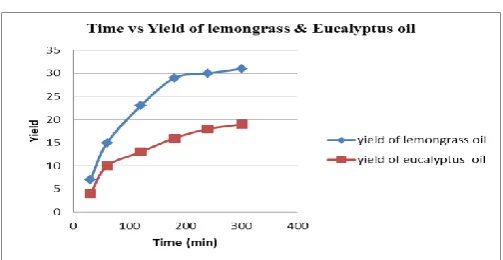
As we have seen the experimental data, the yield of wet sample is more than the yield of dry sample of both grasses. So , we compared the data of wet samples only and it shows that the yield of lemongrass essential oil is greater than the yield of eucalyptus oil, as we observed the reason behind that is we extracted the oil from lemongrass stem and eucalyptus leaves so, the oil present in stem is much greater than oil present in leaves. The analysis was done by GC-MS. The graphical results show the comparison between the yields of wet samples of both the grasses which are as follows:
GC-MS analysis and identification of Lemongrass & Eucalyptus Oil
The GC analysis showed that the major compound present in lemongrass essential oil is citral a or geranial (41.82%) and the major compound present in eucalyptus oil is 1-8 cineole (72.71 %).
Time vs Yield of lemongrass & Eucalyptus oil
[image:3.595.308.560.598.728.2]© 2019, IRJET | Impact Factor value: 7.211 | ISO 9001:2008 Certified Journal
| Page 782
The experimental analysis shows that the yield of both grass i.e. lemongrass and eucalyptus leaves depends upon the time of distillation process. As we have seen that the yield of lemongrass is more than the eucalyptus leaves. At 3 hours the yield of lemongrass was 29 but the yield of eucalyptus leaves was 16.
Temperature vs Yield of lemongrass & Eucalyptus oil
Chart-2: Temperature vs Yield of lemongrass & Eucalyptus oil
After analyzing the graphical data we can conclude that the temperature changed the yield percentage of the both grass. This graph also shows that the yield of lemongrass is more than the eucalyptus leaves. At the optimum temperature (130ºC) for lemongrass the yield was 31 but for optimum temperature (100ºC) of eucalyptus leaves the value of yield was 19.
Conclusions
According to the data obtained from the experiments carried out following are the conclusions drawn;
1. The amount of extracted oil from wet grass sample of lemongrass is more than the dry grass sample of lemongrass.
2. The amount of extracted oil from wet grass sample of eucalyptus leaves is more than the dry grass sample of eucalyptus leaves.
3. As we observed that distillation time is the affecting parameter of extraction of oil. The yield of extraction process has increased with extraction time from 30 minutes to 3 hours, but after that it reached at saturation or equilibrium condition. 4. The condition of grass also affects the yield, as
experimental data showed that as we decreased the size of grass the yield has increased.
5. The highest yield obtained at 180ºC, when the distillation process was carried out for 180 minutes (3 hours) for the grass size of 0.5 cm approximately.
6. The kinetic studies of distillation process showed that oil is not instantly extracted, it have taken certain time.
7. The yield percent is raised from 8% to 12% by using water as solvent. As no chemicals are used there is no need of purification for final product.
8. As we compared the yield of both lemongrass and eucalyptus, we observed that the yield of wet lemongrass is much much greater that the yield of wet eucalyptus leaves. From that we concluded that the oil content in stem is greater than the oil contain in leaves.
9. The gas chromatographic analysis of lemongrass oil showed that the major compound present in extracted oil is citral a (41.82%) and the percentage of remaining compounds are as follows- α-pinene (0.13%), β-pinene, delta-3-catrene (0.16%), myrcene (12.75%), dipentene (0.23%), β-phellandrene (0.07%), β-cymene (0.2%), methyl heptanene (2.62%), citronellal (0.73%), β-elemene (1.33%), β-caryophyllene (0.18%), citronellyl acetate (0.96%), geranyl acetate (3.00%), citral b (0.18%), geraniol (1.85%), elemol (1.2%) and β-caryophyllene oxide (0.61%).
10. The gas chromatographic analysis of eucalyptus oil showed that the major compound present in extracted oil is 1, 8-eucalyptol (72.71 %) and the percentage of remaining compounds are as follows- α-terpineol (2.54 %), terpinen-4-ol (0.34 %), linalool (0.24 %), α-pinene (9.22 %), and β-pinene (0.4 %), α-eudesmol (0.39 %), (-)-globulol (2.77 %), epiglobulol (0.44 %), α-terpineol acetate (3.1 %), geranyl acetate (0.71 %), L-pinocarveol (0.36 %), β-sabinene (0.25 %), andterpinolene (0.19 %).
References
1. A.E. Sadlon and D.W.Lamson, (2010), "Immune-Modifying and Antimicrobical Effects of Eucalyptus Oil and simple Inhalation Devices", Alternative Medicine Review, Vol.15 (1), pp. 33-47.
2. Aihua Song , Ying Wang , Yanmei Liu (2009), “Study on the chemical constituents of the essential oil of the leaves of Eucalyptus globulus Labill from China” Asian Journal of Traditional Medicines, 4 (4) pp. 134-140.
3. Alwani Hamad, Anggi Nuritasari, Dwi Hartani, (2017), “Chemical Composition and Antimicrobial Study of Essential Oil of Lemongrass (Cymbopogon Citratus).” Scholar Research Library, Vol. 9 [5]:109-106.
© 2019, IRJET | Impact Factor value: 7.211 | ISO 9001:2008 Certified Journal
| Page 783
Journal of Agricultural Sciences ISSN: 2167-0447 Vol. 4(12), pp. 351-366.
5. Aswati Mindaryani and Suprihastuti Sri Rahayu, (2007), Essential Oil from Extraction and Steam Distillation of Ocimum Basillicum, World Congress on Engineering and Computer Science, WCECS ,San Francisco, USA.
6. Atish A. Yadav, Sushmita S. Chikate,Rebika B. Vilat Mahesh A. Suryawanshi, Vijay B. Mane, (2017), “Extraction of Essential oil From Plant Leaves”, Scientific Journal of Impact Factor (SJIF), Volume 4, Issue 4, pp. 882-884.
7. Atti-santos A.C., M.Rossato, L.A.Serafini, E.Cassel, and P.Moyna, (2005), “Extraction of essential oils from lime by hydro-distillation and supercritical carbon dioxide”, Brazilian archives of biology and technology vol.48, n. 1: pp. 155-160.
8. Bakkalli F., S. Averbeck, and D. Averbeck, (2008), “Biological effects ofessential oils- a review” Food Chem. Toxicol., 46(2): pp. 446-475.
9. Bankole, S.A. and Joda, A.O., (2004), “Effect of lemon grass (Cymbopogon citratus Stapf) powder and essential oil on mould deterioration and aflatoxin contamination of melon seeds (Colocynthis citrullus L.)” African Journal of Biotechnology, 3(1), pp.52-59.
10. Basma A. Abdul-Majeed, Asrar A. Hassan and Badoor M. Kurji, (2013), “Extraction of Oil from Eucalyptus Camadulensis Using Water Distillation Method” Iraqi Journal of Chemical and Petroleum Engineering Vol.14 (2) pp. 7- 12.
11. Baya Berka-Zougali, Mohamed-Amine Ferhat, Aicha Hassani, Farid Chemat, and Karim S. Allaf, (2012), “Comparative Study of Essential Oils Extracted from Algerian Myrtus communis L. Leaves Using Microwaves and Hydrodistillation”, Internatioanl Journal of Molecular Sciences, 13(4): pp. 4673– 4695.
12. Boland D. J., J. J. Brophy and A. D. House, (1991), “Eucalyptus Oils Use: Chemistry, Distillation and Marketing”, Inkata Melbourne. pp. 252.
13. C. F. Silva, F.C. Moura, M. F. Mendes and F. L. P. Pessoa, (2011), “Extraction of Citronella (Cymbopogon nardus) Essential Oil using Supercritical CO 2 : Experimental Data and Mathematical Modelling.” Brazilian Journal of Chemical Engineering, Vol. 28, No. 02, 343-350.
14. Carin von M¨ uhlen, Claudia Alcaraz Zini, Elina Bastos Caram˜aob, Philip J. Marriott, (2008), “Comparative study of Eucalyptus dunnii volatile oil composition using retention indices and comprehensive two-dimensional gas chromatography coupled to time-of-flight and quadrupole mass spectrometry” Journal of Chromatography A 1200, pp. 34–42.
15. Chen Zhi-linga ,Chao Jian-pinga, Cao Hui-linb, Bi Wei-taoa, Cui Hai-yana, Li Mo-lina, (2011), Research on the Extraction of Plant Volatile Oils Procedia Environmental Sciences 8, pp. 426 – 432.
16. D. Ganjewala, (2009), “Cymbopogon essential oils: Chemical compostion and bioactivities.” International Journal of Essential Oil Therapeutics, Vol. 3, 56-65.
17. D.K.Saxena, S.K.Sharma and S.S.Sambi, (2011), "Comparative Extraction of Cottonseed Oil By N-Hexane And Ethanol", ARPN Journal of Engineering and Applied Sciences, Vol. 6(1), PP. 84-89.
18. Daizy R. Batish , Harminder Pal Singh , Ravinder Kumar Kohli , Shalinder Kaur , (2008) “Eucalyptus essential oil as a natural pesticide” Forest Ecology and Management 256 pp. 2166–2174.
19. Desai, M.A. and Parikh, J., (2015), Extraction of essential oil from leaves of lemongrass using microwave radiation: optimization, comparative, kinetic, and biological studies. ACS Sustainable Chemistry & Engineering, 3(3), pp.421-431.
20. E. Cassel and R.Vargas, (2006), "Experiments and Modeling of the Cymbopogon winterianus Essential Oil Extraction by Steam Distillation", J. Mex. Chem. Soc., Vol. 50(3), pp.126-129.
21. Enoque L. Lima and Paulo Roberto H. Moreno, (2007), “Chemical Composition and Antimicrobial Activity of the Essential Oils from Two Species of Eucalyptus” Phytother. Res. 21, pp. 231–233.
22. Farah, A., M. Fechtal, A. Chouch and S. Zarira., (2002), The essential oil of Eucalyptus Camaldulensis and its natural hybrid (clone 583) from morocco. Flav. Fragr. J., 17: 395-7.
23. G. Ernest, (1948), "The Essential Oils", Dr.Van Nostrand publishing company, Vol.(1), 4thedition, 427 pages.
© 2019, IRJET | Impact Factor value: 7.211 | ISO 9001:2008 Certified Journal
| Page 784
25. Ganjewala Deepak And Gupta Ashish Kumar, (2013), “Lemongrass (Cymbopogon flexuosus Steud.) Wats Essential Oil: Overview and Biological Activities”, RPMP Vol. 37: Essential Oils–II, pp. 233-274
26. Hanaa, A.M., Sallam, Y.I., El-Leithy, A.S. and Aly, S.E., (2012), Lemongrass (Cymbopogon citratus) essential oil as affected by drying methods. Annals of Agricultural Sciences, 57(2), pp.113-116.”.
27. Handa, K.S., L.G. and D.D.Rakesh, (2008), “Extraction Technologies for Medicinal and aromatic Plants”, International Center for Science and High Technology. pp.115-141.
28. J. Kabuba and R. Huberts, (2009), " Steam Extraction of Essential Oils: Investigation of Process Parameters", The Canadian Journal of chemical Engineering, Vol. 87, PP. 915-920.
29. J. Ranjitha and S. Vijiyalakshmi, (2014), “Facile Methods For The Extraction Of Essential Oil From The Plant Species - A Review”, International Journal Of Pharmaceutical Sciences And Research, ISSN (Print): 2320-5148.
30. Jiangxi Province Jishui County Hongda Natural Perfume Co.,(2010), " DATA SHEET OF EUCALYPTOL".
31. Khalid M. Abed1*, Badoor M. Kurji2, Basma A. Abdul-Majeed1, (2015), “Extraction and Modelling of Oil from Eucalyptus camadulensis by Organic Solvent” Journal of Materials Science and Chemical Engineering, 3, pp. 35-42.
32. Koul, V.K., Gandotra, B.M., Koul, S., Ghosh, S., Tikoo, C.L. and Gupta, A.K., (2004), Steam distillation of lemon grass (Cymbopogon spp.).
33. Wissal Dhifi, Sana Belili, Sabrine Jazi, Nada Bahubali, Wissem Mnif (2016) “Essential oils’ Characterization and Investigation of some Biological activities: A critical review.” “MDPI Journal” Vol. 3, 25-36.
34. Luiz Henrique Castelan Carlson, Ricardo Antonio Francisco Machado, Cinthia Bittencourt Spricigo, Lia Kru¨cken Pereira, Ariovaldo Bolzan, (2001), Extraction of lemongrass essential oil with dense carbon dioxide, Journal of Supercritical Fluids 21, pp. 33–39.
35. Lynn M. Hedges and Charles L. Wilkins, (1991), “Component Analysis of Eucalyptus Oil by Gas Chromatography-Fourier Transform-Infrared
Spectrometry-Mass Spectrometry” Journal of Chromatographic Science, Vol. 29, pp. 345-350.
36. M.A.Suryawanshi, V.B.Mane, G.B.Kumbhar, (2016), Methodology To Extract Essential Oils From Lemongrass Leaves: Solvent Extraction Approach, International Research Journal of Engineering and Technology (IRJET) e-ISSN: 2395 -0056 Volume: 03 Issue: 08, pp. 1775-1780.
37. Masamba, W.R.L., Kamanula, J.F.M., Henry, E.M. and Nyirenda, G.K.C., (2003), “Extraction and analysis of lemongrass (Cymbopogon citratus) oil: an essential oil with potential to control the larger grain borer (Prostephanus truncatus) in stored roducts in Malawi”, Malawi Journal of Agricultural Sciences, 2(1), pp.56-64.
38. Nandini Gautam, Anil K. Mantha, and Sunil Mittal, (2014), Essential Oils and Their Constituents as Anticancer Agents: A Mechanistic View, Hindawi Publishing Corporation BioMed Research International, Volume 2014, Article ID 154106.
39. Neeraj Singh, Prasahant Shrivastava and Mumtaj Shah, (2014), “Microwave-assisted extraction of lemongrass essential oil: Study of the influence of extraction method and process parameters on extraction process.” Journal of Chemical and Pharmaceutical Research, Vol. 6 (11): pp. 385-389.
40. Ragula, U.B.R., Devanathan, S. and Mohan, R., (2016), “Solar based lemon grass essential oil distillation for sustainability and livelihood in tribal community”, Global Humanitarian Technology Conference (GHTC), pp. 738-744, IEEE.
41. Seid Yimer, Manoharan and Omprakash Sahu, (2014), “Extraction of Essential oil from Eucalyptus Leaves as Antibacterial Application on Cotton Woven Fabric” International Journal of bacteriology, Virology and Immunology 1(1): pp 001-007.