© 2019, IRJET | Impact Factor value: 7.211 | ISO 9001:2008 Certified Journal | Page 1880
EXPERIMENTAL STUDY ON THE MECHANICAL PROPERTIES OF
CONCRETE USING GLASS FIBRES
Namratha R K
1, Shrujana N
2, Manjunath B
3, Prashanth M
41,2
Student, Department of Civil Engineering, K. S. School of Engineering, Bengaluru, India.
3,4Assistant Professor, Department of Civil Engineering, K. S. School of Engineering, Bengaluru, India
---***---Abstract:- In this paper an attempt is made to study thestrength properties of concrete using Glass fibers. Use of fibres in concrete can control crack formation due to plastic shrinkage and to drying shrinkage. They also reduce permeability of concrete which in turn reduces bleeding of water. Here in present work Anti-Crack HD Alkali Resistant glass fibres are used. Based on the laboratory experiment on fiber reinforced concrete (FRC), cube and cylinders specimens have been designed with Glass Fibre Reinforced Concrete (GFRC) which is a combination of water, polymer, chemical admixtures and glass fiber. The fibres take the place of steel in a wet-cast. The GFRC mix contains fibres of 0%, 0.5%, 1%, 1.5%, 2% and 2.5% volume fraction of Alkali-resistant Glass Fibres by weight of cement were used with addition of 0.5% of super plasticizer by the weight of cement to enhance the workability.
In this process specimens are casted and the tests are conducted for compressive strength, split tensile strength for M30 grade concrete mix for 7, 14 and 28 days from the day of casting.
Keywords:- Fibre Reinforced Concrete, Glass Fibres,
Compressive Strength, Tensile Strength.
I. INTRODUCTION
The cement concrete is a well-known construction material in the field of civil engineering and it has a several desirable properties like high compressive strength, stiffness, durability under normal environmental factors. At the same time concrete is brittle and possess a very low tensile strength. Concrete has some limitations like low tensile strength, a low strain at facture, no post cracking capacity, brittleness and low ductility, limited fatigue life and low impact strength. From many researches it has been known that, reinforcing concrete in tensile one or in both zones can yield a combination of good compressive and tensile strength. But in order to obtain ductility and durability the cracks should be minimized. The presence of cracks is responsible for weakness of cement concrete. This weakness can be removed by the addition of fibres such as Natural fibres: coconut coir fibres, Vegetable fibres, Cotton
fibres etc., and Artificial fibres: Carbon fibres, polymer fibres, Steel fibres, Glass fibres, Polypropylene fibres etc., in the concrete mixture.
II. LITERATURE REVIEW
[1] Chandramouli K et al., has carried out the work to know the performance of concrete and also they have observed that the workability of concrete will be affected when the glass fibres are added more than 1% to concrete mix. They have conducted compressive strength, split tensile strength for M-20, M-30, M-40 and M-50 grade of concrete at 28 days using 0.03% of chopped Cem-Fil-Crack HD glass fibres to the weight of concrete. 25% compressive strength, 30% of split tensile strength and 25% of Flexural strength increases at 28 days when compared to conventional concrete.
[2] Suresh Babu et al., they have carried out experimental study on the addition of glass fibre in concrete mix. The compressive strength increased by about 16.4% by the addition of 0.5%, 24.7% by the addition of 1% and 47.3% by the addition of 1.5% of glass fibre in M-25 concrete Similarly for M-50 concrete, 14.3% by addition of 0.5% of glass fibre, 22.3% by addition of 1% of glass fibre and 43.5% by addition of glass fibre over a conventional concrete.
[3] R.Gowri & M.AngelineMary, have conducted compressive strength, split tensile strength and flexural strength on M-20 grade of concrete for 28 days using Alkali Resistant (AR) glass fibres having aspect ratio of 125. They have observed that the workability of concrete will be affected when the glass fibres more than 1% are added to concrete mix, 15% of compressive strength and 29% of split tensile strength of concrete increases at 28 days compared to conventional concrete.
© 2019, IRJET | Impact Factor value: 7.211 | ISO 9001:2008 Certified Journal
| Page 1881
strength, 20% split tensile strength of the concreteincreases at 28 days compared to conventional concrete.
III.MATERIALSANDMETHODOLOGY MATERIALS USED
a. Cement
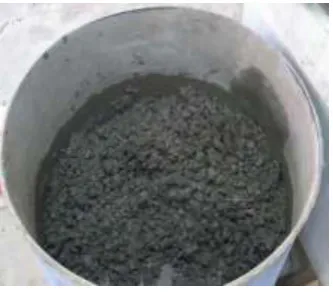
Here, in this present work the Ordinary Portland Cement - 53 Grade, confirming to IS: 12269-1987 has been used as shown in the Figure I.
FIGURE I.CEMENT
b. Fine Aggregates
Fine aggregate (crushed stone sand obtained from hard granite rocks) as shown in the Figure II passing through IS Sieve size of 4.75mm sieve has been used with water absorption of 1.5% .The sieve analysis conducted and it confirms to Zone I as per the specifications of IS: 383-1970.
FIGURE II.FINE AGGREGATES
c. Coarse Aggregates
Coarse Aggregate (obtained from hard granite rocks) as shown in the Figure III of size 20mm maximum and retained on IS Sieve size of 4.75 mm sieve has been used with water absorption of 1%. The sieve analysis of combined aggregates is conducted and it confirms to as per the specifications of IS: 383-1970 for graded aggregates.
FIGURE III.COARSE AGGREGATES
d. Glass Fibres
Glass fibres as shown in the Figure IV of effective length of 12mm and equivalent diameter 14µm, having the aspect ratio 857:1. Glass fibres Anti-Crack HD Alkali Resistant were been used. The numbers of fibres used per Kg is 212 million fibres. Information about fibres is given by manufacturer.
FIGURE IV.GLASS FIBRES
e. Water
Water as shown in the Figure V used in mix is potable water from the supply network system. It was free from suspended solids and organic materials which otherwise might have affected the properties of the fresh and hardened concrete.
© 2019, IRJET | Impact Factor value: 7.211 | ISO 9001:2008 Certified Journal
| Page 1882
f. Super Plasticizer0.5% of the Super Plasticizer Conplast-SP430 as shown in the Figure VI by the weight of cement is used as a chemical admixture.
FIGURE VI.SUPER PLASTICIZER
METHODOLOGY
1. The weighed materials of cement, fine and coarse
aggregates and glass fibres are placed on a large mixing tray which is clean and free from impurities.
2. Initially dry mix (cement, fine and coarse
aggregates) is done in a pan type concrete mixer with glass fibres to obtain uniform mix.
3. The required amount of water and super plasticizer
are added to the dry mix.
4. The concrete mix was then placed into the concrete
cube mould (150 mm × 150 mm × 150mm) in three successive layer with 25 blows each layer, with the help of a tamping rod , the top surface was then smoothened.
The concrete mould is placed in a safe place for 24 hours, after which the mould was opened and the concrete cube was placed in a curing tank for a specified period of time.
IV.EXPERIMENTAL PROGRAM
Experimental investigation is carried out for total 108 samples. The test is carried out for 7, 14 and 28 days respectively to understand the strength characteristics with varying percentages of glass fibres.
The study is to determine the characteristics like
1. Compressive strength of glass fibre reinforced concrete.
2. Tensile strength of glass fibre reinforced concrete.
A. Concrete Mix Design
Guidance for concrete mix design is taken from Indian standard IS: 10262-2009 for M30 grade concrete with water-cement ratio of 0.4 as shown in Table I.
TABLE I. ADOPTEDMIXPROPORTION
Cement aggregate Fine aggregate Coarse Water plasticizer
Super-1 1.89 2.90 0.4 0.5
B. Casting
First coarse aggregate, fine aggregate and cement were added into the pan type concrete mixer as shown in Figure VII. During the dry mix, varying percentage of glass fibres were added. 0.5% Super plasticizer was mixed with water and added to the matrix with mixing time is maintained about 10 minutes.
FIGURE VII. MIXING OF CONCRETE
[image:3.595.101.223.209.346.2] [image:3.595.301.567.230.290.2] [image:3.595.351.518.401.547.2]© 2019, IRJET | Impact Factor value: 7.211 | ISO 9001:2008 Certified Journal
| Page 1883
FIGURE IX.CURING OF SPECIMENSThe cube of size 150 × 150 × 150mm for compression test and cylinders of size 150 × 300mm for split tensile test were casted as shown in Figure VIII, cured as shown in Figure IX and tested using load controlled testing machine at loading rate for 7, 14 and 28 days respectively.
V.RESULTANDDISCUSSION a. Workability
The Slump test is conducted to know the Workability of glass fibre concrete. The results of workability tests on various percentages of glass fibres are tabulated in the Table II and their variations are plotted in the Figure X.
TABLE II. WORKABILITYTESTRESULTSOFDIFFERENT
PERCENTAGEVARIATIONSOFGLASSFIBRES
Glass fibres
(%) Obtained slump in mm
0 92
0.5 96
1 98
1.5 102
2 90
2.5 87
FIGURE X.VARIATION OF SLUMP OF FIBRE REINFORCED CONCRETE WITH VARYING % OF GLASS FIBRE
Observation: From the Figure X it is observed that the percentage increase of glass fibre, increase in the slump value up to 1.5%.
b. Compressive Strength
The 54 test cube specimens are tested in a compressive testing machine to determine the compressive strength.
The compressive strength of glass fibre reinforced concrete with the percentage variations of 0%, 0.5%, 1%, 1.5%, 2% and 2.5%of glass fibres to the weight of cement are tested and the obtained results are tabulated in the Table III and their different variations are plotted in Figure XI.
TABLE III. COMPRESSIVESTRENGTH(MPA)FOR
VARYING%OFGLASSFIBRE
Sl. No. Glass Fibre (%)
Compressive strength(MPa)
7 days 14 days days 28
1. 0 32.06 37.42 41.36
2. 0.5 40.94 48.68 52.67
3. 1 43.35 52.91 59.02
4. 1.5 45.33 57.11 62.42
5. 2 38.01 49.67 53.20
[image:4.595.306.551.127.292.2] [image:4.595.62.275.131.323.2]© 2019, IRJET | Impact Factor value: 7.211 | ISO 9001:2008 Certified Journal
| Page 1884
FIGURE XI.VARIATION OF COMPRESSIVE STRENGTH (MPA) FORVARYING % OF GLASS FIBRE
Observation: : From the Figure XI it is observed that the maximum strength of FRC increases by adding glass Fibre quantity up to 1.5% and beyond that it is observed that there is considerable decrease in strength. The maximum strength of glass fibre reinforced concrete is 45.33MPa for 7 days, 57.11MPa for 14 days and 62.42MPa for 28 days is observed.
c. Tensile strength
The 54 test cylinder specimens are tested in a compressive testing machine to determine the split tensile strength.
The tensile strength of glass fibre reinforced concrete with the percentage variations of 0%, 0.5%, 1%, 1.5%, 2% and 2.5% of glass fibres to the weight of cement are tested and the obtained results are tabulated in the Table IV and their different variations are plotted in Figure XII for 7, 14 and 28 days respectively.
TABLE IV. TENSILESTRENGTH(MPA)FORVARYING%
OFGLASSFIBRE
Sl. No.
Glass Fibre (%)
Tensile strength(MPa)
7 days 14 days 28 days
1. 0 2.97 3.58 3.97
2. 0.5 3.07 3.94 4.39
3. 1 3.35 4.19 4.63
4. 1.5 3.50 4.37 4.84
5. 2 2.97 3.82 4.21
6. 2.5 2.87 3.65 4.07
FIGURE XIIVARIATION OF TENSILE STRENGTH (MPA) FOR VARYING
% OF GLASS FIBRE
Observation: From the Figure XII it is observed that the maximum strength of FRC increases by adding glass fibre quantity up to 1.5% and beyond that it is observed that there is considerable decrease in strength. The maximum strength of glass fibre reinforced concrete is 3.50MPa for 7 days, 4.37MPa for 14 days and 4.84MPa for 28 days is observed.
VI.CONCLUSIONS
Based on the experimental results obtained in the present investigation the following conclusions can be drawn.
Glass fibre reinforced concrete have showed better
performance in the mechanical properties such as compressive strength and tensile strength over a conventional concrete. This may be due to bridging action of the glass fibres in presence of crack.
The compressive strength of glass fibre reinforced
[image:5.595.48.286.126.318.2] [image:5.595.315.559.137.411.2]© 2019, IRJET | Impact Factor value: 7.211 | ISO 9001:2008 Certified Journal
| Page 1885
The split tensile strength of glass fibre reinforced
concrete with glass fibre 1.5% of cement weight was found to be 3.50MPa for 7 days, 4.37MPa for 14 days and 4.84MPa for 28 days, compared to plain concrete it increased by 17.85% for 7 days, 22.07% for 14days and 21.91% for 28days.
At glass fibre percentage greater than 1.5%, there is
a decrease of compressive strength and split tensile strength.
ACKNOWLDEGEMENT
The authors wish to place on record the help provided by the management and the academic teaching and non-teaching faculties of K. S. School of Engineering and Management, in the completion of this current study.
We take pleasure in expressing our sincere thanks to Dr.Vijayalakshmi Akella, Head of the department, Department of Civil Engineering, K.S. School of Engineering and Management, Bengaluru.
REFERENCES
[1] CHANDRAMOULI K, SRINIVASA RAO P,
PANNIRSELVAM N, SESHADRISEKHAR T AND SRAVANA P, “Strength Properties of Glass Fibre Concrete” , ARPN Journal of Engineering and Applied Sciences, VOL.5,NO. 4, April-2010, PP-1-6.
[2] SURESH BABU.R, RAKESH.A.J AND RAMKUMAR.V.R,
“Strength and Permeability Characteristics of Fibre Reinforced Concrete”, IJREAT International Journal of Research in Engineering & Advanced Technology, volume 1, Issue 1, March-2013.
[3] R.GOWRI AND M.ANGELINEMARY, “Effect of glass
wool fibres on mechanical properties of concrete”, International Journal of Engineering Trends and Technology (IJETT)-Volume4Issue7 July 2013, PP- 3045-3048.
[4] SHRIKANT HARLE AND PROF. RAM MEGHE, “Glass
Fibre Reinforced Concrete & its Properties”, International Journal Of Engineering And Computer Science, ISSN:2319-7242 Volume 2 Issue 12 Dec-2013 PP-3544-3547.
[5] AVINASHGORNALE, S IBRAHIM QUADRI, S
MEHMOODQUADRI, SYED MDAKRAM ALI, SYED SHAMSUDDINHUSSAINI, “Strength Aspects of Glass Fibre Reinforced Concrete” , International Journal of Scientific & Engineering Research, Volume 3, Issue 7, July-2012.
[6] LIAQAT A. QURESHI & ADEEL AHMED, “An
Investigation on Strength Properties of Glass Fibre Reinforced Concrete”, International Journal of Engineering Research & Technology Vol.2 - Issue 4, PP- 2567-2572, April-2013.
[7] KAVITHA S KENE, VIKRANT S VAIRAGADE AND
SATISH SATHAWANE, "Experimental study on Behaviour of Steel and Glass Fibre Reinforced Concrete Composites," Bonfring International Journal of Industrial Engineering and Management Science, vol. 2, no. 4, pp. 125-130, Dec 2012.
[8] P. ARULSIVANANTHAM, "Experimental Study on usage
of Class-E Glass Fiber in the Cement Concrete," International Journal of Engineering Research & Technology (IJERT) ISSN: 2278-0181, vol. 4, no. 6, June 2015.
[9] Bureau of Indian Standards 10262:2009. “Concrete
Mix Proportioning – Guidelines".
[10]Bureau of Indian Standards 12269:1987. “Ordinary
Portland Cement, 53 Grade-Specification".
[11]Bureau of Indian standards 383:1970. “Specification