Labels constructively shape object categories in 10-month-old infants
Nadja Althaus1 Gert Westermann2
1Department of Experimental Psychology, University of Oxford, UK 2Department of Psychology, Lancaster University, UK
Keywords: Categorization, eye-tracking, cognitive development
All correspondence should be addressed to
Nadja Althaus, Department of Experimental Psychology, University of Oxford, Oxford, OX1 3UD, UK. Telephone: +44 (0)1865 271 384. E-mail:
and
Abstract
How do infants’ emerging language abilities impact on their organization of objects into categories? The question of whether labels can shape the early perceptual categories formed by young infants has received considerable attention, but evidence has remained inconclusive. Here, ten-month-old infants (N=80) were familiarized with a series of morphed stimuli along a continuum that can be seen as either one category or two. Infants formed one category when the stimuli were presented in silence or paired with the same label, but they divided the stimulus set into two categories when half of the stimuli were paired with one label and half with another. Pairing the stimuli with two different non-linguistic sounds did not lead to the same result. In this case infants showed evidence for the formation of a single category, indicating that non-linguistic sounds do not cause infants to divide a category. These results suggest that labels and visual perceptual information interact in category formation, with labels having the potential to constructively shape category structures already in preverbal infants, and that non-linguistic sounds do not have the same effect.
Abstract: 180 words
Labels constructively shape object categories in 10-month-old infants
One of the central questions in early language and cognitive development is how the emergence of language impacts on infants’ preverbal understanding of the world. In the past 20 years many studies have shown that even very young infants can rapidly form categories on the basis of the static perceptual features of objects (Behl-Chadha, 1996; French, Mareschal, Mermillod, Quinn, 2004; Mareschal & Quinn, 2001; Oakes, Coppage, & Dingel, 1997; Quinn, 2002; Quinn, 2004; Quinn, & Eimas, 1996) and that during the first year of life these early categories are gradually enhanced with more sophisticated knowledge such as feature correlations, sounds, motion, function, and animacy cues (Baumgartner & Oakes, 2011, Burnham, Vignes, & Ihsen, 1988; Pauen & Träuble, 2009; Perone & Oakes, 2006; Younger & Cohen, 1986). Other research has shown that in older children language can shape object categories by enabling the grouping together of perceptually dissimilar objects (such as dogs and whales as mammals) and the separation of similar objects (e.g., bats and birds) into different categories, as well as forming the basis for inferences about hidden object properties (Graham, Kilbreath, & Welder, 2004; Welder & Graham, 2001). There is also evidence that labeling aids object individuation by 12 months (Xu, Cote and Baker, 2005), and even younger infants at 9-10 months expect different labels to refer to different kinds of object (Dewar & Xu, 2007; 2009). However, although several studies have investigated the emerging effect of language on categorization in the first year of life they have yielded little agreement and it is not yet clear how linguistic information interacts with object representations that have developed preverbally.
facilitate object categorization, that is, whether the labeling of objects enables infants to form categories which they would not form without labels. The second question is whether, like in older children, labels can override nonverbal perceptual information and change the structure of perceptual categories when visual similarity and category labels are in conflict with each other.
Much of the work exploring early categorization is based on the familiarization/novelty-preference procedure (Fantz, 1964) which relies on the fact that infants tend to spend more time looking toward novel than toward familiar objects. In a typical study infants are familiarized with a sequence of objects from one category and are then tested with two new objects, one a novel member of the familiarized category and one from a different category. If infants show a looking preference to the object from the new category it can be concluded that they have formed a category that includes the novel within-category object but excludes the object from the different category. The emerging ability of language to shape categories has been studied in variants of this paradigm in which the objects presented during familiarization are accompanied by auditory labels or other sounds and the effect on infants’ looking preferences during test are investigated.
labeling with different novel words did not lead to category formation in 12-month-olds (Waxman & Braun, 2005). Other studies have aimed to provide evidence that consistent novel labels facilitate categorization in infants at 6 and even 3 to 4 months of age (Fulkerson & Waxman, 2007; Ferry et al., 2010). This and other work has led to the claim that words serve as ‘invitations to form categories’, enabling category formation by highlighting commonalities between objects with the same label (Waxman & Markow, 1995).
sequences usually disrupt visual category formation (Robinson & Sloutsky 2007a, 2007b).
A second limitation of the described labeling studies is that they familiarized infants with only a single category. Even if we assume that labels have a facilitative effect above and beyond presentation in silence, such a paradigm cannot answer the question of whether labels constructively interact with preverbal representations to shape category structures. It is a well-known finding that infants’ attention is maintained for longer in the presence of labels compared to silence (Baldwin & Markman, 1989; Robinson & Sloutsky, 2007; Althaus & Mareschal, 2014). The processes involved in this longer looking period may well have to do with more intensive visual processing, but not necessarily in the sense of using the information given by the label to adjust category boundaries. In familiarization with a single category an increase in novelty preference might simply be the outcome of an effectively prolonged stimulus exposure.
The question of a constructive role of category labels can be addressed by familiarizing infants with two separate but visually similar categories with two distinct labels simultaneously. This is similar to word learning studies that test whether infants can associate words and (individual) objects (Schafer & Plunkett, 1998; Werker, Cohen, Lloyd, Casasola, & Stager, 1998; Mani & Plunkett, 2008). This paradigm can then be used to answer the two questions posed above: if infants do not form categories in silence but are successful under labeling, then labels facilitate category formation. If infants successfully categorise in silence but form different
categories under labeling, then labels can serve to override visual information.
drawings of schematic animals based on the same set of four distinctive features. In the ‘broad’ set features were combined such that there were no discernable clusters of stimuli – the eight stimuli formed a single, large category. In the ‘narrow’ set the feature values were correlated (e.g., long-necked animals always had thick tails) and based on these correlations two subcategories of four stimuli could be formed. In Younger’s (1985) study 10-month-old infants were familiarized with the animal drawings in silence. Younger found that the infants were sensitive to the feature correlations and formed a single category for the broad set but two distinct categories for the narrow set. In a separate study Younger & Cohen (1986) showed that 4-month-old infants were not able to make use of feature correlations, indicating that this ability develops between 4 and 10 months of age.
Plunkett et al. (2008) introduced labeling into Younger’s (1985) paradigm. When 10-month-old infants were familiarized using the broad stimulus set and provided with the same label (“Look! Dax!”) for every stimulus, they formed one category, just like in silence. Likewise, when infants were familiarized with the narrow stimulus set and heard two different labels corresponding to the two subcategories, they formed two categories, again like in the silent case. However, importantly, when infants saw the narrow stimulus set but heard the same label for each stimulus infants formed a single category. Plunkett et al. argued that in this case the labels served to override visual categorization, leading the infants to merge two perceptually distinct categories when they shared a common label.
categories) and labels (one label) were in conflict led to overloading the infants, resulting in a more shallow processing of the visual information. This explanation is compatible with results showing that when complex stimuli (e.g., conflicting visual and auditory information) overload the learning system infants can regress to an earlier level of processing – here, that of 4-month-olds (Cohen, Chaput & Cashon, 2002). In this case, instead of the infants constructively using label information to merge two distinct categories they could merely have failed to detect the feature correlations that define the two categories in the first place and, like 4-month-olds, form a single category of the visual stimuli. One way to exclude the possibility that labels merely lead to shallower object processing is to conduct a study with a similarly ambiguous visual stimulus set which is in the absence of labels perceived as a single large category, but which is parsed into two subsets when two distinct labels are presented. In other words, distinct labels cause infants to divide a large category, rather than a single label causing them to merge two sets of objects. In this case deeper processing is a prerequisite for the change in category boundary since a more detailed representation is necessary for subcategory formation. Such a result would constitute evidence for a constructive effect of labels. This is the approach taken in our study.
familiarized with a stimulus set that allows parsing into one or two categories to show that labels can shape the encoded category structure in a way that goes beyond merely enhancing attention. Third, the task should be designed so that category formation in the presence of labels cannot be explained by the processing of less visual detail than when familiarized in silence. A fourth point concerns the difficulty of ensuring that looking preferences represent novelty, rather than familiarity preference. Previous work has demonstrated that infants’ mode of preference can change as a function of task complexity or duration of exposure (Hunter, Ames, & Koopman, 1983; Roder et al., 2000). Since the addition of (one or more) auditory stimuli arguably changes task complexity, a test trial including a visually novel test item is necessary to establish whether infants display a novelty preference (longer looking at the novel test item) or a familiarity preference (shorter looking at the novel stimulus; Cohen, 2004; Oakes, 2010). Note that Plunkett et al. (2008) did not include a novel test stimulus, which complicates interpretation of their results.
Here, we describe a study based on these considerations. We presented infants with a set of objects that we expected to be perceived as a single category when viewed in silence, and we asked whether pairing half of the objects with one label and half with another label would lead infants to split the objects into two categories according to their labels. This would require infants to use more detail for categorization with labeling than in the silent condition.
The overall logic of our study followed that of Younger (1985), but differences between objects were here not based on the variation in distinct features but on a holistic difference achieved by the morphing process. Infants were familiarized with eight objects, either in silence, with one or with two labels. If labels serve to constructively shape category structure infants should form a single category comprising all stimuli when familiarized in silence or when accompanied by a single label, but form two categories when two distinct labels are provided.
Experiment 1
Method
Participants
Sixty-three full-term 10-month-old infants participated in this study (mean age: 302 days, 28 girls). Infants were randomly assigned to either a silent (N=20), a two-label (N=20), or a one-label (N=23) condition. One additional infant was tested but excluded due to technical problems. Infants were recruited on a voluntary basis via local advertisements. Informed consent was received from the caregivers, and infants received a small gift for their participation.
Stimuli and Design
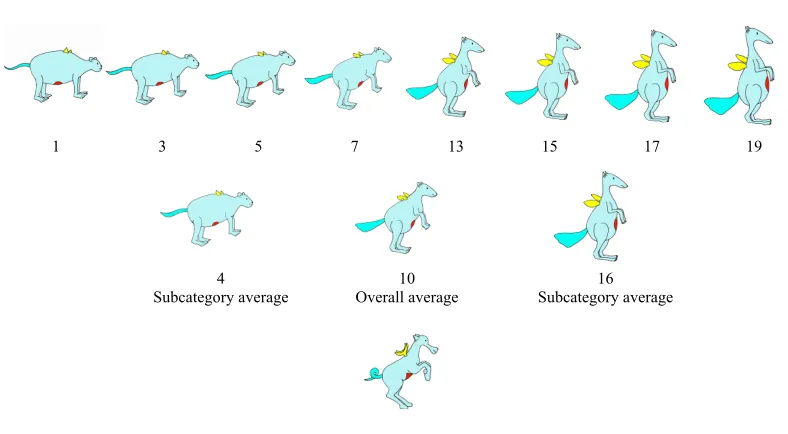
The familiarization and test stimuli are depicted in Figure 1. All stimuli were obtained by morphing Stimulus 1 into Stimulus 19 in 18 steps using the software MorphMagic. To ensure discriminability of the individual exemplars, only every second morphed image was used in the familiarization set. The gap between stimuli 7 and 13 ensured that there was a visual grounding for a division into two separate subcategories (stimuli 1, 3, 5, 7 and 13, 15, 17, 19, respectively). Choice of test stimuli followed the design of Younger’s (1985) study. It was assumed that infants forming one broad category would find the overall average stimulus (here, stimulus 10) less novel than more peripheral stimuli (here, stimuli 4 and 16). Conversely, infants who form two categories should find the overall average more novel because it falls between the categories, but should not show preference for the peripheral stimuli because they now fall into the center of each of the two categories. A novel test animal was constructed to establish whether infants were showing novelty or familiarity preference at test.
discriminate original animal drawings that served as the basis for morphing (e.g. tail, feet, ornament on tummy, wings, head shape), but looked different enough to be easily discriminable.
========== Figure 1 here ===========
Auditory stimuli
The auditory stimuli were the phrases “Look, a geepee!” and “Look, a boota!” recorded digitally from a female native speaker of British English in enthusiastic, infant-directed speech. The label (“A geepee!”/ “A boota!”) was repeated twice, thus occurring three times per stimulus. The onset of the first auditory phrase was at 2000 ms after the onset of the visual stimulus, with the labeling phrase (“A geepee/boota!”) repeated at 5000 and 8000 ms after stimulus onset. In the two-label condition, half of the infants heard the label “geepee” with stimuli 1, 3 ,5 ,7 and the label “boota” with stimuli 13, 15, 17, 19, and vice versa for the other half of the infants. In the one-label condition, half (N=12) the infants heard “geepee” paired with all eight stimuli, and the other half heard “boota” with all eight stimuli.
Procedure
accuracy: 0.5 degrees). During this procedure, a small animated object with accompanying sound was displayed at 9 locations (left, center and right for top, middle and bottom row) on the screen. Calibration was repeated up to 3 times, or until all 9 points had been calibrated successfully.
After the calibration procedure infants were presented with the 8 familiarization stimuli, shown in a pseudo-randomized order for on average 9750 ms (SE=22) each. Individual sequences were obtained by using 3 latin squares of 3 pseudo-random sequences, ensuring that no more than 3 consecutive stimuli were from the same subcategory. In the label conditions infants heard the labels as described above. Prior to the first trial, and in between all following trials, small animated video clips were shown at the center of the screen to direct infants’ attention to this location. Their duration varied between 800 ms and 1800 ms.
stimulus has been presented the overall average and subcategory averages will appear equally uninteresting to the participant, regardless of the category structure established by the end of familiarization.
The location (left/right) of the items on test trials 1, 3 and 5 was counterbalanced across infants. The test trials were silent in all conditions.
Results
Looking time during familiarization
In order to assess whether familiarization had occurred we compared average looking times during the first four and the last four familiarization trials in all three conditions. The data were submitted to a mixed 2-way ANOVA with between-subjects factor Condition (silent, two-label, one-label) and within-subjects factor Block (Block 1: trials 1-4 vs. Block 2: trials 5-8). There were significant main effects of Condition (F(2,60)=15.357, p<.001) and Block (F(1,60)=14.563, p<.001). The interaction between Condition and Block was not significant (F=0.087, p=.917). Post-hoc tests confirmed that infants in both label conditions had longer looking times than those in the silent condition (Two-label: M=8275 ms, SE=280; One-label: M=8274 ms,
SE=271; Silent: M=6249 ms, SE=271, both p<.001, Bonferroni-adjusted). Looking times between one- and two-label conditions did not differ significantly (p=.59). This result is consistent with previous studies showing longer looking under auditory input than in silence (Robinson & Sloutsky, 2007). Further, average looking times during Block 1 (M=7763 ms, SE=160) were higher than those during Block 2 (M=7113 ms,
collapsed data. This indicates that infants across all conditions had become familiarized by the end of the familiarization phase.
=========== Table 1 here ============
Preferential looking during test trials
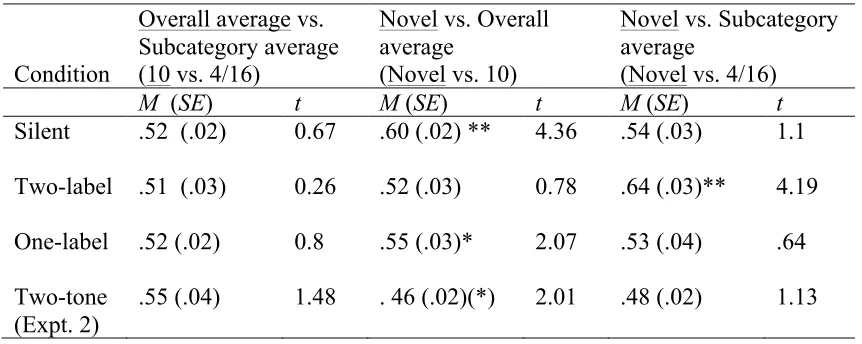
Test trial results are given in Table 1. For the first two test trials, a preference score for the overall average object was obtained for each infant by dividing the total looking time at the overall average object (no. 10) by the total looking time on that trial. For the remaining four test trials, a novelty preference score was obtained for each infant by dividing the looking time at the novel object by the total looking time on that trial. Preference scores for each pair of test trials (1 and 2, 3 and 4, 5 and 6) were calculated as the average between the two.
with the overall average stimulus (t(18)=4.36, p<.001, d = 1.0). This looking pattern indicates that the overall average, but not the subcategory averages, were more familiar than the novel exemplar. These results therefore indicate that in the silent condition infants formed a single category.
In the two-label condition, results for test trials 1 and 2 again showed no preference for either item (t(19)=0.279, p=.78). For the remaining test trials, the results from the silent and one-label conditions were reversed: infants showed no preference when the overall average and novel item were paired (t(19)=0.79, p=.43), but had a preference for the novel stimulus when paired with the subcategory averages (t(19)=4.17, p<.001, d = .94). These results indicate the formation of two categories in the two-label condition, resulting in the subcategory averages being perceived as familiar and the overall average stimulus as novel.
Results in the one-label condition resembled the silent condition: with no preference on the first two test trials (t(22)=0.97, p=.34), infants exhibited a significant novelty preference for the novel test item when it was paired with the overall average (t(22)=2.57, p=.017, d = .54), but not when it was paired with the subcategory averages (t(22)=0.438, p=.66). As in the silent condition, this pattern of results indicates that the infants formed one category when all objects were paired with the same label.
Taken together, these results indicate that infants in the silent condition and in the one-label condition formed a single category comprising all eight familiarization items, but they formed two categories when the objects were paired with two labels.
subcategories). Together, these results therefore provide unequivocal evidence that labels can have a constructive role in category formation in infants prior to their first productive use of language.
One open question with regard to the infants’ performance on the test trials is why infants in all three conditions did not exhibit any preference on the first two test trials contrasting the overall and subcategory averages. A possible explanation is that novelty preference depends on a sort of “feature pop-out”. Since the stimuli were obtained using morphing, there were no clearly identifiable feature differences between stimuli presented side by side, i.e. between the overall average stimulus (no. 10) and the two subcategory averages (no. 4 or 16), respectively. It seems plausible that the lack of clear novelty could have prompted the infants to compare stimuli, resulting in overall similar looking times to both test items. Specifically, none of the stimuli used here (the overall average no. 10, and the subcategory averages no. 4 and 16) violate the familiarized category structure. Even if an infant has formed two categories during familiarization and the overall average (no. 10) is therefore perceived as relatively novel, the infant could attempt to integrate this stimulus into the previously constructed category structure by merely extending the category boundaries, without needing to completely re-form the categories. Similarly, if the infant has formed one category, the subcategory average is not implausible as a category member but merely further away from the overall category average.
novel stimulus but also scan the other item because more processing is necessary to incorporate it into the established category. In other words, competition between the test items, or lack thereof, here reveals how different category boundaries have been formed.
One remaining open question is whether the observed constructive effect for labels in category formation is specific to language or if it extends to other forms of auditory input. In the work by Waxman and colleagues (Balaban & Waxman, 1997; Ferry et al., 2010; Fulkerson & Waxman, 2007) labels were contrasted with tone sequences and differential effects were found. However, as discussed above, these differences were interpreted by Sloutsky and colleagues as being due to the different familiarity of speech sounds and non-speech sounds. Even in studies that did not find positive effects for labels, non-linguistic sounds had a more detrimental impact than labels (Robinson & Sloutsky, 2007). Finally, the study by Plunkett et al (2008), which is the so far best controlled study, did not involve a non-speech sound condition. Therefore, in order to establish whether labels take a special role in shaping visual categories we tested an additional group of infants on a non-linguistic sound condition.
Experiment 2
The design and procedure for this experiment were identical to the 2-label condition in Experiment 1, except that instead of auditory labels non-language sounds were played.
Participants
Seventeen 10-month-old infants participated in this study (mean age: 300 days, 8 girls). Six further infants were excluded due to fussiness (1) or technical problems (5).
Materials
The visual stimuli were the same as in Experiment 1. Two sounds were used: a tingling bell sound and a wooden xylophone tone sequence. Each sound lasted 1 s. Each sound was played three times during the presentation of a picture, starting at 2000 ms, 5000 ms and 8000 ms after stimulus onset. Half of the infants heard the bell sound with stimuli 1, 3 ,5 ,7 and the xylophone sound with stimuli 13, 15, 17, 19, and vice versa for the other half of the infants.
Procedure
The procedure was identical to Experiment 1.
Results
Familiarization
familiarization in Experiment 2 with the conditions of Experiment 1. This revealed a significant effect of Condition (F(3,76) = 10.13, p = <.0005). Post-hoc comparisons showed that infants in Experiment 2 spent approximately equal amounts of time gazing at the stimuli (M = 6468 ms, SE = 336) as those in the silent condition of Experiment 1 (p > .99), i.e. they exhibited shorter familiarization looking times than the infants in the labeling conditions (one label: p = .023; two labels: p = .001).
Test trials
Looking preference scores for all test trials are shown in table 1. Test trials and calculation of looking preferences were the same as in Experiment 1. For test trials 1 and 2 (overall average vs. subcategory average) a the preference score did not differ from chance (t(16) = 1.48, p = .16, two-tailed). In test trials pairing the novel with the overall average stimulus there was a marginally significant preference for the familiar item, i.e. the overall average, over the novel item (t(16) = 2.01, p=.061, d = -.49). On the test trials pairing the novel stimulus with a subcategory average infants did not reliably prefer either stimulus on these two test trials (t-test on average preference
scores: t(16) = 1.13, p = .28). In summary, infants’ results differed from those found in Experiment 1. The marginal familiarity preference exhibited when the novel stimulus was paired with the overall overage stimulus indicates that infants formed a single category in the two-tone condition of Experiment 2.
The two-label condition in Experiment 1 revealed that pairing objects from a single category with two labels led infants to split the category into two separate categories. Pairing the visual stimuli with two non-linguistic tones did not have the same effect. The only (marginal) preference shown by the infants was one for the overall average when it was paired with the novel item. This looking pattern can only be interpreted as a familiarity preference. As described above, familiarity preferences can occur when the familiarization stimuli are complex and/or infants have not become sufficiently familiarized during training.
In line with our interpretation of the results in Experiment 1, we have to interpret the familiarity preference here as indicative of infants forming a single category over the familiarization stimuli. This means that despite the presence of two distinct auditory stimuli infants are not persuaded that there are two visual categories – in contrast to the label condition, where their category representation was guided by the structure provided by the labels.
General Discussion
The results of our studies reconcile arguments that sounds act to overshadow visual processing and that labels have a constructive effect on category formation. The results of Experiment 2 suggest that non-linguistic tones indeed interfere with visual processing so that infants did not form a category in the tone condition when in silence they did. However, whereas Sloutsky and colleagues (Sloutsky & Napolitano, 2003; Sloutsky & Robinson, 2008) argue that labels merely interfere less with visual processing than non-linguistic sounds but contribute nothing to category formation, our Experiment 1 clearly shows that labels do in fact constructively affect categorization. Therefore, depending on their nature, auditory signals can both interfere with and shape visual categories. Furthermore, recent results also indicate the temporal relationship between presentation of visual and auditory stimuli matters so that interference is especially strong when visual and auditory stimuli have a common onset (Althaus & Plunkett, 2015).
In our study, labeling caused infants to use more restrictive criteria for a classification of two items as “similar” and effectively producing two smaller categories. The label therefore serves not so much as a mere additional feature, but instead it modulates the way in which visual features are used. As such our interpretation of the labels’ role is somewhere between the extremes of “labels as features” and “labels as names” – labeling has a supervisory function in the sense that it modulates the processing of similarity, but whether this is enough to establish a “referential” relationship between the labels and objects in these infants at just 10 months remains open. This interpretation is in line with recent computational models (Althaus & Mareschal, 2013; Westermann & Mareschal, 2014) that simulate the role of words in the context of categorization. Althaus & Mareschal (2013) demonstrated how early interactions between word learning and learning about objects led to improved category representations compared to isolated learning, without labels explicitly acting as supervisory signals. The model by Westermann & Mareschal (2014) shows how labels can affect the similarity relations between objects in a top-down manner by warping the perceptual similarity space to increase perceptual distance between objects that have different labels. Such a mechanism could also account for the results presented here.
visual search or recognition memory (Lupyan, 2008a, b). It seems likely that the effects we observe in the experiments presented here reflect early stages of these interactions between language and cognition.
To summarize, the studies presented in this paper show that labels have a constructive impact on category formation in preverbal infants: when a set of objects is accompanied by labels 10-month-old infants adapt their category structure in correspondence to how the objects are labeled. This ability necessitates a deeper processing of objects when they are paired with labels than when presented in silence, with different labels highlighting visual differences between objects. Our results further indicate that the effect of labels is not merely to enhance attention but that it is a constructive process in the sense that infants’ categorization behavior was contingent on the number of labels they heard and that they aligned their categories with the labels. Object labels are thus powerful stimuli that are able to direct infants’ attention to different visual dimensions in the construction of visual categories.
Acknowledgements
References
Althaus, N., & Mareschal, D. (2013). Modeling cross-modal interactions in early word learning. IEEE Transactions on Autonomous Mental Development, 5(4), 288-297.
Althaus, N., & Mareschal, D. (2014). Labels direct infants’ attention to commonalities during novel category learning. PloS one, 9(7), e99670.
Althaus, N., & Plunkett, K. (2015). Timing matters: The impact of label synchrony on infant categorisation. Cognition, 139, 1-9.
Balaban, M. T., & Waxman, S. R. (1997). Do words facilitate object categorization in 9-month-old infants? Journal of Experimental Child Psychology, 64(1), 3–26. Baldwin, D., & Markman, E. (1989). Establishing word-object relations: A first step.
Child Development, 60, 381-398.
Baumgartner, H. A., & Oakes, L. M. (2011). Infants' Developing Sensitivity to Object Function: Attention to Features and Feature Correlations, Journal of Cognition
and Development, 12(3), 275–298.
Behl-Chadha, G. (1996). Basic-level and superordinate-like categorical representations in early infancy. Cognition, 60(2), 105–141.
Booth, A. E., & Waxman, S. (2002). Object names and object functions serve as cues to categories for infants. Developmental Psychology, 38(6), 948–957.
Boroditsky, L. (2001). Does language shape thought? Mandarin and english speakers’ conceptions of time. Cognitive Psychology, 43, 1–22.
Burnham, D. K., Vignes, G., & Ihsen, E. (1988). The effect of movement on infants' memory for visual compounds. British Journal of Developmental Psychology,
Cohen, L. B. (2004). Uses and misuses of habituation and related preference paradigms. Infant and Child Development, 13(4), 349–352.
Cohen, L. B., Chaput, H. H., & Cashon, C. H. (2002). A constructivist model of infant cognition. Cognitive Development, 17(3), 1323–1343.
Dewar, K., & Xu, F. (2007). Do 9-month-old infants expect distinct words to refer to kinds? Developmental Psychology, 43(5), 1227-1238.
Dewar, K., & Xu, F. (2009). Do early nouns refer to kinds or distinct shapes? Evidence from 10-month-old infants. Psychological Science, 20(2), 252-257.
Fantz, R. L. (1964). Visual experience in infants: Decreased attention to familiar patterns relative to novel ones. Science, 146, 668-670.
Ferry, A. L., Hespos, S. J., & Waxman, S. R. (2010). Categorization in 3- and 4-month-old infants: an advantage of words over tones. Child Development, 81(2),
472–479.
French, R. M., Mareschal, D., Mermillod, M., Quinn, P.C. (2004). The role of bottom-up processing in perceptual categorization by 3-to 4-month-old infants: Simulations and data. Journal of Experimental Psychology: General, 133(3), 382–397.
Fulkerson, A. L., & Waxman, S. R. (2007). Words (but not tones) facilitate object categorization: evidence from 6- and 12-month-olds. Cognition, 105(1), 218–228. Graham, S. A., Kilbreath, C. S., & Welder, A. N. (2004). Thirteen-month-olds rely on
shared labels and shape similarity for inductive inferences. Child Development,
75(2), 409–427.
Hunter, M. A., Ames, E. W., & Koopman, R. (1983). Effects of stimulus complexity and familiarization time on infant preferences for novel and familiar stimuli.
Lupyan, G., Rakison, D. H., & McClelland, J. L. (2007). Language is not just for talking - redundant labels facilitate learning of novel categories. Psychological
Science, 18(12), 1077-1083.
Lupyan, G. (2008a). The conceptual grouping effect: Categories matter (and named categories matter more). Cognition, 108(2), 566-577.
Lupyan, G. (2008b). From chair to" chair": a representational shift account of object labeling effects on memory. Journal of Experimental Psychology: General,
137(2), 348.
Lupyan, G. (2012). Linguistically modulated perception and cognition: the label-feedback hypothesis. Frontiers in Psychology, 3, 54.
Mani, N., & Plunkett, K. (2008). Fourteen-month-olds pay attention to vowels in novel words. Developmental Science, 11(1), 53–59.
Mareschal, D., & Quinn, P. C. (2001). Categorization in infancy. Trends in Cognitive Sciences, 5(10), 443–450.
Oakes, L. M., Coppage, D. J., & Dingel, A. (1997). By land or by sea: The role of perceptual similarity in infants' categorization of animals. Developmental
Psychology, 33(3), 396–407.
Oakes, L. M. (2010). Using habituation of looking time to assess mental processes in infancy. Journal of Cognition and Development, 11(3), 255-268.
Pauen, S., & Träuble, B. (2009). How 7-month-olds interpret ambiguous motion events: Category-based reasoning in infancy. Cognitive Psychology, 59(3), 275– 295.
Perone, S., & Oakes, L. M. (2006). It clicks when it is rolled and it squeaks when it is squeezed: what 10-month-old infants learn about object function. Child
Plunkett, K., Hu, J. F., & Cohen, L. B. (2008). Labels can override perceptual categories in early infancy. Cognition, 106(2), 665-681.
Quinn, P. C. (2002). Category representation in young infants. Current Directions in
Psychological Science, 11(2), 66–70.
Quinn, P.C. (2004). Multiple sources of information and their integration, not dissociation, as an organizing framework for understanding infant concept formation. Developmental Science, 7(5), 511–513.
Quinn, P.C., & Eimas, P. D. (1996). Perceptual organization and categorization in young infants. In Rovee-Collier, Carolyn, Lipsitt, Lewis P. (Eds). Advances in
Infancy Research (Vol. 10, pp. 1–36).
Robinson, C. W., & Sloutsky, V. M. (2007a). Linguistic labels and categorization in infancy: do labels facilitate or hinder? Infancy, 11(3), 233–253.
Robinson, C. W., Robinson, C. W., Sloutsky, V. M., & Sloutsky, V. M. (2007b). Visual processing speed: effects of auditory input on visual processing.
Developmental Science, 10(6), 734–740.
Roder, B. J., Roder, B. J., Bushneil, E. W., Bushneil, E. W., Sasseville, A. M., & Sasseville, A. M. (2000). Infants' Preferences for Familiarity and Novelty During the Course of Visual Processing. Infancy, 1(4), 491–507.
Schafer, G., & Plunkett, K. (1998). Rapid word learning by fifteen-month-olds under tightly controlled conditions. Child Development, 69(2), 309–320.
Sloutsky, V. M., & Napolitano, A. C. (2003). Is a picture worth a thousand words? Preference for auditory modality in young children. Child Development, 74(3), 822–833.
Multidisciplinary Journal, 32(2), 342–365.
Waxman, S. R., & Braun, I. (2005). Consistent (but not variable) names as invitations to form object categories: new evidence from 12-month-old infants. Cognition,
95(3), B59–B68.
Waxman, S. R., & Markow, D. B. (1995). Words as invitations to form categories: Evidence from 12- to 13-month-old infants. Cognitive Psychology, 29(3), 257– 302.
Waxman, S., & Gelman, S. (2009). Early word-learning entails reference, not merely associations. Trends in Cognitive Sciences, 13(6), 258–263.
Welder, A. N., & Graham, S. A. (2001). The influence of shape similarity and shared labels on infants' inductive inferences about nonobvious object properties. Child
Development, 72(6), 1653–1673.
Werker, J. F., Cohen, L. B., Lloyd, V. L., Casasola, M., & Stager, C. L. (1998). Acquisition of word-object associations by 14-month-old infants. Developmental
Psychology, 34(6), 1289–1309.
Westermann, G., & Mareschal, D. (2014). From perceptual to language-mediated categorization. Philosophical Transactions of the Royal Society B: Biological
Sciences, 369(1634), 20120391
Younger, B., & Cohen, L. (1986). Developmental change in infants' perception of correlations among attributes. Child Development, 803–815.
Younger, B. (1985). The segregation of items into categories by ten-month-old infants. Child Development, 1574–1583.
Younger, B. , & Gotlieb, S. (1988). Development of categorization skills: changes in the nature or structure of infant form categories?. Developmental Psychology,
Footnotes
Tables
Table 1. Average preference scores obtained in the test trials of Experiments 1 and 2.
Condition
Overall average vs. Subcategory average (10 vs. 4/16)
Novel vs. Overall average
(Novel vs. 10)
Novel vs. Subcategory average
(Novel vs. 4/16)
M (SE) t M (SE) t M (SE) t
Silent .52 (.02) 0.67 .60 (.02) ** 4.36 .54 (.03) 1.1 Two-label .51 (.03) 0.26 .52 (.03) 0.78 .64 (.03)** 4.19 One-label .52 (.02) 0.8 .55 (.03)* 2.07 .53 (.04) .64 Two-tone
(Expt. 2)
.55 (.04) 1.48 . 46 (.02)(*) 2.01 .48 (.02) 1.13
Note. Proportions given were directed at the underlined stimulus. Averages marked
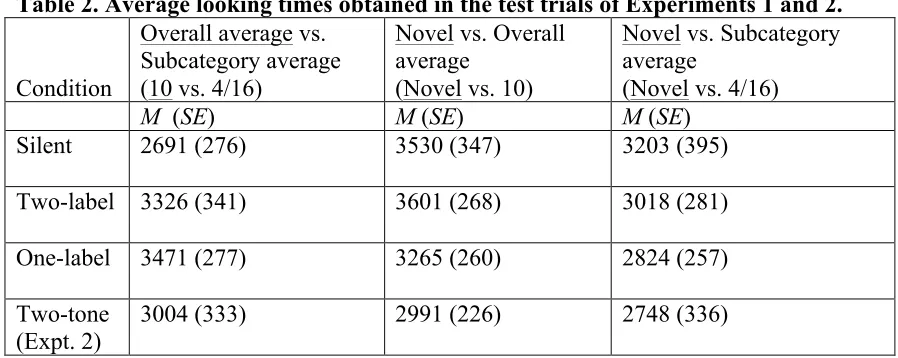
Table 2. Average looking times obtained in the test trials of Experiments 1 and 2.
Condition
Overall average vs. Subcategory average (10 vs. 4/16)
Novel vs. Overall average
(Novel vs. 10)
Novel vs. Subcategory average
(Novel vs. 4/16)
M (SE) M (SE) M (SE)
Silent 2691 (276) 3530 (347) 3203 (395)
Two-label 3326 (341) 3601 (268) 3018 (281) One-label 3471 (277) 3265 (260) 2824 (257) Two-tone
(Expt. 2) 3004 (333) 2991 (226) 2748 (336)
Note. Averaged looking times are given in milliseconds and were directed at the
Figure captions
Figures
Figure 1
1 3 5 7 13 15 17 19
4
Subcategory average
16
Subcategory average 10
Overall average