SYSTEM 4000
The World's First -
and Only
Total Cartridge Concept
It's nice to be first; it's better to be best.
Syst~m 4000 is both. It's the first totally modular "order by number" 1/4" cart-ridge system ever designed. It's the first to have a fully ANSI-compatible format-ter with a byte-oriented I/O, and a pack-ing density of 1600 cpi. And, it's the first to allow you to design your own one, two, three, or four deck system complete' with formatter, electronics, power sup-ply, mounting panel, cabling - even a connector to plug into your mini's con-troller.
System 4000 has a storage capacity of 23 million bits, with a data transfer rate of
KENNEDY
~1iII
\'::'1<."''''.0'1'
See System 4000 at NCC - Booths 839-841
· QUALITV·
5000 bytes, and the same great features of all Kennedy cartridge recorders: CRC generation and checking, error detection. and gap generation, and simplified for-matter commands such as "Write One Block," "Read One Block," etc.
System 4000 is the first truly versatile cartridge tape system. It was designed with minis in mind. It's just possibly the most significant advance in cartridge re-corders since the cartridge itself.
KENNEDY CO.
540 W. WOODBURY RD., ALTADENA, CALIF. 91001 (213) 798-0953
4345
TALLY
DATASCRIBE
&
PRINTER
Still the best buy in your search
for
cost effective terminals.
Put a Tally Datascribe
next to a Tally Printer and
you have a terminal
un-matched in cost
effective-ness and performance.
Tally's Datascribe,
with its unique data
com-pression feature, can
transmit magnetic tape
data at speeds equivalent
to 3000 to 4000 Baud using
a 1200 Baud 202C data set. Tally's
Printer, in 125, 200, or 600 line per minute versions,
offers optimum print speeds for remote terminal
requirements. Monthly rental for this dynamic duo
starts at a low, low $600 a month.
A truly sensible buy.
Datascribe increases your throughput and
decreases line charges. You can actually triple
your 1200 Baud rate without changing modems.
A printer matched to your data volume-125 Ipm,
200 I pm, or 600 Ipm. No wasted capacity. Liberates
your computer for other tasks. Only Tally gives
you all these features and benefits plus field tested
hardware reliability.
It's a proven and popular combination.
We can proudly point to a long list of contented
customers. And to support these installations, we
can point to an expanded field service
organiza-tion. We're committed to service whatwe sell. We're in
the data communications and terminal business for
the long haul.We have a solid 25 year track record.
We plan to build on it in
the future by continually
offering better solutions
to your data processing
problems. Solutions like
our hardwired Datascribe
data compression that
requires no computer
time, no software-a
truly unique approach to
data communications.
Features include unattended
operation for both send and receive functions. Full
2400 foot tape reel. English language display for
ease of key entry.
In actual benchmark tests, these average
throughputs were obtained using 200 character
rec-ords. 150 records per minute with 1200 Baud
mo-dems. 300 records per minute with 3600 Baud
modems. 400 records per minute with 4800
Baud modems. Plus, Datascribe offers four kinds
of error checking features during transmission to
assure dependable data.
If you need even more evidence about this .
cost performance terminal package, we invite your
inquiry. Contact your local Tally man and let him
demonstrate the advantages to you.
In Boston (617) 742-9558, Chicago (312)
298-6710, New York (201) 671-4636, San Francisco
(415) 632-4280. Or contact us direct, Tally
Corporation, 8301 So. 180th Street, Kent,
Washington 98031, Phone (206) 251-5500.
TALLY·
See us at the NCC,APRIL, 1974
volume 20 number 4
This issue 122,900 copies
11\le~~ ~
.. -.,. ...
-.~---'"
.. -.--...
11974 NATIONAL COMPUTER CONFERENCE & EXPOSITION
For years they've wanted a program for the user, and here it is, May 6-10 at Chicago's McCormick Place.
48 Conference Commentary
More sessions, more products, more people; something for everyone.
51 The Programs
A 30-man squad might be able to cover it all.
71 The Computerization of the
ABC Widget Co.
RICHARD L. NOLAN and K. ERIC KNUTSEN. What a dif-ference a decade makes.
79 An Optimization Study
JAMES O. MULFORD. How to improve throughput without mortgaging the ranch.
89 Acquiring and Using a
Hardware Monitor
JERRE D. NOE. It can't measure the system it crashes.
112 April Foolishness
April Fkst fosters fantasy, fun, and poetry on our pages in accordance with ancient ritual, plus-for the first time-award-winning fiction.
1 12 Mimsy Were the Borogoves
WENDELL COCKRELL
114 Validation Game
DONALD KENNEY
Calendar 11
departments
Look Ahead 17 Letters to the Editor
27
News in Perspective 141 Hardware 166 Software & Services 179 Literature 186 People 192 Poem 200 Books 205 Index to Advertisers 210 The Forum 215
54 On The Lakefront
For the nightowls-what to see and do in Chicago.
56 Product Preview
The biggest, fastest and flashiest the industry can produce for 1974.
98 Controlling a Computer System
DONALD L. BLACK. Keep your whims to yourself.
141 News in Perspective
ANTITRUST . . . • 141 MODELING . . . 149 PEOPLE . • . . . • • • . . 145 SERVICE BUREAUS •. 150 COMPANIES . . . • • 145 BANKING . . . 151 MEMORIES . • • . . . • 148 THE ARTS . . . 153 RETAILING . . . . • . . 148 INTERNATIONAL . . • 154
BENCHMARKS . • . . . 157
215 The Forum
THORNTON J. PARKER III. Fixed standards work for screw threads, but not for classes of data.
1 17 Does Anyone Here Speak English? Phase II
MARVIN GROSSWIRTH
123 The Inve~se Peter Principle
A. NONYMOUS
132 I Have No Mouth, and I Must Scream
HARLAN ELLISON. Fantasy'S darker side is explored in this computer drama, winner of sci fi's Hugo award.
about the cover
From the neon flash
of the "broad-shouldered" city comes a pattern to capture the gutsy vibrancy of Chicago, host to the NCC this year; it reflects the excitement of the convention
Now you can switch
RS232 lines between
FEPs instantly. •• at
the touch of a button
T-BAR Series 5100 Remote Control EIA(RS232) FALL BACK SWITCHES are new, fast and reliable, allowing operators to switch modems or terminals singly or simultaneously-in-groups between two or more FEPS ... or between computer ports from on-line to stand-by modems ... or other terminals.... as low as $175/channel!
Featuring a Switcher, illuminated Pushbutton Control Panel, Control Cables, plus 25-pin RS232 Data Cables, the system is also available in a-channel standard packages at slightly higher cost per channel. All for rack, wall or under-floor installation.
Data
T-BAR's complete line of switching
r--Y.--B--a-r--""SYstems
equipment gives the Communications. DIVISIONSystem Engineer and Communications
Manager system cost effectiveness. Write or INCORPOfiATED
phone today for complete literature. SWITCHING TECHNOLOGY
141 Danbury Road, Wilton, CT 06897 Telephone: 203/762-8351
Regional Sales Offices: Boston (617) 890·3085 • Chicago (312) 671·5182 • Columbus (614) 262·0915 • Canada (613) 737·5941 Washington, D.C. (703) 528·7773 • New York (203) 762·8351 • Philadelphia (215) 363·1544 • California (203) 762·8351
*
T-Bar Universal Fall Back Switches have been used successfully to switch var-Ious Front End Processors, Including IBM 3705, IBM 270X, UNIVAC 1108, Burroughs5000, Memorex 1270, DEC PDP~11145.
4 CIRCLE 134 ON READER CARD
CRTRMRTICN@
EDITORIAL STAFFEditor Articles Editor International Editor Communications Editor Industry Editor Products Editor Copy Editor Calendar Editor Letters Editor News Editor Bureau Managers
San Francisco Los Angeles Washington, D.C. New Vork New England Correspondents Minneapolis Southwest Europe Australia Editorial Advisor Technical Advisor Contributing Editors
EDITORIAL OFFICES
John L. Kirkley Richard A. McLaughlin Angeline Pantages Phil Hirsch W. David Gardner Michael William Cashman Merrill Press Cherlin Carol A. Constantian
Angela V. Smith Tom McCusker
Edward K. Vasaki Edith D. Myers Phil Hirsch Angeline Pantages W. David Gardner
James K. Johnson Robert F. Alexander Pearce Wright Frederick A. Bland Robert L. Patrick Lowell Amdahl Paul Armer, Howard Bromberg, Philip H. Dorn, Louis B. Marienthal, Ray W. Sanders, Milton R. Wessel, F. G. Withington
Headquarters: 1801 S. La Cienega Blvd., Los An-geles, CA 90035. Phone (213) 559-5111. Eastern: 35 Mason St., Greenwich, CT 06830, (203) 661-5400. Lakeside Office Park, 599 North Avenue, Wakefield, Mass. 01880, (617) 246-2121, 9805 Singleton Dr., Bethesda, MD 20034, (301) 530-7271-Southwestern: 2711 Cedar Springs, Dallas, TX 75201, (214) 744-0161. Western: 2680 Bayshore Frontage Rd., Suite 401, Mountain View, CA 94043, (415) 965-8222. Foreign: 65, Hill Road, Chelms-ford, Essex, England, 64/90 Blues Point Rd., Mc-Mahons Point, NSW 2060, Australia.
GRAPHIC DESIGN & PRODUCTION Art & Production
Director
Production Manager CIRCULATION
Cleve Marie Boutell Marilee Pitman
35 Mason Street, Greenwich, CT 06830 Circulation Director _ Suzanne A. Ryan Marketing Research
Director Douglas De Carlo
Publisher James M. Morris
Circulation audited by Business Publications Audit
Member
~ABP
American Business Press, Inc .
DATAMATION Is
pub-1-1 ... 1
IIshed monthly on orIf!'
about the first day of every month by Tech-nical Publishing Company, 1301 South Grove Ave., Barrington, Illinois 60010; Arthur L. Rice, Jr., Chairman of the Board; James B. Tafel, President; Gardner F. Landon, Executive Vice President. Executive, Circulation and AdvertiSing offices, 35 Mason Street, Greenwich, CT 06830, (203) 661-5400. Editorial offices, 1801 S. La Cienega Blvd., Los Angeles, CA 90035. Published at Chicago, III. DATAMATION is circulated without charge by name and title to certain qualified individuals who are employed by companies involved with automatic information handling equipment. Avail-able to others by subscription at the rate of $18 annually in the U.S. and Canada. Reduced rate for qualified students. Foreign subscriptions are available for £12.50 or for the equivalent of $30 U.S. in most West European currencies. Sole agent for all subscriptions outside the U.S.A. and Canada is J. B. Tratsart, Ltd. 154 A Greenford Road, Harrow, Middlesex HA13QT, England. No subscription agency is authorized by us to solicit or take orders for subscriptions. Controlled circu-lation paid at Columbus, OH and Form 3579 to be sent to TeChnical Publishing Company, P.O. Box 2000, Greenwich, CT 06830. Copyright 1974, Tech-nical Publishing Company. Microfilm copies of DATAMATION may be obtained from University Microfilms, A Xerox Company, 300 No. Zeeb Road, Ann Arbor, Michigan 48106. Printed by Beslow ASSOCiates, Inc.(Advertisement)
Notes and observations from IBM which may prove of interest to data processing professionals.
DP DIALOG appears regularly in these pages. As its name suggests, we hope DP DIALOG will be a
two-way medium for
DP professionals. We'd like to hear from you. Just write: Editor, DP DIALOG,
IBM Data Processing Division, White Plains, N.¥. 10604.
With virtual storage Carle Clinic now has much greater flexibility in its data processing capabilities. One of the future uses will be medical applications, sllch as analyzing data gathered in the clinic's laboratories.
Why
Carle Clinic Switched to \lrtual Storage
The list of families· using the Carle Clinic in Champaign, Illinois spiraled 75 % in the last five years to over 35,000. The resulting flood of paper-work kept its IBM System/360 Model 20 running nearly 300 hours a month. "Even so, we still weren't able to keep up," says Ed Beranek, data processing manager for the clinic as well as the
adjoining 250-bed hospital.
"But even worse," he continues, "we had more papcr than we knew what to do with. Every week the ac-counts receivable, alone, amounted to a 3,000-page report. What we needed was not to get more information into the computer but to have more infor-mation available on-line."
Carle Clinic, one of a half dozen medical groups of its kind in the coun-try, is the largest group medical prac-tice in Illinois. Its staff consists of over 80 physicians, who are' all specialists in their fields. They service 180,000 patients-about half from the surround-ing area, the other half from all over the country.
(Advert,isement)
Space
and AstronolllYat
the
IBM
Exhibit Center
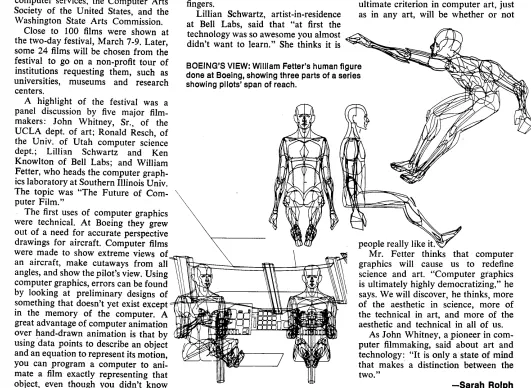
When the Comet Kohoutek made its parabolic path around the sun ear-lier this year, the IBM Exhibit Center in midtown Manhattan made it possi-ble for passers-by to observe its path on a floor-to-ceiling graph, visible through the windows of the center.
Inside the center a terminal linked to an IBM computer plots the exact position of Kohoutek. Although the comet will soon be beyond our view, the computer program will continue to plot the position of the planets, the major stars, the sun and moon as seen
from any point on the earth, at any time. The chart below shows how the sky above Manhattan would look just be-fore sunrise on March 21, not long after Kohoutek has disappeared into the outer reaches of the solar system.
. The IBM star chart is only.part of a much larger exhibit designed by the office of Charles and Ray Eames for IBM, with the help of 1. Bernard Cohen, Professor of the History of Sci-ence at Harvard University.
Titled "computer perspective: AS-TRONOMY," the current focus is on
VIEW FROM 41 DEGREES NORTH, 74 DEGREES WEST ON THURSDAY 1974/3/21 AT 5 30 AM
POSITION OF SUN, MOON AND PLANETS
RT.AS. DECL. MAP GRID • MOON 22 6 -6 31 -.77 -.28
SUN 0 8 o 55
*MERCURY 22 27 -10 57 -.86 -.30
*VENUS 21 12 -13 28 -.62 -.43
MARS 4 47 23 31
*JUPJTER 22 22 -11 49 -.85 -.32
1.0-
.8-
.6-
'.4-• 2- '.4-•
SATURN .URANUS *NEPTUNE .PLUTO KOHOUTEK N I I
I
Ij
1r
I .
I:f
I RT.AS.5 51
un
13 24 3 47
,DECL. MAP GRID
23 10
-8 1 .1>8 -.33
-22 15 -.10 -.61 10 7 .60 -.11 18 33
. .
..
the men who laid the foundations of modern astronomy and physics, from Nicholas Copernicus in the fifteenth century and his revolutionary theory of the sun-centered universe, to Sir Isaac Newton in the eighteenth century, who completed the Copernican Revolution with his formulation of the principl~ of universal gravitation.
Like the other computer exercises at the center, the star chart exercise shows how the computer can help pro-vide sophisticated data based on these early scientific principles.
IBM
MOON SHOWN AS 0 MOON PHASE 0.169 WANING
..
E
.0-.---- ---- ---- ---- --..
'"T1----0:--- -.,,----.-- ---- ---- ----.
W·1
, '6
-.2- . -.4- -.6- -.8- -1.0-I -1.0 q .. MERCURY t-JUPITER
I
-J
ALTAIR -.32 -.25
ARCTURUS .43 -.09
.J'
+VENUS
I I
-.6 -.4
DENEB -.28 .12
VEGA -.10 -.01
I -.2 I
.r
I .' II
.NEPTr= to'I
I..
,,'
+I
..
I I
.0 .2
S
ANTARES .19 -.66
K SCORPIO .01 -.81
r
I
.4
SPICA
.PLUTO
·URANUS
..
I
1.0
(Advertisement)
Library Thrives mth No Books, Fe", Visitors
Instead of books, this quiet library, located 30 miles north of New York City, houses a vast collection of com-puter programs. It is IBM's Program Information Department (PID) which works around the clock to fill customer orders for computer programs.
The master library contains roughly
2,500 operating system and application programs for manufacturers and finan-ciers, wholesalers and retailers, food and chemical processors, scientists and engineers. Besides adding to the master library regularly, IBM program devel-opment groups also update and modify existing programs when necessary.
Every year PID distributes over 300,000 packages contail1ing program material-more than 1,200 each work-ing day. A computer processes the mammoth volume of orders from the time they arrive to the time they are packaged and mailed. The turnaround time is usually about one week, accord-ing to Marty Kloomok, PID's manager. "But in an emergency," he says, "we can have a program in a customer's hands in 24 hours."
After PID's computer receives and edits the order data, it copies the mas-ter file onto the specified medium-either a disk pack, magnetic tape, card deck or a tape cassette. The copy is checked against the original for any errors and is sent to the customer with the appropriate documentation, which tells him how to install and use his program. Finally, the package contents are checked against a computer-pre-pared packing list and shipped with a computer-prepared mailing label.
New orders for processing arrive at IBM's computer program library.
In this way IBM, through its pro-gram library, is helping its customers to optimize the effectiveness of their com-puters-to make them more valuable
assets.
I Bf,i
Sidelines
Coping with the Energy Crisis
Recently, IBM announced its new computer-based Energy Management System, which is designed to help electric utilities produce power more efficiently.
It also makes it possible for these same utilities to moni-tor and control a complex network of electrical generating and transmission equipment much faster than if it were done manually.
The new system combines IBM System/370 and System/7 computers with a set of special application programs, data collection and display units.
By consolidating all power information in one spot, it gives a dispatcher the data he needs to determine how to distribute the power load among the generators in a utility system. As consumer appliances and industrial equipment are turned off and on during the day, the dispatcher can boost the power from the most efficient generators and decrease the electricity from the less efficient ones.
Other advantages include keeping track of fuel and maintenance costs, transmission line losses and the status of all pieces of equipment so as to achieve minimum pro-duction costs and efficient use of available fuel.
Computers at Sea
Even with today's sophisticated radar systems, collisions at sea do happen. Last year alone 300 major vessels of 500 tons or more collided. The problem is that radar can not differentiate between obstacles, from buoys to ships, on a ship's path.
IBM recently announced its. Maritime Applications Bridge System which may help to overcome the problem. The system uses a System/7 computer and a variety of applications programs. One of them, the collision assess-ment program, can automatically identify targets up to 16.5 nautical miles away. It can also differentiate between ships, debris and land masses. Objects are Rashed on a screen with vectors and are identified on an adjoining screen by number, range and bearing, speed and course, and estimated closest point and time of approach.
The Bridge System offers another advantage-planning the ship's optimum route to conserve fuel. Programs for position fixing, route planning and tracking, and adaptive autopilot keep the ship's officers constantly informed of the ship's exact position and the course it should follow.
IBf,l
(Advertisement)
Dr. Siegel explains how compllters can help a sllrgeon's diagnosis.
Helping Doc.tors COlllbat
Heart Disease
Heart disease is still the nation's number one cause of death, in spite of vast improvements in cardiovascular research. Many patients with severe coronary artery disease must undergo open heart surgery as a last resort. Now scientists are conducting research on how computers can help a surgeon's diagnosis by measuring the heart's pumping capacity and automatically pinpointing defects.
Dr. Chao-Kong Chow, a computer scientist, and his associates at IBM's Thomas J. vVatson Research Center and Dr. John Siegel, Chief of Surgery at Buffalo General Hospital, have found a way to use the computer to analyze cineangiograms, or X-ray motion pic-hIres of the heart, by measuring pre-cisely the volume change in the blood-pumping capacity of the heart.
Siegel explains: "Without the help of a computer, sometimes it would take days, even weeks to fully interpret cin-eangiograms. If the patient's very sick, he could die in that period of time. Now, with computer assistance we can get a more accurate analysis in a very brief period of time, sometimes less than an hour."
Siegel and Chow have concentrated their research specifically on the left ventricle of the heart. Here the change -in volume as the heart pumps is a key
8
indicator of heart performance. They took cineangiograms of movement in the left ventricle, recorded at 62 frames a second, and converted them to com-puter-usable form with an IBM 1800 data acquisition and control system. The results were fed into a System/360 Model 91 for further processing.
"A typical 68-frame sequence, which would cover one full cycle of a heartbeat, can be analyzed in less than five minutes," says Chow. But he em-phasizes, "the ultimate speed is not as important as providing an automatic technique where none now exists."
Beyond speed, there are several functions the computer can perform on an angiogram which would otherwise result in a long, painstaking and even inaccurate procedure if done by hand. "In fact," explains Siegel, "the com-puter can go one step further and 'cross-section' the angiogram and cal-culate the ways in which each segment of the ventricle contracts. This is es-pecially useful in diagnosing irregular-ities in the pumping cycle, the rhythm of the cycle and partial malfunction in a specific part of the heart."
"When we find an impairment on an angiogram, we can easily run succes-sive ones on the computer and compare improvement or decay in condition and changes in overall performance or in
performance of certain segments." Although the work of Drs. Chow and Siegel is still in the research stage, both are optimistic about the real pos-sibility that computer-produced cine-angiograms can provide valuable in-formation needed to diagnose a large number of patients with severe heart disease. "In this way," says Siegel, "we can make intelligent decisions as to whether patients should undergo open heart surgery for revascularization, or the rerouting of blood vessels feeding
the heart."
IBM
Carle Clinic ...
(Continued from first page)
The clinic solved its problem of ex-panding needs by converting to an IBM System/370 Model 125 with vir-tual storage last summer. "We found the Model 125 would not only justify our immediate needs, but would also allow us to grow on a long-range basis. Virtual storage gave us that capability without increasing the actual size of our computer," says Ed Beranek. "We also added CICS (Customer Informa-tion Control System) which made it possible to access information directly from the CPU for display on a tele-processing unit."
All in all, the conversion was rela-tively trouble-free. In fact, Beranek reports they were able to convert to DOS (Disk Operating System) in only two days instead of the seven originally planned. They later went to DOS/VS and finally CICS in a matter of a few weeks.
The clinic's Model 125 has been up and running since last July and already it has streamlined the business func-tions, such as accounts receivable, pay-roll and inventory. Other applications, including patient scheduling and some doctor/patient statistics, have been added.
"So far we have had great success with the 125, but we are only on the threshold," says Beranek. "The 125 with virtual storage now makes it pos-sible to add many more applications. By the end of the year we will be able to include both an on-line insurance billing and medical retrieval system. This will enable doctors to see in an instant a full account of a patient's re-cent visits to the clinic."
Beranek feels there are many more medical applications for the computer. One possibility is incorporating the System/7 for EKG analysis and other medical functions which demand mon-itoring. "Over the long range we are interested in giving the best possible care to our patients.' If the computer can help us we're interested in using it."
IBM"
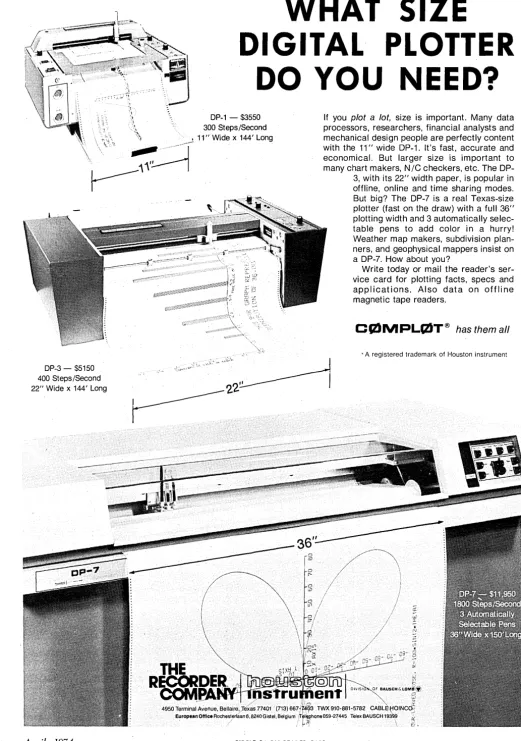
WHAT SIZE
DIGITAL PLOTTER
DO YOU NEED?
DP-1 - $3550 300 Steps/Second \ 11" Wide x 144' Long
",.",.
. . - ----If you plot a lot, size is important. Many data processors, researchers, financial analysts and mechanical design people are perfectly content with the 11" wide DP-1. It's fast, accurate and economical. But larger size is important to many chart makers, N Ie checkers, etc. The
DP-~~,~
r---DP-3 - $5150 400 Steps/Second 22" Wide x 144' Long
36"
/' /
3, with its 22" width paper, is popular in offline, online and time sharing modes. But big? The DP-7 is a real Texas-size plotter (fast on the draw) with a full 36" plotting width and 3 automatically selec-table pens to add color in a hurry! Weather map makers, subdivision plan-ners, and geophysical mappers insist on a DP-7. How about you?
Write today or mail the reader's ser-vice card for plotting facts, specs and applications. Also data on offline magnetic tape readers.
CIDMPLCZiT®
has them all, A registered trademark of Houston instrument
///"'/--'--~''''''\,
[image:11.618.46.568.28.769.2]10
Now Documation has taken
away all
the reasons why you
couldn't get a low cost,
high-speed punch
High speed. Low cost. Until now those two phrases meant
compromise in a computer system. Settle for a slow punch.
Even'then you had to worry about reliability factors.
No more.
Documation built the no-compromise punch you wanted.
This is an on-line punch. You load and unload the
1 ,OOO-card hoppers on the fly ... a true high-speed
punch ... punch all 80 columns at 100 cards
per minute. With fewer columns you can
get up to 285 cards per minute. And,
if you like, you can even get a 400 cpm
reader in the same configuration.
With our price your computer
representative can now give
you more punch for the price ...
a no-compromise punch for a
no-compromise computer
system.
I
I I
A
V
II
DOCUMATION
I N C O R P O R A T E D
I
POST OFFICE BOX 1240 MELBOURNE, FLORIDA 32901 TELEPHONE (305) 724-1111 TWX 510-959-6286Calendar
MAY
ADAPSO 40th :\;Ianagcment Conference~ May 1-3, Las Vegas. More than 250 executives from data centers, time-sharing firms, and software houses will study the impact of the System/3 and similar systems on the future of the computer services industry. Fee: $100, members; $175, others. Contact: J. L. Dreyer, ADAPSO, 210 Summit Ave., Montvale, NJ 07645.
College and University Machinc Record~ Confcrcncc (CUMREC), May 5-8, Waco, Texas. On the theme "Pro-ductivity: Benefit of Systems Planning," the 19th annual CUMREC will have sessions on such diverse topics as: auto-mated grading systems, student scheduling and registration systems, data base management, program budgeting, and bookstore point-of-sale. Fee: $75. Contact: Jack Thornton, Baylor Univ., P.O. Box 6187, Waco, TX 76706.
National Computcr Conference & Exposition. May 6-10, Chicago. See the special NCC&E section beginning on p. 48 for conference particulars, program summaries, and new product preview.
12th Annual Convention of the Assn. for Educational Data Systcms (AEDS), May 7-10, New York. The program, with exhibits, will include such topics as: computers in education -mini to maxi, the virtual machine in instruction, and the role of regional center computers. Fee: $45, members; $55, others; at conference, add $5. Contact: Joseph E. Nove, BOCES 11,201 Sunrise Hwy., Patchogue, NY 11772.
23rd Annual Conference and Exposition of the National Microfilm Assn .. May 7-10, Boston. Ten to 12 thousand users of microform equipment are expected to attend "Mi-cromedia Horizons '74," organized on three levels (one on fundamentals and basic techniques; one on computer output microfilm; and one, for the advanced technician, on micro-publishing, records management, copyright laws, word pro-cessing, computer vs. microfilm retrieval, and new product development). The event will also include applications seminars and 45,000 sq. ft. of exhibits by over 100 com-panies. Fee: $75 for technical sessions. Contact: John B. Bidwell, NMA, 8728 Colesville' Rd., Silver Spring, MD 20910.
APL International Users Group Meeting. May 14-17, Ana-heim, Calit. ACM is the sponsor of this sixth annual confer-ence on the enhancements, extensions, applications, pro-gramming techniques, instructional methods, and future of APL, with demonstrations of APL-oriented hardware, soft-ware, and application packages. Fee: $40. Contact: John R. Clark, Coast Community College District, 2701 Fairview Rd., Costa Mesa, CA 92626.
International Magnetics Conference. May 14-17, Toronto. Sponsored by the IEEE Magnetics Society, the program will include sessions on: competing storage technologies, digital magnetic recording, videoplayers for consumers, bubble memory subsystems, integrated bubble-device processing, film and surface materials characterization, electromagnetic transportation, rare-earth magnets and applications, and Josephson junction devices. Fee: $40, IEEE members; $50, others; at conference, add $5. Contact: W. A. Baker, Bell Telephone Laboratories, 555 Union Blvd., Allentown, PA 18103.
National Opcrations and Automatioll Confercncc. May 19-22, San Francisco. Over 1,500 bankers, suppliers, consul-tants, and manufacturers are expected to attend ,this Ameri-can Bankers Assn. conference on the theme "Managers Make Things Happen." Topics include automated tellers, electronic funds transfer, check processing innovations, re-mote processing, performance measurement, computer out-put microfilm, and minicomout-puters. Approximately 75 ex-hibitors will demonstrate equipment, software, hardware, systems, and services. Fee: $135, bankers; $165, others. Contact: Judith Martin, Operations and Automation Div., ABA, 1120 Connecticut Ave., N.W., Washington, DC 20036.
Socicty for Information Display Intcrnational SYIllPosiulll, May 21-23, San Diego. Original papers will describe de-velopments in information display hardware and software techniques, devices, systems, applications, and effectiveness. Fee: $30, members; $40, others; at conference, add $10. Contact: Lewis Winner, 152 W. 42 St., New York, NY 10036.
Symposium on Computer Networi(s. May 23, Gaithersburg, Md. Jointly sponsored by the Bureau of Standards and the IEEE Computer Society, the symposium will have a panel session and 14 papers covering trends in computer network design and economics, tradeoffs in network design, and applications of existing and proposed networks. Fee: $10, IEEE members; $13, others; at conference, add $3. Contact: Computer Networks, P.O. Box 639, Silver Spring, MD 20901.
Second Computers, Electronics, and Control (CEC) Inter-national Trade Show and Symposium, May 23-25, Calgary, Alberta. With federal and provincial agencies, private indus-try, and professional societies as sponsors, this trade show/ symposium aims to bring new technological advances in computers, electronics, control systems, and components to the attention of companies, universities, and other interested organizations. Fee: not available, about $50. Contact: CEC '74, P.O. Box 3243, Postal Stn. B, Calgary, Alberta, Canada T2M4L8.
JUNE
ICC '74-1EEE International Conference on COlllnumica-tions, June 17-19, Minneapolis. Sponsored by the Com-munications Society and IEEE (Twin Cities section), this program will include: a tutorial session on communications satellites; a technical program of 200 papers on satellite communications and on· data and voice transmission con-nected with wire, radio, and computer-oriented communica-tions in both theoretical and practical applicacommunica-tions; and an exhibition of technical products in the telecommunications field. Contact: Marilou E. Thomas, Northwestern Bell Tele-phone Co., 70 W. 4 St., St. Paul, MN 55102.
Fenwal would have put out the fire
without
business interruption.Water alone can't save you from at least a tem-porary shutdown while the wet mess is cleaned up with overtime expense. Then there's all the business you'll lose while you're shut down. All that before you even start to pay for the heat, smoke and water dam-age done to your records and equipment.
Things are different when you fight fire with Fen-wal. A Fenwal Automatic Fire Suppression System, *
using Halon 1301, stops a fire in seconds ... and dry. The extinguishing agent is clean, electrically non-conductive, non-corrosive and safe for people. The affected area is ready for immediate reuse. .
Thanks to years of designing, testing and
re-designing at our own test facility, Fenwal is way ahead of everybody else in fire and explosion sup-pression. The application of Halon extinguishing agents is our speciality.
If your business relies on the continuous func-tioning of vital data processing or electronic control areas, talk to Fenwal about fool-proof fire protection. Don't leave your business to chance. Contact us, we'll be pleased to arrange a showing of our color film, "The FIREATERS," featuring our systems in ac-tion, or write on your letterhead for our free "Checklist for Computer Room Fire Protection." Fenwal Incor-porated, Ashland, Mass. 01721. Phone (617) 881-2000. A Division of Walter Kidde & Co., Inc.
*FM approved - UL listed
In fire and explosion suppression systems, Fenwal has more experience than any other company in the world.
l)at,a,era1t® SLASH 4 Virtual Memof1
Com-puter S1stem.
Delivers -power. economy. ftexibillty and
versatility.
All
you'l\ ever want.
Or
need. For concurrent
multi-batch Ilroeessint. Critical. rea.\-time.
l\e
m6te
lob entf1.
wna.te
ver
yoUT aililliea.tion. the SLASH 4
VM:
s
'rime sba;ring.·
100
1l3ll
0se00nd
cycle time, automa.tie IlroP
reloea.
tion
•
reentrant Ilrocessors. and elteetive mem
O
f1 uti\iz8.tio
n
deliver hi@lel' throu@lllut tor you. Bit sint\e
Ilro~'"
Ull
to 2u6
K" .
are
bandledwith
ease
in. a multi-task oriented
arehltect
ure
tha.t
~y
e\imina.tes costly
software
pena.l
ties
.
'rbat s
E{flC\en
e1·
'l'b.a.~
'l'ba.~s
s
Money Sa.ved.
the sLASH 4
VM
Comil
uter
System.
You'l\
be
a,tna7£d
at wb.a.t you tet. And how
much yOU
can
do. Conta.et uslor
all
the ta.ets·
Dat,a.eTllit~
1200~tewal
Drive. Fort 1a.uderda.\e. Florida. 33300.
'l'elellho
ne
(30u) 914-1100. For in.ternll.tiona.l in.,\uiri.
es
write:
'l'ecluna.
tion
N.V.
Gebouw 10u /100. SchiIlho\-Oost. Ho\la.nd.
Datacraft®
S(]8SIDIARY OF
FOR COMPUTERIZED MANUFACTURING
Write today for your personal copy of this plan. It is available to help you develop your computer aided manufacturing project, N/C data manage-ment, inventory control, parts management or any other manufacturing process you may be consider-ing. This plan will aid any manufacturer who is concerned with optimizing his process for im-proved A.O.I.
A
'Whatever computerization your .company re-4quires,' we can show you the planning approachthat will save you time and money in getting the process on line. We'll be there to help you plan ,your application and decide how much control , to select, what hardware and peripherals are best,
!' how to implement the software, whether to lease from us or buy ... in short the complete picture for you.
Cincinnati Milacron, a Fortune 500 Company, ' has been a manufacturer since 1884, solving proc-ess problems that are fundamentally the same throughout manufacturing. We've learned a lot. Process Controls Division has over the years par-ticipated in the developments in controls from tubes, to transistors, to IC's, to computers on a chip. The same type of long range continuity and grace-ful transition through planning is available to you.
Computerization doesn't have to be difficult. Our plan shows you how and why. Write for a copy of the Milacron plan today on your letterhead to Mr. Joseph Mount, Director of Marketing, Process Controls Division, Cincinnati Milacron, Lebanon, Ohio 45036.
..
minicomputers
C
~~
CINCINNATI
U~MILACRON
Machine Tools Process Controls Chemicals Plastics
~
LOOK
At-EAD
HONEYWELL'S NEW LINE:
ACCENT IS ON SOFTWARE
Don't look for Honeywell's new line--due out soon--to push the
state-of-the-art in hardware or software, although the accent on the
long-awaited and frequently delayed line will be on software.
Two machines,
perhaps more, will be announced initially. A
mediu~rangemachine,
first designated internally as the D machine and later the P-7, was
designed by Honeywell-Bull in France.
Another lower-range machine,
the C or P-6, was designed by Honeywell Italia.
A working model of the 7 is known to exist in the Boston area, but
we still haven't heard of a working demo of the smaller machine.
That leads to speculation that deliveries of the 6 will come later
than those of the 7.
Further, a third,
upper-mediu~rangemachine
designed in the Boston area has reportedly been killed.
If that is
indeed true, then it could mean that Honeywell will top off its edp
line for some time to come with its 6000 series.
PARTLY GE, BUT STRATEGY IS DIFFERENT
Honeywell's new line is an outgrowth of the Advanced Products Line
(APL) , which GE's Advanced Systems Div. designed as an
across-the-board assault on IBM.
The new Honeywell announcements, however, won't
be aimed at IBM, but rather at unifying Honeywell's conglomeration of
old Honeywell, GE, and Bull lines.
One of the striking things about
Honeywell's new line--and new technology -- is that it relies heavily
on ex-GE technology and people.
For Honeywell, a great deal is riding on the software.
It will
announce software bridges between the new line and the 6000 and the
low end of the model 50 line. The bridges will be challenging to
customers, perhaps, but even more so to Honeywell as it tries to move
the new equipment to its old customer base.
For instance, how do you
sell a 6 machine to GE 100 customers; how do you sell a 7 to Honeywell
200 customers?
On the plus side for Honeywell is the fact that it has sold off
most of its huge and ancient 200 base and the firm simply can net
orders up when it makes new sales of the new equipment.
(This worked
the other way for IBM, with unhappy results, when that firm had to
net down when it replaced too many 360s on rent with 370s.) There is
danger to Honeywell, though: it's tougher to move customers up to new
equipment when they own, rather than rent, their existing equipment.
Users who own 200s, for instance, will likely look at other vendors'
equipment too. As one knowledgeable industry observer said tersely
about the upcoming Honeywell line: "Honeywell can have mundane stuff
and still have tremendous stuff.
But the software better work and it
had better be priced right."
CDC:
UNBUNDLING ALL THE WAY
LOOK ArE AD
Although it's understood a sizable part of the software costs will
still continue to be subsidized by the hardware price tag, CDC
never-theless is wiping away the concept of "free" software as a tie-in to
hardware, a practice criticized by independent software groups,
notably ADAPSO's Software Industry Assn.
The target of ADAPSO's
attacks, of course, is IBM, not CDC.
But while the CDC action won't
open a very big market to the independents, ADAPSO spokesmen see it
as a moral victory in the battle to pressure IBM to do likewise.
THE MISSING LINK?
Recognition Equipment Inc., Dallas, is working on an image processing
system for banks which could prove to be the missing link between the
check and the less-check society.
It also could answer problems posed
by higher postal rates and the paper shortage.
With the system,
checks would be used but not returned to customers.
Instead, checks
returned to a bank would be scanned by REI equipment, with their
images captured electronically, bit by bit, and stored. The firm
hasn't settled on a memory medium.
At statement time stored check
images would be retrieved and imprinted in miniature on the back of a
customer's statement, saving the bank the postage involved in sending
back thick packs of checks.
And, the banks, after keeping the checks
for a required time, could then recycle the paper, which is of high
quality.
REI has demonstrated a prototype of its system for a "major
bank" it declined to identify, possibly the First National City Bank
of New York, which was its first customer for its TRACE (TRAnsaction
Control and Encoding) system for banks, a system for high-speed data
capture, sorting, microfilming, and positive identification of items
passing through it.
150 COMMENTS AND MORE COMING
A lot of people have something to say about the evolution of and
regulation of Electronic Funds Transfer Systems (EFTS), and last month
they were given an extra month in which to say it. The Federal Reserve
Board extended from March 8 to April 8 the deadline for comment on the
broad issues of EFTS.
Although it had received some 150 responses by
the March 8 deadline, the Fed also had received numerous requests for
extension and for additional explanation as to just what was wanted
. in the way of responses.
By way of explanation, the Fed came up with
a series of ten questions and answers designed to help respondents
better understand its request.
The Fed said it would not extend the
deadline again, but one spokesman noted that positions submitted after
the date "would not be ignored," since evaluation of comments received
would be a lengthy procedure.
"Early indications are there's a wide
divergence of opinion on a variety of issues." Three basic positions
seem to be emerging regarding ownership and operation of various
seg-ments of nationwide EFTS:
1.
the Fed does everything; 2.
the Fed is
allowed to provide services on a competitive basis with everybody else;
and 3.
the Fed is not allowed to do anything, does not have the
stat-utory capability to do anything.
IT'S A 4K RAM FOR H-P'S NEW MINI
Although the 4K MOS random access memory is the first semiconductor
to surpass core memory systems in price/performance, nearly all of
the semiconductor houses producing it are bogged down with yield and
production problems.
Nevertheless, Hewlett-p'ackard' s Data Systems
Div. has fixed on a 4K RAM as the main memory in a new line of l6-bit
minis, the first of which--the 32K model 2105A and 32-64K 2l08A--are
This $170,000*system gives you more
computer access than any $300,000
system in existence.
HP's 3000 Minicomputer System gives you four languages: COBOL; BASIC; FORTRAN and HP's System Programming Language. A powerful Editor and File Manager.
And concurrent accessibility from both terminals and batch peripherals.
This innovation works for a living. If you do, call us.
HP
minicomputers. .
They work for a living
HEWLETT
lllji'!
PACKARD
I
I
)
Sales and service from 172 offices in 65 countries.
1501 Page Mill Road, Palo Alto, California 94304
Processing
18,000
business transactions
per hour is nothing new.
A
minicomputer that does
it
for
$80,000*
is!
H P's Management 230 System lets you enter, edit, update and process transactions on as many as 32 remote terminals.
With no interim handling. And without overloading the resources of your central system.
This innovation works for a living. If you dO,call us.
HP minicomputers.
They work for a living.
HEWLETT
/bjff
PACKARD
Sales and service from 172 offices in 65 countries.
1501 Page Mill Road. Palo Alto. California 94304
Webave. aworld"wide network of service
facilities, staffed \vith
well~trained·and. experienced
service
technicians~.And backed up with logistics
and technical support that would make . any service
organization envious.
,
We've put together
an
operation that is ·spe;.
Cificallyintended to cure1he perennial service
head-ache·ofrnix'n'match systems; Raytheon Service
Company will provide leasing companies, users, and
owners. with a single source for competent service at
any EDP installation, anywhere in the free world.
And we'll give any manufacturer good reason to
think twice before he takes on the effort and expense
of building an intemalservice organization.· Raytheon
Service Company. One source for great
service-in North and South America, Europe, the
Far
EaSt-or wherever your equipment might be. We
are .
putting up.
Tryus~CaIlor write Mike Salter,
Com-mercial Marketing Manager, Raytheon Service
Company,
12·
Second· Avenue, Burlington,
Mass.
01803.
~ ..~This minicomputer gives you·
the data base management
you'd expect on a
$1,000,000
computer.
It costs
$78,000:
HP's Management 260 System lets you keep from 5 million to 94 million
bytes of data instantly active ... on-line. Make application programs data independent. Eliminate data redundancy and insure data privacy. This innovation works for a living.
If you do, ca II us.
HP
minicomputers.
They work for a living.
HEWLETT
-'hp,
PACKARD
Sales and service from 172 offices in 65 countries.
1501 Page Mill Road, Palo Alto, California 94304
1000 PDP-11/45
installations
in a year and
a half.
Digital's PDP -11/45.
It's brought more computer
to more people at a lower cost than
ever before possible.
It's got
all
the raw power you
could ever need.
All the speed. (Up to 3
million instructions per second.)
All the capacity. (248K bytes
main storage memory, 320 million
on disk.)
And all the flexibility of two
powerful software systems.
First there's RSX-11D. A
powerhouse of an integrated
real-time system. Dynamic memory
and disk file allocations,
multi-tasking foreground operations,
spooled I/O, and on-line batch
processing.
Plus power that adapts to you
needs. Easy ANSI FORTRAN IV
and ISA real-time extensions.
time, each with jobs as big as
16K
words.
It also has an expanded form
of BASIC that gives you string
operations. On-line files as big
as 30 million characters each.
Matrices, ALGOL-like statements.
What's really amazing is
that you get all of this and Illore
in a PDP-11/45 for half the cost
of systems that can only do half
as much.
Write for more information.
There's plenty.
Digital Equipment
Corpora-tion, Maynard, Mass. 01754,
(617) 897-5111. European
head-quarters: 81 Route de l' Aire,
1211 Geneva 26. Tel: 42 79 50.
Digital Equipment of Canada Ltd.,
P.O. Box 11500, Ottawa, Ontario
K2H
8K8,
(613) 592-5111.
Take.
an mron
peripheral
Add a cassette,
Or, add a dual cassette.
Or, add a printer.
.
It's up to you.
One of the major advantages of the Omron 8025 CRT
Microprocessor System is the ability of the system to
accept field pluggable changes or additions.
It
matters little whether you initially order your system with
a cassette and/or a printer. At any time your needs dictate, .
you can add these peripherals at your installation. Cassette
System-single or dual. Printer-it's your option.
And there's more to come.
The Omron 8025 CRT System is without a doubt, the
industry's most flexible system.
---
..-We do it with cards not mirrors.
Simple, field plug-in cards.
If
that sounds easy - it is.
Contact us for additional
infor-mation about other variable,
expandable configurations. They
make very interesting reading.
The terminal with "Variable
I.Q:'
See us at NCC Booth 821
26 CIRCLE 125 ON. READER CARD
Information Products Division
432 Toyoma Drive
Sunnyvale. California 94086 Telephone: (408) 734-8400
Letters
Memories
Not only have 1 been in the computer field too long for my own good, ap-parently 1 have been around longer than Mr. McCrohan ("Remember When," Feb., p. 76). Does he remem-ber ...
The CPC ( card programmed com-puter) in which the programmer was the loop.
SOAP (Symbolic Optimization and Assembly Program) which was called the end of all programming headaches. Bi-quinary number system-if you don't remember it, 1 couldn't possibly explain it.
PAT NELSON
Scientific Programmer Electronics Laboratory General Electric Co. Syracuse, New York
•
Under the cloak of humor, James McCrohan's "Remember When" fea-ture took some extreme and gratuitous swipes at IBM and its people.
The use of such language as "archi-tect of a society-sapping conspiracy" to describe T. J. Watson, Jr., for example, hardly enriches our stock of business humor. It is malice masquerading as wit, and 1 regret that DATAMATION has given space to a malicious attack on Tom Watson, Jr., who has been a lead-er in helping the data processing indus-tliY grow to its present importance. FRANK T. CARY
Chairman of the Board IBM
DATAMATION replies: We try to exer-cise as little editorial censorship of our authors as possible and do not require that they voice our point of view. Whether the reader finds Mr. McCro-han's piece witty or malicious depends to a great extent on whether he is the target of the "attack." The piece was merely light-hearted humor and we regret that you found it offensive.
Sciolism
Someone on your staff responsible for the LookAhead section ought to have a red face for suggesting to the uninI-tiated that "LRC stands for Longitudi-nal Redundancy Check, an aviation term (Feb., p. 18).
An aviation term it may be, but of more relevance to our data processing world is its time honored use in the parity checking of magnetic tape data recording, the longitudinal direction being the direction of tape motion, as opposed to row or transverse direction. Just to be certain of the terminology, 1 dug out myoId IBM 704 Reference Manual, and on p. 32, the following
appears: "Also, at the end of each record written, a longitudinal redun-dancy check bit is placed automatically in each of the seven channels . . . of that particular record."
FRANK ENGEL, JR.
Computer Specialist Belmont, Massachusetts
Yes, LRC is derived from a dp term, says founder Raymond B. Larsen. It could also stand for Larsen Research Corp., "a name my wife would like, but that didn't occur to us until three months after the company was named."
Tracking the villain
... Mr. Wright suggested in his article ("Antitrust: The Real Villain," Feb., p. 138) that the chief executives of CDC, Univac, NCR and Honeywell were guilty of antitrust violations themselves by their unified approach to the Justice Dept. to carry on the IBM antitrust suit.
Our constitution has always guaran-teed the right of citizens to seek redress of grievances from our governments, whether they be to the President, Con-gress, the Justice Dept. or the state governments. Such right is fundamen-tal to our freedoms and mode of gov-ernment and the suggestion that such is improper or illegal shows a lack of fundamental knowledge of what con-stitutes individual rights ...
LAVELLE DAY
Lake Oswego, Oregon
•
Bravo to Mr. Wright for his courage in stating the moral truths about IBM vs. Telex in particular, and antitrust in general. 1 only wish 1 could have penned the letter. Of course, had 1 done so, the arguments likely would have been repudiated ad hominem. The ad hominem fallacy consists of attempting to refute an argument by impeaching the character of its propo-nent, e.g., he works for IBM, hence he is immoral and his argument must be false. Similarly, anyone expressing agreement with these views is likely to run into the modem version of ad
hominem, the argument from
intimi-dation, e.g., only a fool could believe that!
1 realize this response will be in the minority, but in an age when moral integrity is needed more than ever, we
DA TAi.\;\TIOI'1 '.'/'~lccrnl.;s con',;s;')CJIl-donee: oiJOIH the: cOI',lplJlcr inclu:,;,'~' (Inc! H!; effect' 011 ,neil!I;,', (J:, '.,.'::11 0;
ec.rllllwni5 on :110 cOlyi,'l1j~, o;:ihij plJblicalion. I.elk;r:.; ::houlrl b,) ::/p:c!
rind linliti;d in /..:111]111 10 :!50 "'/01'('1:;,
if pmsihle. V/(! "',':()rv(: th,: rifJhllo edit 01' ~,;I(:ct I:::c,:;,'pl:; trolll k:llcl':; :jl,d.1m iJ I (;CJ in u:;. \\'ri L: to 1 [~O"I :). La CiOt1CCJCJ Blvd., Lo~; '\ll~lt:L:.J~, C. \
90035.
must all begin at home. If any of the ideas or principles stated here or in Mr. Wright's letter are reaching you, 1 sug-gest you begin by reading Ayn Rand's
The Virtue of Selfishness.
BILL BRITTON
IBM
San Jose, California
•
1 find myself in complete agreement with Mr. Wright's remarks on the im-moral and destructive nature of anti-trust laws. IBM indeed deserves our gratitude for creating the computer in-dustry. The fact that its share of the dp market is decreasing even as IBM con-tinues to grow proves that smaller companies with innovative products and competent management can suc-cessfully compete and prosper in a free market. 1 am personally proud that Burroughs had the good sense and in-tegrity not to join the vultures who are urging Justice Dept. action against IBM.
DANIEL WIENER
Circuit Design Engineer Burroughs Corp. Pasadena, California
•
· .. The concepts of pure laissez-faire capitalism or, if you will, pure free enterprise, are merely the economic branch of the political philosophy commonly known as anarchy. The in-teresting thing about anarchy is that its advocates are free to claim all sorts of magnificent benefits which will neces-sarily result from its implementation. That is because they need not fear refutation based on historical expe-rience since no society of men, from the most primitive to the most highly-structured, has ever dared, or wanted, to experiment with it as the established "order" (?)-I am at a loss for words. How can we "establish" anarchy as an "order"?
GILBERT H. FRIEDMAN
Burroughs Corp. Pasadena, California A shade of grey
With regard to Mr. Patrick's article in your January issue (p. 47), it is a disservice to your readers to take such a black-and-white binary position on an issue as complex as the use of the Social Security number as ~ personal identifier.
The charter under which the H.E.W. committee functioned constrained it to explore:
• Harmful consequences that may result from using automated per-sonal data systems.
• Safeguards that might protect against potentially harmful con-sequences.