Manuscript version: Author’s Accepted Manuscript
The version presented in WRAP is the author’s accepted manuscript and may differ from the published version or Version of Record.
Persistent WRAP URL:
http://wrap.warwick.ac.uk/113207
How to cite:
Please refer to published version for the most recent bibliographic citation information. If a published version is known of, the repository item page linked to above, will contain details on accessing it.
Copyright and reuse:
The Warwick Research Archive Portal (WRAP) makes this work by researchers of the University of Warwick available open access under the following conditions.
Copyright © and all moral rights to the version of the paper presented here belong to the individual author(s) and/or other copyright owners. To the extent reasonable and
practicable the material made available in WRAP has been checked for eligibility before being made available.
Copies of full items can be used for personal research or study, educational, or not-for-profit purposes without prior permission or charge. Provided that the authors, title and full
bibliographic details are credited, a hyperlink and/or URL is given for the original metadata page and the content is not changed in any way.
Publisher’s statement:
Please refer to the repository item page, publisher’s statement section, for further information.
Sense of Commitment in HRI
1
The Perception of a Robot Partner’s Effort Elicits a Sense of Commitment to Human-2
Robot Interaction 3
4
Forthcoming in Interaction Studies 5
6
Marcell Székely 7
Affiliation: Central European University, Department of Cognitive Science 8
Address: Oktober 6 Utca 7, Budapest 1051, Hungary 9
Email: [email protected] 10
11
Henry Powell 12
Affiliation: University of Warwick 13
Address: Social Sciences Building, Coventry CV4 7AL, UK 14
Email: [email protected] 15
16
Fabio Vannucci 17
Affiliation: Università di Genova and Istituto Italiano di Tecnologia 18
Address: Via Enrico Melen, 83, 16152 Genova, Italy 19
Email: [email protected] 20
21
Francesco Rea 22
Affiliation: Istituto Italiano di Tecnologia 23
Address: Via Enrico Melen, 83, 16152 Genova, Italy 24
Email: [email protected] 25
Sense of Commitment in HRI
27
28
Alessandra Sciutti 29
Affiliation: Istituto Italiano di Tecnologia 30
Address: Via Enrico Melen, 83, 16152 Genova, Italy 31
Email: [email protected] 32
33
John Michael 34
Affiliation: University of Warwick 35
Address: Department of Philosophy, Social Sciences Building, Coventry CV4 7AL, UK 36
Email: [email protected] 37
38
Sense of Commitment in HRI
Abstract: Previous research has shown that the perception that one’s partner is investing 40
effort in a joint action can generate a sense of commitment, leading participants to persist 41
longer despite increasing boredom. The current research extends this finding to human-robot 42
interaction. We implemented a 2-player version of the classic snake game which became 43
increasingly boring over the course of each round, and operationalized commitment in terms 44
of how long participants persisted before pressing a ‘finish’ button to conclude each round. 45
Participants were informed that they would be linked via internet with their partner, a 46
humanoid robot. Our results reveal that participants persisted longer when they perceived 47
what they believed to be cues of their robot partner’s effortful contribution to the joint action. 48
This provides evidence that the perception of a robot partner’s effort can elicit a sense of 49
commitment to human-robot interaction. 50
51
Keywords: commitment, effort, human-robot interaction, joint action 52
53
54
55
56
57
58
Sense of Commitment in HRI
1. Introduction 60
61
There is a vast potential for robots to assist humans in joint actions in many different 62
domains, from disaster relief to health care, education, and manufacturing (Breazeal et al., 63
2004; Lenz et al., 2008; Clodic et al., 2009; Sciutti et al., 2012; Grigore et al., 2013).1 In
64
optimizing human-robot interactions in order to tap this potential, one challenge is to 65
minimize the risk of human interactants becoming frustrated or impatient when the joint 66
action is not going well, for example because their robot partner makes mistakes or is slow in 67
making its contribution. This may be a particularly important challenge in the case of 68
humanoid robots since, on the one hand, their human-like appearance tends to raise people's 69
expectations about their abilities, their reliability, and their user-friendliness (Ferrari & 70
Eyssel, 2016), and, on the other hand, they will increasingly be expected to perform a wide 71
range of tasks flexibly and autonomously, and may therefore be slow or error-prone in some 72
situations. Indeed, this latter issue may be all the more acute for robots designed to engage in 73
autonomous trial-and-error learning (Cully et al., 2015). 74
Previous research has shown that humans’ patience towards a robot that performs 75
suboptimally can be increased if the robot employs a mitigation strategy such as seeking 76
human assistance and/or adapting its approach (Lee et al., 2010; Brooks et al., 2016; Mirnig et 77
al., 2017), or expresses a negative emotional reaction and attempts to rectify its mistake 78
(Hamacher et al., 2016). The present study aimed to build upon this research by addressing 79
the more general question of how to sustain human interactants' willingness to persist in 80
interacting with a robot partner despite increasing boredom or frustration -- irrespective of 81
whether that boredom or frustration arises from errors on the part of the robot or from the 82
nature of the interaction itself. Specifically, the study was designed to test the hypothesis that 83
Sense of Commitment in HRI
human interactants' willingness to persist may be boosted by exposing the human to cues that 84
the robot has invested effort in the joint action. If this is the case, it may provide roboticist 85
with a useful -- and low-cost -- tool in designing robots that look and /or behave in such a way 86
as to elicit patience and persistence on the part of human interactants. 87
Intriguingly, recent research on joint action in humans (i.e. human-human interaction) 88
provides strong reasons to suspect that this may be the case. This research takes its starting 89
point in Michael, Sebanz & Knoblich's (2015) hypothesis that the willingness to remain 90
engaged in joint actions and to resist tempting alternative options and distractions is governed 91
by a sense of commitment. The concept of a sense of commitment is closely related to the 92
concept of trust, insofar as both refer to psychological mechanisms that help to sustain agents' 93
motivation to contribute to joint action. Trust, however, helps to sustain agents' motivation to 94
contribute to joint action only indirectly -- by stabilizing one agent's expectation that her 95
partner will continue contributing to the joint action in a cooperative manner, it at least 96
reduces a source of uncertainty which could undermine the first agent's motivation to 97
contribute. But it does not directly explain why that first agent would then herself contribute 98
to the joint action in a cooperative manner. Indeed, she might be distracted or tempted to 99
disengage irrespective of her level of trust in her partner. Research on the sense of 100
commitment aims to fill this gap: the sense of commitment is hypothesized as a mechanism 101
which stabilizes agents' motivation to contribute to joint actions (and more generally to others' 102
goals) and to persist in the face of tempting alternative options and distractions. More 103
specifically, it is hypothesized as a mechanism which stabilizes this motivation in response to 104
cues that one's partner values the joint action and may be relying on one to make one's 105
contribution. 106
In support of this hypothesis, Michael, Sebanz & Knoblich (2016) reported evidence 107
that a high degree of spatiotemporal coordination within joint action may function as such a 108
Sense of Commitment in HRI
more likely to persist until the goal is achieved, while Chennells et al. (under review) 110
demonstrated that repeatedly coordinating with the same partner in a decision-making context 111
is sufficient to elicit a sense of commitment, leading agents to resist tempting alternatives and 112
thereby sustaining cooperation through fluctuations in individuals’ interests. In a similar vein, 113
Székely & Michael (2018) probed the hypothesis that one's perception of a partner's 114
investment of effort in a joint action may provide such a cue -- i.e. if one perceives one's 115
partner to be investing a high degree of effort, or to have invested a high degree of effort, this 116
may lead one to feel committed to making one's contribution to the joint action. To illustrate, 117
Székely & Michael sketch the following example: 'Imagine that you have agreed to attend a 118
cocktail party at your colleague’s apartment but, on the occasion, find yourself tired or 119
otherwise tempted to leave after only a short time. If your colleague has obviously invested a 120
great deal of effort in preparing the hors d’oeuvres and decorations, you might find that a 121
sense of commitment leads you to stick around for a few hours after all.' (2018, p. 38). In 122
support of this, their results showed that participants persisted longer at a boring joint action 123
when they perceived cues of a (human) partner’s effortful contribution. 124
In the present study, we adapted Székely & Michael (2018)'s paradigm to the context 125
of human-robot interaction in order to investigate whether participants’ persistence would be 126
similarly reinforced by the perception of cues that a humanoid robot partner was making an 127
effortful contribution (Michael & Salice, 2017). In particular, we chose to focus on the 128
perception of cognitive effort rather than physical effort (as in Székely & Michael, 2018), 129
since we surmised that many people's a priori conception of robots may lead them to be 130
disinclined to perceive the actions of a robot as physically effortful (but see Feltz et al., 2014). 131
The paradigm implements a two-player version of the classic ‘snake game’, in which 132
the participant controls the left-right axis while their partner controls the up-down axis. In our 133
study, as in Székely & Michael (2018), participants were in fact paired with a virtual partner 134
Sense of Commitment in HRI
iCub, a humanoid robot. To bolster this belief, we first exposed participants to a pair of videos 136
of the iCub practicing the tasks that would be performed during the experiment, and then 137
informed them that their game controls during the experiment would be linked with those of 138
the iCub via internet. In fact, however, participants were paired with a virtual partner. To 139
manipulate the perception of the partner's effort, we told participants that, before each round 140
of the snake game, their partner would have to perform a cognitive task in order to ‘unlock’ 141
the round. The cognitive task consisted in deciphering a captcha, which was either difficult 142
(High Effort condition) or easy (Low Effort condition). In fact, however, there were no 143
captchas to be solved, and the visual display indicating the partner's progress in solving each 144
captcha was pre-programmed. Next, the participant and the partner had the shared goal of 145
retrieving as many apples as possible by jointly controlling the snake. Since the apples 146
appeared at an ever-slowing rate, each round became increasingly boring, generating an 147
incentive to disengage. To reinforce this, we determined that participants would not receive 148
points or any other extrinsic rewards for the collection of apples. Participants had been 149
instructed to press a ‘finish’ button whenever they determined that it was time to move on to 150
the next round. This enabled us to operationalize commitment in terms of how long 151
participants persisted in each round. 152
Our minimal interaction setup had two key virtues. The first key virtue was that it 153
enabled us to maintain a high degree of experimental control. By restricting the possibilities 154
for interaction and communication with the robot, we were able to ensure that participants' 155
experiences were as similar as possible, and thereby to focus narrowly on the effect of our 156
manipulation. Secondly, it enabled us to compare our results with those of a control 157
experiment (Experiment 2) in Székely & Michael's (2018) study, in which participants were 158
correctly informed that their partner was a disembodied virtual agent (i.e. 'an algorithm'). The 159
current experiment differed from that experiment only with respect to participants' beliefs as 160
Sense of Commitment in HRI
participants' belief that the partner who was investing effort in the joint action was a 162
humanoid robot. And indeed, previous research provides good reason to expect that this 163
difference in beliefs may lead to very different behavior. For example, Stenzel and colleagues 164
(2012) found that participants who were informed that a robot partner had been designed to 165
function in a human-like manner spontaneously 'co-represented' the robot partner's task -- i.e., 166
they exhibited the 'Social Simon effect' (Sebanz, Knoblich & Prinz, 2003) -- whereas 167
participants who were informed that the robot functioned in a deterministic manner did not. 168
This finding supports the conjecture that the belief that one's interaction partner is a human-169
like robot partner can increase the extent to which one interacts with the partner as though it 170
were human. We therefore hypothesized that if participants believed that their partner were an 171
humanoid robot such as the iCub, the perception of the partner's apparently effortful 172
contribution could elicit a sense of commitment to the interaction. This hypothesis is also 173
supported by research showing that participants were more motivated while performing an 174
exercising task with an embodied robot partner than with a virtual partner (Fasola & Matarić, 175
2013), and by research indicating that participants were more motivated when exercising 176
jointly with a robot partner than when exercising individually according to the instructions of 177
a robot teacher (Schneider & Kümmert, 2016). 178
Thus, while the results of Székely & Michael's (2018) control experiment indicated 179
that participants' persistence was unaffected by the perceived effort of a disembodied virtual 180
agent, we predicted that they would persist longer in the High Effort condition than in the 181
Low Effort condition in the current experiment. Indeed, we predicted that our results would 182
closely resemble those of Experiment 1 in Székely & Michael's (2018) study, in which 183
participants were led to believe that they were interacting with a person (although they were 184
in fact paired with the same disembodied virtual agent used in Experiment 2 of that study and 185
Sense of Commitment in HRI
perceived effort (i.e. longer persistence in the High Effort condition than in the Low Effort 187
condition). 188
189
2. Method
190
191
2.1 Participants 192
Using G*Power 3.1 (Faul et al., 2009) we determined that a sample size of 26 would provide 193
80% statistical power for detecting a medium-sized effect equivalent to what we observed in a 194
pilot study (d= .58), assuming a two-tailed t-test and an alpha level of .05. We therefore 195
recruited twenty-six students (17 females; age range: 18-28, M = 22.05, SD = 2.58), using the 196
participant database at the University of Warwick (UK), where the experiment was 197
conducted. Our stopping rule was therefore as follows: we continued recruitment until 198
twenty-six participants had completed the number of trials which we determined a priori to 199
mark the minimum threshold (as explained below). 200
Six additional participants were excluded prior to analysis because they did not finish 201
the minimum number of trials, as explained below. Thus, 32 participants in total were tested. 202
All participants were naïve to the purpose of the study, reported normal or corrected to normal 203
vision, and signed informed consent prior to the experiment. The experiment was conducted 204
in accordance with the Declaration of Helsinki and was approved by the Humanities & Social 205
Sciences Research Ethics Sub-committee (HSSREC) at the University of Warwick. Each 206
participant received £6 for participating. 207
208
209
2.2 Material 210
The experiment was displayed on a 13-inch computer screen (resolution: 2560 x 1600 pixels, 211
Sense of Commitment in HRI
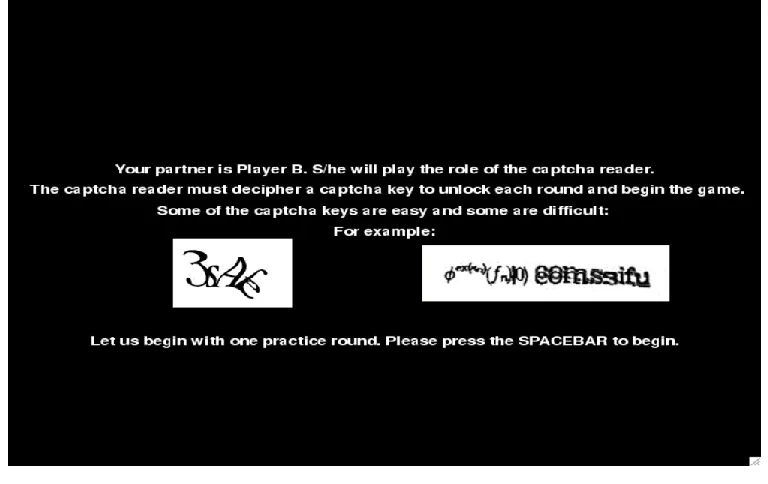
with a framerate of 17 frames per second. The easy captchas (Low Effort condition) consisted 213
of 3 characters; the animation of the partner 'deciphering' them was programmed to take 4-214
8 seconds. The difficult captchas (High Effort condition) consisted of 12 characters; the 215
animation of the partner 'deciphering' them was programed to take 16-20 seconds. The videos 216
which participants viewed of captchas being deciphered can be found in the Supplementary 217
Material (See S2). The captcha before the practice round was of intermediate length (8 218
characters), taking 12 seconds to decipher. The examples of easy and difficult captchas that 219
were presented in the instruction phase are depicted in Figure 1. 220
221
[image:11.595.67.451.321.563.2]222
Fig. 1. Sample Captchas. In the instruction phase, participants were presented with examples 223
of easy and difficult captchas. 224
225
The algorithm for the partner, which controlled the up-down axis, was programmed to 226
behave in a human-like manner: it follows the shortest path to the apple, but sometimes 227
(randomly) makes mistakes, reacting too late or turning in the wrong direction. 228
229
Sense of Commitment in HRI
Participants signed up for slots of one hour. On arrival at the lab, they were first informed that 231
they would be playing 20 rounds of the snake game together with a partner, with the 232
participant controlling the left-right axis, and the partner controlling the up-down axis, and 233
that their joint task would be to collect as many apples as possible in each round by jointly 234
maneuvering the snake. At the end of each round of the snake game, they were given 235
feedback about how many apples they had collected in that round. They were not provided 236
with a running total of the number of apples collected overall. Participants did not receive 237
points or any other rewards for the collection of apples. This was because we did not want to 238
provide external incentives for the collection of apples; instead, our focus was on the 239
motivation arising out of a sense of commitment to the partner. 240
In addition, they were informed that they and their partner had each been assigned an 241
additional task. Their partner would have the additional task of solving a captcha before each 242
round in order to unlock the round. The captchas would sometimes be easy (Low Effort 243
condition) and sometimes difficult (High Effort condition), as depicted in Figure 1. The 244
participant would have the task of determining when it was time to conclude each round of 245
the snake game, and move on to the next round, by pressing the spacebar. 246
They were then told that they would be linked with their partner via the internet, and 247
that their partner was the iCub, a humanoid robot located at our partner lab (the Cognitive 248
Robotics and Interaction Lab, based at the Italian Institute of Technology) in Genoa, Italy. 249
They were informed that the iCub had been practicing solving captchas and playing the snake 250
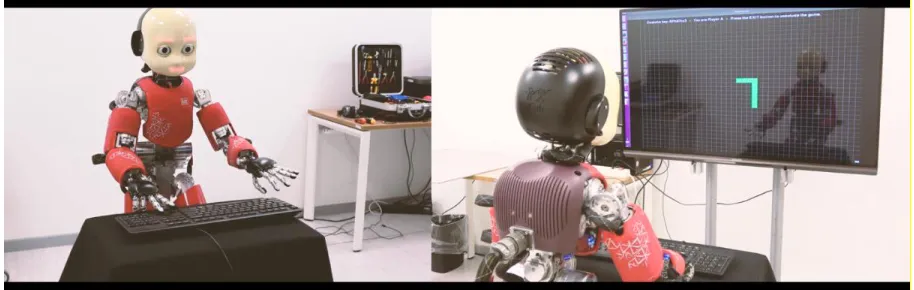
game earlier in the day. Next, they viewed a video (See Figure 2 and S1 in the Supplementary 251
Material) of the iCub robot practicing the snake game, followed by a video of the iCub 252
Sense of Commitment in HRI
254
Fig. 2: Frames from the videos of the iCub. In the instruction phase, participants viewed 255
videos of their robot partner practicing the snake game and practicing deciphering captchas. 256
For the video of the snake game, the robot was programmed to move the index and middle 257
fingers of its right hand to alternately press the left and right arrows while looking at the 258
screen, and thereby to navigate the snake. For the video of the captcha task, the robot was 259
programmed to reach the keyboard with its two hands, as if going to press the different keys 260
to solve the captcha. The sounds of keyboard clicks were added to the video a posteriori. 261
In a within-subject design, the experiment consisted of 20 trials in total, 10 in the High 262
Effort condition and 10 in the Low Effort condition. Each trial consisted of a captcha phase, 263
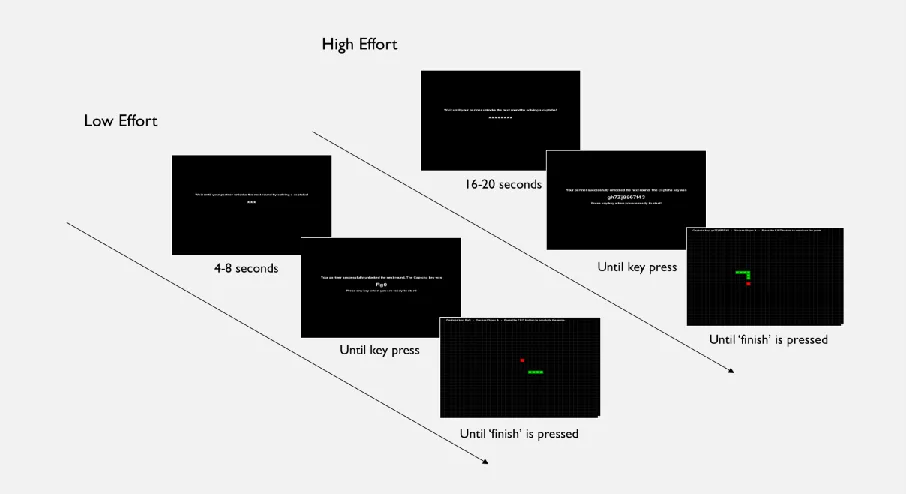
followed by a round of the snake game. In the captcha phase, a video was presented in which 264
stars progressively appeared to indicate that the partner was solving a captcha, and finally the 265
completed captcha key was displayed (See Figure 3 and S2 in the Supplementary Material). 266
The trials were presented in pseudorandomized order. 267
If a participant had not completed the full experiment (i.e. 20 trials) after a maximum 268
of one hour, we interrupted them at the end of whatever trial they were currently performing, 269
and then debriefed them and sent them home. This was because there was no upper limit on 270
how long participants could persist (persistence being the dependent measure), and previous 271
research (Székely & Michael, 2018) led us to anticipate that a small number of participants 272
would tend to persist for so long that they would only complete a few trials, making it 273
[image:13.595.69.526.71.216.2]Sense of Commitment in HRI
consequence of this procedure, 6 participants were interrupted before completing a minimum 275
of 8 trials in each condition (16 in total); the data from these participants was excluded prior 276
to analysis. 277
To make the joint action increasingly boring, apples were programmed to appear at an 278
ever-slowing rate within each round. In the first 10 seconds, each new apple appeared 279
immediately. After 10 seconds, new apples appeared with a delay of 40 frames; this delay was 280
doubled every ten seconds. Participants were instructed to press the ‘finish’ button when they 281
determined that it was time to end each round and move on to the next round. 282
The experiment was preceded by one practice trial. The captcha for the practice trial 283
was of intermediate length between the captcha for the High and Low Effort conditions (8 284
characters), and took 12 seconds to decipher. 285
286
287
288
289
Sense of Commitment in HRI
291
292
Fig. 3: Trial Structure. Each trial consisted of a captcha phase, followed by a round of the 293
snake game. In the captcha phase, a video was presented in which stars progressively 294
appeared to indicate that the partner was solving a captcha. The text on the screen read: 295
‘Please wait until your partner unlocks the next round by solving a captcha!’ Next, the 296
completed captcha key was displayed (See S2 in the Supplementary Material). The text on the 297
screen read: ‘Your partner successfully unlocked the next round. The Catptcha key was: 298
[Captcha key here]. Press any key when you are ready to start!’ Finally, the participant played 299
a round of the snake game. During this round, the text on the top of the screen read: ‘Captcha 300
key: [Captcha key here] – Your Player A – Press the EXIT button to conclude the game.’ 301
Each round continued until the participant pressed the spacebar to ‘conclude’ the round. 302
303
3. Results 304
3.1 Main Analysis 305
For the analysis, we excluded the data from 6 participants who did not complete at least 16 306
[image:15.595.71.525.104.351.2]Sense of Commitment in HRI
sample size of 26 participants, as we had planned. We also excluded the data from trials on 308
which participants collected 0 apples (6 trials; 2.3% of the data). There was a high degree of 309
variability in persistence times across trials, with participants persisting as long as 25 minutes 310
on some trials. Since we had no a priori basis for setting any particular upper bound, we did 311
not exclude any of these longer trials. Instead, we elected to use individual participants’ 312
median persistence times in seconds as the basis for our analyses. In order to test the data for 313
normality and homogeneity of variance we conducted a Shapiro-Wilk test, which revealed a 314
significant deviation from normality, p = .003. We therefore performed a log10 315
transformation on the data to meet the assumption of normality. We then conducted a paired-316
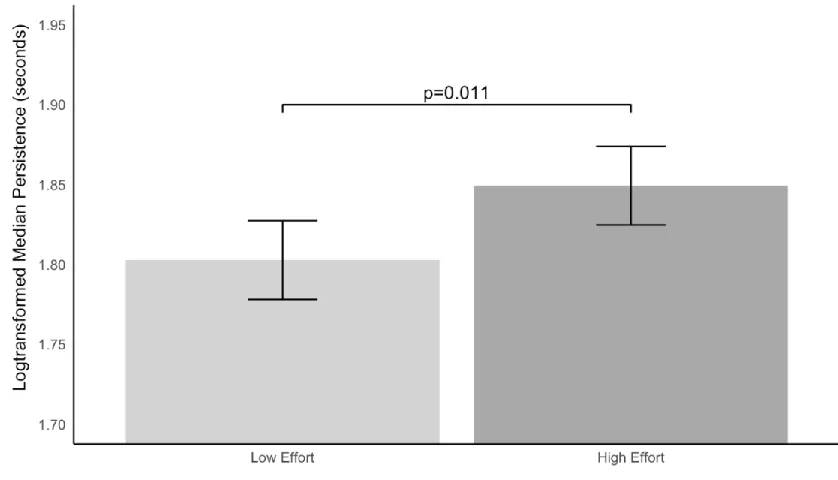
samples t-test, which revealed significant difference between conditions, with participants 317
persisting longer in the High Effort condition (logtransformed M = 1.85, SD = 0.28) than in 318
the Low Effort condition (logtransformed M = 1.80, SD = 0.26), t(25) = 2.76, p = .011, d = 319
0.54 (See Fig. 4, Fig. 5, and Table 1). 320
We also conducted a Wilcoxon Signed-Ranks test on the non-normalized data, which 321
indicated that participants persisting longer in the High Effort condition (M = 83.5, SD = 322
43.83) than in the Low Effort condition (M = 73.97, SD = 36.96;), Z = 263, p=.025, r = 0.50. 323
Sense of Commitment in HRI
325
Figure 4: Results. Persistence for High and Low Effort conditions. Error bars represent the 326
within-subject confidence intervals (following the method proposed by Cousineau, 2005; cf. 327
Loftus & Masson, 1994) 328
329
330
[image:17.595.72.491.81.321.2]Sense of Commitment in HRI
[image:18.595.73.524.67.418.2]332
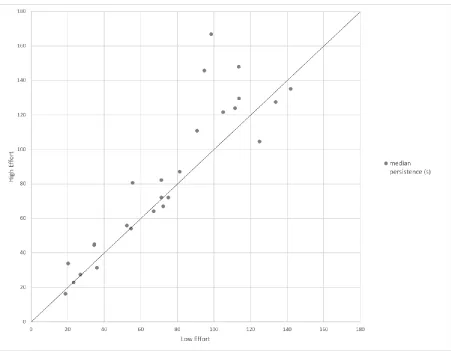
Figure 5: Individual Data. Each dark circle represents one participant’s median persistence in 333
seconds for each of the two conditions: the median persistence (in seconds) for the High 334
Effort condition lies on the Y axis, while the corresponding median persistence for the same 335
participant in the Low Effort condition (in seconds) lies on the X axis. The identity line 336
indicates where each participant's dot would lie if her or his median persistence did not differ 337
between conditions. 338
339
Table 1: Descriptive statistics for the High and Low conditions in the First Half and Second 340
Half of the experiment. All values are given in seconds. 341
Sense of Commitment in HRI
343
344
3.2 Secondary Analyses 345
3.2.1 ANOVA 346
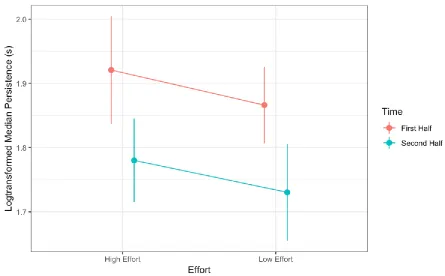
We were also interested in whether participants’ persistence varied over the course of the 347
experiment, and whether the effect of the manipulation was constant over the course of the 348
experiment. To probe these two issues, we performed an ANOVA with Effort (High/Low) 349
and Time (First Half of the experiment/Second Half of the experiment) as separate factors. 350
The results showed a significant main effect of Time, with participants persisting significantly 351
longer in the first half of the experiment (logtransformed M=1.89, SD= 0.26) than in the 352
second half (logtransformed M=1.76, SD= 0.32), F (1,25) = 6.42, p=0.018, p2 = 0.2. There
353
was also a significant main effect of Effort, with participants persisting significantly longer in 354
the High Effort condition (logtransformed M= 1.85, SD= 0.28) than in the Low Effort 355
condition (logtransformed M=1.80, SD=0.26), F (1,25) = 7.5, p=0.013, p2 = 0.22. There was
356
no statistically significant interaction between Time and Effort, F (1,25) = .024, p=0.879, p2
357
Sense of Commitment in HRI
359
[image:20.595.74.518.73.352.2]360
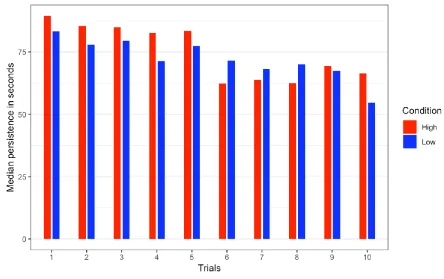
Figure 6: Descriptive data. The X axis represents the time course of the experiment, i.e. the 361
ten rounds of each condition. Each red bar represents the median persistence in seconds for 362
one trial in the High Effort condition; each blue bar represents the median persistence in 363
seconds for one trial in the Low Effort condition. For ease of comparison, the first High Effort 364
trial appears adjacent to the first Low Effort trial, the second High Effort trial adjacent to the 365
Sense of Commitment in HRI
[image:21.595.76.521.72.348.2]367
Figure 7: Results. Persistence for High and Low Effort conditions for the First Half and the 368
Second Half of the experiment. Error bars represent the within-subject confidence intervals 369
(following the method proposed by Cousineau, 2005; cf. Loftus & Masson, 1994). 370
371
3.2.2 Linear Regression 372
Some participants persisted longer in general than other participants. One possible reason for 373
this is that some participants felt more committed to the experimenter than others, and 374
therefore persisted longer. If so, then we may expect the same participants who persisted 375
longer in general to also exhibit a larger difference between the High and Low Effort 376
conditions than participants who persisted less in general, i.e. because they have a more acute 377
sense of commitment. To explore this question, we first confirmed that the assumptions for 378
regression analysis were not violated, and then conducted a linear regression to predict the 379
difference between the High and Low Effort conditions based on the sum of the medians in 380
Sense of Commitment in HRI
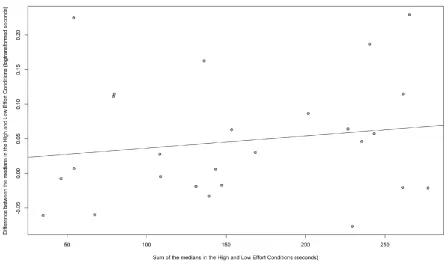
conditions did not significantly predict differences between the High and Low Effort 382
conditions, b = 0.162 , t(24) = 0.805, p = 0.428, (See Fig. 8). 383
[image:22.595.72.520.126.393.2]384
Figure 8: Results. The effect of general persistence, expressed as the effect of the sum of the 385
medians in the High and Low Effort conditions (x axis) upon the difference between the High 386
and Low Effort conditions (y axis). 387
388
4. Discussion 389
390
We implemented a 2-player version of the classic snake game which became increasingly 391
boring over the course of each round. Before each round of the game, participants perceived 392
what they believed to be cues that their partner, a humanoid robot, was deciphering a captcha 393
to unlock the round. In the High Effort condition, those cues indicated a high degree of effort; 394
in the Low Effort condition, they indicated a low degree of effort. To operationalize 395
participants' commitment, we measured how long they persisted in each round of the snake 396
game despite increasing boredom. In line with our prediction, the results revealed that 397
Sense of Commitment in HRI
condition. This supports the hypothesis that the perception of a humanoid robot’s effortful 399
contribution to a joint action is sufficient to elicit a sense of commitment, leading to increased 400
persistence in the face of increasing boredom and/or frustration. 401
We also found that participants’ persistence decreased over the course of the 402
experiment, with median persistence per trial bring shorter in the second half of the 403
experiment than in the first half. This finding confirms that participants did indeed find the 404
task increasingly boring and/or frustrating. With this in mind, it bears emphasizing that the 405
ANOVA revealed no interaction between Time (First Half / Second Half) and Effort (High / 406
Low), indicating that the effect of the manipulation did not decrease over the course of the 407
experiment. In other words, participants continued to persist longer in the High Effort 408
condition than in the Low Effort condition despite increasing boredom and/or frustration. 409
To explore the question whether the effect of our manipulation may have been driven 410
by a subset of participants who were particularly committed in general (i.e. to the task, the 411
experimenter and/or the partner), we also we conducted a linear regression to discern whether 412
persistence in general (i.e. the sum of the medians in the High and Low Effort conditions) 413
predicted the size of the difference in persistence between the High and Low Effort 414
conditions. We did observe a quantitative difference that was consistent with this possibility 415
(i.e. the participants who persisted longer also exhibited larger differences between 416
conditions, as illustrated in Figure 8), but since the difference was not statistically significant, 417
we cannot draw any conclusions about any differences there may have been in how the 418
manipulation affected different participants. 419
Our findings build upon and extend previous research showing that humans evaluate 420
humanoid robots with respect to trustworthiness (DeSteno et al., 2012; Lee et al., 2013). 421
While trust is an important stabilizing force in joint action, it does not directly explain why 422
one agent would persist in contributing to a joint action despite increasing boredom or 423
Sense of Commitment in HRI
commitment can boost an agent's motivation to contribute to joint action as a function of cues 425
indicating that her partner values the joint action and may be relying on her contribution 426
(Michael, Sebanz & Knoblich, 2015). If a human interactant's sense of commitment can be 427
triggered in interaction with a robot, as Michael & Salice (2017) have hypothesized, this 428
could provide roboticists with effective, low-cost tools for designing robots that elicit patience 429
and persistence on the part of human interactants. The findings reported here provide the first 430
direct evidence that this is the case. 431
The suggestion that a human interactant's sense of commitment can be elicited by a 432
robot partner also provides a new perspective on previous research. For example, Clodic and 433
colleagues (2006) designed an interactive robot guide, ‘Rackham’, who made explicit 434
agreements with museum visitors to guide them through an exhibition, and who was designed
435
to maintain the joint commitment by monitoring whether his ‘clients’ were following him,
436
waiting for them and adjusting his pace to theirs. Clodic and colleagues' work may be
437
interpreted as providing a starting point for roboticists aiming to design robots that can elicit
438
human interactants' commitment to interaction. More recently, Kahn et al. (2012) observed 439
how children reacted when an adult came to collect a robot with whom they had been playing, 440
and announced the intention to put it away in the closet despite the robot's pleas to continue 441
playing. In many cases, the children defended the robot and exhibited moral outrage as the 442
adult ignored it's pleas. This can be interpreted as evidence that by interacting with the robot, 443
the children developed a sense of commitment to the robot, which led them to feel concern for 444
its well-being and to judge that it was entitled to be treated fairly. 445
The current research also complements previous results showing that humans’ 446
patience toward robots that perform suboptimally can be increased if the robot appears to 447
invest effort in adapting its strategy to mitigate the consequences of its mistake (Lee et al., 448
2010; Brooks et al., 2016; Mirnig et al., 2017), or expresses a negative emotional reaction and 449
Sense of Commitment in HRI
results by addressing the more general question of how to sustain human interactants' 451
willingness to persist in interacting with a robot partner despite increasing boredom or 452
frustration -- irrespective of whether that boredom or frustration arises from errors on the part 453
of the robot or from the nature of the task. 454
One important question for future research will be to investigate to what extent it may 455
also be possible for non-humanoid robots to elicit a sense of commitment on the part of a 456
human. In this context, it is worth noting that Székely & Michael (2018), using the same 457
paradigm as was employed in the present study, observed no significant effect of the partner's 458
apparent effort upon participants’ persistence in a control experiment (Experiment 2 of their 459
study) in which the partner was described as a disembodied virtual agent (i.e., an ‘algorithm’). 460
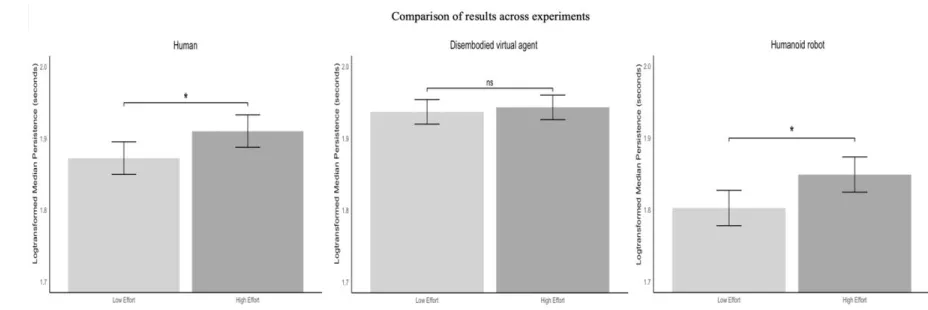
Thus, the differences which we observed between the High Effort and Low Effort conditions 461
in the present study were comparable to those which Székely & Michael (2018) observed 462
between the High and Low Conditions of their Experiment 1 (in which participants believed 463
they were interacting with a human) rather than to those which they observed in Experiment 3 464
of their study (in which participants believed they were interacting with a disembodied 465
algorithm (see Figure 9). 466
[image:25.595.57.521.511.666.2]467
Figure 9: Comparison of results across experiments in which participants’ beliefs about their 468
partner were varied. Persistence for High and Low Effort conditions three experiments. In 469
Székely & Michael, 2018, Experiment 1, participants believed they were interacting with a 470
Sense of Commitment in HRI
interacting with a disembodied virtual partner. In the current experiment, they believed they 472
were interacting with a humanoid robot partner. Error bars represent the within-subject 473
confidence intervals (following the method proposed by Cousineau, 2005; cf. Loftus & 474
Masson, 1994). 475
476
Of course, there are many differences between a disembodied virtual agent and the 477
robot used in the present study, which not only had a body but was indeed highly human-like 478
in appearance and in movement. It will therefore be important to probe the relative 479
importance of such physical features as a body, a face, and a human-like appearance, as well 480
as behavioral features such as gaze detection (Sciutti et al., 2015; Palinko et al., 2016), 481
anticipatory gaze (Sciutti et al., 2012), a human-like movement profile (Sciutti et al., 2013), 482
and the capacity to adapt movements to increase their legibility for a human partner (Dragan 483
et al., 2013; Stulp et al., 2015). With respect to the notion of legibility, for example, the 484
present study motivates the hypothesis that a robot's willingness to choose an action that is not 485
optimal for itself (e.g., in terms of energy), but which maximizes legibility for a human 486
partner, may be perceived as effortful and thereby boost a human partner's commitment to the 487
interaction. If so, this may be a useful means of increasing the human's patience towards the 488
robot in the event that the robot makes an error, performs a task slowly, or misunderstands an 489
instruction. 490
Moreover, it will be important to investigate to what extent a human's sense of 491
commitment to a robot partner may be increased by the robot's physical presence. In our 492
study, participants' only exposure to the robot was through a pair of pre-recorded videos at the 493
beginning of the experiment. In general, however, the physical presence of a robot partner 494
may be expected to increase a human's sense of commitment to interacting with it. Indeed, 495
this conjecture is motivated by the results of a recent study showing that people were more 496
Sense of Commitment in HRI
robot was physically present than when the interaction was mediated by video (Bainbridge et 498
al., 2008), and also Wainer and colleagues' (2006) finding that participants enjoyed 499
interacting with a physically present robot more than with a remote telepresent robot. 500
Similarly, it is also likely that a human's sense of commitment to an interaction with a robot 501
partner could be strengthened by enabling them to communicate: research has shown that 502
people treat a computer agent more like a human when there is an initial verbal interaction 503
between them (Lee, Kiesler & Forlizzi 2010), and that verbal communication can help guide a 504
human interactant in forming appropriate expectations about a robot's capabilities (Fischer, 505
2011). 506
507
508
5. Conclusion 509
The findings reported here have important implications, indicating that human interactants’ 510
willingness to persist in interacting with a robot partner despite increasing boredom or 511
frustration may be enhanced by implementing cues that the robot is investing effort. Further 512
research is needed to investigate what other cues of a robot partner’s effort contribution, such 513
as physical effort or time, may increase a human user’s commitment to remain patiently 514
engaged. 515
516
517
518
519
Acknowledgements 520
521
This research was supported by a Starting Grant from the European Research Council (n 522
Sense of Commitment in HRI
PIRSES-2013-612555). 524
525
526
527
Sense of Commitment in HRI
References 529
530
Bainbridge, W. A., Hart, J., Kim, E. S., & Scassellati, B. (2008, August). The effect of 531
presence on human-robot interaction. In Robot and Human Interactive Communication, 2008. 532
RO-MAN 2008. The 17th IEEE International Symposium on (pp. 701-706). IEEE. 533
534
Breazeal, C., Brooks, A., Gray, J., Hoffman, G., Kidd, C., Lee, H., ... & Mulanda, D. (2004). 535
Humanoid robots as cooperative partners for people. Int. Journal of Humanoid Robots, 1(2), 536
1-34. 537
538
Brooks, D. J., Begum, M., and Yanco, H. A. (2016). “Analysis of reactions towards failures 539
and recovery strategies for autonomous robots,” in Proceedings of the IEEE International 540
Symposium on Robot and Human Interactive Communication (RO-MAN 2016) (New York, 541
NY: IEEE), 487–492. 542
543
Chennells, M., Michael, J. (2018). Effort and performance in a cooperative activity are 544
boosted by the perception of a partner’s effort, Nature: Scientific Reports (2018) 8:15692 | 545
DOI:10.1038/s41598-018-34096-1 546
547
Clodic, A., Cao, H., Alili, S., Montreuil, V., Alami, R., & Chatila, R. (2009). Shary: a 548
supervision system adapted to human-robot interaction. In Experimental Robotics (pp. 229-549
238). Springer Berlin/Heidelberg. 550
551
Clodic, A., Fleury S., Alami, R., Chatila, R., Bailly, G., Brethes, L., …others (2006). 552
Rackham: An interactive robot-guide. In ROMAN 2006-the 15th IEEE International 553
Sense of Commitment in HRI
555
Cousineau, D. (2005). Confidence intervals in within-subject designs: A simpler solution to 556
Loftus and Masson’s method. Tutorials in Quantitative Methods for Psychology, 1(1), 42–45. 557
558
Cully, A., Clune, J., Tarapore, D., & Mouret, J. B. (2015). Robots that can adapt like 559
animals. Nature, 521(7553), 503-507. 560
561
DeSteno, D., Breazeal, C., Frank, R. H., Pizarro, D., Baumann, J., Dickens, L., & Lee, J. J. 562
(2012). Detecting the trustworthiness of novel partners in economic exchange. Psychological 563
science, 23(12), 1549-1556. 564
565
Dragan, A. D., Lee, K. C., & Srinivasa, S. S. (2013, March). Legibility and predictability of 566
robot motion. In Human-Robot Interaction (HRI), 2013 8th ACM/IEEE International 567
Conference on (pp. 301-308). IEEE.
568
569
Fasola, J., and Matarić, M.J. A socially assistive robot exercise coach for the elderly. Journal 570
of Human-Robot Interaction 2.2 (2013): 3-32. 571
572
Faul, F., Erdfelder, E., Buchner, A., & Lang, A. G. (2009). Statistical power analyses using 573
G∗ Power 3.1: Tests for correlation and regression analyses. Behavior Research Methods, 574
41(4), 1149–1160. 575
576
Feltz, D. L., Forlenza, S. T., Winn, B., & Kerr, N. L. (2014). Cyber buddy is better than no 577
buddy: A test of the Köhler motivation effect in exergames. GAMES FOR HEALTH: 578
Research, Development, and Clinical Applications, 3(2), 98-105 579
Sense of Commitment in HRI
Ferrari F, Eyssel F. 2016 Toward a Hybrid Society. In: Springer Handbook of Robotics. 581
Springer International Publishing, p. 909–918. 582
583
Fischer, K. (2011). How people talk with robots: Designing dialog to reduce user 584
uncertainty. AI Magazine, 32(4), 31-38. 585
586
Grigore, E. C., Eder, K., Pipe, A. G., Melhuish, C., & Leonards, U. (2013, November). Joint 587
action understanding improves robot-to-human object handover. In Intelligent Robots and 588
Systems (IROS), 2013 IEEE/RSJ International Conference on (pp. 4622-4629). IEEE.
589
590
Hamacher, A., Bianchi-Berthouze, N., Pipe, A. G., & Eder, K. (2016, August). Believing in 591
BERT: Using expressive communication to enhance trust and counteract operational error in 592
physical Human-Robot Interaction. In Robot and Human Interactive Communication (RO-593
MAN), 2016 25th IEEE International Symposium on (pp. 493-500). IEEE.
594
595
Kahn Jr, P. H., Kanda, T., Ishiguro, H., Freier, N. G., Severson, R. L., Gill, B. T., ... & Shen, 596
S. (2012). “Robovie, you'll have to go into the closet now”: Children's social and moral 597
relationships with a humanoid robot. Developmental psychology, 48(2), 303. 598
599
Lee MK, Kiesler S, Forlizzi J. Receptionist or information kiosk: How do people talk with a 600
robot? Presented at the Conference on Computer-Supported Cooperative Work, New York, 601
2010. 602
603
Lee, J. J., Knox, B., Baumann, J., Breazeal, C., & DeSteno, D. (2013). Computationally 604
modeling interpersonal trust. Frontiers in psychology, 4, 893. 605
Sense of Commitment in HRI
Lenz, C., Nair, S., Rickert, M., Knoll, A., Rosel, W., Gast, J., ... & Wallhoff, F. (2008, 607
August). Joint-action for humans and industrial robots for assembly tasks. In Robot and 608
Human Interactive Communication, 2008. RO-MAN 2008. The 17th IEEE International 609
Symposium on (pp. 130-135). IEEE.
610
611
Loftus, G. R., & Masson, M. E. (1994). Using confidence intervals in within-subject 612
designs. Psychonomic bulletin & review, 1(4), 476-490. 613
614
Michael, J., & Salice, A. (2017). The Sense of Commitment in Human–Robot 615
Interaction. International journal of social robotics, 9(5), 755-763. 616
617
Michael, J., Sebanz, N., & Knoblich, G. (2015). The sense of commitment: A minimal 618
approach. Frontiers in psychology, 6, 1968. 619
620
Michael, J., Sebanz, N., & Knoblich, G. (2016). Observing joint action: Coordination creates 621
commitment. Cognition, 157, 106-113. 622
623
Mirnig, N., Stollnberger, G., Miksch, M., Stadler, S., Giuliani, M., & Tscheligi, M. (2017). 624
To err is robot: How humans assess and act toward an erroneous social robot. Frontiers in 625
Robotics and AI, 4, 21. 626
627
Palinko, O., Sciutti, A., Wakita, Y., Matsumoto, Y., & Sandini, G. (2016, November). If 628
looks could kill: Humanoid robots play a gaze-based social game with humans. In Humanoid 629
Robots (Humanoids), 2016 IEEE-RAS 16th International Conference on (pp. 905-910). IEEE.
630
Sense of Commitment in HRI
Peirce, J. W. (2007). PsychoPy – Psychophysics software in Python. Journal of Neuroscience 632
Methods, 162(1–2), 8–13. 633
634
Schneider, S. & Kümmert, F. Exercising with a humanoid companion are more effective than 635
exercising alone, 2016 IEEE-RAS 16th International Conference on Humanoid Robots 636
(Humanoids), Cancun, 2016, pp. 495-501. 637
638
Sciutti, A., Bisio, A., Nori, F., Metta, G., Fadiga, L., & Sandini, G. (2012). Anticipatory gaze 639
in human-robot interactions. In Gaze in HRI from modeling to communication” workshop at 640
the 7th ACM/IEEE international conference on human-robot interaction, Boston, 641
Massachusetts, USA.
642
643
Sciutti, A., Bisio, A., Nori, F., Metta, G., Fadiga, L., & Sandini, G. (2013). Robots can be 644
perceived as goal-oriented agents. Interaction Studies, 14(3), 329-350. 645
646
Sciutti, A., Bisio, A., Nori, F., Metta, G., Fadiga, L., Pozzo, T., & Sandini, G. (2012). 647
Measuring human-robot interaction through motor resonance. International Journal of Social 648
Robotics, 4(3), 223-234.
649
650
Sciutti, A., Schillingmann, L., Palinko, O., Nagai, Y., & Sandini, G. (2015, March). A gaze-651
contingent dictating robot to study turn-taking. In Proceedings of the Tenth Annual 652
ACM/IEEE International Conference on Human-Robot Interaction Extended Abstracts (pp.
653
137-138). ACM. 654
655
Sebanz, N., Knoblich, G., & Prinz, W. (2003). Representing others’ actions: Just like one’s 656
Sense of Commitment in HRI
658
Stenzel, A., Chinellato, E., Bou, M. A. T., del Pobil, Á. P., Lappe, M., & Liepelt, R. (2012). 659
When humanoid robots become human-like interaction partners: corepresentation of robotic 660
actions. Journal of Experimental Psychology: Human Perception and Performance, 38(5), 661
1073. 662
663
Stulp, F., Grizou, J., Busch, B., & Lopes, M. (2015, September). Facilitating intention 664
prediction for humans by optimizing robot motions. In Intelligent Robots and Systems (IROS), 665
2015 IEEE/RSJ International Conference on (pp. 1249-1255). IEEE.
666
667
Székely, M., & Michael, J. (2018). Investing in commitment: Persistence in a joint action is 668
enhanced by the perception of a partner’s effort. Cognition, 174, 37-42. 669
670
Wainer, J., Feil-Seifer, D. J., Shell, D. A., & Mataric, M. J. (2006, September). The role of 671
physical embodiment in human-robot interaction. In Robot and Human Interactive 672
Communication, 2006. ROMAN 2006. The 15th IEEE International Symposium on(pp. 117-673
122). IEEE. 674
675