© 2019, IRJET | Impact Factor value: 7.211 | ISO 9001:2008 Certified Journal
| Page 257
EXPERIMENTAL STUDY OF CONCRETE WITH COPPER SLAG FOR
PARTIAL REPLACEMENT OF FINE AGGREGATE
S. GOVINDHAN¹, P. PAPITHA²
¹Head of the Department, Department of Civil Engineering, Sembodai R.V Engineering College, Sembodai,
Nagappattinam, Tamilnadu-614820
²PG Scholar, M.E- Structural Engineering, Department of Civil Engineering, Sembodai R.V Engineering College,
Sembodai, Nagappattinam, Tamilnadu-614820
---***---Abstract - In order to avoid using natural river sand. An alternative material is proposed to the strength of the concrete by replacing of fine aggregate. Partially by waste material like copper slag which is an environmental waste. To make us of these material without sacrifice the strength and durability of the concrete structure. To strength is measured by use of non-destructive and destructive techniques. The effects of replacing fine aggregate by copper slag on the compressive strength are attempted in this work. This work includes the determination of different properties of locally available copper slag and utilization of copper slag in concrete by replacing it partially by fine aggregate keeping the other parameters constant. Compressive strength of concrete cubes on M20 grade of concrete with constant 0.50 w/c ratio. Copper slag replacement of 0%, 10%, 20%, 30%, 40%, and 50% are used. This experimental study presents the result of compressive strength test on concrete containing copper slag partially replaced by fine aggregate. The obtained results were compared with those of conventional cement concrete made with Ordinary Portland Cement.
Key Words: Copper Slag, Fine Aggregate, M20 Grade, Compressive Strength, Environmental Waste.
1. INTRODUCTION
1.1 GENERAL
Many countries are witness a rapid growth in the construction industry which involves the use of natural resources for the development of the infrastructure. Natural resources are depleting world-wide while at the same time the generated wastes from the industry are increasing substantially. River sand, which is one of the constituents used in the production of conventional cement mortar, has become highly expensive and also scarce. The sustainable development for construction involves the use of non-conventional and innovative materials, and recycling of wastes in order to compensate the natural resources and to find alternative ways for conserving the environment.
Large amount of industrial wastes or byproducts accumulate every year in all developing countries. Therefore now a day’s utilization of secondary materials has encouraged in construction field. For the production of cement and concrete very high amount of energy is needed. Around 7% of CO₂ released to atmosphere is appeared during
cement production. Harmful effects of concrete by using on environmental can be reduced by producing good and durable concrete by using industrial by products.
The presence of copper, alumina, sulphate in the slag were only traces and harmful. The properties of fine aggregates at all chemical composition of slag is replacement levels are similar to the presented in table-1 and sieve analysis of specification for sand zone II as per IS:383. High strength concrete has to be designed for higher workability, higher mechanical properties and greater durability than those of conventional concrete. The definition of high strength concrete is continuous to change as advances in concrete technology make it easier to achieve increasing higher strength and greater workability using conventional construction practice. In order to achieve high strength concrete with good mechanical properties and durability, fly ash or silica fume that are considered as waste material are used as one of the main ingredients. The recent research showed that the possibility of utilizing industrial byproducts as well as other material in the production of normal concrete and high strength concrete, when used as partial or full replacement of cement mortar and aggregates or as admixtures. This research study presents the results of experimental work conducted on the performance of high strength concrete mortar made with copper slag as fine aggregate. The effects of admixtures made with copper slag has been discussed.
1.2 COPPER SLAG
Copper slag is a byproduct obtained the metal smelting and refining of copper. Copper slag used in this work was brought from Sterlite Industries Ltd (SIL), Tuticorin, and Tamilnadu, India. SIL is produced per day and a total accumulation of around 1.5 million tons. It is a byproduct obtained during the metal smelting and refining of copper. To produce every ton of copper approximately 2.2-3.0 tons copper slag is generated as a byproduct material. Utilization of copper slag in application such as Portland cement substitution and as aggregates has threefold advantages of eliminating air pollution problems.
© 2019, IRJET | Impact Factor value: 7.211 | ISO 9001:2008 Certified Journal
| Page 258
Copper slag is the toxic for environment because it containslarge amount of heavy metals in their oxide. Separated impurities are collected and removed and various substance are added to purified metal which melt it and enrich it, and in those processes slag is generated again as a byproducts.
This type of generated slag depends on the method of cooling of the melted mass on the type of processes metal.
The production of granulated slag sand sized grains are created. Due to its composition, this material has excellent hydraulic properties and in the presence of an appropriate will behave in a manner similar to Portland cement.
Expanded for any slag is more porous and has a smaller volume than air cooled slag. The current quantity of copper slag is estimated at approximated 2.2 million tons. A large quantity of this material on landfill and its potential as a substitute for traditional material has investigated to carry out research into the possibilities of various applications of slag construction primarily as aggregate in concrete mixtures.
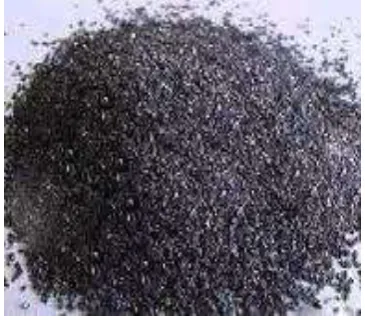
Fig -1: Copper Slag
1.3 BASIC PROPERTIES OF COPPER SLAG
The slag is a black glassy and granular in nature and has a similar particle size range like sand which indicate that it could be tried as replacement for the sand in cementite’s slag mixture. The specific gravity of copper slag is varying between 1.7-1.90 g/cc. which is almost similar to the bulk density. The hardness of gypsum. The pH of aqueous solution of aqueous extract as per IS 11127 is 11ppm. The slag is conforming to the above standards.
The free moisture content present in slag was found to be less than 1%. The sieve analysis for copper slag infers that the gradation properties of fine aggregates at all the replacement levels are similar to the specification for sand zone II as per IS: 383. The chemical composition of slag is presented on table-1 and sieve analysis report is shown of table-2. The presence of silica in slag is about 26% which is desirable since it is one of the constituents of the natural fine aggregate used to normal concreting operations.
The presence of copper, alumina, sulphate in the slag were only traces and harmful. The properties of fine aggregates at all chemical composition of slag is replacement levels are similar to the presented in table-1 and sieve analysis of specification for sand zone II as per IS:383.
In the composition of copper slag there is a significant considered responsible for the biggest lack of this material and its limited usage in road, building. Namely copper slag is very expansive and due to this reason the volume can change by as much as 10% slag weathering in atmosphere conditions is considered to be one of the most appropriate methods of eliminating this adverse property. The weathering period varies depending on the application method and the type of slag itself. Therefore it sometimes takes only several months of weathering in atmospheric conditions or occasional sprinkling with water. According to Belgian and Dutch regulations for the use of slag in unbound base course one year of weathering is sufficient whereas there are known data on the need for weathering for as much as 18 months before using the slag as aggregate.
Those obstruction are particularly dangerous in the case of freezing which renders large damage to pavement structures. This however unlike expansions cannot be prevented by slag weathering.
The grains of this material are pointed with rough surface and this is particularly suitable in the case of use in asphalt mixtures for reason of an increasing in adhesiveness between the pavement and wheels. The big angle of internal friction (40-45) contributes to big stability of materials and CBR value of up to 200%. Copper slag belongs to medium alkaline material with pH values 6.6-7.2.
1.4 SCOPE
The scope of the work includes the studies on the following aspects of cement mortar and cement concrete.
Evaluation of copper slag based on cement mortar in brick masonry construction.
The percentage of copper slag used for replacement of river sand are 0%, 10%, 20%, 30%, 40%, 50%. Cement sand mortar joint thickness of 10 and 15mm. Plaster ability of use of copper slag for partial
replacement material for river sand.
Use of copper slag as replacement material for river sand in cement concrete.
1.5 OBJECTIVES
Copper slag has also gained popularity in the building industry for use as a fill material.
[image:2.595.70.253.326.487.2]© 2019, IRJET | Impact Factor value: 7.211 | ISO 9001:2008 Certified Journal
| Page 259
Copper slag can also use as a building material formedinto blocks.
It is widely used in the sand blasting industry and it has been used in the manufacture of abrasive tools. Copper slag is used as an abrasive media to remove rust, old coating and other impurities in dry abrasive blasting due to its high hardness.
2. MATERIAL, METHODOLOGY AND TESTING
2.1 MATERIALS
2.1.1 CEMENT
Copper slag is used as an abrasive media to remove rust, Cement is a well-known building material has occupied an indispensable place in construction works. Cement is an extremely ground material having adhesive ingredients. It is obtained by burning together, in a definite proportion, a mixture of ingredients. It is obtained by burning together in a definite proportion, a mixture of naturally occurring argillaceous and calcareous, cooled and ground to the required the required fineness to produce material known as cement.
In general cement is a binder a substance that sets and hardens independently and can bind other materials together. The word `cement` is used to describe masonry resembling modern concrete that was made from crushed rock with burnt lime as binder.
Ordinary Portland Cement was used for casing concrete. This cement is the most widely used one in the construction industry in India. The grade of cement is 53 with specific gravity of 3.15. The initial time and final setting time were found to be 30min and 600min respectively.
2.1.2 AGGREGATE
These are chemically inert, solid bodies held together by the cement. Aggregates come in various shapes, sizes and material ranging from fine particle of sand to large rocks. Because cement is the most expensive ingredients in making concrete, it is desirable to minimize the amount of cement used 70%-80% of the volume of concrete is aggregate keeping the cost of the concrete low. Generally flat and elongated particles are avoided or are limited to about 15% by weight of the total aggregate. Unit weight measures the volume that graded aggregate and the voids between them will occupy in concrete. The void content between particles affects the amount of cement paste required for the mix.
Selecting equal sizes of well graded aggregates reduce the void content. Absorption and surface moisture of aggregate are measured while selecting aggregate because the internal structure of aggregate is made up of solid material and voids that may affect the water cement ratio.
2.1.3 AGGREGATE
2.1.3.1 FINE AGGREGATE
Fine aggregate used for concrete should be properly graded to give minimum void ratio and be free from deleterious material like clay, slit content and chloride contamination etc. Hence grading of fine aggregate is relatively different from that in normal concrete. Grading of fine aggregate should be such that it does not cause increase in water demand for the concrete and should give maximum voids so that the fine cementations particles to fill the voids. Hence it is desirable to use the coarser variety of fine aggregate having a high fineness modulus for making workable and strong concrete. The fine aggregate having are taken in saturated surface dry condition.
2.1.3.2 COARSE AGGREGATE
Local aggregate comprising 20mm, and less than 20mm coarse aggregates in saturated surface dry condition, were used. The coarse aggregates were crushed granite type aggregates. Coarse aggregate were obtained in crushed from majority of the particles were of granite type. The quality is tested using impact test.
2.1.3.3 COPPER SLAG
The copper slag used in this study have glassy appearance and black in color. It having the specific gravity of 3.68 and the compacted unit weight as 8.75 KN/m3. The particle size of the copper slag is similar to the river sand i.e. sieve size from 4.75mm to 75 micron.
The tests which conducted on river sand is also carried on copper slag.
Table -1: Physical properties of copper slag
Physical properties of copper slag
Colour Black
Specific gravity 3.68 Appearance Glassy Compacted unit
weight (KN/m3) 8.75
Absorption 5%
Table -2: Chemical properties of copper slag
Chemical properties of copper slag
Iron (Fe2O3) 68.29% Silica dioxide
(SiO2) 25.84%
Calcium oxide
(CaO) 0.15%
Aluminum
© 2019, IRJET | Impact Factor value: 7.211 | ISO 9001:2008 Certified Journal
| Page 260
2.1.4 WATER
It is the key ingredient mixed with cement, forms a paste that binds the aggregate together. The water causes the hardening of concrete through a process called hydration. Hydration is a chemical reaction in which the major compound in cement form chemical bonds with molecules because the water to cement ratio is the most critical factor in the design of perfect concrete. Excess of water reduces strength and workability of concrete.
Portable tap water available in the plant conforming to the requirements of IS456-2000 was used for casting concrete & curing the specimens.
2.2 METHODOLOGY FLOW CHART
Chart -1: Flow chart
2.3 TESTS
2.3.1 TESTS ON FINE AGGREGATE
In this project, the river sand, which was available in saturated surface dry condition was used as fine aggregate
and the following tests were carried out on sand as per IS:2386-1968(iii):
Sieve analysis Density Specific gravity Water absorption
2.3.2 TESTS ON COARSE AGGREGATE
The coarse aggregate are tested for the following Impact value
Sieve analysis Density Specific gravity Water absorption
2.3.3 TESTS ON COPPER SLAG
The copper slag is tested separately for the following Sieve analysis
Density Specific gravity Water absorption
SIEVE ANALYSIS TEST
Sieve analysis helps to determine the particle size distribution of the coarse and fine aggregate. This is done by sieving the aggregates as per IS: 2386 (part I) 1963. In this we use different sieves as standardized by the IS code and then pass aggregate through them and collect different sized particles left over different sieves.
DENSITY
The density of both fresh and hardened concrete is of interest to the parties involved for numerous reasons including its effect on durability, strength and resistance to permeability. Hardened concrete density is determined either by simple dimensional check followed by weighing and calculation or by weight in air water buoyancy method.
SPECIFIC GRAVITY TEST
Purpose
© 2019, IRJET | Impact Factor value: 7.211 | ISO 9001:2008 Certified Journal
| Page 261
Standard reference
IS: 2720 (part 3) 1980, first revision – standard test for specific gravity of material is used as reference for testing.
Significance
The specific gravity of a material is used in the phase relationship of air water and solid in the given volume of material.
Specific gravity =
W₀ = weight of sample material, g=Wps-Wp
WA = weight of pycnometer filled with water WB = weight of pycnometer filled with water
and material.
WATER ABSORPTION
This process is particularly important on concrete for durability. Absorption capacity is a measure of porosity of a material. It is also used as a correlation factor in determination of free moisture by oven dry method. The absorption capacity is determined by finding the weight of surface dry sample after it has been soaked for 24 hours and again finding the weight after sample has been dried in an oven. The difference in weight expressed as a percentage of dry sample weight.
Water absorption = (increased weight in kg/weight of specimen in kg) ×100
3. TEST RESULTS
3.1 SPECIFIC GRAVITY TEST
3.1.1 COPPER SLAG
Instrument used = Pycnometer Material used = Copper slag
Observations:
1. Weight of pycnometer (W1) = 630 g 2. Weight of pycnometer + copper slag (W2) = 1330 g 3. Weight of pycnometer + full water + copper slag
(W3) = 2070 g
4. Weight of pycnometer + full water (W4) = 1560 g
Specific gravity =
=
G = 3.68
3.1.2 FINE AGGREGATE
Instrument used = Pycnometer Material used = Fine aggregate
Observations:
1. Weight of pycnometer (W1) = 630 g 2. Weight of pycnometer + Fine aggregate
(W2) = 950 g
3. Weight of pycnometer + full water + Fine aggregate
(W3) = 1560 g
4. Weight of pycnometer + full water (W4) = 1360 g
Specific gravity =
=
G = 2.68
3.1.3 COARSE AGGREGATE
Instrument used = Pycnometer Material used = Coarse aggregate
Observations:
1. Weight of pycnometer (W1) = 630 g 2. Weight of pycnometer + Coarse aggregate
(W2) = 1010 g
3. Weight of pycnometer + fullwater+Coarse aggregate
(W3) = 1640 g
4. Weight of pycnometer + full water (W4) = 1395 g
Specific gravity =
=
G = 2.80
3.1.4 CEMENT
© 2019, IRJET | Impact Factor value: 7.211 | ISO 9001:2008 Certified Journal
| Page 262
Observations:
1. Weight of pycnometer (W1) = 630 g 2. Weight of pycnometer + Cement (W2) = 1080 g 3. Weight of pycnometer + kerosene + Cement
(W3) = 1600 g
4. Weight of pycnometer + kerosene (W4) = 1263 g 5. Specific gravity of kerosene = 0.79
Specific gravity =
=
G = 3.15
3.2 SIEVE ANALYSIS
3.2.1 COPPER SLAG
Instrument used = Sieve Material used = Copper slag Weight of material = 500 g
Table -3: Sieve analysis on Copper slag
IS Sieve
Size
Weight retained
(g)
% of weight retained
Cumulative
% retained passing % of
4.75
mm 32 6.4 6.4 93.6
2.36
mm 58 11.6 18 82
1.18
mm 126 25.2 43.2 56.8
600 μ 98 19.6 62.8 37.2
300 μ 94 18.8 81.6 18.4
150 μ 78 15.4 97 3
Pan 16 3 100 0
Fineness modulus = 504/100 = 5.04
3.2.2 FINE AGGREGATE
Instrument used = Sieve
Material used = Fine aggregate Weight of material = 1000 g
Table -4: Sieve analysis on Fine aggregate
IS Sieve Size
Weight retained (g)
% of
weight retained
Cumulat ive % retained
% of
passing
4.75 mm 0.01 10 1 99
2.36 mm 0.06 70 7 93
1.18 mm 0.36 430 43 57
600 μ 0.27 700 70 30
300 μ 0.19 890 89 11
150 μ 0.09 980 98 2
Pan 0.02 1000 100 0
Fineness modulus = 408/100 = 4.08
3.2.3 COARSE AGGREGATE
Instrument used = Sieve
Material used = coarse aggregate Weight of material = 2000 g
Table -5: Sieve analysis on Coarse aggregate
IS Sieve
Size
Weight retained
(g)
% of weight retained
Cumulative
% retained passing % of
125 0 100 0 100
100 0 100 0 100
75 0 100 0 100
50 0 100 0 100
40 0 100 0 100
25 730 63.5 36.5 63.5
12.5 2000 0 100 0
10 2000 0 100 0
Fineness modulus = 236.5 / 100 = 2.365
3.3 WATER ABSORPTION TEST
3.3.1 FINE AGGREGATE
Table -6: water absorption of fine aggregates
Sample no.
Weight of oven dried specime
n (W1) Kg
Weight of saturate
d specime
n (W2) Kg
Weight of absorbe
d water
W3=W2-W1 Kg
% of water absorpti
on =(W3/W
1)×100
© 2019, IRJET | Impact Factor value: 7.211 | ISO 9001:2008 Certified Journal
| Page 263
[image:7.595.29.554.97.370.2]3.3.2 COARSE AGGREGATE
Table -7: water absorption of Coarse aggregates
Sample no.
Weight of oven dried specimen (W1)Kg
Weight of saturated specimen (W2)Kg
Weight of absorbed water W3=W2-(W1)Kg
% of water absorptio n
=(W3/ W1)×100
1 1.166 1.172 0.006 0.51
[image:7.595.274.558.114.368.2]3.3.3 COPPER SLAG
Table -8: water absorption of Copper Slag
Sample no.
Weight of oven dried specimen (W1)
Kg
Weight of saturated specimen (W2)
Kg
Weight of absorbed water W3=W2-W1
Kg
% of water absorption =(W3/W1) ×100
1 0.960 1.380 0.42 0.4
3.4 COMPRESSIVE STRENGHT TEST ON CONCRETE CUBE (M20)
FORMULA USED
Compressive strength = (load/area) N/mm²
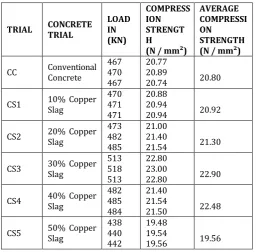
3.4.1 Compressive strength for 7 days
Table -9: Compressive strength after 7 days
TRIAL CONCRETE TRIAL LOAD IN (KN)
COMPRESS ION STRENGT H
(N / mm²)
AVERAGE COMPRESSI ON
STRENGTH (N / mm²)
CC Conventional Concrete 467 470
467
20.77 20.89
20.74 20.80
CS1 10% Copper Slag 470 471
471
20.88 20.94
20.94 20.92
CS2 20% Copper Slag 473 482
485
21.00 21.40
21.54 21.30
CS3 30% Copper Slag 513 518
513
22.80 23.00
22.80 22.90
CS4 40% Copper Slag 482 485
484
21.40 21.54
21.50 22.48
CS5 50% Copper Slag 438 440
442
19.48 19.54
19.56 19.56
Therefore CS3 have a better strength when compared with others after 7 days
[image:7.595.319.550.453.552.2]3.4.2 Compressive strength for 28 days
Table -10: Compressive strength after 28 days
TRIAL CONCRETE TRIAL LOAD IN (KN)
COMPRESS ION STRENGT H
(N / mm²)
AVERAGE COMPRESSI ON
STRENGTH (N / mm²)
CC Conventional Concrete 649 642
646
28.84 28.54
28.73 28.70
CS1 10% Copper Slag 755 760
763
33.54 33.78
33.89 33.73
CS2 20% Copper Slag 807 808
830
35.87 35.90
36.87 36.21
CS3 30% Copper Slag 853 853
858
37.89 37.90
38.14 38.54
CS4 40% Copper Slag 895 898
913
39.78 39.89
40.56 40.28
CS5 50% Copper Slag 821 830
829
36.50 36.89
36.83 36.74
Therefore CS3 have a better strength when compared with others after 28 days
3.4.3 RESULTS FOR COMPRESSION TEST
Table -11: Compression test results After 7 & 28 days
TRIAL Mix 7 Days 28Days
CC Conventional Concrete 20.80 28.70 CS1 Copper Slag 10% 20.92 33.73 CS2 Copper Slag 20% 21.30 36.21 CS3 Copper Slag 30% 22.90 38.54 CS4 Copper Slag 40% 21.48 40.28 CS5 Copper Slag 50% 19.56 36.74
3.4.4 COMPRESSION STRENGTH AFTER 7 DAYS 7& 28 DAYS
[image:7.595.34.293.478.730.2] [image:7.595.307.563.538.735.2]© 2019, IRJET | Impact Factor value: 7.211 | ISO 9001:2008 Certified Journal
| Page 264
3.5 Cost Analysis
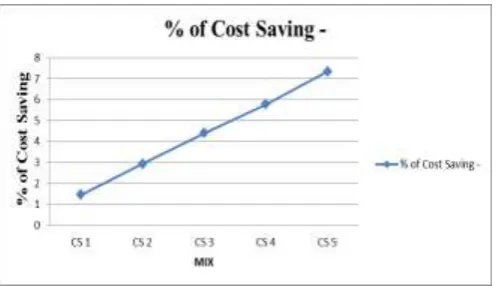
Cost analysis is the very important factor to be considered, while analyzing the project. The cost analysis for various mixes per m3 is shown in Table no 4.6
[image:8.595.311.562.77.220.2]According to that, the cost for reference concrete mix specimen took Rs 5817.4. per m3. Replacing 10%, 20%, 30%, 40%, 50% of copper slag in sand, it cost should be low when compared with “R”.
Table -12: Cost of Material
Materials Quantity Rate in “ ”
Cement 1 bag (50 kg) 420 Copper slag 1bag (50 kg) 150
Fine
aggregate per cft 120
Coarse
aggregate per cft 110
where,
[image:8.595.40.284.209.319.2]1 unit = 100 cft 1 unit = 2830 kg
Table -13: Rate of material per “kg”
Materials Rate in “ ”
Cement 8.5
Copper slag 3.0 Fine aggregate 1.5 Coarse
[image:8.595.38.283.544.731.2]aggregate 1.4
Table -14: Total Cost of Materials for M20 design mix concrete (1:1.53:3.45) per m3
Chart-3: Percentage of improvement of cost Analysis
4. CONCLUSION
Based on the test results obtained from the experimental program of this work the following major calculations are arrived from workability, compressive strength and cost analysis.
4.1 WORKABILITY TEST
Slump Cone Test
From the workability test results, slump value slightly decreases for concrete mixes with Copper slag when compared with reference concrete mix (R).
After 7 days curing
From the experimental test results, the compressive strength of concrete mix of cube having 30% of copper slag (CS3) has the higher strength of 22.90Mpa.
After 28 days curing
From the experimental test results, the compressive strength of concrete mix of cube having 40% of copper slag (CS4) has the higher strength of 40Mpa.
By analyzing its cost and strength parameters concrete mix having 40% replacement of cement by copper slag (CS4) is comparatively more economical.
4.2 COST ANALYSIS
By analyzing its cost and strength parameters concrete mix having 40% replacement of Sand by Copper slag (CS4) is comparatively more economical.
© 2019, IRJET | Impact Factor value: 7.211 | ISO 9001:2008 Certified Journal
| Page 265
REFERENCES
[1] International journal of IT, Engineering and Applied Science Research (Volume 2, No.4, April 2013). [2] Leonardo Journal of Science, (Issue 23, July – December
2013) Research article ISSN 1583 – 0233.
[3] International Journals of Current Engineering and Technology, ISSN 2277 – 4106.
[4] International Journal of Energy and environmental Engineering 2013.
[5] Journal of Civil Engineering and Construction Technology (Volume 3, December 2012), ISSN 2141 – 2634.
[6] AS,./Asian Journal of Civil Engineering (Building and housing), (Volume 7, 2006).
[7] Journal of Wuhan University of technology, Sept – 2010. [8] Chavan, et al, International Journal of Advanced Engineering Research and Studies E-ISSN 2249-8974. [9] BIS:383 – 1970, “specification for coarse and fine
aggregates from natural sources for concrete”.