CD
Computer Enhancement of Radioisotope Pictures
,
July; 1966
How to put your finger on one item out of 36,000
A division of H. K. Porter Company, Inc., does it by dialing a computer center. Anyone of 36,000 items could be at any of seven warehouses and eight plants across the nation. When a product is sold, the information on punched cards is sent via Bell System
Data-Phone* service over regular telephone lines to the Porter computer center in Pittsburgh. The information is instantly
recorded on magnetic tape and fed into the computer.
In a matter of milliseconds, the computer tells the production status or inventory location of the product. And the entire order is processed for shipment in one working day. (It formerly took up to fourteen days.) As ordering information flows in, the computer updates the average monthly demand, economical production quantities,
@
Bell System
. --;-- American Telephone & Telegraph and Associated Companies
and safety stocks.
Replenishment orders are auto-matically produced when needed. The result has been a cut in inventories. And customer service is at its best.
We can help you put your finger on the way to move information quickly and efficiently.
A bank statement in Japan,
inventory records in Colombia,
insurance billing in Australia. ".
That's us all over.
All over the free world, helping to meet the basic needs of businesses small and large everywhere. One thousand and thirty three NCR offices in one hundred and twenty one countries outside the continen-tal United States. Factories all over. And data processing centers. If
you're over there too-or cons],?er-ing an overseas expansion---"-it's something to think of. Procedural standardization alone makes it worth considering NCR foryourdata handling equipment (your Calcutta adding machine speaking the same equipment language of your New
Designate No. 4 on Readers Service Card THE NATIONAL CASH REGISTER CO.
York computer, for example). And maintenance is usually a local tele-phone call away. If your business does not go beyond our shores it's still nice to know that NCR brings a whole world of experience to bear on your business systems problems and needs.
Heads!
You don't pick precision magnetic tape this way, but we have the feeling that
some people do.
"How can you lose," we've heard
it
muttered, "one leading brand is as good
as another."
Well, like the song says,
"it
ain't necessarily so."
Take Computape users. They would rather be safe than sorry. And they've
~oundthat, for long, reliable, error-free performance, Computape is about the
safest tape going.
Has to be. Not a reel of tape leaves the plant that hasn't been checked and
re-checked dozens of times for perfect quality and uniformity. And of course,
each reel has been meticulously produced to meet the individual specifications
of the equipment on which
it
will be used.
Nothing is completely sure in this life, but when you can come this close
with Computape, why tempt fate with some other brand?
JULY, 1966 Vol. 15, No.7
editor and publisher
EDMUND C. BERKELEY
associate publisher
PATRICK J. MCGOVERN
assistant editors
MOSES M. BERLIN
LINDA LADD LOVETT NEIL D. MACDONALD
contributing editors
JOHN BENNETT ANDREW D. BOOTH DICK H. BRANDON JOHN W. CARR, III NED CHAPIN ALSTON S. HOUSEHOLDER
PETER KUGEL ROD E. PACKER
advisory committee
T. E. CHEATHAM, JR. JAMES J. CRYAN RICHARD W. HAMMING ALSTON ~ HOUSEHOLDER HERBERT F. MITCHELL, JR. VICTOR PASCHKIS
art director
RAY W. HASS
fulfilment manager
WILLIAM J. MCMILLAN, 815 Washington st. Newtonville, Mass. 02160, 617-DEcatur 2-5453
advertising representatives
New York 10018, BERNARD LANE 37 West 39 St., 212-BRyant 9-7281
Chicago 60611, COLE, MASON AND DEMING 737 N. Michigan Ave., 312-SU 7-6558
Los Angeles 90005, WENTWORTH F. GREEN 300 S. Kenmore Ave.,. 213-DUnkirk 7-8135
San Francisco 94105, A. S. BABCOCK 605 Market St., 415-YUkon 2-3954
Elsewhere, THE PUBLISHER 815 Washington St., 617-DEcatur 2-5453 Newtonville, Mass. 02160
The front cover shoUis scanning equipment sensitive to radioisotope concentration; a computer enhances the rewlting picture in the same way as pictures
0/
the Moon and Marshave been enhanced by computer. . . .
For more in/ormation see page
42.
, _
bt This Issue
SPecial F eattl're:
Data
C
011tmlttlicatio1ZS
1418
26
34
In
41
7
9
I I
31
8 8
8 23 23
OPTICAL PROCESSING IN MEDICAL SCIENCES
by Robe rt S. Led ley
The large scale quantitative analysis of photographs of biomedical struc-tures depends on optical processing.
MULTIPLICITY IN COMPUTER SYSTEMS
by Ivan Flores
Multiprocessing, multiprogramming, multicomputing, multi priority, multi-users ... some definitions and implications.
COMPUTERS: NO LONGER. A BIG BARGAIN FOR UNEDUCATED USERS
by Seymour V. Pollack and Theodore D. Sterling ':
Computer users need to develop their own skills in programming and sys-tems analysis.
THE USE OF COMPUTERS AS INDUSTRIAL COUNSELORS
by Magoroh Maruyama
In developing computer applications to human dialogues, the use of the computer as a counselor for personnel in industry is an intriguing
pos-sibility. .
Every Issue
across the editor's desk
COMPUTING AND DATA PROCESSING NEWSLETTER
editorial
The Thirst for Computer Knowledge
market report
Burroughs New 6500 Should Get Good Reception
throughput
by Di ck Brandon
capital report
by James Titus
readers' and editor's forum
Computer Installation Census
Comments on the April Issue Special Feature: "Some Provocative Applications of Computers" Farewell from a Former Subscriber
Reports on Data Processing Centers
Comments on "A Data Communications Controller"
reference information
31 Calendar of Coming Events
*0 ON YOUR ADDRESS IMPRINT MEANS THAT YOUR SUBSCRIP-TION INCLUDES THE COMPUTER DIRECTORY. *N MEANS THAT YOUR PRESENT SUBSCRIPTION OOES NOT I NCLlJDE THE COM-PUTER DIRECTORY.
56 Computer Census
58 New Patents, by Raymond R. Skolnick
62 Books and Other Publications, by Moses M. Berlin
index of notices
62 Advertising Index
.,~. COMPUTERS AND AUTOMATION IS PUBLISHED MONTHLY AT 815 WASHINGTON ST., NEWTONVILLE, MASS. 02160, BY BERKELEY ENTERPRISES, INC. PRINTED IN U.S.A. SUBSCRIPTION RATES: UNITED
:.~: STATES, $15.00 FOR 1 YEAR, $29.00 FOR 2 YEARS, INCLUDING THE JUNE DIRECTORY ISSUE; CANADA, ADD SOc A YEAR FOR POSTAGE; FOREIGN, ADD $3.50 A YEAR FOR POStAGE. ADDRESS' ALL ' ... ' EDITORIAL AND SUBSCRIPTION MAIL TO BERKELEY ENTERPRISES, INC., 815 WASHINGTON ST., NEWTONVILLE, MASS., 02160. SECOND CLASS POSTAGE PAID AT BOSTON, MASS.
c&a
EDITORIAL
THE THIRST FO:R COMPUTER KNOWLEDGE
All over the world, it seems, there is a thirst for knowledge about computers: what they really are; how to apply them; how to make them; what their implications are. This was the predominant impression I received during a recent round-the-world trip which included:
- attending the conference on data processing in hospitals in Elsinore, Denmark, on April 22;
- discussing selections for the book club "Library of Computer and Information Sciences," with North Hol-land Publishing Co. in Amsterdam;
- giving a paper on the social implications of computers, at the British Joint Computer Conference in Eastbourne, England, on May 5;
- giving a lecture on time-shared computers and the com-puter programming language LISP in Moscow at one of the scientific institutes;
- talking about "garbage in, garbage out" to an editor of a magazine published in Hong Kong;
- giving three "public talks" and seven days of seminars in Tokyo and Osaka, Japan, May 16 to May 27, as a guest of the Nippon Office Management Association; - talking about the social implications of computers to
two editors in Honolulu;
- giving a paper on the intellectual implications' of com-puters at the meeting of the Computer Society of Cana-da, in Banff, Alberta, on May 31;
-- discussing lectures and courses in computers and infor-mation sciences in Toronto.
The Japanese audiences were the largest; I would estimate that more than a thousand persons in all came to the an-nounced talks. But throughout the trip, it was clear to me that the force of change due to computers and automation is one of the greatest forces of this century; everywhere people are interested in and thirsty for information about computers.
This thirst is natural and desirable. With some 40,000 computers already installed in the world, and the number rapidly increasing, people everywhere need more computer information. Yet in spite of the great quantity of computer publications, much information has not' yet spread from those who know to those who don't know. What can be done to remove the barriers? What can be done to increase the international flow and interchange of knowledge and in-formation, in the best scientific tradition?
Several things can be done, it seems to me, that would significantly increase the flow of information.
First, a library or laboratory in any country, which is interested in a special subject, for example, computer pro-gramming languages, should be able to find other libraries
or organizations in other countries which are working in
that subject and should be able to exchange publications and memoranda with them. This kind of exchange of course already takes place often within a single country; it should be possible to have the same friendly relationship work naturally all over the world. If any organization outside the United States desires to find this kind of collaboration in the United States, we invite a "letter to the editor," and we will see what we can arrange by publishing the letter or in other ways.
Second, there is the problem of translation of important concepts in the computer field from one language to an-other. Here the work of the glossary committee of the International Federation of Information Processing Societies is invaluable. It is to be hoped that the glossaries in other languages besides English will be promptly published.
Third, not all ideas, principles, and questions in the com-puter field are equally important. It would be useful to have a committee or special interest group in the Association for Computing Machinery which would produce from time to time a reasonable selection of fundamental or important ideas, principles, and questions. For example:
1. Idea: multiprocessing.
2. Principle: The top speed of operation of a computer is limited by the speed of an electromagnetic wave in a circuit.
3. Question: What are the main reasons why it is diffi-cult to program a computer to translate well from one natural language to another?
With such a selection as a guide, people newly coming into the computer field could learn more rapidly and their time would be used better.
There are other ways also of reducing barriers to the international flow and interchange of computer knowledge. We invite suggestions from our readers to this end.
And if any readers of "Computers and Automation," especially those outside of the United States, feel a thirst for computer knowledge and information, please write to us and let us see if we can be of help.
COMPUTER INSTALLATION CENSUS
I. From George Sadowsky
Director, Computer Center The Brookings Institution
Washington, D.C. 20036
I believe that your efforts to maintain a census of com-puter installations and to report current changes are a worthwhile service, and I would like to offer the following information for your records.
The Brookings Institution is presently installing an IBM 7040 computer system. Brookings is a private, non-profit institution engaged in policy-oriented research in the social sciences. The computer will be used to support research in the fields of economics, governmental studies and foreign policy studies.
We will inform you of future changes in our computer configuration and areas of application.
II. From the Editor
Thank you for your letter informing us about your recent installation of an IBM 7040 computer system.
. Your kind remarks and cooperation are very encouraging to us. Now that there are over 24,000 computers installed in the United States, it is a real challenge to keep track of the activity. However, thoughtful comments from people like yourself aid us greatly· in keeping up.
III. From Donald E. Harris
Data Processing Supervisor Oakland Bank of Commerce
Oakland, Calif.
Along with the enclosed subscription order, I thought you might be interested in the following installation for the "Newsletter" portion of your excellent magazine:
At: Oakland Bank of Commerce Oakland, California
Of: IBM S/360 model 30 with 1419 MICR Reader/Sorter and 4 Disk Drives.
For: All bank applications, with current emphasis on demand deposits and savings accounting. Plans include ex-panded services for customers, and future conversion to on-line terminals.
From: IBM Corporation
Incidentally, I think that "Computers and Automation" is without equal in its field.
c&a
READERS' & EDITOR'S FORUM
COMMENTS ON THE APRIL ISSUE SPECIAL FEATURE: JlSOME PROVOCATIVE APPLICATIONS OF
COMPUTERSJI
To the Editor:
From George A. Connell
Johnson and Johnson Chicago, III.
My hat is off to you, sir. I have in 25 years of experience in the field of data processing done a fair amount of reading. I have never however read articles of such outstanding calibre as those in the April 1966 issue by Lord C. P. Snow "Science and the Advanced Society" and Edmund A. Bowles "The Humanities and the Computer: Some Current Research Problems" plus your own illuminating editorial comments entitled "Perspective" on page 7.
Would you please send me three reprints of each and bill me?
FAREWELL FROM A FORMER SUBSCRIBER
I. From C. B. Collier
Southern Illinois University Edwardsville, III. 62025
You have sent me a renewal notice to your magazin,e. Th,s gives me an oppoftunity to tell you what I have thought about your magazin~Jj also it gives me an opportunity to explain why I have allowed my subscription to expire.
Since 1949 I have been in data processing work. I do not remember when I first started reading your magazine but do remember that I have always thought it to be one of the best magazines in its field. Many of the features are not available in other places without much work.
Last November I changed my work and no longer am directly connected with Data Processing. Of course with so long a period of association I have the interest but do not find the time to keep up with both my ne~ field and the old one. Thus I am dI'opping my subscription to Com-puters and Automation.
Let me thank you for all of the good work that you have done in the past and wish you well in the future.
II. From the Editor
We appreciate greatly your courteous letter and your kind remarks, and wish you well in your new field.
BURROUGHS NEW 6500, A SOUPED-UP VERSION OF THE B5500, SHOULD GET GOOD RECEPTION
Burroughs Corp. introduced its much rumored B6500 system this past month. The announcement is likely not only to reassure existing B5500 customers that their programming expenses can be reinvested in a newer and faster processor, but also to unease the competition with the prospect of facing a computer system combining the most modern componentry with a software package field tested for over three years.
The B6500 is the newest member of Burroughs' B500 the B500 group is shown in the table below:
Decimal? Av. Monthly Date of Model Binary? Rental Intro. B2500 D $5,000 3/66 B3500 D $14,000 3/66 B5500 B $20,000 9/64 B6500 B $33,000 6/66 88500 B $200,000 8/65
Surprisingly, twenty months are to pass be-fore the first B6500 is to be delivered • • . an announcement-to-delivery delay longer than that of any other system in its price class in the history of the computer industry! . . . and effecting an admirable strategy for preserving the longevity of B5500 rental income. New customers for the B6500 should have ample time to debug their programs on a B5500 before their new system arrives.
Acceptance of the B6500 by new customers as well as by current B5500 users will depend to a large extent upon the degree to which the hardware and software of the B5500 has satisfied the needs of its current customers. To assess the potential of this market acceptance, we conducted an informal survey of current B5500 users this past week. Here's what we found:
Q.
1: How do you rate the performance of your B5500 hardware?Users uniformly were very satisfied; special praise was heaped upon the Burroughs "head~
per-traCk" disk file.
Q.
2: How do you rate the B5500 software and pro-gramming support?Users were quite pleased with it, with one user swearing it was "the best in the in-dustry".
Q.
3: How do you rate the maintenance support for the B5500?Comments ranged from "excellent" to "com-petitive", with one user giving Burroughs highest grades in preventive maintenance.
MARKET
REPORT
The B6500 uses the same logic organization as, and is program-compatible with, the B5500. It uses monolithic integrated circuits and a planar thin-film memory with a .6 usec. cycle time to achieve a processor performance improvement of five times over the B5500 . . • at about a 50% increase in cost. In addition, main memory size (limited to 32K in the B5500) is expandable up to 106K 48-bit words. I/O capability has also been doubled by use of a multiplexer that allows up to eight I/O opera-tions to occur simultaneously.
"family" of computers. The position of the ,B6500
Date of first No. of Est. No. of Installation Instls. Unfilled Orders
1/67 0 22 5/67 0 18 10/64 50 15
2/68 0 2
2/67 ~
-1.
50 58Q.
4: How do you rate the customer training pro-gram for the B5500?in
Here users were less enthusiastic, saying it was "about average" to "outclassed by IBM's full-bodied productions".
Q.
5: What is your overall evaluation of the per-formance of the B5500?Users were quite happy with the productivity of their B5500. One user was ordering three more; another, one more. Main complaint was the 32K limitation on the size of the main memory size . . . users would like to double it. Use of the B300 as a satellite was also cited as affording a boost in productivity.
Q.
6: What are the chances you will upgrade your B5500 to a B6500?Nearly all users felt they may need a machine with the speed and memory capacity of the B6500. Most said they would probably stay with Burroughs, barring unforeseen experiences with their present B5500. One user said that he might order a second B5500 rather than upgrading to a B6500 because the B6500 price policy "does not offer a discount on a three year contract".
10
ave
an
?
•
Have you also ordered, or considered, a digital plotter to produce computer
data in graphic form?
A picture is still worth ten thousand words - or stacks of printed
listings.
Let CalComp show you how volumes of computer output can be
reduced to meaningful charts and graphs - automatically, accurately, and
completely annotated.
CalComp Plotters are compatible" with the IBM/360 and other
advanced digital computers ... and with the computer you now use.
Call HMarketing" for details.
STANDARD OF THE PLOTTING INDUSTRY
CALIFORNIA COMPUTER PRODUCTS, INC. 305 MULLER AVENUE. ANAHEIM. CALIFORNIA
Designate No. 7 on Readers Service Card
c&a
THROUGHPUT
PROGRAMMING LANGUAGES
WHEN?
. A brief examination of the changes in the data processing industry since 1951 shows a startling re-emphasis from the viewpoint of the "average American user". The average annual cost of hardware has declined from approximately $750,000 to $125,000, both through improved technology and the advent of smaller, faster hardware. The annual costs of operating and development personnel show no such de-crease: the average annual cost of data processing personnel has increased from about $120,000 to $190,000.
It is no wonder then that the average American user is be-ginning to become more concerned with the effective use of personnel, especially since the shortages in qualified planning personnel are being noticed widely. It is also no surprise that the user is concerned about the timely and effective delivery of manufacturer-supplied software, an increasingly vital element of the "compleat" data processing installation.
If we examine the history of software delivery, it is hard to find a precedent for timely and effective delivery. Perhaps then it should be no surprise that once again we have prob-lems - especially now that software is complex, often all-inclusive, highly-integrated, and interdependent.
If we refer to history, dozens of Univac users used ma-chine language. The IBM 650, 1401 and 7070 preceded their software by years. Honeywell's F ACT compiler was 24 months off schedule. CDC's 6600 FORTRAN was on-time but incomplete. REX was complete but not on-time. And no-body, but nono-body, discusses their first COBOL. (This should lead to the logical conclusion that all first CaBaLS here-after should be called COBOL-II.)
If we merely faced simple delays in software, the user could stirvive. After all, a delay is often beneficial, and provides the user with an oft-needed opportunity to finish the planning for the installation or the conversion. But we do not face
simple delays; we appear to face highly complex delivery schedules, and a morass of misinformation and manufacturer confusion.
A number of questions come to mind, which should be simple to answer, but apparently are not:
When PL-l and how? A 360/40 compiler appears to be working in the basic version in England, but nothing official has been made available.
When COBOL with disk I/O? or full as, half-full as, semi-duplex or half simplex aS?
Where and how comes the 360/67 Software? When can we expect MULTI CS?
Where is the big SPECTRA 70 operating system? There should be no rancor on the user's part toward the manufacturer for software delays. These are understandable, forgivable, and in most cases worth waiting for. There should be considerable rancor for misinformation or missing information, and something should be done about it, right now!
Would the manufacturers please come forward and offer a list of software components and their anticipated access dates? Contributions from all sources will be gratefully accepted and acknowledged. We will gladly, publish the availability data of the software of any manufacturer.
~-t~'A~
Sperry
Rand
the interlinking
Start with anyone, and simply build
Introducing the Univac®9200:
the first computer
at tab equipment prices.
You can rent the 9200 for about $1000
a month. Or own it for less than $45,000. Tab
equipment prices.
But the 9200 gets you out of the tab
equipment class.
.
In fact, it can produce things like
man-agement reports, payrolls, invoices, inventory
records, and scientific computations eight to
ten
til1~esfaster than the tab equipment you
may be using right now.
The 9200 is a true computer. With a
large, high-speed internal plated-wire
mem-ory. And the latest in micro-circuitry. And a
complete software library.
What's more, it can be converted into a
9300 high-speed tape system. Right in your
office.
Which means you won't have to
replace it when your
business grows. You
can just keep adding to
it in very low-cost modular steps.
Or some peripheral steps.
One of which might be the UNIVAC 1001
Card Controller, which rents for
$475 a month. Add it to the 9200,
and you'vegota high-speed,
multi-file system that will do the work of
six punched-card machines:
An
accounting machine. Calculator.
Collator. Sorter. Reproducer. And
a summary punch.
If you need more capability
than that, read on.
Introducing the Univac 9300:
the first high-speed tape system
the small computer user can afford.
The 9300 brings you from punched-card
data processing to a magnetic tape computer
in one small inexpensive step.
I .
Univac announces
computers.
on it as your computer needs grow.
I t can run one or two peri pheral tape
pro-grams and the main program at the same
time.
It gives you reliability, efficiency, and a
time saving of up to 50%.
And far faster
manage-ment control. Plus the
opportuni ty to grow
smoothly, without
disturbing your
business in the
process. The 9300
is powerful. It
starts with two tape
drives, and can be expanded to sixteen.
Its effective tape read or write speed is
34,160 characters per second.This can be
doub-led by adding another control unit.
But the 9300 does more. It brings you
complete UNIVAC software support: Tape
assembler. Sort/merge. Report Program
Generator. Fortran IV. Cobol. Control Stream
Operations for unscheduled batch processing.
Etcetera.
In other words, the opportunity to
bene-fit from every major advance since UNIVAC
invented the first electronic computer in 1946.
And, the 9300 is just a small step away
from the next higher model in the series.
And, introducing some things to come.
The UNIVAC 9200 and 9300 are here
right now.
But you might also like to know about
some things we're working on for delivery in
the very near future.
Like our UNIVAC 9500, which will
com-bine real-time with batch processing and
sci-entific capabilities never before available in
a medium-scale computer. The 9500 will be
able to serve even a large organization's
en-tire data processing needs.
Watch for it.
.
And wa tch for the
other computers in our 9000 series. They will
be as advanced in their class as the 9200,
9300, and 9500 are in theirs.
One thing more before you go.
UNIVAC has been the technological
leader in the electronic computer business
since we started it. We believe the computers
in the 9000 series will help to demonstrate
this fact. We'd like to discuss them with you.
Call us.
Perhaps we can
help you grow.
UNIVAC
DIVISION OF SPERRY RAND CORPORATION
OPTICAL PROCESSING IN MEDICAL SCIENCES
by
Robert
S. Ledley
National Biomedical Research Foundation
8600 Sixteenth St.
Silver
S pring, Md.
The large scale quantitative analysis of photographs of biomedical,
structures and forms cannot feasibly be achieved by manual methods.
*One of the most important techniques in biomedical research investigation involves the: examination of pictures. The medical scientist has developed highly specialized and precise methods for photographing structures, forms, and phenomena, in almost every field of biomedical research. In-dividual pictures hold a great wealth of precise numerical information, such as morphological and structural character-istics of lengths, areas, volumes, and densities. From sequences of pictures can be derived such quantitative results as the kinematic and dynamic characteristics of trajectories, veloci-ties, and accelerations. Huge masses of pictures are being accumulated at an ever increasing rate. These include photo-micrographs of chromosomes that relate to genetic diseases, photomicrograph sequences showing the dendritic structure of nerve cells, electronmicrographs of virus structures~ films of x-ray diffraction patterns of biologically important molecules, and medical x-rays of various body parts.
The large-scale quantitative analysis of these pictures cannot feasibly be achieved by manual methods because of the tedium, manual precision, and extensive time that are neces-sarily involved. One method of approach to the problem is to utilize optical-processing techniques combined with the use of a digital computer. This technique promises to open up entirely new fields of investigation in biological and medical research. Two main steps are involved in the method: First, an optical scanning instrument "reads" the picture into the high-speed memory of a digital computer; and second, a com-puter programming system "recognizes" the object to be mea-sured and processes quantitative data according to the require-ments of the particular biological or medical problem under consideration. In our own 'research, we have designed a scan-*This work was supported by NIH research grants GM-10797, GM-10789,
NB-04472, AM-08959, and GM-11201.
14
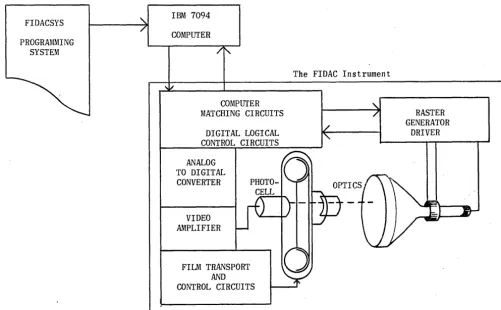
ning instrument called FIDAC (Film Input to Digital Auto-matic Computer), which reads the picture directly into the core memory of an IBM 7094 computer, sampling 350,000 points of the pictures in seven different grey levels within 0.3 sec. Figure 1 shows the FIDAC instrument and a simplified block diagram of the FIDAC system. We have developed two programming language systems for picture processing: the first, called FIDACSYS, is a syntax-directed pattern-recogni-tion language; the second~ called BUGSYS~ is a pointer-manipulation programming language.
In this brief article we shall give four illustrations of optical processing in the medical sciences.
Analyzing Chromosomes'
Recently, there has been much active interest in the analysis of chromosomes in the metaphase stage of mitosis, when they appear as structures split longitudinally into rod-shaped chro-matids lying side by side and held to one another by a con-stricted area called the centromere. Certain abnormalities in the number and structure of chromosomes are particularly evident at this stage and can be related to clinical conditions in animals and in man. For example, in man, mongolism and the Klinefelter and Turner syndromes have been corre-lated with chromosome aberrations.
The study of chromosomes by manual methods, however, requires a great deal of time - enlarged prints must be made from photomicrographs, and each chromosome must then be cut out from the print so that it can be aligned with the others for classification into the so-called chromosome karyo-type. With the FIDAC system, the time required for analyz-ing and classifyanalyz-ing each chromosome can be radically re-duced, to about half a second per chromosome. Here we use
the computer for investigating large numbers of cells with respect to total chromosome complement counts, to quantita-tive measurements of individual chromosome arm-length ratios, densities, areas, and other morphological characteristics, and so forth.
By processing large numbers of chromosome sets and statis-tically analyzing the data, it is possible to give very accurate descriptions of the standard complement of chromosomes and individual-chromosome variability for particular species (see Fig. 2). This statistical technique may be the only way to uncover small variations which may prove important in relat-ing chromosome karyotypes to diseases. For example, careful analysis of the chromosomes of individuals with myeloid leukemia, prior to the availability of automatic computer
FIDACSYS
PROGRAMMING
SYSTEM
IBM 7094
COMPUTER
analysis, showed that the chromosomes characteristically lack a small portion of one arm; less obvious abnormalities may well be revealed by means of the computer.
Analysis of Neurons
In the young kitten's brain, certain neuron cells in the cortex will appear almost entirely within a single section, pro-vided that the section is cut perpendicularly to the dura. Photomicrographs of such sections can be made so that an entire cell appears within a single photograph. Programs have been written which can recognize the dendrites, or exten-sions, of the cell, the dendrite-body junctions, branch points on dendrites, and end points of dendrites. Such an analysis enables quantitative measurements to be made of dendritic lengths, and lengths of complicated network of branches for a cell. From such measurements made on cells of animals of different ages, the ontogeny, or development, of the cell can be studied, and from measurements made on various related animals, the phylogenetic development of such cells can be studied in quantitative detail. Such measurements can also be correlated with neurophysiological and neurochemical research results. It is of interest, for example, to know whether or not the phylogenetically older cerebellar cortex in the mammal undergoes an earlier ontogenetic development than the later-evolved neocortex. Another question of interest is the general pattern of postnatal development of the two types of cortex.
A further study would be the quantitative determination of the manner in which different patterns of morphogenesis are reflected in differences in functional activity. Such informa-tion can be of value in facilitating interpretainforma-tions of structure-to-activity relations in mature cerebral and cerebellar cortex. Similarly, correlations of the differential development of the cortex with neurophysiologic measurements may provide im-portant clues relevant to the problem of the susceptibility of different brain structures to various antenatal and postnatal traumatic or metabolic insults to the nervous system., For example, the effects on cortical development of starvation
The FIDAC Instrument
COMPUTER
MATCHING CIRCUITS
RASTER
GENERATOR
DRIVER
DIGITAL LOGICAL
CONTROL CIRCUITS
ANALOG
TO DIGITAL
CONVERTER
VIDEO
AMPLIFIER
FILM TRANSPORT
AND
CONTROL CIRCUITS
[image:15.618.49.292.46.263.2] [image:15.618.57.558.432.742.2]la~3~;S;S
I ;
II
3!~j~Uri
11
~
"~'I ~ I 1 I';!af.11IJ
:i'~.,;J..,:lI.",,~~:'t.,J't~~-:t~~~;~-;··J..j ' 5 , I J , I 1 J • :1.y~~~~,~~.~:~~·~~.~~~%,~i~~11 J2'" J
-J~-J'"Y· __ "'.J_I.J.J...;)~!! 1 '. J I t J I J I
~;:>rl"IJJIII
Co I J I I I I I ' ! J l l l l 1 ' 1 1 ' 1 I l t . I J 1 j 1 J l I I J l l ' 1 1 1 1 1 1 1 1 1 " ' 1 1 " 1 1 111:1.1"'11111 J l ' I I I " I I I I I I J
12 1IIIJ1111111111111
.11 I I . J I . ' •• 11111111.11111 JIII'II.111111111111111.111 21
;>, ,
a • I • I I J II 1 • I I 1 11 I I •• I JI
22>'
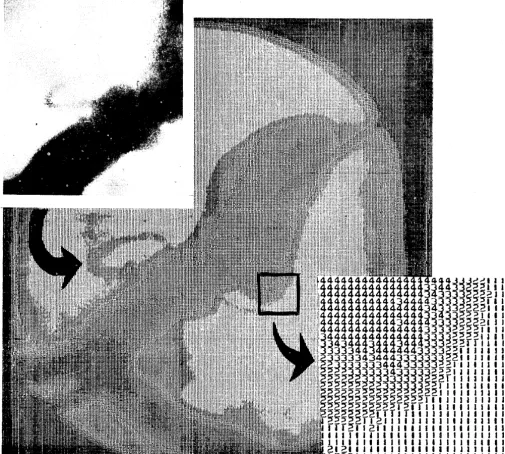
J LL I I I I I J Ll • 1 • I I I I & I I JFigure lc. At the upper left is a section of an original picture of an angiogram, or x-ray
of the heart, after radio-opaque dye had been injected into the blood. In the middle is a
print-out from the computer's memory of the entire picture, and in the lower right an enlargement of
one section of the printout.
from birth for a predetermined perIod, followed by a period of catch-up growth, can be studied.
Analysis of the Angiogram
Volumetric measurements taken manually from cineangio-grams of the human heart are presently being utilized to pro-duce pressure-volume curves for the analysis of the rapid ventricular events that occur during systole and diastole. However, the difficulty and tedium of making hand measure-ments from the cineradiographs limit the information obtain-able from sequences of such pictures. Automatic methods for accomplishing this task can be utilized as a new tool for the study of the dynamic activity of the heart. The cine-angiogram technique involves injecting into the blood in the heart a radio-opaque dye which makes the outlines of the ventricles clearly visible when x-ray movies are taken (see
16-Fig. Ic). From such pictures, measurements can be made on the area of radio-opacity in the ventricle, the location of the center of gravity of that area, the locations of the lowest point and the most lateral points of the area, and so forth. As the pictures are taken, the actual ventricular pressure at the moment of exposure can also be instantaneously recorded directly on the film frame being exposed. In this way the pressure curve can. be correlated directly with the area
observed. '
[image:16.618.50.556.42.496.2]utilized as a direct measure of heart activity and can be corre-lated with normal and diseased states of the heart. The velocities and accelerations' of atrial and ventricular filling and emptying can be computed, and from this data the ventricle compliance and the velocity of myocardial fiber shortening can be calculate,d. The determination of these variables makes it feasible to characterize myocardial function in patients with various forms of valvular heart disease and myocardial failure, and to determine the effects of various therapeutic interven-tions, such as cardioactive drugs, muscular exercise, etc. The results may lead to more sensitive and specific diagnostic pro-cedures and evaluations of treatment results.
Processing of Electronmicrographs
Electronmicroscopists are utilizing great skill and are spend-ing much time a'nd effort in obtainspend-ing photographs of struc-tural and molecular patterns of great biological significance. Many of the biological structures being investigated exhibit repetitive patterns or are composed of symmetric particles. The interpretation of such pictures can be greatly enhanced and more quantitative information can be obtained from them by the use of the method of picture averaging. In those cases where picture averaging is applicable, this may be the only means for obtaining more significant information, since the noise found in electronmicrographs can be considered in part as an inherent property of electronmicrographic methods. A similar method has further applicability in neurophysiology, where the averaging of neurological reaction to evoked re-sponse, as recorded by electrodes, has greatly enhanced the results obtained.
III 1333 J 35131 135133 I ~31111 I
I I I I •
13~l2j~~§t~:
I
J1~~~~~~~~~~~~1~~~5j~
133593~9~151~~a~~~13Jl
1~1199~9~9YS?lS'1113.
I 1~J113-1~g1~335331
I
1113~3j5193~31
III I 5533313~~91 3 JI i 33J33331~:l1 1
: I
3~~1~~~~~1:
I:
t~~~~~~?ll
I 1331 I J
I I I
Figure 2. A t the right is the representa-tion in the computer's memory of a scanned chromosome. At the left are the plotted results of the computer analysis: the crosses represent the locations determined by the computer for the ends of the arms; the central line represents the location of the centromere as determined by the computer.
It is well known that where repetitive patterns are avail-able, random noise that may occur in the patterns can be eliminated by averaging. Two-dimensional pictorial averaging has been accomplished by means of superimposed-photog-raphy techniques. The photographic technique has a disad-vantage that a positioning jig must be fashioned beforehand for each exposure, and the successive pictures must be made from the jig in an essentially "blind" fashion. This is a tedious and time-consuming task, particularly where many trials of different superpositions must be made. Hence this photographic method is not extensively applied.
Utilizing computerized picture processing, many trials of overlapping positioning of repetitive patterns can be made rapidly. Certain theoretical problems, however, must be care-fully studied, for there are many pitfalls in such pictorial averaging, such as the fact that artificial patterns may be gen-erated due to the nature of the superpositioning process,
[image:17.623.322.561.72.644.2]rather than due to any intrinsic pattern existing in the original picture. But if used with care, such processing of electron-micrographs can be of great value.
Figure 3a. Printout of the scanned x-ray
of the femur of a rat.
X-Rays of Bone
The growth and development of bone can be studied by means of x-ray techniques. The optical processing of such x-rays can enable the making of measurements of the quanti-tative density of the hard calcium structure of bone. The x-rays are absorbed by the hard structure of the bone, and therefore the optical density of the x-ray film becomes a mea-sure of the calcium absorption of the x-rays. Such meamea-sure- measure-ments on thin sections of, for example, an excised femur of a rat (see Fig. 3) can enable a more detailed description of the density distribution of the bone. The method can be utilized for the study of the effects of mechanical forces, physiologic agents, and so forth, on the growth and development of bone. In our work we are attempting to establish a quantitative relationship between mechanical stresses and bone growth. To do this, we have constructed a theoretical model in which, for a given applied-force pattern, the stresses within the bone are computed. A relationship is hypothesized between the maximum stress developed at any point in the bone and an increment of bone growth. In our theoretical model we include this increment, which then itself changes t}le theoreti-cal stress pattern, from which we again produce anuther increment of growth, and so forth. In this way we develop a simulation of bone growth. However, the simulation is useful only if it compares successfully with actual bone growth taking place in a real animal. The optical scanning-densitometric method mentioned above is used to check the experimental measurements with the theoretical results. Rats at different stages of development are sacrificed, and a complete three-dimensional density characterization is made of the femur of each for comparison with the model. This method of study of the detailed calcium density distribution in bone is made
pos-sible only through the use of the high-speed optical processing technique utilizing the FIDAC.
Additional applications of bone density measurements from x-rays are associated with the evaluation of the actual physio-logical age of a child (as opposed to the chronologie age of the child). X-rays of children's hands indicate ealcium-deficient areas at the ends of the finger bones at the places where the greatest bone growth is occurring. The thickness of these epiphyseal plates has been shown to be an excellent criterion for evaluating physiologic age. Large-scale screen-ing methods of such x-rays of the hand is made feasible only through the use of automatic optical processing on such films.
Conclusions
In this short article I have attempted to review a few of the medical applications of optical processing, choosing those in which I have had personal experience. There are, however, many more applications of such optical processing in other areas. Some of these are:
• the analysis of Schlieren photographs in the deter-mination of the molecular weights of large molecules, utilizing the ultracentrifuge;
• the analysis of autoradiographs made by polymorpho-nuclear leukocytes (white blood cells) which have had radioactive material incorporated in them, for the study of leukemia and other blood diseases;
• the analysis of Papanicolau smears in the detection of cancer;
• the interpretation of photomicrographs of bacteria for laboratory identification;
[image:18.620.81.529.370.702.2]• the automatic densitometric reading of crystallographic films in the determination of molecular structures of biological importance;
Figure 3b. Printout from an x-ray of a cross-sectional slice of the femur of a rat, showing the density distribution of apatite in the bone.
(Please turn
topage 23 )
MULTIPLICITY IN COMPUTER SYSTEMS
Ivan Flores
Associate Professor) Electrical Engineering Stevens Institute
Hoboken) N.J.
i\1
ultiprocessing, multiprogramming, multicomputing, multipriorit)"
multiusers . . . some definitions and implications, and the philosophy
thereof·
This article is about multi things : multiprocessing, multi-programming, and multicomputing. Multiprogramming means several programs operating in the same environment;
multi-processing means several multi-processing units in the same
com-puter which can operate simultaneously; multicomputing means there are several computers in the same environment.
Multiprocessing
Several processing units are necessary for several processes to go on at the same time. "Multi" here implies simultaneity; we consider the computer running with several different pieces of processing going on. These processes could pertain to the same program or they could pertain to several programs. The latter case is a category of multiprogramming described later. Let us examine one program with several processes going on: a single program with parallel processing.
What is required in the way of the program? Define four different pieces of processing, A, B, C and D. Multiprocess-ing means say that A and B may proceed together and C and D also proceed at the same time. What does this require with regard to the relations between the calculations A, B, C and D? When A and B produce results, are these required by C and D? If they are, then certainly both A and B must terminate before C and D begin. Further, we would expect that we must organize this processing so that A and C do not proceed together because the results of A are required for C.
This means each program must be organized \vith regard to some precedence arrangement; we establish which processes can proceed concurrently, which must proceed in a given order, and which are independent.
Programming is customarily arranged sequentially in time; the programmer writes down a sequence of steps that the computer executes in the order written. There are excep-tions in terms of subroutines and loops and so forth but
these can be restated to conform to this precept. For instance, a subroutine or a loop can be reduced to a point on a line where the other points on the line represent sequential process-ing. The line has direction: we go from start to finish even though there are loops in it.
Parallel processing requires that while we are going along one line we are also traversing a second line. This places a heavy burden upon a programmer who must indicate to the program (the program must also be capable of communicat-ing to the computer) which calculations are sequence bound and which are sequence free.
Is there an advantage to multiprocessing? Multiprocessing requires resolution of a problem into small segments to be performed concurrently; naturally, the problem may be completed more quickly. But, given a particular investment in equipment, if it were distributed according to a multipro-cessing discipline, would it result in a more effective system than if it were distributed conventionally? Certainly there would be a small, class of problems which multiprocessing would definitely cause to run faster. Many other problems however do not lend themselves to multiprocessing. Further, consider the amount of time which the programmer spends determining sequence-bound and sequence-free segments and precedence relations.
It is possible that in the future software might examine programs to find sequence-bound or sequence-free segments.
A problem is suitable for multiprocessiI'!-g if:
• First, the problem is reducible to concurrently pro-cessable portions or segments.
• Second, the means for the control assignment is faster than the processing or is overlapped with the process-ing.
• Third, the problem we solve is processor-limited. • Finally, the majority of the time spent by the
These conditions provide an advantage to a given problem set. For an overall advantage most problems would have to be divisible into segments which permit concurrent process-ing: it is doubtful if such is generally the case.
Multiprogramming
In multiprogramming, several programs are executed simul-taneously. Several programs reside in the memory at once and, during a given period of time, several of these are processed. After we process a portion of program 1 we pro-cess portions of other programs and then return to program 1. For true simultaneity of program execution we would have to have multiprocessing. Let us rule that out for the moment.
We distinguish several levels of multiprogramming:
•
•
•
•
•
•
•
First and most basic, we have simple simultaneity of
in put / out put;
Second (not usually considered multiprogramming), is the coexistence of software and a program in mem-ory both used by the computer within the same inter-val of time
Third is a level built on the last level: segmentation: A program, too big to be held in memory, is broken into several segments, some of which co-occupy mem-ory at different times.
The fourth level is interleaved programming where a piece of each program is done in round-robin fashion. Fifth is background-foreground multiprogramming
with a dual priority structure;
The sixth is priority multiprogramming with a com-plete priority schedule;
The seventh is user-operator multiprogramming - the time-shared systems, such as MAC (multiaccess com-puter) at Mass. Inst. of Tech. where there are several users-programmers who are also operators.
Simultaneous Input-Output
Simultaneity means that 10 operations take place while processing is going on. If we consider 10 as a kind of process-ing, then simultaneity looks like multiprocessing: informa-tion is put in as other informainforma-tion is being processed. Here processing is independent of input. The IBM 1401 and the RCA 301 both have simultaneity of this sort.
This takes on the guise of multiprogramming when the 10 device receives a sequence of steps, as for the IBM 7090 and its brothers and sisters. A sequence of commands ob-tained from memory by the channel controller is given to one or more 10 units which execute them at the same time the main program is under way, via the main control subsystem and processing subsystem. This is an example of two pro-grams which take place in two different subsystems.
Software Coexistence
Weare a ware of these kinds of software:
20
• The system supervisor coordinates all the other pieces of software.
• The foreman or executive accepts interrupt informa-tion from simultaneously operating 10 channels. In-terrupt is used to stop the computer from performing its present program to repair or monitor program incoming and outgoing information.
• The translator takes information in source-oriented form and converts it into machine language.
• The input-output control system, integrated with the foreman (IOEX), receives interrupts, making sure that buffering assignments, blocking, deblocking and so
forth proceed as required.
• The loader brings in new programs, coordinates them with subroutines, macros, and the library and does relocation as needed.
While the program is running, we see what takes place in a large software system. The 10 interrupts the present program, calls in the foreman, which handles incoming or outgoing in-formation and makes sure that it does not need to be repaired in any way. Then it turns over control to the input/output communication system to determine the next assignment and to properly organize· the incoming information with regard to the program. The 10CS usually returns control directly to the program. In turn the program may make calls upon 10CS which takes control out of the program proper into 10CS which makes assignments and queues up requests for 10 devices. 10CS returns control to the program where it was left off.
The program, during this interaction, is multiprogrammed. Also, main pieces of the program are interrelated with sub-ordinate pieces. These are parts of the subroutine library which the programmer has requested and which the loader has properly entered into the memory.
Again, during normal execution of an untried program there may be reporting back and forth between that program and the system supervisor and the debugging or dump routine. After dump, or when a program is completed, return is made to the system supervisor which coordinates bringing in new programs and working with the programmer's requests with regard to new programs. For instance, after one program is completed, the new one that comes in may require translation. The supervisor must go back and forth between the translator and the requests of the programmer. When the program is finally compiled and translated, return goes to the loader which brings in anything else that is required and finally turns over control to the translated program.
Since here some of the time the program is managing the computer and other times the software, this is the first approach to a multiprogramming environment.
One final point about software-program relation involves memory protect. Multiprogramming requires sovereign areas inviolable to a given program and which should not be inter-fered with by any other programs. This is possible with memory protect. A running program could not clobber the software if memory protect is provided. Unfortunately this is not the case for many middle-sized systems and often the program does clobber the software.
This is repaired rather simply when there is a copy avail-able, either in another part of core or in auxiliary memory.
Segmented Programs
Here, as previously, there is a program and software in memory. However, the program consists of several segments, all of which cannot fit into memory at once. A goodly por-tion of the program is in an auxiliary memory medium such as magnetic tape, disk or drum. As one portion of program is completed and another is needed, the loader is called upon to bring it in. The loader or a portion of it e~ists in memory, along with the segment being processed. The main program calls upon the loader which goes to the auxiliary medium to pick up more of itself, after which it can then again go to the auxiliary medium and pick up the next segment.
This segment is overlaid, placed over the current segment, and then control given over to the new segment. While this happens, we may keep a small portion of main program in memory.
Round Robin
years, is multiprogramming. It uses a memory protect feature and it permits several completely different programs to be
performed in the computer simultaneously. The Honeywell 800 provides for eight programs in memory each with a separate hardware control unit. These control units £lre time-shared. They are examined in sequence by a commutator; each is given a fixed amount of active time. When control unit 1 is on, it performs commands from program 1 until its time has expired. The commutator then assigns control to control unit 2, giving it a fixed time. If a control unit has no
request for time it is skipped - it loses its turn.
. The arrangement may revert to uniprogramming when only· one control unit is in control; once its time has expired it regains control.
Let's suppose with several programs going a control unit has made an 10 assignment which is vital to it and without the data therefrom it is unable to continue. It must wait for data to come in; it becomes hung up. It is pulled out of the commutator cycling. When the commutator examines this control unit, since an 10 operation is in progress for it, it is disregarded. The next control unit is hence examined.
How effective is this system for handling programs? It does several programs at once and masks delays caused by
10 devices even when simultaneity is not provided. An 10
device goes off on its own, cutting off its program; we con-tinue with whatever programs are left. When 10 reports in,
this program is re-embraced by the round robin milieu.
This is a neat way, without elaborate 10CS, and without simultaneity, to provide efficient device manipulation and efficiently running programs. It is especially useful when we combine 10 limited and processor limited programs. But it is even effective when the programs mixed are all 10 limited, provided they don't all require 10 at the same time.
To implement this system Honeywell provides limit regis-ters for each control unit so that one program does not clobber another, and so that one program can be debugged while other programs, previously debugged, are performing useful work - no fear of them being clobbered. This is truly multiprogramming because several programs are run at the same time. The software may be on a separate control unit or it may be called in to any particular control unit as required. For instance, when one program terminates, that channel may call in the supervisor which takes over just as in any uniprogrammed environment. The supervisor reviews the system input device and determines the next program, calls in the translator which will then occupy that channel and so forth and so on.
No problem arises when two or more programs terminate at the same time since they can be processed on a priority basis. The problem which does arise is the amount of memory available to each of the eight programs and to the software. This becomes a limiting factor only when we try to use eight large programs.
Foreground-Background
This multiprogramming has been adopted by Univac III
which combines two tasks. It gets one of them done in the spare time that the other one provides.
As long as we have simultaneity, interrupt, and the ability of software and a program to coexist in memory, it is fairly simple to get two programs and software to coexist; this is
the philosophy that the Univac people used for Univac III.
With programs that are 10 or processor bound, other facili-ties are lying fallow; so why not have two programs? One of these is of primary importance, but when it gets hung up, we take the other program which is in the background and make it use the computer until the facilities which were tied up become free. Then the foreground program can continue.
This works well where the background program is a card-to-tape, tape-to-card or card-to-printer conversion, one of the utility programs which we don't like to spend a lot of time on directly but which are necessary to the proper operation of the facility. We do this efficiently because main-frame com-puter time which would otherwise be wasted is applied to this peripheral problem.
The alternative which some installations adopt is a satellite system - multiple computers.
Multipriority
It is a simple matter to extend the foreground-background concept to embrace a multiplicity instead of a duet of pro-grams. This requires a hierarchy of importance embodied in a priority structure. The discipline for selecting the next pro-gram for execution when another propro-gram has temporarily expired distinguishes multipriority schemes from each other and deserves much more attention than can be provided in this paper.
Personally, it seems to me the most important avenue opened by multiprogramming is multipriority. To continue the metaphor, I hope my scythe may hack away some of the underbrush impeding our progress but on a different occasion.
Multiuser Operator System
This is the on-line, time-sharing system. There are a num-ber of consoles, each of which communicates between the computer and a user who is also the programmer and opera-tor. The user has a problem to solve; he constructs a program for it on line. He sits at a console, enters information into it and receives results back from it - the interaction is in real time. If we furnished him with a large computer and put it
at his disposal as long as he needed, it would cost several hun-dred dollars an hour. By permitting the computer to do other tasks in between the short time required to respond to the user, most efficient use is made of the computer.
The system consists of
• multiple consoles at each of which one user may sit • one or more background programs
• software - all the software we discussed earlier - if not to handle the multiprogramming environment, then to handle the background program
• a monitor for the multiprogrammer • a philosophy (built into the supervisor)
consoles
Foreground programs are entered at the user's console with source language commands which the computer compiles or assembles for him, as required. He also enters control instruc-tions to the monitor, telling it what he wants done. He also enters:
• data
• program segments to be translated
• routines which have already been compiled into ma-chine
• language
He enters this information on line when he thinks it is needed.
user time
About each user we ask:
• how much time does he get? • how often?