Abstract—This article presents the simulation and comparison between the space vector pulse width modulation and sinusoidal pulse width modulation techniques for back to back converters with a decoupling control strategy, PSCAD/EMTDC for simulation purpose is used. Also, a study of steady state and transient performance characteristics of the system is carried out for both techniques. The simulation results show that the transient response is similar for both schemes, and the SVPWM technique has the advantage less harmonic content, which it is useful in applications that require a low harmonic level for avoiding overheats and malfunction in sensitive systems.
Index Terms—Power electronics, PSCAD simulator, PWM technique.
I. INTRODUCTION
OWER converters are increasingly important in many applications areas; in the electric utility for example many devices based on power electronics are used since finer and ever more intelligent controls are needed to improve the electrical grid performance in different voltage levels [1-2]. They are essential for applications in emerging generating systems derived on renewable resources. It must ensure a robustness performance when are applied in isolated operation or when are connected with the conventional grid [3]. Their use is increasing in the industry for machines regulation. Furthermore, consumer market applications such as remote generating systems and quality energy applications result in a growing topic for analysis and improvement [4]. Electrical power generation with wind and solar as source of power may be considered of the most promising renewable energy sources, but the control schemes are an important issue [5-6]. There are extensive frameworks of various types of electrical machines and controls algorithms that have been developed for wind generator applications as are presented in [7-9]. Among the schemes of wind energy conversion systems (WECS), the
Manuscript received June 17, 2013; revised July 08, 2013. This work was supported in part by PROMEP: Redes Temáticas de Colaboración under the project titled: Fuentes de Energías Alternas.
Agustina Hernández, Rubén Tapia and Omar Aguilar are with the Engineering Department at Polytechnic University of Tulancingo, Tulancingo, Hidalgo, CO 43629, Mexico (corresponding authors to provide phone: 775-755-8319; fax: 775-755-8321; e-mail: ruben.tapia, [omar.aguilar]@upt.edu.mx).
Abel Garcia is with Mechatronics Department at Polytechnic University of Pachuca, Zempoala, Hidalgo, CO 43830, Mexico (e-mail: [email protected]).
induction machine and permanent magnet synchronous machine are seen as promising elements for energy conversion. In all cases back to back (BTB) arrangement based on power electronics is required to take advantage of the benefits [9-11]. BTB converter is formed by two identical voltage source converters (VSC) connected by a common dc-link. This topology presents several advantages in terms of power processing and allows bidirectional power flow with quasi-sinusoidal currents. The load can be active, passive or even another network, in such case achieve a unity power factor is possible if it is required. The dc-link in the middle provides decoupling between both converters; as a result, they could be driven independently. Therefore, it is possible to have a fast and independent control of active and reactive power for both converters and improve the system operation [12]. To attain simultaneously these benefits is important to explore control strategies, which allow obtaining the desired regulation.
These devices have as their main component a voltage source converter, which uses pulse width modulation (PWM) for controlling purposes. The switching elements are power semiconductors that operate at high frequencies. There are several techniques for controlling semiconductors' converter; each one has its own advantages and disadvantages. The sinusoidal PWM (SPWM) is matured technology. In this method a triangular wave is compared to a sinusoidal wave. The space vector PWM (SVPWM) has been increasingly used in last decade. This modulation, instead of using a separate modulator for each of the three phases, the complex reference voltage vector is processed as a whole. An aptitude for easy digital implementation is the notable feature of space vector modulation, which can be easily implemented in digital signal processor (DSP) [13]. Moreover, suitable control scheme is necessary to deal with different operating conditions and uncertainties in the network due to the parameters or load variations.
This article presents the performance comparison of a back to back converter connected to a stand-alone load, where the SPWM and SVPWM techniques are applied. The two schemes characteristics and the implemented methodology in PSCAD are presented. The simulation results show some differences in the behavior of both techniques. The system under study is a back to back converter and is subject to different operating conditions and load variations. This work addresses two main issues: a) first, it presents a detail implementation procedure of PWM techniques in industrial software and; b) it realizes a behavior comparison for the analysis system.
Comparison of SVPWM and SPWM
Techniques for Back to Back Converters in
PSCAD
Agustina Hernandez, Ruben Tapia,
Member, IAENG,
Omar Aguilar, and Abel Garcia
II.AC-DC-AC CONVERTER MODEL
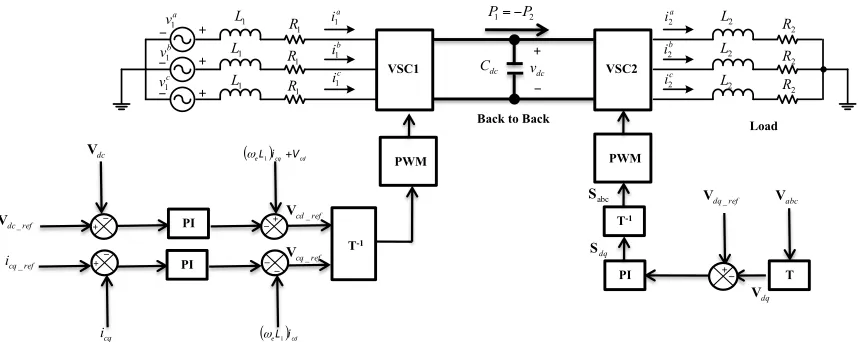
The back to back converter shown in Fig. 1 is formed by two shared VSC with a common DC bus. Both converters can operate as a rectifier or inverter depending on the power flow direction and the operation is complementary. The source side converter is designated as VSC1 and the converter connected to the load side as VSC2. This topology presents several advantages in terms of power processing and allows bidirectional power flow with quasi-sinusoidal currents.
The control objectives which are set for the BTB operation depend on the application, for example: 1) AC voltage; 2) AC frequency; 3) active power; 4) reactive power; and 5) DC voltage regulation. Two control tasks are assigned to each VSC and how they allocate can be arbitrary. Fig. 1 shows the BTB converter control structure.
A. Source side converter control
The source side converter objective is to keep the dc-link voltage constant. The vector control method is used with a reference frame oriented along vector position, enabling independent control of the active and reactive power flowing between the source and the converter [14]. The PWM signals are obtained by current regulated scheme, with d-axis current used to manipulate the dc-link voltage and the q-axis current component to regulate the reactive power. The reference values for the grid-side converter V*
1d and V*
1q are established with a PI controller, respectively. The equations (1) and (2) show the development control scheme [15-16].
V1d*
=−V1d'
+
(
ωeL1i1q+V1d)
(1)V1q *
=−V1q '
−(
ω
eL1i1d) (2)where V´1d and V´1q are reference voltage for the d-axis and q-axis, respectively; ωe is the AC frequency in the grid; L1 is the inductance of source side; i1d and i1q are currents of the d-axis and q-axis; V1d is voltage the source in the dq0 frame.
B. Load side converter control
The control targets can be choice and drivers depending on the application. For example, in distributed generation
systems it is usual that the control block includes a scheme for regulating the AC frequency and voltage. Therefore, in this article we are controlling the AC voltage and frequency values; also DC link voltage regulation is required. The VSC2 must keep constant AC frequency and voltage values for different load variables. In this converter the control problem is to determine the reference signal in the PWM control scheme to allow the load voltage tracking the reference. The carrier signal is fixed in 5 KHz for 60 Hz load. Hence, the needed measurement is the three-phase voltage at the connection point. For control purpose a dq0
conversion is employed and its expression is the following,
V
dq0=
TV
abc (3)where T is the transformation matrix.
T=2
3
sin
( )
ωt sin ωt−2π3
" #
$ %
&
' sin ωt+2π
3 " # $ % & '
cos(ωt) cos ωt−2π
3
" #
$ %
&
' cos ωt+2π
3 " # $ % & ' 1 2 1 2 1 2 ( ) * * * * * * * * + ,
-- (4)
The angular velocity is acquired by phase lock loop (PLL) strategy and the error signal employed for obtaining the PWM reference signal takes the form,
e(t)
=
V
d_refV
q_ref!
"
#
#
$
%
&
&
−
V
dV
q!
"
#
#
$
%
&
&
(5) Defining the reference voltages, there are two separate axes 90 electrical degrees. d-axis is in phase with the reference vector, whereas q-axis is delayed 90 degrees respect to voltage, similarly, into a d-q component the current is decomposed. Therefore, vd_ref=300V andvq_ref=0V. For obtaining the PWM reference signal in dq frame a PI controller is included, after that, an inverse transform is applied from dq to abc. To obtain a PWM signal for VSC2 control a comparison between both techniques SPWM and SVPWM is carried out.
VSC1 Cdc vdc VSC2
+ − PI abc V ref dq_ V dq V T PWM abc S T-1 dq S 2 1 P P=− 1 R 1 R 1 R 1 L 1 L 1 L a i1 b i1 c i1 + + + − − − a v1 b v1 c v1 2 R 2 R 2 R 2 L 2 L 2 L a i2 b i2 c i2 Load Back to Back
PWM ref dc_ V dc V PI ref cq
i _ PI
cq
i (ωeL1)icd
ref cd_ V ref cq_ V (ωeL1)icq+Vcd
[image:2.595.84.513.598.769.2]T-1 − + +− +− −+ − −
III. PROGRAMMING PWM TECHNIQUES IN PSCAD
A. SPWM implementation
Within the programming environment, the SPWM technique is developed using some blocks that have already been designed in master library. The configuration of each block is based on the mathematical model. In Fig. 2 the triangular wave (carrier) is compared with each phase sinusoidal voltage, where the output variables represent the pulses to switching the power electronic elements. The carrier signal operates at 5 KHz and is compared with the modulated signals at 60 Hz [16].
[image:3.595.315.538.48.223.2]gt2$ gt5$ gt6$ gt3$ gt4$ gt1$ Varef$ Vbref$ Vcref$
Fig. 2. SPWM pulse generator scheme in PSCAD.
B. SVPWM implementation
The SVPWM technique in PSCAD/EMTDC is carried out by five user-defined sub-systems, (A)-(E). These are shown in Fig. 3. In sub-system (A): at first the magnitude (Vmag) and phase angle (Theta) are determined from the reference three-phase voltage. To find out the sector, the range of calculated angle value must be between 0 and 2π. The equations (6) and (7) are programming in this block.
VS
* =VS
*
ejθs* (6)
V
S *=
V
Sα*2
+
V
Sβ*2
θ
S *=
tan
−1V
Sβ*
V
Sα*
"
#
$$
%
&
''
(7)where Vs* is the magnitude and θs* is the phase angle; (B): this sub-system is designed to calculate the turn-on time of two adjacent active vectors and the zero state vectors; sub-system (C): the transition time of active and zero vectors are calculated; (D): in this block the duty cycles generation procedure is established; finally, sub-system (E): the switching pulses for power electronic devices are generated. The technique was taken from [17].
[image:3.595.67.269.219.407.2]gT1 gT5 gT4 gT3 gT6 gT2 Vmag1 Theta1 sec1 Vmag1 Theta1 sec1 Tk11 Tk22 Tk00 Tk11 Tk22 Tk00 T11 T22 T33 T44 T55 T66 T77 T11 T22 T33 T44 T55 T66 T77 TIME D000 D11 D22 D077 sec1 D000 D11 D22 D077 Ecd magnitude and phase Vralfa Vrbeta Vmag1 Theta1 sec1 Time sec1 Theta1 Vmag1 Ecd Tk11 Tk22 Tk00 calculation Vralfa Vrbeta Vector Tk00 Tk11 Tk22 T11 T22 T33 T44 T55 T66 T77 transition time calculation Duty cycle T11 T22 T33 T44 T55 T66 T77 Time2 D000 D11 D22 D077 Switching pulse sec1 D000 D11 D22 D077 gT1 gT4 gT3 gT6 gT5 gT2 generation (A) (B) (C) (D) (E)
Fig. 3. SVPWM technique in PSCAD.
IV. SIMULATION RESULTS
In order to verify the control scheme applicability for the back to back converter the PSCAD software is used. To analyze the results two cases are presented. Case A and B are described below. The system data are: the voltage source is 380 V operating at 60 Hz and the load to 25KW, 300 V.
A.Case 1
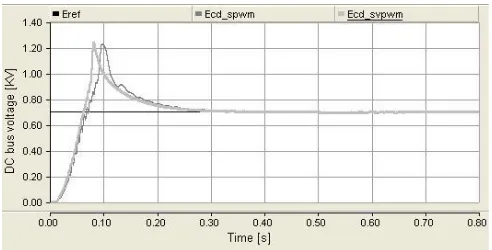
In this case, initially the system is inactive; all variables have a value equal to zero, after a transient period they are stabilized around of a constant value at steady state. Through the feedback control strategy the DC voltage achieves, VDCref = 700V. Fig. 4 shows the DC voltage performances when the SPWM and SVPWM control strategies are applied. These techniques implemented by software determine the sequence and duration of the time on and off the switches. One can see that the steady state and transient responses have similar characteristics for both algorithms. The control strategy also allows regulating the power factor, which must remain closed to one, thus the reactive power is equal to zero. Fig. 5 exhibits that the source side converter is operating at unity power factor, since the reactive power tracks the reference zero for both modulation strategies.
The control of the load side converter regulates the AC voltage and frequency. Fig. 6 presents the voltage performance in phase A, for both algorithms. The modulation techniques show a fast evolution, allowing that the converters are operated properly and the interest variables reach the desired steady state value with fast transient response.
[image:3.595.304.550.649.774.2]Fig. 5. Reactive power output in the source side converter.
Fig. 6. Phase voltage output in load side converter.
B.Case 2
[image:4.595.46.291.207.333.2]The second case illustrates the system’s evolution when the load is increasing from 15 to 25 KW, at t = 0.5 s. One can see that the transient period is short and quickly response is exhibited before the steady state condition is achieved. The load voltage attains the reference value at 300V, before and after the load changed, Fig. 7. By increasing the load value, the current takes a new value and it is established around 90A, Fig. 8. It is clear that the transient response is similar for both schemes and the settling time is same for two cases. The modulation techniques display very well performance allowing that the converters operate properly and the interest variables reach the desired steady state value.
Fig. 7. Load voltage when the load is increased.
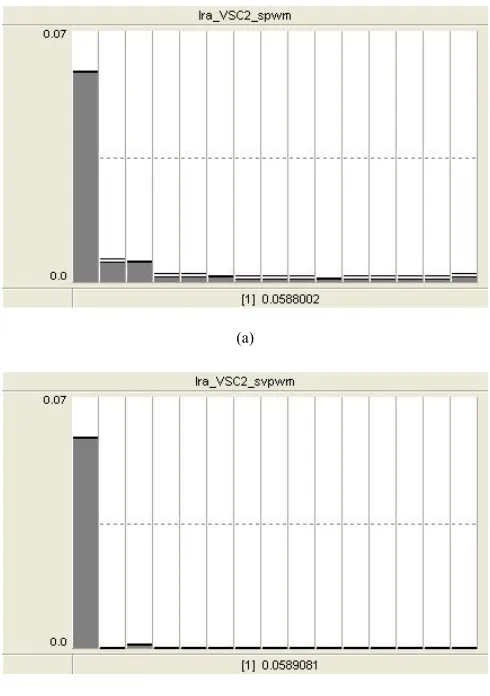
The waveform distortion according to FFT analysis in Fig. 9 is exhibited. Using the SVPWM scheme the harmonic current components of phase A is less that with the SPWM technique. In general, drive systems with low harmonic content are better than that with high content. The two cases validate the appropriate system evolution under
[image:4.595.304.549.265.613.2]perturbations. The simulations of back to back structure under different operating conditions demonstrate the effectiveness and robustness of PWM techniques. Transient and steady state response were analyzed.
Fig. 8. Load current when the load is increased.
(a)
(b)
Fig. 9.FFT analysis of phase current A: a) SPWM; b) SVPWM.
V.CONCLUSIONS
[image:4.595.45.292.555.676.2]SVPWM has advantage of less harmonic content with this scheme has a value of 3.66%, whereas 6.05% with SPWM; it is useful principally to avoid malfunction of sensitive equipment by harmonic excess, as well as, problems of transformers and wiring overheating.
ACKNOWLEDGMENT
This project has been partially funded by the CONACyT- Mexico grant CB-169062 and by the ECEST-SEP (Espacio Común de Educación Superior Tecnológica) Program under the mobility scheme for students, and was supported by PROMEP: Redes Temáticas de Colaboración under the project titled: Fuentes de Energías Alternas.
REFERENCES
[1] Juan Segundo-Ramírez, Aurelio Medina, “Modeling of FACTS devices Based on SPWM VSCs”, IEEE Trans. on Power Delivery, Vol. 24, No. 4, pp. 1815-1823, 2009.
[2] Narain G. Hingorani, Laszlo Gyugyi, Understanding FACTS, IEEE Press Editorial Board, 2000.
[3] R. Majumder, A. Ghosh, G. Ledwich, F. Zare, “Control of Parallel Converters for Load Sharing with Seamless Transfer Between Grid Connected and Islanded Modes”, IEEE Power and Energy Society General Meeting, 2008.
[4] Pedro Roncero-Sánchez, Enrique Acha, Jose Enrique Ortega-Calderon, Vicente Feliu, Aurelio García-Cerrada, “A Versatile Control Scheme for a Dynamic Voltage Restorer for Power-Quality Improvement”, IEEE Trans. on Power Delivery, Vol. 24, No. 1, pp. 277-284, 2009.
[5] Hoa M. Nguyen, D. Subbaram Naidu, “Advanced Control Strategies for Wind Energy Systems: An Overview”, IEEE PES Power Systems Conference& Exposition (PSCE), 2011.
[6] Adrià Junyent-Ferré, Oriol Gomis-Bellmunt, Andreas Sumper, Marc Sala, Montserrat Mata, “Modeling and Control of the Doubly Fed Induction Generator Wind Turbine”, Simulation Modelling Practice and Theory, vol. 18, No. 9, pp. 1365-1381, 2010
[7] G.O. Cimuca, C. Saudemont, B. Robyns, and M.M. Radulescu, “Control and Performance Evaluation of a Flywheel Energy-Storage System Associated to a Variable-Speed Wind Generator,” IEEE Trans. Industrial Electronics, vol. 53, No. 4, pp. 1074-1085, 2006. [8] S. Niu, K.T. Chau, J.Z. Jiang, and C. Liu, “Design and Control of a
New Double-Stator Cup-Rotor Permanent-Magnet machine for wind power generation,” IEEE Trans. Magnetics, vol. 43, No. 6, pp. 2501-2503, 2007.
[9] Yi Wang, Lie Xu, “Coordinated Control of DFIG and FSIG-Based Wind Farms Under Unbalanced Grid Conditions”, IEEE Trans. Power Delivery, vol. 25, No. 1, pp. 367-377, 2010.
[10] S. Mishra, Y. Mishra, Fangxing Li, Z. Y. Dong, “TS-fuzzy Controlled DFIG based Wind Energy Conversion Systems”, IEEE Power & Energy Society General Meeting, pp. 1-7, 2009.
[11] F. M. Hughes, O. Anaya-Lara, N. Jenkins, and G. Strbac, “Control of DFIG-based Wind Generation for Power Network Support,” IEEE Trans. Power Systems, vol. 20, No. 4, pp. 1958–1966, 2005. [12] Janeth Alcalá, Victor Cárdenas, Emanuel Rosas and Ciro Nuñez.:
Control System Design for Bi-directional Power Transfer in Single-Phase Back to Back Converter Based on the Linear Operating Region, Applied Power Electronics Conference and Exposition (APEC), pp. 1651-1658, 2010.
[13] Amit Kumar Gupta, Ashwin M. Khambadkone, “A Space Vector PWM Scheme for Multilevel Inverters Based on Two-Level Space Vector PWM”, IEEE Trans. on Industrial Electronics, Vol. 53, No. 5, pp. 1631-1639, 2006.
[14] R. Pena, J.C.J.C Clare, G.M. Asher, “Doubly fed induction generator using back-to-back PWM converters and its application to variable-speed wind-energy generation”, IEE Proceedings Electric Power Applications, Vol. 143, No. 3, pp. 231-241, 1996.
[15] Jatin Nath Wani and Artie W. Ng., Paths to sustainable energy, Intech, chapter. 14, 2010.
[16] B. Wu, Y. Lang, N. Zargari, S. Kouro, “Power Conversion and Control of Wind Energy systems”, IEEE Press, chapter. 2, 2011. [17] Muyeen, S.M., Mannan, M.A., Ali, M. H.: Simulation Technique and