Decision-Feedback Equalization Using Multiple-Hyperplane Partitioning for
Detecting ISI-Corrupted
M-ary PAM Signals
S. Chen, L. Hanzo, and B. Mulgrew
Abstract—A decision-feedback equalizer scheme is derived based on multiple-hyperplane partitioning of signal space for detectingM-ary pulse amplitude modulation symbols transmitted through a noisy intersymbol interference channel. The proposed scheme is based on the fact that the optimal Bayesian decision boundary separating two neighboring signal classes is asymp-totically piecewise linear and consists of several hyperplanes, when the signal-to-noise ratio tends to infinity. An algorithm is developed to determine these hyperplanes, which are then used to partition the observation signal space. The resulting detector can closely approximate the optimal Bayesian detector, at an advantage of considerably reduced detector complexity.
Index Terms—Asymptotic decision boundary, Bayesian de-cision-feedback equalizer, multiple-hyperplane detector, signal space partitioning.
I. INTRODUCTION
T
HE decision-feedback equalizer (DFE) is a powerful tech-nique for combating distortion and interference in com-munication links and high-density data storage systems. For the class of DFE structures that employs symbol-by-symbol detec-tion, the optimal solution is well understood to be the maximum a posteriori probability or Bayesian detector [1]–[5]. The com-plexity of the optimal Bayesian DFE is determined by the factor of , where being the size of the symbol constellation and the channel-impulse response (CIR) length. As the com-plexity of the optimal detector increases exponentially with the size of symbol set , the conventional or linear-combiner DFE [6]–[10] is often used in practice to provide a tradeoff between performance and detector complexity.For the binary case, the difference in performance between the conventional and optimal Bayesian DFEs can be explained geometrically: a linear-combiner DFE can only partition the ob-servation space with a hyperplane while the optimal Bayesian detector can do so with a hypersurface [4]. Asymptotically, the optimal Bayesian hypersurface becomes piecewise linear and is made up of a set of hyperplanes [11]. In practice, at large signal-to-noise ratio (SNR) (usually 10–20 dB), the Bayesian decision hypersurface can closely be approximated by a mul-tiple-hyperplane form. Thus, a detector that partitions the ob-servation space with multiple hyperplanes can approximate the
Paper approved by S. L. Miller, the Editor for Spread Spectrum of the IEEE Communications Society. Manuscript received June 16, 2000; revised August 10, 2000.
S. Chen and L. Hanzo are with Department of Electronics and Computer Science, University of Southampton, Southampton SO17 1BJ, U.K. (e-mail: [email protected]).
B. Mulgrew is with Department of Electronics and Electrical Engineering, University of Edinburgh, Edinburgh EH9 3JL, U.K.
Publisher Item Identifier S 0090-6778(01)04075-2.
optimal Bayesian detector more closely than the conventional DFE.
Signal space partitioning techniques for binary intersymbol interference (ISI) channels have been developed. Notably, Moon and Jeon [12] developed a detector using the Voronoi diagram. Kim and Moon [13], [14] improved on the design and developed a new signal space partitioning technique. Their technique de-termines a set of hyperplanes that separate clusters of noiseless channel states. The convex regions associated with individual states are constructed by intersecting hyperplanes. The overall decision region is then formed from these convex regions. The decision complexity and performance of the detector is con-trolled during design by a specified minimum separating dis-tance. The main drawback of their design is that a combinato-rial search and optimization process is carried out to find those hyperplanes, which requires extensive computational efforts. In our previous work [15], we have shown that this design com-plexity can be avoided and we have proposed a much simpler alternative design to explicitly realize the asymptotic Bayesian decision boundary for binary ISI channels.
In this letter, we extend this multiple-hyperplane detector design to -ary pulse amplitude modulation (PAM) channels. Based on a geometric translation property for the sets of noiseless channel states, the asymptotic Bayesian boundary for separating any two neighboring signal classes can be deduced, and this allows us to extend the algorithm for the binary case [15] to the general -ary PAM case. Similar to the binary case, the design of our multiple-hyperplane detector for -ary PAM channels is straightforward, and guarantees to realize the asymptotic Bayesian DFE detector. Furthermore, the reduction in detector complexity with signal space partitioning approach is more significant for . A simulation example is included to compare the performance and detection complexity of the resulting multiple-hyperplane detector with those of the optimal Bayesian DFE.
II. PROBLEMFORMULATION
We will assume that the real-valued channel generates the received signal samples of
(1)
where are the CIR taps, the Gaussian white noise has zero mean and variance , and the -ary PAM symbol
takes the value from the symbol set
. The SNR of the system is defined
as , where is the symbol
vari-ance. The generic DFE studied in this letter uses the
tion present in the noisy observation vector
and the past detected symbol vector to produce an
estimate of , where and are the
de-cision delay, the feedforward and feedback orders, respectively.
We will choose and , as this
choice is sufficient to guarantee a desired linear separability for different signal classes [8], [9].
The observation vector can be expressed as [5], [8]
(2)
where
, and
. .. ... ..
. . .. . ..
(3)
. .. ... . .. ..
. . .. . ..
(4)
are the and CIR matrices, respectively.
Assuming correct past decisions, we have and
(5)
Thus, the decision feedback translates the original space into a new space
(6)
Let the possible sequences of be
. The set of the noiseless channel states in the translated signal space, namely
(7)
can be partitioned into subsets conditioned on
(8)
The optimal Bayesian DFE [5] can now be summarized. The decision variables are given by
(9)
and the minimum-error-probability decision is defined by
with (10)
The complexity of this optimal detector is given in Table I.
TABLE I
COMPARISON OFDECISIONCOMPLEXITY FOR THEFULLBAYESIAN ANDMULTIPLE-HYPERPLANEDETECTORS
Fig. 1. Illustration of shift property for subsets of channel states.
III. MULTIPLE-HYPERPLANEDETECTOR
We first establish a geometric translation property for any two neighboring subsets of channel states.
Lemma 1: For , the subset is a
trans-lation of by the amount
(11)
where . Furthermore, and
are linearly separable.
Proof: From the definitions of and , for any , there exists a such that
, which implies (11). To prove the linear separability, consider the hyperplane
(12)
with . For any and any
, we have and
. Fig. 1 illustrates this lemma graphically.
A. Asymptotic Optimal Boundary for Two Neighboring Classes
Although it is always possible to construct a hyperplane to correctly separate from , the optimal decision boundary that separates from cannot generally be approximated by a single hyperplane. Without the loss of generality, consider , the optimal decision boundary
for separating and . Because of
Lemma 1, when (or ), the influence from
all the other for and vanishes
much more quickly, and it effectively becomes a two-class problem. We have the following definition, similar to the one given in [15].
Definition 1: A pair of opposite-class channel states is said to be dominant if
and
where denotes the union operator and
(14)
The following properties of are useful in the derivation of a multiple-hyperplane detector (see [11]). A necessary condition
for a point is
(15)
where denotes an arbitrary vector in the subspace orthog-onal to and are a pair of dominant states, and the sufficient conditions for are
(16)
(17)
(18)
The following lemma describing in the asymptotic case of is a direct consequence of the necessary and sufficient conditions (15)–(18).
Lemma 2: Asymptotically, the optimal decision boundary
separating and is piecewise linear
and made up of a set of hyperplanes. Each of these hyper-planes is defined by a pair of dominant states, the hyperplane is orthogonal to the line connecting the pair of dominant states and passes through the midpoint of the line.
B. Multiple-Hyperplane Detector for Two Neighboring Classes
According to Lemma 2, a multiple-hyperplane detector can be constructed to partition the signal space into the two
re-gions of and , respectively. The
detector will consist of linear discriminant functions and a many-to-one Boolean mapper, similar to the binary case given in [15]. For completeness, the following design procedure for this multiple-hyperplane detector is produced here with the nec-essary modifications.
Step 1) Select all the pairs of dominant channel states from
the two subsets and . For each
pair, compute a hyperplane that separates these two opposite-class states.
Step 2) A Boolean logic function is obtained to make a deci-sion based on the location of the observation vector relative to each hyperplane. This is achieved by first defining a convex region associated with each state in a given class, e.g., the class , and then forming a union of these regions.
From (15)–(18), it is easily seen that pairs of dominant states that define the asymptotic boundary can be selected using the following algorithm.
L = 0;
FORr(+)q 2 R((M=2)+1)
FORr(0)j 2 R(M=2)
x = (r(+)
q + r(0)j )=2; = kr(+)q 0 xk2;
IF(kr(+)l 0 xk2> ; 8r(+)l 2 R((M=2)+1); l 6= q)AND (kr(0)l 0 xk2 > ; 8r(0)
l 2 R(M=2); l 6= j)
L += 1;
RAsym (r(+)L ; r(0)L )4= (r(+)q ; r(0)j );
END IF NEXTr(0)j NEXTr(+)q
Each pair determines a hyperplane
(19)
that is a part of the asymptotic optimal decision boundary. The weight vector and bias of the hyperplane can be computed straightforwardly as
(20)
and
(21)
The hyperplane defined by (20) and (21) is a canonical hyper-plane with as its two support vectors [16], and has
the property that and . The
fol-lowing definition is useful in the optimal multiple-hyperplane partitioning.
Definition 2: A state is said to be
sufficiently separable by the hyperplane if can separate correctly with a “canonical distance” . Notice that is sufficiently separable by
if and only if . Similarly,
is sufficiently separable by if and only if
. Number the states in as to and those in
as to , where . All the states
in are tested to see if they can be separated sufficiently by . This generates the following “separability” matrix:
..
. ... ... ... ... ...
where . The rule in generating this matrix is as follows: if a state can sufficiently be separated by , the corre-sponding binary index ; otherwise .
TABLE II
SEPARABILITYMATRIX FOR THETWOSUBSETS OFCHANNELSTATES
The half-space defined by a hyperplane is given by . To construct a convex region covering a state , select those hyperplanes
which can sufficiently separate and denote
. Then is obtained by the intersection of all the with
(22)
In fact, a subset of the hyperplanes defined by is enough to construct , provided that every state in can suf-ficiently be separated by at least one hyperplane in the subset. The overall decision region associated with the decision
is simply formed as the union of all the
(23)
The Boolean logic function for the multiple-hyperplane detector is now completely defined. Define the threshold detector output
for a linear discriminant function to be
(24)
A Boolean logic value indicating whether
or not is obtained via a logicANDoperation of
(25)
A Boolean logic value indicating whether
(that is, ) or not is obtained via a logicORoperation
of for all
(26)
C. Multiple-Hyperplane Detector for Classes
According to Lemma 1, if is a hyperplane that forms a part of the asymptotic decision boundary for separating
and is a hyperplane that is a part of
the asymptotic boundary for separating and , where . In fact, the asymptotic decision boundary for separating and is the translation of the asymp-totic decision boundary for separating and by an amount . Notice that
(27)
where . To indicate which asymptotic decision boundary, the index , is used. The half-space
defined by the hyperplane is
, the convex region covering is
, and the decision region for is .
The corresponding Boolean logic value for the linear
discrimi-nant function is denoted by ,
the Boolean logic value indicating whether or not
is denoted by , and the Boolean logic
value indicating whether or not is denoted by .
The resulting multiple-hyperplane detector can now be sum-marized. At sample
FORl = 1 to L
COMPUTE Hl(k) = wTl r(k); NEXTl
FORi = 1 to M 0 1 FORl = 1 to L
COMPUTE Hl(k) + bl;i; NEXTl
COMPUTE Boolean logic valuei(k);
IF (NOTi(k)) f
^s(k 0 d) = si; BREAK;
g ELSE IF ((i == M 0 1) f ^s(k 0 d) = sM;
BREAK;
g
NEXTi
As all the values of are precomputed at the design stage, the detector complexity is what is required to compute the linear discriminant functions, as listed at Table I. Thus the com-plexity of this multiple-hyperplane detector is times of the linear-combiner DFE. As long as , this multiple-hy-perplane detector requires less computation than the optimal Bayesian detector. The pairs of dominant states are selected from two subsets, which have states. Empirically, we
have found usually .
IV. A SIMULATIONEXAMPLE
An example was used to test the proposed multiple-hy-perplane detector, in which 4-ary PAM symbols were transmitted over a three-tap channel specified by the CIR . The structure parameters of the DFE were
accordingly set to and . The channel
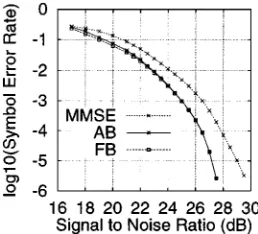
Fig. 2. Performance comparison of the classical MMSE DFE (MMSE), the multiple-hyperplane detector (AB), and the full Bayesian DFE (FB) with detected symbols being fed back.
logic function can be obtained. For instance, the states
to in require the two hyperplanes and for
separation from and are separated from
by and ; finally, separates to from
the opposite-class . Thus, given the five values of linear
discriminant functions , the detector
requires two logicANDand two logicORoperations to complete the Boolean logic value .
The symbol-error rate (SER) performance of this multiple-hyperplane detector is compared with those of the full Bayesian and conventional minimum mean-square-error (MMSE) DFEs in Fig. 2, where it can be seen that there is hardly any SER per-formance difference between the multiple-hyperplane and full Bayesian detectors. For this example, the full Bayesian DFE re-quires 380 additions, 256 multiplications, and 64 func-tion evaluafunc-tions to detect a symbol. The multiple-hyperplane de-tector, however, needs only 25 additions and 15 multiplications to make a decision, which is less than 6% of the complexity required by the full Bayesian DFE. The linear MMSE DFE re-quires only five additions and three multiplications to make a decision, as it contains a single hyperplane, but its performance is much inferior.
V. CONCLUSION
We have extended a signal space partitioning technique, orig-inally developed for binary channels, to -ary PAM channels. A design scheme is presented to automatically construct a mul-tiple-hyperplane partitioning that is asymptotically optimal. The
resulting detector consists of a set of linear discriminant func-tions and associated Boolean logic values, and it has much lower decision complexity compared with the optimal Bayesian de-tector. Although this multiple-hyperplane detector achieves the optimal Bayesian performance only at the asymptotic case of infinite SNR, in practice, it can close approximate the optimal performance under finite SNR conditions.
REFERENCES
[1] K. Abend and B. D. Fritchman, “Statistical detection for communica-tion channels with intersymbol interference,” Proc. IEEE, vol. 58, pp. 779–785, May 1970.
[2] J. F. Hayes, T. M. Cover, and J. B. Riera, “Optimal sequence detection and optimal symbol-by-symbol detection: Similar algorithms,” IEEE
Trans. Commun., vol. COM-30, pp. 152–157, Jan. 1982.
[3] D. Williamson, R. A. Kennedy, and G. W. Pulford, “Block decision feed-back equalization,” IEEE Trans. Commun., vol. 40, pp. 255–264, Feb. 1992.
[4] S. Chen, B. Mulgrew, and S. McLaughlin, “Adaptive Bayesian equaliser with decision feedback,” IEEE Trans. Signal Processing, vol. 41, pp. 2918–2927, Sept. 1993.
[5] S. Chen, S. McLaughlin, B. Mulgrew, and P. M. Grant, “Bayesian de-cision feedback equaliser for overcoming co-channel interference,” in
Proc. Inst. Elect. Eng.–Commun., vol. 143, 1996, pp. 219–225.
[6] E. Shamash and K. Yao, “On the structure and performance of a linear decision feedback equalizer based on the minimum error probability cri-terion,” in Proc. ICC’74, 1974, pp. 25F1–25F5.
[7] S. U. H. Qureshi, “Adaptive equalization,” Proc. IEEE, vol. 73, pp. 1349–1387, Sept. 1985.
[8] S. Chen, B. Mulgrew, E. S. Chng, and G. Gibson, “Space translation properties and the minimum-BER linear-combiner DFE,” in Proc. Inst.
Elect. Eng.–Commun., vol. 145, 1998, pp. 316–322.
[9] S. Chen and B. Mulgrew, “The minimum-SER linear-combiner decision feedback equaliser,” in Proc. Inst. Elect. Eng.–Commun., vol. 146, 1999, pp. 347–353.
[10] S. Chen, S. Gunn, and C. J. Harris, “Decision feedback equalizer design using support vector machines,” in Proc. Inst. Elect. Eng.–Vision, Image,
Signal Processing, vol. 147, 2000, pp. 213–219.
[11] R. A. Iltis, “A randomized bias technique for the importance sampling simulation of Bayesian equalizers,” IEEE Trans. Commun., vol. 43, pp. 1107–1115, Feb./Mar./Apr. 1995.
[12] J. Moon and T. Jeon, “Sequence detection for binary ISI channels using signal-space partitioning,” IEEE Trans. Commun., vol. 47, pp. 891–901, July 1998.
[13] Y. Kim and J. Moon, “Delay-constrained asymptotically optimal de-tection using signal-space partitioning,” in Proc. ICC’98, Atlanta, GA, 1998.
[14] , “Multi-dimensional signal space partitioning using a minimal set of hyperplanes for detecting ISI-corrupted symbols,” IEEE Trans.
Commun., vol. 48, pp. 637–647, Apr. 2000.
[15] S. Chen, B. Mulgrew, and L. Hanzo, “Asymptotic Bayesian decision feedback equalizer using a set of hyperplanes,” IEEE Trans. Signal
Pro-cessing, vol. 48, pp. 3493–3500, Dec. 2000.