Augmented reality supported work instructions for onsite facility
maintenance
Matthias Negesaand Christian Kochb aRuhr-University Bochum, Germany bUniversity of Nottingham, United Kingdom
[email protected](Lead author email address)
Abstract.During the operation and maintenance phase of buildings operators need to perform onsite maintenance activities to prevent functional failures of technical equipment. As this phase is the longest and most expensive one respective improvements can significantly reduce the overall life-cycle budget. Based on their previous work, in this paper the authors present an Augmented Reality (AR) based concept and implementation to support mobile and onsite maintenance activities by (1) preparing and generating AR work order instructions based on Product Lifecycle Management (PLM) information, (2) using these to aid the actual onsite maintenance job using hybrid 3D tracking, and (3) creating enhanced and context-related maintenance service reports to be fed back to the PLM system. Preliminary results reveal the potential of the proposed solution, but also leave room for future improvements.
1. Introduction
The operation and maintenance phase is the longest and most expensive period within the life-cycle of a building or a facility. During this period operators need to perform onsite maintenance tasks to prevent functional failures of technical equipment. Improving current onsite maintenance procedures can significantly reduce the overall life-cycle budget, since it is estimated that more than 85% of the entire life-cycle costs are actually spent on facility management (Teicholz 2004).
Although computer-supported systems have been utilized, it has been reported that still 50% of the onsite maintenance time is solely spent on localizing inspection targets and navigating indoors. (Lee, Akin 2011). Moreover, Hou et al. (2015) have recently concluded that a context-sensitive Augmented Reality (AR) based onsite maintenance procedure for a complex piping system can reduce (1) the total work time by 55% and (2) the error by 50%.
In order to digitally support facility maintenance operators in performing their daily onsite jobs, the authors have previously proposed and tested an Augmented Reality based framework that integrates Building Information Models, natural AR markers and IMU data to support indoor navigation (Neges et al. 2015; Koch et al. 2014). In this paper, however, we present a complementary part of the overall research framework that is related to preparing AR based maintenance instructions offline, using them to support the actual onsite maintenance job, and finally create service reports.
2. Background
maintenance work instructions (Wohlgemuth, Friedrich 2007). Therefore, Saske (2008) focused on the integration of AR maintenance orders in Product Lifecycle Management (PLM) systems for the purpose of generating AR maintenance work instruction based on PLM product structures and available wireframe object models. However, a major drawback is that the overlay of the wireframe object models with real maintenance objects has to be done manually by the user. Mader and Urban (2010) provided an approach for textual work instructions with a specific formularized structure to overlay the maintenance objects with specific visual information, e.g. the work instruction, the used tool and direction indicators for the disassembly process. They used 2D marker tracking and neglected the visualisation of 3D models. The limitation of hardware performance on mobile device led to approaches for outsourcing the tracking and visualisation of 3D models to servers. Following this up, Fründ (2007) provided an approach for AR on mobile devices. The rapid development of high performance smart devices, like phones and tables, enables new approaches for AR solutions. Therefore, existing AR frameworks offer robust 3D tracking functionalities. This combination of modern AR frameworks and up-to-date smart devices is highly promising.
The usability of AR for maintenance task is not limited to the mobile AR software. Rather, an intuitive authoring tool to generate AR specific work instructions is crucial (Steindecker et al. 2014). Some standard 3D-CAD software tools support the generation of work instructions (Wang et al. 2013). Based on the 3D model, the generation of different work steps is very intuitive. However, these instructions are administered specifically to the program and can only be exported as static animations. For that reason, an integration in a dynamic and interactive step-by-step AR work instruction is not possible. In fact, the structure of the work instructions has to be similar to what is presented by Mader and Urban (2010) to actually support an interactive maintenance task. It is conspicuous that AR solutions are limited to visualisation of information and 3D models as an overlay to the real world. Thereby, AR enables new interaction concepts, e.g. intuitive identification of defect parts or position related photos for advanced service reports.
Analysing current approaches the authors have identified seven main requirements for AR work instructions:
1. Use of product information (e.g. product structures and 3D models) from PLM system 2. Intuitive generation of single work steps based on the 3D model
3. Visualisation of affected parts (e.g. screws to unscrew) for the specific work steps on the 3D model
4. Addition of visual hints (e.g. direction indicators for disassembly parts) 5. Flexible structure format of the work instruction
6. Advanced service reports based on interaction in AR 7. Robust tracking of the maintenance object
3. Evaluation of a current standard Augmented Reality framework
[image:3.595.152.446.209.395.2]In order to fulfil the last requirement (robust tracking) the authors have evaluated existing tracking methods implemented in standard AR frameworks. Neges (2015) has identified six conditions to guarantee the usability of AR in maintenance process. There are five conditions aiming at the robustness of the tracking method, e.g. light conditions, defilement or damages on the surface. Furthermore, the operation under real conditions requires the tracking of the real maintenance objects without the need for additional and artificially placed markers.
Table 1: Evaluation of tracking methods implemented in standard AR frameworks
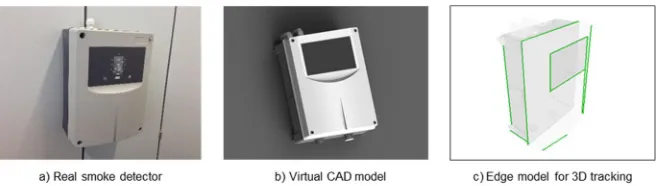
As the evaluation shows, a hybrid 3D tracking method is recommended. In this method, the tracking initialisation is based on a virtual edge model, generated automatically from the CAD file. After the initialisation, a Simultaneous Localization and Mapping (SLAM) algorithm detects the environment of the real object and a 3D point cloud map will be generated in the background of the tracking process. This point cloud will be continuously extended and enables the user to move freely around the maintenance object. There is no need to hold a specific point or element in the camera view to keep the tracking going. This hybrid 3D tracking function is only available in one current standard AR framework, the metaioSDK.
3.1 Verification of 3D tracking functions
[image:3.595.134.467.593.686.2]can be found frequently in reality. The edge based tracking initialisation was even successful with a high grade of defilement (Figure 2b and c). Furthermore, the combination of edge base tracking initialisation and point based tracking enables the progressive disassembly of the real object (Figure 2d, e and f).
Figure 2: Verification of the hybrid 3D tracking under real conditions
[image:4.595.106.492.580.743.2]4. Proposed Approach
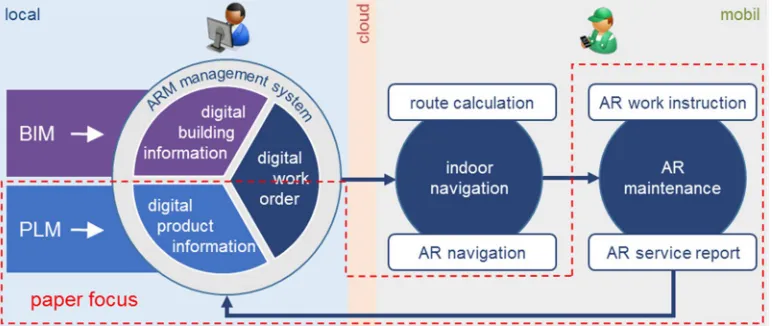
Figure 3 depicts the authors’ overall research framework that mainly consists of three parts: (1) digital work order preparation (local), (2) onsite indoor navigation (mobile), and (3) onsite maintenance support (mobile). The digital work order preparation is the collection and integration of all required information based on digital building and product models. Therefore, a web based AR Maintenance (ARM) management system is needed. On the one hand, 3D building models are usually created within the Building Information Modelling (BIM) approach in the AEC domain. On the other hand, product models, e.g. for technical equipment and installations, are created and managed in Product Life-cycle Management (PLM) systems in the mechanical engineering domain. The second part encompasses BIM based route calculation and AR supported indoor navigation using natural markers and IMU data. Details on this part of the framework can be found in (Neges et al. 2015; Koch et al. 2014).
This paper focusses on the third part of the overall framework, which is AR supported onsite maintenance support (as highlighted in Figure 3). The proposed approach mainly comprises the following three main sub task:
Creating AR based maintenance instructions and generating a digital maintenance work order (local, offline)
AR supported onsite maintenance (mobile, online), and
Creating maintenance reports (mobile, online)
Focusing on these sub tasks, the subsequent sections present the developed concepts and visualization tools in detail as well as a proof of concept using the case study of maintaining a smoke detector.
4.1 Product information from PLM-System
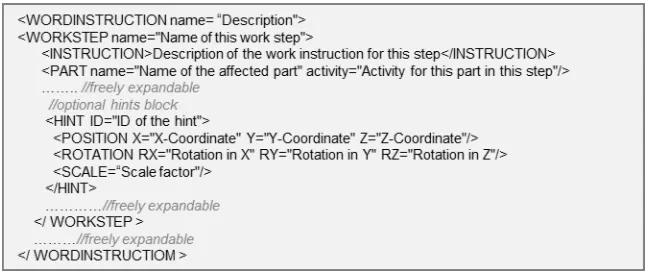
The PLM-System contains all required product information, e.g. the 3D models of the product including parts, the product structure and metadata information. This information can be distinguished into two groups: textual information like the product structure or metadata and geometrical information, the 3D models. To offer a flexible data exchange to the provided management system, the textual information can be administrated by an XML scheme file (Figure 4). Each element (product, part, assembly) has a unique PLM ID that ensures the consistent relationship between the PLM system and the ARM management system.
Figure 4: Formalized format for product structure and metadata
Figure 5: Concept of the product information integration in the ARM management system
4.2 AR based maintenance work instruction
The use of OBJ files for the 3D representation offers the opportunity to realize a generation of maintenance work instructions based on a standard 3D viewing system. This standard 3D viewing system has to be extended with functionalities to create single work steps (Figure ). Within each step, a work instruction is needed. This textual information will be extended with several visual information. Each first work step refers to specific parts of the product. For example, in the first work step the four screws on the front panel have to be removed and these screws will be highlighted in the later AR application. Therefore, three different activities are required, (a) highlight a part, (b) disassemble a part and hide it in the next work steps and (c) assemble a part and show it in the virtual model. In addition, the concept considers a library for visual hints, which is available in the viewing system and the mobile application. The library offers all available hints and each hint gets a unique ID. A visual hint can be direction indicators for disassembly parts or textual information about the defined tool used for this work step. This ID minimizes the required data exchange, because no geometrical information has to be transferred. Each hint can be loaded from the local library, within the viewing system or on the mobile application, based on its unique ID. Therefore, all information can also be stored in a corresponding XML scheme file (Figure 6).
Figure 6: Formulized format for AR maintenance work instruction
4.3 AR based service report
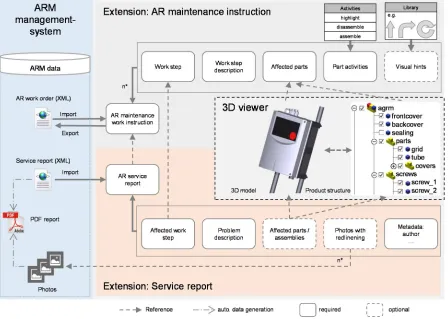
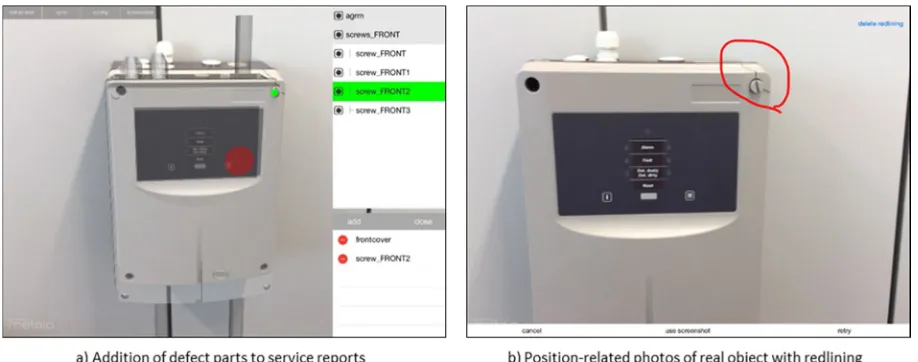
[image:6.595.136.459.533.670.2]feedback from service process. If problems occur during the service process, e.g. broken cable or screw head, the service technician can easily identify the correct part number by clicking on the overlay of the virtual 3D model on the touchscreen and add a position related photo with redlining marks to a service report. According to the textual description of the problem and this additional visual information, further maintenance tasks can be planed more precisely and faster. As with all information exchange processes in our approach, a formalized XML structure is used for service reports.
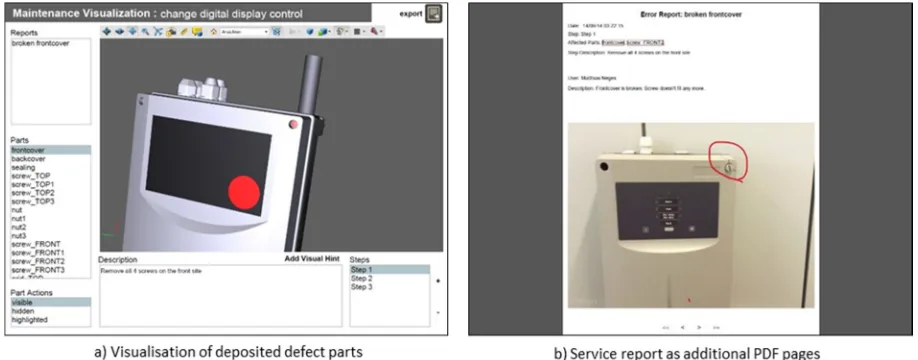
[image:7.595.75.523.231.550.2]The correct identification of the defect part in the 3D model is a direct feedback to the visualisation in the 3D Viewer, which is used for the generation of work instructions. The 3D viewer is also responsible for the illustration of the service reports (Figure 7).
Figure 7: Concept of maintenance work instructions and service reports
5. Preliminary results
Figure 8: Screenshot of the prototype (offline) - Creating maintenance instructions
Figure 9: Screenshot of the prototype (online) - AR based visualisation of maintenance instructions
[image:8.595.70.529.534.715.2]After synchronisation with the server, the new service report is available in the ARM management system and can be opened directly from this point in the 3D viewing system (Figure 1). The problem metadata, e.g. author and date of the report, the description and the photo with redlining marks are added as additional pages within the PDF file. The deposited part names are direct links to the virtual parts. The illustration of service reports as additional PDF files has further advantages: if needed, service reports can easily be saved and distributed and from now on be opened in the free available Adobe PDF Reader without ARM management system connection.
Figure 11: Screenshot of the prototype (online) – Visualisation of service reports
6. Conclusion and future work
The presented AR based approach on the offline generation and the online usage of maintenance instructions as well as the online reporting are a significant part in the authors’ overall concept for AR based onsite facility maintenance. The implemented prototype was successfully verified in a controlled, but real environment. Through the consistent use of formulised information exchanges based on the XML format, this approach is universally suitable to different PLM systems and CAD file formats. The developed ARM management system is a web based solution and will be extended with the viewing functionalities. The aim is a complete transformation of the 3D viewer functions within the web-based environment to reduce the number of software systems, e.g. only need for Adobe Acrobat Professional.
References
ARTESAS (2004): BMBF-Leitprojekt ARTESAS. Advanced Augmented Reality Technologies for Industrial Service Applications. Available online at http://www.artesas.de/, updated on 8/17/2004, checked on 7/31/2014. ARVIKA (2003): BMBF-Leitprojekt ARVIKA. Augmented-Reality für Entwicklung, Produktion und Service. Available online at http://www.arvika.de, updated on 8/1/2003, checked on 7/31/2014.
Fründ, Jürgen (2007): Eine Architekturkonzeption für eine skalierbare mobile Augmented Reality Anwendung für die Produktpräsentation. Dissertation. Universität Paderborn, Paderborn, Deutschland. Heinz Nixdorf Institut. Hou, L.; Wang, X.; Truijens, M. (2015): Using Augmented Reality to Facilitate Piping Assembly: An Experiment-Based Evaluation. In Journal of Computing in Civil Engineering 29 (1), p. 5014007. DOI: 10.1061/(ASCE)CP.1943-5487.0000344.
Koch, Christian; Neges, Matthias; König, Markus; Abramovici, Michael (2014): Natural markers for augmented reality-based indoor navigation and facility maintenance. In Automation in Construction 48, pp. 18–30. DOI: 10.1016/j.autcon.2014.08.009.
Lee, Sanghoon; Akin, Ömer (2011): Augmented reality-based computational fieldwork support for equipment operations and maintenance. InAutomation in Construction(4), pp. 338–352. DOI: 10.1016/j.autcon.2010.11.004. Mader, Steffen; Urban, Bodo (2010): Creating Instructional Content for Augmented Reality based on Controlled Natural Language Concepts. In Bruce H. Thomas, Hirokazu Kato (Eds.): Proceedings of 20th International Conference on Artificial Reality and Telexistence. ICAT'10. Adelaide, Australia, 1.12.-3.12.2010. University of South Australia. Adelaide, Australia: University of South Australia, pp. 9–13.
Neges, Herms-Matthias (2015): Smart Augmented Reality Lösung für die Indoor-Navigation und Instandhaltung. Bochum, Deutschland: Bochumer Universitätsverlag.
Neges, Matthias; Koch, Christian; König, Markus; Abramovici, Michael (2015): Combining visual natural markers and IMU for improved AR based indoor navigation. InAdvanced Engineering Informatics.In press. DOI: 10.1016/j.aei.2015.10.005.
Saske, Bernhard (2008): Augmented Reality in der Instandhaltung. Konzept zur effizienten Nutzung und Integration in das Product Lifecycle Management. Dissertation. Technischen Universität Dresden, Dresden, Deutschland. Institut für Maschinenelemente und Maschinenkonstruktion.
Schwald, B.; Figue, J.; Chauvineau, E.; Vu-Hong, F.; Robert, A.; Arbolino, M. et al. (2001): STARMATE: Using augmented reality technology for computer guided maintenance of complex mechanical elements. In Brian Stanford-Smith (Ed.): E-work and E-commerce. Novel solutions and practices for a global networked economy. Amsterdam, Netherlands: IOS Press, pp. 196–202.
Steindecker, Erik; Stelzer, Ralph; Saske, Bernhard (2014): Requirements for Virtualization of AR Displays within VR Environments. In Randall Shumaker, Stephanie Lackey (Eds.): Proceedings of the 6th International Conference on Virtual, Augmented and Mixed Reality. VAMR'14, vol. 8525. Heraklion, Crete, Greece, June 22-27, 2014. International Conference on Human-Computer Interaction. Berlin, Germany: Springer Verlag (LNCS sublibrary. SL 3, Information systems and application, incl. Internet/Web and HCI, 8525), pp. 105–116.
Teicholz, Eric (2004): Bridging the AEC/FM technology gap. In Journal of Facilities Management2, pp. 1–8. Available online at http://www.graphicsystems.biz/gsi/articles/Bridging%20the%20AEC_FM%20Gap_r2.pdf, checked on 6/23/2014.
Wang, Xu Ping; Chen, Xiao Hu; Yao, Chun Jiang; Ding, Yao; Gao, Shu Xiang (2013): Desktop Virtual Maintenance Training Platform Based on NGRAIN. InAMR - Advanced Materials Research765-767, pp. 1546– 1549. DOI: 10.4028/www.scientific.net/AMR.765-767.1546.