ISSN: 1992-8645 www.jatit.org E-ISSN: 1817-3195
3487
WEIGHT ANALYSIS FOR WEIGHTED CLUSTER
ALGORITHMS IN MOBILE AD-HOC NETWORK
1HADEEL NOORI SAAD, 2MOHAMMED BAQER M. KAMEL
1,2Univeristy of Kufa, College of Education for Girls, Department of Computer Science, Iraq
E-mail: 1[email protected], 2[email protected]
ABSTRACT
Mobile ad-hoc network (MANET) is an infrastructure-less network with unstable dynamic nature. Such environment may cause high control signaling for self-rearrangement, and scalable problems. Weight-based Cluster routing algorithms aim to reduce configuration steps, retransmission and collisions. These algorithms differ in principal of cluster head selection upon some weight criteria such as (energy, connectivity, no. of node’s neighbors and mobility). In this research an analytical model was proposed to examine different criteria’s weights themes for cluster head election. The result expos the effect of the significant of multi combinations of them. Computation of criteria weight upon another criteria gives a smooth weight update with different update steps as results show. This can reflect new trend of weighted clustering algorithms based on network state.
Keywords: MANET, MANET Clustering, CH Selection, Weighted Clustering,
1. INTRODUCTION
MANET with its dynamic and flexible nature can serve wide spread of applications starting from military aspects, collaborative applications, medical applications and so forth. It covers a wide variety of research topics. These attractive characteristics leads to various constraints and challenges. MANET as its name refers to mobility which in turn mean unmanaged network nodes, unpredictable multi-hop routing paths and high configuration message distribution. Clustering is the process of grouping nodes according to their positions, each have a cluster head (CH) node and gateway nodes for inter-cluster and intra-clusters communications respectively.
clustering restricts the routing prospects, give an efficient result, reduce power consumptions and preserve bandwidth from over utilization by configuration messages [1]. The efficiency of the entire network can be affected by the CH fitness. The best is the long live, best positioning, and relatively stable [2]. Weighted cluster algorithms aim to rank each node with some id [3] and tried to maximize this id to elect the maximum node’s id as CH, the others can be considered as next possible CHs. It’s obvious that node characteristics affect the competence of the node with different percentage.
This work aim to analyze the node weight computation with various characteristic’s fractions
and compare its behavior with best characteristic values within cluster, to reveal the importance of each one, and produce optimal weight computation function. The following sections of the paper will organized as follow: in section 2 we studied WCAs and focus on the weights computation formula, section 3,4 and 5 will cover the simulation scenarios, analysis process, and conclusions, respectively.
2. LITERATURE REVIEW
Clustering algorithms vary from single characteristic based to multi-characteristics. Torkestani and Meybodi [4] proposed that the CH is the class member with minimum relative mobility, they compute each node neighbor’s mobility to compare with.
3488 will form node ID which serve as a target of maximize/minimize function, which can be expressed as a node weight. In this section some of related WCAs frameworks will be described and the evaluation of node ID will be expressed.
Balaji and Priyadharsini [11] proposed a weight based cluster head selection, according to closeness and average minimum power required is considered for election of the adequate nodes. The node with maximum net weight NW is selected as a cluster head.
(1)
where, P = {Neighborhood contribution percentage cp, Stability of the link Ns, energy consumption ENi, distance between two nodes Dp, and node velocity NV}, fi is the weight factor of the particular parameter Pi and ∑ fi is equal to one. He suggests avoiding the nodes which has less number of neighbors and energy compared to other nodes will reduce the overhead in selecting the head cluster.
Monsef et al [12] proposed an efficient weight-based clustering algorithm (EWBCA) for mobile ad-hoc networks. The proposed algorithm aims to improve the usage of network resources such as bandwidth and energy, and try to minimize routing overhead, and increase end-to-end throughput. The proposed parameters are the Number of neighbor nodes Nn, Residual battery power Rb, Stability of node St, Variance of distance Vd with all neighbors of a node, then the highest node’s weight the possible cluster head election.
weight=C1 Nn + C2 Rb + C3 St + C4 Vd (2)
where C1 = 0.2, C3 =0.7, and C2, C4 were calculated through linear functions. The proposed algorithm produced 10.2% better throughput than WCA for the node speed of 10 m/s and higher.
Selvam and Palanisamy [13] proposed a new WCA according to inter-node displacements. They defined weight function w(p) to be calculated the for each node. For each node p, the weight function w(p) is defined as:
w (p) =3 t (p) +2 s(p) + r (p) (3) where t (p) and s(p) are the number of neighbors as multicast member 1-hop and 2-hop respectively and r (p) is the number multicast member and cluster member neighbors are being within two hops.
Hussein et al [14], proposed an enhancement on weighted clustering algorithm (EWCA), which leads to a high degree of stability in the network and improves the load balancing. The node weight was calculated as:
Wv=w1 delta_v+w2 Dv+w3 Mv+w4 Pv (4) Where delta_v is the threshold of cluster size, Dv max distance, Mv measure of mobility, PV remaining battery power.
He chooses w1, w2, w3, w4 Weights to be 0.45, 0.05, 0.45, 0.05, respectively. Taking the node with the smallest Wv as the cluster head, then all the neighbors of the chosen cluster head are no longer allowed to participate in the election procedure.
Chatterjee, Das and Turgut [15] proposed a weight-based distributed clustering algorithm which takes into consideration the ideal node degree, transmission power, mobility, and battery power of mobile nodes. Calculating the combined weight Wv for each node v, as:
Wv = w1 ∆v + w2 Dv + w3Mv + w4Pv (5) Where ∆v is degree difference of every node, Dv is the sum of differences with all its neighbors, Mv measure of node mobility, and Pv power consumption. Finally, w1, w2, w3 and w4 are the weighing factors for the corresponding system parameters, which considered to be 0.7, 0.2, 0.05 and 0.05 respectively. From previous studies it is obvious that, there is no precise vision about required contribution percentage of node characteristics in computation of its ID or weight.
3. PROPOSED ANALYSIS SYSTEM
The proposed weight analysis system has been derived from an important questionable points:
1- Studying weights effect on CH live time period.
2- Reveal relations between residual energy, mobility and connectivity criteria.
3- Required tradeoff between high-connectivity, and residual energy. As they highly-coupled.
4- Taking more metrics together lead to another task of finding perfect contribution ratio of each, in the CH weight equations.
ISSN: 1992-8645 www.jatit.org E-ISSN: 1817-3195
3489
TABLE 2DETAILS OF WEIGHTS
W1 (energy) W2 (connectivity) W3 (mobility) Transmitted Packets Power Consumption Focused Region
0.1 0.1 0.8 584 0.225
Mobility
0.1 0.2 0.7 592 0.227
0.1 0.3 0.6 601 0.228
0.1 0.4 0.5 602 0.229
0.1 0.5 0.4 631 0.234
Connectivity
0.1 0.6 0.3 651 0.240
0.1 0.7 0.2 644 0.238
0.1 0.8 0.1 623 0.234
0.3 0.1 0.6 571 0.218
0.3 0.2 0.5 581 0.222
0.3 0.3 0.4 590 0.225
0.3 0.4 0.3 600 0.230
0.3 0.5 0.2 605 0.227
0.3 0.6 0.1 614 0.229
0.5 0.1 0.4 545 0.205
0.5 0.2 0.3 549 0.207
0.5 0.3 0.2 570 0.220
0.5 0.4 0.1 566 0.217
0.6 0.1 0.3 516 0.203
Energy
0.6 0.2 0.2 537 0.211
0.6 0.3 0.1 525 0.208
0.7 0.1 0.2 501 0.202
0.7 0.2 0.1 510 0.207
0.8 0.1 0.1 477 0.195
1 0 0 451 0.187 Energy Based
0 1 0 575 0.222 Connectivity Based
0 0 1 609 0.226 Mobility Based
Simulation scenarios with different criteria’s weight have been derived to facilitate studying and analyzing CH node validity accordingly.
The proposed simulation methodology depends on varying the node characteristic’s weight wi with the range (0.1- 0.9) as in (6).
where Cj represent the three criteria metrics, residual energy, connectivity, and mobility, respectively.
CH lifetime (or validity) can be estimated by monitoring the resulting network overheads, while un suitable CH will force the network to recalculate new CH.
Then CH’s computed-ID will be compared with best criteria value within the same class to study weight effect on ID validity.
Residual power energy P, connectivity C, and mobility M are the three characteristics we will focus on for weight computation, with the preservation of w1+w2+w3 =1.
4. RESULT AND ANALYSIS
The simulation is carried out on network simulator ver. 2.35. for simulation an (300m x 300m) simulation area size is used. 24 nodes have been defined in the environment. The Wi value was varied in range between 0 – 1. At every time unit, the nodes are moved randomly in all possible directions in 250 * 250 m2 space. The simulation parameters as shown in table 1.
TABLE 1SIMULATIONPARAMETERS.
Simulation Parameter Value Simulator NS-2 (ver 2.35)
Simulation Time 80 s
Simulation area 300m x 300m
MAC protocol IEEE 802.11
No. of nodes 24
No. of clusters 4
Initial energy 100%
Transmission range 50 m
Routing Protocol AODV
Traffic Type CBR
Number of sources 15
Number of destination 15
Data payload 1000
3490
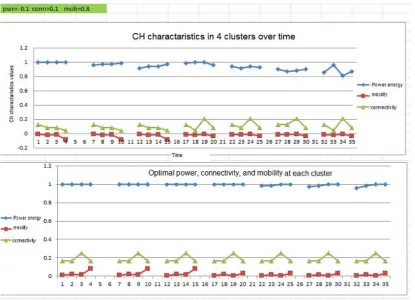
Figure. 1. CH characteristics (w1=0.1, w2=0.1, w3=0.8) Table 2 show power energy consumption and
communication size (number of transmitted control packets), corresponding to each weight computation scheme. The table also shows the focused regions of weights for each corresponding set of weights. The focused regions are:
1- Mobility-focused 2- Connectivity-focused 3- Energy-focused
4- Energy based (single factor) 5- Connectivity based (single factor) 6- Mobility based (single factor)
As shown in Table 2, energy-focused weights consume energy and generate overhead packets similar to other weight’s schemes this reveal that focusing on energy among other characteristics cannot give a correct view of the network state and CH optimality, this includes connectivity and mobility.
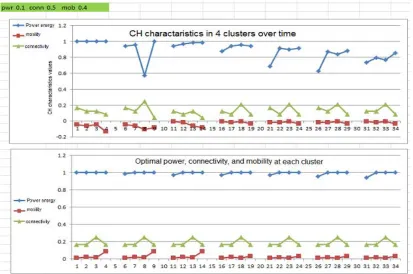
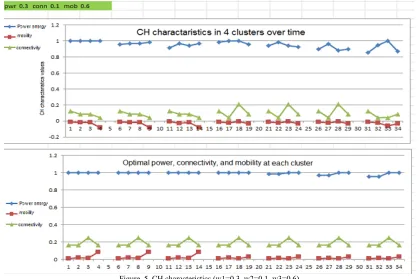
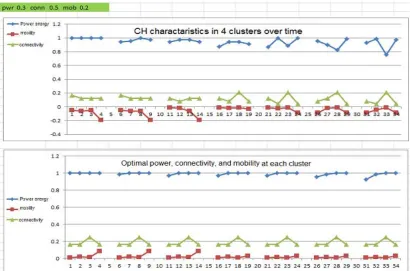
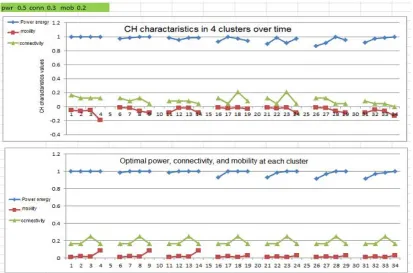
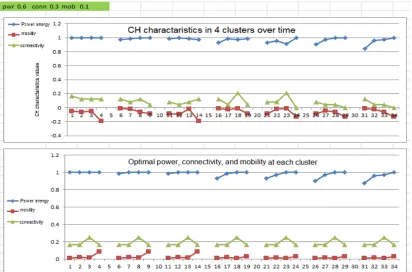
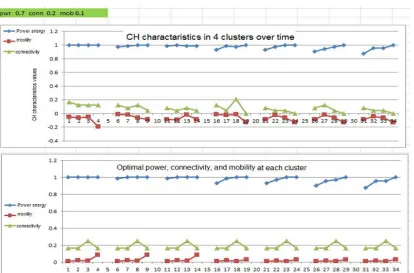
The CH characteristics was compared with the optimal values for residual power energy, connectivity, and mobility at each cluster along the simulation time period. The results show that mobility can has important influence on node’s weight as residual energy dose with w1= 0.1, w2=0.1, and w3=0.8 as in figure 1, whereas figures 3 and 4 exhibit the results when connectivity dominates the computation of node’s weight. It is obvious that power energy suffers from drain as time proceeding which is expectable while more neighbors results more communication cost.
ISSN: 1992-8645 www.jatit.org E-ISSN: 1817-3195
[image:5.612.100.516.111.388.2]3491
[image:5.612.100.513.430.704.2]Figure. 3. CH characteristics (w1=0.1, w2=0.5, w3=0.4) Figure. 2. CH characteristics (w1=0.1, w2=0.3, w3=0.6)
3492
Figure. 4. CH characteristics (w1=0.1, w2=0.7, w3=0.2)
[image:6.612.94.513.430.709.2]ISSN: 1992-8645 www.jatit.org E-ISSN: 1817-3195
[image:7.612.98.516.104.389.2]3493
Figure. 6. CH characteristics (w1=0.3, w2=0.3, w3=0.4)
[image:7.612.101.511.429.700.2]
3494 `
Figure. 8. CH characteristics (w1=0.5, w2=0.1, w3=0.4)
[image:8.612.97.510.429.702.2]ISSN: 1992-8645 www.jatit.org E-ISSN: 1817-3195
[image:9.612.107.521.108.382.2]3495
Figure. 10. CH characteristics (w1=0.6, w2=0.1, w3=0.3)
[image:9.612.101.513.430.702.2]3496
Figure. 12. CH characteristics (w1=0.7, w2=0.2, w3=0.1)
[image:10.612.100.514.429.700.2]ISSN: 1992-8645 www.jatit.org E-ISSN: 1817-3195
[image:11.612.101.515.108.382.2]3497
Figure. 14. CH characteristics (w1=0.0, w2=1.0, w3=0.0)
[image:11.612.101.512.430.700.2]3498
TABLE 3COMPUTING NODE ID WITH RESPECT TO MOBILITY
Table 3 gives mathematical computation and analysis of node weight’s update ∆w according to node state. The association weights with node’s criteria: residual energy, connectivity and mobility had been examined with the proposed weight scheme where each weight had been computed with respect to mobility changes as in (7).
∆wi = wJ* ∆m/CJ (7)
where i≠j , CJ represent node’s criteria , and ∆m
represent mobility changes as in (8)
division of mobility change with respect to other criteria will smooth the weight update and keeps its value with the validation range.
∆m= m t+1- mt (8)
Where t and t+1 represent time points
As in shown in the table the proposed computed CH ‘s Id was affected with mobility change and its value diverge faster than the flat CH ‘s Id computation.
This will give an estimation of future weight computation as simulation process proceed, by smoothing weight’s value by factor of ∆ which represent the evolution of other node’s state criteria.
5. CONCLUSIONS
The Results show that node’s criteria can contribute differently with node’s weights, while it is tightly related. In some situations, its founded that specific criteria can be the most important to be taken into consideration over other characteristics as shown in figures 6-12. Energy, mobility or connectivity based weights cannot serve well separately. Node behavior analysis with different W1 energy W2 mobilit y w3 connec t ∆w1=w1 * ∆m/e ∆w3= w3*∆m/ c residual energy connectiv ity mobility Node id proposed node ID
2
0.7 0.2 0.1 0.002222222 0.003333333 9 6 4 6.1 6.1
0.7 0.2 0.1 ‐0.01 0.001666667 8 6 5 5.2 5.08
0.7 0.2 0.1 ‐0.02 0.003333333 7 6 7 4.1 3.91
0.7 0.2 0.1 ‐0.02 0.003333333 6 6 9 3 2.81
0.7 0.2 0.1 0.06 ‐0.01 5 6 3 3.5 3.71
0.7 0.2 0.1 ‐0.01 0.001666667 4 6 4 2.6 2.53
0.7 0.2 0.1 0.02 ‐0.003333333 3 6 2 2.3 2.32
0.7 0.2 0.1 ‐0.02 0.003333333 2 6 4 1.2 1.14
0.7 0.2 0.1 ‐0.05 0.008333333 1 6 9 ‐0.5 ‐0.59
0.7 0.2 0.1 ‐0.005 ‐0.006666667 9 6 5 5.9 5.765
0.7 0.2 0.1 0.01 ‐0.001666667 8 6 4 5.4 5.43
0.7 0.2 0.1 ‐0.02 0.003333333 7 6 6 4.3 4.12
0.7 0.2 0.1 ‐0.04 0.006666667 6 6 10 2.8 2.5
0.7 0.2 0.1 0.06 ‐0.01 5 6 4 3.3 3.5
0.7 0.2 0.1 0.03 ‐0.005 4 6 1 3.2 3.28
0.7 0.2 0.1 ‐0.08 0.013333333 3 6 9 0.9 0.65
0.7 0.2 0.1 0.05 ‐0.008333333 2 6 4 1.2 1.21
0.7 0.2 0.1 ‐0.004285714 ‐0.005 9 6 1 6.7 6.621429
0.7 0.2 0.1 ‐0.03 0.005 8 6 4 5.4 5.15
ISSN: 1992-8645 www.jatit.org E-ISSN: 1817-3195
3499 weight themes lead to best weight prediction, and can cope with high complicated node state behavior. According to the proposed analysis the results show significant weight theme in which the CH remain with best node criteria category. analysis Results also show how we can compute characteristic weights in respect to some of them or some previous values. This work produces a step toward adaptive weight calculation and network state based weights.
REFERENCES
[1] R. P. Selvam and V. Palanisamy, “An Efficient Cluster-Based Multi-Source Multicast Routing Protocol in Mobile Ad-hoc Networks”, IEEE Proc.ICCCCT’10, 2010, pp.414-419.
[2] N. Karimi and M. Shayesteh, “An Innovative Clustering Method for MANET Based on Cluster Convergence”, International Journal of Computer Science and Telecommunications, vol. 3, no. 80, pp. 2012, 80-86.
[3] M. Chatterjee, S. K. Das, and D. Turgut, “WCA: A Weighted Clustering Algorithm for Mobile Ad Hoc Networks”, Cluster Computing, Vol. 5, No. 2, April 2002, pp. 193-204.
[4] J. A. Torkestani and M. R. Meybodi, “A mobility-based cluster formation algorithm for wireless mobile ad-hoc networks”, Cluster Computing, Vol. 14, No. 4, 2011, pp. 311-324. [5] J. J.Yin Leu, M. H. Tsai, T. C. Chiang and Y.
M. Huang "Adaptive Power-Aware Clustering and Multicasting Protocol for Mobile Ad Hoc Networks", International Conference on Ubiquitous Intelligence and Computing, 2006, pp. 331-340.
[6] A. Fathi and H. Taheri. “Enhance Topology Control Pro-tocol(ECEC) to Conserve Energy based clustering in Wireless Ad Hoc Networks,” 3rd IEEE ICCSIT, 2010, pp. 356-360.
[7] M. Gerla and J.T.C. Tsai, “Multicluster, mobile, multimedia radio network”, Wireless Networks, Vol. 1, No. 3, 1995, pp. 255–265. [8] A. K. Parekh, “Selecting routers in ad-hoc
wireless networks”, Proceedings of the SBT/IEEE International Telecommunications Symposium, 1994, pp. 420-424.
[9] S. Basagni,” Distributed Clustering for Ad Hoc Networks”, Proceedings of the International Symposium on Parallel Architectures, Algorithms and Networks (ISPAN '99), 1999, pp. 310-315.
[10]J. Y. Yu and P. H. Chong, “A Survey of Clustering Schemes for Mobile Ad Hoc Networks”, IEEE Communications Survey &Tutorials, Vol. 7, No. 1, 2005, pp. 32-48. [11]S. Balaji and V. Priyadharsini, “A Robust
Cluster Head Selection Based On Neighborhood Contribution and Average Minimum Power for MANETS”, ICTACT Journal on Communication Technology, Vol. 6, No. 2. June 2015
[12]M. R. Monsef, S. Jabbehdari and F. Safaei, “An Efficient Weight-based clustering algorithm for MANET”, Journal of Computing, Vol. 3, Issues 1, 2011.
[13]R. P. Selvam and V. Palanisamy, “Stable and Flexible Weight based Clustering Algorithm in Mobile Ad hoc Networks,” International Journal of Computer Science and Information Technologies, 2011, pp. 824-828.