Elsevier Editorial System(tm) for Renewable & Sustainable Energy Reviews Manuscript Draft
Manuscript Number:
Title: Review of solid-liquid phase change materials and their encapsulation technologies Article Type: Review Article
Keywords: Phase change material (PCM), micro-/nano-encapsulation technology, evaluation technologies
Corresponding Author: Mr. Weiguang Su,
Corresponding Author's Institution: University of Nottingham Ningbo China First Author: Weiguang Su
Order of Authors: Weiguang Su; Jo Darkwa; Georgios KOKOGIANNAKIS
Abstract: Various types of solid-liquid phase change materials (PCMs) have been reviewed for thermal energy storage applications. The review has shown that organic solid-liquid PCMs have much more advantages and capabilities than inorganic PCMs but do possess low thermal conductivity and density as well as being flammable. Encapsulation technologies and shell materials have also been examined and limitations established. The morphology of particles were identified as a key influencing factor on the thermal and chemical stability and the mechanical strength of encapsulated PCMs. Enhancement methods and standardization of testing procedures for microencapsulated PCMs are therefore being encouraged.
Suggested Reviewers: Anton Ianakiev Nottingham Trent University
[email protected] Robert Critoph
University of Warwick [email protected] Guohui Gan
The University of Nottingham [email protected]
Centre for Sustainable Energy Technologies (CSET), University of Nottingham-Ningbo, Ningbo-China
The Editor
Renewable & Sustainable Energy Reviews
January 15, 2014
Dear Editor,
Please see attached a copy of a manuscript entitled “Review of solid-liquid phase change materials and their encapsulation technologies” for consideration and publication in the journal.
This paper is a review paper focusing on solid-liquid phase change materials and micro-/nano-encapsulated phase change material fabrication technologies. This is part of a research to develop a high quality microencapsulated phase change material for thermal energy storage in university of Nottingham Ningbo China.
The first author is Mr Weiguang Su, who is the correspondence author, currently a Ph.D. candidate in Centre for Sustainable Energy Technologies (CSET), University of Nottingham Ningbo China.
The second author is Professor Jo Darkwa, Director of CSET.
The third author is Dr Georgios Kokogiannakis
Correspondence:
Add: Centre for Sustainable Energy Technologies (CSET), University of Nottingham Ningbo China. 199 East Taikang Road, Ningbo 315100
Tel: +86 574 8818 0319
Fax: +86 574 8818 0313
Email: [email protected]
No designated Reviewers to be excluded.
Yours sincerely,
1 2 3 4 5 6 7 8 9 10 11 12 13 14 15 16 17 18 19 20 21 22 23 24 25 26 27 28 29 30 31 32 33 34 35 36 37 38 39 40 41 42 43 44 45 46 47 48 49 50 51 52 53 54 55 56 57
Review of solid-liquid phase change materials and
their encapsulation technologies
Weiguang Su, Jo Darkwa, Georgios KOKOGIANNAKIS
Centre for Sustainable Energy Technologies, University of Nottingham Ningbo China
1
Introduction
Energy consumption in buildings continues to pose environmental problems to many countries and the world as a whole. Techniques such as thermal energy storage are being explored at different levels for reducing energy consumption in buildings which currently accounts for about 40% percentage of total global energy consumption [1]. Phase change materials (PCMs) are capable of storing and releasing large amounts of energy during melting and solidification at specific temperatures. Thermal energy storage does not only reduce the mismatch between energy supply and demand but also improves the performance and reliability of energy systems and plays an important role in conserving energy resources. Current application of PCMs in buildings include air conditioning i.e. free cooling [1], cold thermal storage media and absorption refrigeration. Other integrated systems are PCM Trombe wall, PCM wallboards, PCM shutter, PCM concrete, PCM under-floor heating systems, PCM ceiling boards[2-4] as well as hot water supply and waste heat recovery systems [5]. For instance, E.Oro et al. [6] and Gang Li et al.[7] reviewed PCMs melting point below 20 ºC for cold thermal energy storage applications. Agyenim et al. [8] identified phase change materials of melting temperature within 0-65 ℃ to be suitable for domestic heating/cooling application. They also stated that PCMs of melting temperatures 80℃ to 120℃ could be used in absorption cooling system whereas those types of melting temperatures above 150℃ could be applied in solar power plants systems coupled with parabolic trough collectors for direct steam generation. Furthermore, Cabeza et al. [9] stated more comprehensively that melting temperatures up to 21℃ are more suitable for cooling applications, 22-28℃ for thermal comfort applications, 29-60 ℃ for hot water supply and over 120℃ for waste heat recovery applications.
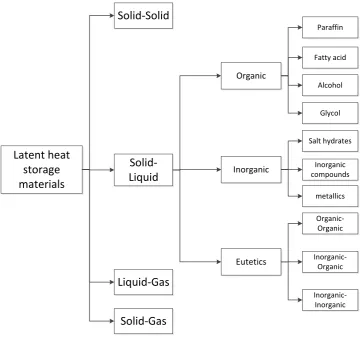
Depending on the type of PCM, energy storage process could be described as solid-solid, solid-liquid, liquid-gas or solid-gas as shown in Fig. 1 [2, 3, 8, 9]. However, liquid-gas and solid-gas processes are not applicable to construction materials due to their large volume and pressure change during phase change process. On the other hand, solid-liquid types of organic PCMs could leak into their surroundings during heat storage process if they are applied directly without being encapsulated. Most of the organic PCMs also have low thermal conductivity and poor thermal response as well as being flammable which pose a serious potential danger of fire outbreak. Meanwhile, most inorganic PCMs are known to be corrosive which could cause irretrievable damage to storage containers [10]. These problems *Manuscript
1 2 3 4 5 6 7 8 9 10 11 12 13 14 15 16 17 18 19 20 21 22 23 24 25 26 27 28 29 30 31 32 33 34 35 36 37 38 39 40 41 42 43 44 45 46 47 48 49 50 51 52 53 54 55 56 57 58
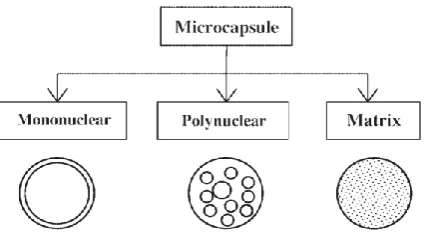
may be overcome by employing encapsulation technology to produce enhanced microencapsulated phase change material (MEPCM) or nanoencapsulated phase change material (NEPCM) for various applications. As shown in Fig. 2, a typical structure of MEPCM/NEPCM is composed of core and shell layers [11], which can be classified as mononuclear, polynuclear or matrix type. This paper therefore focusses on review of various types of solid-liquid PCMs and their related micro/nano-encapsulation technologies in order to advance their development and application.
Figure 1 Classification of PCMs
Figure 2 Structure of MEPCMs/NEPCMs[11]
2
Properties of solid-liquid PCMs
There are a number of factors which can influence effectiveness and application of solid-liquid types of PCMs. For instance good thermal properties depend on suitable phase transition temperature, high latent heat of transition per unit weight, high thermal conductivity, and large specific heat capacity. In the physical side PCMs should have favourable phase equilibrium, high density, minor volume changes during phase transition, and low vapour pressure at the operation temperature. For kinetic properties the PCMs need to exhibit little or no sub-cooling during freezing, sufficient crystallization rate, melting and solidification at the same temperature and phase segregation. They should also possess good chemical properties capable of completing reversible freezing/melting cycle, long-term chemical stability, compatibility with other materials, no degradation after long term thermal cycles, non-corrosive, non-toxic, no fire hazard, and non-explosive compounds. These properties are therefore reviewed in the following chapter for the different types of organic and inorganic PCMs.
2.1
Organic solid-liquid PCMs
Organic solid-liquid PCMs are described as paraffin and non-paraffin materials (fatty acids, alcohols and glycols). Organic materials have stable phase change temperature (without phase segregation), consequent degradation of latent heat fusion, self-nucleation (no supercooling) and usually non-corrosiveness[12].
2.1.1
Paraffin materials
1 2 3 4 5 6 7 8 9 10 11 12 13 14 15 16 17 18 19 20 21 22 23 24 25 26 27 28 29 30 31 32 33 34 35 36 37 38 39 40 41 42 43 44 45 46 47 48 49 50 51 52 53 54 55 56 57
melting temperature. Paraffin materials are safe, reliable, predictable, less expensive, non-corrosive and have low vapour pressure. However, they possess some undesirable properties such as low thermal conductivity, non-compatible with the plastic container, moderately flammable, a high volume change between the solid and liquid stages. Tab. 1 shows the thermophysical properties of the commercially available paraffin materials.
Table 1: Thermophysical properties of paraffin [2, 5, 9]
2.1.2
Non-paraffin materials
Non-paraffin organic materials such as esters, fatty acids, alcohols and glycols, can also be used as PCMs as listed in Tab. 2. They are the largest group of candidate materials for latent heat storage particularly, the fatty acids. They are however flammable and should therefore not be exposed to excessively high temperature, flames or oxidizing agents. Other properties of the non-paraffin PCMs include high heat of fusion, inflammability, low thermal conductivity, low flash point, varying level of toxicity, and instability at high temperature.
Table 2: Thermophysical properties of non-paraffin PCMs [2, 5, 6, 9]
2.2
Inorganic solid-liquid PCMs
2.2.1
Salt hydrates
Salt hydrates in Tab.3 are the oldest and most studied PCMs, which can be regarded as alloys of inorganic salts and water forming a typical crystalline solid of general formula AB·nH2O. The solid-liquid transformation of salt hydrates is a dehydration of the salt, although this process resembles melting or freezing thermodynamically. At the melting point the hydrate crystals breakup into anhydrous salt and water, or into a lower hydrate and water, and the melting behaviour of the salt hydrates can be identified as: congruent, incongruent and semi-congruent melting[14]. Congruent melting occurs when the anhydrous salt is completely soluble in its water of hydration at the melting temperature. Incongruent melting occurs when the salt is not entirely soluble in its water of hydration at the melting point. Semi-congruent melting occurs when the liquid and solid phases are in equilibrium during a phase transition. The most attractive properties of salt hydrates are: (i) high latent heat of fusion per unit volume, (ii) relatively high thermal conductivity (almost double of the paraffin’s), and (iii) small volume changes on melting. There is however supercooling and phase segregation problems associated with their applications.
1 2 3 4 5 6 7 8 9 10 11 12 13 14 15 16 17 18 19 20 21 22 23 24 25 26 27 28 29 30 31 32 33 34 35 36 37 38 39 40 41 42 43 44 45 46 47 48 49 50 51 52 53 54 55 56 57 58
2.2.2
Inorganic compounds
Tab. 4 shows a list of available inorganic compounds but some are considered to be unsuitable for application in buildings due to their relatively small latent heat capacity. In addition many of the inorganic PCMs compounds are harmful to the environment and human health.
Table 4: Thermal physical properties of inorganic compounds[2, 5]
2.2.3
Metals
As shown in Table 5, low melting point metals and their alloys can be used as latent heat energy storage materials. These metals are have high thermal conductivity, good electrical conductivity, low vapor pressure, low heat of fusion per unit weight but high heat of fusion per unit volume (duo to large density), and small volume change during phase transition[17]. Thus, if certain metal or metal alloy is used as a PCM, the heat transfer capacity will be improved significantly compared with traditional PCMs. Therefore, low melting point liquid metals could be used for application in laser system[18], USB flash memory[19] and smartphone[20] cooling.
Table 5: Melting temperature and latent heat of metallic PCMs [2, 17]
2.3
Eutectics solid-liquid PCMs
Table 6 shows a list of Eutectic solid-liquid PCMs. They normally consist of two or more low melting temperature components, each of which melts and freezes congruently to form a mixture of the components’ crystals during crystallization[2]. Eutectics do possess high thermal conductivity and density and do not experience any segregation and supercooling. However the latent and specific heat capacities are much smaller than salt hydrates and paraffin.
Table 6: Thermophysical properties of eutectic PCMs [2, 6, 9, 17]
2.4
Analysis of various PCMs
1 2 3 4 5 6 7 8 9 10 11 12 13 14 15 16 17 18 19 20 21 22 23 24 25 26 27 28 29 30 31 32 33 34 35 36 37 38 39 40 41 42 43 44 45 46 47 48 49 50 51 52 53 54 55 56 57
the other hand, the inorganic solid-liquid PCMs have high density that means they have higher heat storage capacity, they are cheaper and readily available, possess high thermal conductivity and are non-flammable. Nevertheless, there are also some problems such as supercooling and phase segregation associated with phase change process.
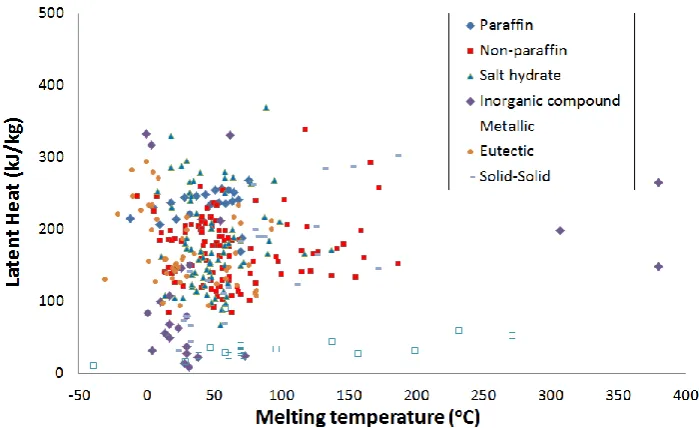
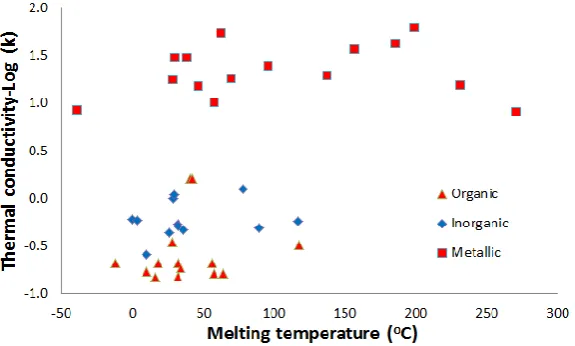
Fig. 3 illustrates the relationship between latent heat capacity of various PCMs and their melting point temperatures. It shows that the organic, salt hydrate, eutectic and solid-solid PCMs have relatively lower melting temperatures. The inorganic compound and metallic PCMs have much higher melting temperature range but the metallic PCMs do in general have the lowest latent energy storage capacity. Tables 1-5 indicate that only about 10% of thermal conductivity (k) data for PCMs have been established over the past few years which distributed in the range of 0.149-61 W/m·K. In order to highlight the difference of various kinds of PCMs the relationship between the Log (k) and the melting temperatures is presented in Fig. 4, and it is clear that the metallic and their compounds have much higher thermal conductivities than the other inorganic PCMs and organic PCMs by over 10 W/m·K (Log(k)>1). On the other hand, most of the inorganic PCMs have higher thermal conductivity than the organic PCMs.
Figure 3 Melting temperature and latent heat distribution for different types of PCMs
Figure 4 Thermal conductivity distribution for different types of PCMs
3
Development of micro/nano-encapsulated PCMs
Microencapsulation is defined as a process in which tiny particles or droplets are surrounded by a coating material, or embedded in a homogeneous or heterogeneous matrix, in order to provide small capsules with useful properties[21]. Microencapsulation processes are usually categorized into two groups: physical processes and chemical processes. Physical methods include spray cooling, spray drying and fluidized bed processes. However, physical methods are limited by their granulated sizes thus making them useful for producing micro encapsulated PCM particles [22]. On the other hand, chemical methods can produce much smaller encapsulated PCM particles. This chapter therefore reviews various types of fabrication technologies for micro/nano-encapsulated PCMs (MEPCM/NEPCM).
3.1
In-situ polymerization
1 2 3 4 5 6 7 8 9 10 11 12 13 14 15 16 17 18 19 20 21 22 23 24 25 26 27 28 29 30 31 32 33 34 35 36 37 38 39 40 41 42 43 44 45 46 47 48 49 50 51 52 53 54 55 56 57 58
emulsion production, 2) preparation of prepolymer mixture liquid, 3) adding prepolymer mixture liquid into O/W emulsion to encapsulate core material particles, 4) washing and drying MEPCM/NEPCM. As an example, Fig. 5 shows the process of encapsulation of n-octadecane with resorcinol-modified melamine–formaldehyde shell [23] using the in-situ polymerization process.
Figure 5 Fabrication of the MEPCM by in-situ polymerization [23]
Choi et al. [24] used a melamine formaldehyde shell and 5 wt% styrene-maleic anhydride-monomethyl (SMA) as emulsifier to encapsulate tetradecane. The result showed reduction in the size of the capsules and uniformity was improved with an optimum emulsion speed of up to 8000 rpm. Fang et al. [25] used a UF shell to encapsulate tetradecan PCM. The liquid was emulsified at 60℃ for 30min with an emulsion speed of 1500 rpm. Sodium dodecyl sulfate and resorcin were used as emulsifier and system modifier respectively. Further analysis of the results showed that the thermal stability of the capsules was also improved after adding 2-5wt% of NaCl. Yang et al. [26] successfully fabricated four types of MEPCM with different shell materials (PVAc, PS, PMMA and PEMA). Jin et al. [27] dispersed paraffin using Hydrolyzed-styrene-alt-maleic anhydride(HSMA) as the emulsifier at a speed of 12000 rpm and then used UF as a shell material to produce MEPCM. The content of the shell material was then increased to 28% and was subjected to number of thermal cycles. The results showed the capsules to be intact thus making them thermally stable than a bulk paraffin material. Zhang et al.[28] encapsulated n-octadecane with MF material, emulsifier (TA 0.6-2.3 wt%) and cyclohexane (0-36.8wt%) material. They observed that the diameters of the microcapsules could be reduced by increasing the stirring speed from 3000 rpm to 9000 rpm. Li et al. [29] emulsified n-octadecane at a stirring rate of 8000 rpm and then encapsulated it with MF shell to obtain MEPCM of an average diameter of 2.2μm and latent heat capacity of 144kJ/kg. Hong and Park [30] fabricated MEPCM by using 53wt% fragrant margin oil and MF as core and shell materials respectively. The experimental study which was conducted at an emulsion speed of 3000 rpm resulted in a MEPCM of particle size smaller than 10μm. Other encapsulation process involving binary mixture of n-hexadecane and n-eicosane and MF as a shell material achieved a maximum energy storage capacity of 163-170kJ/kg [31]. Song et al. [32] also introduced nano-silver particles in in-situ polymerization process to encapsulate bromo-hexadecane (BrC16) with aminoplast as the shell material. Their result did prove that nano-silver particles can enhance mechanical strength and thermal stabilities of MEPCMs without experiencing any particle agglomeration problem.
3.1.1
Interfacial polycondensation
1 2 3 4 5 6 7 8 9 10 11 12 13 14 15 16 17 18 19 20 21 22 23 24 25 26 27 28 29 30 31 32 33 34 35 36 37 38 39 40 41 42 43 44 45 46 47 48 49 50 51 52 53 54 55 56 57
core material and then the resulting mixture is dispersed in an aqueous phase containing a mixture of emulsifiers and protective colloid stabilizers. Combination of monomers is then added to the aqueous phase for the formation of a polymer shell [33]. Fig. 6 shows a process used by Zhang et al. [34] to synthesize microencapsulated n-octadecane with polyurea shells which were produced with tolylene 2,4-diisocyanate (TDI) and three different amines namely, ethylene diamine (EDA), diethylene triamine (DETA) and Jeffamine T403. The oil solution was prepared by mixing together TDI and n-octadecane and then adding water to the mixture at a stirring speed of 3000 rpm to produce O/W emulsion. Furthermore an EDA solution consisting of 0.1wt % SMA was added into O/W emulsion at stirring rate of 600 rpm to complete the interfacial polymerization process. The MEPCM produced with Jeffamine as the amine monomer displayed the best anti-osmosis property.
Figure 6 Microcapsule manufactured by interfacial polycondensation [34]
Other studies have also been conducted using the same process. For instance, Chen et al. [35] used butyl stearate as core material and TDI/EDA as shell material to produce MEPCM. They also investigated the effect of different stirring rates (300-700 rpm), emulsifier (polyethylene glycol octylphenyl ether (OP)-10) content and core/shell mass ratios on the quality of the MEPCM. The results established asuitable stirring rate of 500 rpm for a core/shell mass ratio of 4:1 but found no significant influence on the emulsifier.Zou et al.[36] also encapsulated hexadecane with the same type of shell and emulsifier material as above but at a stirring rate of 300rpm. Cho [37], Siddhan [38] and Su [39] all used TDI and DETA to produce shell materials for encapsulating n-octadecane. The main difference between their methods was that Siddhan and Su used higher stirring speed ranging from 2500-4000 rpm to produce the O/W emulsion whereas Cho’s emulsion speed was limited to a lower speed of 300 rpm. Surprisingly, the average diameters of MEPCM particles produced by Siddhan and Su were 5μm and 7.3μm respectively as compared with 1μm obtained by Cho. Tseng et al. [40] fabricated MEPCM of mean capsule diameter of 47-150μm by using 53-61wt% paraffins (n-pentadecane, n-eicosane and paraffin wax) as core materials and UF for the shell.
1 2 3 4 5 6 7 8 9 10 11 12 13 14 15 16 17 18 19 20 21 22 23 24 25 26 27 28 29 30 31 32 33 34 35 36 37 38 39 40 41 42 43 44 45 46 47 48 49 50 51 52 53 54 55 56 57 58
3.1.2
Suspension polymerization
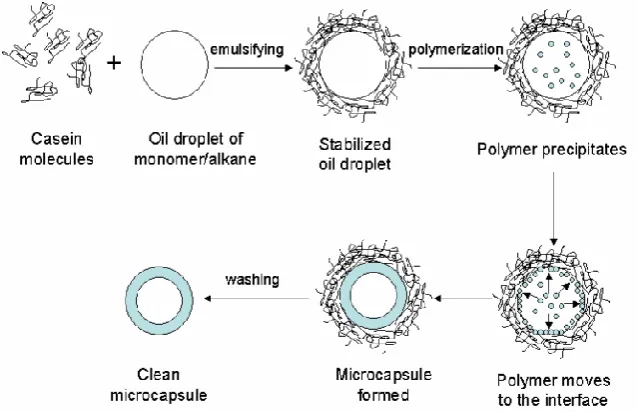
The use of suspension polymerization process for the fabrication of MEPCM usually follows certain basic procedures as: 1) Dissolution of polymer monomer into organic phase (core materials); 2) Production of oil/water (O/W) emulsion; 3) Separation and precipitation of the monomer molecules from core materials and generation of solid shell. Various researchers have produced MEPCMs using the suspension polymerization process. Fig. 7 describes the suspension polymerization process which Y.F. Ai et al. [44] used for microencapsulating n-hexadecane. The results demonstrated that higher emulsion speed could reduce particle sizes of MEPCMs.
Figure 7 Schematic of the fabrication MEPCM by suspension-like polymerization[44]
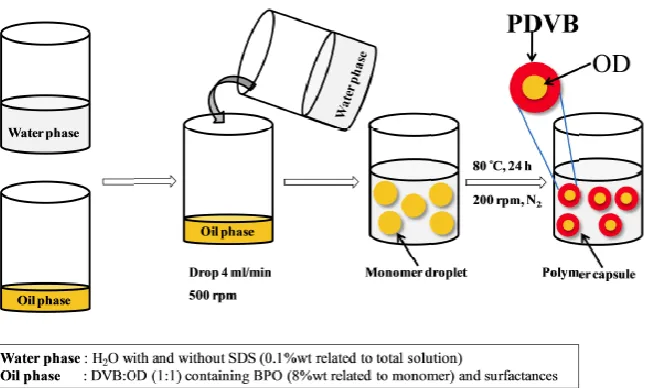
Sánchez et al. [45] fabricated MEPCMs by encapsulating 50wt% of paraffin wax PRS, tetradecane, Rubitherm 20 and nonadecane as core materials in a polystyrene shell. Further experimental studies by Sánchez et al [46] proved that crosslinking reaction temperature has no significant effect on the particle size distribution. It also revealed that it is difficult to achieve encapsulation when core/shell mass ratio is greater than 2.00. You et al. [47, 48] produced n-Octadecane microcapsules with a styrene (St)–divinybenzene (DVB) copolymer shell and achieved an average diameter of 80μm and latent heat fusion capacity of 126kJ/kg. Thermogravimetric (TG) analysis of the St-DVB shell showed the initial weight-loss temperatures to be above 230 oC thus making it better than MF shell. Li et al.[49] microencapsulated n-octadecane with styrene-1,4-butylene glycol diacrylate copolymer (PSB), styrene–divinylbenzene copolymer (PSD), styreneedivinylbenzenee1,4-butylene glycol diacrylate copolymer (PSDB), and polydivinylbenzene (PDVB) shell materials. They then analysed the morphology of the MEPCMs from scanning electron microscope (SEM) images and found the type with PSDB shell to be the best of all the samples.
1 2 3 4 5 6 7 8 9 10 11 12 13 14 15 16 17 18 19 20 21 22 23 24 25 26 27 28 29 30 31 32 33 34 35 36 37 38 39 40 41 42 43 44 45 46 47 48 49 50 51 52 53 54 55 56 57
Unlike other encapsulation technologies there is a special precautions must be taken under some suspension polymerization processes. For instance when using polystyrene, styrene-methyl methacrylate (St-MMA), polydivinylbenzene (PDVB) and polyurethane as MEPCM shell materials nitrogen gas protection facility would be necessary during the fabrication process and for the fact that the reaction time could take as long as 5-24 hours.
Figure 8 Schematic of the preparation of the PDVB/Octadecane capsules by the microsuspension polymerization[50]
3.1.3
Emulsion/Miniemulsion polymerization
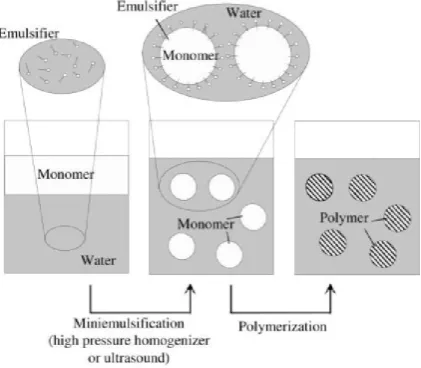
Emulsion polymerization takes place over a number of steps, where various chemical and physical events take place simultaneously during the process of particle formation and growth. Three major mechanisms for particle formation have been proposed to date. Particle formation is considered to have taken place when (1) a free radical in the aqueous phase enters a monomer-swollen emulsifier micelle and propagation proceeds therein or; (2) the chain length of a free radical growing in the aqueous phase exceeds its solubility limit and precipitates to form a particle nucleus, or; (3) a free radical growing in the aqueous phase enters a monomer droplet and propagation proceeds therein [53].
Polymethylmethacrylate (PMMA) is a common shell material used for producing MEPCM with emulsion polymerization method. For instance, Alkan et al. [54] encapsulated docosane with PMMA for thermal energy storage material. The capsules contained 28wt% of core material with a narrow particle size distribution (average particle size was 0.16 μm) and were carefully controlled at emulsion stirring rate of 2000 rpm. Alkan et al. [55] further coated PMMA shell material containing capsules of average diameter 0.70 μm with 35wt% of n-Eicosane. Sari et al. [56, 57] also produced smaller sizes of NEPCM ranging from 0.14–0.40μm with 43wt% of n-Ocataedcane and 38wt% n-Heptadecane as core materials and at a stirring speed of 2000 rpm. Ma et al.[58] produced higher core material content MEPCM which the core material content to be 61.2wt% and its latent heat capacity as much as 101kJ/kg. During the polymerization process UV irradiation light intensity and exposure time were used to control polymerization speed which helped to minimise the polymerization time to only 30 minutes. SEM analysis revealed the diameter range of the MEPCM as 0.5 to 2μm. Alay et al. [59] developed n-hexadecane microcapsules for textile application. The mean particle diameter of the capsules was in the range of 0.22μm-1.05μm with corresponding enthalpy of 68.9-145.6kJ/kg.
1 2 3 4 5 6 7 8 9 10 11 12 13 14 15 16 17 18 19 20 21 22 23 24 25 26 27 28 29 30 31 32 33 34 35 36 37 38 39 40 41 42 43 44 45 46 47 48 49 50 51 52 53 54 55 56 57 58
thermodynamic factors (the level and type of surfactant and hydrophilic comonomer, and the monomer/paraffin ratio), kinetic factors (the level of the crosslinking agent or chain-transfer agent), and nucleation modes did have significant influence on the encapsulation process. Chen et al. [61] produced nanocapsules of an average particle size of 150nm with n-Dodecanol as the core material and PMMA as the shell material. Maximum phase change enthalpy of 98.8 J/g and encapsulation efficiency of 82.2% were obtained with 3% mass ratios of polymerizable emulsifier (DNS-86)/core material and 2% co-emulsifier (hexadecane (HD))/core material. Li et al. [62] successfully synthesized NEPCM with the two-step miniemulsion polymerization method and achieved a mean particle diameter of 270nm. The experimental results did reveal that by increasing the amount of surfactant material (sodium dodecyl sulphate (SDS)) the phase-change enthalpy of the nanocapsules did also increase but the mean particle size was reduced. Fuensanta et al.[63] encapsulated paraffin wax (RT 80) of particle size ranging from 52-112 nm with encapsulation efficiency of about 80%. Meanwhile, in comparison with raw RT80 its melting temperature was decreased by 1–7°C but did show good thermal stability after 200 thermal cycles.
Figure 9 The procedure of miniemulsion polymerization[64]
3.1.4
Concluding remark
As summarised in Tab. 7, it is clear that various wax materials have been encapsulated with different shell materials but melamine formaldehyde (MF), urea formaldehyde (UF), polymethyl methacrylate (PMMA), polyurea and polystyrene appear to be the most widely used shell materials due to their good chemical stability and mechanical strength. They however, have low thermal conductivity and also some of the chemicals such as formaldehyde can cause environmental and health problems during fabrication process of the MEPCM/NEPCM. Although high thermal conductivity inorganic shells i.e. Al(OH)3 and SiO2 have been used for thermal enhancement their presence did reduce the overall energy storage capacities of the phase change materials.
Table 7: MEPCM/NEPCM fabricated by in-situ polymerization
3.2
Complex coacervation
1 2 3 4 5 6 7 8 9 10 11 12 13 14 15 16 17 18 19 20 21 22 23 24 25 26 27 28 29 30 31 32 33 34 35 36 37 38 39 40 41 42 43 44 45 46 47 48 49 50 51 52 53 54 55 56 57
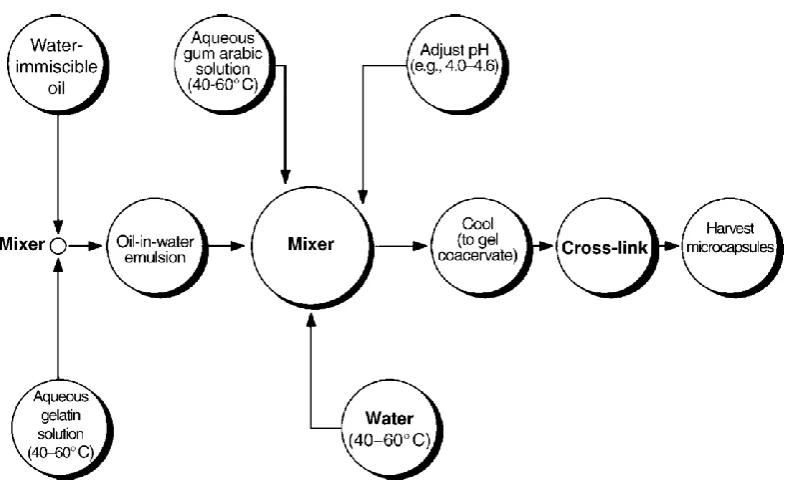
finishes it off with the cooling down of the mixture, microencapsulation and harvesting of the MEPCM. The main limitation of this approach is the difficulty in scaling up the process [67].
Figure 10 Flow diagram of a typical encapsulation process based on the complex coacervation[67]
Nevertheless, a number of encapsulation developments have been carried out over the past years with the complex coacervation method. Ozonur et al. [68] encapsulated natural coco-fatty acid with gelatin–gum Arabic and achieved MEPCM of particle size of 1 mm. It was subjected to a number of thermal cycles and found no physical deformation to its geometrical shape. In comparison with pure coco-fatty, its melting temperature also increased about 7°C. Onder et al.[69] used three types of paraffin waxes: n-hexadecane, n-octadecane and n-nonadecane as core materials and gum arabic–gelatin mixture as a shell material to produce MEPCMs. The results showed that microcapsules produced with n-octadecane achieved the highest enthalpy value. They concluded that the quality of MEPCM could be improved by ensuring precise pH value and correct amount of surfactants at higher stirring rates. Hawlader et al.[70] established the optimal homogenizing time in coacervation method as 10 minutes and the amount of cross-linking agent required as 6–8 ml. They also demonstrated that microencapsulation efficiency is dependent upon the process parameters such as core material ratio, emulsifying time and the amount of cross-linking agent. Bayes-Garcia [71] successfully produced Rubitherm® RT 27 microcapsules from two different coacervates; Sterilized Gelatine/Arabic Gum for the SG/AG method and Agar-Agar/Arabic Gum for the AA/AG method. According to the particle sizing analysis the average diameter of the capsules produced with the SG/AG method was 12μm whereas the AA/AG method achieved far smaller size of 104nm. Su et al. [72] also used the two-step coacervation (TSC) method and an MF shell to encapsulate n-octadecane. This method reduced the cracks on the shell and increased its compactness and permeability coefficient.
3.3
Sol-gel method
The term “sol-gel” is an abbreviation for “solution-gelling” and denotes a process by which largely inorganic materials are synthesized. The process follows a principle whereby a solution undergoes a transition to a gel characterized by an infinite three-dimensional network structure spreading uniformly throughout the liquid medium [11]. For instance, H. Zhang et al. [73] fabricated microcapsules of n-Octadecane with silica shell to enhance thermal conductivity and phase-change performance, as shown in Fig. 11. The results achieved good phase-change performance, high encapsulation efficiency, high thermal conductivity and good antiosmosis property.
1 2 3 4 5 6 7 8 9 10 11 12 13 14 15 16 17 18 19 20 21 22 23 24 25 26 27 28 29 30 31 32 33 34 35 36 37 38 39 40 41 42 43 44 45 46 47 48 49 50 51 52 53 54 55 56 57 58
Other researchers have also fabricated MEPCMs using the sol-gel method but with silicon as a shell material. Wang et al. [74] were the first to encapsulate PCMs with silicon and to investigate the formation mechanism which established that the use of cationic surfactants (i.e. cetyltrimethylammonium chloride, dodecyltrimethyl-ammonium chloride and dodecyltrimethylammonium bromide) as emulsifiers are suitable for the production of MEPCMs. Li et al. [75] prepared different composite MEPCMs based on paraffin/SiO2/ expanded graphite and paraffin/SiO2 and achieved much higher thermal conductivities than pure paraffin. Fang et al.[76] also produced paraffin-based MEPCM using SiO2 as a shell material and reported solidification/melting temperatures of 57.02/58.37°C and latent heat capacity of 107.05/165.68kJ/kg. Chang et al. [77] microencapsulated n-Octadecane using a PMMA network-silica hybrid shell. They concluded that the most suitable condition for producing high percentage (74%) of PCM microcapsules of high latent heat capacity (180kJ/kg) was to add 5% of silicon dioxide (SiO2) to the process. Chen et al. [78] produced MEPCM (diameter 20–30μm) capsules by using 90.7 % of stearic acid (SA) and SiO2 as core and shell materials respectively. The experimental results achieved good thermal stability for energy storage capacity of 162.0 - 171.0 kJ/kg over a phase change temperature range of 52.6°C-53.5°C. Chen et al.[79] further encapsulated high percentage (82.2%) content of paraffin with SiO2 shell and obtained good thermal characteristics. The results showed that the microcapsules melted at 57.96°C (latent heat 156.86 kJ/kg) and solidified at 55.78°C (latent heat 144.09 kJ/kg). Sara T.L. et al.[80] synthesized PCM nanocapsules which contained palmitic acid (PA) as core and SiO2 as shell materials. They observed that by progressively increasing the pH level of the core material, the mean diameter and the energy storage capacity of the nanocapsules also increased. For instance an increase in pH value from 11 to 12 resulted in an increase of 183.7 to 722.5 nm in the particle diameter and 168 to 181kJ/kg in its energy storage capacity.
3.4
Solvent extraction/evaporation method
Inorganic PCMs can be encapsulated by solvent extraction/evaporation method through the: (i) incorporation of the bioactive compound, (ii) formation of the microdroplets, (iii) solvent removal and (iv) harvesting and drying the particles. As shown in Fig. 12, Salaün et al. [81] studied sodium phosphate dodecahydrate (DSP, Na2HPO4·12H2O) encapsulation by solvent evaporation–precipitation method with various organic solvents and cellulose acetate butyrate (CAB) crosslinked by methylene diisocyanate (MDI). It was evident in the results that surface appearance of MEPCM depends on the rate of polymer precipitation at the interface, and that thermal stability and the thermal degradation were strongly influenced by the core content and the surface roughness of the MEPCM.
1 2 3 4 5 6 7 8 9 10 11 12 13 14 15 16 17 18 19 20 21 22 23 24 25 26 27 28 29 30 31 32 33 34 35 36 37 38 39 40 41 42 43 44 45 46 47 48 49 50 51 52 53 54 55 56 57
In other studies, Wang and Huang [82] encapsulated DSP with PMMA using the same method and was able to produce uniform sizes of 1–10μm MEPCM capsules within polymerization time of 4 hours at a reaction temperature of 80-90°C. The maximum measured energy storage capacity was obtained as 173.9 kJ/kg at a temperature of 51°C. Wang et al. [83] recently encapsulated DSP with PMMA and UF. They obtained mean MEPCM diameters of 6μm and 500nm with corresponding latent heat capacity of 142.90kJ/kg and 121.20kJ/kg. However, the encapsulation efficiencies of UF and PMMA shell were only 55.74% and 63.97% respectively and also noticed that and the organic solvent residual in MEPCM could cause the leakage problem after few multiple heating-cooling cycles. Huang et al.[84] further encapsulated a hydrated salt (Na2HPO4·7H2O) as phase change energy storage material by modifying PMMA. The morphology study revealed the mean diameter of the capsules to be about 6.8μm. The thermal analysis showed that the weight loss in the MEPCM was less than 10% during the heating process from 30 to 84 °C. The phase change melting point was 51°C whereas the heat of fusion was obtained as 150kJ/kg.
3.5
Other micro-/nano-encapsulation methods
Apart from the already discussed encapsulation technologies, other technologies such as phase separation method, internal phase separation method, pre-polymer mixing method and self-assembling method do exist. For instance, Loxley and Vincent [85] proposed phase separation method to encapsulate n-Hexadecane with polymethylmethacrylate (PMMA). The encapsulation process as shown in Fig. 13 involves: (1) preparation of PMMA and dissolving PMMA in dichloromethane and then adding hexadecane, (2) stirring emulsion at a speed of 10,000 rpm to produce oil droplets (3) migration of polymer-rich phase on core material particles surface, 4) removal all of volatile solvent to finish off encapsulation.Yang et al. [86] used the phase separation method to produce microencapsulated n-tetradecane with different shell materials (Acrylonitrile–styrene copolymer (AS), acrylonitrile–styrene–butadiene copolymer (ABS) and polycarbonate (PC)). The particle sizes were less than 1μm with melting enthalpy of more than 100 kJ/kg and encapsulation efficiency of 66–75%for all the three shell materials.
Figure 13 Schematic of the encapsulation process[85]
(n.v.n.s. - non-volatile non-solvent; v.s.- volatile solvent)
1 2 3 4 5 6 7 8 9 10 11 12 13 14 15 16 17 18 19 20 21 22 23 24 25 26 27 28 29 30 31 32 33 34 35 36 37 38 39 40 41 42 43 44 45 46 47 48 49 50 51 52 53 54 55 56 57 58
Through the pre-polymer mixing process, Kim E.Y. and Kim H.D. [89] encapsulated n-octadecane with waterborne polyurethane (WBPU) shell to obtain microcapsules of sizes ranging from 1-6μm. The results showed the sizes to be reducing with increasing amount of emulsifier. The heat of fusion, heat of crystallization, and encapsulation efficiencies of n-octadecane were also found to increase with increasing amount of microencapsulated blends, thickener and hardener.
Fig. 14 shows the self-assembling procedure which was recently used by Yu et al. [90] to encapsulate n-octadecane with calcium carbonate (CaCO3) as a shell material. Different core/mass ratios of 30/70, 40/60 and 50/50 were used for the fabrication to obtain corresponding energy storage capacities of 46.93 kJ/kg, 67.91 kJ/kg and 84.37 kJ/kg. Thermal conductivities ranging from 1.264-1.674 W/m·K were obtained but more than 60% of the n-octadecane was wasted during the encapsulation process due to low encapsulation efficiency.
Figure 14 Scheme of MEPCM formation with CaCO3 shell via a self-assembly method [90]
3.6
Comparison of various microencapsulation technologies
The review has shown that micro/nano organic PCMs can be encapsulated by various methods such as in-situ polymerization which include: interfacial polycondensatoin, suspension polymerization and emulsion/miniemulsion polymerization, complex coacervation, and sol-gal methods etc. In brief, in-situ suspension polymerization and complex coacervation method can be used to produce large particle size MEPCMs with high core material content and encapsulation efficiency. In-situ emulsion/miniemulsion polymerization methods are suitable for producing nanocapsules. However, in-situ suspension-like and in-situ emulsion/miniemulsion polymerization methods are hardly applied to large scale production. This is due to the fact that high stirring rate is needed to generate oil droplets during encapsulation process which in turn results in high energy consumption and production costs. For instance, the emulsion speed used for in the reviewed in-situ polymerization encapsulation processes was found to be in the range of 1000 to 13500 rpm depending on the particle size. In contrast, the polymerization reaction process was achieved with a relatively lower stirring speed of 300-600 rpm. Regarding the other processes covering sol-gel, in-situ polymerization and self-assembling methods, they can all be used to encapsulate organic PCMs using inorganic shells in order to produce MEPCM with high thermal conductivity and good fire resistance. However, inorganic shells have poor mechanical strength and are not as flexible as copolymers which could impact on the life cycle of the MEPCM.
1 2 3 4 5 6 7 8 9 10 11 12 13 14 15 16 17 18 19 20 21 22 23 24 25 26 27 28 29 30 31 32 33 34 35 36 37 38 39 40 41 42 43 44 45 46 47 48 49 50 51 52 53 54 55 56 57
carbon tetrachloride, chloroform and acetone) which are employed within the solvent extraction/evaporation encapsulation process. Beside this the residual organic solvent in MEPCM could permeate the shell materials (e.g. UF, PMMA, CAB-MDI etc.) and cause leakage problem after a period of thermal cycling. In general the encapsulation processes have shown that the higher the emulsion speed the smaller the sizes of the capsules. Meanwhile microencapsulation efficiencies do decrease as the ratios of core-to-coating increase. See as the summarized data in Tab. 8.
Table 8: Statistics results of MEPCM/NEPCM via various encapsulation technologies
The review has also highlighted that crosslinking takes the longest period in the whole microencapsulation process usually 2-5 hours, but could take as long 24 hours for silicon based shells. Apart from the crosslinking time most shell monomers require additional and external heating period to finish off copolymerization while gelatin-gum Arabic materials need to be cooled down to about 5-10 oC. Meanwhile all the major manufacturers of these microencapsulation shell materials have cautioned that these materials could be harmful to human and the environment. There is therefore the need for the dosage of the materials to be optimized in order to achieve complete reaction and to neutralise any unreacted reagents after crosslinking.
4
Evaluation of MEPCM/NEPCM
There are many standard instruments and methods for evaluating the properties of MEPCM/NEPCM capsules. For instance, differential scanning calorimetry (DSC) [91] can be used to measure the phase change latent enthalpy and phase change temperature; thermal gravimetric analysis (TGA) can be used the measurement of thermal stability. Thermal conductivities can be obtained with instruments such as laser thermal diffusivity-conductivity instrument (Germany, NETZSCH, LFA447) [83], Thermal Property Analyzer (USA, Decagon Devices, KD2 Pro) [92], EKO HC-110 thermal conductivity tester [73], and thermal conductivity apparatus (Cussons Technology) [93]. Various microscopes (i.e. scanning electron microscopy (SEM), transmission electron microscope (TEM) and optical microscope) and dynamic light scattering particle size analyser could be used to study the particle size distribution and morphology of MEPCM/NEPCM. Fourier transform infrared (FT-IR) spectroscopy and X-ray diffraction (XRD) methods are also available for analysing the chemical structure of MEPCM/NEPCM shell materials. Apart from these technologies, other methods have been improved or developed for evaluating the properties of MEPCM/NEPCM.
4.1
Thermal energy storage capacity and phase change temperature
1 2 3 4 5 6 7 8 9 10 11 12 13 14 15 16 17 18 19 20 21 22 23 24 25 26 27 28 29 30 31 32 33 34 35 36 37 38 39 40 41 42 43 44 45 46 47 48 49 50 51 52 53 54 55 56 57 58
after their phase change processes. They reported high measurement accuracy of phase change temperatures and enthalpies of less than 5% in comparison with the theoretical values.
In order to determine latent heat and melting temperature of larger samples, Zhang et al. [95] developed the T-history method. Eva Günther et al. [96] compared the T-history method with two types of DSC measurement modes: dynamic mode and isothermal step mode. They found out that the isothermal step mode offers higher precision than dynamic mode, but the T-history method is more suitable for heterogeneous PCMs. Desgrosseilliers et al. [97] has since then improved on the T-history enthalpy model and been successfully used for evaluating composition-dependent two-phase equilibrium processes.
Besides evaluate MEPCM/NEPCM thermal energy storage capacity, latent heats measurement results can be used to calculate the core material content ratio in MEPCM/NEPCM by compare the thermal energy storage capacity with pure PCMs. Meanwhile, Tseng et al. [40] assumed the MEPCM particle was a prefect sphere and then through core material content and MEPCM diameter to calculate the shell thickness. Moreover, it’s helpful for evaluation of micro/nano-encapsulation process, i.e.: Zhang et al.[34] suggested using encapsulation efficiency which was defined as the ratio of the actual core content of the microcapsules to the theoretical core content.
4.2
Thermal conductivity
For the evaluation of thermal conductivity of NEPMC/MEPCM, researchers such as Meng and Wang [98], Wang et al. [99] and Hunger et al. [100] have built and tested other devices using the hot wire method. Meanwhile, the effective thermal conductivities of MECPMs and their compositions have been studied with various methods. Zhao et al. [101] used the 3ω method [102] in an experimental study and achieved the maximum effective thermal conductivity of the MEPCM at its peak value of the phase change temperature. They also observed that the conductivity value did increase as the density of the material was increased. This was attributed to reduction in the porosity of the MEPCM. Darkwa and Kim [103] developed an effective thermal conductivity testing rig in accordance with ISO 8301 Standards and used it to determine the thermal conductivity of a composite MEPCM sample as shown in Fig. 15. Similarly, Marchi et al. [104] tested the thermal conductivity of panels containing MEPCM by using the thermofluximeter method and in accordance with the EN12667:2001 Standards. The experimental results were closely in agreement with the theoretical predictions based on the effective medium theory (EMT) equations.
Figure 15 Thermal conductivity testing rig
4.3
Thermal stability
1 2 3 4 5 6 7 8 9 10 11 12 13 14 15 16 17 18 19 20 21 22 23 24 25 26 27 28 29 30 31 32 33 34 35 36 37 38 39 40 41 42 43 44 45 46 47 48 49 50 51 52 53 54 55 56 57
Park [30] investigated the long term stability of MEPCM under a 60- day drying experimental test. As shown in Fig. 16 a known weight sample of MEPCM was dried under 25℃ and 60℃ respectively, and weighed after every 10 days for the resident weight percentage. The results show that the progressive residual weight percentage at 60℃drying condition was about 42% whereas under 25℃ it was at the rate of 8% after 60 days. Sharma et al. [105] proposed an accelerated thermal cycle testing method to study the changes in latent heat and melting temperature of acetamide, stearic acid and paraffin wax. The results showed good thermal stability for the paraffin and acetamide after 1500 thermal cycles. Alkan et al. [54] also performed series of thermal stability tests on PMMA/docosane microcapsules using their DSC curves and FT-IR data and found no significant changes in their phase change temperatures, latent heat enthalpies and chemical structures after number of thermal cycles.
Figure 16 Resident weight (%) of melamine resin microcapsules in long self-life test[30]
4.4
Mechanical strength
Zhang et al.[106], Sun and Zhang [107, 108] and Hu et al. [109] have all through the micromanipulation technology (shown in Fig. 17) determined the mechanical properties of various MEPCMs/NEPCMs. It involves using a single probe in squeezing a microcapsule which is positioned on a slide and then measuring its bursting strength. The probe is connected to a force transducer and mounted on a 3D micromanipulator that can be programmed to travel at a given speed. The slide is placed on the stage of an inverted microscope. When a microcapsule is squeezed, the force being imposed on it is measured simultaneously by sampling the voltage signal from the force transducer. When the probe eventually touches the slide, the force will increase rapidly to signal the end of the test as displayed in Fig. 18. Sun and Zhang’s investigation [107] showed that the mean bursting force and yield point did not change significantly with different compression speed.
Figure 17 Schematic diagram of the micromanipulation rig[107]
Figure 18 Force versus probe moving distance [107]
1 2 3 4 5 6 7 8 9 10 11 12 13 14 15 16 17 18 19 20 21 22 23 24 25 26 27 28 29 30 31 32 33 34 35 36 37 38 39 40 41 42 43 44 45 46 47 48 49 50 51 52 53 54 55 56 57 58
found no sign of fragmentation of the MEPCM particles after a pressure of 2.8MPa was applied.
4.5
Chemical stability
Anti-Osmosis test is an important approach for determining the rate of weight loss and thus chemical stability of MEPCMs. Zhang et al. [34] used this method for evaluating the durability of samples of MEPCMs. The releasing rate (weight percentage of the released substance) of 10 g of microencapsulated n-octadecane was measured by dispersing it in a 50ml acetone (as an extraction solvent) and at a stirring speed of 200 rpm. Analysis of the results showed that the release rate of the microcapsules increased when the weight percentage of the core materials increased and that the shell produced with Jeffamine material exhibited the best anti-osmosis behaviour. Zhang et al. [73] capitalised on this findings and evaluated SiO2 coated n-octadecane with the same method. Su et al. [39] also used this method but with different extraction solvent (ethyl alcohol) to evaluate another type of MEPCM. The however found out that the amount of emulsifier used in that investigation had some effect on the material’s anti-osmosis property.
5
Conclusions
This paper was focused on the review of various types of organic and inorganic solid-liquid PCMs and their thermophysical properties for various energy storage applications. The review has shown that organic solid-liquid PCMs have more advantages in terms of wider temperature range application, less super cooling and segregation effects, and other capabilities. They do however have disadvantages such as low thermal conductivity, low density and being flammable. In contrast, inorganic solid-liquid PCMs possess higher heat storage capacities and conductivities, cheaper and readily available as well as being non-flammable. Nevertheless in-organic PCMs do experience problems associated with supercooling and phase segregation during phase change process.
1 2 3 4 5 6 7 8 9 10 11 12 13 14 15 16 17 18 19 20 21 22 23 24 25 26 27 28 29 30 31 32 33 34 35 36 37 38 39 40 41 42 43 44 45 46 47 48 49 50 51 52 53 54 55 56 57
References
[1] Waqas A, Ud Din Z. Phase change material (PCM) storage for free cooling of buildings—A review. Renewable and Sustainable Energy Reviews. 2013;18:607-25.
[2] Sharma A, Tyagi VV, Chen CR, Buddhi D. Review on thermal energy storage with phase change materials and applications. Renewable and Sustainable Energy Reviews. 2009;13:318-45.
[3] Zhou D, Zhao CY, Tian Y. Review on thermal energy storage with phase change materials (PCMs) in building applications. Applied Energy. 2012;92:593-605.
[4] Baetens R, Jelle BP, Gustavsen A. Phase change materials for building applications: A state-of-the-art review. Energy and Buildings. 2010;42:1361-8.
[5] Sharma SD, Kitano H, Sagara K. Phase change materials for low temperature solar thermal applications. Res Rep Fac Eng Mie Univ. 2004;29:31-64.
[6] Oró E, de Gracia A, Castell A, Farid MM, Cabeza LF. Review on phase change materials (PCMs) for cold thermal energy storage applications. Applied Energy. 2012;99:513-33.
[7] Li G, Hwang Y, Radermacher R. Review of cold storage materials for air conditioning application. International Journal of Refrigeration. 2012;35:2053-77.
[8] Agyenim F, Hewitt N, Eames P, Smyth M. A review of materials, heat transfer and phase change problem formulation for latent heat thermal energy storage systems (LHTESS). Renewable and Sustainable Energy Reviews. 2010;14:615-28.
[9] Cabeza LF, Castell A, Barreneche C, de Gracia A, Fernández AI. Materials used as PCM in thermal energy storage in buildings: A review. Renewable and Sustainable Energy Reviews. 2011;15:1675-95.
[10] Zhao CY, Zhang GH. Review on microencapsulated phase change materials (MEPCMs): Fabrication, characterization and applications. Renewable and Sustainable Energy Reviews. 2011;15:3813-32.
[11] Ghosh SK. Functional coatings : by polymer microencapsulation. Swapan Kumar Ghosh2006. [12] Kuznik F, David D, Johannes K, Roux J-J. A review on phase change materials integrated in building walls. Renewable and Sustainable Energy Reviews. 2011;15:379-91.
[13] Parameshwaran R, Kalaiselvam S. Energy efficient hybrid nanocomposite-based cool thermal storage air conditioning system for sustainable buildings. Energy. 2013.
[14] Sharma SD, Sagara K. Latent Heat Storage Materials and Systems: A Review. International Journal of Green Energy. 2005;2:1-56.
[15] Farid MM, Khudhair AM, Razack SAK, Al-Hallaj S. A review on phase change energy storage: materials and applications. Energy Conversion and Management. 2004;45:1597-615.
[16] Turnbull AG. Thermal Conductivity of Phosphoric Acid. Journal of Chemical & Engineering Data. 1965;10:118-9.
1 2 3 4 5 6 7 8 9 10 11 12 13 14 15 16 17 18 19 20 21 22 23 24 25 26 27 28 29 30 31 32 33 34 35 36 37 38 39 40 41 42 43 44 45 46 47 48 49 50 51 52 53 54 55 56 57 58
[18] Chi W, Guo J, Zhou X, Ren X. Experimental research and application analysis of solid-to-liquid phase-change material. Qiangjiguang Yu Lizishu/High Power Laser and Particle Beams. 2009;21:1170-4.
[19] Ge H, Liu J. Phase change effect of low melting point metal for an automatic cooling of USB flash memory. Frontiers in Energy. 2012;6:207-9.
[20] Ge H, Liu J. Keeping Smartphones Cool With Gallium Phase Change Material. Journal of Heat Transfer. 2013;135:1-5.
[21] POSHADRI A, KUNA A. MICROENCAPSULATION TECHNOLOGY: A REVIEW. JRes ANGRAU. 2010;38:86-102.
[22] Smith MC. Microencapsulated phase change materials for thermal energy storage. New Zealand: The University of Auckland; 2009.
[23] Zhang H, Wang X. Fabrication and performances of microencapsulated phase change materials based on n-octadecane core and resorcinol-modified melamine–formaldehyde shell. Colloids and Surfaces A: Physicochemical and Engineering Aspects. 2009;332:129-38.
[24] Choi JK, Lee JG, Kim JH, Yang HS. Preparation of microcapsules containing phase change materials as heat transfer media by in-situ polymerization. Journal of Industrial and Engineering Chemistry. 2001;7:358-62.
[25] Fang G, Li H, Yang F, Liu X, Wu S. Preparation and characterization of nano-encapsulated n-tetradecane as phase change material for thermal energy storage. Chemical Engineering Journal. 2009;153:217-21.
[26] Yang R, Xu H, Zhang Y. Preparation, physical property and thermal physical property of phase change microcapsule slurry and phase change emulsion. Solar Energy Materials and Solar Cells. 2003;80:405-16.
[27] Jin Z, Wang Y, Liu J, Yang Z. Synthesis and properties of paraffin capsules as phase change materials. Polymer. 2008;49:2903-10.
[28] Zhang XX, Fan YF, Tao XM, Yick KL. Fabrication and properties of microcapsules and nanocapsules containing n-octadecane. Materials Chemistry and Physics. 2004;88:300-7.
[29] Li W, Zhang X-X, Wang X-C, Niu J-J. Preparation and characterization of microencapsulated phase change material with low remnant formaldehyde content. Materials Chemistry and Physics. 2007;106:437-42.
[30] Hong K, Park S. Melamine resin microcapsules containing fragrant oil: synthesis and characterization. Materials Chemistry and Physics. 1999;58:128-31.
[31] Salaün F, Devaux E, Bourbigot S, Rumeau P. Development of phase change materials in clothing part I: Formulation of microencapsulated phase change. Textile Research Journal. 2010;80:195-205.
[32] Song Q, Li Y, Xing J, Hu JY, Marcus Y. Thermal stability of composite phase change material microcapsules incorporated with silver nano-particles. Polymer. 2007;48:3317-23.
[33] Sarier N, Onder E. Organic phase change materials and their textile applications: An overview. Thermochimica Acta. 2012;540:7-60.
1 2 3 4 5 6 7 8 9 10 11 12 13 14 15 16 17 18 19 20 21 22 23 24 25 26 27 28 29 30 31 32 33 34 35 36 37 38 39 40 41 42 43 44 45 46 47 48 49 50 51 52 53 54 55 56 57
[35] Liang C, Lingling X, Hongbo S, Zhibin Z. Microencapsulation of butyl stearate as a phase change material by interfacial polycondensation in a polyurea system. Energy Conversion and Management. 2009;50:723-9.
[36] Zou GL, Tan ZC, Lan XZ, Sun LX, Zhang T. Preparation and characterization of microencapsulated hexadecane used for thermal energy storage. Chinese Chemical Letters. 2004;15:729-32.
[37] Cho JS, Kwon A, Cho CG. Microencapsulation of octadecane as a phase-change material by interfacial polymerization in an emulsion system. Colloid and Polymer Science. 2002;280:260-6. [38] Siddhan P, Jassal M, Agrawal AK. Core content and stability of n-octadecane-containing polyurea microencapsules produced by interfacial polymerization. Journal of Applied Polymer Science. 2007;106:786-92.
[39] Su J-F, Wang L-X, Ren L. Synthesis of polyurethane microPCMs containing n-octadecane by interfacial polycondensation: Influence of styrene-maleic anhydride as a surfactant. Colloids and Surfaces A: Physicochemical and Engineering Aspects. 2007;299:268-75.
[40] Tseng YH, Fang MH, Tsai PS, Yang YM. Preparation of microencapsulated phase-change materials (MCPCMs) by means of interfacial polycondensation. Journal of Microencapsulation. 2005;22:37-46.
[41] Zhang H, Sun S, Wang X, Wu D. Fabrication of microencapsulated phase change materials based on n-octadecane core and silica shell through interfacial polycondensation. Colloids and Surfaces A: Physicochemical and Engineering Aspects. 2011;389:104-17.
[42] Pan L, Tao Q, Zhang S, Wang S, Zhang J, Wang S, et al. Preparation, characterization and thermal properties of micro-encapsulated phase change materials. Solar Energy Materials and Solar Cells. 2012;98:66-70.
[43] Li B, Liu T, Hu L, Wang Y, Gao L. Fabrication and Properties of Microencapsulated Paraffin@SiO2 Phase Change Composite for Thermal Energy Storage. ACS Sustainable Chemistry & Engineering. 2013;1:374-80.
[44] Y.F. Ai YJ, J. Sun, D.Q. Wei. Microencapsulation of n-hexadecane as phase change material by suspension polymerization. e-Polymers. 2007;9:pp. 1–98.
[45] Sánchez L, Sánchez P, de Lucas A, Carmona M, Rodríguez JF. Microencapsulation of PCMs with a polystyrene shell. Colloid and Polymer Science. 2007;285:1377-85.
[46] Sánchez L, Sánchez P, Carmona M, Lucas A, Rodríguez J. Influence of operation conditions on the microencapsulation of PCMs by means of suspension-like polymerization. Colloid and Polymer Science. 2008;286:1019-27.
[47] You M, Zhang X, Wang J, Wang X. Polyurethane foam containing microencapsulated phase-change materials with styrene-divinybenzene co-polymer shells. Journal of Materials Science. 2009;44:3141-7.
[48] You M, Wang X, Zhang X, Zhang L, Wang J. Microencapsulated n-Octadecane with styrene-divinybenzene co-polymer shells. Journal of Polymer Research. 2011;18:49-58.
1 2 3 4 5 6 7 8 9 10 11 12 13 14 15 16 17 18 19 20 21 22 23 24 25 26 27 28 29 30 31 32 33 34 35 36 37 38 39 40 41 42 43 44 45 46 47 48 49 50 51 52 53 54 55 56 57 58
[50] Chaiyasat P, Chaiyasat A. Preparation of poly(divinylbenzene) microencapsulated octadecane by microsuspension polymerization: Oil droplets generated by phase inversion emulsification. RSC Advances. 2013.
[51] Qiu X, Li W, Song G, Chu X, Tang G. Fabrication and characterization of microencapsulated n-octadecane with different crosslinked methylmethacrylate-based polymer shells. Solar Energy Materials and Solar Cells. 2012;98:283-93.
[52] Cheng F, Wei Y, Zhang Y, Wang F, Shen T, Zong C. Preparation and characterization of phase-change material nanocapsules with amphiphilic polyurethane synthesized by 3-allyloxy-1,2-propanediol. Journal of Applied Polymer Science. 2013:n/a-n/a.
[53] Nomura M, Tobita H, Suzuki K. Emulsion Polymerization: Kinetic and Mechanistic Aspects. In: Okubo M, editor. Polymer Particles: Springer Berlin Heidelberg; 2005. p. 1-128.
[54] Alkan C, Sarı A, Karaipekli A, Uzun O. Preparation, characterization, and thermal properties of microencapsulated phase change material for thermal energy storage. Solar Energy Materials and Solar Cells. 2009;93:143-7.
[55] Alkan C, Sarı A, Karaipekli A. Preparation, thermal properties and thermal reliability of microencapsulated n-eicosane as novel phase change material for thermal energy storage. Energy Conversion and Management. 2011;52:687-92.
[56] Sarı A, Alkan C, Karaipekli A. Preparation, characterization and thermal properties of PMMA/n-heptadecane microcapsules as novel solid–liquid microPCM for thermal energy storage. Applied Energy. 2010;87:1529-34.
[57] Sarı A, Alkan C, Karaipekli A, Uzun O. Microencapsulated n-octacosane as phase change material for thermal energy storage. Solar Energy. 2009;83:1757-63.
[58] Ma S, Song G, Li W, Fan P, Tang G. UV irradiation-initiated MMA polymerization to prepare microcapsules containing phase change paraffin. Solar Energy Materials and Solar Cells. 2010;94:1643-7.
[59] Alay S, Alkan C, Göde F. Synthesis and characterization of poly(methyl methacrylate)/n-hexadecane microcapsules using different cross-linkers and their application to some fabrics. Thermochimica Acta. 2011;518:1-8.
[60] Luo Y, Zhou X. Nanoencapsulation of a hydrophobic compound by a miniemulsion polymerization process. Journal of Polymer Science Part A: Polymer Chemistry. 2004;42:2145-54.
[61] Chen Z-H, Yu F, Zeng X-R, Zhang Z-G. Preparation, characterization and thermal properties of nanocapsules containing phase change material n-dodecanol by miniemulsion polymerization with polymerizable emulsifier. Applied Energy. 2012;91:7-12.
[62] Li M, Zhang Y, Xu Y, Zhang D. Effect of different amounts of surfactant on characteristics of nanoencapsulated phase-change materials. Polym Bull. 2011;67:541-52.
[63] Fuensanta M, Paiphansiri U, Romero-Sanchez MD, Guillem C, Lopez-Buendia AM, Landfester K. Thermal properties of a novel nanoencapsulated phase change material for thermal energy storage. Thermochimica Acta. 2013;565:95-101.
1 2 3 4 5 6 7 8 9 10 11 12 13 14 15 16 17 18 19 20 21 22 23 24 25 26 27 28 29 30 31 32 33 34 35 36 37 38 39 40 41 42 43 44 45 46 47 48 49 50 51 52 53 54 55 56 57
[65] Zhang XX, Tao XM, Yick KL, Wang XC. Structure and thermal stability of microencapsulated phase-change materials. Colloid and Polymer Science. 2004;282:330-6.
[66] Fang Y, Kuang S, Gao X, Zhang Z. Preparation and characterization of novel nanoencapsulated phase change materials. Energy Conversion and Management. 2008;49:3704-7.
[67] Thies C. Microencapsulation, in: Kirk-Othmer Encyclopedia of Chemical Technology. Wiley, Hoboken,New Jersey: John Wiley & Sons Inc; 2006.
[68] Özonur Y, Mazman M, Paksoy HÖ, Evliya H. Microencapsulation of coco fatty acid mixture for thermal energy storage with phase change material. International Journal of Energy Research. 2006;30:741-9.
[69] Onder E, Sarier N, Cimen E. Encapsulation of phase change materials by complex coacervation to improve thermal performances of woven fabrics. Thermochimica Acta. 2008;467:63-72.
[70] Hawlader MNA, Uddin MS, Khin MM. Microencapsulated PCM thermal-energy storage system. Applied Energy. 2003;74:195-202.
[71] Bayés-García L, Ventolà L, Cordobilla R, Benages R, Calvet T, Cuevas-Diarte MA. Phase Change Materials (PCM) microcapsules with different shell compositions: Preparation, characterization and thermal stability. Solar Energy Materials and Solar Cells. 2010;94:1235-40. [72] Su JF, Huang Z, Ren L. High compact melamine-formaldehyde microPCMs containing n-octadecane fabricated by a two-step coacervation method. Colloid and Polymer Science. 2007;285:1581-91.
[73] Zhang H, Wang X, Wu D. Silica encapsulation of n-octadecane via sol-gel process: A novel microencapsulated phase-change material with enhanced thermal conductivity and performance. Journal of Colloid and Interface Science. 2010;343:246-55.
[74] Wang L-Y, Tsai P-S, Yang Y-M. Preparation of silica microspheres encapsulating phase-change material by sol-gel method in O/W emulsion. Journal of Microencapsulation. 2006;23:3-14.
[75] Li M, Wu Z, Tan J. Properties of form-stable paraffin/silicon dioxide/expanded graphite phase change composites prepared by sol–gel method. Applied Energy. 2012;92:456-61.
[76] Fang G, Chen Z, Li H. Synthesis and properties of microencapsulated paraffin composites with SiO2 shell as thermal energy storage materials. Chemical Engineering Journal. 2010;163:154-9.
[77] Chang CC, Tsai YL, Chiu JJ, Chen H. Preparation of phase change materials microcapsules by using PMMA network-silica hybrid shell via sol-gel process. Journal of Applied Polymer Science. 2009;112:1850-7.
[78] Chen Z, Cao L, Shan F, Fang G. Preparation and characteristics of microencapsulated stearic acid as composite thermal energy storage material in buildings. Energy and Buildings. 2013;62:469-74.
1 2 3 4 5 6 7 8 9 10 11 12 13 14 15 16 17 18 19 20 21 22 23 24 25 26 27 28 29 30 31 32 33 34 35 36 37 38 39 40 41 42 43 44 45 46 47 48 49 50 51 52 53 54 55 56 57 58
[80] Sara TL, Mohammad M, Mehdi M, Meurah IMT, Simon CMH. Synthesis, characterization and thermal properties of nanoencapsulated phase change materials via sol–gel method. Energy. 2013.
[81] Salaün F, Devaux E, Bourbigot S, Rumeau P. Influence of the solvent on the microencapsulation of an hydrated salt. Carbohydrate Polymers. 2010;79:964-74.
[82] Wang TY, Huang J. Synthesis and characterization of microencapsulated sodium phosphate dodecahydrate. Journal of Applied Polymer Science. 2013:n/a-n/a.
[83] Wang T, Huang J, Zhu P, Xiao J. Fabrication and characterization of micro-encapsulated sodium phosphate dodecahydrate with different crosslinked polymer shells. Colloid and Polymer Science. 2013:1-6.
[84] Huang J, Wang T, Zhu P, Xiao J. Preparation, characterization, and thermal properties of the microencapsulation of a hydrated salt as phase change energy storage materials. Thermochimica Acta. 2013.
[85] Loxley A, Vincent B. Preparation of Poly(methylmethacrylate) Microcapsules with Liquid Cores. Journal of Colloid and Interface Science. 1998;208:49-62.
[86] Yang R, Zhang Y, Wang X, Zhang Y, Zhang Q. Preparation of n-tetradecane-containing microcapsules with different shell materials by phase separation method. Solar Energy Materials and Solar Cells. 2009;93:1817-22.
[87] Jiang Y, Wang D, Zhao T. Preparation, characterization, and prominent thermal stability of phase-change microcapsules with phenolic resin shell and n-hexadecane core. Journal of Applied Polymer Science. 2007;104:2799-806.
[88] Zhang Y, Lin W, Yang R, Zhang Q. Preparation and thermal property of phase change material microcapsules by phase separation. 2007. p. 2293-6.
[89] Kim EY, Kim HD. Preparation and properties of microencapsulated octadecane with waterborne polyurethane. Journal of Applied Polymer Science. 2005;96:1596-604.
[90] Yu S, Wang X, Wu D. Microencapsulation of n-octadecane phase change material with calcium carbonate shell for enhancement of thermal conductivity and serving durability: Synthesis, microstructure, and performance evaluation. Applied Energy. 2014;114:632-43. [91] WATSON ES, WATSON ES. DIFFERENTIAL MICROCALORIMETER. U.S.1962.
[92] Darkwa J, Su O, Zhou T. Development of non-deform micro-encapsulated phase change energy storage tablets. Applied Energy. 2012;98:441-7.
[93] SarI A. Form-stable paraffin/high density polyethylene composites as solid-liquid phase change material for thermal energy storage: preparation and thermal properties. Energy Conversion and Management. 2004;45:2033-42.
[94] Wang H-Y, Lu S-S. Study on thermal properties of phase change material by an optical DSC system. Applied Thermal Engineering. 2013.
[95] Zhang Y, Yi J, Yi J. A simple method, the T-history method, of determining the heat of fusion, specific heat and thermal conductivity of phase-change materials. Meas Sci Technol. 1999;10:201-5.