JESUS THE MESSIAH OF ISRAEL :
A STUDY OF MATTHEW'S MESSIANIC INTERPRETATION
OF SCRIPTURE AS A CONTRIBUTION TO NARRATIVE
STUDY OF HIS CHRISTOLOGY
Paul Yokota
A Thesis Submitted for the Degree of PhD at the
University of St Andrews
2005
Full metadata for this item is available in St Andrews Research Repository
at:
http://research-repository.st-andrews.ac.uk/
Jesus the Messiah of Israel:
A Study of Matthew's Messianic Interpretation of Scripture
as a Contribution to Narrative Study of his Christology
Paul Yokota
Ph. D Degree
Abstract
The purpose of this thesis is to study Matthew's messianic interpretation of
Scripture as a contribution to narrative study of his Christo logy. While narrative
approach to the Gospels has been appreciated in Gospel studies, it has often failed to
take seriously into account the distinctive nature of the Gospel text, that is, its relation
with the Old Testament. Thus, in order to remedy this deficiency of the narrative
approach, this thesis attempts to study Matthew's messianic interpretation of the Old
Testament and integrate the results of it into understanding of Matthew's narrative
presentation of Jesus.
The study of Matthew's messmlllC interpretation of the Old Testament,
furthermore, helps us to understand Matthew's Christology in its historical context from
which early narrative criticism has tended to distance itself. This thesis attempts to
explore early Jewish messianic interpretation of the Scripture so as to understand the
significance or effect of Matthew's messianic interpretation of the Old Testament upon
(1) I, Paul Yokota, hereby certify that this thesis, which is approximately 100,000 words in length, has been written by me, that it is the record of work carried out
by me and that it has not been submitted in any previous application for a higher degree.
Date:
JLt
Oc
:
fo
h
~Y
).00If
Signature of candidate(2) I was admitted as a research student in September 1999 and as a candidate for the
degree of Ph. D in May 2000; the higher study for which this is a record was carried
out in the University of St Andrews between 1999 and 2004.
Date:
/
'1
Oct
b
e
y
2Ro
>,-
.
Signature of candidate(3) I hereby certify that the candidate has fulfilled the conditions of the Resolution and
Regulations appropriate for the degree of Ph.D in the University of St Andrews and
that the candidate is qualified to submit this thesis in application for that degree.
Date~
\CJ-or-
0
*
.
Signature of <'11"''''''[1'In submitting this thesis to the University of St Andrews I understand that I am giving
permission for it to be made available for use in accordance with the regulations of the
University Library for the time being in force, subject to any copyright vested in the
work not being affected thereby. I also understand that the title and abstract will be
published, and that a copy of the work may be made and supplied to any bonda fide
library or research worker.
. ' i r ~ _ t ~ t
Date:
I
Lf
Odb(}
'
r }.{)o
t;-.
Signature of candidateI
Acknowledgement
I have looked forward to the time when I note my appreciation of my teachers,
my friends, and my family because I joyfully acknowledge that I have owed so much to
them.
First of all, I would like to thank my supervisor Professor Richard J. Bauckham. I
still remember vividly how much I was excited when I knew I was accepted as one of
his postgraduate students. He has been always gracious to me and an inexhaustible
source to stimulate my academic thinking. The conversation we had in our meeting
always brought me joy and excitement. I have particularly appreciated that he gently
drew me to a fruitful line of research in the early stage of my study. Although he feels
sorry to have been unable to supervise the final stage of my study due to his unexpected
sickness, my appreciation of him will never change.
I am also grateful to Dr Bruce Longenecker who has undertaken the role of my
interim supervisor. I have appreciated his kindness and friendliness as well as his
perceptive comments on my work. My thanks also go to the two examiners of my thesis,
Professors John Riches and Ronald Piper, who helped me to improve it. I have also
benefited from other faculty members and staffs at St Mary's College. Colin Bovaird
former teacher at Associated Mennonite Biblical Seminary. He has read the entire
manuscript of my thesis and given me many helpful suggestions. It was a great joy to
have him and his wife Mary in St Andrews for about three weeks. Dr David
Instone-Brewer has also kindly read the Jewish section of my thesis. I am grateful to Dr
Raymond Brown for his proofreading of my thesis with meticulous care. He and his
wife Christine greatly helped me and my wife to feel at home in the beginning and end
of our life in U.K. I would also like to thank Dr Robert and Mrs Nancy Lee for their
help and genuine interest in my study for the last several years. My thanks go to other
wonderful teachers in Japan and U.S. as well: to name a few, Drs Kazuo Kobayashi,
Nobumichi Murakami, Takashi Saito, Mary Schertz, Dorothy J. Weaver, and Rev.
Wataru Saito.
As part of the fruits of my research, I had privilege to present papers at the
Hermeneutic Seminar in the British New Testament Conference in Birmingham in 2003
and at East Asia Theological Consultation in Elkhart in Indiana in 2003. I am grateful to
the participants of the seminar and the consultation for their great encouragement and
helpful suggestions.
I would also like to thank my friends. I had much happy time with Bob Keay, my
our favorite fudge donuts! I am glad that we could have shared our joy, excitement, and
concerns during the last three years. Although I wish to express my gratitude to all of
my friends, space does not allow me to do so. Thus, I must list only the names of some
of them with gratitude. They all have shown me that it is possible to have genuine
friendship in Christ beyond earthly nationality: Jill Keay, Ian Smith, Fiona Barnard,
Colin Bovaird, Dong Yoon Kim, Chan-Kwon Seok, Abraham Oh, Pablo De Felipe, Carl
Mosser, Dan Gurtner, David Calvert, Brent and Launa Beck, Gustav Guenter, our
friends in St Andrews Baptist Church and Belmont Church, Naoto and Kawori Kamano,
Katsuya and Fumiko Kawano, Masami and Kaori Nakashima, Masanobu and Kaoru
Endo, Hideo and Michiko Okayama, Kenichi and Marilm Yoshida, Makoto and Mica
Okura, Satoshi and Mari Akiyama, Taku Osoegawa, and Torno Katagiri.
Furthermore, I would like to give thanks to my denomination, Jesus Christ
Church in Japan, which has helped me to study abroad financially and spiritually. My
sincere thanks also go to the members of my home church in Japan, Aburayama Shalom
Chapel, who have supported me and my wife with great love and prayer for years. We
have owed so much to them.
Moreover, I would like to express my gratitude to my family. My parents,
price they had to pay for it. I know that this comes not just from their love as my parents
but from their passion for Christ and His kingdom. I am honored to be their son. I would
also like to thank my sisters and brothers in law as well as my parents in law, all of
whom have supported me and my wife in various ways: Junko and Ikuo Kato, Itsuko
and Nobuo Kanai, and Hiromi and Sumie Takeda.
Finally, I would like to give my sincere thanks to my beloved wife Chiharu. She
has always stood by me and prayed for me. During the last seven years, we laughed
together, cried together, danced together, and prayed together. Each moment of our life
in U.S. and in Scotland has been and will be treasured. But I remember we used to say
to each other our favorite saying: "The best is yet to come!" I believe that this will be
true in our ministry in Japan and beyond. With my deepest gratitude, I would like to
dedicate this thesis to my parents Takeyuki and Chiyoko, and my wife Chiharu.
"For it is God who is at work in you, enabling you
Abbreviations
In this thesis, for the abbreviations of the titles of journals and reference works,
we follow the conventions of The JBL Handbook of Style: For Ancient Near Eastern,
Acknowledgement
Abbreviations
Contents
Chapterl Introduction
Contents
1.1. From A Title-Centered Approach to A Narrative Approach to Matthew's
Christology
1.2. Narrative Criticism
1.3. Narrative Criticism and the Implied Reader
104. Narrative Criticism and the Old Testament
1.5. Narrative Criticism and Historical Study
1.5.1. The Assumed Knowledge of Implied Reader: The Messiah
1.5.2. Messianic Interpretation of the Scripture
1.5.3. Implied Reader's Knowledge Constructed from the Gospel Narrative
1.6. Identifying Intertextuality
1.7. Narrative Criticism and Redaction Criticism
1.8. The Plan ofthis Study
Part 1
1
V
vi
1
Identifying the Implied Reader's Assumed Knowledge Concerning the Messiah
Chapter 2 Early Jewish Royal Messianic Interpretation of the Scripture 24
2.1. Messianic Interpretation ofIsa 11: 1-5
2.1.1. 4Q161A 8-10 3:11-24
2.1.2. 4Q285 5:1-6
2.1.3. lQ28b (lQSb) 5:20-29
2.1.4. Pss. Sol. 17:21-24,35-37
2.1.5. Similitudes of Enoch 49:3-4; 62:2
2.1.6.4 Ezra 13:10
2.1.7. 2 Bar. 36-40
2.1.8. Summary
2.2. Messianic Interpretation of Gen 49:9-10
2.2.1. 4Q252 (4QpGen) 5:1-7
2.2.3. 4Ezra 11-12
2.2.4. Summary
2.3. Messianic Interpretation ofNum 24:17
2.3.1. CD 7:18-21
2.3.2. 4Q175 (4QTestimonia)
2.3.3. Psalm 154:19
2.3.4. Sib. Or. 5:155-161
2.3.5. Josephus 2.3.6. Bar Kosiba
2.3.7. Summary
2.4. Messianic Interpretation of Dan 7:13-14
2.4.1. Similitudes of Enoch
2.4.2.4Ezra 11-13
2.4.3.2Bar. 39-40
2.4.4. Sib. Or. 5:414-433
2.4.5. Summary
2.5. Messianic Interpretation of2 Sam 7:12-14
2.5.1. Sir47:22
2.5.2. 4Q174
2.5.3. Pss. Sol. 17:21
2.5.4. Summary
2.6. Messianic Interpretation ofPs 2
2.6.1. Pss. Sol. 17
2.6.2.4QI74
2.6.3. Similitudes of Enoch 48:10
2.6.4. 4Ezra 13
2.6.5. Summary
2.7. Messianic Interpretation of Jer 23:5 and 33:15
2.7.1. 4Q252
2.7.2. Pss. Sol. 17:32
2.8. Messianic Interpretation ofIsaiah Servant Songs
2.8.1. Messianic Interpretation of the Servant in Isa 49: 1-7 in the Similtiudes
2.8.2. Messianic Interpretation of the Servant in Isa 42:1-4 in the Similitudes
2.8.3. Messianic Interpretation of the Servant in Isa 52:13-15 in the Similitudes
2.9. Messianic Interpretation ofPs 132: 17
2.9.2. Ps 154:19
2.10. Messianic Interpretation ofNum 24:7
2.10.1. Philo, Mos. 1:289-91
2.10.2. Philo, Praem. 95
2.11. Messianic Interpretation of Amos 9: 11
2.11.1. 4Q174
2.12. Messianic Interpretation ofMic 4: 13
2.12.1.1 Q28b 5 :26
2.13. Messianic Interpretation ofMic 5:7 (ET 5:8)
2.13.1. lQ28b 5:27-29
2.14. Summary and Reflections on Early Jewish Royal Messianic Interpretation
of the Scripture
Chapter 3 Matthew's Characters' Views of the Messiah 120
3.1. Introduction
3.2. The Disciples
3.3. John the Baptist
3.3.1. The Identity of the Figure John the Baptist Expected (3: 10-12)
3.3.2. John's View of the Messiah
3.4. The Crowds
3.5. King Herod
3.6. The Priestly Leaders
3.7. The Pharisees
3.8. The Scribes
3.9. The Sadducees
3.10. The Elders
3.11. Magi
3 .12. Pilate
3.13 .. The Roman Soldiers
3.14. Summary and Reflections
Part 2
Matthew's Presentation of Jesus the Messiah of Israel
Chapter 4 Matthew's Messianic Interpretation of the Old Testament 157
4.2. Isa 7: 14 lIsa 8:8 II Matt 1 :23
4.3. Num 24:17 II Matt 2:1-12 4.4. Mic 5:1 12 Sam 5:2 II Matt 2:6
4.5. Hos 11:1 IMatt2:15
4.6. Jer 31 :15 II Matt 2:18
4.7. Isa 11:1 (Judg 13:5, 7) II Matt 2:23
4.8. Isa 40:3 II Matt 3:3
4.9. Ps 2:7 lIsa 42:1 I Gen22:2 II Matt 3:17
4.l0. Ps 2:8 I Dan 7:14 II Matt 4:8-9
4.l1. Isa 8:23-9:1 II Matt 4:15-16
4.12. Isa 53:4 II Matt 8:17
4.13. Ezek 34 II Matt 9:36 110:6 114:14 115:24,32
4.l4. Isa35:5-6IIsa61:1 II Matt 11:5
4.l5. Mal 3:1 I Exod 23:20 II Matt 11:10
4.l6. Isa 42:1-4 II Matt 12:18-21
4.l7. Job 9:8 lIsa 43:1-13 II Matt 14:22-33
4.18. 2 Sam 7:12-14 II Matt 16:16,18
4.19. Ps 2:7 lIsa 42:11 (Deut 18:15, 18) II Matt 17:5
4.20. Isa 53:10-12 II Matt 20:28
4.21. Isa 53:12 I Passover Lamb I Exod 24:8 I Zech 9:11 I Jer 31:31, 34 II Matt
26:28
4.22. Isa 62:11 I Zech 9:9 II Matt 21:5
4.23. Zech 13:7-9 II Matt 26:31-32
4.24. Zech 11:12-13 II Matt 26:15 127:3-10
4.25. Ps 118:22-23 II Matt 21:42
4.26. Ps 110:1 II Matt 22:44
4.27. Ps 110:1 (Dan 7:14) II Matt 26:64
4.28. Dan 7:13-14 II Matt 26:64 124:30
4.29. Dan 7:13-14 II Matt 28:18
4.30. Ps 22 II The Passion Narrative I 28:10 128:17-20
4.31. Summary and Reflections
4.31.1. Jesus the Messiah in the Light of Matthew's Messianic Interpretation of
the Scripture
4.31.2. The Significance of Matthew's Messianic Interpretation of the Scripture
4.31.2.1. Matthew's Interpretation of the "Royal Messianic" Texts Common to
Matthew and Early Judaism
4.31.2.2. Matthew's Interpretation of the "Royal Messianic" Texts Not in
Common with Early Judaism
4.31.2.3. Matthew's Interpretation of the "Not Obviously 'Royal Messianic'"
Texts
Excursus: Jesus as the new Moses
Chapter 5 Matthew's Narrative Presentation of Jesus the Messiah of Israel 278
5.1. The Identity and Mission of Jesus the Messiah (1: 1-4:11)
5.2. Jesus the Messiah's Restorative Ministry to Israel and her Responses
(4:12-13:58)
5.3. Jesus the Messiah's Ministry to his Disciples (14:1-20:34)
5.4. Jesus the Messiah's Ministry in Jerusalem and his Confrontation with the
Jewish Leaders (21 : 1-25: 46)
5.5. Jesus the Messiah's Suffering and Death (26:1-27:50)
5.6. The Significance of Jesus the Messiah's Death and Resurrection for the
Restoration ofIsrael (27:55-28:20)
Part 3 Conclusions
Chapter 6 Summary and Reflections
6.1. The Significance of Matthew's Portraiture of Jesus the Messiah
in the Light of Early Jewish Royal Messianism
6.2. Jesus the Messiah and the Restoration ofIsrael
Bibliography
318
Chapter
1Introduction
1.1. From A Title-Centered Approach to A Narrative Approach to Matthew's
Ch risto logy
The purpose of this thesis is to understand Matthew's Christology, that is, to seek
"Matthew's answer to the question 'who is Jesus and how is he significant?",l In the
study of Christo logy, for some decades, NT scholarship has been preoccupied with
Christological titles as if NT Christology is a matter of the history of titles? Such
preoccupation has, indeed, been seen in the study of Matthew's Christology. Kingsbury,
in his influential study of Matthew: Structure, Christology, Kingdom, has focused on
Matthew's use of Christological titles and claimed that" 'Son of God' is the central
christological title of Matthew.,,3 Meier, on the other hand, regards "Son of Man just as
central to Matthew's Christology as is Son of God.,,4
Such preoccupation with Christological titles, however, has been rightly criticised
by Keck and others.5 Although the study of them is of some value, one needs to be
aware of some severe limits of this approach. First, the meaning of the Christological
titles derives ultimately from their usage in the Gospel. As Keck indicates, whereas the
I Donaldson forthcoming; Keck 1999, 193. I am grateful to Prof. T. L. Donaldson for allowing me
to read the manuscript of his article.
2 Keck 1986, 368.
3 Kingsbury 1976, 41. Note his chapter titles: Chapter 2 "The Christo logy of Matthew: The Title
Son of God" and Chapter 3 "The Christology of Matthew: Other titles".
4 Meier 1979,4. Other scholars' views of the Christological titles are listed in Kingsbury 1976,
41-42.
christological titles interpret Jesus, his whole life also interprets them. 6
Second, although there have been debates about which Christo logical title IS
regarded as central in the Gospel, it is more likely that the titles do not so much compete
against each other as complement each other.7 Hengel states: "The multiplicity of
christological titles does not mean a multiplicity of exclusive 'christologies' but an
accumulative glorification of Jesus."g
Third, the title-centered approach does not do justice to the fact that "there is
much of profound christological significance which cannot be directly related to any
title.,,9 For instance, although teaching activity is a conspicuous aspect of Jesus'
ministry and his five discourses (chapters 5-7; chapter 10; chapter 13; chapter 18;
chapters 24-25) clearly represent it, the Christo logical titles rarely appear there. 10
These limitations of the title-centered approach lead one not only to be cautious
about its use, but also to search for a more comprehensive approach to Matthew's
Christo logy.
In the past twenty years, a considerable interest in narrative approach has grown
among Gospel scholars II; this approach characteristically attempts to study a Gospel
6 Keck 1986, 368-370; idem 1999,196-197. Davies and Allison raise the caution of giving any
particular title definitive or stable content. Matthew's use of "Son (of God)" is a case in point. As we
will discuss later, its content may not be exactly the same from place to place but vary according to
context, palticularly to the user of the title. Davies and Allison 1997, 720.
7 Gerhardsson 1999, 17-18.
8 Hengel 1983,41.
9 Davies and Allison 1997,719.
10 Davies, and Allison 1997, 719-720.
narrative as a whole.12 Furthermore, there is an increasing conviction among scholars
that Gospel is narrative and Christo logy is narratively constituted. Luz states:
Like anyone else who wishes to write a theology of Matthew, I am faced with a fundamental decision: should I present the theology of Matthew systematically, organized by topic, as has been attempted for example by J. Ernst and R.T. France? Or should I follow the Matthean account and write a 'Matthew's Story of Jesus' in the manner ofR .A. Edwards and J. D. Kingsbury? I have chosen the second option, not because I am well versed in matters of literary criticism, but because I am convinced that the Gospel of Matthew is a story of Jesus that can only be understood when one retraces it and tries to grasp what it wished to convey to its intended readers (Emphasis original). 13
We share the same conviction with Luz that the Gospel of Matthew is a story of Jesus in
such a way that a narrative approach is potentially fruitful for the study of Matthew's
Christology narratively constituted. 14
1.2. Narrative Criticism
The focuses of narrative approach, which may be called narrative criticism in
biblical studies, are aptly summarised by Rhoads in his recent article "Narrative
Criticism: Practices and Prospects": "Narrative criticism has come to be understood as
(1) the analysis of the storyworld of a narrative and (2) the analysis of its implied
rhetorical impact on readers.,,15 That is, this approach analyzes the story world inside a
narrative "with its own times and places, its own characters, its past and future, its own
sets of values, and its series of events moving forward in some meaningful way."
12 We will shortly discuss some characteristics of this approach.
13 Luz 1995, x i . See also Donaldson forthcoming; Keck 1999, 186.
14 This conviction may be supported and strengthened by Burridge's important studies of Gospel
genre. He has persuasively shown that Gospel is a kind of Graeco-Roman biography. Burridge 1992;
Further, it attempts to analyze the implied impact of a narrative upon readers. This
impact derives "both from the stOlY itself as well as from the way it is told with
distinctive style and point of view, set of literary techniques, and order of recounting"
(Emphasis original).16
In this thesis, we will employ narrative criticism for the understanding of
Matthew's Christology by focusing on two things: (1) the analysis of the story world
built and guided by Matthew (the implied author) in which Jesus is a main character and
through which his identity is constituted, and (2) the analysis of its implied significance
or effect upon the implied reader.
In order to achieve these goals adequately, we need to develop narrative criticism
in three ways, to which we now turn.
15 Rhoads 1999,265.
16 Rhoads 1999, 265. He also summarises the shift of the focus of narrative criticism from that of
historical criticism. Narrative criticism shifts the focus
(1) from the world outside the Gospel to the world of the story itself;
(2) from the study of brief form-critical units to the study of a Gospel narrative as a whole;
(3) from reconstructing the layers of tradition to the analysis of the single surface layer of the final
story;
(4) from the author as redactor to the author as creator of a story;
(5) from how the author may have constructed the Gospel to how the readers may have experienced
it.
Rhoads 1999, 266. For the basic concepts and presuppositions of narrative criticism, see the
following works, Powell 1990, 1995b; Rhoads and Michie 1982; Culpepper 1983; Kingsbury 1988;
Moore 1989; Howell 1990. For secular literary theories, Abrams 1993; Bal 1985; Booth 1983;
1.3. Narrative Criticism and the Implied Reader
Narrative criticism emerged when New Criticism, which studies the text in its
own right apart from authorial intention or reader responses, was influential among
secular literary critics. However, subsequent literary studies have made clear the
significance of the reader in that "there is no story apart from the reading experience ...
Apart from the reading experience, the text is only a series of marks on a page." 17
Although the "reader" has been variously defined,18 in our thesis, the implied
reader is, following Kingsbury, defined as the "imaginary person in whom the intention
of the text is to be thought of as always reaching its fulfillment.,,19 This implied reader
is expected to fill in gaps left by the narrative text itself. Rimmon-Kenan indicates that
"holes or gaps are so central in narrative fiction because the materials the text provides
for the reconstruction of a world (or story) are insufficient for saturation.,,2o Thus,
whenever there are gaps or holes, or wherever the flow is interrupted, the implied reader
is expected to establish connections, i.e. filling in gaps, by means of textual knowledge
prior to the gap in question, or of presupposed knowledge for the implied reader, or of
his or her own imagination?1 Through such reading experience, the implied reader is
expected to become "a mirror image of the implied author.,,22
17 Rhoads 1999,269.
18 Cf.Fowler1985.
19 Kingsbury 1988, 38. However, as we will argue shOltly, unlike Kingsbury, this implied reader is
to be constructed both from the Gospel narrative and its historical context.
20 Rimmon-Kenan 1983, 127.
21 Cf. Iser 1974, 285; Rhoads 1999,269.
1.4. Narrative Criticism and tlte Old Testament
One of key objections to narrative criticism has been whether this approach does
justice to the nature of the Gospel narrative. Since it emerged as an alternative to the
historical critical approach which reconstructs "the layers of tradition and redaction," it
has regarded the Gospel narrative as "the single surface layer of the final story. ,,23 This,
however, shows some confusion in that focusing on the final form of the Gospel
narrative is not the same as seeing it as "the single surface layer. ,,24 Even within the
final form of the Gospel narrative, there are still some layers which evoke stories outside
the Gospel narrative. As we hope to show, by means of citations from and allusions to
the Old Testament, Matthew invites the implied reader to make a connection between
the story of Jesus and the larger story of God's dealings with Israel. The Gospel
narrative does not characteristically consist of a "single surface layer" nor it is
se/fcontained?5 Allison rightly observes the very nature of the Gospel narrative:
The first discovery is that the Gospel is like a chapter in a book. Scriptural citations and allusions-which are anything but detachable ornamentation-direct the reader to other books and so teach that Matthew is not a self-contained entity: much is
23 Rhoads 1999,266.
24 This reductionistic tendency is easily seen especially in the early works of the narrative critics
such as Kingsbury 1988; Edwards 1985; Powell 1990. They fail to take seriously into account the
significance of Matthew's use ofOT in the nal1'ative presentation of who Jesus is. Even when some
deal with the use of OT in narrative critical studies, they tend to focus on formal (rhetorical)
functions of OT to establish reliability of characters rather than the material function to picture who
Jesus is. Thus, in substance, Matthew's use of the OT has hardly contributed to the exploration of
the material identity of Jesus in narrative critical study. Powell, in his most recent book, has only
begun to remedy this deficiency although his treatment of this subject is limited. Powell 2001.
25 Cf. Riches 1996, 91-93. Although Merenlahti and Hakola also raise the same question about the
nature of the Gospel narrative as ours, their criticism derives from a historical-critical perspective
missing. The Gospel, in other words, stipulates that it be interpreted in the context of other texts. This means that it is, in a fundamental sense, an incomplete utterance, a book full of holes. Reader must make present what is absent; they must become actively engaged and bring to the Gospel knowledge of what it presupposes, that being a pre-existing collection of interacting texts, the Jewish Bible.26
If this is the case, one needs to take seriously into account Matthew's use of the Old
Testament in order to understand the story of Jesus. Matthew shows who Jesus is not
simply by his sayings and actions. He also cites and alludes to the Old Testament in
order to invite the implied reader to situate the story of Jesus in the larger story of God's
dealings with Israel?7 The connection between the story of Jesus and the larger story of
God's dealings with Israel has insufficiently been dealt with in nalTative critical studies,
so it will become an important part of our task to explore Matthew's actual use,
throughout the Gospel, of the Old Testament for a more comprehensive understanding
of his Christology.28
26 Allison 1993,284. Cf. Riches 2000, 277. Swartley, in his important study, has also observed:
"narrativity requires tradition. As a narrative discloses its full meaning, it prompts questions that
often receive answers only from an understanding of traditions behind the text. For this reason the
task of compositional analysis, as a significanct component of narrative analysis, invites intertextual
and intratextual study. Gospel study must utilize methods that affirm both narrativity and tradition as
intrinsic components of the genre that we call 'Gospel'." Swartley 1994, 31, 302-304.
27 OT story is certainly not limited to God's dealings with Israel. It may also include the story of
God's creation of the world. For discussion of other elements of the story of OT, see Longenecker
2002. Having said that, however, Matthew is palticularly concerned with locating the story of Jesus
in the larger story of God's dealings with Israel, as the genealogy shows. We will later discuss the
significance of the theme of the restoration of Israel. Cf. Riches 2000,271-273.
28 Our study, then, may resonate with what Richard Hays suggests for "moving the discussion
forward" in the study of the narrative christology in Pauline studies: "Once we discern the outlines
of this story, however, another question quickly comes into view: how does the story of Jesus fit into
the wider story ofIsrael, the story of election and promise told in the Old Testament? ... One
1.5. Narrative Criticism and Historical Study
1.5.1. The Assumed Knowledge of Implied Reader: The Messiah
Although the narrative approach has been accused, rightly or wrongly, of its
ahistorical nature,29 this need not necessarily be the case.30 In this thesis, we will
attempt to take seriously the historical context of the Gospel narratives, 1.e. III a
narrative critical term, the implied reader's knowledge that the Gospel narrative
assumes.3! The significance of understanding the assumed knowledge is twofold. For
one thing, it will help us to see how the implied reader fills in the gaps in the Gospel
narrative to build a consistent reading of it. For another, making explicit the assumed
knowledge of the implied reader will help us to understand the significance or effect of
quotations and allusions in the argument of Galatians. To what extent do these citations correspond
to or clarify the gospel story? ... We can make further progress in our understanding of Paul's
theology by attending more carefully to the way in which he reads Scripture as figuring forth the
story ofIsrael's Messiah and the eschatological people that he gathers to himself." Hays 2002a
[1983], x x x v - x x x viii.
29 Rhoads 1999, 268-269; Cmter 1994,34-35.
30 Riches' observation is worth noting. "The former view will take very seriously the litermy hist01Y
of which Matthew's Gospel is a part; the latter will treat it as an isolated phenomenon which can
stand on its own. It is fashionable to characterize such views as on the one hand historical, on the
other literary-critical. This seems to me to be dangerously misleading: both are interested in literary
texts which are part of the culture of a particular age"(emphasis his). Riches 1996,88.
31 Carter 2001,4. Although Carter prefers "authorial audience" to "implied reader," our
understanding of "implied reader" is close to his "authorical audience" in that we also take seriously
into account the historical context of the implied reader. It is important to make clear at this point
that the historical context to which we refer is not the so-called Matthean community behind the
Gospel. For the important criticism of such scholarly hypothetical reconstruction of the communities
the Gospel narrative upon the implied reader.32
In this thesis, we will explore messianism as a key perspective for an
understanding of the identity of Jesus in Matthew. This choice is justified for the
following reasons. First, the Gospel starts with the superscription: the origin of Jesus the
Messiah, Son of David, and Son of Abraham. It then traces the genealogy of the
Messiah which shows the history of Israel, the Messiah appearing at its climax. This
information is given, not to any characters in the story, but exclusively to the implied
reader. Furthermore, this is the primary information provided in the prologue of the
Gospel to the implied reader. Taken together, they form the fundamental perspectives
from which the implied reader can understand who Jesus is in the subsequent narrative,
though the idea of the Messiah is redefined in the course of the narrative?3
Second, the issue of the identity of Jesus as the Messiah plays an important part in
the subsequent narrative where he is often referred to as "Son of David" (1: 1; 9:27;
12:23; 15:22; 20:30-31;21 :9,15;cf. 1 :20; 22:42, 45).34 Furthermore, as Verseput
observes, it is the issue of the messianic identity of Jesus which provokes the conflict
with the Jewish leaders and develops the plot of the narrative.35 Moreover, as we hope
to show later, if we take seriously into account Matthew's use of the OT, the theme of
the Davidic Messiah is much more pervasive in Matthew than has usually been thought.
32 Powell 2001, 96.
33 These points will be discussed in greater detail in due course.
34 The title appears only four times in Mark (10:47-48 and 12:35, 37), four times in Luke (18:38,
39) and none in John.
Thus, Davies and Allison rightly observe the significance of the messianism in Matthew
as follows:
Matthew is a messianic document. That is, it proclaims that the Messiah has come. The conviction is foundational, and it lends coherence to the entire narrative. For any number of major themes and motifs can be directly related to Jesus' identity as the Messiah.36
Senior endorses the observation of Davies and Allison in his recent article:
Davies and Allison affirm what is surely a strong consensus of virtually all modem interpreters of Matthew: the conviction that Jesus is the Messiah is the conceptual foundation of Matthew's Gospel and explains much of the Gospel's characteristic content. The liberal use of the Old Testament and fulfillment quotations, the profusion of traditional titles applied to Jesus, the emphasis on his miracles, and the dominant role of the Sermon on the Mount within the structure and theology of Matthew-all are based on Matthew's overriding belief that Jesus is the Messiah and Son of God.37
Thus, it is valuable to explore the identity of Jesus in the light of messianism.38 This
perspective is also profitable in that we have access to a reasonable amount of the early
Jewish literature speaking of messianism. If we succeed with reasonable confidence in
constructing the assumed knowledge of the implied reader about the Messiah from it,
this can illumine the significance or effect of the messianic identity of Jesus in Matthew
upon the implied reader.
Nonetheless, it is important to make clear at this point that this study focuses, not
on the early Jewish messianism as a whole, but on early Jewish royal messianim. Recent
36 Davies and Allison 1997,718.
37 Senior 2001, 15-16.
38 Kingsbury underestimates the significance of Davidic Messianism in Matthew due to his insular
Christological assumption as discussed above. Kingsbury 1976. Verseput aptly questions
Kingsbury's simplistic view that Matthew has "outgrown" the Son of David title. Verseput 1995,
studies have shown the diversity of early Jewish messianism.39 Although the study of
other messianic traditions may be helpful, since in Matthew's genealogy Jesus is clearly
identified as the royal Davidic Messiah, it is justifiable to focus on early Jewish royal
messianism.
1.5.2. Messianic Interpretation of the Scripture
A next important issue is how it is possible to illumine the significance of the
messianic identity of Jesus in Matthew in the light of early Jewish royal messianism.
The task is not as simple as it appears. Recent studies have highlighted not only the
diversity of early Jewish messianism as a whole, but also that of early Jewish royal
messianism.40 Verseput, who undertook a similar task to ours, notes the difficulties:
We can no longer fairly suppose that the divided Judaism of the first century could possibly have agreed upon a fixed messianic script against which Matthew's Gospel might have been read. Even the kingly messianic tradition remained frustratingly divergent in the details, concurring on little more than the vague notion that the royal Messiah would in some manner be used of God to overcome Israel's grievances against its most recent history.41
Aware of this difficulty, Verseput has attempted to illumine the messianic identity of
Jesus in the light of Jewish royal messianism. In spite of a number of his valuable
observations, however, it cannot be deemed as entirely successful in that he lacks
methodological control to compare the former with the latter.42
39 Collins speaks of the king Messiah, the priest messiah, the prophet messiah, and the heavenly
messiah. Collins 1995; also Neusner et al. 1987; Charlesworth 1992.
40 For instance, Pomykala 1995, 270-271.
41 Verseput 1995,103-104.
42 Verseput 1995. Although he has helpfully shown the significance of the interplay of the theme of
In this regard, it is worth noting recent research in the study of early Judaism. It
has shed more light on the fact that the scripture plays a key role in the development of
Jewish theology.43 Thus, Vermes' remark is still much to the point:
(I)nter-testamental and rabbinic Judaism may correctly be defined as a 'religion of the Book,' religion in which practice and belief derive from the study and interpretation of Scripture.44
Similarly, J. A. Sanders has insisted that one common feature of pluriformity within
Judaism is the pervasive and radical influence of the Scripture on Judaism. He notes
that,
the important observation that emerges from close study of the scriptural intertextuality manifest in all this literature is that they were so convinced of what they felt they had been given to say that they wrote it in scriptural phrases, shapes, tones and cadences.45
What is apparent from these remarks is that within Judaism, theological ideas derive
from scripture and are expressed scripturally. It is critical, then, to attend to scriptural
elements within Jewish texts including early Christian texts, not least the Gospel of
Matthew, in order to understand the essential features of Jewish and Christian
messianism.46 In this regard, Bauckham's remark is apt and instructive:
fails to do justice to Matthew's redefinition of the early Jewish royal messianism within the Gospel
narrative.
43 Cf. Evans 2000; Evans, and Stegner 1994; Charlesworth and Evans 1993. According to E. P.
Sanders, the study of Scripture is part of so-called common Judaism. E. P. Sanders 1992, 197. For
the significance of the OT for the NT theology, see the following important works. Dodd 1952; Kee,
1975; Hays 1989; Marcus 1992; Bauckham, 1993 b; Swartley 1994; and Watts 1997.
44 Vermes 1975, 59.
45 J. A. San ers 1993, 15. d
46 In order to illustrate the significance of scripture for messianism, we may cite an example from
Josephus because he is well known as a first century Jew (37 C.E.-ca. 100 C. E.) with a negative
... Second Temple Jewish theology, including early Christian theology, was primarily a tradition of exegesis, not a tradition of ideas passed on independently of exegesis, ... .Jewish teachers and writers did not work primarily by transferring models, from one heavenly or eschatological figure to another, but by asking to which figure particular texts applied or which texts applied to a particular figure and what such texts said about the figure in question.47
If this is the case, it could be said that traditions about royal messianism are to be
defined in association with the choice of scriptural texts and with the interpretation of
them. Then, the study of the royal messianic interpretation of the Scripture in both the
early Jewish texts and the Gospel of Matthew is critical in that they can provide an
important perspective to illumine Matthew's royal messianism in the light of early
Jewish royal messianism.48 In other words, the implied reader understands the
significance of the messianic identity of Jesus in terms of Matthew's messianic
interpretation of the Scripture compared with the early Jewish messianic interpretation
existence and significance of the messianic interpretation of scripture which may have contributed to
the Jewish revolt against Rome. He says:
But what more than all else incited them to the war was an ambiguous oracle, likewise found in
their sacred scriptures, to the effect that at that time one from their country would become ruler
of the world. This they understood to mean someone of their own race, and many of their wise
men went astray in their interpretation of it. The oracle, however, in reality signified the
sovereignty of Vespasian, who was proclaimed Emperor on Jewish soil (J W. 6:312-314;
Emphasis added).
Although Josephus eventually applied the messianic interpretation of Scripture to Vespasian, there is
no doubt that he was aware of the existence of messianic interpretation of Scripture as much as his
contemporary Jews. While it is often conjectured what scriptural text Josephus refers to here, as we
will later discuss, it is probably Num 24: 17.
47 Bauckham 1999,63.
48 It is worth remembering, however, that the Jewish texts that have survived are not necessarily
fully representative of the Judaism of the period. Thus, every messianic interpretation of scripture
of the Scripture.49
However, it should be clear that we are not claiming here that the implied reader
of Matthew is supposed to have read directly the early Jewish literature in question.
What we are claiming is that the messianic interpretation of the Scripture found in the
early Jewish literature may represent the kind of messianic interpretation that existed
around the time of Jesus and Matthew, and that the implied reader is familiar with it. 50
This claim will be strengthened if we can identify in the Gospel narrative the kind of
view about the Messiah which the early Jewish royal messianic interpretation of
scripture suggests.51 We now turn to this issue.
49 Thus, we will differ from many of previous studies on Jewish messianism which employ either a
title-centered approach or a function-centered approach. See Brooke's succinct review of the studies
of Qumran messianism in the light of their approaches. Brooke 1998,442-444. However, this does
not mean that we will not deal with the messianic titles or functions in our discussion. Our primary
focus is on the messianic interpretation of the Scripture within Jewish texts; discussion of the titles
and functions of the messiah will be employed as long as they help us achieve our goal.
In the light of this project, the work of Collins on exegetical traditions is helpful, though his
treatment is apparently limited in scope and depth. Collins 1995,64-67. Although Pomykala's work
is close to our study, his primary focus is not so much on particular scriptural texts and their
interpretation as on biblical traditions consisting of "the complex of ideas and images set forth in
biblical texts." Pomykala 1995, 1-3. Oegema's discussion on methods for the study of Jewish
messianic interpretation is valuable. However, one of his weak points is that, although he indicates
particular scriptural texts which are interpreted messianically within Jewish and Christian texts, he
hardly provides textual arguments to support them. Oegema 1998, chapters 2-6. Thus, we will
attempt to provide substantial textual arguments for the existence of the messianic interpretation of
scripture within Jewish texts and Matthew.
50 Carter 2001,5; cf. Bauckham 1995a, 95.
51 Cf. Powell proposes three simple but helpful criteria to identify relevant historical knowledge
which the implied reader is assumed to hold: availability, reference, and thematic coherence. Powell
1.5.3. The Implied Reader's Knowledge Constructed/rom the Gospel Narrative
An important source for the construction of the implied reader's knowledge of the
Messiah is the Gospel narrative itself. Here, we focus particularly on characters' views
of the Messiah in that, as Powell suggests, the implied author often uses characters in a
narrative as foils to show the belief and knowledge which the implied reader is assumed
to hold:
This rhetoric of value formation often uses characters in a narrative as foils for reader identification. Certain characters voice opinions that implied readers are assumed to harbor, which gives occasion for these to be challenged by a more reliable character. ... In Matthew, the disciples of Jesus may sometimes become the voice for the implied readers, and Jesus, the voice of the implied author.52
If this is the case, the analysis of characters' views of the Messiah sheds significant light
on the implied reader's assumed knowledge of the Messiah. Thus, in this thesis, we will
analyze characters' views of the Messiah including not only the disciples but also others
such as John the Baptist, the Jewish leaders, and the Roman soldiers.
When the implied author presents characters to the implied reader, he or she will
do this by two means, that is, "telling and showing. ,,53 In the former, the narrator, the
voice of the implied author, makes explicit comments on characters. In the latter, the
narrator shows what these characters say and do. It is also important to note what other
characters say and do against them because this may also reveal something important
about the characters in question. In this thesis, we will focus on what characters say and
do concerning the view of the Messiah and what other characters (particularly Jesus who
52 Powell 2001,123-124.
is reliable and whose perspective is always aligned with that of the narrator)54 say and
do concerning Matthew's characters' view.
At this point, however, it is necessary to respond to possible suspicion of whether
we can distinguish characters' views from the narrator's view. The degree of the
possibility of constructing characters' views depends on the kind of material we
examine. It is possible to classify narrative text into two types of material: characters'
direct speech and narration that is the voice of the narrator. From the former, it is
possible to construct characters' view in a reasonably confident way. Thus, in our study,
characters' direct speech is an important resource to construct character's view of the
Messiah.
As far as narration is concerned, there are two types: covert and overt narration.
As far as overt narration is concerned, it reflects not so much the characters' view as the
narrator's view. On the other hand, covert narration expresses characters' speech or
thoughts in indirect form. Since there can be no guarantee that a character used exactly
the same words as those the narrator does in the narration, it is possible that covert
narration also reflects, to some extent, the narrator's view. 55 Nonetheless, we do not
need to conclude that we cannot use covert narration to construct a character's view. 56
If the view which is constructed from the text concurs with that constructed from other
texts, the text in question may be usable.
In short, in order to construct characters' view of the Messiah, we have two types
54 J. C. Anderson 1994, 55-74.
55 Chatman 1978, 197.
56 See the comment of Rimmon-Kenan, "But a person (and by analogy, a narrative agent) is also
of material: description of characters' direct speech, and description of characters'
speech and thought in indirect form by the narrator. The examination of characters'
views of the Messiah may shed light on the implied reader's assumed knowledge of the
Messiah. The information both from the Gospel narrative and from the early Jewish
literature may illumine and/or qualify each other.57 Our attempt to identify the assumed
knowledge of the implied reader is admittedly not an easy task. 58 It is certainly a
construct by an interpreter. However, as Carter indicates, it is a "historically and
narratively informed" construct for understanding the process of reading the Gospel
narrative of the implied reader and for understanding the effect upon the implied reader
of the Gospel narrative. 59
1.6. Identifying Intertextuality
Before moving to actual analysis of texts, we must say something about the
method by which we will ascertain scriptural elements in both Matthew and early
Jewish literature. I propose the following criteria for identifying textual connections
between scriptural texts and Jewish and Matthew's texts.60
(1) Vocabulary is basic to identify textual connections. Verbal agreements between two
texts may playa major role to establish it though it is still debatable how much verbal
57 Cf. Rhoads 1999,280.
58 Powell notes: "Almost all narrative critics recognize that the implied readers of a given narrative
are expected to know certain things that are not explicitly revealed within the narrative. But we are at
once on shakier ground when we try to define such knowledge with any precision. This is, indeed,
the hornet's nest of narrative criticism." Powell 2001,89.
59 Carter 2001, 5.
agreement is necessary to establish textual connections.61 This may depend on the
degree of "the distinctiveness, prominence, or popular familiarity of the precursor
text.,,62
(2) Morphology and phonology may also contribute to identifying textual connections.
As Alter shows, Hebrew writers may create a convention of verbatim repetition with
strategic variations by means of morphological (e.g. same word root) and phonological
(e.g. same or similar sound) devices. 63 Thus, we need to take into account
morphological and/or phonological variations under the discussion of verbal agreement.
(3) Syntax and style sometimes contribute to establishing textual connections. Are there
any syntactic and/or stylistic agreements between two texts? They include word order,
word play, and sequence of actions. 64
(4) Motifand theme are another important criterion. Although some scholars use the two
categories interchangeably, we will define them in the following way. Motif is a
concrete image, a type of incident, sensory quality, action, reference, device, or object
which occurs frequently through a particular work of literature. Theme, on the other
hand, is defined as a general concept, idea, or doctrine, whether implicit or asserted. It is
part of the value system of the literary work which is shown in some recurring pattern. It
may often be associated with one or more particular terms. 65
61 Moyise 2000, 18.
62 Hays 2002e, 55.
63 Alter 1981, 104 and 92-97.
64 Sommer 1998, 67-72.
How do we use such criteria? Perhaps verbal agreement is a good place to begin
finding textual connections. However, some scholars have recently suggested a
distinction between cultural and/or scriptural stock phrases and particular textual
connections.66 Aware of this problem, Sommer argues that if we can find stylistic
agreement(s) along with verbal agreement(s) between two texts, it will be more likely to
suggest particular textual connections than stock phrases.67
With respect to verbal agreement, it should be noted that, as we have mentioned,
in the light of the Hebrew literary technique of repetition and parallelism, it may
accommodate not only formal verbal agreement but also morphological and
phonological agreement.68 Moreover, if we detect these literary devices, they will not
only become part of verbal agreement(s), but also evince the author's deliberate
intention so that they will more likely suggest textual connections.
As far as the use of motif and theme is concerned, although Dimant does not
make a distinction between motif and theme, her observation is still helpful.
(A) term taken out from its original context is deprived of its power of reference without the support of a relevant context or motif. But the relationship between the motif and the specific terminology belonging to it can be reversed: the motif is carried out and articulated by certain terminology and phraseology belonging to it. 69
It is likely that motif and theme, as well as vocabulary, work together to establish textual
connections in complementary way. However, it is important to note that whether
textual connections are more compelling or not depends on cumulative arguments which
66 Brooke 1994, 342.
67 Sommer 1998,157-160.
68 Berlin 1992,157-160.
are based on the combined use of the criteria. 70
1. 7. Narrative Criticism and Redaction Criticism
Redaction criticism is a subset of historical criticism and was the dominant
method used to study the synoptic Gospels for three decades or so after the end of the
second World War. 71 Although early redaction criticism tended to focus on smaller
units within the gospel where the evangelist was alleged to alter his source material,
later redaction criticism intends to be comprehensive and to study the gospel as a
whole.72 Thus, it may be worth considering the relationship between narrative criticism
and redaction criticism.
The most significant difference between narrative criticism and redaction
criticism lies in understanding the role and significance of "the reader." While the reader
plays no or little role in redaction criticism, the reader does playa crucial role III
narrative criticism. Vanhoozer succinctly makes the point:
What is it that readers have hitherto not been free to do? The answer of an increasing number of literary theorists is: "make meaning." ... What is in the text is only the potential for meaning. Meaning is actualized not by the author
70 Hays has also proposed seven criteria to identify textual connections: availability, volume,
recurrence or clustering, thematic coherence, historical plausibility, history of interpretation,
satisfaction. While these criteria were proposed originally in Hays' book in 1989, some of them are
more carefully explained in his recent article. Hays 2002c, 53-62; 1989,29-32. Our discussion about
the method is particularly linked with the "volume" in his categories though ours is more detailed
than his. While we do not use Hays' other criteria explicitly in the following arguments, they may be
helpful, in some cases, to undergird the exegetical judgment we will make.
71 For an excellent review of the development of redaction criticism in Matthean studies, Stanton
1992,23-28. Cf. Perrin 1969.
at the point of the text's conception but by the reader at the point of the text's reception. 73
If this is the case, one may say that redaction criticism attempts to understand the
meaning of the text at the point of the text's conception by the author (redactor) while
narrative criticism attempts to understand the meaning of the text at the point of the
text's reception by the reader. Given that the reader in narrative criticism is expected to
establish connections, i.e. fill in gaps in the text/4 it seems natural that the meaning of
the text in narrative criticism is not necessarily the same as the meaning of the text in
redaction criticism, even though both methods deal with the text as a whole.
Having said that, I need to emphasise that my approach should not be confused
with "radical reader-response" which regards "all attempts to find and fix 'the meaning'
of texts as covert attempts to impose an authoritarian rule on the reader.,,75 My primary
goal is to identify with the reading of the implied reader who follows "ideally" the
textual guidance by the narrator (and the implied author).76 This means that textual
constraints on interpretation are important as much as textual openness.77
Thus, understanding the intention of the implied author, i.e. the textual
intentionality, still matters in narrative criticism. It is at this point that redaction
73 .
Vanhoozer 1995,301.
74 Here "the reader" means the implied reader. For the concept of the implied reader, see 1.3.
75 Vanhoozer 1995, 310.
76 Cf. Kingsbury 1988, 38. The concept of the implied author parallels that of the implied reader,
and it must be reconstructed by readers on the basis of what are found in narrative. Then, the implied
author mayor may not be identical with the real author(s). What primarily matters for narrative
criticism, however, is the intention of the implied author rather than that of the real author(s). Powell
1995,240-241.
criticism may contribute something to narrative criticism in a complementary way. What
can be inferred from the text about the intention of the implied author may be
supplemented or strengthened by "occasional glances at Mark or Luke.,,78 However, it
is important to note that for narrative criticism primary attention must be given to "the
internal connections it (a passage) may have to other passages in the same book" rather
than "comparisons between a passage and its parallels in the other Gospels.,,79
1.8. The Plan of this Study
In Part 1, we will attempt to identify the implied reader's assumed knowledge of
the Messiah. In chapter 2, we will focus on the messianic interpretation of the Scripture
in the early Jewish literature (from the second century BC to the first century CE). In
chapter 3, we will analyze characters' views of the Messiah and then consider the
implied reader's assumed knowledge of the Messiah in the light of the findings of these
two chapters. In part 2, we will explore Matthew's presentation of Jesus the Messiah. In
chapter 4, we will investigate Matthew's messianic interpretation of the Scripture and
78 Cf. Kingsbury 1988, 147. Powell states that narrative criticism and historical criticism will not
necessarily be contradictory. Rather, potential exists for them to be used "in ways that are distinctive
but complementary" although he does not propose anything more about them. Powell 1990, 10.
Stanton also suggests that redaction criticism and narrative (literary) criticism are to be seen as
friends, not enemies. Redaction criticism is practiced effectively by embracing appropriate literary
methods.
Matthew has re-shaped earlier traditions in two ways: some have been modified extensively, while others have been taken over with very little adaptation. In the latter case re-interpretation inevitably takes place as Marcan, Q and other traditions are set in a new framework. Once this is recognized, it is obvious that careful attention must be given to the structure and argument of the gospel as a whole. And in order to do this effectively, appropriate literary methods must be embraced with enthusiasm (Stanton 1992, 109).
consider the meSSianIC theology it may suggest. Then, we will contemplate the
significance or effect of Matthew's messianic interpretation of the Scripture in the light
of the early Jewish messianic interpretation. In chapter 5, we will offer a narrative
reading of the Gospel to show the identity and significance of Jesus the Messiah by
incorporating the insights that the foregoing analysis provides. In part 3, we will
Chapter
2 Early Jewish Messianic Interpretation of the Scripture
In this chapter, we will explore the early Jewish royal messianic interpretation of
the Scripture. Before proceeding to it, however, it is necessary to set up the definition of
the royal messiah studied in our project. Our working definition is as follows: a royal
messiah is a kingly figure who will playa critical role as part of God's decisive act in
the future so that a different state of affairs may ensue. 1 This figure is sometimes, but
not always, labeled as "messiah.,,2
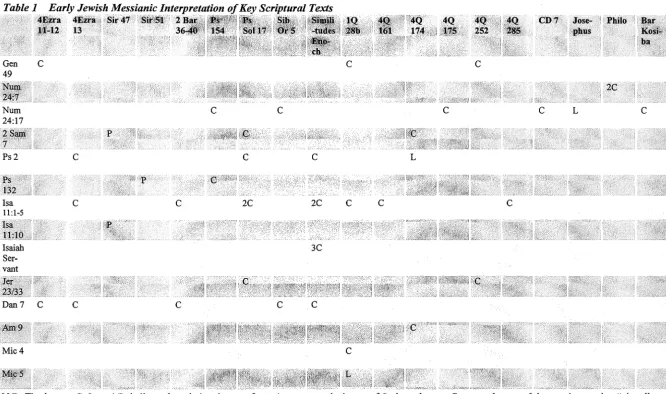
2.1. Messianic Interpretation of Isaiah 11:1-5
2.1.1. 4Q161A (4QpIsa a) 8-10IIIll-243
4Q161A is a continuous pesher on Isa 10:22-11:5 which speaks of the Branch
of David4 who will participate in the eschatological wars against the Kittim, which
scholars agree refers to the Romans.6 Since 4Q252 identifies the Branch of David with
"the Messiah of righteousness,,,7 there is no doubt that the Branch of David refers to the
Davidic Messiah. The relevant lines which follow the scriptural quotation from Isa
11: 1-5 read as follows:
1 Cf. Nicklesburg 1992; Aune 1992.
2 Cf. Oegema 1998,26-27; Collins 1995, 11-12.
3 Vermes assigns this text to the first century BCE. Vermesl998, 466. Pomykala dates this text from
30 BCE to 20CE on the basis of the script, suggested by Strugnell following Cross. Pomykala 1995,
198.
4 8-10:17
5 Fragment 5-6:10 refers to "the end of the days" in interpreting Isa 10:28-32. Fragment 8-10:3-9
refers to the battle against the Kittim in interpreting Isa 10:33-34.
17. [Its interpretation concerns the Branch of] David ('~" [M~~]) who will arise at the
e[ nd of days ] ([C~~~i1 n~' ]MN::l)
18. his [ene ]my, and God will sustain him with [ the] Law
19. th]rone of glory, a ho[ly] crown, and garments ofvarigat[ed stuff ]
20. in his hand, and over all the G[ entile]s he will rule, and Magog
21. [ al]l the peoples shall his sword judge. And as it says, Not
22. [ ] or decide by what his ears shall hear: its interpretation is that
23. [ ] and according to what they teach him so shall he judge, and according to their command [ ]
24. with him, one of the priests of repute shall go out with garments of [ ] in his hand. s
There are several points to be made in our discussion. First, the author explicitly
identifies "the shoot from the stump of Jesse" from Isa 11: 1 with "the Branch of David"
('~" [M~~l). 9
Since there is a common image between shoot and branch, it is not
difficult to see the identification in the light of Qumran exegetical practices such as the
"equation of synonymous."lO It is also likely that the term "the Branch of David"
reflects Jeremiah's the "righteous Branch" who can be identified with a future Davidic
king (Jer 23:5-6; 33:15).1l Second, although Isa 11:1 in MT shows that the new king
will appear in an undefined future, 4Q161A interprets it clearly in an eschatological
sense. Since a technical term "at the end of the days (C~~~i1 n~']MN::l)" is used in the
context of the war against the Kittim, it doubtless suggests an eschatological meaning.12
7 Garcia Martinez 1995, 162-164.
8 The reconstruction of the text and its translation as well as the numbering are indebted to Allegro.
Allegro 1968, 13-15.
9 The reconstruction of i~'i [mY~ll is quite likely based on 4Q285 which is another interpretation of
Isa11: 1 as well as 10:34, where the Branch of David appears, too.
10 Brownlee 1951, 60-62.
II Collins 1995,62.
Third, while Isa 11: 4 in MT likely shows that the new king will rule over Israel, line 20
shows that the rule of the Davidic Messiah is expanded in a way to rule over all the
Gentiles. \3 Fourth, whereas Isa 11:4 and 5 highlight that the new king's rule is a
righteous rule for the poor and the needy, the present text barely highlights the righteous
character of the Messiah's rule.14 It may not be coincidence that the wisdom through
the spirit which links to the king's righteous rule in Israel is little mentioned in our text.
Fifth, line 21 shows that the mysterious instruments of the new king in Isa 11 :4, "the rod
of his mouth" and "the breath of his lips," are interpreted here as a literal weapon,
"sword.,,15 Lastly, lines 22-24 show that "He shall not judge by what his eyes see, or
decide by what his ears hear" in Isa 11:3 is taken to mean that the Davidic Messiah will
be under the instruction of some possibly priestly figures, although this cannot be
certain owing to the lacuna. 16
In short, 4Q 161 A envisages, through the exegesis of Isa 11: 1-5, the Davidic
Messiah as the one who will arise at the end of the days, and will playa warrior-like role
in the eschatological battle against the Kittim so that he might judge and rule over all the
Gentiles, although he will likely be under the instruction of the priestly figures.
last period of time, directly before the time of salvation." Steudel 1993, 225-246. For the eschatology
of the Dead Sea Scrolls, Collins, 1997, 74-90; Idem 2000, 256-26l.
13 Schiffman 1995, 124.
14 Pomykala 1995, 202.
15 Atkinson 2000, 116; Pomykala 1995, 202.
16 The priests appear in the next line (In. 24). The significance of the priests in Qumran is well
recognized. For instance, 1 QSa shows that the priest takes precedence over the Davidic Messiah