Action-Level Intention Selection for BDI Agents
Yuan Yao
School of Computer Science University of Nottingham
Nottingham, UK
[email protected]
Brian Logan
School of Computer ScienceUniversity of Nottingham Nottingham, UK
[email protected]
ABSTRACT
Belief-Desire-Intention agents typically pursue multiple goals in parallel. However the interleaving of steps in different intentions may result in conflicts, e.g., where the execution of a step in one plan makes the execution of a step in another concurrently execut-ing plan impossible. Previous approaches to avoidexecut-ing conflicts be-tween concurrently executing intentions treat plans as atomic units, and attempt to interleave plans in different intentions so as to min-imise conflicts. However some conflicts cannot be resolved by ap-propriate ordering of plans and can only be resolved by apap-propriate
interleaving of steps within plans. In this paper, we presentSA, an
approach to intention selection based on Single-Player Monte Carlo Tree Search that selects which intention to progress at the current cycle at the level of individual plan steps. We evaluate the perfor-mance of our approach in a range of scenarios of increasing diffi-culty in both static and dynamic environments. The results suggest
SAout-performs existing approaches to intention selection both in
terms of goals achieved and the variance in goal achievement time.
1.
INTRODUCTION
In Belief-Desire-Intention-based (BDI) agent programming lan-guages, e.g., [4, 9], the behaviour of an agent is specified in terms
of beliefs, goals, and plans. Beliefsrepresent the agent’s
informa-tion about the environment (and itself). Goalsrepresent desired
states of the environment the agent is trying to bring about. Plans
are the means by which the agent can modify the environment in
order to achieve its goals. Plans are composed ofstepswhich are
eitherprimitive actionsthat directly change the agent’s
environ-ment orsubgoalswhich are in turn achieved by other plans. For
each top-level goal, the agent selects a plan which forms the root
of anintention, and commences executing the steps in the plan. If
the next step in an intention is a subgoal, a (sub)plan is selected to achieve the subgoal and added to the intention, and the steps in the (sub)plan are then executed and so on. This process of repeatedly
choosing and executing plans is referred to as the agent’s
delibera-tion cycle.
In many BDI agent architectures, the plans comprising the agent’s intentions are executed in parallel, e.g., by executing one step of an intention at each cycle in round robin fashion [4, 30]. Interactions between interleaved steps in different intentions may result in con-flicts, i.e., the execution of a step makes it impossible to execute a step in another concurrently executing intention. For example, con-sider a Mars Rover which has a goal to perform a rock experiment,
Appears in: Proceedings of the 15th International Conference on Au-tonomous Agents and Multiagent Systems (AAMAS 2016),
J. Thangarajah, K. Tuyls, C. Jonker, S. Marsella (eds.), May 9–13, 2016, Singapore.
Copyrightc 2016, International Foundation for Autonomous Agents and
Multiagent Systems (www.ifaamas.org). All rights reserved.
r, and a goal to upload some image data,u. The plan to perform
a rock experiment consists of two actions: collecting a sample,a1,
and analysing the sample,a2. a1has preconditionp(being at the
appropriate location) anda2has the postcondition¬q(overwriting
the current contents of the rover’s data buffer). The plan to upload
image data also consists of two steps: compressing the image,b1,
and transmitting the compressed data,b2. b1 has preconditionq
(the image currently in the data buffer), andb2has postcondition
¬p(the rover must be reoriented for transmission). Even ifpand
q have been established by previous steps in the intentions forr
andu, it is clear thatranducannot both be achieved without an
appropriate interleaving of plan steps.
A number of approaches to reasoning about possible interactions between intentions have been proposed in the literature.
Thangara-jah et al. [22, 21] describe an approach based on summary
in-formationthat avoids conflicts by reasoning about necessary and possible pre- and post-conditions of different ways of achieving a goal. They give algorithms for computing summary information at compile time, and for dynamically updating it at run-time. They also present mechanisms to determine whether a newly adopted (sub)goal will definitely be safe to execute without conflicts, or will definitely result in conflicts, or may result in conflicts. If the goal cannot be executed safely, execution of the intention is deferred. Yao et al. [31] present a stochastic approach based on Single-Player Monte-Carlo Tree Search (SP-MCTS) in which pseudorandom sim-ulations of different interleavings of the plans in each intention are used to determine which intention to progress. However these ap-proaches are limited to interleaving intentions at the plan level, i.e., execution of another intention is only possible when a subgoal is posted and steps in different plans are not interleaved, and they have only been evaluated in a static environment. Waters et al. [27,
28] present acoverage-basedapproach to intention selection
pro-posed by [23], in which the intention with the lowest coverage, i.e., the highest probability of becoming non-executable due to changes in the environment, is selected for execution. Unlike Thangarajah et al. and Yao et al. [23, 31], they evaluate their approach in a dy-namic environment; however intention selection is again limited to the plan level, and their experimental evaluation assumes that there are no conflicts between intentions.
In this paper, we introduceSA, a new approach to avoiding
con-flicts between intentions.SAextends the stochastic scheduling
ap-proach of Yao et al. [31] in two ways. First, we allow the interleav-ing of primitive actions in different intentions. Second, we change the function used to select the ‘best’ intention to progress at this cy-cle to take both the dynamism of the environment and the fairness
of the interleaving into account. We evaluate the performance ofSA
selection in static and dynamic environments, both in synthetic do-mains and a more realistic scenario based on the Miconic-10
ele-vator domain [14]. Our results suggestSAout-performs RR, FIFO,
SI, and C both in terms of goals achieved and/or the variance in goal achievement time, and is capable of successfully interleaving inten-tions so as to achieve their top-level goals even when the number of potential conflicts between intentions is high. Moreover, in the
scenarios considered, the computational overhead ofSAis modest.
2.
GOAL-PLAN TREES
We use the notion ofgoal-plan trees[22, 21] to represent the
relations between goals, plans and actions, and to reason about the interactions between intentions. The root of a goal-plan tree is a top-level goal (goal-node), and its children are the plans that can be used to achieve the goal (plan-nodes). Plans may in turn contain subgoals (goal nodes), giving rise to a tree structure representing all possible ways an agent can achieve the top-level goal. In [22, 21] goal-plan trees contain only goals and plans. To support action-level intention selection, we extend the definition of goal-plan trees to allow primitive actions in plans in addition to subgoals as in [32]. To allow reasoning about interactions between intentions, each goal plan tree records information about the conditions necessary to achieve a (sub)goal or successfully execute a plan or an action in the form of pre-, in- and post-conditions associated with goal, plan
and action nodes.Preconditionsare conditions that must be true in
order to execute a plan or an action. In-conditionsare conditions
that must hold during the pursuit of a goal or plan; if an in-condition becomes false during the execution of a goal or plan, the goal or
plan is dropped with failure.Postconditionsare conditions that are
made true by executing a plan or an action or by achieving a goal (in addition to achieving the goal itself).
↵ ⌦
G0:DeliverGoal(p,f1) Post:{At(p,f1)}
P0:DeliverPlan(p,f1) Pre:{At(p,f0),f0!=f1}
Post:{At(p,f1)}
↵ ⌦
G1:MoveToGoal(f0)
Post:{At(lift,f0)} A0:Board(Pre:{At(lift,f0p,f0),) At(p,f0)}
Post:{In(p,lift)}
X X X ⇠ ⇠ ⇠ ⇠ ⇠ ⇠ XX
X ↵ ⌦
G2:MoveToGoal(f1)
Post:{At(lift,f1)} A1:Debark(Pre:{At(lift,f1p,f1),) In(p,lift)}
Post:{At(p,f1)}
X X X ⇠ ⇠ ⇠ ⇠ ⇠ ⇠ XX X
P1:MoveToPlan(f0) Pre:{At(lift,f2),f0!=f2}
Post:{At(lift,f0)}
A2:Move(f2,f0) Pre:{At(lift,f2)}
Post:{At(lift,f0)}
X XX ⇠ ⇠⇠ ⇠ ⇠⇠ XXX
P2:MoveToPlan(f0) Pre:{At(lift,f0)}
Post:{At(lift,f0)}
P3:MoveToPlan(f1) Pre:{At(lift,f2),f2!=f1}
Post:{At(lift,f1)}
A3:Move(f2,f1) Pre:{At(lift,f2)}
Post:{At(lift,f1)}
X XX ⇠ ⇠⇠ ⇠ ⇠⇠ XXX
P4:MoveToPlan(f1) Pre:{At(lift,f1)}
[image:2.612.62.287.406.545.2]Post:{At(lift,f1)}
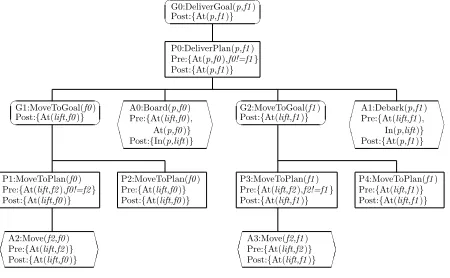
Figure 1: A goal-plan tree for the elevator domain
Figure 1 shows a simple goal-plan tree for the elevator domain
[14]. The top level goal, G0, is to deliver passengerspto floor
f1. There is a single plan, P0, to achieve G0. P0 consists of two
subgoals, G1 and G2 and two actions, A0 and A1. Each subgoal may be achieved by two subplans (P1 and P2 for G1 and P3 and P4 for G2). The pre- and postconditions of plans and actions are
shown in the figure; for example, the action A0:Board(p, f0), has
precondition that both theliftand passengerspare at floorf0, and
postcondition that the passengers are in the lift.
In addition to defining the relationships between goals, plans and actions, goal-plan trees can be used to define several notions that characterise the robustness of an agent program in a given environ-ment (and hence the likelihood that a particular interleaving of two
goal plan trees will result in conflicts). Thecoverageof a goal-plan
tree is the percentage of world states for which there is some
ap-plicable plan for any subgoal within an intention. Theoverlapof
a goal-plan tree is the percentage of world states in which two or more plans for a goal are applicable [23]. A preparatory-effect or
p-effectoccurs when a plan or action establishes the precondition of a later step (subplan or action) in the same goal-plan tree [22]. (Note that we extend the notion of p-effect in [22] to include the es-tablishment of the precondition of an action by a previous action in the same plan.) For example, in Figure 1, a precondition of action A0, At(lift, f0), is established by executing plans P1 or P2. At(lift,
f0) is therefore a p-effect which needs to be protected until action
A0 is executed. We define thesize of a p-effectas the number of
possible interleaving points between the plan or action that estab-lishes a precondition and the later step which requires the p-effect as its precondition. For example, the size of the p-effect At(lift, f0) is 1, as there is only one point at which a step from another inten-tion can be interleaved. Like coverage and overlap, p-effect size is a measure of an intention’s robustness: the greater size of the p-effects, the more likely interleaving steps from other intentions will destroy (clobber) the established precondition.
In a dynamic environment,SAtakes the coverage of each
goal-plan tree into account when choosing which intention to progress. We also use coverage, overlap and p-effect size to characterise the difficulty of the evaluation scenarios in Section 6.
3.
SELECTING INTENTIONS
We represent the agent’s intentions as a set of goal-plan trees
T ={t1, . . . , tn}corresponding to the agent’s top-level goals. The progression of an intention to achieve a top-level goal amounts to choosing a path through the corresponding goal-plan tree. Each path corresponds to a different way of achieving the top level goal forming the root of the tree. The path specifies a sequence of plans, actions, subgoals and sub-plans that, if executed successfully, will achieve the top-level goal. The execution of an agent program thus corresponds to an interleaving of paths through each of the goal-plan trees corresponding to the agent’s current intentions.
An inappropriate interleaving of plans or primitive actions in dif-ferent goal-plan trees can give rise to conflicts. We say the pro-gression of a set of intentions isconflict free, if the choice of path through each goal-plan tree, and the interleaving of the steps in these paths, ensure that the preconditions of each plan and action on a path are true when the plan or action are executed, and that any in-conditions required by a goal or plan are true during the achievement of the goal or execution of the plan.
To minimise conflicts (and hence maximise the number of goals
achieved),1 an intention selection mechanism must be able to
ap-propriately interleave the execution of steps in an agent’s inten-tions. In many cases, the interleaving of intentions is also desirable in its own right, e.g., to ensure more predictable response times for users or other agents. We therefore prefer interleavings that
max-imisefairness. We say an interleaving is more fair if it minimises
the variance in the elapsed time of each successful intention
(sub-ject to achieving as many goals as possible). The elapsed time,r,
of an intention is defined asr = df −da, wheredais the
cy-cle at which the top-level goal of the intention is adopted by the
agent, anddf is the cycle at which the goal is achieved. The
vari-ance in elapsed time,v, of a set ofnintentions with elapsed times
r1, . . . , rnis given byv=Pni=1(ri−r)2/n, whereris the
aver-age elapsed time. Fairness is then defined as1/v.
1
Theintention selection problemis the problem of choosing an intention to progress at the current deliberation cycle, such that the progression of the set of intentions is conflict free. To make the
problem precise, we introduce the notion of the current step,si,
and next step,succ(si), of a goal-plan treetirepresenting an
in-tention. siis a pointer to the current step inti, which may be a
primitive action or a subgoal. The path from the root of the goal-plan tree to the current step represents the choices made (and steps executed) so far in achieving the top-level goal. When an agent
adopts an intention for a new top-level goalgi, the current step of
the goal-plan tree rooted atgiis initially set togiitself. The next stepsucc(si)specifies howtiis to be progressed followingsi. If the current step is a primitive action, the next step is the primitive action or subgoal following that action in the same plan. If the cur-rent step is a subgoal, advancing the curcur-rent step involves choosing a plan for the subgoal, and setting the next step to be the first action or subgoal of the selected plan. The intention selection problem can now be stated as: given a set of goal plan trees and their cur-rent step pointersI = {(t1, s1), . . . ,(tn, sn)}corresponding to
the agent’s current intentions, and a set of condition variablesE
representing the current state of the agent’s environment, return a next stepsucc(si)of an intention(ti, si)∈Ito be executed at the
current deliberation cycle. We further require thatsucc(si)
max-imises the number of goals achieved and fairness of the interleav-ing, subject to achieving as many goals as possible. That is, there
is no(tj, sj) ∈ I, j 6=isuch that progressingtjwould achieve
more goals than progressingti, or if progressingtjandtiachieve
the same number of goals, progressingtjresults in an interleaving
that is at least as fair.
4.
SA ALGORITHM
Our approach to intention scheduling is based on Single-Player Monte-Carlo Tree Search (SP-MCTS) [18]. SP-MCTS is a best-first search in which pseudorandom simulations are used to guide expansion of the search tree. It was originally developed to solve single-player puzzles (games against the environment) [18], how-ever it has also been used successfully to solve reentrant scheduling problems [15].
Algorithm 1Return the action be executed at this cycle 1: I← {(t1, s1), . . . ,(tn, sn)}
2: procedureSA(E, e, δ, α, β)
3: n0←node0(I, E)
4: fori←1, αdo
5: ne←MAX-UCT-LEAF-NODE(n0)
6: children(ne)←EXPAND(ne)
7: ns←RANDOM-CHILD(children(ne))
8: S← ∅
9: forj←1, βdo
10: S←S∪ {SIMULATE(ns)}
11: vg(ns), vf(ns)←max<g,f(S)
12: BACKUP(ns)
13: ife > δthen
14: nb←max<g,c,fchildren(n0)
15: else
16: nb←max<g,fchildren(n0)
17: I←gpt(nb)
18: return(n0, nb)
TheSAalgorithm updates the set of goal plan trees and their
current step pointersI = {(t1, s1), . . . ,(tn, sn)}corresponding to the agent’s current intentions. It takes five parameters as input:
the current state of the agent’s environment,E, the average number
of environment changes per deliberation cycle, e, the dynamism
threshold,δ, the number of iterations to be performed,α, and the
number of simulations to be performed at each iteration,β; and
returns a next step of an intention inI for execution at this cycle
(see Algorithm 1). The parametersδ, αand β allow the agent
developer to configureSAfor a particular application: δspecifies
the mean number of environment changes per deliberation cycle at which the agent should favour more robust (higher coverage) plans;
αandβdetermine the effort expended on intention selection.
Starting from a root noden0representing the current progression
of the agent’s intentionsIand state of the environmentE, the
algo-rithm iteratively builds a search tree. Each node in the search tree
represents an interleaving of steps from the goal-plan trees inIthat
is consistent with the order of steps in each tree. The node records the state of the agent’s environment resulting from the execution of this interleaving, the current step in each goal-plan tree, the start time of all top-level goals and the completion time for the goals achieved by the interleaving. In addition, the node also contains a record of the number of times it has been visited, the value of the node, and the best simulation performed from the node (described below). Edges represent the selection of a plan for a subgoal or the execution of primitive action in a plan.
Each iteration of the main loop (lines 4–12) consists of 4 phases:
selection, expansion, simulation and back-propagation. In the
se-lectionphase, a leaf node,ne, is selected for expansion (line 5). A node may be expanded if it represents a non-terminal state (a state in which it is possible to execute the next step of a goal-plan
tree).neis selected using a modified version of Upper Confidence
bounds applied to Trees (UCT) [18], which models the choice of
node as ak-armed bandit problem. Starting from the root noden0,
we recursively follow child nodes with highest UCT value until a
leaf nodeneis reached.
In theexpansionphase, nodes representing the environment state
(and the current step of each goal-plan tree) resulting from execut-ing each next step of a goal-plan tree that is executable the state
represented byneare added as children ofne(line 6). Each child
node corresponds to a different choice of which intention to
exe-cute at this cycle. One of the newly created child nodes,ns, is then
selected at random for simulation (line 7).
In thesimulationphase, the value ofnsis estimated by
perform-ingβpseudorandom simulations (lines 8–11). Thevalueof a node
consists of two components: the maximum number of goals that
can be achieved from this node,vg, and the fairness of the
inter-leaving,vf. Each simulation starts in the environment represented
byns. A next step of a goal-plan tree that is executable in the
envi-ronment state represented bynsis randomly selected and executed,
and the environment and the current step of the selected goal-plan tree updated. We keep choosing executable next steps and updating the environment until a terminal state is reached in which no next steps can be executed or all top-level goals are achieved. The value
of the simulation is taken to be the values ofvgandvfin the
termi-nal state. The simulation with the highest value is returned as the value ofns(<g,fis a lexicographic order onvgandvf, i.e.,vf is
used to break ties when child nodes have the samevgvalue).
Finally, the simulation value isback-propagatedfromnsto all
nodes on the path to the root noden0(line 12).
As the search tree is expanded by iteration of the main loop, the random part of the interleaving represented by leaf nodes becomes
shorter, and we obtain better estimates ofvgandvf. Afterα
itera-tions, the step that leads to the best childnbof the root noden0is
returned, and the goal-plan trees and their associated current step
at the next deliberation cycle (lines 13–18). (The functiongpt re-turns the goal-plan trees and their associated current step pointers
represented by the nodenb.) Which step is considered best depends
on the degree of dynamism of the environment. If the mean num-ber of environment changes observed by the agent is less than the
dynamism threshold set by the agent developer,δ,SAselects steps
using<g,f, i.e., first on the number of top-level goals achieved,
and, where two or more steps result in the achievement of the same number of goals, it prefers steps that also maximise fairness. If
the dynamism exceeds the threshold,SAselects steps using the
or-der<g,c,f, i.e., first on the number of goals achieved, secondly on coverage (intentions with lower coverage are preferred) and thirdly which maximise fairness.
SAtherefore adopts a similar approach to [23, 27, 28] in dynamic
environments, in prioritising intentions which are more likely to be-come unexecutable due to changes in the environment. However, unlike previous coverage-based approaches, it selects the intention to be progressed at the action, rather than plan level, interleaving actions in a manner that is most likely to achieve the largest number of goals, and adaptively prioritises fairness in low dynamism envi-ronments. Our use of SP-MCTS to sample the space of possible interleavings is similar to [31], but that work interleaves intentions at the plan level and does not take the coverage of intentions or fairness into account.
5.
SA AND THE DELIBERATION CYCLE
SAimplies some modifications to the standard BDI deliberation
cycle. In this section we briefly sketch these changes and some obvious optimisations of our approach.
The standard BDI deliberation cycle consists of three phases [5, 16]:
1. select one or more events to process at this cycle;
2. for each selected goal event, select a relevant applicable plan to achieve the goal;
3. finally, select one or more intentions, and execute one or more steps of each selected intention.
Particular BDI languages may subdivide one or more of these phases. However some instantiation of this basic deliberation cycle is found in most BDI agent languages and platforms.
SAeffectively merges elements of phase 1 and phases 2 and 3
of the standard deliberation cycle into a single process which is re-sponsible for determining both which plan to adopt for a particular (sub)goal, and which step of which intention to execute at this cy-cle. Only the choice of which top-level goals to adopt falls outside
the scope ofSA: once a top-level goal is adopted,SAdetermines
which plans to execute and how these plans should be interleaved so as to maximise the number of goals achieved and minimise the variance in elapsed time. If the intention selected for execution at
the previous cycle posted a subgoal,SAexplores, through sampled
pseudorandom simulation, the implications of intending all rele-vant applicable plans for the subgoal (and the possible subplans of those plans) and their possible interleavings with all possible ways of achieving the agent’s other intentions, for the number of goals achieved and the elapsed time.
As such it assumes responsibility for decisions that some agent
platforms traditionally leave to the developer, e.g., theSOandSI
selection functions of Jason [4] allow a developer to customise Ja-son’s plan and intention selection for a particular application do-main. While such customisation may be necessary or desirable for some problems, it requires specialist expertise on part of the devel-oper to program at the level of the interpreter rather than writing
BDI agent code.2 In addition, the developer no longer has to
an-ticipate and control possible interactions between intentions using
atomic constructs. On the other hand, SAdoes entail additional
developer effort in defining the pre- and postconditions of actions. However alternative approaches to avoiding conflicts between in-tentions, e.g., SI, require similar information in the form of pre- and
postconditions of plans and goals. (Note that inSA, pre- and
post-conditions of plans are derived from the pre- and postpost-conditions of the actions comprising the plan.) Some BDI programming lan-guages already require the developer to specify the pre- and post-conditions of actions, e.g., actions in GOAL [13], belief-update ac-tions in 2APL [9]. For languages such as Jason, our experimental results indicate the kinds of scenarios where the additional effort of specifying the pre- and postconditions of actions would be worth-while in terms of increased agent performance.
We conclude this section by briefly outlining some simple opti-misations of our current implementation. As described in Section
4,SAbuilds a search tree at each deliberation cycle. As we show
below, in many casesSAis able to find an interleaving that achieves
all the agent’s goals. If the environment does not change, the next step in this interleaving can simply be returned at subsequent delib-eration cycles without further computation. It is only necessary to build a new search tree when the environment changes or the agent adopts a new top-level goal. In low dynamism environments, this
means the already small overhead ofSA(see Section 6.3) can be
amortised over multiple execution steps.
6.
EVALUATING SA
In this section we compare the performance ofSAwith
exist-ing approaches to intention selection used in practical implemen-tations of agent programming languages (first in first out, round robin), and from the theoretical literature (summary information, coverage-based). We consider both static and dynamic environ-ments in synthetic domains, and a more realistic scenario based on the Miconic-10 elevator domain [14].
First in first out(FIFO) executes each of the agent’s intentions to completion (the goal is achieved or the next step in the intention cannot be executed) before starting to execute the next intention
(this is termed anon-interleaved execution strategyin [2]). FIFO
minimises interactions between intentions, however it has the dis-advantage that the achievement of some goals may be significantly delayed compared to other goals.
Round robin(RR) attempts to ensure ‘fairness’ between inten-tions by executing a fixed number of steps of each intention in turn. A disadvantage of round robin is that it increases the number of possible conflicts between intentions: the interleaving of steps in different intentions may destroy a precondition established by a step in another intention before the action that requires the
precon-dition is executed.3 Round robin is the default intention selection
function used by Jason [4]; some platforms, such as JACK [30] al-low the developer to choose between round robin and first in first out.
InSummary Information-based intention selection (SI), summary information about pre-, in- and postconditions is propagated up each goal-plan tree to allow reasoning about interactions between
trees. For example, if there are two possible plans for a goal g
which both havepas a postcondition, then it is possible to infer
2
SAcould be extended to allow customisation of the value
func-tion(s) that determine which interleavings are preferred; however our current implementation does not support this.
3The same problems occur if the agent executes a step of each
thatpwill definitely occur as a result of achievingg, and that any
other goal that brings about¬pmay cause a conflict. SI uses this
information to protect active p-effects and in-conditions. If adopt-ing a new goal will result in a conflict, i.e., a postcondition of the new goal destroys an active p-effect or in-condition, then progres-sion of the intention containing the new goal is delayed until the p-effect or in-condition is no longer active.
Coverage-based intention selection (C) is based on the notions ofcoverageandoverlapdefined in Section 2. It prioritises the pro-gression of intentions with lowest coverage, as they are more likely to fail due to changes in the environment. Waters et al. [27, 28] implemented and evaluated the approach proposed in [23] (which they call c0), and a preemptive variant of c0 which they call c1. c0 executes the progressable intention with lowest coverage and main-tains focus as long as possible. Only when the current intention is finished or blocked will c0 recalculate coverage for all intentions and change focus to the progressable intention with lowest cover-age. In c1, whenever a sub-goal is posted, the coverage of each intention is recalculated and its progressibility determined. As a result, c1 will change focus to a lower coverage progressable inten-tion, even if the current intention is progressable.
FIFO does not interleave the execution of intentions. SI and C
interleave intentions at the plan level. RR andSAinterleave
inten-tions at the action level.
FIFO, RR, SI and C implicitly prioritise different criteria. FIFO prioritises minimisation of conflicts at the expense of ‘fairness’. Round robin introduces more potential for conflicts, but is more fair. Summary information based and coverage-based intention se-lection lie somewhere in between. We therefore evaluate the per-formance of each approach on two criteria: the number of goals
achieved, and the variance in elapsed time (see Section 4).4 In
Sections 6.1.1 and 6.1.2, we only report variance results where the
number goals achieved is>8; as the number of intentions which
complete successfully decreases, the variance value conflates the ability to achieve goals with the fairness of intention selection. For example, intentions that fail increase the variance of RR and de-crease the variance of FIFO.
6.1
Synthetic Domains
In the interests of generality, our first evaluation is based on sets of randomly-generated, synthetic goal-plan trees representing the current intentions of an agent in a simple environment. By con-trolling the characteristics of the trees, and the dynamism of the environment, we can evaluate the performance of each scheduling algorithm under different conditions.
The environment is defined by a set of propositions that may appear as pre-, in- or postconditions of a goal-plan tree. Each en-vironment variable is modelled as a Poisson process with specified mean, allowing the frequency with which the environment changes the value of the variable to be controlled. For a static environment, the means of all Poisson processes are set to 0. For the experiments reported below, the environment consists of 20 propositions.
Each synthetic goal-plan tree is specified by five parameters: the depth of the goal-plan tree, the plan branching factor (the maxi-mum number of plans that can be used to achieve a goal), the goal branching factor (the maximum number of sub-goals a plan may have), the maximum number of actions in a plan and the number of environment variables that may appear in the tree.
For the experiments reported below, we assume there are at most two plans for each goal, and that each plan has a single environment variable as its precondition. The precondition may either depend on
4An alternative definition of fairness is used as an evaluation
crite-rion in [28].
the current state of the environment or be established by the post-condition of a previous step in the goal-plan tree, i.e., by a p-effect.
Where the preconditions of the plans for a goalgare not
estab-lished by p-effects (e.g., top-level goals), a propositionpis chosen
randomly from the set of environment variables, and one plan for
ghas the preconditionpand the other plan has precondition¬p.
Each plan consists of a number of actions followed by a single sub-goal. The first action in the plan has the plan’s precondition as its own precondition. The remaining actions either have the plan precondition as their own precondition or their precondition is es-tablished by a previous action in the plan. The postcondition of an action is selected randomly from the set of environment variables. The constraints ensure that: (a) each plan is well formed (the plan can be successfully executed in some environment), and (b) taken individually, each goal-plan tree is executable (there is at least one way to achieve the top-level goal in all (static) environments).
These parameters generate trees similar to those used in previous evaluations of SI [21] and C [27, 28]. The main differences are that: unlike [21] goals do not have postconditions and plans and goals do not have in-conditions (for compatibility with [27, 28]); and, unlike [27, 28], environment variables are shared by all goal-plan trees (for compatibility with [21]).
6.1.1
Static Environment
Our first set of experiments evaluated the performance of FIFO,
RR, SI andSAin a static environment. (C is designed primarily
for dynamic environments and is considered in Section 6.1.2.) For each experiment, we generated 50 sets of 10 goal-plan trees using the parameters specified above (depth 5, plan branching factor of at most 2, goal branching factor 1). Other parameters of the trees were varied in each experiment as detailed below. The environment consisted of 20 variables, all of which can be chosen for pre- and
postconditions in each tree. SAwas configured with a dynamism
thresholdδ= 0.1, and to perform 100 iterations (α= 100) and 10
random simulations at each iteration (β= 10).
We first consider two parameters which influence the number of potential conflicts between intentions: the number of plan precon-ditions established by p-effects and the coverage of the goal plan trees. These parameters were varied to create intention selection scenarios of increasing difficulty.
Experiment 1In the first experiment we varied the percentage of plan preconditions established by p-effects from 33% to 100%. Goal-plan trees with lower % p-effects have higher coverage (plans whose precondition is not established by a p-effect have have
pre-conditionspand¬p, and hence no overlap), and therefore less
po-tential for conflicts (whatever the value ofpthe agent has an
ap-plicable plan). We set the average p-effect size at level 5 to be 3 (i.e., on average, the precondition of a plan is established by an ac-tion executed three steps earlier, in the parent plan), and each plan contained three actions.
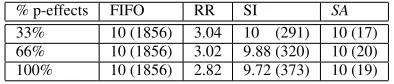
% p-effects FIFO RR SI SA
33% 10 (1856) 3.04 10 (291) 10 (17)
66% 10 (1856) 3.02 9.88 (320) 10 (20)
[image:5.612.338.535.588.630.2]100% 10 (1856) 2.82 9.72 (373) 10 (19)
Table 1: Goals & variance with increasing % p-effects
Table 1 shows the average number of goals achieved and variance in goal achievement time (in brackets, smaller numbers are better) for each scheduling algorithm for each percentage of p-effects consid-ered. (Recall that we only report variance results where the number
goals achieved is>8.) As can be seen, RR is able to achieve only
estab-lished by p-effects. This is because, even though 67% of subgoals have 100% coverage, there are still many points at which an action from another intention can destroy the precondition of a plan or an action. With 33% p-effects SI is able to achieve all 10 goals, how-ever as the percentage of p-effects increases, the number of goals
achieved decreases slightly. FIFO andSAare able to achieve all 10
goals even with 100% p-effects. However the variance in
comple-tion time is much higher with FIFO (1856) than withSA(20).
Experiment 2We investigated the effect of reducing coverage. When generating the goal-plan trees, we varied the probability of a goal having only a single plan. 25% 1-plan means that with prob-ability 0.25 only one plan is generated for a goal, and so on. In-creasing the probability that a goal has only one plan reduces cov-erage, and increases the likelihood of conflicts between intentions. The percentage of plan preconditions established by p-effects was 100% (i.e., all plans to achieve subgoals have their preconditions established by preceding actions); other parameters were as in Ex-periment 1.
% 1-plan FIFO RR SI SA
0% 10 (1856) 2.82 9.72 (373) 10 (19)
25% 8.92 (1603) 2.76 9.24 (455) 10 (22)
50% 7.92 2.44 8.88 (475) 10 (27)
75% 7.36 2.12 8.52 (489) 10 (28)
Table 2: Goals & variance with increasing % 1-plan (100% p-effects)
The results are shown in Table 2. As can be seen, for FIFO, RR and SI, as coverage decreases, the average number of goals achieved also decreases. This effect is particularly marked in the case of FIFO (if a top-level goal has only one plan, the postcondition of an action in a previously executed intention which destroys the
pre-condition of the plan will make the intention unexecutable). SAis
able to achieve 10 goals at all coverage levels. ForSAand SI
vari-ance increases as coverage decreases. HoweverSAhas significantly
lower variance than SI for all coverage levels, as SI approximates FIFO when protecting p-effects.
Next we investigated the performance of each approach when intentions are more complex and hence the likelihood of negative interactions is greater. In these experiments, we varied the p-effect size, and the number of actions in each plan.
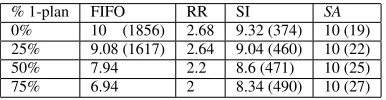
Experiment 3We investigated the effect of increasing p-effect size. We generated trees in which the precondition of each plan is chosen from environment variables appearing in the postcondition of any preceding action in the tree. For trees of depth 5, this gives an average p-effect size of 5 at level 5 (i.e., on average, the pre-condition of a plan is established by an action executed five steps earlier, in the parent of the parent of the plan). As in Experiment 2, we varied the probability of a goal having only a single plan from 0% to 75%; all other parameters are the same as in Experiment 2.
% 1-plan FIFO RR SI SA
0% 10 (1856) 2.68 9.32 (374) 10 (19)
25% 9.08 (1617) 2.64 9.04 (460) 10 (22)
50% 7.94 2.2 8.6 (471) 10 (25)
[image:6.612.339.535.104.152.2]75% 6.94 2 8.34 (490) 10 (27)
Table 3: Goals & variance with increasing % 1-plan (100% p-effects, average p-effect size 5)
The results are shown in Table 3. With a larger p-effect size, FIFO, RR and SI perform slightly worse in terms of goals achieved than
in Experiment 2, whileSAis still able to achieve 10 goals in all
cases. The variance for all approaches is essentially the same as in Experiment 2.
Experiment 4We increased the number of actions in each plan to 5. As in Experiment 2, we varied the probability of a goal having only a single plan from 0% to 75%; all other parameters are the same as in Experiment 2.
% 1-plan FIFO RR SI SA
0% 10 (5156) 1.64 9.28 (544) 10 (40)
25% 8.92 (4564) 1.56 9 (755) 10 (58)
50% 7.36 1.36 8.52 (843) 10 (63)
[image:6.612.77.272.253.302.2]75% 6.52 1.32 8.3 (874) 10 (66)
Table 4: Goals & variance with increasing % 1-plan (100% p-effects, each plan contains 5 actions)
The results are shown in Table 4. As can be seen, the performance of FIFO, RR and SI decrease when plans have 5 actions, with a more marked decline in the case of RR. SI shows a significant
in-crease in variance. However, SAstill achieves all 10 goals, and
while the variance is increased, it is much smaller than that for the other approaches.
6.1.2
Dynamic Environment
Our second set of experiments evaluated the performance of FIFO,
RR, SA, and two variants of C from [27, 28], c0 and c1, in a
dynamic environment. In the dynamic case, all the Poisson pro-cesses controlling the environment variables have the same non-zero mean. (In reality, different environment variables will change value at different rates, however for random trees we believe this is a reasonable approximation.) The larger the mean, the greater the
probability an environment variable will change value (frompto
¬por vice versa). We used three values for the mean: 0.01, which
results in an average of 0.2 events (changes in the value of an en-vironment variable) per deliberation cycle, 0.05 (which gives an average of 0.97 events per cycle), and 0.1 (which gives 1.91 events per cycle). In the dynamic case, the environment is first updated to reflect the execution of the next step of the selected intention (as in the static case). The Poisson processes controlling the environ-ment variables are then evaluated, possibly resulting in additional changes to the environment. The resulting environment state is then ‘sensed’ by the agent at the beginning of the next deliberation cy-cle. For each experiment, we generated 50 sets of 10 goal plan trees using the same parameters as in the static experiments. As before,
δ= 0.1,α= 100andβ= 10.
We first consider the effect of increasing dynamism and reduced coverage.
Experiment 5In the fifth experiment, we used the same param-eters as in first row in Table 2, i.e., all plans have two goals (0% 1-plan), %effects was 100%, each plan has 3 actions and the p-effect size at level 5 was 3. The means of Poisson process was varied from 0.01 to 0.1.
Dyn FIFO RR c0 c1 SA
0.01 8.92 (1625) 2.24 9.52 (1849) 8.88 (96) 9.82 (95)
0.05 5.40 1.06 8.62 (1830) 8.64 (94) 9.40 (95)
0.10 3.28 1 8.16 (1962) 8.56 (97) 9.08 (95)
Table 5: Goals & variance with increasing dynamism (100% p-effects, 0% 1-plan)
The results are shown in Table 5. As can be seen, for all approaches, as the means of Poisson processes increase, the average number of goals achieved decreases. This effect is particularly marked in the case of FIFO. c0 performs better than c1 when the Poisson mean is small, and c1 has a better performance than c0 when Poisson
[image:6.612.78.271.583.633.2]the number of goals achieved. The variance in goal achievement
time ofSAis similar to c1 and significantly lower than c0.
Experiment 6We set the probability of a goal having only a single plan to be 0.25 (i.e., the second row in Table 2); the means of the Poisson processes varied from 0.01 to 0.1; all other parameters are the same as in Experiment 2.
Dyn FIFO RR c0 c1 SA
0.01 7.90 1.82 9.12 (1877) 8.40 (116) 9.74 (114)
0.05 4.74 1.14 7.98 8.26 (118) 9.28 (120)
0.10 2.54 0.72 7.64 8.22 (124) 8.94 (123)
Table 6: Goals & variance with increasing dynamism (100% p-effects, 25% 1-plan)
The results are shown in Table 6. As can be seen, for all approaches and levels of dynamism, with reduced coverage (25% 1-plan) the average number of goals achieved decreases and the variance in
completion time increases. However,SAstill achieves the highest
number of goals of any of any approach (between 8%–16% better than c1), and its variance in goal achievement time is comparable to c1.
We then investigated the effect of increasing dynamism when intentions are more complex.
Experiment 7We increased the p-effect size to 5 at level 5. All other parameters were as in the first row in Table 2, and we again varied the means of Poisson process from 0.01 to 0.1.
Dyn FIFO RR c0 c1 SA
0.01 8.88 (1641) 2 9.42 (1863) 8.6 (100) 9.8 (96)
0.05 5.34 1.02 8.48 (1876) 8.54 (108) 9.32(97)
0.10 3.12 0.94 8.02(1978) 8.48 (110) 8.98 (96)
Table 7: Goals & variance with increasing dynamism (100% p-effects, p-effect size 5)
The results are shown in Table 7. Compared to Experiment 5, the performance of c0, c1 decreases as we increase the p-effect size.
However,SAstill outperforms other approaches on the number of
goals achieved and its variance in completion time is slightly lower than that of c1.
Experiment 8We increased the number of actions in each plan to 5; other parameters were same as the first row in Table 2, and the means of the Poisson process were varied from 0.01 to 0.1.
Dyn FIFO RR c0 c1 SA
0.01 8.4 (4664) 1.08 9.22 (4605) 8.32 (360) 9.52 (346)
0.05 3.76 0.62 8.18 (4765) 8.26 (387) 9.08(367)
0.10 1.84 0.42 7.88 8.18 (382) 8.72 (386)
Table 8: Goals & variance with increasing dynamism (100% p-effects, each plan contains 5 actions)
The results are shown in Table 8. As can be seen, compared to
Ex-periment 5, the performance of FIFO, RR, c0, c1 andSAdecreases
as we increase the number of actions in each plan. However,SA
still outperforms other approaches on the number of goals achieved and has a similar variance to c1.
Overall, SAoutperforms FIFO, RR and SI on the number of
goals achieved in static environments. In simpler scenarios, FIFO and SI are able to achieve all 10 goals. However, as the scenar-ios become more challenging, their performance declines (FIFO
more markedly than SI).SAalso has a significantly lower variance
in elapsed time (particularly compared to FIFO), as it allows
in-terleaving at the action level. In dynamic environments,SA
out-performs FIFO, RR, c0 and c1 in terms of the number of goals
achieved. The variance in elapsed time time ofSAis comparable to
that of c1, and significantly lower than that of c0. While the relative
performance advantage ofSAin a dynamic environment is smaller
than in a static environment, it consistently outperforms c1 in terms of number of goals achieved by between 5% and 10%.
6.2
Miconic-10 Elevator Domain
In this section we evaluate the performance ofSAin a more
real-istic scenario based on the Miconic-10 elevator domain [14].5
Un-like traditional elevators, the Miconic-10 elevator allows passen-gers to enter their destination floor when calling the elevator using a 10-digit keypad installed in each elevator lobby. In the scenario, the Miconic-10 elevator is controlled by a BDI agent program. Using standard techniques for translating HTN planning problems into BDI agent programs, e.g., [10], we translated the methods and op-erators in the Miconic-10 Elevator HTN planning domain given in [14], to goals, plans and actions in a BDI agent program. The goal-plan tree for the resulting BDI program is shown in Figure 1.
In our experiments, there is a single Miconic-10 elevator in-stalled in a 10 floor building. Passengers may move from floor to floor using the elevator. Requests to travel to a particular floor give rise to top-level goals (one for each request) which are achieved by the BDI agent program. For simplicity, we assume there is no lim-itation on the number of passengers that can be in the elevator at any one time.
We evaluated the performance ofSAin two scenarios. In the first
experiment, all goals (elevator requests) are given at deliberation cycle 0 (corresponding to the static environment in the synthetic domains). We generated 50 sets of 10 goals to travel between two
randomly chosen distinct floors. SAwas configured as in Section
6.1.1, i.e.,δ= 0.1,α= 100andβ= 10.
FIFO RR SI SA
10 (123) 1.10 10 (33) 10 (28)
Table 9: Goals & variance for 10 goals
The number of goals achieved and variance in elapsed time (in
parentheses) for FIFO, RR, SI andSAare shown in Table 9. As
can be seen, with the exception of RR, all approaches achieve 10 goals. However FIFO has significantly higher variance than SI and
SA, as FIFO executes the intentions sequentially.
In our second experiment, we use a more realistic model in which elevator requests arrive over time. As before, a total of 10 top-level goals must be achieved. However, in this scenario two goals are given at deliberation cycle 0, and the remaining top-level goals are posted during the progression of the agent’s current intentions.
We varied#g, the number of new top-level goals generated after
executing each primitive action, from 0.33 to 3. When#g= 0.33,
a new top-level goal is posted after every 3 primitive actions; when
#g = 3, 3 new top-level goals are posted after executing each
primitive action. TheSAsearch configuration was the same as in
the first scenario.
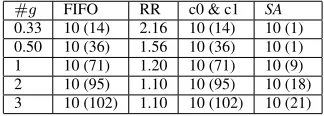
#g FIFO RR c0 & c1 SA
0.33 10 (14) 2.16 10 (14) 10 (1)
0.50 10 (36) 1.56 10 (36) 10 (1)
1 10 (71) 1.20 10 (71) 10 (9)
2 10 (95) 1.10 10 (95) 10 (18)
[image:7.612.355.517.613.671.2]3 10 (102) 1.10 10 (102) 10 (21)
Table 10: Goals & variance with decreasing time between goals
5
The results are shown in Table 10. As in the first scenario, with the exception of RR, all approaches achieve 10 goals. However in the dynamic setting, c0 and c1 have the same variance as FIFO (as the
MoveTosubgoal has 100% coverage, achieving aMoveTosubgoal does not change the coverage of the current intention and so both
c0 and c1 behave like FIFO). In contrastSAhas significantly lower
variance (i.e., the waiting times for passengers is ‘fairer’), as it is able to interleave actions in different intentions without destroying preconditions.
6.3
Computational Overhead of SA
The computational overhead ofSAdepends on the search
config-uration: how many iterations of the algorithm are performedαand
how many random simulations are performed at each nodeβ. With
the search configuration used for the experiments above (α= 100
andβ = 10),SArequires 35 milliseconds to compute a complete
interleaving of actions in 10 synthetic goal-plan trees (150 primi-tive actions). In a static environment, this interleaving only needs to be recomputed when the agent adopts a new top-level goal, so in the best case (no new top-level goals during the execution of the
current intentions) the overhead ofSAis effectively amortised over
the execution of all 10 intentions, and the amortised CPU time re-quired to selection an intention is approximately 0.2 milliseconds per deliberation cycle. In a dynamic environment, the interleaving must be recomputed whenever the agent’s beliefs change, so the cost of intention selection will be correspondingly higher.
7.
RELATED WORK
In addition to the work of Thangarajah et al. [22, 21, 23], Waters et al. [27, 28] and Yao et al. [31] discussed above, a number of other approaches to scheduling intentions to avoid conflicts have been proposed in the literature.
Shaw and Bordini have proposed approaches to intention selec-tion based on Petri nets [19] and constraint logic programming [20]. As in [22, 21, 23, 27, 28, 31]), the plans and sub-goals in a goal-plan tree are regarded as basic steps, and interleaving is at the level of sub-plans and subgoals. They do not consider interactions be-tween actions in plans.
The TÆMS (Task Analysis, Environment Modelling, and Sim-ulation) framework [11] together with Design-To-Criteria (DTC) scheduling [26] have been used in agent architectures such the Soft Real-Time Agent Architecture [25] and AgentSpeak(XL) [3] to schedule intentions. TÆMS provides a high-level framework for specifying the expected quality, cost and duration of of methods (actions) and relationships between tasks (plans). DTC decides which tasks to perform, how to perform them, and the order in which they should be performed, so as to satisfy hard constraints (e.g., deadlines) and maximise the agent’s objective function. DTC can produce schedules which allow interleaved or parallel execu-tion of tasks and can be used in an anytime fashion. In the work closest to that presented here, DTC was used to schedule execu-tion of AgentSpeak intenexecu-tions at the level of individual plans [3]. The TÆMS relations between plans required to generate a schedule (enables,facilitatesandhinders) were specified as part of the agent
program. In contrastSAinterleaves intentions at the level of
ac-tions, and information about possible conflicts between intentions is extracted automatically from goal-plan trees generated from the agent program.
In [17] Sardina et al. show how an HTN planner can be integrated into a BDI agent architecture. However their focus is on finding a hierarchical decomposition of a plan that is less likely to fail by avoiding incorrect decisions at choice points, and they do not take into account interactions with other concurrent intentions.
In [29], Wilkins et al. present the Cypress architecture which combines the the PRS-CL reactive executor and the SIPE-2 look-ahead planner. A Cypress agent uses PRS-CL to pursue its inten-tions using a library of procedures (plans). If a failure occurs dur-ing the execution of the plan due to an unanticipated change in the agent’s environment, the executor calls SIPE-2 to produce a new plan to achieve the goal, and continues executing those portions of plans which are not affected. However, their approach focuses on the generation of new plans to recover from plan failures, rather than interleaving intentions so as to avoid conflicts.
In [32], Yao et al. present an approach to recovering from execu-tion failures in BDI agent programs that relies on progressing exe-cutable intentions so as to (re)establish the precondition of the next step in an unexecutable intention as a ‘side effect’. As in the work presented here, they interleave intentions at the action level. How-ever the focus of their work is on minimising backtracking (try-ing an alternative plan when an intention becomes unexecutable), rather than coverage and fairness. Moreover, their approach is based on MCTS (rather than SP-MCTS), and their evaluation is limited to static domains.
There has also been work on avoiding conflicts in a multi-agent setting. For example, Clement and Durfee [6, 7, 8] propose an approach to coordinating concurrent hierarchical planning agents using summary information and HTN planning. However in this work, summary information is used to identify when conflicts may arise between two or more agents rather than to avoid conflicts be-tween the intentions of a single agent. Moreover, it is assumed that the agents plan offline in a static environment. In [12], Ephrahi et al. present an approach to planning and interleaving the execu-tion of tasks by multiple agents. The task of each agent is assigned dynamically, and the execution of all tasks achieves a global goal. They show how conflicts between intentions can be avoided by ap-propriate scheduling of the actions of the agents.
8.
DISCUSSION & FUTURE WORK
We presentedSA, an extension of the stochastic scheduling
ap-proach proposed in [31], that allows the interleaving of primitive actions in different intentions, and which takes both the dynamism of the environment and fairness into account when choosing which intention to progress. Action level intention selection allows con-flicts that cannot be resolved by scheduling at the plan level to be
avoided. We evaluated the performance ofSA in static and
dy-namic environments, both in synthetic domains and a more realis-tic scenario based on the Miconic-10 elevator domain. Our results indicate that our approach out-performs RR, FIFO SI, and C, and is capable of successfully scheduling intentions so as to achieve their top-level goals even when the number of potential conflicts between intentions is high. Moreover, in the scenarios considered,
the computational overhead ofSAis modest.
Our approach has a number of limitations. When the agent’s beliefs or goals change, our current implementation simply regen-erates the SP-MCTS search tree from scratch, rather than merging belief and goal updates into the search tree from the previous de-liberation cycle. A direction for future work is therefore to inves-tigate ways of re-using an existing SP-MCTS search tree when the interleaving must be recomputed. Another line of future work is to consider intention selection where top-level goals are associated with deadlines as in, e.g., [24].
Acknowledgments
REFERENCES
[1] N. Alechina, T. Behrens, M. Dastani, K. Hindriks, J. Hubner, B. Logan, H. Nguyen, and M. van Zee. Multi-cycle query caching in agent programming. In M. desJardins and
M. Littman, editors,Proceedings of the Twenty-Seventh
AAAI Conference on Artificial Intelligence (AAAI 2013), volume 1, pages 32–38, Bellevue, Washington, July 2013. AAAI, AAAI Press.
[2] N. Alechina, M. Dastani, B. Logan, and J.-J. C. Meyer. Reasoning about agent deliberation. In G. Brewka and
J. Lang, editors,Proceedings of the Eleventh International
Conference on Principles of Knowledge Representation and Reasoning (KR’08), pages 16–26, Sydney, Australia, September 2008. AAAI.
[3] R. Bordini, A. L. C. Bazzan, R. d. O. Jannone, D. M. Basso, R. M. Vicari, and V. R. Lesser. AgentSpeak(XL): Efficient intention selection in BDI agents via decision-theoretic task
scheduling. InProceedings of the First International
Conference on Autonomous Agents and Multiagent Systems (AAMAS’02), pages 1294–1302, 2002.
[4] R. H. Bordini, J. F. Hübner, and M. Wooldridge.
Programming multi-agent systems in AgentSpeak using Jason. Wiley Series in Agent Technology. Wiley, 2007. [5] M. E. Bratman, D. J. Israel, and M. E. Pollack. Plans and
resource-bounded practical reasoning.Computational
Intelligence, 4(4):349–355, 1988.
[6] B. J. Clement and E. H. Durfee. Theory for coordinating concurrent hierarchical planning agents using summary information. In J. Hendler and D. Subramanian, editors,
Proceedings of the Sixteenth National Conference on Artificial Intelligence (AAAI’99), pages 495–502, Orlando, Florida, USA, July 1999. AAAI Press / The MIT Press. [7] B. J. Clement and E. H. Durfee. Performance of coordinating
concurrent hierarchical planning agents using summary
information. InProceedings of the 4th International
Conference on Multi-Agent Systems, pages 373–374, Boston, MA, USA, July 2000. IEEE Computer Society.
[8] B. J. Clement, E. H. Durfee, and A. C. Barrett. Abstract
reasoning for planning and coordination.Journal of Artificial
Intelligence Research, 28:453–515, 2007.
[9] M. Dastani. 2APL: a practical agent programming language.
Autonomous Agents and Multi-Agent Systems, 16(3):214–248, 2008.
[10] L. de Silva and L. Padgham. A Comparison of BDI Based Real-Time Reasoning and HTN Based Planning. In G. I.
Webb and X. Yu, editors,AI 2004: Advances in Artificial
Intelligence, Proceedings of the 17th Australian Joint Conference on Artificial Intelligence, volume 3339, pages 1167–1173, Cairns, Australia, December 2004. Springer. [11] K. S. Decker and V. R. Lesser. Quantitative modeling of
complex environments.International Journal of Intelligent
Systems in Accounting, Finance and Management, 2:215–234, 1993.
[12] E. Ephrati and J. S. Rosenschein. A framework for the interleaving of execution and planning for dynamic tasks by multiple agents. In C. Castelfranchi and J. Müller, editors,
From Reaction to Cognition, Proceedings of the 5th European Workshop on Modelling Autonomous Agents (MAAMAW’93), pages 139–153, Neuchatel, Switzerland, August 1993. Springer.
[13] K. V. Hindriks. Programming rational agents in GOAL. In
A. El Fallah Seghrouchni, J. Dix, M. Dastani, and R. H.
Bordini, editors,Multi-Agent Programming: Languages,
Tools and Applications, pages 119–157. Springer, 2009. [14] J. Koehler and K. Schuster. Elevator Control as a Planning
Problem. In S. Chien, S. Kambhampati, and C. A. Knoblock,
editors,Proceedings of the Fifth International Conference on
Artificial Intelligence Planning Systems, pages 331–338, Breckenridge, CO, USA, April 2000. AAAI.
[15] S. Matsumoto, N. Hirosue, K. Itonaga, N. Ueno, and H. Ishii. Monte-Carlo tree search for a reentrant scheduling problem. In40th International Conference on Computers and Industrial Engineering (CIE), pages 1–6, Awaji, 2010. IEEE. [16] A. S. Rao and M. P. Georgeff. An abstract architecture for
rational agents. In C. Rich, W. Swartout, and B. Nebel,
editors,Proceedings of Knowledge Representation and
Reasoning (KR&R-92), pages 439–449, 1992. [17] S. Sardiña, L. de Silva, and L. Padgham. Hierarchical
planning in BDI agent programming languages: a formal approach. In H. Nakashima, M. P. Wellman, G. Weiss, and
P. Stone, editors,Proceedings of the Fifth International Joint
Conference on Autonomous Agents and Multiagent Systems (AAMAS 2006), pages 1001–1008, Hakodate, Japan, May 2006. ACM.
[18] M. P. D. Schadd, M. H. M. Winands, M. J. W. Tak, and J. W. H. M. Uiterwijk. Single-player Monte-Carlo tree search for
SameGame.Knowledge-Based Systems, 34:3–11, 2012.
[19] P. H. Shaw and R. H. Bordini. Towards alternative approaches to reasoning about goals. In M. Baldoni, T. C. Son, M. B. van Riemsdijk, and M. Winikoff, editors,
Proceedings of the Fifth International Workshop on Declarative Agent Languages and Technologies (DALT 2007), volume 4897, pages 104–121, Honolulu, HI, USA, May 2007. Springer.
[20] P. H. Shaw and R. H. Bordini. An alternative approach for reasoning about the goal-plan tree problem. In H. Coelho,
R. Studer, and M. Wooldridge, editors,Proceedings of the
19th European Conference on Artificial Intelligence (ECAI 2010), volume 215, pages 1035–1036, Lisbon, Portugal, August 2010. IOS Press.
[21] J. Thangarajah and L. Padgham. Computationally effective
reasoning about goal interactions.Journal of Automated
Reasoning, 47(1):17–56, 2011.
[22] J. Thangarajah, L. Padgham, and M. Winikoff. Detecting & avoiding interference between goals in intelligent agents. In
G. Gottlob and T. Walsh, editors,Proceedings of the
Eighteenth International Joint Conference on Artificial Intelligence (IJCAI-03), pages 721–726, Acapulco, Mexico, August 2003. Morgan Kaufmann.
[23] J. Thangarajah, S. Sardina, and L. Padgham. Measuring plan coverage and overlap for agent reasoning. In W. van der Hoek, L. Padgham, V. Conitzer, and M. Winikoff, editors,
Proceedings of the 11th International Conference on Autonomous Agents and Multiagent Systems (AAMAS 2012), pages 1049–1056. IFAAMAS, June 2012.
[24] K. Vikhorev, N. Alechina, and B. Logan. Agent programming with priorities and deadlines. In K. Turner,
P. Yolum, L. Sonenberg, and P. Stone, editors,Proceedings
of the Tenth International Conference on Autonomous Agents and Multiagent Systems (AAMAS 2011), pages 397–404, Taipei, Taiwan, May 2011.
[25] R. Vincent, B. Horling, V. Lesser, and T. Wagner.
the Fifth International Conference on Autonomous Agents (AGENTS’01), pages 355–362, 2001.
[26] T. Wagner, A. Garvey, and V. Lesser. Criteria-directed
heuristic task scheduling.International Journal of
Approximate Reasoning, 19:91–118, 1998.
[27] M. Waters, L. Padgham, and S. Sardina. Evaluating coverage based intention selection. In A. Lomuscio, P. Scerri,
A. Bazzan, and M. Huhns, editors,Proceedings of the 13th
International Conference on Autonomous Agents and Multi-agent Systems (AAMAS 2014), pages 957–964. IFAAMAS, 2014.
[28] M. Waters, L. Padgham, and S. Sardiña. Improving domain-independent intention selection in BDI systems.
Autonomous Agents and Multi-Agent Systems, 29(4):683–717, 2015.
[29] D. E. Wilkins, K. L. Myers, J. D. Lowrance, and L. P. Wesley. Planning and reacting in uncertain and dynamic
environments.Journal of Experimental and Theoretical
Artificial Intelligence, 7(1):121–152, 1995.
[30] M. Winikoff. JACK intelligent agents: An industrial strength platform. In R. H. Bordini, M. Dastani, J. Dix, and A. E.
Fallah-Seghrouchni, editors,Multi-Agent Programming:
Languages, Platforms and Applications, pages 175–193. Springer, 2005.
[31] Y. Yao, B. Logan, and J. Thangarajah. SP-MCTS-based intention scheduling for BDI agents. In T. Schaub,
G. Friedrich, and B. O’Sullivan, editors,Proceedings of the
21st European Conference on Artificial Intelligence (ECAI-2014), pages 1133–1134, Prague, Czech Republic, August 2014. ECCAI, IOS Press.
[32] Y. Yao, B. Logan, and J. Thangarajah. Robust execution of BDI agent programs by exploiting synergies between
intentions. InProceedings of the Thirtieth AAAI Conference