A Study of Genetic Operators for the Workforce
Scheduling and Routing Problem
Haneen Algethami1, Dario Landa-Silva2
1 University of Nottingham 1
School of Computer Science, Jubilee Campus, Nottingham, UK [email protected]
2 University of Nottingham
School of Computer Science, Jubilee Campus, Nottingham, UK [email protected]
Abstract
The Workforce Scheduling and Routing Problem (WSRP) is concerned with planning visits of qual-ified workers to different locations to perform a set of tasks, while satisfying each task time-window plus additional requirements such as customer/workers preferences. This type ofmobile workforce
scheduling problem arises in many real-world operational scenarios. We investigate a set of genetic operators including problem-specific and well-known generic operators used in related problems. The aim is to conduct an in-depth analysis on their performance on this very constrained scheduling problem. In particular, we want to identify genetic operators that could help to minimise the vio-lation of customer/workers preferences. We also develop two cost-based genetic operators tailored to the WSRP. A Steady State Genetic Algorithm (SSGA) is used in the study and experiments are conducted on a set of problem instances from a real-world Home Health Care scenario (HHC). The experimental analysis allows us to better understand how we can more effectively employ genetic operators to tackle WSRPs.
1
Introduction
The Workforce Scheduling and Routing Problem (WSRP) involves the scheduling of employees in an organization to travel across different locations to complete a set of tasks or activities. The problem arises in real-world scenarios such as Home Health Care, Home Care, Scheduling Technicians, Secu-rity Personnel Routing and Rostering and Manpower Allocation [3]. The WRSP is a combination of personnel scheduling and routing problems, hence it shares many aspects with these problems many of which are known to be NP-Hard [12]. The scheduling part allocates staff to tasks in order to fulfill work demand and customer/workers satisfaction. The routing part requires generating routes formobile staff to service customers across various locations and within given time-windows. Real-world instances of the WSRP are large and very difficult to solve. It is necessary to develop efficient algorithms because manual planning involves a large effort and may produce low-quality plans.
In this paper we conduct a study of several genetic operators when applied to a WSRP using a Steady State Genetic Algorithm (SSGA) [19]. For this study we use a set of instances from a real-world home health care scenario provided by our industrial partner. Home health care involves providing services such as nursing, home life aids, physical therapy and house cleaning to patients at their homes. Section 2 describes the WSRP, model and instances used in this study. Section 3 gives details of the implemented genetic operators and GA. Section 4 describes the experimental study while Section 5 presents and discusses results. The paper is then concluded in Section 6.
2
Workforce Scheduling and Routing Problem (WSRP)
Each problem instance contains a set of locationsL = {l1, l2, . . . , l|L|}and each location l ∈ L has a set of required tasks. Each taskt∈T has a time-window[wL
t, wUt ]within which task must be serviced.
A group of locations are assembled as a geographical areaa∈A. Also, a problem instance has a set of workersC={c1, c2, . . . , c|C|}. A workerc∈Chas a set of skillsSc⊆SwhereS ={s1, s2, . . . , s|S|} represents a set of all available skills. A worker c ∈ C has to travel between locations in a graph
G = (V, E)[11] where the set of verticesV is the union of task locations, departure locationsD, and destination locationsD0, that isV = D∪L∪D0. Then, the set of edgesE is a set of routes between vertices in V. We have a number of instances from a real-world WSRP, specifically home health care scenario in the UK. The main features of the seven instances used in this work are shown in Table 1.
Instance B-01 B-02 B-03 B-04 B-05 B-06 B-07
|C| 25 25 34 34 32 32 32
|L| 27 11 43 14 38 38 38
|T| 36 12 69 30 61 57 61
|A| 5 4 6 4 7 7 6
Table 1: Main Features of the WSRP Instances Used Here. |C|is the number of workers, |T|is the number of tasks,|L|is the number of locations grouped in|A|geographical areas.
Assigning tasks only according to workers’ skills, satisfying time-windows and not exceeding weekly working hours are usually considered as hard constraints. Additional workers’ requirements such as preferable areas to work or customers’ requirements such as preference for certain workers to do the tasks are considered preferences hence tackled as soft constraints. The violation of soft constraints is penalized according to some established priority. In this study, the problem objectives and the set of constraints to be tackled are shown in Table 2. For more details on the MIP model please refer to [11]. In general, a WSRP solution is to assign each task to a worker while satisfying the constraints and minimizing distance travelled and cost. Hence, the objective function in equation (1) includes the Assignment Costand thePenalty Cost. The Assignment Cost includesPayment Cost and Travelling Cost, i.e. wages plus the journeys cost for each worker. The Penalty Cost is the accumulated penalty for the violations of the soft constraints listed in Table 2.
Objectives Hard constraints Soft constraints
Distance Travelled Skills Requirements Unassigned Tasks
Payment Costs Time Conflicts Area Availability
Maximum Hours Violations Time Availability
Preferences ( Skills, Workers, Area)
MinX
c∈C
X
i∈D∪T
X
j∈D0∪T
di,j+pcj
xci,j+X
c∈C
X
i∈D∪T
X
j∈D0∪T
ρcjxci,j+
X
j∈T
M1yj +M2(ωj +ψj) (1)
where:
• Binary decision variablexci,j = 1if workerc ∈ C is assigned to taskj ∈ T after servicing taski ∈ T, xci,j= 0otherwise.
• yjis a binary decision variable indicates that a taskj ∈T is assigned to a dummy worker. An assignment
only takes place when the taskjcannot be assigned to a real worker due to the problem restrictions.
• M1andM2are penalty costs applied to unassigned tasks and constraints violation penalties. The values are
provided along with data instances.
• The Payment Cost is denoted bypc
jfor workerc∈Cto perform taskj∈T
• The Travelling Cost is denoted bydi,jfrom location of taski∈T to the location of taskj∈T.
• The Penalty Cost due to the violation of soft constraints is denoted byρcj.
Priority among the six soft constraints is as follows. The Unassigned Tasksconstraint has the highest priority so a violation of this constraint costs more than a violation of any of the other five constraints. Both Time Availability and Area Availability constraints have the same priority. Note that there are two constraints associated to the area in which workers are assigned to tasks. If a worker is assigned outside his/her Area Availability then this involves a constraint penalty cost. Likewise, if a worker is not assigned to one of his/her Preferred Area then this involves a preference penalty cost. Also, The worker’s and client’s preferencesρc
j is a penalty cost that varies according to the preference required.
We introduce three preference requirement levels for each preference constraints in the problem. The first requirement level is the preferred worker qualificationsRLs, then the preferred area to workRLa,
and finally the preferred workerRLc. Such preference satisfaction level is in the range[0,1]depending
on the level of preference achieved.
3
Genetic Algorithm, Conflict Reduction Heuristic and Genetic
Opera-tors
This TCRH aims to seed the GA with better initial solutions by reducing the number of time-conflicts generated with the random process. Basically, the heuristic re-assigns time-conflicting tasks to a different random worker. Tournament selection and elitism is used at the end of each generation so that33.3%of the best individuals are copied to the new population. Individuals are ranked according to their fitness given by the minimization objective function.
Operator RSM IM SM 1-point 2-point UX HX PMX OX CX
Reference [4] [7] [4] [14] [9] [14] [6] [21] [20] [16]
Table 3: Operators considered in the study and adopted from the literature.
Various genetic operators, including crossover and mutation, are applied to the chromosomes in order to obtain better offspring. In this study, there are three different types of operators: ten well-known generic operators (shown in Table 3), two cost-based problem specific operators designed to obtain offspring with fewer violations, and a repair operator. These operators were selected after a literature survey conducted to identify genetic operators that have been applied to WSRP and related problems. By studying the overall performance of these operators we seek to identify the best combination of operators for tackling the WSRP constraints. Each operator allows feasible solutions only. As a result, the operators always create offspring with fewer constraint violations regardless of the total cost. The operators used in the study are as follows:
• Well-known Generic Operators
– Crossover These well-known generic crossovers are divided in two groups:
1. Scheduling crossovers such as: Single Point (1-point), Two Point (2-point), Uniform (UX) and Half Uniform (HX).
2. Routing crossovers such as: Order crossover (OX), Cycle crossover (CX) and partially matched crossover (PMX).
– Mutation Applied mutation operators are: Random Swap Mutation (RSM), Inversion Muta-tion (IM) and Scramble MutaMuta-tion (SM).
Algorithm 1Cost-Based Uniform Crossover (CBUX). Selectskin IndividualiP arent
ifWorkercis Available to work in Tasktk area iniP arentthen
Workercis Inserted into thekthgene ini Child
end if
Evaluate theCost ValueiChild
if iChildhas more Violation than ParentiP arentthen
iChild:=iP arent
end if
• Cost-Based Operators
These are problem-specific operators that are specifically designed for WSRP to maximize the customer/workers preferences satisfaction.
– Cost-Based Uniform Crossover (CBUX).
stream of workers in an offspring provided that it does not make the chromosome infeasible. Therefore, the selected gene has lower cost.
– Cost-Based Mutation (CBM).
This operator is designed to target each gene in an individual by maintaining the maximum number of preferred workers for each task as shown in Algorithm 2. Each Task ti ∈ T
has a list of preferred workers C = [c1, c2. . . , cM] where M is the number of workers
in the preferred list. The CBM operator checks the preferred workers and alters the genes accordingly.
• Repair Operator
The feasibility of an individual is gone if a hard constraint is violated. Therefore, the repair opera-tor is designed to maintain feasible solutions while maintaining the least possible cost value. The operator checks the feasibility of each worker assigned to a task and alters the genes accordingly. This procedure is designed to reach a good area in the search space in a fast computation time. At every generation, the repair operator is utilized after the mutation. A random swap occurs if a worker is not suitable for a task, provided that the alteration does not create infeasible solutions. Algorithm 2Cost-Cased Uniform Mutation (CBM).
for allGenekin IndividualiP arentdo
ifWorkercis in a Preferred Worker for TasktkiniP arentthen
Workercis Inserted into thekth gene iniChild
end if end for
Evaluate theCost ValueiChild
if iChildhas more Violation than ParentiP arentthen
iChild:=iP arent
end if
4
Experimental Study
The aim of the experiments was to investigate the effect of the set of genetic operators listed above on the worker’s and customer’s preferences satisfaction. The experiments were conducted on 3.60 GHz Intel (R) core (TM) i7 CPU and the implementation was in Java under Windows 7. The experimental setting was as follows. The population of a size 100 was generated randomly with initial seed yet initial individuals were improved with the TCRH. The crossover probability pcwas alternated between 100% , 50% and
10%. Similarly the mutation probability pm 30% , 10% and 0.1%, i.e. we tried two different values
for crossover and mutation probabilities. Each GA setting was executed using different combinations of genetic operators on each of the seven problem instances mentioned in Table 1. In total we had 32 combination with 9 different settings of the GA alternately and each one was executed 15 times with the same initial population. Each run stops at the generation stagnation (with a maximum number of 200 iterations). For each GA setting, we kept the objectives value for the best solution obtained in each of the 15 runs and the average of those best values is used to measure the quality of the GA setting. Also, a repair operator was executed to reduce the number of soft constraints violations while maintaining a flow of feasible solutions. Consequently, we grouped each run by the mutation operators where RSM, IM, SM and CBM. Each mutation operator was combined with one crossover operator (1-point, 2-point, UX, HX, PMX, OX, CX, CBUX) at a time. However, to investigate the behaviour of the repair operator, the approach was tested with two additional settings. If a combination was not combined with a repair operator, then the combinations were denoted asX∗. Then the combinations with the repair operator and probabilities ofpc= 0.1% andpm= 0.01% (i.e. practically no crossover and no mutation). These values
5
Results and Discussion
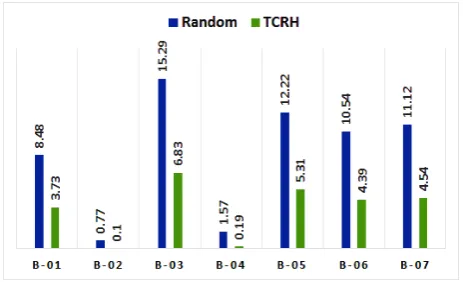
[image:6.595.182.414.314.455.2]Having time-conflicts in the generated solutions, i.e. the violation of time-windows, was a problematic issue in this study. TCRH was implemented to reduce the number of such time-conflicts. The quality of the random initial population and the TCRH methods are compared in Figure 1. TCRH performance is directly measured by two elements: the number of time-conflicts and the initial population quality. Hence, in in Figure 1, each bar presents the average value of the time-window conflicts occurrences for each problem instance before and after applying TCRH. It can be seen that after applying TCRH there is a clear reduce in time-window conflicts for all instances. The second measurement method is the population quality. This measurement is reflected by the population diversity and the computation time. As shown in Table 4, the computation time increases when TCRH is applied. However, instances such as B-01 and B-02 required less time while using TCRH and B-04 required similar computation time to the random initialisation. This outcome was a result of few time-window conflicts primarily even with the random initialization. Furthermore, the population diversity is equally the same in all instances for both initialisation methods. Thus, population diversity is maintained while TCRH is used with the GA. In general, we observed that TCRH reduced the number of workers with time-conflict occurrences in each problem instance with the utilization of the repair operator.
Figure 1: The Average Number of Conflicts in the Initial PopulationP(Random / TCRH).
Random TCRH
Problem B 01 02 03 04 05 06 07 01 02 03 04 05 06 07
time(ms) 83 12 1 0 16 34 18 31 0 62 0 31 15 27
Diversity(%) 24 24 31 31 30 30 30 24 24 31 32 30 30 30
Table 4: Effects of the TCRH on the initial PopulationP.
B-01 B-02
1Point 2Point UX PMX OX HX CX CBUX 1Point 2Point UX PMX OX HX CX CBUX
1Point - < < > < > < < - > > > > > > >
2Point > - > > > > > < < - > > > > < <
UX > < - > < > < < < < - < < > < <
PMX < < < - < > < < < < > - < < < <
OX > < > > - > > < < < > > - > < <
HX < < < < < - < < < < < > < - < <
CX > < > > < > - < < > > > > > - <
CBUX > < > > > > > - < > > > > > >
-B-03 B-04
1Point 2Point UX PMX OX HX CX CBUX 1Point 2Point UX PMX OX HX CX CBUX
1Point - < ≤ ≤ ≤ ≤ ≤ ≤ - < < < > < > <
2Point > - < > > < < < > - < > > > > >
UX ≥ > - > > > < < > > - > ≥ > > >
PMX ≥ < < - < < ≤ ≤ > < < - > < > <
OX ≥ < < > - < < < < < ≤ < - < < <
HX ≥ > < > > - < < > < < > > - > >
CX ≥ > > ≥ > > - < < < < < > < - <
CBUX ≥ > > ≥ > > > - > < < > > < >
-B-05 B-06
1Point 2Point UX PMX OX HX CX CBUX 1Point 2Point UX PMX OX HX CX CBUX
1Point - < < < < < < ≤ - < < < < > > <
2Point > - < < > > < ≤ > - > > > > > <
UX > > - > > > < < > < - < < > > <
PMX > > < - < > < < > < > - > > > <
OX > < < > - > > < > < > < - > > <
HX > < < < > - < < < < < < > - > <
CX > > > > > > - < < < < < > < - <
CBUX ≥ ≥ > > < > > - > > > > > > > -B-07
1Point 2Point UX PMX OX HX CX CBUX
1Point - < < < > > > <
2Point > - > < > > > <
UX > < - < > > > <
PMX > > > - > > > <
OX < < < < - > > <
HX < < < < > - < <
CX < < < < > > - <
CBUX > > > > < > >
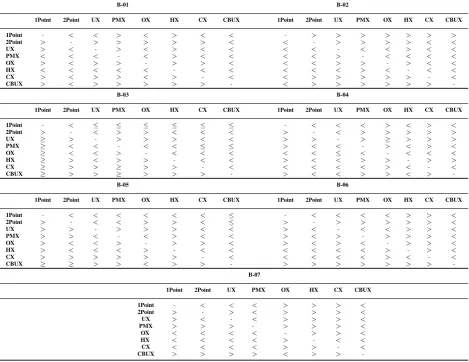
-Table 5: Wilcoxon sign rank test of the Average Preferences Satisfaction Values Grouped by the Crossover Operators where>(<) means that Crossoveriis significantly better (worse) than Crossover
jwithin a confidence interval of 95%. Similarly,≥(≤)shows that Crossoveriperforms slightly better than Crossoverj(with no statistical significance). The sign = refers to equal performance.
µ, standard deviationσ, the best values obtained are highlighted in bold and the average computation time in seconds used by the GA. It is apparent that the combinationsX∗ were not affected by the ge-netic operators for all instances. They sustained similar outcomes throughout the trials with a near to random offspring. Overall, CBM had less spread out values with lower σ values in association to the other combinations. Additionally, CBM have succeeded to obtain the best cost values in B-01 and B-7. RSM achieved best cost values as well in both B-02 and B-03. Both obtained lessσvalues throughout all the instances. On the contrary, IM obtained best cost values in B-04, B-05 and B-06. Yet IM had more computation time and spread out values overall the instances as well. For the most part, lowerPc, Pm
values have obtained good solutions in less computation time in comparison with other combinations settings for all instances excluding B-05. In the cases of B-01 and B-02, best obtained value is achieved when highPmis used. However, low probability preformed worse in B-05 with Rsm and IM in particular
while and best obtained values when highPcis used. On the other hand, the optimal cost values for each
[image:7.595.71.541.73.435.2]6
Conclusion
Reducing the number of soft constraint violations is one of the challenges when applying evolutionary methods to workforce scheduling and routing problems (WSRP), which are difficult and very constrained real-world scheduling problems. Constraints in these problems include those related to workers skill qualifications, time availability and time-conflicts. In this study we investigated the performance of various generic and problem-specific genetic operators in their ability to reduce the number of constraint violations. It is apparent that not using a repair operator results in many constraint violations regardless of the combination of genetic operators used. The different combinations of genetic operators are co-dependent on the use of a repair heuristic that uses problem domain knowledge. A simple time-conflict repair heuristic (TCRH) was used here for improving the initial solutions quality. The simple Steady State Genetic Algorithm (SSGA) used here converged earlier to local minima when using TCRC than when using completely random initial solutions. However, not reducing time-conflict occurrences results in far worse outcome on the quality of solutions over the algorithm generations. Therefore, TCRH might give worse solutions in terms of cost (but with less time-conflicts) in the initial population but will help to obtain less time-conflicts in the longer run. Well-known generic operators, three mutation operators and seven crossover operators that have performed well on related problems were investigated here on their performance on the WSRP. Additionally, two cost-based genetic operators were developed with some problem domain knowledge. According to our experiments, all considered operators are suitable for the WSRP. However, some of the generic operators such as IM, PMX, HX and CX exhibited poorer performance. The SSGA provided solutions that can be improved further using problem-specific operators aided by the repair operator. In this paper we were only interested in exploring relative strengths and weaknesses of various genetic operators on the WSRP. We did not aim to design the most competitive algorithm for the problem. Consequently, we have restricted ourselves to using a simple evolutionary processes with no improvements such as local search. We believe that this study gives us guidelines for the future development of more effective algorithms incorporating genetic operators to tackle the WSRP.
References
[1] Chananes Akjiratikarl, Pisal Yenradee, and Paul R Drake. Pso-based algorithm for home care worker scheduling in the{UK}. Computers & Industrial Engineering, 53(4):559–583, 2007. [2] J Arturo Castillo-Salazar and Dario Landa-Silva. A greedy heuristic for workforce scheduling and
routing with time-dependent activities constraints.Proceedings of the 4th International Conference on Operations Research and Enterprise Systems (ICORES 2015), pages 367–375, January 2015.
[3] J Arturo Castillo-Salazar, Dario Landa-Silva, and Rong Qu. Workforce scheduling and routing problems: literature survey and computational study. Annals of Operations Research, pages 1–29, 2014.
[4] Vincent A Cicirello and Robert Cernera. Profiling the distance characteristics of mutation operators for permutation-based genetic algorithms. InThe Twenty-Sixth International FLAIRS Conference, 2013.
[5] Peter Cowling, Nic Colledge, Keshav Dahal, and Stephen Remde. The trade off between diversity and quality for multi-objective workforce scheduling. In Jens Gottlieb and GntherR. Raidl, edi-tors,Evolutionary Computation in Combinatorial Optimization, volume 3906 ofLecture Notes in Computer Science, pages 13–24. Springer Berlin Heidelberg, 2006.
[7] David B Fogel. A parallel processing approach to a multiple travelling salesman problem using evolutionary programming. InProceedings of the fourth annual symposium on parallel processing, pages 318–326, 1990.
[8] Maik G¨unther and Volker Nissen. A comparison of neighbourhood topologies for staff scheduling with particle swarm optimisation. In Brbel Mertsching, Marcus Hund, and Zaheer Aziz, editors, KI 2009: Advances in Artificial Intelligence, volume 5803 ofLecture Notes in Computer Science, pages 185–192. Springer Berlin Heidelberg, 2009.
[9] S¨onke Hartmann. A competitive genetic algorithm for resource-constrained project scheduling. Naval Research Logistics (NRL), 45(7):733–750, 1998.
[10] Ketan Kotecha, Gopi Sanghani, and Nilesh Gambhava. Genetic algorithm for airline crew schedul-ing problem usschedul-ing cost-based uniform crossover. In Suresh Manandhar, Jim Austin, Uday Desai, Yoshio Oyanagi, and AsokeK. Talukder, editors,Applied Computing, volume 3285 ofLecture Notes in Computer Science, pages 84–91. Springer Berlin Heidelberg, 2004.
[11] Wasakorn Laesanklang and Dario Landa-Silva. Mixed integer programming with decomposition to solve a workforce scheduling and routing problem.Proceedings of the 4th International Conference on Operations Research and Enterprise Systems (ICORES 2015), pages 283–293, January 2015.
[12] Jan Karel Lenstra and A. H. G. Kan. Complexity of vehicle routing and scheduling problems. Networks, 11(2):221–227, 1981.
[13] Kevin Martin and Mike Wright. Using particle swarm optimization to determine the visit times in community nurse timetabling. InProceedings of the 7th International Conference on the Practice and Theory of Automated Timetabling (PATAT08), Montreal, Canada, 2008.
[14] Melanie Mitchell. An introduction to genetic algorithms. The MIT Press, Cambridge, MA, USA, 1998.
[15] M Mutingi and Charles Mbohwa. Home healthcare worker scheduling: a group genetic algorithm approach. InProceedings of the World Congress on Engineering, volume 1, pages 3–5. WCE, http://www. iaeng. org, 2013.
[16] I. M. Oliver, D. J. Smith, and J. R. C. Holland. A study of permutation crossover operators on the traveling salesman problem. InProceedings of the Second International Conference on Genetic Algorithms on Genetic algorithms and their application, pages 224–230, Hillsdale, NJ, USA, 1987. L. Erlbaum Associates Inc., L. Erlbaum Associates Inc.
[17] Stephen Remde, Peter Cowling, Keshav Dahal, and Nic Colledge. Evolution of fitness functions to improve heuristic performance. In Vittorio Maniezzo, Roberto Battiti, and Jean-Paul Watson, editors,Learning and Intelligent Optimization, volume 5313 ofLecture Notes in Computer Science, pages 206–219. Springer Berlin Heidelberg, 2008.
[18] Franz Rothlauf. Representations for genetic and evolutionary algorithms. Studies in Fuzziness and Soft Computing, 104:9–32, 2003.
[19] Michael D Vose. The simple genetic algorithm: foundations and theory, volume 12. MIT press, Cambridge, MA, USA, 1999.
[20] D.-Z. Zheng and L Wang. An effective hybrid heuristic for flow shop scheduling.The International Journal of Advanced Manufacturing Technology, 21(1):38–44, 2003.