COUNTING SUBWORDS AND OTHER RESULTS
RELATED TO THE GENERALISED STAR-HEIGHT
PROBLEM FOR REGULAR LANGUAGES
Thomas Bourne
A Thesis Submitted for the Degree of PhD
at the
University of St Andrews
2017
Full metadata for this item is available in
St Andrews Research Repository
at:
http://research-repository.st-andrews.ac.uk/
Please use this identifier to cite or link to this item:
http://hdl.handle.net/10023/12024
Counting Subwords and Other Results
Related to the Generalised Star-Height
Problem for Regular Languages
Thomas Bourne
This thesis is submitted in partial fulfilment for the
degree of PhD at the University of St Andrews
Declarations
Candidate’s declarations
I, Thomas Bourne, hereby certify that this thesis, which is approximately 32000
words in length, has been written by me, and that it is the record of work carried
out by me, or principally by myself in collaboration with others as acknowledged,
and that it has not been submitted in any previous application for a higher
degree.
I was admitted as a research student in September 2013 and as a candidate
for the degree of PhD Mathematics in September 2013, the higher study for
which this is a record was carried out in the University of St Andrews between
2013 and 2017.
Date: Signature of candidate:
Supervisors’ declarations
I hereby certify that the candidate has fulfilled the conditions of the Resolution
and Regulations appropriate for the degree of PhD Mathematics in the
Univer-sity of St Andrews and that the candidate is qualified to submit this thesis in
application for that degree.
Date: Signature of supervisor:
Permission for publication
In submitting this thesis to the University of St Andrews I understand that I
am giving permission for it to be made available for use in accordance with the
regulations of the University Library for the time being in force, subject to any
copyright vested in the work not being affected thereby. I also understand that
the title and the abstract will be published, and that a copy of the work may be
made and supplied to any bona fide library or research worker, that my thesis
will be electronically accessible for personal or research use unless exempt by
award of an embargo as requested below, and that the library has the right
to migrate my thesis into new electronic forms as required to ensure continued
access to the thesis. I have obtained any third-party copyright permissions that
may be required in order to allow such access and migration, or have requested
the appropriate embargo below.
PRINTED COPY: No embargo on print copy.
ELECTRONIC COPY: No embargo on electronic copy.
Date: Signature of candidate:
Date: Signature of supervisor:
Abstract
The Generalised Star-Height Problem is an open question in the field of formal
language theory that concerns a measure of complexity on the class of regular
languages; specifically, it asks whether or not there exists an algorithm to
de-termine the generalised star-height of a given regular language. Rather
surpris-ingly, it is not yet known whether there exists a regular language of generalised
star-height greater than one.
Motivated by a theorem of Th´erien, we first take a combinatorial approach
to the problem and consider the languages in which every word features a fixed
contiguous subword an exact number of times. We show that these languages
are all of generalised star-height zero. Similarly, we consider the languages in
which every word features a fixed contiguous subword a prescribed number of
times modulo a fixed number and show that these languages are all of generalised
star-height at most one.
Using these combinatorial results, we initiate work on identifying the
gen-eralised star-height of the languages that are recognised by finite semigroups.
To do this, we establish the generalised star-height of languages recognised by
Rees zero-matrix semigroups over nilpotent groups of classes zero and one before
considering Rees zero-matrix semigroups over monogenic semigroups.
Finally, we explore the generalised star-height of languages recognised by
finite groups of a given order. We do this through the use of finite state automata
and ‘count arrows’ to examine semidirect products of the form Ao Zr, where
Acknowledgements
Over the course of the past three and a half years, I have been fortunate enough
to receive a phenomenal amount of support from my family, friends and
col-leagues. I would like to take this opportunity to say that I am eternally grateful
to all of you for everything that you have done for me during my time as a
research student. Special thanks are owed to the following people:
To my supervisors, Professor Nik Ruˇskuc and Dr Colva Roney-Dougal, for
your guidance throughout the PhD process and for challenging me to push
myself beyond my self-perceived mathematical limits. Without your support I
doubt I would have made it to the end of this journey.
To my father Karl, my mother Chris and my sister Katie, whose
uncondi-tional love has transformed me into the person that I am today. I hope that I
have done you proud and that I continue to do so from here on out.
To Rachael, for filling me with enthusiasm on the days where I felt deflated
and for encouraging me to explain ‘what it is that I actually do’ in a way that
you understand. Also, for being on the receiving end of many of my jokes and
for listening to all of my (terrible) puns.
To my friends: Jenni, for being my gig companion and fellow gin enthusiast;
Julius, for sharing my obsession with the gym and for allowing me to make fun
of your native tongue; Alex, for pretending to like gin for fear of missing out
on social interaction; Sascha, for agreeing to be my flatmate, for relating all of
your Dad’s antics, and for shower pictures from around the world; and Amy, for
remaining my closest friend despite us living 460 miles apart.
To my office colleagues in The (Not Quite As) Ginger (As Before) Office and
next door neighbours in The Office of Doom, for providing copious amounts of
tea and cake alongside both thought-provoking discussion and mindless chatter.
To all of the swimmers at the University of St Andrews Swimming Club
and all of the coaches and swimmers at Step Rock Amateur Swimming Club,
for tolerating my grumpiness and for presenting me with so many wonderful
Contents
Declarations ii
Abstract iv
Acknowledgements v
1 Introduction and Preliminaries 1
1.1 Set theory . . . 3
1.2 Semigroups, monoids and groups . . . 6
1.3 Formal languages . . . 10
1.4 Generalised star-height problem . . . 18
1.5 Finite state automata . . . 22
2 Counting Subwords 26 2.1 Motivation . . . 26
2.2 Definitions . . . 27
2.3 Over a unary alphabet . . . 29
2.4 Over a non-unary alphabet . . . 30
2.4.1 Counting subwords of length 1 . . . 30
2.4.2 Counting subwords of length 2 . . . 31
2.4.3 Counting subwords of length 3 . . . 36
2.5 Main result . . . 39
2.6 Examples . . . 48
2.7 Forming a variety of languages . . . 52
3 Rees Matrix Semigroups 56 3.1 Definitions and motivation . . . 56
3.2 Setup . . . 57
3.3 Over the nilpotent group of class 0 . . . 59
3.4.1 Cyclic groups . . . 60
3.4.2 An example . . . 63
3.4.3 Direct products . . . 69
3.4.4 Extending to abelian groups . . . 72
3.5 Over monogenic semigroups . . . 72
4 Counting Arrows 76 4.1 Definitions and motivation . . . 76
4.2 Semidirect products . . . 79
4.2.1 Cyclic group of order 2 . . . 80
4.2.2 Cyclic group of order 3 . . . 83
5 Conclusions and Open Questions 88
Chapter 1
Introduction and
Preliminaries
The Generalised Star-Height Problem for regular languages is a long-standing
problem in the field of formal language theory. Specifically, it asks whether
or not there exists an algorithm to determine the generalised star-height of a
given regular language. In particular, it is not yet known whether there exists
a regular language with generalised star-height greater than or equal to one. In
this thesis, we establish the generalised star-height of a wide range of regular
languages by using new and existing combinatorial and algebraic techniques.
To ensure that this thesis is self-contained, we introduce the prerequisite
mathematical knowledge required in Chapter 1. This includes all of the
neces-sary notions from set theory, semigroup theory (including relevant information
on monoids and groups), formal language theory and automata theory. We
in-troduce both the (restricted) star-height problem and the generalised star-height
problem before giving an outline of known results for both.
In Chapter 2, we take a combinatorial approach to the generalised star-height
problem and, motivated by a theorem of Th´erien, consider the contiguous
sub-word ordering on the set of all sub-words over a fixed alphabet. We define the regular
languages Count(w, k) and ModCount(w, k, n) and split into two cases, first
con-sidering words over a unary alphabet before turning our attention to words over
a non-unary alphabet. In each case, we show that the language Count(w, k)
is of generalised star-height zero while the language ModCount(w, k, n) is of
generalised star-height at most one. After this, we highlight the construction of
the regular expressions found for Count(w, k) and ModCount(w, k, n) through a
the appropriate formulation of a variety of monoid languages for the ModCount
family of languages.
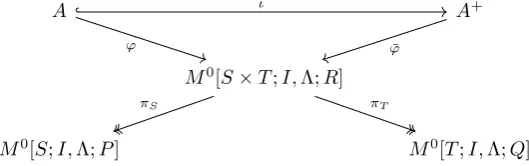
In Chapter 3, we venture into the world of Rees zero-matrix semigroups and
begin a classification of the languages that are recognised by finite semigroups.
The ‘building blocks’ of finite semigroups are the finite 0-simple semigroups and
the zero semigroups and, by The Rees Theorem (Theorem 3.1), a semigroup
with zero is completely 0-simple if and only if it is isomorphic to a Rees
zero-matrix semigroup over a group with regular sandwich zero-matrix. As such, we
investigate the languages recognised by Rees zero-matrix semigroups over the
trivial group and languages recognised by Rees zero-matrix semigroups over
finite abelian groups, concluding in each case that the generalised star-height
of these languages is at most one. To get at languages recognised by Rees
zero-matrix semigroups over finite abelian groups, we first consider languages
recognised by Rees zero-matrix semigroups over finite cyclic groups. We then
make use of properties of direct products, homomorphisms and projection maps
and appeal to the Fundamental Theorem of Finite Abelian Groups. To complete
this chapter, we take a slight detour and show that languages recognised by Rees
zero-matrix semigroups over finite monogenic semigroups are also of generalised
star-height at most one.
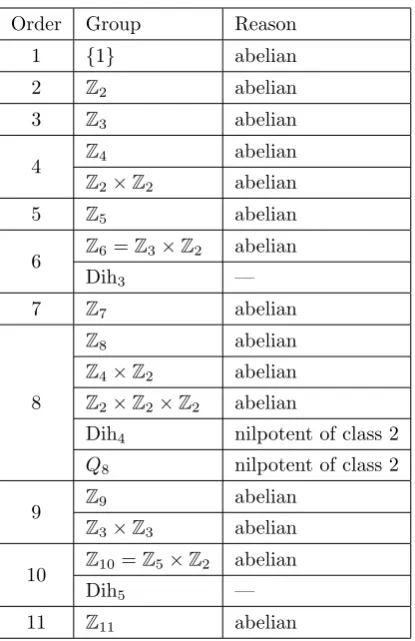
In Chapter 4, we examine which languages are recognised by finite groups
of a given order. This work is motivated by a theorem of Pin, Straubing and
Th´erien (Theorem 4.1) which states that every language recognised by a finite
group of order less than 12 is of generalised star-height at most one. Their
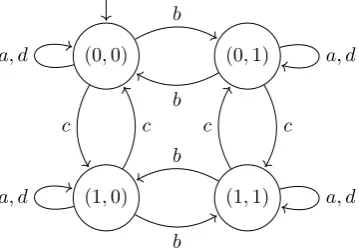
proof relies on analysing semidirect products of the formAo Z2, whereAis an
abelian group andZ2 is the cyclic group of order 2. This is done through the
use of ‘cyclic’ automata and counting arrows. We attempt to extend this work
to semidirect products of the form Ao Z3 by adhering to their proof strategy.
Unfortunately, this ultimately fails due to an issue with unique factorisation of
words into non-overlapping subwords. Nonetheless, insight into the problem is
gained even though the result is not extended to languages recognised by finite
groups of order 12 or higher.
Finally, in Chapter 5, we present some open questions that relate to both
the work portrayed in this thesis and to that of others who have contributed to
1.1
Set theory
Sets, subsets and examples
A set is a collection of objects; its members are referred to as elements. In general, we will denote sets by upper case letters and elements of sets by lower
case letters. If x is an element of a set X then we write x ∈ X; otherwise,
x /∈X. If a set has finitely many elements then it is possible to list them, and we do this using braces; for example,
X={1,2,3,4,5}.
Often, we need to describe a set by stipulating a property P that its elements
must satisfy. In this case, we write
{x|xsatisfies propertyP};
that is, the set of allxsuch thatxsatisfies propertyP. When a set has infinitely
many members we can describe it using a property or, in circumstances where
membership follows a clear pattern, through the use of ellipses; for example,
{. . . ,−4,−2,0,2,4, . . .}
denotes the set of even integers.
A set worthy of special mention is theempty set, which is denoted by∅. It is the unique set containing no elements.
Throughout this thesis, we denote the set of integers{. . . ,−1,0,1, . . .} by
Z, the set of positive integers {1,2,3, . . .} by Z+ and the set of non-negative
integers{0,1,2, . . .}byN. We often refer to elements ofNasnatural numbers.
Two setsX andY areequal if they contain precisely the same elements. A set Y is asubset of a setX if all the elements ofY are also elements ofX and we writeY ⊆X; otherwise,Y *X. IfY ⊆X andX 6=Y thenY is aproper
subset ofX and we writeY ⊂X. Importantly,∅ ⊆X andX⊆X for every set
X. It should also be noted thatZ+⊂
N⊂Z.
In many cases, we prove that two setsX andY are equal by showing that
each set is a subset of the other; that is,
X =Y ⇔X ⊆Y andY ⊆X.
Operations on sets
Given two sets X and Y, we can combine and compare them in the following
X andY; that is,
X∩Y ={z|z∈X andz∈Y}.
TheunionofX andY is the set of all elements that belong toX orY; that is,
X∪Y ={z|z∈X orz∈Y}.
The word ‘or’ never implies exclusivity, so ‘or’ always means ‘this set, that set or
both’. Therelative complement ofY with respect toX is the set of all elements that belong to X but notY; that is,
X\Y ={z|z∈X and z /∈Y}.
Theseboolean operationssatisfy a number of laws that we do not explicate here. In this thesis, we will be interested in subsets of some fixed set U. We
refer to U as theuniverse and define the setXc =U\X to be the (absolute)
complement ofX. The following equalities hold for any setsX andY:
(X∪Y)c=Xc∩Yc and (X∩Y)c=Xc∪Yc. (1.1) Collectively, these equalities are known asde Morgan’s Laws.
Products of sets and binary relations
Given two setsX and Y, define theCartesian product ofX andY by
X×Y ={(x, y)|x∈X andy∈Y};
that is, the set of all ordered pairs in which the first component is an element
of X and the second component is an element ofY. This construction can be
extended to any finite number of sets by repeated applications of the rule.
Given two setsXandY, abinary relationρis a subset of the productX×Y; that is,ρis a collection of ordered pairs (x, y) inX×Y. If (x, y) belongs toρ
thenxand y are said to beρ-related. We often use infix notation for relations and writex ρ y to show thatxandy areρ-related.
WhenX = Y, relations can satisfy certain additional properties that can
lead to further classification. A binary relation∼onX is:
• reflexive ifx∼xfor allxinX;
• symmetric ifx∼y impliesy∼xfor allxandy inX;
• antisymmetricifx∼yandy∼ximplyx=y for allxandy inX; and,
A partial order is a binary relation that is reflexive, antisymmetric and transi-tive, while anequivalence relationis a binary relation that is reflexive, symmetric and transitive. Theequivalence class ofxis defined by
[x] ={y∈X |y∼x};
that is, the set of all y in X such that y is ∼-related to x. The equivalence classespartition the setX; that is,X can be written as a disjoint union of its equivalence classes.
Functions
Let X and Y be sets. A function ϕ from X to Y is a binary relation that satisfies the following rule: for every x in X there exists precisely one y in Y
such thatx ϕ y. We refer toX as thedomain ofϕ, toY as thecodomain ofϕ
and writeϕ:X→Y. The set of all functions fromX to Y is denoted byYX.
Letϕ : X →Y be a function. An element xin X is an argument of the function and its correspondingy value inY is theimage ofxunderϕ. We write functions on the right of their arguments; that is, xϕ=y.
LetA be a subset ofX. We define theimage ofAby
im(A) ={y∈Y |y=xϕfor some x∈A};
that is, the set of ally inY such thatyis the image of somexinA. In the case
whereA=X, we refer to im(X) as the image of the functionϕ.
Now suppose thatB is a subset of Y. We define thepreimage ofB by
Bϕ−1={x∈X |xϕ∈B};
that is, the set of allxinX such that the image ofxunder ϕis an element of
B. It is important to note that
Bϕ−1= [
b∈B
bϕ−1;
that is, the preimage of a setB is the union of the preimages of the individual
elements ofB.
A functionϕ : X → Y is injective ifaϕ =bϕ implies a =b for all a and
b inX; that is, distinct elements of the domain never get mapped to the same
element of the codomain. The functionϕissurjectiveif every elementyinY has a corresponding elementxin X such that xϕ=y; in other words, im(ϕ) =Y.
1.2
Semigroups, monoids and groups
Semigroups, monoids and groups
Asemigroupis a setSequipped with a well-defined, associative binary operation
◦:S×S→S; that is,x◦(y◦z) = (x◦y)◦zfor allx, yandz inS. When the binary operation is clear, we denote the semigroup (S,◦) by S alone. We also drop the symbol denoting the binary operation and show it acting on pairs of
elements by juxtaposition; that is, we writexyinstead ofx◦y.
LetSbe a semigroup. The cardinality of the underlying set, denoted by|S|, is theorder of the semigroup. IfxandyinS satisfy the equalityxy=yxthen
x and y commute. The semigroup S is commutative if every pair of elements commute.
IfShas order at least two and there exists an element 0 in Ssatisfying the
equalities x0 = 0 = 0x for all xin S then 0 is a zero element of S and S is a semigroup with zero. It follows, by definition, that if a semigroup contains a zero element then it is unique. If S does not contain a zero element then we
can adjoin a new element 0 toS and definex0 = 0 = 0x for all xin S∪ {0}. The resulting semigroup is the semigroup obtained fromS by adjoining a zero, which we denote byS0.
In a similar vein, if there exists an element 1 inS satisfying the equalities
1x=x=x1 for allxinS then 1 is anidentity element ofS andS is amonoid or semigroup with identity. We will usually denote a monoid byM. It follows, by definition, that if a semigroup contains an identity element then it is unique.
If S does not contain an identity element then we can adjoin a new element 1
to S and define 1x=x=x1 for allxin S∪ {1}. The resulting monoid is the monoid obtained fromS by adjoining an identity, which we denote byS1.
LetM be a monoid with identity 1. If for everym in M there exists nin
M such thatmn= 1 =nmthenM is agroupandnis the inverseofm, which we denote bym−1. The inverse of a group element is, necessarily, unique. We
will usually denote a group byG. A commutative group is said to beabelian. IfAandB are subsets of a semigroupS then
AB={ab|a∈Aandb∈B}.
Whenever A =B we write A2, noting that this refers to {a
1a2 | a1, a2 ∈ A}
Substructures
A non-empty subset T of a semigroup S is a subsemigroup if it is closed with respect to the multiplication on S; that is, ifxy lies inT for allxand y in T.
IfS is a monoid then a subsemigroupT ofS is asubmonoid if 1 is an element of T. Moreover, if a subsemigroup T of S forms a group with respect to the
multiplication inherited fromSthenT is asubgroupofS. A semigroup in which every subgroup is trivial is said to beaperiodic.
A non-empty subset I of a semigroup S is called a left ideal if SI ⊆ I, a right ideal ifIS⊆I and a(two-sided) ideal if it is both a left ideal and a right ideal. By definition, all ideals ofSare also subsemigroups but the converse does
not hold. Ideals ofSinclude Sitself and, ifScontains a zero element,{0}. An idealI such that{0} ⊂I⊂S is said to beproper.
A semigroup without zero is said to besimple if it has no proper ideals. A semigroupSwith zero is said to be 0-simpleif{0}andSare its only ideals and
S26={0}.
-morphisms and congruences
LetSandTbe semigroups. A functionϕ:S →Tis asemigroup homomorphism if (st)ϕ= (sϕ)(tϕ) for allsand tin S. IfS andT are monoids with identities
1S and 1T respectively, then ϕ is a monoid homomorphism if, in addition,
1Sϕ = 1T. If, in addition, S and T are groups then ϕ is said to be a group
homomorphism and, consequently, (s−1)ϕ= (sϕ)−1for allsinS.
In all three cases, amonomorphism is an injective homomorphism, an epi-morphism is a surjective homomorphism and an isomorphism is a bijective homomorphism. If there exists an isomorphism betweenS andT then they are
isomorphic, and we write S∼=T.
A semigroup T divides a semigroup S if T is a homomorphic image of a subsemigroup ofS; that is, if there exists a subsemigroup S0 ofS and an
epi-morphismϕ:S0 →T.
Let S be a semigroup. A binary relation ρ on S is said to be compatible if s1 ρ t1 and s2 ρ t2 imply that s1s2 ρ t1t2 for all s1, s2, t1 and t2 in S. A
compatible equivalence relation is acongruence.
Ifρis a congruence on a semigroupS then thequotient semigroup is the set
Products of semigroups
Given two or more semigroups, it is possible to construct new semigroups in
various different ways.
IfSandT are semigroups then thedirect product ofSandT is the setS×T
equipped with the binary operation
(s1, t1)(s2, t2) = (s1s2, t1t2),
where s1 and s2 are elements of S and t1 and t2 are elements of T. This
construction can be extended to any finite number of semigroups by repeated
applications of the rule.
LetS and T be semigroups. For clarity, we write S additively but do not
assume that it is commutative. Aleft action ofT onS is a function
T ×S →S: (t, s)7→ts
such that
t(s1+s2) =ts1+ts2
t1(t2s) = (t1t2)s
for alls,s1 ands2in S and allt,t1andt2in T.
Given a left action ofT onS, thesemidirect product SoT is the semigroup defined onS×T by the multiplication
(s1, t1)(s2, t2) = (s1+t1s2, t1t2),
wheres1 ands2 are elements ofS andt1 andt2are elements ofT.
For any two semigroups S and T, where S is written additively but not
assumed to be commutative, thewreath product SoT is the semigroup defined onST ×T by the multiplication
(f1, t1)(f2, t2) = (f, t1t2),
wheref1andf2 are elements ofST,t1 andt2are elements ofT andf inST is
defined bytf =tf1+ (tt1)f2 for allt inT. Note that the wreath productSoT
is isomorphic to the semidirect product ST
oT.
Examples of groups
elements of X and their inverses;Gis said to be generated byX and we write
G=hXi.
Acyclic group is a group that is generated by a single element. We denote the finite cyclic group of order n by Zn and the infinite cyclic group by Z∞. Every cyclic group is abelian and will often be written additively. The following
theorem highlights the importance of cyclic groups.
Theorem 1.1 (Fundamental Theorem of Abelian Groups, [10, Theorem 2.2]).
Every finite abelian group is isomorphic to a direct product of finite cyclic groups of prime power order.
Theorem 1.1 shows that every finite abelian group can be decomposed into
a product of cyclic groups; that is, the cyclic groups are the ‘building blocks’ of
the abelian groups.
Thedihedral groupof order 2n, denoted by Dihn, is the group of symmetries
of a regularn-gon; for example, Dih3is the group of symmetries of an equilateral
triangle. If ρ represents the rotation by 2π/n of the regular n-gon about its
centre and σ represents any of the reflections of then-gon then Dihn =hρ, σi
subject to the conditions ρn = 1,σ2= 1 andρσ=σρ−1.
For a groupG, define thelower central series ofGby
G1=G and Gi+1= [Gi, G],
where [H, K] denotes the subgroup ofGgenerated by all elements of the form
h−1k−1hk, wherehis inH andkis inK. The groupGis said to benilpotent
of class mifGm6={1} andGm+1={1}.
It follows from the definition that the trivial group {1} is the only nilpo-tent group of class 0 and that the non-trivial abelian groups are precisely the
nilpotent groups of class 1. The smallest nilpotent group of class 2 is Dih4, the
dihedral group of order 8.
Pseudovarieties of monoids
A pseudovariety of monoids is a class of finite monoids that is closed under the taking of submonoids, homomorphic images and finite direct products. We
denote pseudovarieties of monoids in bold font. Examples of pseudovarieties
of monoids include: Mon, which consists of all finite monoids; Grps, which consists of all finite groups; and, AbGrps, which consists of all finite abelian groups. We definepseudovarieties of semigroups analogously.
detail): first, we find all finite direct products of elements ofC and formP(C); next, we find all submonoids of elements ofP(C) and formSP(C); finally, we find all homomorphic images of elements ofSP(C) and formHSP(C).
Given two pseudovarieties of monoidsVand W, we denote byVoWthe pseudovariety generated by all semidirect products of a monoid ofVby a monoid ofW. Similarly, we denote byVoWthe pseudovariety generated by all wreath products of a monoid of V by a monoid of W. Since SoT is isomorphic to
ST
oT for any monoidsS andT, we conclude the following:
Lemma 1.2 ([14, p. 709]). The pseudovarieties VoWandVoW are equal.
1.3
Formal languages
In this section, we aim to provide the reader with the necessary background
information required from within the field of formal language theory. Many
of the definitions and results that follow are standard. The interested reader
should consult [8] and [13] for further details.
Alphabets, letters and words
An alphabet is a finite, non-empty set; its elements are letters (or symbols). From this point onwards,A will always denote an alphabet. The total number
of letters in Ais denoted by|A|. Two alphabets worthy of note are the unary alphabet{a}and the binary alphabet{0,1}, though we will often use{a, b}for the latter so that, in order to aid understanding, all of our letters are letters in
the everyday sense of the word.
A finite sequence of letters from A is a word (over A). Thus, formally, (a1, a2, . . . , ar) is a word over some alphabet. For the sake of simplicity, we
write words with their letters juxtaposed instead; that is, a1a2. . . ar. It is
possible to take a sequence of zero letters from A; the resulting word is the
empty word and we denote it by ε. The set of all words over Ais denoted by
A∗ and the set of all non-empty words overAis denoted byA+. Note that A∗
is the union ofA+ and the empty word.
Thelengthof a wordw, denoted by|w|, is the length of the sequence defining
w; for example, |ab|= 2 and |abbab|= 5. The empty word is the unique word of length zero. If ais a letter fromA then|w|a denotes the number of timesa
appears inw; for example,|ab|a = 1 and|abbab|b = 3. Note that
|w|=X
a∈A
Two words v = a1a2. . . ar and w = b1b2. . . bs over the same alphabet A are
equal if and only ifr=sandai=bi for all 0≤i≤r; that is, if they are of the
same length and feature exactly the same letters in exactly the same order.
Given two words v and w over the same alphabet A, we can form a new
word by adjoining the letters of w to the end ofv. The resulting word is the
concatenation ofvandwand is denoted byv·w. When emphasis of the concate-nation is not required, we drop the symbol denoting concateconcate-nation and write
the resulting word asvw. It should be noted that, in general, concatenation of
words is not commutative; that is, vw 6= wv. For example, aab·ba = aabba
whereasba·aab=baaab. However, the order in which words are concatenated is unimportant when working over a unary alphabet. Note that the length of
the resulting word vwafter concatenation is equal to the sum of the lengths of
the individual words; that is, |vw|=|v|+|w|.
Concatenation of words is an associative operation; that is,u(vw) = (uv)w
for all wordsu,vandw. The empty word plays an important role with regards
to concatenation asεw=w=wεfor all words w. Because of these two facts,
the setA∗of all words overAforms a monoid under concatenation; its identity
element is the empty word. We refer to A∗ as thefree monoid generated byA. Similarly, A+ is thefree semigroup generated byA.
Ifw is a word thenwn, where n≥1, denotes the concatenation ofw with
itselfntimes. We definew0=ε. It follows that
wmwn =wm+n and (wm)n =wmn
hold for all natural numbersmandn.
Letuandv be elements ofA∗. Ifw=uvthen uis aprefix ofwandv is a suffix ofw. The prefixu(respectively, suffixv) isproper ifu6=w(respectively,
v 6=w) and non-empty if u=6 ε (respectively, v 6=ε). Any prefix of w that is also a suffix of w is a border. A border is proper if it is a proper prefix (and, therefore, also a proper suffix) andnon-empty if it is not the empty word.
Languages and operations on languages
Given an alphabetA, a monoid (respectively,semigroup)language is a subset ofA∗ (respectively,A+). For example, the setK ={an |n∈2
N} is a monoid
language over the alphabet{a}while the setL={anbn|n∈
Z+}is a semigroup
language over the alphabet{a, b}.
IfKandLare languages over the same alphabet then so too areK∪L,K∩L,
relative complement and complement, respectively. Union, intersection and
complement are boolean operations.
We now define further operations that are specific to formal language theory.
Theconcatenation productofKandLis the language consisting of all possible concatenations of a word fromK with a word fromL; that is,
KL={vw |v∈K andw∈L}.
Example 1.3. Examples of products of languages include:
1. For every languageL,L∅=∅=∅L. 2. For every languageL,{ε}L=L=L{ε}. 3. If K={a, ab}andL={b, ba, bb} then
KL={ab, aba, abb, abba, abbb}
and
LK={ba, bab, baa, baab, bba, bbab}.
The third part of Example 1.3 shows that, in general,KL6=LK. Moreover,
KLandLK need not have the same cardinality.
The next language operation that we wish to define is that of (theKleene) star. IfLis a language then we defineL0={ε},Ln+1=LnLand
L∗= [
n≥0
Li.
Example 1.4. Examples of Kleene stars of languages include:
1. ∅∗={ε}. 2. {ε}∗={ε}.
3. If L={a3}thenL∗={ε, a3, a6, a9, . . .}.
4. If L={a, ab}thenL∗={ε, a, ab, aa, aab, aba, abab, . . .}.
A related notion is that of the(Kleene) plus operation, which is defined by
L+= [
n≥1
Li.
Thus,L∗=L+∪ {ε}.
IfK andLare two languages ofA∗ then theleft quotient (orresidual) ofL
byK is the languageK−1Ldefined by
K−1L={v∈A∗| ∃u∈K such thatuv∈L}.
Example 1.5. Examples of left and right quotients of languages include:
1. For every languageL,{ε}−1L=L=L{ε}−1.
2. For every languageLcontainingε,L−1{ε}={ε}={ε}L−1.
3. For every languageLnot containingε, L−1{ε}=∅={ε}L−1.
By combining the above operations in different ways, we can write down a
wide range of expressions that represent certain languages. In order to avoid the tedious nature of writing { and } repeatedly, we will omit them and use ( and ) as and when required for avoiding ambiguity. This is especially prevalent
for singleton sets; the set{w} will virtually always be written asw.
Example 1.6. Examples of languages over the alphabetA={a, b}:
1. We can write the set of all words over A, namely A∗, as (a∪b)∗. Here, brackets are included asa∪b∗ represents an entirely different language. For comparison,
A∗= (a∪b)∗={ε, a, b, aa, ab, ba, bb, aaa, . . .},
while
a∪b∗={a, ε, b, bb, bbb, . . .}.
This example reflects the convention that the star operation takes
prece-dence over the union operation.
2. The language K in which all words have prefix ab is represented by the
expressionab(a∪b)∗.
3. The language L in which all words have suffix ab is represented by the
expression (a∪b)∗ab.
4. The language in which all words have borderab, namely K∩L, is repre-sented by the expression
ab(a∪b)∗∩(a∪b)∗ab.
Thus, an expression representing the intersection of two languages is given
by the intersection of the two expressions representing each individual
lan-guage. The same conclusion can be drawn for each of the other operations
described above.
Hierarchy of languages
regular
∩
context-free
∩
context-sensitive
∩
recursive
∩
recursively enumerable
As can be seen, each class is a proper subclass of the class above it. For
example, every regular language is also context-free but there exist context-free
languages that are not regular. The archetypal example is that of the language
{anbn|n≥1}, which is context-free but not regular.
If we omit the class of recursive languages, then the hierarchy is attributed
to the linguist Noam Chomsky. He first described the hierarchy in 1956 in terms
of classes of formal grammars, a topic which we do not touch upon in this thesis.
It should be noted that the vast majority of languages do not fit into this
hierarchy and, as such, the hierarchy cannot be considered as a complete
clas-sification of languages.
Regular languages via regular expressions
Within this thesis, we concern ourselves with the ‘simplest’ class of languages;
that is, the regular languages. In older literature, this class of languages is
also referred to as the class ofrational languages. Depending on one’s point of view, there are four different ways for defining the class of regular languages:
grammars, as seen in the Chomsky hierarchy; a combinatorial approach; an
algebraic approach; and, an approach via theoretical machines. In this thesis,
we opt for the second of these approaches as our definition, though the third
and fourth approaches will also be introduced and used throughout.
Given an alphabet A, we define the empty set, the empty word and each
letter in Ato be a basic regular expression. We recursively define new regular expressions in the following manner: ifEandF are regular expressions then so are
(RE1) EF (product);
Product, union and star are referred to as theregular operators, and they work in exactly the same way as in their definitions for languages. For example,
E∗= [
n≥0
En.
The operations have an order of precedence: star, then product, then union.
In Example 1.6, the first three examples all feature regular expressions whereas
the fourth does not, as intersection is not a regular operator.
Every regular expressionErepresents a language, which we denote byL(E).
This leads to an important definition.
Definition 1.7. A languageL isregular if there exists a regular expressionE
such thatL=L(E).
It is important to note that a regular language can be represented by more
than one regular expression. For example, we have seen in Example 1.6 that
the languageA∗can be represented by the regular expression (a∪b)∗. However,
A∗ can also be represented by the regular expression (a∗∪b∗)∗.
Since we have also defined the intersection, relative complement and
com-plement operations, it is natural to ask what happens to the class of regular
languages under these operations. Interestingly, applying these operations to
a regular language returns a language that is also regular. Specifically, the
following is true.
Lemma 1.8 ([16, Corollary I.3.5]). The class of regular languages is closed under complementation.
Now, since every regular language is represented by a regular expression, it
follows that we can use the complement operator in our expressions without
introducing any new languages which are not regular. As such, any expression
that uses the complement operator as well as product, union and star is referred
to as a generalised regular expression. Note that, through de Morgan’s Laws (Equation (1.1)), we are also free to use the intersection and relative complement
operations within our generalised regular expressions.
Example 1.9. Examples of generalised regular expressions over the alphabet
A={a, b}:
1. The expression
(a∪b)∗(ab∪ba)c
represents the language in which all words do not have suffix ab or ba;
2. The expression
a(a∪b)∗\aa(a∪b)∗
represents the language in which all words have prefixabut do not have
prefixaa.
3. The expression
ab(a∪b)∗∩(a∪b)∗ab
(as seen in Example 1.6) represents the language in which all words have
borderab.
Recognition of a language by a monoid
By definition, a language is a subset of the free monoid generated by the set
A. Because of this, it seems natural for there to be an algebraic approach to
languages through the world of monoids. Indeed, the following definition can
be made.
Definition 1.10. A language L of A∗ is recognised by a monoid M if there exists a monoid homomorphism ϕ:A∗→M such thatL= (Lϕ)ϕ−1.
In literature, the following alternative definition may also be found.
Definition 1.11. A language L of A∗ is recognised by a monoid M if there exists a monoid homomorphism ϕ: A∗ → M and a subset P of M such that
L=P ϕ−1.
In either case, if there exists a monoidM such thatL is recognised by M
thenLis said to be recognisable.
In the following lemma, we show the above two definitions are equivalent.
Lemma 1.12. Let X and Y be sets and ϕ: X → Y be a function. For any subset L of X, it follows thatL= (Lϕ)ϕ−1 if and only ifL=P ϕ−1 for some subset P ofY.
Proof. If L = (Lϕ)ϕ−1 then L = P ϕ−1 with P =Lϕ. Conversely, note that
L is always a subset of (Lϕ)ϕ−1, since if l ∈ L then lϕ ∈ Lϕ and therefore
l∈ {x∈X |xϕ∈Lϕ}= (Lϕ)ϕ−1. Now, ifL=P ϕ−1for some subset P ofY
then
w∈(Lϕ)ϕ−1⇒wϕ∈Lϕ
⇒wϕ=vϕfor some v∈L
⇒w∈P ϕ−1=L.
Hence (Lϕ)ϕ−1⊆Land, therefore,L= (Lϕ)ϕ−1.
In this thesis, we will allow ourselves the freedom to use the definition that
is more convenient in each given situation.
The following characterisation of regular languages is, on rare occasions,
used as its ‘algebraic’ definition.
Theorem 1.13 ([8, Theorem 3.1.4]). A language is regular if and only if it is recognised by a finite monoid.
A language may be recognised by more than one monoid, so it is natural to
ask what the ‘smallest’ monoid recognising a given language is. In this setting,
‘smallest’ refers to the cardinality of the monoid recognising the language.
Syntactic monoids
LetLbe a language over an alphabetA. Thesyntactic congruenceofL, denoted byσL, is defined by x σL y if and only if
uxv∈L⇔uyv∈L
for alluandv inA∗. The monoid Syn(L) =A∗/σL is thesyntactic monoid of
L.
The syntactic monoid of a language is the smallest monoid recognising said
language. This is captured in the following lemma.
Lemma 1.14([8, Theorem 3.1.6]). LetLbe a language. A monoidM recognises
L if and only ifSyn(L)divides M.
More generally, we can use the fact that division of monoids is a transitive
relation (that is, ifM divides N andN dividesP thenM dividesP) to prove
the following corollary.
Corollary 1.15. Let M and N be monoids and let L be a language. If M
recognisesL andM divides N thenN recognisesL.
Combining Theorem 1.13 and Lemma 1.14 results in the following theorem.
Varieties of languages
A variety of monoid languages L is a family of languages LA, where A ranges
over all alphabets, such that the following conditions hold:
(VL1) for each alphabet A, the set of languagesLA is a subset of P(A∗)
that is closed under the Boolean operations;
(VL2) for each alphabetA, each language Lin LA and each letterainA,
botha−1LandLa−1belong toLA; and,
(VL3) if ϕ : A∗ → B∗ is a monoid homomorphism and L belongs to LB
thenLϕ−1 belongs toL
A.
We can also define avariety of semigroup languages in an analogous way by replacing all occurrences of∗ with +. It is important to note that the variety of semigroup languages and the variety of monoid languages are fundamentally
different. This is due to the fact that in a variety of monoid languages,
condi-tion (VL3) allows us to ‘erase’ letters by replacing them with the empty word.
However, this is not possible when considering varieties of semigroup languages.
In the following theorem, we establish the link between pseudovarieties of
monoids and varieties of monoid languages. The result remains true when
‘monoid’ is replaced by ‘semigroup’.
Theorem 1.17 (Eilenberg’s Variety Theorem, [5, Theorem VII.3.4s]). There exists a one-to-one correspondence between the collection of all pseudovarieties of monoids and the collection of all varieties of monoid languages.
The connection in Eilenberg’s Variety Theorem is established in the
follow-ing way. Given a pseudovariety of monoids M, the corresponding variety of monoid languages consists of all those languages whose syntactic monoid is in
M. Conversely, given a variety of monoid languagesL, the corresponding pseu-dovariety of monoids is generated by the syntactic monoids of those languages
in L. As an example, if we consider the trivial pseudovariety of monoids Triv
then the corresponding variety of monoid languages is
L(Triv) ={{∅, A∗} |Ais an alphabet}.
1.4
Generalised star-height problem
LetAbe an alphabet and letEandF be regular expressions for some languages
• h(∅) =h(ε) =h(a) = 0, whereais a letter fromA;
• h(EF) =h(E∪F) = max{h(E), h(F)}; and,
• h(E∗) =h(E) + 1.
For a regular languageL, we define the star-height of L, which we denote byh(L), to be
h(L) = min{h(E)|E is a regular expression forL};
that is, the minimum star-height of all regular expressions representingL.
Example 1.18. Let A ={a, b} be an alphabet and consider the expressions
E = (a∪b)∗ and F = (a∗ ∪b∗)∗. We see that h(E) = 1 and h(F) = 2. However, E andF both represent the language L =A∗. Since there does not
exist an expression of star-height zero representing this language, we conclude
that h(L) = 1.
The following questions were posed by Eggan in 1963.
Question 1.19 (Star-Height Problem). Can all regular languages be expressed using regular expressions of limited star-height? If not, does there exist an al-gorithm to determine the star-height of a given regular language?
The first of these questions was answered in the negative when Eggan [4,
Corollary 3.1] illustrated the existence of regular languages of star-heightnfor
all natural numbers n. Expressions for languages of star-height 1, 2 and 3 are
as follows:
E1=a∗1
E2= (a∗1a∗2a3)∗
E3= ((a∗1a∗2a3)∗(a∗4a∗5a6)∗a7)∗.
These expressions can be defined recursively. Note that the expression En
re-quires an alphabet of size at least 2n −1. In his concluding remarks, Eggan
questioned whether a language of star-height n could be found for all natural
numbers n in the case whereA is a binary alphabet. This was answered
pos-itively by Dejean and Sch¨utzenberger [3] in 1966. The expressions are defined
recursively by
E1= (ab)∗ and En+1= (a . . . a
| {z }
2n
·En·b . . . b
| {z }
2n
·En)∗.
Thus, explicitly, the expressions are
E2= (aa(ab)∗bb(ab)∗)∗
E3= (aaaa(aa(ab)∗bb(ab)∗)∗bbbb(aa(ab)∗bb(ab)∗)∗)∗
.. .
The second question posed in Question 1.19 was answered positively by
Hashiguchi [6, Theorem 4.2] in 1983, but the algorithm he provided was
compu-tationally impossible from a practical point of view. A more efficient algorithm
was devised by Kirsten [11] in 2005 but this algorithm is still deemed to be
practically infeasible.
By Lemma 1.8, we know that the class of regular languages is closed under
complementation. This allows us to use generalised regular expressions in order
to represent regular languages. Thus, we can extend the definition of star-height
of a regular expression to that of the generalised star-height of a generalised regular expression by defining h(Ec) =h(E). It follows by de Morgan’s Laws
(Equation (1.1)) that
h(E∩F) =h((Ec∪Fc)c) =h(Ec∪Fc)
= max{h(Ec), h(Fc)}
= max{h(E), h(F)}
and
h(E\F) =h(E∩Fc) = max{h(E), h(Fc)}= max{h(E), h(F)}.
We define thegeneralised star-height of a regular languageLas in the restricted case; that is,
h(L) = min{h(E)|E is a generalised regular expression forL}.
We can now pose the same questions as in Question 1.19:
Question 1.20 (Generalised Star-Height Problem). Does there exist an algo-rithm to determine the generalised star-height of a regular language? In partic-ular, does there exist a language of generalised star-height greater than one?
As implied by the phrasing of the questions above, the generalised star-height
problem is considerably more difficult to solve than the star-height problem;
remarkably, it is not yet known whether there exist languages with generalised
star-height two or greater.
To end this section, we state some known results regarding the generalised
star-height problem. This list is not exhaustive and further known results have
Lemma 1.21. For every natural numbern, the set of languages of generalised star-height at most nis closed under set difference, concatenation product and the Boolean operations.
Proof. This follows directly from the definition of generalised star-height.
Proposition 1.22 ([15, Proposition 4.1]). For every natural numbern, the set of languages of generalised star-height at most n is closed under left and right quotients.
One of the first and by far the most influential result concerning generalised
star-height is the following theorem.
Theorem 1.23 (Sch¨utzenberger, [17]). A regular language is of generalised star-height zero if and only if its syntactic monoid is finite and aperiodic.
Sch¨utzenberger’s Theorem gives us an algorithm for determining whether or
not a given language is of generalised star-height zero. This is most easily done
through the use of finite state automata, which are introduced in Section 1.5.
Ideally, it would be most convenient if, given a generalised regular expression,
we had a technique for removing stars without altering the language that it
represents. In one of the most elementary cases, this can be done directly.
Lemma 1.24 ([15, Lemma 3.3]). For any alphabetA and any subsetB of A,
A∗=∅c and B∗=A∗\(A∗(A\B)A∗) = (∅c(A\B)∅c)c.
Hence,
h(A∗) =h(B∗) = 0.
Proof. LetA be an alphabet and letB be a subset ofA. The first equality is trivially true as the set of all words over A is equal to the complement of the
set of no words overA.
Consider the second equality. We see that
w∈B∗⇔w=εor w=b1b2. . . brfor some b1, b2, . . . , br∈B
⇔wis not of the formA∗aA∗, wherea∈A\B
⇔w6∈A∗(A\B)A∗
⇔w∈(A∗(A\B)A∗)c
⇔w∈A∗\(A∗(A\B)A∗).
Since neither the expression forA∗nor the expression forB∗ contain any stars,
Though not a technique for removing stars, the Transfer Lemma ([15, Lemma
6.1]) can be used for reducing the height of a given generalised regular
expres-sion. Informally, it ‘transfers’ stars from one letter to another through the use
of a substitution. We do not record this result here as it is not required in this
thesis and only proves useful in a handful of cases.
1.5
Finite state automata
A(finite state) automaton is a quintupleA= (S, A, s0, δ, T), where
• S is a finite set ofstates;
• Ais aninput alphabet;
• s0in S is theinitial state;
• δ:S×A→S is thetransition function; and,
• T ⊆S is a set ofterminal states.
In order to ensure thatδis a valid function, we insist that all of our automata
arecomplete anddeterministic, meaning thatδ(s, a) is uniquely defined for all
sin S and allain A.
We represent automata using transition diagrams, which are special types of directed, labelled graphs. The vertices are labelled by elements of S and
there exists an arrow from the vertexs to the vertext labelled by the lettera
wheneverδ(s, a) =t. The initial state is identified by an inward-pointing arrow
and terminal states are identified by a double border.
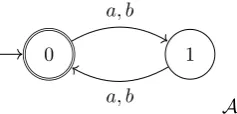
Example 1.25. Define an automatonA= (S, A, s0, δ, T) by
• S={0,1};
• A={a, b};
• s0= 0;
• δ(0, a) = 1,δ(0, b) = 1, δ(1, a) = 0 andδ(1, b) = 0; and,
• T ={0}.
The transition diagram ofAis shown in Figure 1.1.
0 1
a, b
a, b
[image:31.595.241.360.626.683.2]A
For any given automaton, we can uniquely extend the transition functionδ
to the domainS×A∗; that is,δ:S×A∗→S. We define
(ETF1) δ(s, ε) =s; and,
(ETF2) δ(s, wa) =δ(δ(s, w), a).
Thus, we can now deal with input words and not just input letters.
LetA= (S, A, s0, δ, T) be an automaton. A wordwoverAisaccepted byA
if there exists a path labelled byw beginning at the start state and ending at
some terminal state; that is, if δ(s0, w) lies inT. Otherwise,wis rejected. We
define the languagerecognised byA, which we denote byL(A), to be
L(A) ={w∈A∗|δ(s0, w)∈T};
that is, the set of all wordsw that are accepted byA.
Example 1.26. The automaton in Example 1.25 accepts the words
ε, aa, ab, ba, bb, aaaa, aaab, aaba, aabb, . . .
and rejects the words
a, b, aaa, aab, aba, abb, baa, bab, bba, bbb, aaaaa, . . . .
Thus,L(A) = (aa∪ab∪ba∪bb)∗; that is, the set of all words of even length.
At this point, we make note of the following theorem of Kleene, which ties
together the concept of regular languages to that of finite state automata.
Theorem 1.27 (Kleene, [12]). A language is recognisable if and only if it is regular.
Theorem 1.27 establishes a connection between the concept of regular
lan-guages and the concept of recognisable lanlan-guages; indeed, it shows that they are
equivalent notions. This means that we can construct automata for languages
in order to prove that they are regular and can tackle the generalised star-height
problem via automata too.
LetL be a recognisable language. An automaton A is said to beminimal (for L) if Arecognises Land any other automaton recognising L has at least as many states as A. It is clear from this definition that every recognisable language has an associated minimal automaton, and this automaton is unique
up to isomorphism.
LetA= (S, A, s0, δ, T) be an automaton. For eachwinA∗, define a function
The set of all such functions, which we denote byT(A), is called thetransition monoid ofA; that is,
T(A) ={τw|w∈A∗}.
The identity element ofT(A) isτε.
Theorem 1.28 ([13, Theorem 9.4.3]). Let L be a recognisable language. The transition monoid of the minimal automaton forLis isomorphic to the syntactic monoid ofL.
A related notion that we will make use of in Chapter 2 is that of a transducer.
A(finite state) transducer is a sextupleA= (S, A, B, s0, δ, γ), where
• S is a finite set ofstates;
• Ais aninput alphabet;
• B is anoutput alphabet;
• s0in S is theinitial state;
• δ:S×A→S is thetransition function; and,
• γ:S×A→B∗ is theoutput function.
In order to ensure thatδis a valid function, we insist that all of our
trans-ducers are complete and deterministic.
As with automata, we represent transducers using transition diagrams where
the label “a|w” on an arrow means “read the input letteraand output the word
w”.
Example 1.29. Define a transducerA= (S, A, B, s0, δ, γ) by
• S={0,1};
• A={a, b};
• B={a, b};
• s0= 0;
• δ(0, a) = 1,δ(0, b) = 1, δ(1, a) = 1 andδ(1, b) = 1; and,
• γ(0, a) =b,γ(0, b) =a,γ(1, a) =aandγ(1, b) =b.
The transition diagram ofAis shown in Figure 1.2.
0 1
a|b, b|a
a|a, b|b
A
Figure 1.2: Transition diagram for the automatonAin Example 1.29.
For any non-empty wordwoverA, this transducer replaces the first letter of
wwith the other letter inAand leaves the rest of the word intact; for example,
For any given transducer, we can uniquely extend the domain ofδtoS×A∗
in exactly the same way as we do with automata. Moreover, we can uniquely
extend the domain of γtoS×A∗ by defining
(EOF1) γ(s, ε) =ε; and,
(EOF2) γ(s, wa) =γ(s, w)γ(δ(s, w), a).
The functionσ:A∗→B∗ realised byAis defined bywσ=γ(s0, w) and a
Chapter 2
Counting Subwords
2.1
Motivation
Our motivation for counting subwords stems from a theorem of Th´erien (see
Theorem 2.1 below), first proved in 1983. Th´erien’s Theorem establishes a
connection between counting scattered subwords and recognition of a language
by a finite nilpotent group.
A word w = a1a2. . . ar is a scattered subword of a word v if there exist
wordsv0, v1, . . . , vroverAsuch thatv=v0a1v1a2. . . arvr. We use the notation v
w
to denote the number of times wappears as a scattered subword of v. As
an example, the words bc,ba and aaare all scattered subwords of abaca, with
abaca bc
= 1, abacaba
= 2 and abacaaa
= 3.
For every word w in A+, every natural number k and every integer n
greater than or equal to 2 with 0 ≤ k < n, we define the regular language ScatModCount(w, k, n) by
ScatModCount(w, k, n) =nv∈A∗|
v
w
≡k (modn)o;
that is, the set of words v overA such thatw appears as a scattered subword
ofv preciselykmodulontimes.
We can now state Th´erien’s Theorem:
Theorem 2.1 (Th´erien, [18, Theorem 5]). A language is recognised by a finite nilpotent group of classmif and only if it is a boolean combination of languages of the form ScatModCount(w, k, n), where|w| ≤m.
Despite this characterisation, there are surprisingly few results concerning
This is due to the fact that determining the generalised star-height of the
lan-guages ScatModCount(w, k, n) is much harder than it first appears. The
follow-ing results summarise what is known:
Theorem 2.2 (Henneman, [7]). Every language recognised by a finite abelian group (that is, a finite nilpotent group of class one) is of generalised star-height at most one.
Theorem 2.3 ([15, Theorem 7.3]). Every language recognised by a finite nilpo-tent group of class two is of generalised star-height at most one.
Very little is known about the generalised star-height of languages recognised
by finite nilpotent groups of higher class. The following result showcases what
can be established for a certain word form, and this result is used in the proof
of the partial result for nilpotent groups of class three.
Proposition 2.4 ([15, Theorem 7.4]). Let aandb be two distinct letters from an alphabet A. The generalised star-height ofScatModCount(aibaj, k, n)is at most one for all natural numbers i,j,kandn withn≥2 and0≤k < n.
Theorem 2.5 ([15, Theorem 7.5]). Let a, b and c be letters from an alpha-bet A. If n ≥ 2 is a square-free integer then the generalised star-height of ScatModCount(abc, k, n)is at most one for all natural numberskwith0≤k < n.
Occurrences of scattered subwords can be considered as a partial order on
the set of wordsA∗. Indeed, we can define an order≤scat by
v≤scatw⇔vis a scattered subword ofw.
A second partial order that we can place on A∗ is that of occurrences of
contiguous subwords. Define the order≤cont by
v≤contw⇔v is a contiguous subword ofw.
The concept of contiguous subword is defined in Section 2.2 and forms the basis
of the remainder of this chapter.
The results found in Sections 2.3 and 2.4 have been published in [2].
2.2
Definitions
ababa. From this point on, the word ‘subword’ will always means contiguous
subword.
For every wordwin A+ and every word v in A∗, we denote the number of
times thatwappears as a subword ofv by|v|w. Whenwis a letter, sayw=a,
the notation|v|a coincides with its usual meaning; that is, the number of times
the letteraappears in a wordv.
For every wordwinA+and every natural numberk, we define the language
Count(w, k) by
Count(w, k) ={v∈A∗| |v|w=k};
that is, the set of words v over A such that w appears as a subword of v
precisely k times. As such, we regard Count(w,0) as the set of all words that
do not featurewas a subword. From this characterisation, we note that
v∈Count(w,0)⇔v∈A∗\A∗wA∗⇔v∈(A∗wA∗)c⇔v∈(∅cw∅c)c, (2.1) where the final equivalence follows by Lemma 1.24. Thus, for a fixed word w,
Count(w,0) can be represented by a star-free expression and is, therefore, of
generalised star-height zero.
In order to simplify the proofs of some of the forthcoming results, we
intro-duce the language CountBorder(w, k) which is defined by
CountBorder(w, k) =wA∗∩Count(w, k)∩A∗w;
that is, the set of wordsv overAsuch thatwis a prefix ofv,wis a suffix ofv
andwappears as a subword of vpreciselyk times.
In a similar manner, for every wordw in A+, every natural number k and
every integerngreater than or equal to 2 with 0≤k < n, we define the language ModCount(w, k, n) by
ModCount(w, k, n) ={v∈A∗| |v|w≡k (mod n)};
that is, the set of words v over A such that w appears as a subword of v
precisely k modulontimes. When finding expressions for ModCount(w, k, n),
our general strategy is to first count koccurrences of the subword wand then
repeat in multiples ofn.
Throughout this chapter we will treat ModCount(w,0, n) as a special case.
With slight abuse of notation, we see that
ModCount(w,0, n) = Count(w,0)∪ModCount(w, n, n).
This equality is true as, on the right-hand side, the Count(w,0) term covers all
term covers all words that contain occurrences ofw in positive multiples ofn.
The reverse inclusion is immediate.
Notice that ModCount(w, k, n) can be defined in terms of Count(w, k);
ex-plicitly,
ModCount(w, k, n) = [
m≥0
Count(w, k+mn).
At first glance, it may appear that the generalised star-height of the language
ModCount(w, k, n) is equal to the maximum star-height of Count(w, k+mn),
where m ranges over all natural numbers. However, this is not the case as
the union on the right-hand side is infinite and is, therefore, not a generalised
regular expression.
The regularity of both Count(w, k) and ModCount(w, k, n) can be
estab-lished directly by constructing finite state automata accepting the languages
and appealing to Kleene’s Theorem. Alternatively, regularity can be
estab-lished by constructing regular expressions for the languages, as is the case in
the results presented throughout this chapter.
2.3
Over a unary alphabet
Let A = {a} be a unary alphabet and consider the word w = ar, wherer is
a positive integer. It is well known that a language Lover A is regular if and
only if L is of the form X∪Y(as)∗, where X and Y are finite sets and s is a natural number; see, for example, [16, Proposition II.2.3]. Thus, every language
over a unary alphabet is of generalised star-height at most one. However, we
want to find expressions of minimal generalised star-height for Count(ar, k) and ModCount(ar, k, n).
We begin by finding an expression for Count(ar, k). If we consider an
ar-bitrary word as, where s is a positive integer, then, with the exception of the finalr−1 letters, eachaappearing inas is the start of an occurrence ofar. It
immediately follows that
Count(ar, k) =ar+k−1 (2.2) fork≥1, and, as an alternative to that previously established in Equation (2.1),
Count(ar,0) =ε∪a∪ · · · ∪ar−1. (2.3) Next, we find an expression for ModCount(ar, k, n) for non-zero values of
then repeat in multiples of n. Recalling the expression for Count(ar, k) in
Equation (2.2) we obtain
ModCount(ar, k, n) =ar+k−1(an)∗. (2.4) An expression for the remaining language, namely ModCount(ar,0, n), is
ob-tained by using similar reasoning, while keeping in mind the special nature of
Count(ar,0) as in Equation (2.3); it yields
ModCount(ar,0, n) =ε∪a∪ · · · ∪ar−1∪ar+n−1(an)∗.
It should be noted that the expression for ModCount(ar, k, n) actually only
depends onr+kandn. Thus, different combinations of the parametersr, kand
nmay lead to the same regular expression and, hence, the same language. For
example, ModCount(a3,1,4), ModCount(a2,2,4) and ModCount(a,3,4) are all
represented by the expressiona3(a4)∗.
A combination of the above constitutes a proof for the following lemma:
Lemma 2.6. Let A= {a} be a unary alphabet. For every positive integer r, the language Count(ar, k) is of generalised star-height zero and the language
ModCount(ar, k, n)is of generalised star-height at most one.
2.4
Over a non-unary alphabet
We now deal with the more complicated case of counting subwords over a
non-unary alphabet. Our plan of attack here is to start by exploring the languages
in which we count subwords of length one, then explore the languages in which
we count subwords of length two, and so on.
When counting subwords of length two, we notice that our arguments can
be generalised to a wider class of languages, namely those in which we count
subwords that have the empty word as their only border and those in which we
count subwords which are powers of a letter.
Counting subwords of length three is the first situation where a spanner is
thrown in the works, and it is after this stage that we generalise our methods in
order to explore the languages in which we count subwords of any fixed length.
2.4.1
Counting subwords of length 1
Counting subwords of length one equates to counting how many times a
cer-tain letter appears in a word. As such, the languages ModCount(a, k, n) and
fixedk andn. Hence, counting subwords of length one is covered by the
previ-ously stated theorem of Henneman:
Theorem 2.7 (Henneman, [7]). Every language recognised by a finite abelian group is of generalised star-height at most one.
Proof. LetLbe a language recognised by a abelian group. By Theorem 2.1, L
is a boolean combination of languages of the form ModCount(a, k, n), wherea
is a letter. An expression for ModCount(a, k, n) is given by
ModCount(a, k, n) = (B∗a)k((B∗a)n)∗B∗,
where B = A\ {a}. By Lemma 1.24, h(B∗) = 0. Hence, the generalised star-height of ModCount(a, k, n) is at most one and, in turn, the generalised
star-height ofL is at most one.
2.4.2
Counting subwords of length 2
Next, we consider the case where the subwordwunder consideration is of length
two. In this situation, every word is either of the form aa or of the formab,
where a and b are distinct letters from an alphabet A; that is, every word of
length two is either a power of a letter or has the empty word as its maximal
border. As such, we consider these two cases in full generality, beginning with
the latter.
Suppose that w has maximal border ε, meaning that w does not overlap
itself. Once we have started to read w we can continue reading it until it
ends without worrying that another occurrence ofw may have already begun.
From Equation (2.1), we know that Count(w,0) can be represented by the
star-free expression (∅cw∅c)c. From this we can obtain an expression representing
Count(w, k) which is star-free:
Count(w, k) = (Count(w,0)·w)k·Count(w,0). (2.5) As can be seen from this expression, we begin with a word from Count(w,0),
which may be empty, and then count thekoccurrences of the subword w, with
each pair of occurrences ‘padded’ by a (possibly empty) word from Count(w,0).
We finish with a word from Count(w,0), which, again, may be empty.
We now turn our attention to counting occurrences ofwmodulon. Following
our general strategy, an expression for ModCount(w, k, n) which is of generalised
star-height one is given by