REFLECTION AND HYPER-PROGRAMMING IN PERSISTENT PROGRAMMING SYSTEMS
Graham N. C. Kirby
A Thesis Submitted for the Degree of PhD at the
University of St. Andrews
1992
Full metadata for this item is available in Research@StAndrews:FullText
at:
https://research-repository.st-andrews.ac.uk/
Please use this identifier to cite or link to this item: http://hdl.handle.net/10023/1673
This thesis should be referenced as:
Reflection and Hyper-Programming in
Persistent Programming Systems
Graham N. C. Kirby
Department of Mathematical and Computational Sciences
University of St Andrews
St Andrews
Fife KY16 9SS
Abstract
In an orthogonally persistent programming system, data is treated in a manner independent of its persistence. This gives simpler semantics, allows the programmer to ignore details of long-term data storage and enables type checking protection mechanisms to operate over the entire lifetime of the data.
The ultimate goal of persistent programming language research is to reduce the costs of producing software. The work presented in this thesis seeks to improve programmer productivity in the following ways:
• by reducing the amount of code that has to be written to construct an application; • by increasing the reliability of the code written; and
• by improving the programmer’s understanding of the persistent environment in which applications are constructed.
Two programming techniques that may be used to pursue these goals in a persistent environment are type-safe linguistic reflection and hyper-programming. The first provides a mechanism by which the programmer can write generators that, when executed, produce new program representations. This allows the specification of programs that are highly generic yet depend in non-trivial ways on the types of the data on which they operate. Genericity promotes software reuse which in turn reduces the amount of new code that has to be written. Hyper-programming allows a source program to contain links to data items in the persistent store. This improves program reliability by allowing certain program checking to be performed earlier than is otherwise possible. It also reduces the amount of code written by permitting direct links to data in the place of textual descriptions.
Both techniques contribute to the understanding of the persistent environment through supporting the implementation of store browsing tools and allowing source representations to be associated with all executable programs in the persistent store.
Acknowledgements
I thank my supervisor Ron Morrison for his support, guidance and enthusiasm. He has succeeded in providing a superb research environment.
Ron Morrison, Richard Connor, Quintin Cutts, Al Dearle and Dave Stemple have all been directly involved in the research described in this thesis. I thank them and the other members of the PISA group at St Andrews, Fred Brown, Dave Munro and Craig Baker, for the benefits of numerous discussions. I have also been helped by talking with Alex Farkas, Tim Sheard, John Rosenberg and Malcolm Atkinson.
Ron Morrison, Dave Stemple and Richard Connor provided invaluable constructive criticism during the writing of this thesis.
Contents
1 Introduction ...1
1.1 Persistence and Software Costs...1
1.2 The FIDE View of Software Production...2
1.3 Persistence as a Platform...3
1.3.1 Writing Less Code ...3
1.3.2 Writing More Reliable Code ...4
1.3.3 Understanding the Persistent Environment ...4
1.3.4 Research Topics ...4
1.4 Linguistic Reflection ...5
1.5 Hyper-Programming ...5
1.6 Software Products ...6
1.7 Thesis Structure...6
2 Reflection ...7
2.1 Introduction ...7
2.1.1 Behavioural Reflection ...7
2.1.2 Linguistic Reflection ...8
2.1.2.1 Characterisation ...8
2.1.2.2 Lisp...8
2.1.2.3 POP-2 ...9
2.1.2.4 TRPL ... 10
2.1.2.5 PS-algol ... 11
2.1.2.6 Napier88 ... 13
2.2 Type-Safe Linguistic Reflection ... 14
2.3 Anatomy of Type-Safe Linguistic Reflection ... 16
2.3.1 Reflection in General ... 16
2.3.2 Compilation... 19
2.3.3 Compile-Time Linguistic Reflection ... 20
2.3.4 Optimised Compile-Time Linguistic Reflection... 21
2.3.5 Run-Time Linguistic Reflection ... 23
2.3.6 Combined Compile-Time and Run-Time Linguistic Reflection ... 25
2.4 Dimensions of Type-Safe Linguistic Reflection... 25
2.4.1 Initiation of Reflection ... 26
2.4.2 Time of Generator Execution... 26
2.4.3 Nature of Generators ... 26
2.4.5 Time of Type Checking of Generated Code ... 27
2.4.6 Execution Environment of Generated Code ... 27
2.4.7 Linking Generated Code into the Original Program ... 27
2.4.8 Characterisation of TRPL, PS-algol and Napier88 ... 27
2.4.8.1 TRPL ... 27
2.4.8.2 PS-algol ... 28
2.4.8.3 Napier88 ... 29
2.5 Applications of Type-Safe Linguistic Reflection ... 30
2.5.1 Genericity and Efficiency ... 30
2.5.2 Software Evolution in Persistent Systems ... 32
2.5.3 Implementing Data Models... 35
2.5.4 Optimising Implementations ... 35
2.5.5 Validating Specifications ... 35
2.6 Anatomy of Generators ... 36
2.6.1 Generator Components ... 36
2.6.2 Components in TRPL Generators ... 37
2.6.3 Components in PS-algol Generators ... 37
2.6.4 Components in Napier88 Generators ... 38
2.6.5 Factors in Understanding Generators... 39
2.7 Research Areas... 39
2.8 Conclusions ... 40
3 Hyper-Programming ... 42
3.1 Introduction ... 42
3.2 Motivations and Benefits ... 44
3.2.1 Program Composition ... 44
3.2.2 Early Checking... 44
3.2.2.1 Checking Persistent Data Access ... 44
3.2.2.2 Other Kinds of Checking ... 46
3.2.3 Source Code Control ... 47
3.2.3.1 Relationships Among Program Forms ... 47
3.2.3.2 Languages with External Storage Systems ... 48
3.2.3.3 Persistent Languages ... 50
3.2.3.4 Hyper-Programs ... 52
3.2.4 Flexible Linking Mechanisms... 55
3.2.5 Program Succinctness ... 58
3.3 Procedure Representations ... 58
3.4 Hyper-Worlds... 60
4 Hyper-Programming Tools ... 63
4.1 Introduction ... 63
4.2 Hyper-Programming Tools ... 63
4.2.1 Data Representation Display Format ... 64
4.2.2 Constructing a Hyper-Program ... 67
4.2.3 Editing a Hyper-Program ... 75
4.2.4 Compile-Time Linking ... 78
4.2.5 Comparison with Other Systems... 80
4.2.5.1 PS-algol Browser ... 80
4.2.5.2 Refined PS-algol Browser... 80
4.2.5.3 Napier88 Browser ... 81
4.2.5.4 ABERDEEN ... 81
4.3 Conclusions ... 81
5 Reflective Programming Tools ... 82
5.1 Reflection and Hyper-Programming ... 82
5.2 Ease of Programming Generators ... 83
5.3 Generator Model ... 83
5.4 Napier88 Representation of Generator Model ... 84
5.5 Generator Evaluation ... 86
5.6 Pre-defined Types and Operators... 90
5.7 Graphical Interface... 90
5.7.1 Creating Generators ... 90
5.7.2 Testing Generators ... 96
5.7.3 Generating Hyper-Program Links... 98
5.8 Conclusions ... 100
6 Implementation ... 102
6.1 Introduction ... 102
6.2 User Interface Tool-Kit ... 102
6.2.1 History... 103
6.2.2 Event Distribution ... 103
6.2.3 Windows and Window Managers ... 106
6.2.4 Hyper-Text Editing ... 107
6.2.5 Interface Widgets ... 107
6.2.6 Implementation of WIN ... 108
6.2.6.1 Window Manager Implementation ... 108
6.2.6.2 Window Manager Data Structures ... 109
6.2.6.4 Hyper-Text Editor Data Structures ... 116
6.3 Browser ... 118
6.3.1 History... 118
6.3.2 Browser Interface ... 119
6.3.3 Browser Implementation ... 119
6.3.3.1 Reflective Implementation ... 119
6.3.3.2 Low-Level Implementation... 121
6.3.3.3 Browsing Structures, Variants and Vectors ... 123
6.3.3.4 Browsing Environments... 124
6.4 The Napier88 Compiler ... 125
6.5 Hyper-Programming Tools ... 126
6.5.1 Hyper-Program Representations ... 126
6.5.2 Constructing Closure Representations ... 129
6.6 Conclusions ... 135
7 Conclusions ... 137
7.1 Type-Safe Linguistic Reflection ... 137
7.2 Hyper-Programming ... 138
7.3 Related Work ... 138
7.3.1 Reflective Languages ... 138
7.3.2 Linking Mechanisms ... 138
7.3.3 User Interface Tool-Kits ... 139
7.3.4 Other Languages and Database Systems ... 139
7.3.4.1 Smalltalk-80 ... 139
7.3.4.2 GemStone ... 140
7.3.4.3 Arjuna... 140
7.3.4.4 OSS ... 140
7.3.4.5 Iris ... 140
7.3.4.6 VBASE... 140
7.3.4.7 O2 ... 141
7.3.4.8 ML... 141
7.4 Future Research... 141
7.4.1 Programming Support ... 141
7.4.2 Hyper-Worlds... 141
7.4.3 Linking Control ... 142
7.4.4 Type-Safe Linguistic Reflection ... 142
7.5 Conclusions ... 143
Example Using Generator Tool ... 144
Example in Napier88 ... 150
Example in TRPL... 154
Appendix B. Generator Interfaces ... 157
Pre-defined Types ... 157
Pre-defined Procedures ... 158
Appendix C. WIN Interfaces ... 161
User Types ... 161
Implementation Types... 165
1
Introduction
1.1
Persistence and Software Costs
The persistence of data in a computer system is the length of time for which the data exists; this may range from the very short to the very long. Some examples at the extremes of the spectrum are the temporary data created during the evaluation of an expression in a program and the long-term data stored in a company’s customer database. In the first case the data persists for a brief fraction of a single program execution, while in the second the data may outlive the programs that operate on it.
In an orthogonally persistent programming system, the manner in which data is manipulated is independent of its persistence. The same mechanisms operate on both short-term and long-term data, avoiding the traditional need for separate systems to control access to data of different degrees of longevity. Thus data may remain under the control of a single persistent programming system for its entire lifetime. The benefits of orthogonal persistence have been described extensively in the literature [ACC82, ABC+83, ABC+84, AM85, AMP86, AB87, Dea87, MBC+87, Wai87, AM88, Dea88, Bro89, MBC+89, Con90, MBC+90]; only a brief outline will be presented here.
The principal gains provided by orthogonal persistence are presented in the FIDE Course on Database Programming Languages and Persistent Systems [AAC+91] as:
• Improved programming productivity from simpler semantics.
• Without persistence, ad hoc arrangements for long term data storage, and data translations are necessary.
• Type checking protection mechanisms operate over the whole environment. • Referential integrity is automatically supported.
In a non-persistent system, long-term data is stored in a database such as a file system or relational database. Programs operate on the data by reading it from the database, manipulating it in some way and writing it back to the database. Typically, the format of the data is translated to and from a richer programming language format as it is transferred between the database and programming language domains. Figure 1.1 illustrates the conceptual mappings that must be maintained and understood by the programmer.
Program Real world
Database
Figure 1.1: Conceptual mappings in a non-persistent system
The provision of a persistent language eliminates two of the three mappings since data retains its programming language format over its entire lifetime. This simplification is illustrated in Figure 1.2:
Program Real world
Further benefits of orthogonal persistence, as described in [AAC+91], are:
• Programs such as procedures and modules can be represented by first class values which reside in the persistent store.
• The persistence mechanism provides incremental loading.
• The persistence mechanism provides linking via incremental data loading. • The persistence mechanism verifies type correctness of such linking.
• The persistence mechanism supports incremental program construction and replacement. • The persistence mechanism provides program and data library management.
The ultimate goal of persistent programming language research, as in many other branches of computer science, is to reduce the costs of producing software. These costs are borne during a number of phases in the software development process which include software design, coding, debugging and software evolution. The aim of the work described in this thesis is to investigate and to support certain mechanisms for reducing software costs in persistent systems. Gains in productivity are sought in three ways:
• by reducing the amount of code that has to be written to construct an application; • by increasing the reliability of the code written; and
• by improving the programmer’s understanding of the persistent environment in which applications are constructed.
Details of how these sub-goals are tackled will be elaborated later in this chapter.
1.2
The FIDE View of Software Production
The context of this work is the ESPRIT funded FIDE project [FID90], a collaboration in which a number of groups worked towards the integration of programming languages and database systems. The research areas within FIDE included type systems, object stores, compiler technology and integrated programming environments. In [Con90], Connor summarises the goals of the project as follows:
“An ideal model for building applications in an integrated data-intensive system has been described by the FIDE project, and may be likened to the diagram in Figure 1.3. In such a model as much as possible is factored out of the application programs into a central repository. Using such a model it should be possible to accelerate software production, improve system reliability and gain economies from code re-use.
Applications Software
Building Tools
Central Repository of Data, Model, Constraints
and Operations
[image:13.612.137.484.22.360.2]Growing Population of Applications Programs
Figure 1.3: The FIDE model of applications building
The programming of systems which deal with large amounts of long-lived data is intrinsically difficult. However, the major failure of current technology as outlined above is that the lack of integration leads to avoidable complexity.
Persistent programming systems are one area in which to experiment with the removal of this avoidable complexity. By merging the distinction between long-term and short-long-term data, it becomes possible to model all of the activities required for a body of data within a single system.”
1.3
Persistence as a Platform
A number of persistent programming systems have been proposed, including PS-algol [ACC82], Amber [Car85], Galileo [ACO85], Leibniz [Eve85], Persistent Prolog [GMD85], Poly [Mat85], DBPL [MS89], E [RC90], χ [HS90], Napier88 [MBC+89] and STAPLE [DM90]. To various extents these systems provide the benefits described earlier. The work presented in this thesis attempts to advance the technology by taking the basic persistent system as given and using it as a platform on which to build further programming support. The aim is to reduce software costs in a number of ways.
1.3.1
Writing Less Code
• reusing existing fragments of code; or
• automating parts of the code writing process.
Work in this thesis addresses the second and third points. One area involves the specification of highly generic program forms. A generic program is more generally applicable than a non-generic equivalent and the range of situations in which it can be reused is thus increased. The thesis describes research on the specification of these forms and also on the structure needed to support their reuse. This structure includes tools to aid the programmer in locating candidate programs for reuse and in composing those selected to form new programs.
Another research area to be described involves allowing the programmer to specify certain parts of an application without having to write code explicitly. In particular the need to write code describing the positions of programs and data in the persistent store is reduced.
1.3.2
Writing More Reliable Code
Debugging incorrect programs is costly. In general the earlier in the application development process that errors are detected, the cheaper it is to correct them. The considerations may not be solely financial: consider, for example, the differing opportunities available for correction when an error in a jet engine controller is detected during development as against during operation. To increase the number of errors caught early, many systems subject programs to a variety of static checks before allowing them to be executed. This enables many errors to be corrected before they have an opportunity to cause harm. In addition to static checking, programming systems may employ dynamic checking, performed during program execution in an attempt to detect and prevent harmful operations before they occur.
Most orthogonally persistent systems enforce strong typing. This means that, through a combination of static and dynamic checking, they ensure that no data is operated on in a manner forbidden by its type. This increases program reliability by preventing a particular class of errors defined by the type system. It is widely believed that at least some of the type checking in persistent systems must be performed dynamically if the systems are to be useful. However, it is advantageous for as much of the type checking as possible to be static, as this allows type errors to be detected earlier and thus at less cost. The thesis describes research to increase the proportion of static type checking while retaining the required flexibility. The techniques established also extend to another form of checking, verifying the presence of data in the persistent store. It is also believed that they may be used to allow forms of checking that have been regarded as intrinsically dynamic to be performed statically [Con92].
1.3.3
Understanding the Persistent Environment
To make use of existing programs in composing applications, the programmer must be able to obtain descriptions of those programs available. That is, there is a need to explore the persistent environment in which application construction takes place. The thesis describes research to provide tools for this exploration; they assist the programmer to discover what software components are available and whether a given component is type compatible with an intended use. The tools are also able to provide source representations for any executable programs located in the persistent store. This is achieved by enforcing the retention, in the persistent store, of source code at the time it is compiled.
1.3.4
Research Topics
The research in this thesis follows the directions described in the previous sections in two main research areas:
nature of reflection and the development of tools to support the writing of reflective programs.
Hyper-programming is a technique that allows source programs to contain direct links to values in the persistent store. As with reflection, the research involves a study of the nature of hyper-programming and the development of support tools. A further topic is the investigation of how reflection and hyper-programming may be used in conjunction.
1.4
Linguistic Reflection
With linguistic reflection, programs can create new program representations and transform them into executable programs. Type-safe linguistic reflection is a kind of linguistic reflection in which the program representations are checked for type correctness. The technique may be used to specify highly generic program generators that create programs tailored to the types of the data to be operated on. This genericity extends beyond that available in current polymorphic systems and thus provides greater opportunities for software reuse.
A related use is in accommodation to system evolution: using linguistic reflection, applications may adapt to changes in the structure of the data on which they operate, while retaining a high degree of static type checking. Support for adaptable applications assists the goal of writing less code, by reducing the need to re-implement applications as data evolves. Several systems that support type-safe linguistic reflection have been implemented in the past; these include PS-algol [PS88], Napier88 [MBC+89]. and TRPL [She90]. Various applications of the technique are described in [Coo90a, Phi90, She91, HKS92, Kir92, SSF92, SSS+92]. This thesis describes research that focuses on the following aspects:
• classification and analysis of the anatomies of reflective systems;
• identification of issues affecting the useability of linguistic reflective systems; and • investigation of the interaction between linguistic reflection and persistence.
1.5
Hyper-Programming
A hyper-program is a source program that contains links embedded in the text, in the same way that a fragment of hyper-text contains links to other fragments. The difference is that hyper-program links may to refer to data of any type in the persistent store, rather than being restricted to textual data [FDK+92, KCC+92b].
1.6
Software Products
The software produced during the work described in this thesis comprises the following: • a set of reflective programming tools;
• a programming environment in which the programmer may browse the contents of the persistent store and compose hyper-programs linked to data found there;
• the support technology on which these tools are based: - a graphical user interface tool-kit;
- an interactive persistent store browser;
- a hyper-text editor which is used to support editing of hyper-programs.
1.7
Thesis Structure
Chapter 2 analyses the components of reflective systems, identifying two main types, behavioural reflection and linguistic reflection. The category of linguistic reflection is further classified into type-safe and non-type-safe varieties. Examples of type-safe linguistic reflection in different languages are given. The chapter analyses the nature of the program generators used in linguistic reflective systems and identifies some aspects that lead to their being difficult to write.
Chapter 3 describes the concept of hyper-programming and explains the benefits obtained. Chapter 4 gives details of the user interface of the hyper-programming environment. To illustrate this it shows how a simple application may be constructed by combining new code with reused existing programs.
Chapter 5 presents some proposals for improving the ease with which reflective program generators may be written. A generator model which supports the implementation of these proposals and allows hyper-program representations to be manipulated is described. The chapter then illustrates the user interface to the programming tools with which these generators are constructed.
2
Reflection
2.1
Introduction
Reflection involves programs being able to modify their own behaviour in the course of their evaluation. They can achieve this in two ways: by changing the way that programs are evaluated in the system, or by changing their own structures. Existing reflective languages can be placed in one of two categories according to the variety of reflection that they support. These varieties are behavioural reflection and linguistic reflection. One particular form of reflection in the latter category, type-safe linguistic reflection, allows all reflective operations to be type-checked. This form is suitable for use in strongly typed persistent systems in which the integrity of large amounts of data depends on the prevention of operations that contravene type rules.
This chapter describes some of the forms of reflection used in existing systems, and analyses two forms of type-safe linguistic reflection, run-time reflection and compile-time reflection. Applications of these techniques are described. These are: attaining high levels of genericity, accommodating evolution in persistent systems, implementing data models, optimising implementations and validating specifications. Some of the factors that affect the useability of type-safe linguistic reflective systems from the point of view of the programmer are identified. The nature of the generators, the functions that produce new program representations, is described in detail.
Although its use is not confined to persistent systems, type-safe linguistic reflection is particularly useful in such systems. As well as facilitating the evolution of persistent data, it provides the basis for implementing hyper-program capabilities, as will be described in Chapter 3. Conversely, the provision of a persistent store may enhance the usefulness of reflective techniques by allowing both generic program forms and specialised versions to persist.
2.1.1
Behavioural Reflection
With behavioural reflection a program can alter its own meaning. It does this by manipulating its evaluator. One way to achieve this is for an interpreted language to allow access to the internal structures of the interpreter at run-time. Thus a program may change the behaviour of the interpreter as the program is being interpreted. This results in the interpreter performing different actions in the process of interpretation, effectively altering the meaning of the program. Another possible technique is for a program to change its own compiler during its compilation, although no implementations of this are known.
Another mechanism, used in object oriented languages, is to provide a meta-object for every object in the system. A meta-object controls some aspects of the behaviour of its associated object, for example, how it inherits from super-classes, how its methods are invoked or how to make a copy of it. In effect the meta-object is a mini-interpreter for its object. By sending messages that change the way these aspects are handled to its meta-object, an object can indirectly modify its own behaviour.
A number of existing systems that support behavioural reflection are listed below:
Brown is a variant of Lisp [MAE+62]. It allows the definition of reflective functions that manipulate interpreter data structures [FW84].
Meta-Prolog is a logic based language based on Prolog [Kow79, CM84]. Meta-theories
SOAR is a rule-based reflective language. The programmer may specify meta-rules that control the operation of the inference system itself [LRN86].
3-KRS is an object oriented language. Every object in the language has a object. Meta-objects are themselves objects so they have their own meta-meta-objects and so on. Meta-objects are created lazily. Each meta-object contains information about the implementation and interpretation of its corresponding object. By sending messages to its meta-object an object can alter itself indirectly [Mae87].
Modulex is a strongly-typed language based on Modula-2 [Wir83] and supports both object oriented and relational models. All objects have meta-objects. The programmer can control the degree to which the representations of those objects are accessible to other users. Making the representation of a meta-object visible allows users to run queries against it [Ala90].
2.1.2
Linguistic Reflection
2.1.2.1 Characterisation
In linguistic reflection systems, programs can change themselves directly, in contrast to the indirect manner supported by behavioural reflection. A linguistic reflective program manipulates data structures that represent itself in some way, and any changes are integrated into the current computation. The program may, for example,
• in an interpreted language, alter the data structure that represents the program; • in a compiled language, alter the compiled code that is being executed; or • generate new data structures to be interpreted or new code to be executed.
These options offer different trade-offs between flexibility, execution efficiency and assurance of program correctness. For example the first two options give a high degree of flexibility, but without constraints on the nature of allowable updates to the program there is little opportunity for program verification.
The systems described below all support the third method of achieving reflection, where programs generate new code fragments that are incorporated into the programs. There are no known examples of systems supporting the first two methods; some possible reasons for this are described in Section 2.2. The third method of reflection may be used to cut out a level of interpretation and provide more succinct notations. This method also facilitates implementation of checks on the new code before it is executed. Some of the systems described perform type checking on the new code, while others simply attempt to run whatever code is generated.
This informal definition of reflection will be supplemented by a more detailed description later.
2.1.2.2 Lisp
(setq code-rep '(defun id-fun (x) x) ) (eval code-rep)
(id-fun 3) => 3
Figure 2.1: Example of reflection in Lisp
The first line of the program defines code-rep to be an expression that represents the source code of a function definition, defun id-fun (x) x. In the second line this expression is evaluated with the result that the function id-fun comes into scope. The function is then applied to the value 3 to give the result, also 3.
Lisp and its variants support both behavioural and linguistic reflection, the former through allowing programs to alter the interpreter, as in Brown, and the latter through the ability to create new expressions that are interpreted. Another Lisp variant, Scheme [RC86], supports reflection at compile-time through macros. The reflection here is of the same form as that of POP-2 macros, described below.
2.1.2.3 POP-2
[image:19.612.72.517.421.627.2]POP-2 [BCP71] is an untyped language that supports linguistic reflection at both compile-time and run-compile-time. The former is achieved using macros that are executed during compilation to produce lists of lexical items. A macro is executed when its identifier is encountered in the compiler input stream. The macro body may read further lexical items from the input stream. After execution of the body the list of items produced is substituted for the macro identifier in the input stream and compilation resumes. Thus a program containing macro calls may alter itself by creating new program fragments that are integrated with it during compilation.
Figure 2.2 shows the definition of a macro, due to Atkinson [Atk91], that replicates the items in the input stream, up to end, a specified number of times.
macro repeat;
vars count, res, rep, next;
itemread() → count; !! get number of repetitions
nil → rep; !! sequence of items to repeat collecting: itemread() → next; !! next item in repeated list
if next = "end" then goto collected; !! terminated by end
rep <> [% next %] → rep; !! append next item
goto collecting; !! repeatedly join this to res collected: nil → res; !! res holds repeated groups expanding: if count <= 0 then goto expanded; !! how many times done?
rep <> res → res; !! join repeated element on count - 1 → count;
goto expanding;
expanded: macresults( res )
end;
Figure 2.2: Example of compile-time reflection in POP-2
appending the list rep with a list containing the single item next. Following the label expanding the macro builds up a new list in res by appending rep to it count times. Finally the list res is returned as the macro result and the lexical items in it are inserted into the compiler input stream.
The macro repeat may then be used as follows: [% repeat, 5, a, b, c, end d %]
This program is equivalent to:
[% a, b, c, a, b, c, a, b, c, a, b, c, a, b, c, d %]
POP-2 also supports reflection at run-time, with the pre-defined function popval. This function takes as argument a list of lexical items and treats it as a program representation which is compiled and executed. An example of a call to popval is shown below:
popval([ x + y => goon ]);
This compiles the program representation up to the reserved word goon and executes it, resulting in the value of x + y being written out. Here linguistic reflection is achieved by allowing programs to create new program fragments that are integrated into the current execution.
2.1.2.4 TRPL
TRPL [She90] is a statically typed language that supports compile-time linguistic reflection. New code is generated and integrated with the original program during compilation. To do this the programmer writes context sensitive macros which are functions that produce code representations. When the compiler encounters a call to a macro it is executed immediately and the resulting code replaces the original call. Within a macro definition the programmer can access the information accumulated by the compiler during compilation up to the macro call. In particular this allows the types of identifiers introduced earlier in the program to be discovered, allowing the action of the macro to depend on the types of its arguments. The code representations manipulated by the macros are in a parsed, abstract syntax form, expressed as TRPL values.
The abstract syntax produced by the execution of a macro is fed back into the compiler and compiled as normal. The new code may in turn contain macro calls, leading to further macro executions as they are compiled. So long as this terminates eventually, at the end of compilation the compiled program contains no reflective language constructs. Since all the new code is processed by the compiler in the normal way it is guaranteed to be type-correct once compilation succeeds. Linguistic reflection is achieved through the ability of a program with macro calls to create new program fragments, during compilation, that are integrated into the original program.
macro INC (x := make_id (?, ?)); env e;
let x_type := type_of (x, e) in @ get the type of x
case x_type
{ TYPE (integer) → EREP (a := a + 1, a := x)
others → x}
variable i : integer := 3;
INC (i)
Figure 2.3: Example of reflection in TRPL
The macro header in the first line specifies that the macro takes one parameter called x. All macro parameters are code representations, i.e., instances of abstract syntax. The header also contains a pattern, make_id(?, ?), that the parameter must match. This ensures that the parameter passed to the macro is the representation of an identifier. The components of the make_id construct are not important here so the ‘don’t care’ symbol ? is used. If the macro is passed a code representation that does not match the pattern an error is reported and compilation fails.
On the second line the variable e is bound to the compilation environment at the point of the macro call. It is then used in the following line in the call to the pre-defined function type_of. This returns a representation of the type of the given code expression in that environment. It is the ability to discover this information that allows the output of a macro to depend on the types of its parameters. In this example the type representation is used to check that the identifier passed to the macro is of type integer. If so the result of the macro is an expression that increments the variable by 1. The pre-defined macro EREP is used to avoid having to write down a messy abstract syntax expression. EREP produces a parsed version of the expression passed to it, with optional substitutions. If the identifier is not of the correct type the others branch of the case clause is executed and the result of the macro is the input expression unchanged.
After the macro definition a variable i is declared, followed by a call to the macro. When the program is compiled the resulting executable code will be equivalent to that produced by compiling the following program:
variable i : integer := 3;
i := i + 1
The checking of the type of the parameter in this example was shown to illustrate how macros have access to type information. Even if no checking was performed, incorrect uses of the macro, such as passing it a string identifier, would be detected at compilation time by the type-checking of the macro’s output.
The reflective facilities in TRPL do not enlarge the class of programs that can be written. For any TRPL program with macro calls there is also an equivalent non-reflective program that contains the code produced by the macros. The power of the reflection is that it allows the programmer to write highly generic, yet statically type-checked, functions that vary their behaviour depending on the types of their parameters. This can give major savings in the total amount of code that the programmer writes [SSF92].
2.1.2.5 PS-algol
in the persistent store. Linguistic reflection is achieved through programs altering themselves by creating new program fragments, at run-time, which are compiled and integrated into the current execution.
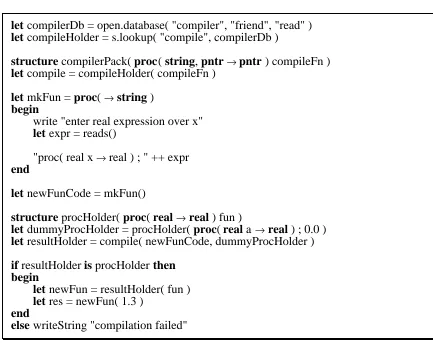
The compiler operates on string representations of programs rather than abstract syntax forms. The programmer passes a representation of the expected type of the result to the compiler along with a string to be compiled. To compile successfully the string must represent a procedure value. The compiler returns an instance of type pntr which is the infinite union of all structure types. If the compilation was successful and the type of the result matched that specified, the pntr is a structure containing the result. Otherwise an error is reported and the pntr is a null value. In this scheme the subsequent use of the compiled result can be type-checked statically. A dynamic check is required to determine whether the compilation succeeded. Figure 2.4 shows an example of run-time reflection in PS-algol:
let compilerDb = open.database( "compiler", "friend", "read" ) let compileHolder = s.lookup( "compile", compilerDb )
structure compilerPack( proc( string, pntr → pntr ) compileFn )
let compile = compileHolder( compileFn )
let mkFun = proc( → string )
begin
write "enter real expression over x"
let expr = reads()
"proc( real x → real ) ; " ++ expr
end
let newFunCode = mkFun()
structure procHolder( proc( real → real ) fun )
let dummyProcHolder = procHolder( proc( real a → real ) ; 0.0 )
let resultHolder = compile( newFunCode, dummyProcHolder )
if resultHolder is procHolder then begin
let newFun = resultHolder( fun ) let res = newFun( 1.3 )
end
[image:22.612.79.512.178.521.2]else writeString "compilation failed"
Figure 2.4: Example of reflection in PS-algol
result. A pointer, dummyProcHolder, to an instance of the structure containing a dummy procedure value is also defined. This pointer is passed to the compiler procedure along with the new code representation. The next line tests whether the result produced is a pointer to an instance of procHolder. If so the compilation has succeeded and the structure is dereferenced and the new function called. Otherwise an error is reported.
2.1.2.6 Napier88
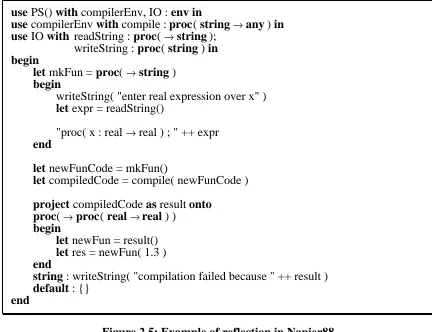
Napier88 supports run-time linguistic reflection of a similar style to that of PS-algol. Linguistic reflection is achieved through creating new program fragments in string form to be compiled at run-time, and incorporating the resulting values into the running program. The main difference is in the interface to the compiler. Napier88 allows code representing values of any type to be compiled, rather than only procedures. The result returned from the compiler is an instance of the infinite union type any. If any errors have occurred during compilation the any contains a string describing them, otherwise the any contains a procedure that will execute the compiled code when called. Figure 2.5 shows the same example in Napier88:
use PS() with compilerEnv, IO : env in
use compilerEnv with compile : proc( string → any ) in
use IO with readString : proc( → string ); writeString : proc( string ) in
begin
let mkFun = proc( → string )
begin
writeString( "enter real expression over x" )
let expr = readString()
"proc( x : real → real ) ; " ++ expr
end
let newFunCode = mkFun()
let compiledCode = compile( newFunCode )
project compiledCode as result onto proc( → proc( real → real ) )
begin
let newFun = result() let res = newFun( 1.3 ) end
string : writeString( "compilation failed because " ++ result ) default : {}
[image:23.612.79.511.239.571.2]end
Figure 2.5: Example of reflection in Napier88
error. The default branch is required by Napier88 rules but should never be executed in this program as one of the first two branches should always match.
Current work on the Napier88 compilation system is investigating further refinements to the compiler interface [Cut92]. These involve a separation of the processes of syntax checking, code generation and linking existing values into compiled code. This could allow a program to be compiled in the context of an existing environment, or to be partially compiled and then have different copies linked into different environments.
2.2
Type-Safe Linguistic Reflection
In general linguistic reflection involves a program modifying some form of itself in a way that affects its continued execution. The previous section described languages in which this modification takes place during the compilation of the program (Scheme, POP-2, TRPL), and languages in which it takes place during execution (Lisp, POP-2, PS-algol, Napier88). TRPL, PS-algol and Napier88 are strongly typed, that is, all computations are checked for type correctness before they are executed. Some restrictions on the forms of linguistic reflection allowable are necessary if strong typing is to be enforced efficiently.
Program compilation involves the translation of a source program into another form which is interpreted at execution time. There is a trade-off between compiler and interpreter complexity. Where a compiler performs a large amount of processing the compiled form may be low-level, requiring only a simple interpreter. At one end of the spectrum the compiled form is native machine code, and interpretation reduces to direct execution by the CPU. Where the compiler is simple, however, a higher-level compiled form is produced and an interpreter of greater complexity is required. Thus at the other extreme the compilation phase is omitted and the source code is interpreted directly.
Where reflection takes place at compile-time a program contains distinguished sections that are interpreted during the compilation process and affect the resulting compiled form:
compilation process
source program
reflective part
2 1
{
3
1 source program translated into compiled form
2 reflective part of source program translated into compiled form
3 compiled form of reflective part interpreted, affecting final compiled form resulting compiled program
compiled form of reflective part
compiled form of non-reflective part
Figure 2.6: Compile-time reflection
execution process
reflective part
{
reflective part interpreted, altering
compiled program compiled
program
modified version of compiled
program
changed part
}
Figure 2.7: Run-time reflection
In strongly typed languages every action performed by a program is type-checked before it takes place, in order to enforce the modelling and protection roles of the type system. To attain type-safe linguistic reflection, the subject of the remainder of this chapter, all modifications made by a reflective program to itself must be checked for type correctness before the modified sections are executed. In the general case a modification to a program involves both the removal or overwriting of some existing code, and the addition of some new code. Strong typing thus requires checking that the program remains type correct after the removals and additions.
A simple way to achieve this is to impose the following two restrictions on the forms of reflection:
• that modifications be allowed to source programs only; and • that the only modifications allowed be additions.
The first restriction allows the type checking to be performed using existing type-checking technology which operates on source programs or parse trees. The second restriction, to incremental modifications, means that only the newly added code needs to be checked, rather than the entire modified program.
Future research may address the issues of validating program modifications that do not adhere to these restrictions. In the first case this would involve either type checking low-level compiled forms, from which much type information had been ‘compiled away’, or constraining the modifications to those that preserved type correctness. In the second case it would involve re-checking the entire program or verifying that the removal of a fragment of code from a correct program left the program still correct.
source program
reflective part
1
1 reflective part translated into compiled form
2 compiled form of reflective part interpreted to generate new source code 3 new source code translated into compiled form
4 compiled form integrated with rest of compiled program compile
time
{
2
3
4
compiled program
}
Figure 2.8: Compile-time type safe linguistic reflection
With type-safe run-time reflection, as in PS-algol and Napier88, the newly generated sections are compiled and the resulting compiled forms incorporated into the compiled form being interpreted. This is illustrated in Figure 2.9. This style of reflection requires a dynamic linking mechanism: in PS-algol and Napier88 it involves dereference of pointers and projection of anys respectively. As the new sections are compiled in isolation from the original source program they cannot refer to identifiers in scope in the original program. It will be described later how this restriction may be relaxed to allow the incrementally added new code to communicate with the existing code.
compiled program
1
2 3
4
1 source program translated into compiled form
2 compiled form of reflective part interpreted to generate new source code 3 new source code translated into compiled form
4 compiled form incorporated with original compiled program compile-time
run-time
{
{
reflective
part
}
compiled program source program
reflective part
{
Figure 2.9: Run-time type-safe linguistic reflection
2.3
Anatomy of Type-Safe Linguistic Reflection
2.3.1
Reflection in General
eval : L → Val
The domain of values, Val, differs for different languages. Examples of Val include numbers, character strings, final machine states, the state of a persistent object store, and the set of bindings of variables produced by the end of a program’s execution.
For linguistic reflection to occur, there must be a subset of Val, called ValL, that can be
mapped into L . For example, ValL could be the set of character strings containing
syntactically correct L expressions. Since ValL is a subset of Val that may be translated into
the language L it may be thought of as a representation of L.
A subset of L consisting of those language constructs that cause reflective computation is denoted by LR. LR is called the reflective sub-language and ValLR stands for its
representation. An evaluation of an expression in LR invokes a generator. In linguistic
reflection the generators, the programs that produce other programs, are written in a subset of the language L which will be denoted by LGen. LGen may include all of L but the programs
written in LGen must produce results in ValL. The major relationships among the language
and value sets are:
LR⊂ L
ValLR⊂ ValL⊆ Val
LGen⊆ L
The significance of the proper subset relationships is explained later. Two functions are required for a full description of linguistic reflection. The first, drop, takes a construct in LR
and produces a generator in LGen. The second, raise, takes a value in ValL and produces an
expression in L: drop : LR→ LGen
raise : ValL→ L
Linguistic reflection is defined as the occurrence of the following pattern of computation, within the eval function, in the evaluation of a program in L:
procedure eval( e : L ) → Val ! This types e as L and eval as L → Val.
case
...
inLR (e) => eval( raise( eval( drop( e ) ) ) )
...
Figure 2.10: The linguistic reflective nature of eval
g : Val → ValL
The generator takes some arguments and returns as its result an expression in ValL which is
then translated into L by raise. The result is finally evaluated by the outer eval. This is illustrated in Figure 2.11. The whole diagram represents the eval function, as does the box containing eval within the diagram. This nested structure is a consequence of representing the recursive function eval by a flow diagram and will be a feature of other diagrams.
reflection path
drop LR
e : L
eval
Val e
in LR
ValL raise
LGen
non-reflective part of eval
yes no
Figure 2.11: eval in linguistic reflection
In order to make these concepts more concrete an example language is introduced. In this language:
• ValL is the set of character strings that represent sentences in L;
• LR contains the single verb execute which initiates reflection;
• drop presents a string expression to the inner evaluation function;
• raise maps a string representation to the corresponding sentence in L;
• LGen is the set of expressions in L that result in character strings in ValL.
In this example language, drop and raise are defined by:
drop( execute( stringExpression ) ) = stringExpression raise( "expression" ) = expression
eval( execute( "2+" ++ "3" ) ) ! the reflection is recognised
=> eval( raise( eval( drop( execute( "2+" ++ "3" ) ) ) ) ) => eval( raise( eval( "2+" ++ "3" ) ) )
=> eval( raise( "2+3" ) ) => eval( 2+3 )
=> 5
Figure 2.12: An example of linguistic reflection
The above example shows that some reflective expressions may be evaluated statically, at compile-time, since here all the information to perform the inner eval may be found statically. Uses of this style of reflection are described later. This is not always the case however and some reflective computation may have to be delayed until run-time. Figure 2.13 shows such a computation in which run-time input is solicited by the readString procedure. The inner eval is thus constrained to execute at run-time.
execute( "2+" ++ readString() )
Figure 2.13: Example of run-time linguistic reflection
A reflective computation is well formed if it terminates and the output of each inner eval is syntactically correct and typed correctly. Termination requires that the inner eval must eventually result in a value in ValL-LR, the set of values that represent non-reflective program
constructs. Syntactic correctness requires that the result of eval( drop( e ) ) is in ValL for all
reflective expressions. A generated expression must be internally type consistent as well as typed correctly for its context.
In general, type correctness must be checked for each individual generated expression. Type checking generators for the types of all their possible outputs is a topic for further research, and is undecidable in general.
2.3.2
Compilation
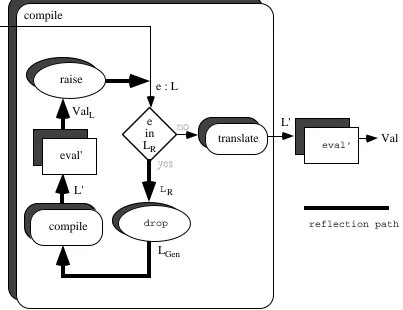
This section is concerned with the mechanisms for linguistic reflection in compiled languages and the anatomy given so far must be further refined to describe these. Figure 2.14 shows the structure of eval as a composition of two functions: compile and eval'. The function compile takes an expression in language L and produces another in a target language L'. The function eval' is the evaluation function for L'. The types of the functions are defined by:
compile : L→L' eval' : L' → Val
L’
L compile Val
eval’
2.3.3
Compile-Time Linguistic Reflection
One way in which linguistic reflection can be accomplished in a compilation environment is for reflective constructs to be compiled and executed during the compilation of a program containing them. This is limited to cases where the reflection is over compile-time information, that is static, and cannot be used for reflection that depends on values that are only available at run-time.
In such a system, generators are used to express computations over the syntactic elements of a program. As in any form of linguistic reflection, the computations are expressed in the subset LGen of the language L. The reflective sub-language LR contains the calls to the
generators. That is, the pattern of evaluation that defines LR is only initiated by these
reflective calls. A possible drop function in this architecture is a function that takes a reflective call, finds its generator definition and uses the definition and the call arguments to form a call to the generator. The inner eval executes the call at compile-time to produce a new expression in ValL. This in turn is transformed to an L expression by raise and presented
to the outer eval. Figure 2.15 illustrates this model. Such a pattern of reflection is called compile-time linguistic reflection since the reflection is performed at compile-time even though the evaluator, eval', is called. The type checking of the generated expressions is performed by the compiler. The pattern of eval is given by:
procedure eval( e : L ) → Val ! This types e as L and eval as L → Val. eval'( compile( e ) )
procedure compile( e : L ) → L'
if inLR(e)
eval’
reflection path drop
LR
LGen
yes
L'
no
compile
e : L compile
Val
L'
e in LR ValL
raise
[image:31.612.97.500.28.338.2]translate eval'
Figure 2.15: eval in compile-time linguistic reflection
The macro facilities in POP-2 and Lisp contain this style of compile-time reflection without the type checking.
2.3.4
Optimised Compile-Time Linguistic Reflection
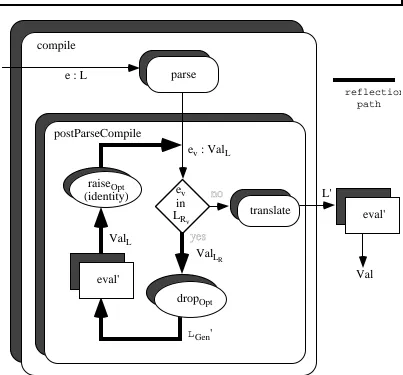
An optimised variant of the previous architecture can be produced by having the parser generate abstract syntax as values in Val. This choice of ValL allows the result of the inner
eval to be passed directly to the post-parse compiler called postParseCompile. The raise
function reduces to the identity function in this optimisation. The drop function here produces a compiled version of the generator in the target language generator subset LGen.
This optimised drop function is denoted by dropOpt. The structure of eval in this case is
shown in Figure 2.16. Here ev denotes the parsed form of e expressed in ValL and LRv the
parsed forms of LR. The pattern of eval is given by:
procedure parse( e : L ) → ValL …
procedure eval( e : L ) → Val eval'( compile( e ) )
procedure postParseCompile( ev : ValL ) → L'
if inLRv( ev )
then postParseCompile( raiseOpt( eval'( dropOpt( ev ) ) ) )
else translate( ev )
reflection path
LGen'
compile
yes
L'
Val
no
e : L
ValL
ValL
R
parse
ev : ValL
ev in LR
v
raiseOpt (identity)
translate postParseCompile
dropOpt
eval'
[image:32.612.97.500.82.457.2]eval'
Figure 2.16: eval in optimised compile-time linguistic reflection
The two versions of the same function eval' in both Figure 2.15 and Figure 2.16 highlight some implementation choices. Although both eval' functions are semantically the same, they may be implemented differently. For example, the eval' within the compiler could be an interpreter function and the right hand eval' could be the machine executing machine code. The details of these implementations are not germane to this description.
An example of such an architecture is the implementation of TRPL. The TRPL reflective constructs are TRPL context sensitive macro calls, the elements of LR. The dropOpt function
takes the parsed arguments of a macro call and passes them to the macro definitions which have been compiled into target language functions (generators) ready for eval'. Thus a call of the compiler is avoided in the reflective eval. The result of executing the compiled macro definitions is to produce new TRPL code expressed in the parsed form ValL. This code can
contain new function, type and even macro definitions. This new code is presented to the post-parse compiler for compilation and evaluated using eval'. Type checking is performed after each inner eval'.
Figure 2.17 gives an example of optimised compile-time reflection as it occurs in TRPL. ev
eval( execute( "2+" ++ "3" ) )
=> eval'( compile( execute( "2+" ++ "3" ) ) )
=> eval'( postParseCompile( parse( execute( "2+" ++ "3" ) ) ) ) => eval'( postParseCompile( (execute( "2+" ++ "3" ))v ) )
! the reflection is recognised
=> eval'( postParseCompile( raiseOpt( eval'( dropOpt( (execute( "2+" ++ "3" ))v ) ) ) ) )
! dropOpt produces "2+" ++ "3"Gen which denotes compiled generator of (2+3)v
=> eval'( postParseCompile( raiseOpt( eval'( "2+" ++ "3"Gen ) ) ) )
=> eval'( postParseCompile( raiseOpt( (2+3)v ) ) )
! raiseOpt is the identity function
=> eval'( postParseCompile( (2+3)v ) )
=> eval'(2+3) => 5
Figure 2.17: Optimised compile-time linguistic reflection in TRPL
The original expression, execute( "2+" ++ "3" ), is parsed and then examined by the post-parse compiler which recognises that it is a post-parsed form of a reflective construct. A generator previously compiled into its L' form from a definition of execute is produced by dropOpt
using the parsed form of execute’s input. This generator, "2+" ++ "3"Gen, evaluates to the
ValL form of 2+3. The inner eval' executes the generator and the parsed form (2+3)v is
produced. This is passed to the post-parse compiler, which completes its compilation. It is eventually evaluated in its compiled form by eval' as the completion of the original eval.
2.3.5
Run-Time Linguistic Reflection
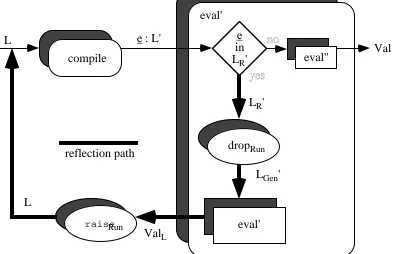
Where reflection occurs at run-time the expression in LR, which causes the reflection, has
already been compiled. That is, it is the eval' function that recognises the expression in LR',
the compiled form of LR, to initiate reflection. The original expression e is in the process of
being evaluated by: eval( e )
=> eval'( compile( e ) )
=> eval'( e ) ! where e is the compiled form of e The pattern of eval' in this case is shown by
procedure eval'( e : L' ) → Val ! This types e as L' and eval' as L'→ Val.
if inLR'( e )
then eval( raiseRun( eval'( dropRun( e ) ) ) )
else eval''( e )
Notice that the outer evaluation function is eval whereas the inner one is eval'. The outer eval encompasses the compiler since it expands to eval'( compile( … ) ). The d r o pRun
function has the type LR' → LGen'. This is illustrated in Figure 2.18, where eval'' denotes the
raiseRun
ValL L
LR'
yes no
Val eval'
dropRun compile
e in LR'
eval' LGen' L
eval'' e : L'
[image:34.612.101.495.32.286.2]reflection path
Figure 2.18: eval in run-time linguistic reflection
An example of this form of reflection is the use of a run-time callable compiler together with the ability to bind and execute newly compiled program fragments within the running program. PS-algol and Napier88 with their callable compilers and incremental loaders are examples of languages that provide run-time linguistic reflection. The function eval in Lisp and the function popval in POP-2 are early examples of untyped run-time reflection.
Figure 2.19 gives an example of run-time reflection as it occurs in Napier88.
eval( execute( "2+" ++ readString() ) )
=> eval'( compile( execute( "2+" ++ readString() ) ) ) => eval'( execute( "2+" ++ readString() ) )
! now the reflection is recognised
=> eval( raiseRun( eval'( dropRun( execute( "2+" ++ readString() ) ) ) ) )
=> eval( raiseRun( eval'( "2+" ++ readString() ) ) )
! if "3" is input for the call of readString => eval( raiseRun( "2+3" ) )
! applying raiseRun and expanding eval
=> eval'( compile( 2+3 ) ) => eval'( 2+3 )
=> 5
Figure 2.19: Run-time linguistic reflection in Napier88
The original expression is first compiled and is in the process of being evaluated by eval' when the reflection is discovered. The compiled form execute( "2+" ++ readString() ) is presented to dropRun which removes the execute verb. The inner eval' reads in the string and
"2+3". This expression is in ValL and is transformed into L by raiseRun. Finally the
expression 2+3 is compiled and evaluated by compile and eval'.
2.3.6
Combined Compile-Time and Run-Time Linguistic Reflection
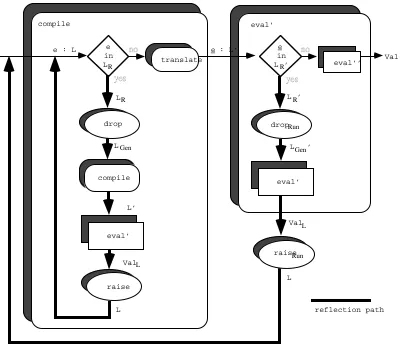
The integration of compile-time and run-time linguistic reflection is a topic for further research. Figure 2.20 shows a possible structure for eval in a combined system:
eval’ drop
LR
LGen yes
no
compile e : L
L’ e in LR
ValL
raise
translate compile
L
LR’ no
Val eval’
e in LR’
eval’ LGen’
ValL
L e : L’
reflection path yes
dropRun
raiseRun
[image:35.612.97.497.120.465.2]eval’’
Figure 2.20: eval in combined compile-time and run-time linguistic reflection
2.4
Dimensions of Type-Safe Linguistic Reflection
The previous sections have described some particular mechanisms for type-safe linguistic reflection. The reflective process has a number of dimensions, choices for each of which must be made when designing a reflective system. These are:
• the way that the reflection process is initiated; • the nature of the generators;
• the time at which the generators are executed;
• the environment in which the generators are executed; • the time at which generated code is type checked;
2.4.1
Initiation of Reflection
Linguistic reflection is initiated by an expression in the reflective sub-language, LR, being
evaluated. Some examples of the form of LR expressions are:
• a simple verb applied to a program representation, such as execute "3+4"; • a macro call, such as INC (i);
• a call to a compiler function, such as compile( newFunCode ).
2.4.2
Time of Generator Execution
In existing implementations the generators are executed at fixed points in the evaluation process, either during program compilation or at run-time. A goal of current research is to unify compile-time and run-time reflective technology in a single system, providing a consistent notation for specifying both styles of reflection. One proposal for such a notation, due to Connor [Con91], suggests the provision of two LR constructs. Both perform the same
function but they differ temporally and therefore in the environments in which they operate. They are:
force which forces the reflective evaluation on the first encounter and replaces the force construct with the generated result. It therefore performs the inner eval and the drop.
delay which delays reflective evaluation. That is the inner eval and drop are not performed until the program is executing after the initial compilation phase. Compile-time linguistic reflection uses force implicitly whereas run-time linguistic reflection uses delay. The two constructs could also be used in combination to give finer control over the time at which reflection occurs.
2.4.3
Nature of Generators
Since the generators are all written in the language subset LGen, it is the nature of the
language forms that they manipulate that distinguishes different linguistic reflective languages. The generators compute over and produce expressions in ValL. In some systems
this is simply the set of strings.
Where some processing of the expressions has already taken place, there is a possibility of using more structured forms for ValL. In optimised compile-time linguistic reflection the
generators operate over parsed forms of L . Thus ValL can be the abstract syntax trees
constructed by the parser. The generators compute over these abstract syntax trees and form new ones.
Readability of the generators is an important issue with either kind of program representation, and is discussed in Section 2.7. When available, pre-defined abstractions operating over program representations aid the task of defining new program representations through analysis and composition of existing ones.
2.4.4
Execution Environment of Generators
The second issue is that generators may link to existing values. This linking may be to R-values, by copy, or L-R-values, by reference, and may be resolved at compile-time or delayed until run-time.
2.4.5
Time of Type Checking of Generated Code
In optimised compile-time linguistic reflection the result of the generation is integrated into the program being compiled. The internal type consistency of the new program fragment and its type compatibility with the environment into which it is placed are both checked by the post-parse compiler before execution.
In run-time linguistic reflection the result of the generation is type checked when it is presented to the compiler as part of the outer eval. This checks for the fragment’s internal consistency. The type compatibility of the fragment with its environment is checked when it is linked into the original running program.
2.4.6
Execution Environment of Generated Code
In compile-time linguistic reflection the generated code fragments are incorporated into the main program and are thus executed in the environment created by that program. In existing run-time reflective systems the generated fragments are compiled and executed in isolation, and the results then linked into the running program. It is possible for a generated program to access values in scope in the original program that initiated the reflection, but only indirectly through the persistent store: the main program can place a value in the store where it can be accessed by the generated program.
More flexibility could be provided by parameterising generated code fragments with an environment in which to execute, together with a mechanism to allow the environment at any given point to be captured. Another mechanism that allows generated code to refer directly to values available in the generator will be described in Chapter 5.
2.4.7
Linking Generated Code into the Original Program
In compile-time linguistic reflection the code produced by executing a generator is incorporated into the program being compiled. The new code is compiled just as if it had been part of the original program, thus no special linking mechanism is needed.
In run-time linguistic reflection the generated code is compiled and executed independently of the main program and the results linked into the running program. This requires a dynamic linking and type-checking mechanism.
2.4.8
Characterisation of TRPL, PS-algol and Napier88
The type-safe reflective languages TRPL, PS-algol and Napier88 represent three sets of choices among the dimensions described above. The languages can be characterised as follows:
2.4.8.1 TRPL
Linguistic reflection in TRPL is initiated when the post-parse compiler encounters the parsed form of a macro call. The macro arguments, which are instances of TRPL abstract syntax, i.e., elements of ValL, are passed to the compiled form of the corresponding generator. The

![Figure 2.2 shows the definition of a macro, due to Atkinson [Atk91], that replicates the itemsin the input stream, up to end, a specified number of times.](https://thumb-us.123doks.com/thumbv2/123dok_us/8574817.368989/19.612.72.517.421.627/figure-definition-atkinson-replicates-itemsin-stream-specified-number.webp)