LAND USE CHANGE IN THE SOLOMON ISLANDS
Tammy E. Davies
A Thesis Submitted for the Degree of PhD
at the
University of St Andrews
2014
Full metadata for this item is available in
St Andrews Research Repository
at:
http://research-repository.st-andrews.ac.uk/
Please use this identifier to cite or link to this item:
http://hdl.handle.net/10023/11852
Assessing the relationship
between poverty and
biodiversity, within the context
of land use change in the
Solomon Islands
Tammy E. Davies
This thesis is submitted in fulfilment of the requirements for
the degree of Doctor of Philosophy
University of St Andrews
iii
Abstract
There is convergence at the international level that conserving biodiversity can
contribute to poverty alleviation, but empirical evidence for this relationship is scarce. In this thesis I assess the relationship between poverty and biodiversity, within the context of land use change, using a case-study from the Solomon Islands. This interdisciplinary study is based on both social and ecological data, primarily collected through focus groups, household surveys and avian line transect surveys. Poor households in Kahua were characterised by fewer members of a working age and fewer male members. They were also found to own fewer assets, which were correlated to lower land tenure. Natural resources, including wild foods, were a crucial resource for the consumption and income for poor households, with evidence of wild foods buffering shortfalls in household consumption. The livelihoods of poor households were dependent on natural resources, whereas wealthier households relied on cash crops. The lower involvement of poor households in cash cropping suggests that the poor have less
access to such income sources, possibly through a lack of initial land holding assets.
Cash crop areas of monoculture cocoa were the most intensive land use in Kahua and
were found to be a poor habitat for many bird species, including most endemics.
Overall, the relationship between poverty and biodiversity was found to be complex,
iv
Acknowledgements
The last three and a half years have been both challenging and rewarding, and would not have been enjoyable, or even possible, without the support and expertise of those around me. I would first of all like to thanks my supervisors: Ioan Fazey, Nathalie Pettorelli, Will Cresswell and Guy Cowlishaw, who have been an excellent supervisory team and supported me from the beginning. Specifically I’d like to thank Ioan for
introducing me to Kahua and your way of working; Nathalie for your constant support and welcoming me into the Institute; Will for always believing in me and saying the right thing at the right time; and Guy for your in-depth comments and thoughts. I wouldn’t
have made it without you, nor learnt as much and improved as a person without you all. Thank you for your belief in me.
The PhD would not have been possible without financial support from the Natural Environment Research Council and the University of St Andrews. I was also fortunate to receive additional support from Chester Zoo, Rufford Small Grants and Lubee Bat Conservancy, which enabled me to expand my fieldwork considerably.
v
My time in the Solomon Islands was extremely tough and lonely and I have no doubt that I wouldn’t have been able to complete it without the amazing support of Patti Duke
and Val Stanley who were always there for me when I could make it back to Honiara. Your generosity and kindness knew no bounds and will never be forgotten.
I am also incredibly indebted to the advice and support of John Ewen and Rohan Clarke. Special thanks to Rohan for your practical assistance, and for being an excellent sounding board and always taking the time to see me whenever I passed through Melbourne. Huge thanks to my visitors John, Kevin and Kate. John and Kevin: your trip was perfectly timed in many ways (except for the cyclone, but at least that meant I wasn’t the only one who experienced trench foot). Your enthusiasm and
expertise provided the perfect springboard to the start of my main fieldwork. Kate: your trip was also perfectly timed, thank you for being so patient (and bringing a stash of chocolate!) and would like to apologise on behalf of the fire ants, but at least we were rewarded with a Makira thrush!
I owe heartfelt thanks to all my friends both near and far who have been unwavering in their support and encouragement, which has not only helped me keep my eyes on the prize, but also kept me sane throughout this process. Big thanks to Team Burns in St Andrews: Holly, Vikki, Marion and Alex, the PhD experience wouldn’t have been nearly as much fun without you, and I can’t believe we are almost disembarking from our
vi
Preface
This thesis stems from a personal interest in conservation, and more specifically
improving natural resource management to be both socially and ecologically sound. My interest in this area was originally sparked while working for a marine conservation NGO in Madagascar, where conservation strategies proposed for the region were at odds with local livelihoods. More conservation work and a MSc later, I realised how much I actually enjoyed applied research, and the scope this provided to improve conservation and development efforts.
Thus, a personal aim of undertaking a PhD and writing this thesis was to develop and improve as an independent interdisciplinary researcher, to further my career in
conservation. As a result, this PhD spans the natural and social sciences, and included the collection and analysis of both biological and social data, with chapters of this thesis written with publication in mind. While undertaking my PhD, I supervised a Masters student (Filip Ruzicka, UCL) who analysed the ultrasonic bat data I collected; I was involved in the study design, data collection, supervision of analysis and re-writing for publication, and have included the manuscript as Appendix A1.
vii
The Solomon Islands are by the far the most challenging place I have worked for a variety of reasons. The lack of infrastructure and rugged terrain made travel between study sites difficult. Torrential rain caused problems for data collection through disrupting surveys and preventing travel through rough seas and flooded rivers. This was further compounded by entrenched gender equalities and differing world views, which to some extent relate to the desires for money within communities and a general feeling that they were missing out on some sort of benefit. Allaying these feelings required intensive investments of time and resources throughout the data collection period. There is also a lack of background knowledge to the area, including an absence of basic guide books to local flora and fauna, so identifying anything other than a bird was complicated! Likewise, it was also these conditions and the understudied nature of the Solomon Islands that made Kahua an exciting site to base my study!
Naopaworo village, West Wainoni. Houses are made of traditional
viii
Contents
Chapter 1: General Introduction ... 1
1.1 Thesis objectives ... 3
1.2 Thesis structure ... 4
1.3 Thesis format... 6
1.4 Ethics statement ... 7
Chapter 2: Literature review ... 8
2.0 Chapter Overview ... 9
2.1 Introduction ... 9
2.2 Ambiguous use of definitions ... 13
2.2.1 Poverty ... 13
2.2.2 Biodiversity ... 15
2.3 Inappropriate monitoring ... 17
2.3.1 Ambiguous definitions ... 18
2.3.2 Donor pressures ... 19
2.3.3 Limited understanding between traditional scientific disciplines: ... 20
2.3.4 Lack of reporting ... 21
2.4 Recommendations ... 21
2.5 Conclusion ... 26
Chapter 3: Study Site ... 29
3.0 Chapter Overview ... 29
3.1 Rationale for selecting Kahua, Solomon Islands ... 30
3.2 The Solomon Islands ... 31
3.2.1 Background and History ... 31
3.2.2 Biogeography ... 33
3.3 Study site location ... 36
Figure 3.2: Location of Kahua study site ... 36
Chapter 4: Identifying the poor ... 43
4.0 Chapter Overview ... 44
4.1 Introduction ... 44
4.2 Methods ... 48
ix
4.2.2 Data analysis ... 51
4.3 Results ... 52
4.4 Discussion ... 58
Chapter 5: Importance of wild foods ... 63
5.0 Chapter Overview ... 64
5.1 Introduction ... 64
5.2 Methods ... 66
5.2.1 Study area ... 66
5.2.2 Data collection ... 67
5.2.2.1 Measuring use of wild foods and other natural resources ... 67
5.2.3 Data analysis ... 69
5.2.3.1 Measuring household wealth ... 69
5.2.3.2 Testing effects of household wealth and season ... 69
5.3 Results ... 70
5.3.1 Overview of the household economy ... 70
5.3.2 Wild food consumption ... 71
5.3.3 The effect of wealth and season on consumption of wild foods ... 72
5.3.4 The effect of wealth on sources of income ... 74
5.4 Discussion ... 75
5.4.1 The importance of wild foods where availability is limited ... 76
5.4.2 The effects of household wealth on the use of natural resources ... 78
5.4.3 Implications for conservation ... 81
Chapter 6: Impacts of land use change on tropical avifauna ... 84
6.0 Chapter Overview ... 85
6.1 Introduction ... 85
6.2 Methods ... 88
6.2.1 Study area ... 88
6.2.2 Data collection ... 88
6.2.3 Data analysis ... 94
6.3 Results ... 95
6.4 Discussion ... 101
6.4.1 Changes in species richness... 101
6.4.2 Changes in species composition ... 102
x
6.4.4 Limitations of the current study ... 104
6.4.5 Implications of future land use change ... 105
6.4.6 Implications for conservation ... 107
Chapter 7: Overall synthesis ... 109
7.0 Chapter Overview ... 109
7.1 Introduction ... 110
7.1.1 How is the relationship between poverty and biodiversity changing within the context of land use change? ... 112
7.1.2 An overview of traps from the literature ... 114
7.1.3 Overview of Kahua case study in relation to traps ... 119
7.2 Summary of data collection: ... 121
7.3 Summary of results:... 125
7.3.1 Considering the key findings from this thesis in relation to traps ... 126
7.4 Main conclusions ... 129
7.4.1 Wider implications of a social-ecological trap for conservation and development ... 132
7.4.2 Limitations of this thesis and further study... 136
7.4.3 Implications and recommendations for conservation and development from research in this thesis ... 140
7.5 The contributions I have made to this work ... 143
7.6 How the work contributes significantly to the expansion of knowledge... 145
7.7 Conclusion ... 147
Appendix A1: Impacts of forest conversion on bat assemblages ... 172
A1.0 Abstract ... 172
A1.1 Introduction ... 173
A1.2 Methods ... 176
A1.2.1 Study area ... 176
A1.2.2 Acoustic monitoring ... 178
A1.2.3 Statistical Analyses ... 179
A1.3 Results ... 181
A1.3.1 Habitat responses ... 184
A1.4 Discussion ... 188
A1.5 Conclusions ... 192
A1.6 References... 193
xi
xii
List of Figures
Figure 3.1: Seasonal rainfall and temperature at Honiara and Santa Cruz (PCCSP
2011). ... 32
Figure 3.3: Fibreglass boat used for transport around Makira Island. ... 37
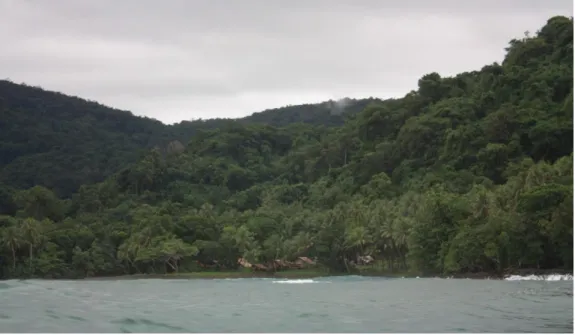
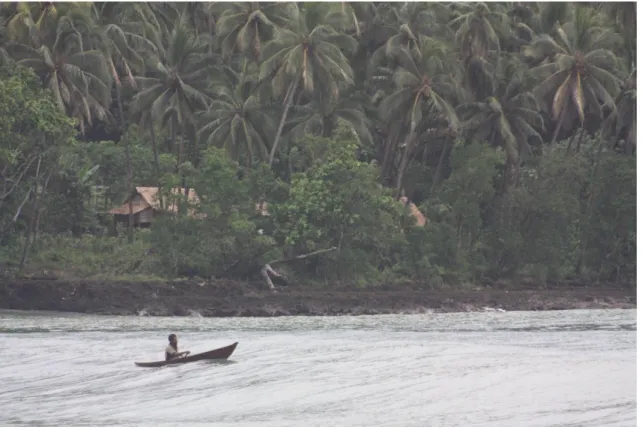
Figure 3.4: Huni village viewed from the sea ... 39
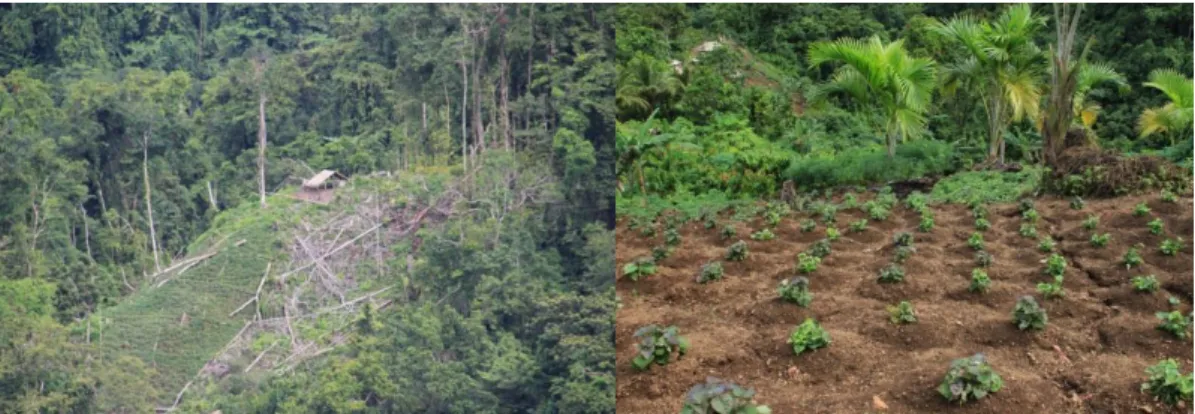
Figure 3.5: New garden area cleared in the forest (Left); Recently planted garden with sweet potato crops (Right) ... 40
Figure 3.6: Man going fishing in typical dugout canoe with no out-rigger. ... 41
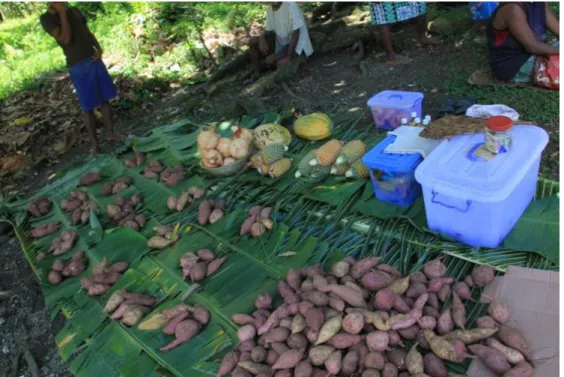
Figure 3.7: Small markets are becoming increasingly common in Kahua. ... 42
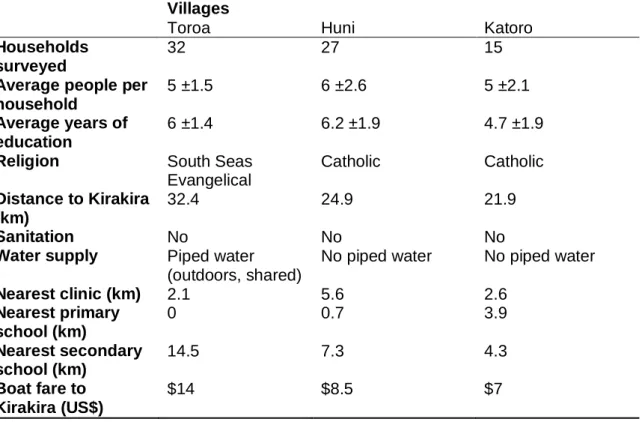
Figure 4.1: Location of study villages in Kahua. ... 50
Figure 4.2: Plot of wealth score against annual monetary expenditure ... 57
Figure 6.1: Location of Kahua study site, and location of the ten transects in the different habitats (F= forest, S= secondary, G= garden, C= mixed cocoa, M = monoculture cocoa). ... 91
Figure 6.2: Cluster dendrogram to visualise similarities in avian community composition across land uses. ... 97
Figure 6.3: Relative abundance across habitats for species which showed significant differences in their distribution ... 99
Figure 7.1: Model of a social-ecological trap. ... 119
xiii
List of Tables
Table 2.1: Summary of conservation interventions shown to provide poverty reduction benefits, and those which benefited the poorest (Adapted from Leisher et al. 2013b). 12 Table 2.2: Indicators of Attributes and Components of Biodiversity with a focus on measures that would be most useful in determining potential effects of human use on biodiversity (Agrawal and Redford 2006). ... 16 Table 2.3: Current flaws for evaluating pro-poor conservation and proposed solutions (see main text for details) ... 22 Table 3.1. Definition of Melanesia specific terms ... 35 Table 4.1: Population and social structure of the study villages in Kahua ... 53 Table 4.2: Descriptive information gathered from all focus groups on how each
indicator changes across the wealth categories (only main indicators identified at the workshop). ... 54 Table 4.3: Wealth factor scores from the principal components analysis of locally
xiv
1 Chapter 1: General Introduction
Introduction
The continued growth of human populations and per capita consumption have resulted in unsustainable exploitation of Earth’s biological diversity (Rands et al. 2010). Broadly, biodiversity affects the properties of ecosystems and hence the benefits that humans obtain from them (Díaz et al. 2006). Thus the rapid rate of biodiversity loss, including disruption of ecosystems, loss of genes, species and functional traits, is of paramount concern for continued human wellbeing.
2
contributions to livelihoods of the rural poor, it is not necessarily the diversity of natural resources, but rather the volume (in terms of extent and abundance) of a resource. However, in a more general sense, it is the diversity that is likely to be more important at the ecosystem level to enhance ecosystem resilience, with many species required to maintain multiple functions at multiple times and places in a changing world (Isbell et al. 2011). In this thesis, I refer to the precise elements of biodiversity that I am
assessing, where appropriate, which is either natural resources or species richness using avifauna as a focal taxa.
At some levels the relationship between biodiversity and poverty is absolute:
biodiversity underpins the delivery of essential ecological services on which the whole of humanity is dependent (Roe et al. 2014). Yet there is no linear relationship, and numerous studies have noted the dynamic and context-specific nature of the relationship (e.g. Kepe et al. 2004). However, there is an explicit assumption that conserving biodiversity (or reducing the rate of biodiversity loss) can help in efforts to tackle global poverty and enhance human well-being (Roe et al. 2014). The
3
conservation and poverty alleviation efforts, priority needs to be given to protecting the elements of biodiversity, and the services it provides, that are of particular importance to the well-being of the poor (Roe et al. 2013). In addition, understanding who the poor are, the role biodiversity can play in alleviating poverty (e.g. through meeting basic needs, or as a safety net in times of need) is central to be able to prioritise
conservation activities and ensuring the poor do not become further marginalised. In light of the considerable social and environmental change many Least Developed Countries are experiencing it is necessary to understand the relationship between poverty and biodiversity within the context of a social-ecological system.
Tropical islands present an excellent case-study for studying the relationship between poverty and biodiversity because they tend to have stronger linkages between
ecosystem services and people (Millennium Ecosystem Assessment 2005). They also have reduced functional diversity (compared to continental areas) and are undergoing particularly rapid environmental change. For example, island deforestation rates have been recorded at almost three times the annual world average rate (0.8% compared with 0.3%) (FAO 1999). The Solomon Islands are a Small Island Developing State currently dealing with ‘classic’ challenges of sustaining rapidly growing populations, as well as more ‘modern’ problems of globalisation and global change (Reenberg et al.
2008). Crucially, as with many tropical island systems, the Solomon Islands remain desperately understudied, but are home to high levels of endemism making them an important focus for both conservation and development.
1.1 Thesis objectives
4
social-ecological trap. I use Kahua, a remote area of the Solomon Islands as a case study to explore this relationship. To achieve this aim I will:
1) Clarify key terms, including poverty and biodiversity
2) Establish an appropriate measure of poverty, through evaluating whether a participatory approach can be used to gain locally-appropriate measures of household wealth inequality
3) Assess how household wealth relates to use of biodiversity through consumption and sources of income
4) Assess how biodiversity is changing with increasing intensity of land use 5) Use a broader systems view and overarching theory of social-ecological traps
to explain the relationship between poverty and biodiversity and how it is changing within the context of land use change
1.2 Thesis structure
This thesis is interdisciplinary and has included the use of multi-methods to collect both social and ecological data. Therefore different methods have been used in each data chapter and as such there is no separate methods chapter, but rather the relevant methods are detailed in the appropriate chapter. Since data for this thesis are built around a case-study, I have detailed Kahua, my study site, in a separate chapter, including background information and specific details, to avoid repetition in subsequent chapters.
5
including poverty and biodiversity. In addition I provide recommendations for poverty and conservation initiatives. Where possible, I incorporated these recommendations into the data collection and design of this thesis.
In Chapter 3 I outline my study site providing information on why Kahua is an ideal location for exploring the relationship between poverty and biodiversity in the context of land use change. I also provide relevant background information in order to provide a necessary understanding of the social and environmental context in which this study took place.
In Chapter 4, I gain an appropriate measure of poverty for Kahua. As highlighted in Chapter 2, definitions of key terms and multi-dimensional measures of poverty are important for effectively assessing the relationship between poverty and biodiversity. Therefore, in this Chapter I aim to establish a locally appropriate, multi-dimensional measure of poverty using a participatory approach. In this Chapter I determine: Can locally appropriate indicators of wealth be identified? Do these indicators represent variation in wealth within communities? Then to determine the validity of this approach I ask, are these indicators correlated with annual monetary income and expenditure? Finally I explore local inequalities through determining what the key predictors of poverty are.
6
In Chapter 6, I then turn to the ecological system and assess how biodiversity changes with increasing intensity of land use, across five major land use types associated with local livelihood activities, using avifauna as my focal taxa. I address the following questions: Does avian species richness and the proportion of endemic species vary along a gradient of human disturbance? Does avian community composition vary along a gradient of human disturbance? Does avian diversity (species, microhabitat and feeding guild) vary along a gradient of human disturbance?
In Chapter 7, I summarise the aims, objectives, methodology, results and conclusions covered in previous chapters, and critically discuss the change occurring in Kahua in the broader context of a social-ecological system. I summarise key findings from this thesis and discuss the implications for conservation and development. I also indicate how the preceding chapters form a coherent body of work, the contributions I have made to this work, and finally how the work contributes significantly to the expansion of knowledge.
1.3 Thesis format
Numerous chapters in this thesis form the basis of publications (either in press or under review). These are acknowledged at the start of the relevant chapter, and are also listed here:
Davies T.E., Fazey I.R.A., Cresswell W., Pettorelli, N. 2013. Missing the trees for the wood: why we are failing to see success in pro-poor conservation. Animal Conservation 17 (4) 303-312
7
conservation: a case-study from the Solomon Islands. Environmental Conservation DOI: 10.1017/S0376892914000058
Davies T.E., Fazey I.R.A., Pettorelli, N., Cresswell W., Cowlishaw, G. The importance of wild foods to rural households. PLOS ONE Under Review
Davies T.E., Clarke, R.H., Ewen, J.G., Fazey I.R.A., Pettorelli, N., Cresswell W. Impacts of land use change on endemic avifauna on Makira, Solomon Islands: endemics avoid monoculture. EMU Under Review
1.4 Ethics statement
The research was carried out in accordance with the ethics guidelines of the
Geography and Sustainable Development Ethics Committee of St Andrews University who approved the methods and approach prior to data collection. A research permit was obtained from the Solomon Islands Ministry of Education, with support from the Kahua Association that represents communities in the study region. Prior to data collection, a meeting was held with all community members to carefully explain the purpose of the study, with ample time for respondents to ask questions. Due to the low level of literacy in the area it was not possible to obtain written consent, so informed consent was obtained verbally from all respondents who voluntary decided to
participate in the study (Appendix A3). This procedure was approved by the Geography and Sustainable Development Ethics Committee of St Andrews University.
8 Chapter 2: Literature review
Assessing reasons for the lack of
evidence for effectiveness in joint
poverty and conservation
initiatives
Material from Chapter 2 formed the basis of the following publication:
Davies T.E., Fazey I.R.A., Cresswell W., Pettorelli, N. 2014. Missing the trees for the
wood: why we are failing to see success in pro-poor conservation. Animal Conservation
17 (4) 303-312
Publication included in Appendix A5
A family outside their home in Nama village, East Wainoni.
Woman on the right holds Sago palm fronds for re-roofing the
9 2.0 Chapter Overview
In this chapter I synthesise the latest literature from the conservation, development and interdisciplinary realms to evaluate reasons for the lack of effectiveness for success in joint poverty alleviation and biodiversity conservation initiatives. Through this Chapter, I provide the broad conservation context for understanding the relationship between poverty and biodiversity, in addition to clarifying key terms that are essential to
understanding the relationship between poverty and biodiversity. In this Chapter I bring together and discuss some of the major flaws highlighted in the literature that are hindering assessment of effectiveness of joint poverty alleviation and biodiversity conservation efforts. I then propose recommendations that address these flaws and that could help improve the evaluation of effectiveness in joint biodiversity conservation and poverty alleviation efforts.
2.1 Introduction
The current decline in biodiversity is of great concern, not only for the loss of its intrinsic value and the unknown impacts on ecosystem functioning, but also for the potential negative repercussions for human well-being (Cardinale et al. 2012; Reich et al. 2012). Addressing biodiversity loss and poverty are international societal and political goals (Sachs et al. 2009; Roe 2010). Each year the world spends around US$126 billion of official aid tackling global poverty and between US$8-12 billion on addressing biodiversity loss (Roe et al. 2011), yet in neither case are these resources considered sufficient to solve these challenges (Roe et al. 2011; Evans et al. 2012). The majority of the world’s poor live in rural areas (IFAD 2010) where they depend
10
overconsumption and climate change, there is a strong need for further integration of the poverty alleviation and biodiversity conservation agendas (Sachs et al. 2009).
The integration of these agendas has so far proved more difficult and more expensive than many had hoped (Adams 2013). Conservation activities first started to address development issues in the 1970s, motivated by the substantial negative impacts on local people borne from earlier ‘fortress’ conservation activities (Adams et al. 2004). This ‘people-friendly’ approach, broadly termed Integrated Conservation and
Development Projects (ICDPs) (Blomley et al. 2010), initially attracted substantial support from international development agencies and conservation NGOs, and was rather hurriedly seen as a panacea for conservation and sustainable development. However, early results proved disappointing and the approach rapidly fell out of favour (McShane et al. 2011; Miller et al. 2011). The ICDP label is now less common, but biodiversity conservation and poverty reduction continue to be addressed as dual goals; the extent to which largely depends on the perceived role of poverty in
determining the status and threats to the intended conservation target (Sandbrook and Roe 2013). Adams et al. (2004) proposed a typology of four positions conservationists may take on the question of poverty: 1) poverty and conservation are separate policy realms; 2) poverty is a critical constraint on conservation, meaning it must be tackled to achieve conservation goals; 3) conservation activities must not compromise poverty reduction, and 4) poverty reduction is a goal, dependent on resource conservation. Recognising these fundamental differences in value positions can help contextualise the project’s rationale, objectives and behaviour of different actors, particularly when
faced with difficult trade-off decisions between conservation and development goals (Leader-Williams et al. 2011). Truly addressing the dual goals of biodiversity
11
defined as: a people-centred approach that has poverty reduction and livelihood
security as core objectives and seeks robust conservation approaches to achieve these (adapted from: Roe et al. 2003; Roe and Elliott 2006; Kaimowitz and Sheil 2007). It builds on the poor’s priorities and capabilities, effectively engages all stakeholders in
addressing the underlying policy and institutional drivers of environmental degradation and empowers vulnerable groups with the assets, rights, and entitlements they need to improve their lives through sound environmental management (Hazlewood et al. 2004). Pro-poor conservation can take a number of different forms and encompass a variety of approaches, including: community-based conservation initiatives, direct payments (e.g. Payments for Ecosystem Services schemes, REDD+), and locally managed protected areas.
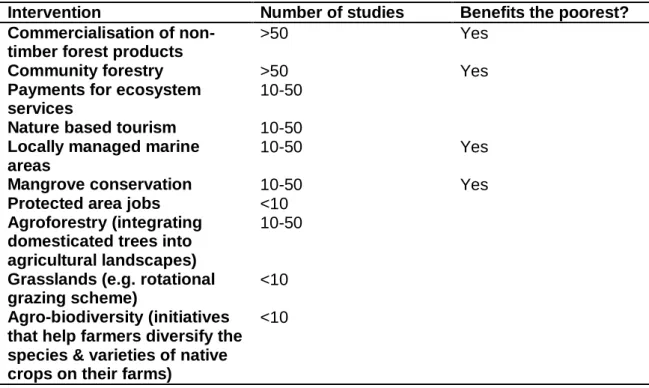
Despite biodiversity conservation and poverty reduction being addressed as linked challenges for a number of years, there is growing concern over the lack of empirical evidence for these endeavours (Barrett et al. 2011). An extensive review by Leisher et al. (2013b), although constrained by the limited number of studies with robust evidence of poverty impacts, was able to highlight ten conservation interventions that had
12
Table 2.1: Summary of conservation interventions shown to provide poverty reduction benefits, and those which benefited the poorest (Adapted from Leisher et al. 2013b).
Intervention Number of studies Benefits the poorest? Commercialisation of
non-timber forest products
>50 Yes
Community forestry >50 Yes
Payments for ecosystem services
10-50 Nature based tourism 10-50 Locally managed marine
areas
10-50 Yes
Mangrove conservation 10-50 Yes
Protected area jobs <10 Agroforestry (integrating
domesticated trees into agricultural landscapes)
10-50
Grasslands (e.g. rotational grazing scheme)
<10 Agro-biodiversity (initiatives
that help farmers diversify the species & varieties of native crops on their farms)
<10
13 2.2 Ambiguous use of definitions
Key concepts are often not explicitly defined in pro-poor conservation efforts (Lu 2010; Roe 2010; Roe et al. 2013), leading to vague objectives and preventing data
aggregation and comparison (Kapos et al. 2008). Poor or narrow definitions are the root cause of limited empirical evidence in pro-poor conservation: how a concept is defined determines what is measured, and what is chosen to be measured determines how success is defined (Leisher et al. 2013a).
2.2.1 Poverty
Our understanding of poverty has evolved considerably from its original definitions, which focused on a lack of income or wealth (Sen 1993; Roe 2010). It is now viewed as a multi-dimensional concept, encompassing material deprivation, the lack of access to basic needs such as education, health, nutrition and food security, the absence of political autonomy and empowerment, as well as the lack of freedom of choice and social inequality (Chambers 1995; Shackleton et al. 2008; Sunderlin et al. 2008). Interest in multidimensional poverty measurement has been growing steadily over the last decade (Alkire and Foster 2011; Ravallion 2011; Ferreira and Lugo 2012) and mainstream poverty research has become more sophisticated in its handling of this concept, both through a diversification of methods, as well as by more inclusive processes of assessment that include the perspectives of the poor (Addison et al. 2009).
14
2012); they can also be aggregated into indices, such as the Multidimensional Poverty Index (Alkire and Foster 2011) or the Human Poverty Index (Dhillon and Kaur 2010). Hierarchical human needs (Maslow 1970) also presents a multidimensionality to poverty measurement, in addition to insights into what is required to improve wellbeing (Clarke et al. 2006). Poverty can be defined in either relative or absolute terms.
Absolute terms measure poverty in relation to the amount of money necessary to meet basic needs, whereas relative poverty is defined in relation to the prevailing standards of living of other members of the society (Scheidel 2013). The decision whether to use absolute or relative poverty is ultimately a value judgement dependent on the main purpose for which the poverty measure is to be used. Where the relative definition is taken it is important to find a locally appropriate understanding of a certain social group or context (Scheidel 2013). In either case, the chosen dimensions across which poverty has been defined and measured must be explicitly stated, as conceptual and
methodological differences in defining poverty can lead to the identification of different individuals and groups as poor (Lu 2010).
Although reports of pro-poor conservation studies discuss poverty as a
15
the question of community wants and needs, leading to narrowly conceived
conservation benefits and incentives for local people (Murphree 2009; Berkes 2013).
The dispersion of a distribution of income, consumption or other welfare indicator, (or its inequality), is also an important dimension that is largely ignored. Inequality is moving to the forefront of the development policy agenda, in recognition of its relationship to poverty and poverty reduction (Melamed 2012): inequality directly determines the rate of poverty reduction, and certain types of inequalities (e.g. access to health care, education or markets, or civil and political rights) have a direct causal effect on poverty (Jones 2009). Equity has largely been addressed indirectly in pro-poor conservation through the implicit assumption about spreading the costs or benefits, or as a secondary concern, as with post hoc comparisons of the equity of outcomes (White et al. 2012). Pro-poor conservation would benefit from a focus on inequality as this would provide an incentive to focus on those groups which are left behind.
2.2.2 Biodiversity
Biodiversity is defined by the Convention on Biological Diversity as “the variability
among living organisms from all sources including diversity within species, between species and of ecosystems” (CBD 1992). However, biodiversity is often used to refer to
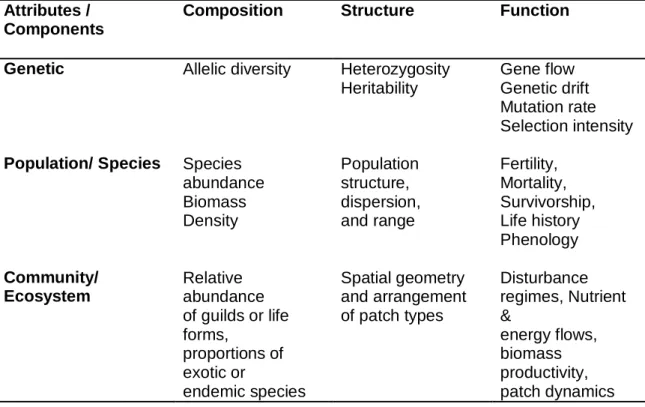
the amount of species and/or populations, or to specific elements of biodiversity rather than variety per se (Roe et al. 2013). Biodiversity, like poverty, is a fundamentally multidimensional concept (Lyashevska and Farnsworth 2012): it can be measured in terms of different components (genetic, population/species, and community/ecosystem; see Table 2.2). Each of these components has compositional, structural and functional attributes; these categories can be considered the ‘three dimensions’ of biodiversity
16
(e.g. gene, population, community) is fundamental, and different levels of resolution are appropriate for different questions (Noss 1990).
Table 2.2: Indicators of Attributes and Components of Biodiversity with a focus on measures that would be most useful in determining potential effects of human use on biodiversity (Agrawal and Redford 2006).
Attributes / Components
Composition Structure Function
Genetic Allelic diversity Heterozygosity Heritability
Gene flow Genetic drift Mutation rate Selection intensity Population/ Species Species
abundance Biomass Density Population structure, dispersion, and range Fertility, Mortality, Survivorship, Life history Phenology Community/ Ecosystem Relative abundance of guilds or life forms, proportions of exotic or endemic species Spatial geometry and arrangement of patch types
Disturbance regimes, Nutrient & energy flows, biomass productivity, patch dynamics
17
functional, phylogenetic and taxonomic aspects of biodiversity in conservation biology (Lopez-Osorio and Miranda-Esquivel 2010; Mouchet et al. 2010; Strecker et al. 2011).
There are two main problems with the use of the term “biodiversity” in pro-poor
conservation. Firstly, where biodiversity has been defined, it is typically measured using a narrow perspective such as species richness, or a proxy that does not include any ecological information, such as perceptions of change in animal populations or attitudes towards conservation (Agrawal and Redford 2006). Broader approaches to defining and measuring biodiversity have yet to be incorporated into pro-poor
conservation efforts. Conservation measures that aim to enhance a specific attribute or component of biodiversity may have unanticipated effects on other measures of
biodiversity; multiple measures targeting specific combinations of attributes and components of biodiversity are therefore needed (Agrawal and Redford 2006).
Secondly, the components used to frame biodiversity are often not clarified, rendering the collected data meaningless. Knowing the biodiversity (however measured) of one place, group or time is not useful in itself; it is the comparable measurements of biodiversity from multiple places, groups or times that can be used to answer crucial questions about how it might best be conserved (Purvis and Hector 2000).
2.3 Inappropriate monitoring
Another reason for the lack of evidence for evaluating effectiveness for pro-poor conservation is the lack of monitoring and inconsistent reporting of outputs or outcomes. Continual and independent evaluation of conservation interventions is a prerequisite to ensuring that conservation is appropriately targeted and effective (Saterson et al. 2004; Sutherland et al. 2004), in addition to ensuring that conservation fulfils its ethical responsibility to do no harm (Barrett et al. 2011). But as with
18
designing appropriate methods for monitoring and evaluating project progress and outcomes (Blom et al. 2010). This lack of evaluation has restricted opportunities to learn and improve pro-poor conservation through adaptive management (Saterson et al. 2004).
Successful pro-poor conservation strategies occur across a variety of dimensions, including attitudinal, behavioural, economic and ecological (Wamukota et al. 2012). Data that cover only one or two of these dimensions have limited analytical value and can overlook trade-offs between outcomes (Daw et al. 2011; Brooks et al. 2012). For example, an extractive reserve may be considered a success by an economist based on increased income for local inhabitants, but a failure by an ecologist and an
anthropologist based on critical population decline within the ecosystem and an absence of changed community values regarding conservation (Waylen et al. 2010; Brooks et al. 2012). Consequently, in order to effectively determine success of a pro-poor conservation strategy, measures are needed across the distinct dimensions, as defined by the expected outcomes (Wamukota et al. 2012). Furthermore, monitoring data for pro-poor conservation initiatives is rarely disaggregated for the poorest (or by ethnicity, gender, religion etc.), yet this would facilitate explicit assessment of how equity influences the ability to achieve project outcomes and produce a more nuanced picture of the intervention impacts on different groups (Halpern et al. 2013).
Inappropriate monitoring can be attributed to four key problems: ambiguous definitions, donor pressures, lack of understanding between traditional scientific disciplines and lack of adequate reporting.
2.3.1 Ambiguous definitions
19
projects are often not clearly stated or linked directly to individual actions that might be monitored later (Bottrill et al. 2011). For example, community-level development activities, such as alternative livelihoods, are often emphasised as an indirect step toward effective long-term biodiversity conservation, but when the link between the activities and the aim are vague, projects tend to focus on ticking off activities, as opposed to monitoring the impacts of these activities (Sayer and Wells 2004). What, where and how to monitor, follows logically from clear and unambiguous objectives and questions (Lindenmayer et al. 2012).
2.3.2 Donor pressures
Effective monitoring is compromised through the influence of donors’ demands and
priorities (Bottrill et al. 2011) in three main ways. Firstly, there is a mismatch between the short time frame of funding and the long time frame needed to evaluate impacts on socio-economic conditions and the ecosystem, which often take longer than the
funding period to undergo detectable change (Barrett et al. 2011; Pullin et al. 2013). Secondly, projects are influenced by donor priorities and emphasize particular kinds of objectives over others, with the objectives that are less attractive to funders left
unstated or poorly articulated (Pullin et al. 2013). Pro-poor conservation projects have multiple objectives, and as a result the total monitoring can be a major drain on finite resources, with managers often reluctant to divert scarce resources from action to monitoring (Gardner 2010). In addition, the inarticulation of all objectives in the funding proposal means there are often inadequate funds available for monitoring the full range of outcomes (Kapos et al. 2008). Thirdly, neither donors (nor conservation
organisations) have created a culture in which monitoring of outcomes is seen as desirable in its own right (Kapos et al. 2008). Both individual and institutional concerns about exposing shortcomings have served as a strong disincentive for critical
20
demonstrating success in that perceived improvements may reduce the case for public, political and/or financial support (Pullin et al. 2013). However, Kapos et al. (2008) suggest that the capacity for rigorous analysis and synthesis should provide a strong incentive for evaluation to donors and practitioners alike.
2.3.3 Limited understanding between traditional scientific disciplines:
Monitoring is further compromised through a lack of understanding of social science research by natural scientists who often lead pro-poor conservation efforts (Lélé and Norgaard 2005). The collection of social data, such as people’s behaviours or
perceptions of change has followed natural scientists’ affinity for quantitative data and
large sample sizes that allow statistical analyses and broad generalisations (Drury et al. 2011). But poor understanding of the aims and scope of qualitative methods can lead to the false assumption that social data can be collected in a straightforward manner and interpreted at face value (e.g. that interviewees will always answer questions honestly), leading to misinterpretation of the results (Adams 2007;
Homewood 2013). Natural science research approaches cannot simply be extended to the social science domain, as paradoxically an emphasis on quantification of social data may compromise data quality and validity (Adams 2007; Drury et al. 2011).
Ineffective application of social science research methods has also limited monitoring value due to a lack of meaningful participation. Given the range of different dimensions that need to be considered and in order to ensure data quality, the dimensions on which monitoring should focus should be defined by local people’s priorities and local
interest in contributing to and making use of the results (Homewood 2013). Local people’s participation and inclusion in pro-poor conservation is rarely meaningful and in
21
recipients of concessions and development assistance (Lélé et al. 2010). This ineffective application of social science research methods is ultimately detrimental to what pro-poor conservation sets out to achieve (McShane and Wells 2004). Successful initiatives require community objectives to be taken seriously and empowerment of all community members (Murphree 2009). Better application of social-science principles would help achieve this through developing an understanding of local aspirations, refraining from manipulating communities and thinking about trade-offs (Berkes 2013).
2.3.4 Lack of reporting
Many project implementers still do not report outputs or outcomes consistently, and consequently there have been few quantitative comparative evaluations (Waylen et al. 2010; Brooks et al. 2012). There is also a potential publication and reporting bias, with unsuccessful cases or metrics less likely to be published (Wamukota et al. 2012). This makes true comparative studies and analyses difficult, and strongly limits any attempt to describe relationships between poverty reduction and biodiversity conservation.
2.4 Recommendations
22
Table 2.3: Current flaws for evaluating pro-poor conservation and proposed solutions (see main text for details)
Problem Solution
Ambiguous definitions Unequivocal definitions of key terms (e.g. poverty and biodiversity) (Roe 2010) Inappropriate monitoring Rigorous monitoring that is efficient and
appropriate for purpose (Kapos et al. 2008)
Disaggregated data (Daw et al. 2011) Donor pressures Long-term approach for sustainability
Fundamental shift in donor funding (long-term, flexibility etc.) (Bottrill et al. 2011) Limited understanding between
traditional scientific disciplines
Greater awareness and correct
application of social-science principles (Drury et al. 2011)
Lack of reporting/communication Systematic reporting of outcomes (whether successful or not) (Hirsch et al. 2011)
Progress for the poorest groups reported separately (Melamed 2012)
23
and consequently an urgent goal is to catalogue species with their significant functional traits in accessible databases to enable field-collected species lists to serve as a key to estimating biodiversity in its fuller meaning (Lyashevska and Farnsworth 2012).
2) Rigorous monitoring that is efficient and appropriate for purpose. This follows naturally from a thorough understanding of all the dimensions that need to be
measured for poverty and biodiversity. A monitoring programme must be designed to be sensitive enough to detect incremental changes and capture the full range of potential outcomes across different dimensions (attitudes, behaviour, ecological and economic; see Margoluis et al. 2009). Appropriate monitoring data will reveal
opportunities to learn and develop more responsible management practices (Gardner 2010). Appropriate monitoring also requires local inputs; equitable participation of all stakeholders is considered central to the adaptive management processes and ultimately leads to better results and sustainability (Jacobson et al. 2009).
24
Since project outcomes may not be achieved over the short timescale of the project, indices based on outputs will always be needed (Jones 2012). Assessing the degree to which intermediate outcomes have been achieved can support adaptive management and provide insights on likely long-term effectiveness of interventions (Kapos et al. 2008; Pullin et al. 2013). For this to be effective, how the delivery of outputs is linked to outcomes needs careful consideration (see planning protocol in: Conservation
Measures Partnership 2013). Jones (2012) suggests that for output measures to be more valuable for assessing project success, the linkages between outputs and outcomes, both in project proposals and reports, alongside the evidence upon which the assumption is based, should be explicitly stated (Jones 2012).
3) Long-term approach for sustainability. Pro-poor conservation efforts need to be based on long-term commitment, reflecting the time needed to make the project work (Blom et al. 2010). This will require a level of institutional change among organizations and agencies responsible for funding pro-poor conservation, through 1) providing more long-term and flexible funding; 2) incentivizing and promoting a culture of adaptive management and prospective ventures in trial and error (Bottrill et al. 2011), and; 3) being open to funding ‘less attractive’ projects that address the needs and threats to
the poor and which are not built from pre-determined external viewpoints (Kaimowitz and Sheil 2007).
25
implementation, although it should be considered in the planning stage, with possible revisions based on achievements during the programme (Young 2008).
4) Greater awareness and correct application of social-science research
methods.This could be achieved through collaborations across the social and natural sciences. This would improve pro-poor conservation through: 1) the adoption of meaningful participation (for further details see Burns et al. 2004)); 2) the facilitation of qualitative approaches that complement quantitative methods through acknowledging the limitations of different research methods in a social and cultural context (Drury et al. 2011), and; 3) improved understanding of local level processes and outcomes,
particularly with regard to the complex formal and informal governance of common-pool resources. Use of common-pool resources is structured through institutions (“the sets
of formal and informal rules and norms that shape interactions of humans with others and nature”; Agrawal and Gibson 1999); an analysis of these institutions could offer
insights for developing appropriate pro-poor conservation activities, and could be achieved through the Institutional Analysis and Development framework (see Imperial and Yandle 2005; Ostrom 2007; Ostrom 2009). This would lead to the recognition of factors that can influence pro-poor conservation outcomes at the local level, including power relations and inherent biases of different actors in the research process (Drury et al. 2011).
26
biological and social outcomes, through mitigation of different languages and concepts between natural and social sciences (Ostrom 2009).
5) Systematic reporting of outcomes (whether successful or not). This will facilitate identification of effective interventions and the conditions under which they work more consistently, aiding replication and scaling-up of these successes in
intelligent and evidence-based ways (Rands et al. 2010). Inevitably, there will be trade-offs in pro-poor conservation, but an open and integrative approach to acknowledging the trade-offs incurred by various choices and actions will provide insight and
opportunity for genuine reflection, honest communication, and responsible action (Hirsch et al. 2011). Meaningful participation and multidimensional measurement of outcomes will help assess potential trade-offs, which should be assessed amongst all outcomes, and could lead to more resilient and sustainable conservation outcomes (McShane et al. 2011). To ensure the poor are benefitting from overall progress, data for the poorest groups should be measured and reported separately (Melamed 2012). While scientific publications and making data freely available are important for the wider scientific community, regular feedback of findings to stakeholders is also
essential; it reaffirms that their involvement is being acted on in a transparent manner and also fosters social learning (Williams 2011).
2.5 Conclusion
In this Chapter, I have reviewed literature from across the natural, social and
27
engaging in meaningful participation with rigorous monitoring and reporting of
outcomes. Much has been learnt about the failure of ICDPs, but mistakes continue to be repeated, and I am certainly not the first to highlight the need for rigorous,
systematic monitoring in conservation (e.g. Blom et al. 2010; Bottrill et al. 2011; Jones 2012). This highlights a disconnect between research and practice that urgently needs to be resolved leading to a culture of effective, rather than simply well-intentioned, conservation practice (Pullin et al. 2013).
Given that the challenges facing biodiversity and inequality worldwide show no signs of diminishing, the rationale for addressing biodiversity conservation and poverty
reduction together is ever more important. In order to increase funding for conservation activities and to encourage donor confidence in conservation investments, there needs to be considerably more attention devoted to developing and applying robust and cost-effective approaches for evaluating success (Jones 2012). Conservation is currently marginal to the Millennium Development Goals, but building an empirical evidence base for pro-poor conservation could help influence the development of the post-2015 development goals and help development and conservation become more mutually supportive at both international and national levels.
28
29 Chapter 3: Study Site
Study site
3.0 Chapter Overview
In this Chapter I introduce my study site, Kahua, which is a region of Makira Island, in the Solomon Islands. This Chapter provides general background information on the Solomon Islands and Kahua, in order to provide a necessary understanding of the social and environmental context in which this study took place. This Chapter does not provide details of the methods used for data collection or analysis. Instead, and given the cross-disciplinary nature of the research, the different social and natural science methods are explained in the relevant chapters. In this Chapter I first provide
justification of why Kahua was an ideal study site for this thesis. I then provide illustrated background information on the history and biogeography of the Solomon Islands, followed by a description of the Kahua study site, including its biological and demographic characteristics, to provide a comprehensive contextualisation of this thesis.
30
3.1 Rationale for selecting Kahua, Solomon Islands
In order to best explore the relationship between poverty and biodiversity within the context of land use change, I required a study site within a Least-Developed Country that contains high levels of biodiversity, has a population with a high dependence on the environment, and is undergoing rapid environmental change. The Kahua region of the Solomon Islands fitted all of these criteria. In addition, the components of
biodiversity and the ecosystem services they provide are all the more critical in island systems (Millennium Ecosystem Assessment 2005), which makes understanding the relationship between poverty and biodiversity even more important from conservation and development perspectives. The Solomon Islands are, overall, an understudied region, presenting a unique opportunity to provide new data and insights about the biodiversity, ecology and underlying drivers of the threats to the biota on this island system. More specifically, the Kahua region of the Solomon Islands presented an ideal study site for various ecological, social and logistical factors. Ecologically, Kahua has particularly high levels of avian endemism, and relatively undisturbed coastal tropical rainforest due to a rare absence of commercial logging. Socially, Kahua has a degree of cultural distinction, with all communities speaking the same dialect (Kahuan; with different dialects spoken in adjacent areas on Makira Island). However, Kahua, and the Solomon Islands in general, present a challenging place to conduct research because not only are the Islands geographically remote and lack infrastructure, but also
31
Working in the Kahua region was facilitated through Ioan Fazey’s prior work and strong
relations with communities and a local grass-roots organisation, called the Kahua Association. The Kahua Association, which seeks to work across Kahua communities, is relatively unique in the Solomon Islands. Working with the Association helps facilitate research because it provides a bridge between communities and researchers, such as providing access to land and communities, and helping disseminate research findings. The Association also assisted by coordinating key project management tasks such as the selection of research assistants, study villages and research dissemination. This ensured greater control and responsibility of the research project by the local
communities. The Kahua Association also acted as a buffer between researchers and communities and distanced researchers from the expectations and demands of local people, thereby greatly reducing the chance that the presence of external researchers would exacerbate aid dependency attitudes (Fazey et al. 2010).
3.2 The Solomon Islands 3.2.1 Background and History
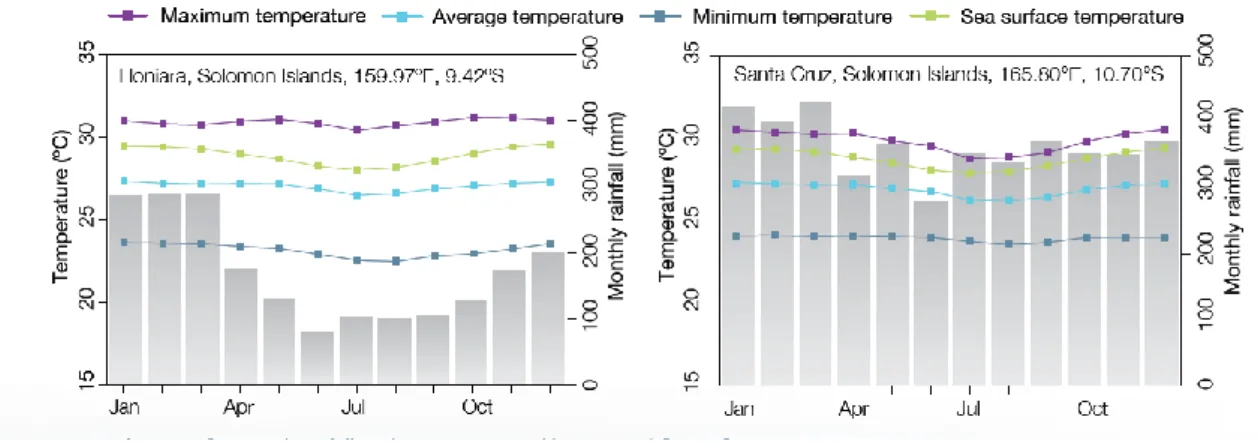
32
Figure 3.1: Seasonal rainfall and temperature at Honiara and Santa Cruz (PCCSP 2011).
The initial settlement of the Solomon Islands involved the people from Greater New Guinea by at least 29,000 B.P. (Matisoo-Smith and Robins 2004). Many modern-day descendants of these people speak what is often termed “Papuan” languages, which
includes a remarkably diverse group of languages quite distinct from the more recently introduced Austronesian languages (Matisoo-Smith and Robins 2004). The Solomon Islands has one of the highest linguistic diversities in the world, with 75 spoken languages and a Linguistic Diversity Index of 0.965 (UNESCO 2009).
The first known European to visit the Solomon Islands was the Spanish explorer Álvaro de Mendaña in 1568. By the late 19th century, the islands were being exploited for labour to work in plantations in nearby areas of Fiji and Queensland, Australia. The Solomon Islands became a British protectorate in 1899. Under the protectorate, missionaries were safe to settle and started to convert people to Christianity. Today 92% of the population are Christian (US Department of State 2007). Prior to the
33
The Solomon Islands saw some of the fiercest fighting of the Second World War, which continued until the end of the war. The War established much of the limited
infrastructure still in place today (e.g. roads, airport runways, bridges).
3.2.2 Biogeography
The Solomon Islands are part of the East Melanesian Islands biodiversity hotspot (Myers et al. 2000) and contain one of the last remaining tracts of coastal tropical rainforest (Bayliss-Smith et al. 2003). The Solomon Islands are a poorly studied region, with the majority of the information known about the fauna of this region collected during the Whitney South Seas Expedition (1921- c.1932). However, this unique biodiversity is under threat from rapid environmental change, with the Solomon Islands economy heavily based on extractive industries. Log exports comprise 46% of the economy, followed by minerals and fisheries (CBSI 2011). The logging industry is operating at unsustainable levels, and in 2011 almost seven times the sustainable harvest estimate of logs were exported, with just 4.5% from plantations (Hughes et al. 2010; CBSI 2012). Development in the Solomon Islands is hindered by this focus on a narrow productive base, in addition to a rapid population growth, low levels of
investment, donor dependency, weak governance, and political instability (Hughes et al. 2010; Hayward-Jones 2014). The Solomon Islands is the poorest country in the Pacific region (OECD 2012), and is ranked 143 out of 187 countries in the United Nations 2012 Human Development Index. There are also significant physical
constraints to the development in the Solomon Islands. The population of 500,000 is spread across more than 900 islands, consisting of hundreds of different identity
34
is continuously wet and in many places excessive rainfall is considered a constraint to agricultural production and infrastructure development (Macintyre and Foale 2004).
As with other areas in Melanesia, the Solomon Islands have also undergone rapid social change in relation to colonization, expanding trading opportunities, and the introduction of Christianity and western medicine. This has led to abandonment of traditional practices that controlled fertility (Dureau 1994), decreased violence-related mortality (Jackson 1978) and lowered rates of infant mortality (Lauer et al. 2013), resulting in a rapid population growth over the 20th century, that remains one of the highest population growth rates in the world (2.6% per annum; UNICEF 2011). The market economy was introduced to the Solomon Islands far later than in other developing countries (Furusawa and Ohtsuka 2006). Yet even in remote rural areas there is growing engagement with the cash economy, particularly through the payment of school fees, transport and imported foods, and on many islands cash crops have become important (Reenberg et al. 2008). The increasing effects of globalisation are leading to social and environmental change. The change occurring in the Solomon Islands is of particular concern from both conservation and development perspectives because the area is a biodiversity hotspot with high levels of endemism (Myers et al. 2000) and 84% of the population depend on subsistence agriculture (Mertz et al. 2012).
35
most households involved in tribe-specific networks that give and reciprocate goods and services, termed the ‘wantok system’ (Gibson 2006). Demands are rarely refused,
and although the giver of the goods or services does not receive payment, the giver knows that it will be reciprocated when needed. While the wantok system can act as an important safety net, it also represents an unequal system that supports the interests of certain individuals (De Renzio, 2000) and is open to exploitation. For example, income earning individuals may find it difficult to save any money or to advance his/her
economic position because of the heavy demands imposed by unemployed or “lazy”
wantoks (De Renzio, 2000). Therefore the wantok system simultaneously creates a cultural resistance to sustained accumulation of material wealth (Foale and Manele, 2004). Please refer to Table 3.1 for further details on Melanesia specific terms.
Table 3.1. Definition of Melanesia specific terms Melanesian term Meaning
Wantok Literally means “one talk” and is considered synonymous with “relative” (Foale 2008). It is an important concept associated with networks of distinct tribal, ethnic, linguistic, and geographic groupings in Melanesia (Nanau 2011).
Wantok system Melanesian practice of demanding money or goods from relatives who are deemed to be capable of sharing (Foale 2008). Demands are rarely refused, and although the giver of the goods or services does not receive payment, the giver knows that it will be reciprocated when needed. In a country without a social security system, the wantok system provides for material care, a sense of identity and support during difficult times (Forster 2005).
36 3.3 Study site location
The research for this thesis was conducted in the Kahua region (Wards 12 and 13; 162⁰0−162⁰15E, 10⁰25−10⁰40S) of Makira Island (formally San Cristobal; Figure 3.2).
37
Makira is the fourth largest island of the archipelago with an area of 3191 km2 and consists of a narrow coastal plain with steep forested central ridges with altitudes up to 1200 m (Allen et al. 2006). Makira has a wet tropical climate with little annual variation; average annual rainfall is 3.6–4 m, with up to 8 m reported in the higher elevations
(Allen et al., 2006). There is limited infrastructure, with no roads and only a limited number of high frequency radios for communication. Transport to the provincial capital of Kirakira (access to main market and hospital) is either by foot or fibreglass boats with small outboard motors (Figure 3.3).
38
Lack of market access is a major constraint to development in the region (Allen et al., 2006). Kahua is experiencing rapid social and environmental change through an increasing population, desire for monetary prosperity, a loss of social cohesion (Fazey et al. 2011) and a loss of traditional methods of natural resource use and management (Ministry of Environment Conservation and Meteorology 2008).
Makira contains globally significant biodiversity and is an important area of endemism. It is part of a high priority Endemic Bird Area (Birdlife International, 2013) and contains 18 extant endemic bird taxa, which is more restricted-range bird species and
subspecies than any other area of comparable size in the world (Danielsen et al. 2010). Kahua is one of the only regions on Makira not to have experienced commercial
logging, but the region is still undergoing rapid environmental change. Changes in primary productivity have been detected suggesting significant ecological change at a landscape scale (Garonna et al., 2009) and at the local level, the availability of forest and marine resources may be declining with reports of falling crop yields and
increasing incidence of pests and diseases (Bourke et al. 2006; Fazey et al. 2011). One endemic species of bird (Thick-billed Ground Dove Gallicolumba salamonis) from Makira has been reported as extinct, and the Critically Endangered Makira Moorhen (Gallinula silvestris) has not been sighted since 1953 (Dutson 2011; BirdLife
International 2013). Makira is particularly understudied region of the Solomon Islands, and there have been no recent surveys to establish population status or viability of many species, including the Critically Endangered Makira Moorhen.
39
The main livelihood strategy is subsistence agricultural production, supplemented by fishing and exploitation of a wide range of species. The main food crops are yams (Dioscorea alata and D. esculenta), taro (Colocasia esculenta), sweet potato (Ipomoea batatas), and banana (Musa spp.). The Pacific has a long history of swidden (shifting) cultivation (Mertz et al. 2012) which is employed on Makira with lands rotated between cultivation (garden) and fallow, with large fruit and nut trees preserved throughout the landscape. I use the Melanesian term ‘garden’ in this thesis to refer to land used for small-scale agriculture (Fig. 3.5). Gardens differ from the ‘home-gardens’ found in
many areas of Asia, which generally refer to land cultivated around the family home, where typically only supplementary foods, such as fruits may be grown. Melanesian gardens are often not located close to houses or villages, and because subsistence agriculture is typically the main livelihood activity, they tend to be larger areas of land than home-gardens (Mertz et al. 2012).
40
There are gender-differentiated roles associated with agriculture: women are the primary farmers (Pollard 2000) and also the main gatherers of wild plants, which are often collected on the way to or from the garden. Men are involved in some agricultural activities (e.g. clearing of new gardens) and are heavily involved with plantation (cash) crops. Hunting is a male activity and culturally important, with wild pigs required for village feasts and reaffirming cultural ties (Miles 1998). Young boys also engage in hunting birds and flying foxes. Only traditional hunting methods are used (e.g. spears and dogs for wild pig, sling-shots or bow and arrow for birds and bats) since guns were outlawed in the Solomon Islands in 2003 (Wainwright 2003). Fishing is usually
conducted with hook and line, from a three metre dugout canoe with no outrigger (Fig 3.6). Men are the primary fishers, with women involved in the collection of shells. However, the Kahua people are traditional forest people, only moving to the coast during the colonial period (Scott 2000). There are no fringing reefs in Kahua, with the sea floor dropping off quickly and often leading to large swells and surf during bad weather. As such, fishing is not a major livelihood activity in Kahua, compared to other areas of the Solomon Islands (e.g. Aswani 2005; Brewer et al. 2009).
41
Interaction with the cash economy in Kahua is limited, but increasing, mainly through the payment of school fees, transport and imported foods. Households engage in a range of income generating activities including the sale of agricultural produce (Fig 3.7), handicrafts and livestock (chickens and pigs), and the production of cash crops (copra and cocoa). Participation in these income-generating activities requires access to land, which is predominantly customary-owned across Melanesia, with tenure established through genealogy (Fazey et al. 2011).
42
Kahua’s geographic isolation and economic marginality means that its communities are
dislocated from political structures and processes and the region receives very little assistance from external institutions (Fazey et al. 2010). Within this context, traditional authorities, such as village chiefs, continue to play a key role in the social, political and economic lives of Kahua people. The Kahua Association is therefore an important mechanism for cross-community governance. The Kahua Association aims to achieve a more united, locally based, and sustainable approach to development (Kahua Association 2005). While the Kahua Association is a fairly young organization, it has already successfully created more effective cross-community discussions and more equitable decision-making, such as when communities have been approached by logging and mining companies (Fazey et al. 2010).
43 Chapter 4: Identifying the poor
Who are the poor? Appropriately
measuring poverty
Material from Chapter 4 formed the basis of the following publication:
Davies T.E., Pettorelli, N., Cresswell W., Fazey I.R.A. 2014. Who are the poor?
Measuring wealth inequality to aid understanding of socioeconomic contexts for
conservation: a case-study from the Solomon Islands. Environmental Conservation
DOI: 10.1017/S0376892914000058 Publication included in Appendix A6