ISSN Online: 2160-696X ISSN Print: 2160-6951
DOI: 10.4236/gsc.2018.84023 Nov. 30, 2018 334 Green and Sustainable Chemistry
A Mild and Efficient Method for the Synthesis of
Acylals from Aromatic Aldehydes and Their
Deprotections Catalyzed by Synthetic
Phosphates under Solvent-Free Conditions
Fathallaah Bazi
1, Bahija Mounir
2, Mohammed Hamza
1, Said Sebti
31Laboratoire de Chimie Analytique et physicochimie des Matériaux, Université Hassan II, Faculté des Sciences Ben M’Sik,
Casablanca, Morocco
2Laboratoire Matériaux, Substances Naturelles, Environnement & Modélisation (LMSNEM), Université Sidi Mohamed Ben
Abdellah Fes, Faculté Polydisciplinaire, Taza, Morocco
3Laboratoire de Chimie Physique Catalyse et Environnement, Université Hassan II, Faculté des Sciences Ben M’Sik, Casablanca,
Morocco
Abstract
An efficient and clean preparation of acylals from aromatic aldehydes in the presence of synthetic phosphates (flourapatite and hydroxyapatite doped with ZnCl2 and ZnBr2) and acetic anhydride was achieved easily in high yields (86% - 97%) at room temperature under solvent-free conditions. Deprotec-tion of the resulting acylals has also been attained by using the same catalysts under microwave irradiation. This method consistently has advantage of ex-cellent yields (82% - 96%) and a short reaction time (3 - 4 min).
Keywords
Synthetic Phosphates, Clean Process, Acylals, Protection, Deprotection
1. Introduction
There has been an increasing emphasis among researchers from both academia and industry to design synthetic strategies keeping in view the principles of “Green Chemistry” [1]. Adopting the principles of green chemistry means to reduce or eliminate the generation and use of hazardous substances. In recent years, replacement of hazardous solvents with environmentally benign solvents
[2] [3] or development of solvent-free syntheses [4] [5] [6] is one of the major focus areas of Green Chemistry. In other cases, the use of heterogeneous
cata-How to cite this paper: Bazi, F., Mounir, B., Hamza, M. and Sebti, S. (2018) A Mild and Efficient Method for the Synthesis of Acylals from Aromatic Aldehydes and Their Deprotections Catalyzed by Synthetic Phos-phates under Solvent-Free Conditions. Green and Sustainable Chemistry, 8, 334-344.
https://doi.org/10.4236/gsc.2018.84023
Received: September 14, 2018 Accepted: November 27, 2018 Published: November 30, 2018
Copyright © 2018 by authors and Scientific Research Publishing Inc. This work is licensed under the Creative Commons Attribution International License (CC BY 4.0).
DOI:10.4236/gsc.2018.84023 335 Green and Sustainable Chemistry lysts under solvent-free conditions is becoming very popular as it has many ad-vantages: reduced pollution, reusability, high selectivity, low cost, and simplicity in process and in handling. These factors are especially important in industry.
The 1,1-diacetates (acylals) have been introduced as a suitable protection group for aldehyde because of their remarkable stability to neutral and basic conditions [7]. In addition, they can be converted into other useful functional groups by reaction with appropriate nucleophiles [8] and used as carbonyl sur-rogates for asymmetric synthesis [9]. 1,1-Diacetates, on the other hand, are am-bident substrates containing two types of reactive carbon centres, the carbon atom of the protected aldehyde function and the carbonyl group in the ester moieties [10]. The relative acid stability of 1,1-diacetates is another interesting feature of such 1,1-diacetates in the field of protection-deprotection chemistry
[11].
The synthesis of acylals is usually achieved via the reaction of an aldehyde with acetic anhydride (AC2O) in the presence of a protic acid [12] [13] [14], Lewis acids [15]-[23], or heterogeneous catalyst [24]-[30]. Many of reported methods, however, involve strongly acidic or oxidizing conditions, corrosive reagents, high temperature, high catalyst loading, longer reaction time and cumbersome procedures. In view of these, the search for finding a cost-effective, mild and simple protocol for synthesis of acylals from aldehydes is still relevant. In recent years, we have used the synthetic phosphates (hydroxyapatite (HAP) and fluorapatite (FAP)) alone, doped and modified by metal salts as the hetero-geneous catalysts for several reactions, such as Knoevenagel condensation [31] [32], Friedel-Crafts alkylation [33] [34] [35], Michael addition [36] [37], hydra-tion of nitriles to amides [38], and Cross aldol Condensation [39]. In this work, we wish to report a mild, convenient and green methodology for the synthesis and deprotection of acylals from aromatic aldehydes using ZnCl2/FAP, ZnBr2/FAP, ZnCl2/HAP and ZnBr2/HAP.
2. Results and Discussion
DOI:10.4236/gsc.2018.84023 336 Green and Sustainable Chemistry different experiments were carried out using varying values of catalyst weight in the protection of benzaldehyde with acetic anhydride (Table 1). The yield of product 2a increased as weight of catalyst increased. This result indicate the pos-itive effect of the catalyst in this transformation, we have chosen 0.1 g of the cat-alyst for further study.
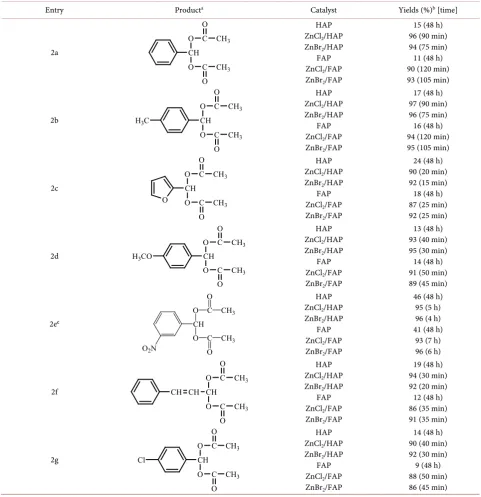
To explore the scope of this methodology the protection of different substrates was investigated. To appreciate the important enhancement of the activity of the doped materials, we have carried out synthesis of acylals with ZnCl2/FAP, ZnBr2/FAP, ZnCl2/HAP and ZnBr2/HAP in the same condition (Table 2). The positive effect of doped solid catalysts can be observed in all cases. The yields obtained are high (86% - 97%) at room temperature except for the product re-quired relatively longer reaction time (entry 2e) at 70˚C, possibly owing to the strong electron-withdrawing nitro substituent (see Table 2). Meanwhile, the presence of electron-donating groups (entry 2b, 2d, 2g, Table 2) increases the yields, demonstrating the participation of both the aldehydes and the acetic an-hydride in the rate controlling step of the reaction. Furthermore, α, β-unsatured aldehydes, such as cinnamaldehyde (Table 2, product 2f) and acid sensitive al-dehydes, such as furfural (Table 2, product 2c) reacted well without any de-composition or polymerization under the selected reaction conditions.
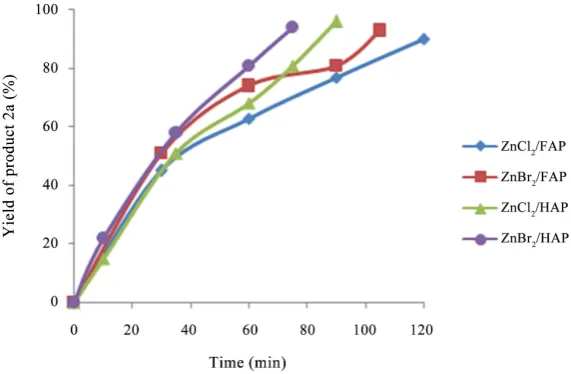
[image:3.595.228.514.505.692.2]To evaluate the influence of the metal halide in the activity of the doped ma-terial, we have compared the yields obtained in the synthesis of product 2a using ZnCl2/HAP, ZnBr2/HAP, ZnCl2/FAP and ZnBr2/FAP. Thus the kinetic curves of these reactions as shown in Figure 1, indicate clearly the promoting effect of Lewis acids, ZnBr2/HAP appear to be somewhat the more active catalyst. Reuse of ZnBr2/HAP was studied in the synthesis of product 2a. The yields obtained were 94%, 76% and 69% using the fresh catalyst and reused for the first and the second time, respectively. The decrease of the yields can be explained by the ac-cumulation of organic substrates over the active sites of the catalyst.
DOI:10.4236/gsc.2018.84023 337 Green and Sustainable Chemistry
Table 1. Effect of the weight of ZnBr2/HAP and ZnBr2/FAP in the synthesis of product 2a.
Weight of catalyst (g) Catalyst Yield (%) [time (min)]
ZnBr2/HAP ZnBr2/FAP
0.05 53 (75) 56 (105)
0.1 94 (75) 93 (105)
0.2 95 (75) 96 (105)
0.5 95 (75) 96 (105)
Table 2. Preparation of 1,1-diacetates from aldehydes.
Entry Producta Catalyst Yields (%)b [time]
2a CH
O O C C O O CH3 CH3 HAP ZnCl2/HAP ZnBr2/HAP
FAP ZnCl2/FAP ZnBr2/FAP
15 (48 h) 96 (90 min) 94 (75 min) 11 (48 h) 90 (120 min) 93 (105 min)
2b CH
O O C C O O CH3 CH3
H3C
HAP ZnCl2/HAP ZnBr2/HAP
FAP ZnCl2/FAP ZnBr2/FAP
17 (48 h) 97 (90 min) 96 (75 min) 16 (48 h) 94 (120 min) 95 (105 min)
2c CH
O O O C C O O CH3 CH3 HAP ZnCl2/HAP ZnBr2/HAP
FAP ZnCl2/FAP ZnBr2/FAP
24 (48 h) 90 (20 min) 92 (15 min) 18 (48 h) 87 (25 min) 92 (25 min)
2d CH
O O C C O O CH3 CH3
H3CO
HAP ZnCl2/HAP ZnBr2/HAP
FAP ZnCl2/FAP ZnBr2/FAP
13 (48 h) 93 (40 min) 95 (30 min) 14 (48 h) 91 (50 min) 89 (45 min)
2ec CH
O O C C O O CH3 CH3
O2N
HAP ZnCl2/HAP ZnBr2/HAP
FAP ZnCl2/FAP ZnBr2/FAP
46 (48 h) 95 (5 h) 96 (4 h) 41 (48 h)
93 (7 h) 96 (6 h)
2f CH CH CH
O O C C O O CH3 CH3 HAP ZnCl2/HAP ZnBr2/HAP
FAP ZnCl2/FAP ZnBr2/FAP
19 (48 h) 94 (30 min) 92 (20 min) 12 (48 h) 86 (35 min) 91 (35 min)
2g CH
O O C C O O CH3 CH3 Cl HAP ZnCl2/HAP ZnBr2/HAP
FAP ZnCl2/FAP ZnBr2/FAP
14 (48 h) 90 (40 min) 92 (30 min) 9 (48 h) 88 (50 min) 86 (45 min)
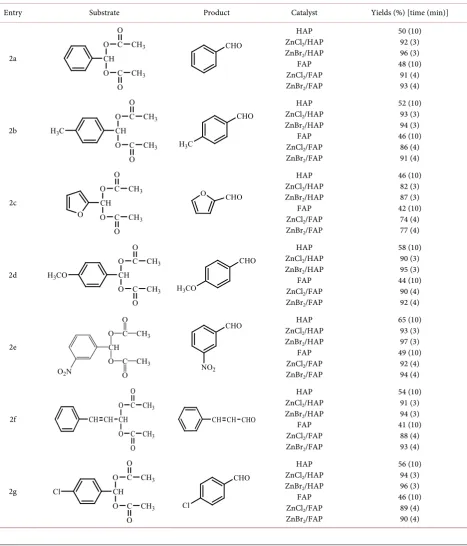
[image:4.595.58.540.215.713.2]DOI:10.4236/gsc.2018.84023 338 Green and Sustainable Chemistry Recently, microwave-assisted solvent-free synthesis in organic reactions has been of growing interest as an efficient, economic and clean procedure (“green chemistry”) [6] [39] [40] [41] [42]. For these reasons, we have tried the method for deprotection of geminal-diacetates catalyzed by same supports FAP, HAP, ZnBr2/FAP, ZnCl2/FAP, ZnBr2/HAP and ZnCl2/HAP). The results are summarized in Table 3. The reaction were completed within 3 min for
Table 3. Regeneration of aldehydes from 1,1-diacetates.
Entry Substrate Product Catalyst Yields (%) [time (min)]
2a CH
O O C C O O CH3 CH3 CHO HAP ZnCl2/HAP ZnBr2/HAP
FAP ZnCl2/FAP ZnBr2/FAP
50 (10) 92 (3) 96 (3) 48 (10) 91 (4) 93 (4)
2b CH
O O C C O O CH3 CH3
H3C
CHO
H3C
HAP ZnCl2/HAP ZnBr2/HAP
FAP ZnCl2/FAP ZnBr2/FAP
52 (10) 93 (3) 94 (3) 46 (10) 86 (4) 91 (4)
2c CH
O O O C C O O CH3
CH3 O
CHO
HAP ZnCl2/HAP ZnBr2/HAP
FAP ZnCl2/FAP ZnBr2/FAP
46 (10) 82 (3) 87 (3) 42 (10) 74 (4) 77 (4)
2d CH
O O C C O O CH3 CH3 H3CO
CHO
H3CO
HAP ZnCl2/HAP ZnBr2/HAP
FAP ZnCl2/FAP ZnBr2/FAP
58 (10) 90 (3) 95 (3) 44 (10) 90 (4) 92 (4)
2e CH
O O C C O O CH3 CH3 O2N
CHO
NO2
HAP ZnCl2/HAP ZnBr2/HAP
FAP ZnCl2/FAP ZnBr2/FAP
65 (10) 93 (3) 97 (3) 49 (10) 92 (4) 94 (4)
2f CH CH CH
O O C C O O CH3 CH3
CH CH CHO
HAP ZnCl2/HAP ZnBr2/HAP
FAP ZnCl2/FAP ZnBr2/FAP
54 (10) 91 (3) 94 (3) 41 (10) 88 (4) 93 (4)
2g CH
O O C C O O CH3 CH3 Cl CHO Cl HAP ZnCl2/HAP ZnBr2/HAP
FAP ZnCl2/FAP ZnBr2/FAP
DOI:10.4236/gsc.2018.84023 339 Green and Sustainable Chemistry ZnX2/apatite (P = 300 W) and high yields (82% - 96%) of regeneration of alde-hydes. Whereas, similar reaction in the presence of apatite alone (P = 500 W) afforded moderate yields of product (49% - 63%) within 10 min of irradiation time.
It was noticed that there was no reaction under microwave without catalyst, and to what was observed in traditional heating without solvent. This shows a certain synergy between catalyst and the microwave. It is thus completely rea-sonable to think that the effect of the temperature is a determining factor to promote this transformation. Unfortunately, domestic microwave was used and therefore it was impossible to measure the exact temperature during the reac-tion.
In conclusion, we have developed a clean and easy method for the synthesis of geminal-diacetates from aldehydes in solvent free conditions, and regeneration of aromatic aldehydes from the corresponding acylals in microwave irradiation using metal halides doped apatite (HAP or FAP) as heterogeneous catalysts. The positive effect of doping the apatite with ZnCl2 and ZnBr2 has been observed, and the comparison of these materials indicates that ZnBr2/HAP is the best cat-alyst for this reaction. The use of metal halides doped apatite offers diverse ad-vantages including simplicity of operation due to the heterogeneous nature of reaction, easy workup and high yields.
3. Experimental
3.1. Preparation and Characterization of the Catalysts
3.1.1. Preparation and Characterization of HAPThe synthesis of hydroxyapatite [33] is carried out by reaction between diam-monium phosphate and calcium nitrate in presence of ammonia. An amount of 250 ml of aqueous solutions containing 7.92 g of diammonium phosphate, maintained at a pH greater than 12 by addition of ammonium hydroxide (70 ml), were dropped under constant stirring into 150 ml of a solution containing 23.6 g of calcium nitrate (Ca(NO3)2H2O). The suspension was refluxed for 4 h. Distilled water (DW) was used to prepare the solutions. The obtained hydrox-yapatite was filtered, washed with DW, dried overnight at 80˚C and calcined in air at 800˚C for 1 h before use.
The structure of the obtained hydroxyapatite was confirmed by X-ray diffrac-tion, infrared spectroscopy and chemical analysis. The hydroxyapatite crystal-lized in the hexagonal system with the space group P63/m. The lattice parame-ters of the prepared HAP are in excellent agreement with standard data: a = 6.883 A˚ and c = 9.422 A˚. Surface area of the calcined HAP was determined by the BET method from the adsorption-desorption isotherm of nitrogen at its liq-uid temperature (77 K), and was found to be S = 35 m2·g−1.
3.1.2. Preparation and Characterization of FAP
DOI:10.4236/gsc.2018.84023 340 Green and Sustainable Chemistry spectroscopy and chemical analysis. The fluorapatite crystallized in the hex-agonal system with the space group P63/m. The lattice parameters of the pre-pared FAP are in excellent agreement with standard data: a = 9.364 A˚ and c = 6.893 A˚. Surface area of the calcined FAP was determined by the BET method, and was found to be S = 15 m2·g−1.
3.2. Preparation of ZnX2/Apatite (ZnX2/HAP or ZnX2/FAP)
[X = Br, Cl]
The preparation of ZnX2/apatite was as follows: 10 mmol of ZnX2 and 10 g of apatite (FAP or HAP) were mixed in 100 mL of water and then evaporated to dryness and dried for 2 h at 150˚C before use.
The XRD patterns of ZnX2/apatite are similar to that of apatite [34] [35] [36]. The modification of the apatite by ZnX2 impregnation does not change the crys-talline structure of the solid material. The intensity of typical diffraction peaks did not significantly change indicating no disorganization of the crystalline structure of apatite. It should be noted that no ZnX2 phases were detected on the doped materials in all cases, indicating that ZnX2 was highly dispersed in the solid apatite.
3.3. Procedure for the Preparation of 1.1-Diacetates
A typical procedure for the preparation of 1,1-diacetates is a follows: the alde-hyde (3 mmol) and acetic anhydride (9 mmol) were placed in a two-necked flask with stirring at room temperature. The catalyst (200 mg of apatite (HAP or FAP) or 100 mg of (ZnX2/FAP or ZnX2/HAP) was added and obtained mixture was maintained at room temperature (only for entry 2e a temperature at 70˚C was needed) for the appropriate time (see Table 2). After the completion of the reaction was monitored by TLC (hexane/ethyl acetate 5% - 20%), Et2O was added to the mixture and filtered, and then the catalyst was again washed with Et2O and collected for reuse. Evaporation of the solvent followed by column chromatography on silica gel afforded the pure compound corresponding to 1,1-diacetates.
3.4. Procedure for Deprotection of 1.1-Diacetates
A typical procedure for the regeneration of aldehydes from 1,1-diacetates is a follows: 0.5 g of synthetic phosphates were placed, at 500 w for (HAP or FAP) or 350 w for (ZnX2/FAP or ZnX2/HAP) in a domestic microwave oven, for the ap-propriate time (Table 3). After the completion of the reaction was monitored by TLC (hexane/ethyl acetate 5% - 20%), Et2O was added to the mixture and fil-tered. Evaporation of the solvent followed by column chromatography on silica gel afforded the pure compound corresponding to aldehydes.
Conflicts of Interest
DOI:10.4236/gsc.2018.84023 341 Green and Sustainable Chemistry
References
[1] Anastas, P.T. and Warner, J.C. (1998) Green Chemistry, Theory and Practice. Ox-ford University Press, OxOx-ford.
[2] Polshettiwar, V. and Varma, R.S. (2008) Microwave-Assisted Organic Synthesis and Transformations Using Benign Reaction Media. Accounts of Chemical Research, 41, 629-639. https://doi.org/10.1021/ar700238s
https://pubs.acs.org/doi/abs/10.1021/ar700238s
[3] Polshettiwar, V. and Varma, R.S. (2008) Aqueous Microwave Chemistry: A Clean and Green Synthetic Tool for Rapid Drug Discovery. Chemical Society Reviews, 37, 1546-1557. https://doi.org/10.1039/b716534j
http://pubs.rsc.org/en/content/articlelanding/2008/cs/b716534j/unauth#!divAbstrac t
[4] Toda, F. and Tanaka, K. (2000) Solvent-Free Organic Synthesis. Chemical Reviews, 100, 1025-1074. https://pubs.acs.org/doi/abs/10.1021/cr940089p
https://doi.org/10.1021/cr940089p
[5] Varma, R.S. (2002) Clay and Clay-Supported Reagents in Organic Synthesis. Tetrahedron, 58, 1235-1255. https://doi.org/10.1016/S0040-4020(01)01216-9
http://parazite.nn.fi/hiveboard/picproxie_docs/000458467-Tetrahedron_58_2002_1 235-1255.pdf
[6] Varma, R.S. (1999) Solvent-Free Organic Syntheses Using Supported Reagents and Microwave Irradiation. Green Chemistry, 1, 43-55.
http://pubs.rsc.org/en/content/articlehtml/1999/gc/a808223e https://doi.org/10.1039/a808223e
[7] Greene, T.W. and Wuts, P.G.M. (1999) Protective Groups in Organic Synthesis. 3rd Edition, John Wiley and Sons, New York, 306.
[8] Heerden, F.R., Huyser, J.J., Williams, D.B.G. and Holzapfer, C.W. (1998) Palla-dium-Catalysed Substitution Reactions of Geminal Allylic Diacetates. Tetrahedron Letters, 39, 5281-5284. https://doi.org/10.1016/S0040-4039(98)01000-4
https://www.sciencedirect.com/science/article/pii/S0040403998010004
[9] Trost, B.M. and Lee, C. (2001) Gem-Diacetates as Carbonyl Surrogates for Asym-metric Synthesis. Total Syntheses of Sphingofungins E and F. Journal of the Ameri-can Chemical Society, 123, 12191-12201.
https://pubs.acs.org/doi/abs/10.1021/ja0118338 https://doi.org/10.1021/ja0118338
[10] Sandberg, M. and Sydnes, L.K. (1998) The Chemistry of Acylals. Part II. Formation of Nitriles by Treatment of Acylals with Trimethylsilyl Azide in the Presence of a Lewis Acid. Tetrahedron Letters, 39, 6361-6364.
https://www.sciencedirect.com/science/article/pii/S0040403998013094 https://doi.org/10.1016/S0040-4039(98)01309-4
[11] Kochhar, K.S., Bal, B.S., Deshpande, R.P., Rajadhyaksha, S.N. and Pinnick, H.W. (1983) Protecting Groups in Organic Synthesis. Part 8. Conversion of Aldehydes into Geminal Diacetates. Journal of Organic Chemistry, 48, 1765-1767.
https://pubs.acs.org/doi/abs/10.1021/jo00158a036?journalCode=joceah https://doi.org/10.1021/jo00158a036
[12] Tomita, M., Kikuchi, T., Bessho, K., Hori, T. and Inubushi, Y. (1963) Studies on Pi-locereine and Related Compounds. III. Synthesis of 2, 2’, 3-Trimethoxydiphenyl Ether-4’, 5- and -4’, 6-Dicarboxaldehyde. Chemical and Pharmaceutical Bulletin, 11, 1484-1490. https://doi.org/10.1248/cpb.11.1484
DOI:10.4236/gsc.2018.84023 342 Green and Sustainable Chemistry [13] Davey, W. and Gwilt, J.R. (1957) Chalcones and Related Compounds. Part I. Prep-aration of Nitro-, Amino-, and Halogeno-Chalcones. Journal of the Chemical So-ciety, 0, 1008-1014. https://doi.org/10.1039/jr9570001008
http://pubs.rsc.org/en/content/articlelanding/1957/jr/jr9570001008/unauth#!divAbs tract
[14] Marshall, J. and Wuts, P.G.M. (1977) Stereoselective Synthesis of Racemic Occi-dentalol and Related Cis-Fused Hexahydronaphthalenes from M-Toluic Acid. Journal of Organic Chemistry, 42, 1794-1798.
https://pubs.acs.org/doi/abs/10.1021/jo00430a027?journalCode=joceah https://doi.org/10.1021/jo00430a027
[15] Deka, N., Kalita, D.J., Borah, R. and Sarma, J.C. (1997) Iodine as Acetylation Cata-lyst in the Preparation of 1,1-Diacetates from Aldehydes. Journal of Organic Che-mistry, 62, 1563-1564. https://doi.org/10.1021/jo961741e
https://pubs.acs.org/doi/abs/10.1021/jo961741e?journalCode=joceah
[16] Scriabire, I. (1961) Nouveau procédé de préparation des aldéhydes dihidrocinnamique. Bulletin de la Société Chimique de France, 1194.
[17] Wang, C.D. and Li, M.H. (2002) A Novel and Efficient Conversion of Aldehydes to 1,1-diacetates Catalyzed with FeCl3/SiO2 under Microwave Irradiation. Synthetic
Communication, 32, 3469-3473. https://doi.org/10.1081/SCC-120014779 https://www.tandfonline.com/doi/abs/10.1081/SCC-120014779
[18] Yadav, J.S., Reddy, B.V.S. and Srinivas, C. (2002) Indium Trichloride Catalyzed Chemo-selective Conversion of Aldehydes to gem-Diacetates. Synthetic Communication, 32, 1175-1180. https://www.tandfonline.com/doi/abs/10.1081/SCC-120003607
[19] Yin, L., Zhang, Z.H., Wang, Y.M. and Pang, M.L. (2004) Indium Tribromide as a Highly Efficient and Versatile Catalyst for Chemoselective Synthesis of Acylals from Aldehydes under Solvent-Free Conditions. Synlett, 10, 1727-1730.
https://www.thieme-connect.com/products/ejournals/abstract/10.1055/s-2004-8295 49
[20] Heravi, M.M., Bakhtiari, K., Benmorad, T. and Oskooie, H.A. (2007) VSO45H2O: A
Mild and Efficient Catalyst for Chemo-Selective Conversion of Aldehydes to 1,1-Diacetates. Journal of the Chinese Chemical Society, 54, 273-275.
https://onlinelibrary.wiley.com/doi/abs/10.1002/jccs.200700040
[21] Karimi, B. and Maleki, J. (2003) Lithium Trifluoromethanesulfonate (LiOTf) as a Recyclable Catalyst for Highly Efficient Acetylation of Alcohols and Diacetylation of Aldehydes under Mild and Neutral Reaction Conditions. Journal of Organic Che-mistry, 68, 4951-4954. https://doi.org/10.1021/jo026678+
https://pubs.acs.org/doi/abs/10.1021/jo026678%2B?journalCode=joceah
[22] Ghosh, R., Maiti, S., Chakraborty, A. and Halder, R. (2004) Indium Triflate: A Reusable Catalyst for Expeditious Chemoselective Conversion of Aldehydes to Acylals. Journal of Molecular Catalysis A: Chemical, 215, 49-53.
https://www.sciencedirect.com/science/article/pii/S1381116904000573
https://doi.org/10.1016/j.molcata.2004.01.018
[23] Jin, T.S., Sun, G., Li, Y.W. and Li, T.S. (2002) An Efficient and Convenient Proce-dure for the Preparation of 1,1-Diacetates from Aldehydes Catalyzed by H2NSO3H.
Green Chemistry, 4, 255-256. https://doi.org/10.1039/b200219a
http://pubs.rsc.org/en/content/articlelanding/2002/gc/b200219a/unauth#!divAbstra ct
DOI:10.4236/gsc.2018.84023 343 Green and Sustainable Chemistry (WCl6). Synthetic Communication, 32, 669-673.
https://www.tandfonline.com/doi/abs/10.1081/SCC-120002503
https://doi.org/10.1081/SCC-120002503
[25] Firouzabadi, H., Iranpoor, N., Nowrouzi, F. and Amani, K. (2003) Aluminum Do-decatungstophosphate (AlPW12O40) as an Efficient Heterogeneous Inorganic
Cata-lyst for the Chemoselective Synthesis of Geminal Diacetates (Acylals) under Sol-vent-Free Conditions. Tetrahedron Letters, 44, 3951-3954.
https://www.sciencedirect.com/science/article/pii/S0040403903008116
https://doi.org/10.1016/S0040-4039(03)00811-6
[26] Romanelli, G.P., Thomas, H.J., Baronetti, G.T. and Autino, J.C. (2003) Solvent-Free Catalytic Preparation of 1,1-Diacetates from Aldehydes Using a Wells-Dawson Acid (H6P2W18O62·24H2O). Tetrahedron Letters, 44, 1301-1303.
https://www.sciencedirect.com/science/article/pii/S0040403902028174
https://doi.org/10.1016/S0040-4039(02)02817-4
[27] Curini, M., Epifano, F., Marcotullio, M.C., Rosati, O. and Nocchetti, M. (2002) Preparation and Deprotection of 1,1-Diacetates (Acylals) Using Zirconium Sulfo-phenyl Phosphonate as Catalyst. Tetrahedron Letters, 43, 2709-2711.
https://www.sciencedirect.com/science/article/pii/S0040403902003696
https://doi.org/10.1016/S0040-4039(02)00369-6
[28] Smitha, G. and Reddy, C.S. (2003) A Facile and Efficient ZrCl4 Catalyzed
Conver-sion of Aldehydes to Geminal-Diacetates and Dipivalates and Their Cleavage. Te-trahedron, 59, 9571-9576.https://doi.org/10.1016/j.tet.2003.10.002
https://www.sciencedirect.com/science/article/pii/S0040402003015813
[29] Ziyaei, A., Azizi, N. and Saidi, M.R. (2005) Chemoselective and Convenient Prepa-ration of 1,1-Diacetates from Aldehydes, Mediated by Solid Lithium Perchlorate under Solvent-Free Conditions. Journal of Molecular Catalysis A: Chem, 238, 138-141. https://doi.org/10.1016/j.molcata.2005.05.022
https://www.sciencedirect.com/science/article/pii/S138111690500364X
[30] Sebti, S., Tahir, R., Nazih, R., Saber, A. and Boulaajaj, S. (2002) Hydroxyapatite as a New Solid Support for the Knoevenagel Reaction in Heterogeneous Media without Solvent. Applied Catalysis A, 228, 155-159.
https://www.sciencedirect.com/science/article/pii/S0926860X01009619
https://doi.org/10.1016/S0926-860X(01)00961-9
[31] Sebti, S., Nazih, R., Tahir, R., Salhi, L. and Saber, A. (2000) Fluorapatite: New Solid Catalyst of the Knoevenagel Reaction in Heterogeneous Media without Solvent. Applied Catalysis A, 197, L187-L190.
https://doi.org/10.1016/S0926-860X(99)00492-5
https://www.sciencedirect.com/science/article/pii/S0926860X99004925
[32] Sebti, S., Tahir, R., Nazih, R. and Boulaajaj, S. (2001) Comparison of Different Lewis Acid Supported on Hydroxyapatite as New Catalysts of Friedel-Crafts Alkylation. Applied Catalysis A: General, 218, 25-30.
https://www.sciencedirect.com/science/article/pii/S0926860X01005993
https://doi.org/10.1016/S0926-860X(01)00599-3
[33] Saber, A., Smahi, A., Solhy, A., Nazih, R., Elaabar, B., Maizi, M. and Sebti, S. (2003) Heterogeneous Catalysis of Friedel-Crafts Alkylation by the Fluorapatite Alone and Doped with Metal Halides. Journal of Molecular Catalysis A, 202, 229-237.
https://www.sciencedirect.com/science/article/pii/S1381116903001869
https://doi.org/10.1016/S1381-1169(03)00186-9
DOI:10.4236/gsc.2018.84023 344 Green and Sustainable Chemistry Catalysis A: General, 298, 261-264.https://doi.org/10.1016/j.apcata.2005.09.024 https://www.sciencedirect.com/science/article/pii/S0926860X05007222
[35] Tahir, R., Banert, K., Solhy, S. and Sebti, S. (2006) Zinc Bromide Supported on Hy-droxyapatite as a New and Efficient Solid Catalyst for Michael Addition of Indoles to Electron-Deficient Olefins. Journal of Molecular Catalysis A, 246, 39-42.
https://www.sciencedirect.com/science/article/pii/S1381116905007259
https://doi.org/10.1016/j.molcata.2005.10.012
[36] Zahouily, M., Mounir, B., Charki, H., Mezdar, A., Bahlaouan, B. and Ouammou, M. (2006) Investigation of the Basic Catalytic Activity of Natural Phosphates in the Michael Condensation. Arkivoc, 13, 178-186.
https://www.arkat-usa.org/get-file/22824/
[37] Bazi, F., El Badaoui, H., Tamani, S., Sokori, S., Solhy, A., Macquarrie, D.J. and Sebti, S. (2006) A Facile Synthesis of Amides by Selective Hydration of Nitriles Using Modified Natural Phosphate and Hydroxyapatite as New Catalysts. Applied Cataly-sis A, 301, 211-214.https://doi.org/10.1016/j.apcata.2005.12.003
[38] https://www.sciencedirect.com/science/article/pii/S0926860X05009269
[39] Mounir, B., Bazi, F., Mounir, A., Toufik, H. and Zahouily, M. (2018) So-dium-Modified Fluorapatite: A Mild and Efficient Reusable Catalyst for the Synthe-sis of α,α’-Bis(Substituted Benzylidene) Cycloalkanones under Conventional Heat-ing and Microwave Irradiation. Green and Sustainable Chemistry, 8, 156-166.
http://www.scirp.org/journal/PaperInformation.aspx?paperID=84414
https://doi.org/10.4236/gsc.2018.82011
[40] Lidstrom, P., Tierney, J., Wathey, B. and Westman, J. (2001) Microwave Assisted Organic Synthesis. Tetrahedron, 57, 925-9283.
https://www.erowid.org/archive/rhodium/pdf/microwave.organic.chemistry.review. pdf https://doi.org/10.1016/S0040-4020(01)00906-1
[41] Rezayati, S., Hajinasiri, R. and Erfani, Z. (2016) Microwave-Assisted Green Synthe-sis of 1,1-Diacetates (acylals) Using SelectfluorTM as an Environmental Friendly
Catalyst under Solvent-Free Conditions. Research on Chemical Intermediates, 42, 2567-2576. https://doi.org/10.1007/s11164-015-2168-1
https://link.springer.com/article/10.1007/s11164-015-2168-1
[42] Naeimi, H., Kiani, F. and Moradian, M. (2018) Rapid Microwave Promoted Hete-rocyclization of Primary Amines with Triethyl Orthoformate and Sodium Azide Using Zinc Sulfide Nanoparticles as Recyclable Catalyst. Green Chemistry Letters and Reviews, 11, 361-369. https://doi.org/10.1080/17518253.2018.1510990