ISSN Online: 2328-4870 ISSN Print: 2328-4862
DOI: 10.4236/jhrss.2018.64040 Nov. 20, 2018 235 Journal of Human Resource and Sustainability Studies
Assessing the Impact of Computer Mediated
Communication (CMC) on Productivity and
Efficiency in Faecal Sludge Management: A Case
Study of the Giant Faecal Sludge Management
Company in Ghana
Florence Asiamah
1, Issahaku Ahmed
1*, Esi Awuah
2, Florence Cobbold
1, Lola Asiseh Ashitey
11Sewerage Systems Ghana Ltd., Accra, Ghana
2Department of Civil Engineering, Kwame Nkrumah University of Science and Technology, Kumasi, Ghana
Abstract
Today’s environment had seen technology taking the center stage in research, and several researches in this area assess the impact of technology on the so-ciety and business organizations. This study outlines the impact of computer mediated communication (CMC) on productivity and efficiency in the faecal sludge industry and Sewerage Systems Ghana Limited was used as a case study. Selective sampling technique was used to identify the institution and respondents were randomly selected to undertake the study. A total of 92 respondents were engaged and a questionnaire was administered in order to get the required responds. The study indicates that about 53% of the respon-dents admitted to the use of emails as medium in communication to be the best medium in attaining high efficiency and productivity, while 28% believed the use of What’s App application would improve the effectiveness and productivity. Some respondents preferred other methods, for example, com-municating face to face which they have highlighted is a medium which en-hances interpersonal relationships. The use of printed memo and letters as well as the use of the notice boards was also endorsed to have positive conse-quence on productivity and efficiency. It was noted that the usage of CMC is highly dependent on age and educational background. As the age of the re-spondents increased, there was decrease in the utility acceptance of CMC and the reverse was noted for educational background. The highly rated and pre-ferred medium of communication based on the study is the most used me-dium utilized by Sewerage Systems Ghana Ltd. Employing the most preferred
How to cite this paper: Asiamah, F., Ahmed, I., Awuah, E., Cobbold, F. and Ashitey, L.A. (2018) Assessing the Impact of Computer Mediated Communication (CMC) on Prod-uctivity and Efficiency in Faecal Sludge Man-agement: A Case Study of the Giant Faecal Sludge Management Company in Ghana. Journal of Human Resource and Sustainability Studies, 6, 235-248.
https://doi.org/10.4236/jhrss.2018.64040
Received: August 8, 2018 Accepted: November 17, 2018 Published: November 20, 2018
Copyright © 2018 by authors and Scientific Research Publishing Inc. This work is licensed under the Creative Commons Attribution International License (CC BY 4.0).
DOI: 10.4236/jhrss.2018.64040 236 Journal of Human Resource and Sustainability Studies
medium for communication in the organization is evidenced in the high per-formance of the staff which is reflective in the overall perper-formance of the plant operations. The application of the CMC and the utilization of the ap-propriate medium or media in the management of faecal sludge highly aided the productivity and efficiency of personnel as well the overall performance of the plant operations and hence the organization.
Keywords
Computer Mediated Communication, Faecal Sludge Management, Productivity, Efficiency, SSGL
1. Introduction/Literature Review
Today’s world is characterized with technology and every society is adopting to its use to either facilitate business or social networks. This has become an im-portant asset or tool for human beings in all walks of life [1]. As Green [2] puts it, technology has proven to be an all important tool for humans which plays a major role since the beginning of human race from the faces of life, such as the use of fire as a weapon and a tool for development, through invention of light bulb that gives birth to the electrification age and the development of computers and internet which describes our current age of life. Rogers [3] makes an asser-tion that microcomputer is among the most important innovaasser-tions of our present age if we should assess its significance and impact in schools, homes, businesses and social centers. Again, according to Rogers [4], the internet was a medium that exposed the computer to be a global craze. In 2002, about 544 mil-lion people were estimated to use the internet internationally which has kept on increasing [2].
DOI: 10.4236/jhrss.2018.64040 237 Journal of Human Resource and Sustainability Studies
share of information and access of information and it is very paramount through emails or electronic mails by a hit of a button to either a group of people within and outside of the working environment at the side time while they could share this information individually. Now big companies are making use of this me-dium of communication to sell their products and advertise their product to gain wider clientele base and small to medium companies are doing same through this same medium. Until the beginning of the computer era in 1946 which is also known as the interactive communicative era, research has indicated that there were three different era of communication [3], but they were rather cumber-some, less efficient and time consuming. New technology has been adopted by individuals as well as organizations with the existence of the internet. This has had different impact on almost every aspect of the human life. According to Rogers [4], the internet was developed in the year 1969 when ARPANET net-work was initiated to allow thirty US Department of Defense contractors to share computer software and databases. He recounts that the email system be-came the main function for network users after the computer software and da-tabase system. These two systems were merged in 1980 which gradually gained grounds within 18 years and the rate at which it was accepted has made a huge impact in today’s world. In addition, Kiesler, Siegel, & McGuire [5] states that Computer Mediated communication has the advantage of affecting workplace interactions where, members within a group participated more in sharing of ideas and gave room for members at all backgrounds to contribute where high status members did not dominate the interaction to the same degree of face to face meetings. This is believed to have happened because Computer Mediated communication has the ability to sieve out certain personal and social behavioral cues; for example, body language and voice tone which are used in the direct contact interactions.
Irrespective of all these advantages, there are some associated disadvantages which may include, distort of communication and others. With Computer Me-diated communication the richness of a communication is believed to be lost because having that physical contact would give both the sender and the receiver of any information a clear meaning [6]. Although Computer Mediated commu-nication is believed to take away the richness in conversations such as focus, dif-ferent ways to convey messages as well as certain cues and clues, it is believed that in Computer Mediated communication, a sure way of interpreting and communicating information based on some factors such as sender or recipient role in the organization [7], thread of conversations, type of relationship that ex-ists between sender and recipient, subject of message and more.
DOI: 10.4236/jhrss.2018.64040 238 Journal of Human Resource and Sustainability Studies
improvement in employee task efficiency, planning flexible work schedule, eli-minating manual action plans, responding to the environment, time manage-ment, action plans, composing and preparing written documents. Computer Mediated communication goes beyond all other forms of communication which is aided by the use of computer and it is known to improve information processing systems in organizations.
Like other businesses and sectors [9] [10], Computer Mediated Communica-tion (CMC) is seen to be a very important parameter in the Faecal Sludge Man-agement (FSM) sector of operations and it has the potential to affect productivi-ty and efficiency. Research has indicated that, sewage and faecal sludge treat-ment plants may gradually increase in Ghana and a large demand for informa-tion on appropriate procedures and technologies has to be developed [11]. There are several prospects in the management of faecal sludge in Ghana [11] [12] [13] [14] [15] and this is also evidenced with the progress observed in recent times with regard to establishment of a sanitation ministry. With the attention being given in the area of sanitation which encompasses the treatment of faecal sludge and sewage in attaining the sustainable development goals, it has become imper-ative for detail research to be conducted across all facet of its management. This study therefore, seeks to identify some important values of Computer Mediated Communication on productivity and efficiency of employees in the FSM sector. Also, assess whether Computer Mediated communication has the potential to increase a worker’s efficiency and productivity as well as identify any disadvan-tages of the use of Computer Mediated communication and interpersonal inte-ractions of individuals by the use of Computer Mediated Communication in FSM. This assessment of Computer Mediated Communication on productivity and efficiency in FSM was carried out using SSGL as a case study. This is because in Ghana, SSGL is a giant leader in the management of liquid waste. Just like the other sectors of businesses who had adopted the use of Computer Mediated Communication to enhance or gain competitive advantage over their competi-tors [9] [10], so is this work would want to figure out the consequence of the ap-plication of CMC in liquid waste management. The knowledge of this study would highlight whether Computer Mediated Communication will cause the same effect on staff in terms of efficiency and productivity as it is in the other sectors of businesses.
DOI: 10.4236/jhrss.2018.64040 239 Journal of Human Resource and Sustainability Studies
2. Methodology
2.1. Setting and Context
This paper made its assessment in the Faecal Sludge Management setting in Ghana. Sewerage Systems Ghana Limited (SSGL) is a privately owned institution set to give Ghanaians a more decent and environmentally acceptable standard facility for liquid waste management. It is a Public Private Partnership arrange-ment with the Local Governarrange-ment and Rural Developarrange-ment to predicate an inter-national best practice where faecal and sewerage systems are usually owned and operated by municipal authority. SSGL has a total of 128 employees which com-prises of 41 staff belonging to the executive, managers, administrative and pro-fessional staff [12] who have access to a networked computer and what’s up platform. The 41 personnel represent 32% of the total workforce with 87 staff (68%) being operational staff. SSGL since its inception saw the need to provide most of its staff with a networked computer to aid in the work they do as busi-ness evolution era has made it imperative. The idea was to ensure staff use this medium to uplift effectiveness and high productivity. However, although SSGL is doing well in terms of handing over information from person to person or among various department, this paper seeks to identify if the employees share the same thought of being effective and productive with the Computer Mediated communication that has been provided. Would they have been better off with-out the Computer Mediated communication platforms, whether they would have just been better off with the “Hand me down” old system or manual way of transferring information among personnel.
2.2. Sampling and Data Collection
In this study, selective sampling was used to select SSGL for the case study be-cause SSGL is a giant leader with little or no competition at all when it comes to FSM in Ghana. The random sampling technique was used to determine the sample size from the population of employees. The objectives of this study guided us in the choice of questions to be adopted for the study. The type of questions that were asked was very clear and self-explanatory with a well-defined response options. To be able to get accurate information, staff were randomly selected for this survey. Those selected for the survey cuts across all levels in the organizational structure. However, as a tradition in research, there are some oc-currences which cannot be avoided as far as research and collecting of data is concerned. Not everybody was willing to cooperate, some were too busy to com-plete the questionnaire, and others would just not be interested. Thus, at the end of the survey, 100 questionnaires were sent out but 92 questionnaires were accu-rately filled for the study which makes our sample size 92. The questionnaire was divided into 3 main parts.
DOI: 10.4236/jhrss.2018.64040 240 Journal of Human Resource and Sustainability Studies
These parameters were chosen because we believed that there would be varied views about the use of Computer Mediated communication based on the para-meters mentioned.
Part B of the questionnaire comprised of questions related to the use of emails and what’s App platforms and the reason why they would prefer to use these platforms and their rationale behind the importance of using these platforms in relation to executing their tasks and duties at the work environment. This to some extent assesses the advantages and disadvantages of the use of the Com-puter Mediated communication. It focused on finding how CMC has affected employee relationship in the organization, how CMC has affected their duties to make them productive and efficient in what they do, whether they appreciate the use of Computer Mediated communication to the traditional way of passing down information or the face to face method and their opinion on the method they preferred.
Part C was also designed to examine the type of gadget they preferred to use in order to make them productive and efficient at the work place. They were also given an opportunity to give their personal opinions on their position with the use of Computer Mediated communication compared to not using it.
3. Results and Discussions
The questionnaire designed for this study was distributed randomly to 100 em-ployees in SSGL taking into account ages, gender and educational level. Respon-dents for the questionnaire were a total of 92 comprising 80 men (87%) and 12 women (13%). The margin of percentage of male to female respondents was wide. This is a clear indication that Sewerage Systems Ghana Limited is a male dominated organization. However, it is not surprising due to the area of opera-tion. Data for the study was analyzed based on the three stated objectives. The first objective dealt with the effect Computer Mediated communication has on worker productivity and efficiency in FSM (SSGL).
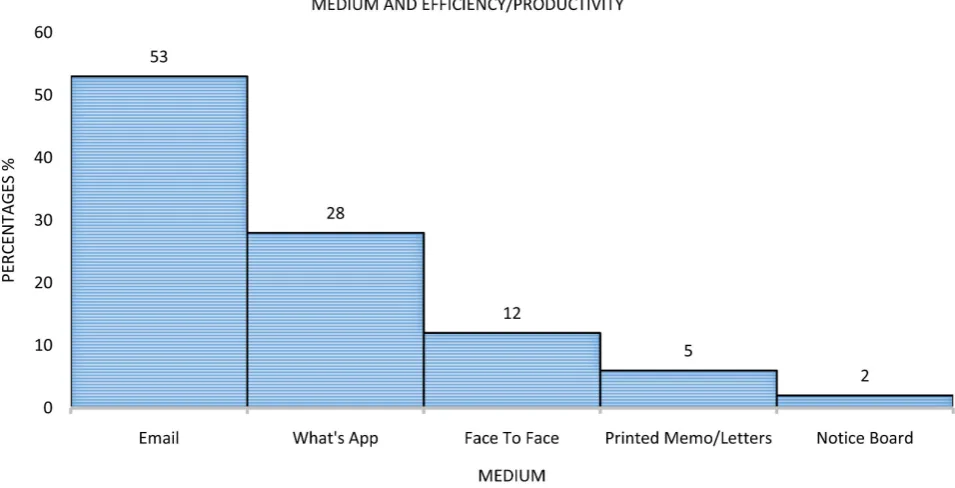
From Figure 1, about 53% of respondents indicated the use of emails make them productive and efficient. 28% indicated what’s app made them productive and efficient. 12% of respondents preferred face to face communication me-dium, 5% preferred printed letters and memos and then 2% of the respondents preferred the notice board to access information.
DOI: 10.4236/jhrss.2018.64040 241 Journal of Human Resource and Sustainability Studies
Figure 1. Respondents preferred medium of communication with respect to them being efficient and productive.
Figure 2. Breakdown of respondent’s age and their preferred medium of communication.
[image:7.595.62.539.361.508.2]DOI: 10.4236/jhrss.2018.64040 242 Journal of Human Resource and Sustainability Studies
ages of 46 - 55 years, indicated that they preferred face-to-face medium of com-munication because it enhances relationships and improves positive organiza-tional culture. To them, since employees spend most of their time in the office it is only appropriate for them to interact with each other to prevent depression or isolation. They believe it is only appropriate that they maintain relationships by interacting physically. In addition, from Figure 2, 5% of the respondents pre-ferred printed letters and memos to electronic transfer of information or me-dium of communication. 2% respondents which consisted of only respondents between the ages of 18 - 25 years on the other hand indicated they preferred in-formation communication through the notice board.
A survey conducted on “The impact of Computer Mediated Communication (CMC) on Productivity and Efficiency in Organization: A Case study of an Elec-trical Company in Trinidad and Tobago” [9], gave results not so different from what this study generated from the survey. Kenrick & Prahalad, 2014 had a sam-ple size relatively small compared to this study but the trend of response is al-most the same. The results indicated that 73% agree to the use of Computer Me-diated communication making them productive and efficient whiles 27% disag-ree with the use of Computer Mediated communication making them efficient and productive. In this study, a total of about 81% agrees whiles 19% disagrees with the assertion. The trend is consistent with the earlier research conducted
[9]. Respondents gave reasons for agreeing and disagreeing. For those who agree that Computer Mediated Communication makes them efficient and productive, some of the reasons included the fact that they were able to get information through to a large number of people through a hit of a button, they get instant feedback, emails gave evident of work done and others. It was however stated some reasons for the staff not appreciating emails which they added the follow-ing: that E-mails are most often than not taken for granted, that access is not quick enough which sometimes delays urgent matters, that there is excess of in-formation, distraction to interpersonal relationship amongst others. It was es-tablished that all the respondents irrespective of these challenges were all using email and it is consistent with the works of Bob and Prahalad [9].
DOI: 10.4236/jhrss.2018.64040 243 Journal of Human Resource and Sustainability Studies
a mail is sent and a follow up message is sent through What’s App, they are able to revert and quickly get to their mails to answer or access which ever informa-tion is in their mail that needs their atteninforma-tion. However, a noticeable trend from the general comments column suggested that, really it is not a matter or exis-tence of a Computer Mediated Communication that makes employees efficient and productive. Rather it is an aid to them being efficient and productive. This indicates that Computer Mediated Communication in itself does not make em-ployees efficient and productive but a medium that helps them to be efficient and productive in terms of time to convey information and respond to informa-tion to take the needed acinforma-tions.
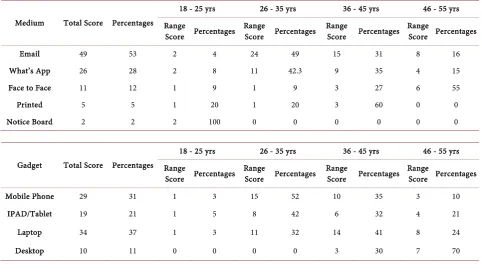
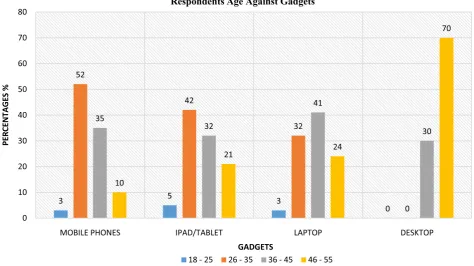
[image:9.595.57.540.465.737.2]The third objective was to know which gadget employees/respondents pre-ferred to communicate information through. Majority (34%) of the respondents opted for laptops (Table 1) of which 3% were between the ages of 18 - 25 years (Figure 3), 32% were between the ages of 26 - 25 years, 41% were between the ages of 36 - 45 years and 24% were between the ages of 46 - 55 years. For mobile phones, 31% (Table 1) of personnel preferred such gadget of which 3% were between the ages of 18 - 25 years, 52% were between the ages of 26 - 35 years, 35% were between the ages of 36 - 45 years and 10% were between the ages of 46 - 55 years. Again, for IPad/tablet 19% of the respondents were established to prefer the use of this gadget to communicate.5% was between the ages of 18 - 25 years, 42% were between the ages of 26 - 35 years, 32% were between the ages of 36 - 45 years and 21% were between the ages of 46 - 55 years (Figure 3). Very few employees preferred desktops which were about 11% (Table 1) of which 30% were between the ages of 36 - 45 years and 70% were between the ages of 46 - 55
Table 1. Summary of collected data and statistical analysis.
Medium Total Score Percentages
18 - 25 yrs 26 - 35 yrs 36 - 45 yrs 46 - 55 yrs Range
Score Percentages Range Score Percentages Range Score Percentages Range Score Percentages
Email 49 53 2 4 24 49 15 31 8 16
What’s App 26 28 2 8 11 42.3 9 35 4 15
Face to Face 11 12 1 9 1 9 3 27 6 55
Printed 5 5 1 20 1 20 3 60 0 0
Notice Board 2 2 2 100 0 0 0 0 0 0
Gadget Total Score Percentages
18 - 25 yrs 26 - 35 yrs 36 - 45 yrs 46 - 55 yrs Range
Score Percentages Range Score Percentages Range Score Percentages Range Score Percentages
Mobile Phone 29 31 1 3 15 52 10 35 3 10
IPAD/Tablet 19 21 1 5 8 42 6 32 4 21
Laptop 34 37 1 3 11 32 14 41 8 24
DOI: 10.4236/jhrss.2018.64040 244 Journal of Human Resource and Sustainability Studies
Figure 3. Employee responds of age against their preferred gadget as medium of communication.
years and it could be traced to the fact that they were mostly stationed at the of-fice to be able to execute their work. This is not to say they weren’t comfortable with other gadgets. Almost all of them had at least a mobile phone in addition to the desktop which aided them to receive and send information as and when they were not available or stationed at their offices.
DOI: 10.4236/jhrss.2018.64040 245 Journal of Human Resource and Sustainability Studies
them less effective and productive and opted for the notice board. Once again, an off the questionnaire enquiry gave reasons of the fact that, they are mostly not connected to the internet and also the Computer Mediated Communications seems a bit cumbersome. This is not to say they do not use any gadget or are not privy to what’s app and emails. They are, but they thought seeing a notice on the notice board draws their attention faster than using the other means of commu-nication.
The first objective of this study which was to identify the medium with which employees or respondents preferred to make them efficient and productive at the work place as highlighted in Figure 1; 53% of the respondents preferred emails, 28% preferred what’s app. 12% preferred face to face, 5% preferred printed memos and letters while 2% preferred the notice board. Objective num-ber two was also to find out how age would influence the choice of medium for communication of employees to make them efficient and productive. Figure 2
clearly specified the age ranges and their preferred medium of communication. The third objective dealt with the gadget respondents preferred use and whether the age factor would be an influence in the choice of gadget and that was been established as well.
4. Overview
Figure 1 highlights the respondents preferred medium of communication for ef-ficiency and productivity. This revealed that, the lowest percentage of people 2% opted for the notice board. 6% opted for the printed memo and letters which was the second least percentage of the respondents. 12% were for the face to face. There was however an increase in the percentage of respondents who preferred What’s App which recorded 28% and the maximum of respondents opted for emails with a percentage of 53%. For the 53% of respondents who preferred emails to be their choice of communication, the highest groups were those in the age range of 26 - 35 years with 31% score. The choice of emails as medium of choice decreases as the age group of respondents gets older, a statement consis-tent with the works of Bob and Prahalab [9]. It could be assumed that, people find the importance of interacting with people more when they age than in their youthful stage where they think technology could do and replace all things.18% of the respondents in the age range of 36 - 45 years also chose emails. Only 8% of the respondents in the age range of 46 - 55 years preferred emails which is a clear indication of the assumption.
DOI: 10.4236/jhrss.2018.64040 246 Journal of Human Resource and Sustainability Studies
for the face to face medium of communication. From Table 1, only 8% within the range of 46 - 55 years opted for emails and 4% for what’s app although a sig-nificant number of them 6% opted for face to face medium which is a sigsig-nificant improvement from the range of 26 - 35 years and 36 - 45 years respectively. This brought about the assumption that as people grow they tend to opt for face to face rather than emails and other mediums which do not require any contact probably because of the fact that they wish to connect more with others.
Lastly, Figure 3 gives us a fair idea as to which age range or group preferred which gadget to send and receive information. About 14% of the respondents in the age range of 18 - 25 years preferred mobile phones to the other mediums followed by the range of 36 - 45 years which is 11%. Only 3% opted for mobile phones in the age range of 46 - 55 years. This makes us understand that, res-pondents within the age range of 26-35 years are more comfortable with mobile phones. Ipads and tablets also gave the same trend with the highest number of respondents being in the age range of 26 - 35 years followed by the age range of 36 - 45 years and then 46 - 55 years with only 1% coming from the 18 - 25 year of age range. Preference for laptops gave a slightly different response with the age range of 36 - 45 recording the highest of 14% followed by the range of 26 - 35 years and then by 46 - 55 years and lastly the age range of 18 - 25 years. Desktop on the other hand, one would say is old fashioned and commended the age range of 45 - 55 years very well although, it was as a result of the fact that their duties mostly required them to be in the office or stationed at one place to execute. The next was the age range of 36 - 45 years with the age range of 26 - 35 years and 18 - 25 not opting for desktop computers and having a respective score of 0%.
5. Conclusion
DOI: 10.4236/jhrss.2018.64040 247 Journal of Human Resource and Sustainability Studies
appropriate media in the management of faecal sludge highly aided the produc-tivity and efficiency of personnel as well the overall performance of the plant operations and hence the organization. It is believed that the involvement of CMC in the areas of customer service would also enhance the actual business understanding. By this assertion, it would require a common What’s App plat-form which would involve the stakeholders and the organization for better stakeholder engagement. Again, it would also require the use of Global Posi-tioning Systems (GPS) in the tracking of customers who brings faecal sludge into the treatment plant for processing.
Acknowledgements
The authors would like to extend their profound gratitude to the Board, man-agement and the entire staff of Sewerage Systems Ghana Ltd., the executive chairman (EC) of the Jospong group of companies (JGC).
Conflicts of Interest
The authors would like to declare that, we have no significant competing finan-cial, professional or personal interests that might have influenced the perfor-mance or presentation of the work described in this manuscript.
References
[1] Lawlor, B. (2007) The Age of Globalization: Impact of Information Technology on Globalization on Business Strategies. The Honors Program Senior Capstone Project. [2] Green, L. (2002) Communication, Technology and Society. Sage Publication Ltd.,
London.
[3] Rogers, E.M. (1986) Communication Technology: The New Media in Society. The Free Press, New York.
[4] Rogers, E.M. (2003) Diffusion of Innovations. 5th Edition, The Free Press, New York.
[5] Kiesler, S., Siegel, J. and McGuire, T.W. (1984) Social Psychological Aspects of Computer-Mediated Communication. American Psychologist, 39, 1123-1134.
https://doi.org/10.1037/0003-066X.39.10.1123
[6] Waldvogel, J. (2001) Email and Workplace Communication: A Literature Review: Language in the Workplace Occasional Papers Number 3. Victoria University of Wellington, New Zealand.
[7] Williams, E. (1999) E-Mail and the Effect of Future Developments. First Monday, 4.
https://doi.org/10.5210/fm.v4i8.686
[8] Rice, R.E. and Blair, T.H. (1984) New Organizational Media and Productivity Bev-erly Hills. Sage, Thousand Oaks, CA.
[9] Kenrick, B. and Prahalad, S. (2014) The Impact of Computer Mediated Communi-cation (CMC) on Productivity and Efficiency in Organization. Advances in Jour-nalism and Communication, 2, 45-51. https://doi.org/10.4236/ajc.2014.22005 [10] Trevino, L.K. and Webster, J. (1992) Electronic Mail and Voice Mail Evaluation and
Impacts. Communication Research, 19, 539-573.
As-DOI: 10.4236/jhrss.2018.64040 248 Journal of Human Resource and Sustainability Studies
sessment of the Rehabilitated Mudor Sewage Treatment Plant at James Town Ac-cra-Ghana. Journal of Water Resource and Protection, 10, 725-739.
https://doi.org/10.4236/jwarp.2018.108041
[12] Yeboah, J.S., Ahmed, I., Ofori-Amanfo, D., Cobbold, F., Agbotui, G.T. and Awuah, E. (2018) Occupational Health and Safety Status in the Management of Faecal Sludge in Ghana: A Case Study of the Lavender Hill Faecal Treatment Plant. Journal of Health and Environmental Research, 4, 42-50.
[13] Ahmed, I., Quarshie, A.M., Ofori-Amanfo, D., Cobbold, F., Amofa-Sarkodie, E.S. and Awuah, E. (2018) Assessment of Foreign Material Load in the Management of Faecal Sludge in the Greater Accra Region of Ghana. International Journal of Ener-gy and Environmental Science, 3, 27-36.
[14] Ofori-Amanfo, D., Rockson, G.N.K., Arthur, A. and Ahmed, I. (2018) Formulated Faecal Sludge and Compost Fertilizer Pellet for Crop Production: The Case Study of the Lavender Hill Faecal Treatment Plant. American Journal of Environmental Protection, 7, 7-13.