GENE THERAPY:
*Megha Takiar, Ritika Jaiswal, Surinder Sachdeva
Maharishi Markandeshwar College of Dental Sciences and Research, Maharishi Markandeshwar University,
ARTICLE INFO ABSTRACT
Gene therapy is a field of biotechnology and has proved to acquire the by genetic modification of cells for
this, using
modification. Gene transfer protocols have been approved for human cancers and acquired disorders. It has a promising
used as a mod
pain management. It encompasses various future strategies to modify various diseases at the very root of initiation.
effective addition to the
Copyright©2017, Megha Takiar et al. This is an open access article distributed under the Creative Commons Att distribution, and reproduction in any medium, provided the original work is properly cited.
INTRODUCTION
Periodontal disease is a multi-factorial oral disease with a wide spectrum of responses that are catastrophic in nature. The destructive inflammatory responses lead to breakdown of the periodontal apparatus, causing loosening of teeth and eventually exfoliation. Current perception encompasses the role of genes in the etiology and progression of periodontal breakdown. While microbial and environmental factors are believed to initiate and regulate periodontal disease progression, genes play a role in susceptibility and progression of periodontal diseases as well. (Rathi et al
traditional periodontal therapy is highly unpredictable and challenging to achieve regeneration of lost tissues. The basic problem pertaining is the lack of biologic basis for regeneration of the periodontium. Critical issues include the complexity of the periodontium, the use of very high doses of proteins, the ideal carrier has still not been found and the enormous costs that are associated. (Bosshardt
2009) With a better understanding of periodontal biology integrated with tissue engineering applications, has enlightened novel treatment strategies to enhance reconstruction. Gene therapy has emerged from field of biotechnology and has proved to acquire the forefront of medical research.
specific sequences of bases that encode instructions on how to
*Corresponding author: Megha Takiar,
Maharishi Markandeshwar College of Dental Sciences and Research, Maharishi Markandeshwar University, Mullana
ISSN: 0975-833X
Article History:
Received 16th October, 2016
Received in revised form 22nd November, 2016
Accepted 28th December, 2016
Published online 31st January,2017
Key words:
Periodontal diseases, Bone regeneration, Electroporation, Antibiotic resistance, Designer drug therapy.
Citation: Megha Takiar, Ritika Jaiswal, Surinder Sachdeva and Sunil Takiar Journal of Current Research, 9, (01), 44800-44805.
RESEARCH ARTICLE
THERAPY: PROGRESS AND PROSPECTS IN DENTISTRY
Ritika Jaiswal, Surinder Sachdeva and Sunil Takiar
College of Dental Sciences and Research, Maharishi Markandeshwar University,
Mullana
ABSTRACT
Gene therapy is a field of biotechnology and has proved to acquire the
by genetic modification of cells for therapeutic purposes. Safe methods have be
this, using several viral and non-viral vectors. Two main strategies include in vivo and modification. Gene transfer protocols have been approved for human
cancers and acquired disorders. It has a promising era in the field of dentistry. Gene therapy has been used as a mode for regeneration, treatment of salivary gland diseases, head and neck cancers and
pain management. It encompasses various future strategies to modify various diseases at the very root of initiation. This review will highlight
effective addition to the arsenal of approaches to many dental therapies in the 21st century.
is an open access article distributed under the Creative Commons Attribution License, which distribution, and reproduction in any medium, provided the original work is properly cited.
factorial oral disease with a wide spectrum of responses that are catastrophic in nature. The destructive inflammatory responses lead to breakdown of the periodontal apparatus, causing loosening of teeth and ation. Current perception encompasses the role of genes in the etiology and progression of periodontal breakdown. While microbial and environmental factors are believed to initiate and regulate periodontal disease bility and progression
et al., 2015) The traditional periodontal therapy is highly unpredictable and challenging to achieve regeneration of lost tissues. The basic problem pertaining is the lack of biologic basis for the regeneration of the periodontium. Critical issues include the complexity of the periodontium, the use of very high doses of proteins, the ideal carrier has still not been found and the Bosshardt and Sculean, With a better understanding of periodontal biology integrated with tissue engineering applications, has enlightened novel treatment strategies to enhance reconstruction. Gene therapy has emerged from field of biotechnology and has efront of medical research. Genes are specific sequences of bases that encode instructions on how to
Maharishi Markandeshwar College of Dental Sciences and Research,
make proteins. Genes are carried on chromosomes and are the basic physical and functional units of heredity. Each person's genetic constitution is different and the changes in the genes determine the differences between individuals.
2015) A broad definition of gene therapy is the genetic modification of cells for therapeutic purposes.
al., 2013) It is a technology by which genes
sequences are delivered to human cells, tissues or organs to alter the genetic makeup to provide new therapeutic functions for the prime purpose of prevention and treatment of diseases. With the hoopla surrounding the beneficial effects of the g therapeutic approach, it is evident that patients would expect high hopes in the treatment outcomes. This
includes the concepts of effective and efficient DNA vaccines, therapeutic antibodies and proteins
agents using gene transfer to kill pathologic or diseased cells, and introducing DNA into speci
regeneration. Genetic basis of periodontal diseases has mitigated the urge for creating gene therapy as an important arsenal in the field of dentistry.
Historical perspective
Since ancient times, humans have acknowledged the fact that characteristic traits can be inherited from parent to its offspring through transfer of genes. It was only in 1950s, American biochemist James Watson and Brit
developed their revolutionary model of double stranded DNA
Available online at http://www.journalcra.com
International Journal of Current Research
Vol. 9, Issue, 01, pp.44800-44805, January, 2017
INTERNATIONAL
OF CURRENT RESEARCH
Ritika Jaiswal, Surinder Sachdeva and Sunil Takiar, 2017. “Gene therapy: Progress and
z
DENTISTRY
Sunil Takiar
College of Dental Sciences and Research, Maharishi Markandeshwar University,
Gene therapy is a field of biotechnology and has proved to acquire the forefront of medical research therapeutic purposes. Safe methods have been advocated to do in strategies include in vivo and ex vivo modification. Gene transfer protocols have been approved for human use in inherited diseases, era in the field of dentistry. Gene therapy has been regeneration, treatment of salivary gland diseases, head and neck cancers and pain management. It encompasses various future strategies to modify microorganisms and treat This review will highlight human gene therapy as an arsenal of approaches to many dental therapies in the 21st century.
ribution License, which permits unrestricted use,
make proteins. Genes are carried on chromosomes and are the basic physical and functional units of heredity. Each person's genetic constitution is different and the changes in the genes determine the differences between individuals. (Rathi et al., broad definition of gene therapy is the genetic modification of cells for therapeutic purposes. (Chatterjee et
It is a technology by which genes, DNA or RNA sequences are delivered to human cells, tissues or organs to alter the genetic makeup to provide new therapeutic functions for the prime purpose of prevention and treatment of diseases. With the hoopla surrounding the beneficial effects of the gene therapeutic approach, it is evident that patients would expect high hopes in the treatment outcomes. This eld of medicine includes the concepts of effective and efficient DNA vaccines, therapeutic antibodies and proteins, other pharmaceutical sing gene transfer to kill pathologic or diseased cells, and introducing DNA into speci c cells to aid in repair and Genetic basis of periodontal diseases has mitigated the urge for creating gene therapy as an important
f dentistry.
Since ancient times, humans have acknowledged the fact that characteristic traits can be inherited from parent to its offspring through transfer of genes. It was only in 1950s, American biochemist James Watson and British biochemist Francis Crick developed their revolutionary model of double stranded DNA
INTERNATIONAL JOURNAL OF CURRENT RESEARCH
helix and gave a clear picture of the physical nature of genes. Hence, techniques to deliver a gene into cells of mammals to correct a genetic defect or treat a disease were recognized. The first human gene therapy trial was to treat β thalassemia patients by transfecting β globin gene into human bone marrow cells. In 1990, American doctor Anderson performed gene therapy on a girl, with severe combined immune deficiency (SCID), where they successfully implanted genes producing ADA into WBCs, thus strengthening her immune system. (Misra, 2013)Since then, gene therapy has emerged as a boon for medical sciences. Scientists have successfully treated metastatic melanoma in two patients using killer T cells genetically targeted to attack the cancer cells. Gene therapy has been effectively used to treat adult patients for a disease affecting myeloid cells. Trials involving gene therapy has also been carried out for the correction of retinal diseases. (Chatterjee et al., 2013)Head and neck cancers have been an attractive target for local gene delivery. Several strategies have been developed for cancer gene therapy, including immunogenic therapy, anti-angiogenic therapy, oncolytic virus therapy, gene replacement therapy and suicide gene therapy. (Prabhakar et al., 2011)Gene therapy has been instrumental in bone regeneration. It has the unique ability to deliver gene products to precise anatomical locations for prolonged period of time at elevated levels. Gene transfer can also be utilized to augment salivary secretions by transferring genes that encode secretory proteins into salivary glands. Local delivery of recombinant gene can have disease modifying effects in submandibular gland of mouse model of sjӧgren’s syndrome. (Prabhakar et al., 2011) Nanotechnology based gene therapy (which delivers genes wrapped in nanoparticles) to target and destroy hard-to-reach cancer cells has also been tried by researchers. (Misra, 2013) Advances in technology coupled with vast knowledge of diseases have stimulated research on genetics. It is evident that gene therapy from a small cocoon has emerged into a majestic butterfly broadening the horizon of periodontal treatment.
Fundamentals
The goal of gene therapy is to transfer the DNA of interest, thereby allowing it to be synthesized in these cells and its proteins expressed. This technique called recombinant DNA technology involves: (Primrose and Twyman, 2006)
Isolation of the gene coding for a protein of interest Transfer of this gene into an appropriate production
host
Expression of gene
There are a variety of different methods to replace or repair the genes targeted in gene therapy. (Chatterjee et al., 2013)
Insertion of normal gene into a non-specific location to replace a non-functional gene thereby changing the genetic makeup. This approach is most common. Swapping of abnormal gene by a normal gene through
homologous recombination
Replacement of defective gene through selective reverse mutation, which returns the gene to its normal function.
Alteration to the degree to which a gene is turned on or off
Replacement of mitochondrial DNA by spindle transfer that changes entire mitochondria.
Approaches
Genetic principles are being coupled with tissue engineering applications for periodontal rehabilitation. There are three approaches of tissue engineering in periodontics:
1. Cell based approach: Cells provide the machinery for new tissue growth and differentiation. Cell delivery approaches are used to accelerate periodontal regeneration through two primary mechanisms, to use cells as carriers to deliver growth or cellular signals or to provide cells those are able to differentiate to multiple cell types to promote regeneration.
2. Protein based approach: Growth and differentiation factors are used for regeneration of periodontal tissues likes TGF-β, BMP-2, 6, 7, 12, FGF, VEGF and PDGF 3. Gene delivery approach: To overcome the short
half-lives of growth factor peptides in vivo, gene therapy uses a vector that encodes the growth factor, is utilized to stimulate tissue regeneration. So far, two main strategies of gene vector delivery have been applied to periodontal tissue engineering. Gene vectors can be introduced directly to the target site (in vivo technique) or selected cells can be harvested, expanded, genetically transduced and then reimplanted (ex vivo technique). (Rios et al., 2011)
Principles
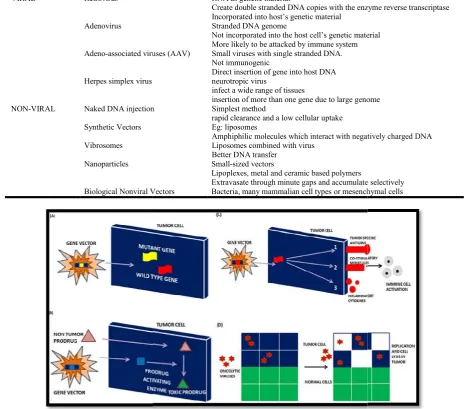
The principles of gene therapy includes: selection of a gene (Figure 1), a vector and management strategy.
1. Selection of gene
i. Mutant gene correction- vehicle carrying DNA enter the cell where it can be processed with the help of the host enzymes to produce specific proteins.
ii. Suicide gene therapy-enables selectively the transfected cell to transform a prodrug into a toxic metabolite, resulting in cell death.
iii. Immunotherapy- this involves gene transfer of tumour-specific antigens, co-stimulatory molecules and/or inflammatory cytokines into tumour cells which initiates an immune response against tumor cells. iv. RNA interference- MicroRNAs (miRNA) regulate gene
expression at the post-transcriptional level resulting in either mRNA degradation or inhibition or translation. miRNA has tumour suppressor potential and can modify the response to therapeutic agents. (Touchefeu
et al., 2010)
2. Selection of vector
Vector is a carrier molecule to get the new or replacement gene into the patient’s target cells. The vector has to be safe, has to protect the genetic material from degradation in the extracellular environment, and must release the genetic material to the target cell. (Misra, 2013) Various vectors are depicted in Table 1.
3. Management strategy involves in vivo and ex vivo gene
transfer
During In vivo gene transfer, the foreign gene is injected into the patient by viral and nonviral methods. Importantly this
strategy does not cause genetic alteration and thus will not be transmitted to next generation. In contrast, the
[image:3.595.62.529.117.552.2]consists of collecting a cell type or its precursor from the
Table 1. Various vectors and their significance
VIRAL Retrovirus
Adenovirus
Adeno-associated viruses (AAV)
Herpes simplex virus
NON-VIRAL Naked DNA injection
Synthetic Vectors
Vibrosomes
Nanoparticles
[image:3.595.62.532.129.538.2]Biological Nonviral Vectors
Figure 1. Principles of gene therapy. (A) Gene re
therapy. A combination of the systemic administration of a nontoxic prodrug and the tumour
(C) Immune therapy. The vector carries a gene encoding a specific immunogenic tumour antigen. (D) Oncolytic viruses specifica
Figure 2. Principle mechanism of DNA transfer. Direct transfer by physical transfection, chemical mediated transfer, transduction by virus vector, bactofection by transfecting into bacteria and introduction of DNA by chemical transfection involving formation of a complex
interactions with plasma membrane of cell
44802 International Journal of Current Research,
strategy does not cause genetic alteration and thus will not be In contrast, the ex vivo strategy consists of collecting a cell type or its precursor from the
[image:3.595.99.496.593.766.2]subject, culturing and transducing the cells with the vector DNA and then reintroducing the genetically modified cells into the subject.
Table 1. Various vectors and their significance (Primrose and Twyman, 2006
RNA as genetic material
Create double stranded DNA copies with the enzyme reverse transcriptase Incorporated into host’s genetic material
Stranded DNA genome
Not incorporated into the host cell’s genetic material More likely to be attacked by immune system associated viruses (AAV) Small viruses with single stranded DNA.
Not immunogenic
Direct insertion of gene into host DNA neurotropic virus
infect a wide range of tissues
insertion of more than one gene due to large genome Naked DNA injection Simplest method
rapid clearance and a low cellular uptake Eg: liposomes
Amphiphilic molecules which interact with negatively charged DNA Liposomes combined with virus
Better DNA transfer Small-sized vectors
Lipoplexes, metal and ceramic based polymers
Extravasate through minute gaps and accumulate selectively Biological Nonviral Vectors Bacteria, many mammalian cell types or mesenchymal cells
gene therapy. (A) Gene re-expression. The vector carries a wild-type version of a mutant gene into the tumour. (B) Suicide therapy. A combination of the systemic administration of a nontoxic prodrug and the tumour-specific delivery of the prodrug
(C) Immune therapy. The vector carries a gene encoding a specific immunogenic tumour antigen. (D) Oncolytic viruses specifica kill tumour cells (Touchefeu et al., 2010)
Direct transfer by physical transfection, chemical mediated transfer, transduction by virus vector, bactofection by transfecting into bacteria and introduction of DNA by chemical transfection involving formation of a complex
with plasma membrane of cell (Primrose and Twyman, 2006)
International Journal of Current Research, Vol. 9, Issue, 01, pp.44800-44805, January, 201
subject, culturing and transducing the cells with the vector DNA and then reintroducing the genetically modified cells into
Primrose and Twyman, 2006)
Create double stranded DNA copies with the enzyme reverse transcriptase
Not incorporated into the host cell’s genetic material
insertion of more than one gene due to large genome
Amphiphilic molecules which interact with negatively charged DNA
Extravasate through minute gaps and accumulate selectively Bacteria, many mammalian cell types or mesenchymal cells
type version of a mutant gene into the tumour. (B) Suicide specific delivery of the prodrug-activating enzyme gene. (C) Immune therapy. The vector carries a gene encoding a specific immunogenic tumour antigen. (D) Oncolytic viruses specifically replicate in and
Direct transfer by physical transfection, chemical mediated transfer, transduction by virus vector, bactofection by transfecting into bacteria and introduction of DNA by chemical transfection involving formation of a complex that facilitates
Methods
Techniques are available for the introduction of DNA or RNA into different cell types to produce recombinant proteins and to manipulate the endogenous genome. Various techniques are: (Patil et al., 2012)
1.Gene modification Replacement therapy Corrective therapy 2.Gene transfer
Physical Chemical Biologic
3.Gene transfer in specific cell line Somatic gene therapy Germ line gene therapy 4.Eugenic approach
Replacement therapy: Gene is inserted somewhere in the
genome so that its product could replace that of defective gene.
Corrective therapy: It is the replacement of a mutant gene or
a part of it with a normal sequence.
Gene transfer: Transfer of genetic material is broadly
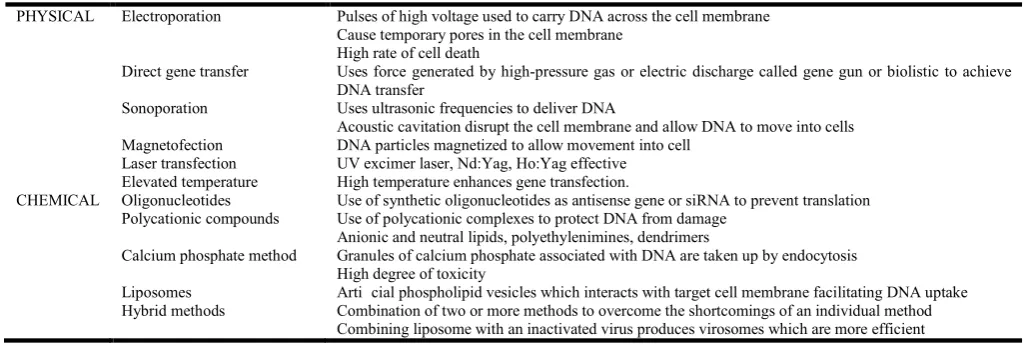
categorized under two mechanisms: biological and non- biological (Figure 2). Biological comprises of transduction, transfer of gene by virus vector; and bactofection, transfer by bacteria. Non- biological comprises of chemical method when the DNA is presented as a synthetic complex with an overall positive charge, allowing it to interact with the negatively charged cell membrane and promote uptake by endocytosis; and physical methods include microinjection, particle bombardment, ultrasound, and electroporation. (Primrose and Twyman, 2006) Various methods of gene transfer are depicted in Table 2.
Germ line gene therapy: It is where germ cells (sperm or
egg) are modified by the introduction of functional genes, which are integrated into patients genome. Therefore changes due to therapy would be heritable and would be passed on to later generation.(Chatterjee et al., 2013)
Somatic gene therapy: It is where therapeutic genes are
transferred into somatic cells of a patient. Any modifications and effects will be restricted to the individual patient only and
will not be inherited by the patient’s offspring or any later generation.(Chatterjee et al., 2013)
Eugenic approach: Certain human qualities are valuable.
Health, intelligence, and moral character are to a substantial extent genetically determined. Hence it would be possible to improve these qualities genetically. The new eugenics consists of the use of human biotechnology to achieve eugenic objectives. The techniques of human biotechnology comprise artificial insemination by donor, prenatal diagnosis of genetic diseases and disorders, in vitro fertilization and peri-implantation diagnosis, cloning, and genetic engineering by the implantation of new genes. (Richard Lynn, 2001)
Gene therapy in general dentistry
Worldwide, in research facilities, scientists are trying to treat the very roots of the disease. Instead of finding drugs to illnesses they are trying to change the genes that cause the diseases. Gene therapy holds a promising role in the field of dentistry. (Prabhakar et al., 2011; Garlick and Fenjves, 1996)
1. Bone repair: Bone losses by trauma, neoplasia, reconstructive surgery, congenital defects or periodontal disease poses a major problem worldwide and are important targets for treatment. Gene therapy plays an important modality in regeneration as it enhances osteoconduction via expression of growth factors and osteoblast differentiation.
2. Gene therapeutics to salivary glands: Salivary gland destruction occurs as a result of various pathological conditions. Salivary glands are excellent target sites for gene transfer as retrograde injection can be given for delivery of vectors into the gland intraductally and has resulted in increase salivary protein secretion.
3. Head and neck cancer is an attractive target for local gene therapy due to the anatomy.
4. Use of gene transfer technology can be used to manipulate specific, localized biochemical pathways involved in pain generation by continuous release of short lived bioactive peptides in or near the spinal dorsal horn. Researchers of Mount Sinai School of Medicine invented a technique in which results lasted for almost 3 months.
5. Epidermal and oral keratinocytes can be used as vehicles for gene therapy.
[image:4.595.34.551.76.249.2]6. Orthodontic tooth movement can be modulated by local gene transfer of RANKL and osteoprotegrin.
Table 2. Various mechanisms of gene transfer (Primrose and Twyman, 2006; Patil et al., 2012; Ma and Chen, 2005)
PHYSICAL Electroporation Pulses of high voltage used to carry DNA across the cell membrane Cause temporary pores in the cell membrane
High rate of cell death
Direct gene transfer Uses force generated by high-pressure gas or electric discharge called gene gun or biolistic to achieve DNA transfer
Sonoporation Uses ultrasonic frequencies to deliver DNA
Acoustic cavitation disrupt the cell membrane and allow DNA to move into cells Magnetofection DNA particles magnetized to allow movement into cell
Laser transfection UV excimer laser, Nd:Yag, Ho:Yag effective Elevated temperature High temperature enhances gene transfection.
CHEMICAL Oligonucleotides Use of synthetic oligonucleotides as antisense gene or siRNA to prevent translation Polycationic compounds Use of polycationic complexes to protect DNA from damage
Anionic and neutral lipids, polyethylenimines, dendrimers
Calcium phosphate method Granules of calcium phosphate associated with DNA are taken up by endocytosis High degree of toxicity
Liposomes Arti cial phospholipid vesicles which interacts with target cell membrane facilitating DNA uptake Hybrid methods Combination of two or more methods to overcome the shortcomings of an individual method
7. Dental researchers hope to grow new teeth to replace the lost natural teeth.
Regeneration of lost periodontal structures remains as the major goal in periodontal therapy. It is well known that the requisite of regeneration are appropriate signals, cells, blood supply and scaffold. Cells provide the new apparatus for cellular growth, growth factors signals the cells to differentiate and produce matrix, the new vasculature provides basis for nutrition and homeostasis and a scaffold guides and creates a template for the above processes. The rationale behind treating a disease by gene therapy is its potential of transferring genetic materials to modulate speci c genes. Gene therapy may achieve greater bioavailability of growth factors within periodontal wounds, which may provide greater regenerative potential. (Ramseier et al., 2006)Advantages of growth factors like platelet-derived growth factor and bone morphogenetic proteins have been widely documented. These proteins have been successfully used in the treatment of periodontal defects with enhanced migration and proliferation of all cell types, potent chemotactic effects of PDL fibroblasts and increase in amount of newly formed cementun and bone. BMPs specially categorized as differentiation factors stimulate angiogenesis and migration, proliferation and differentiation of mesenchymal stem cells into cartilage and bone forming cells (Rao et al., 2013) in both periodontal defects as well as dental implant defects (Dunn et al., 2015). Newer strategies are being implemented by advocating the use of electroporation as a transfection technique for alveolar bone remodeling which has resulted in greater efficiency and safer approach than viral methods. (Ferreira et al., 2012)Periodontal vaccination: being the best application of immunological principles for human health, periodontal vaccination will not only be essential in treating the disease but also for preventing it. Results demonstrated decreased alveolar bone loss (Sharma et al., 2001), inhibition of candidal infection (Yin et al., 2006), and greater resistance to P. gingivalis infection (Ma et al., 2013; Zheng et al., 2013). Biofilm formation is the primary etiology behind periodontal disease. The bacterial colonies display its unique feature of antibiotic resistance compared to its planktonic counterpart. This approach targets specific genes that aid in development of resistance. Hence, a co-therapeutic approach will render biofilms more susceptible to antibiotics. (Zheng et al., 2013; Shanmugam et al., 2015) It has been shown that specific genes control the virulence of pathogens and development of mutant strains with less infective potential predictably controls periodontal disease progression and pathogenesis. In a study by Shanmugam et al. they showed that colonization, bone resorption/disease and antibody response
were all elevated in the wild-type fed rats compared to genetically modified AA (Aggregatibacter
actinomyecetemcomitans). (Zheng et al., 2013) As earlier discussed the demerits of antibiotic resistance, genetic approach was implemented to target genes that potentiates the host defences and enhances the antimicrobial activity. (Maita and Boonbumrung, 2014; Mah et al., 2003)If genes necessary for normal development are known, then “designer drug therapies” can be developed. These designer drugs will be safer than current medications because they would only affect the defect in a gene clearly identified through genetic research. (Patil et al., 2012)
Disadvantages
No therapy exists without some associated risks and drawbacks. Some of the problems associated with gene therapy are: (Misra, 2013)
1) Short-lived nature- Problems associated with lack of long term benefits of gene therapy have been attributed to integrating difficulties and rapid division of cells. 2) Immune response can be evoked due to introduction of
foreign element into host body
3) Problems with viral vectors- toxicity, immune and inflammatory response and gene control and targeting issues.
4) Multigenic disorders- Presence of multiple genes causing a disease can pose a great difficulty in gene therapy
5) Insertional mutagenesis-The problem commonly encountered is that the virus may target the wrong cells if the DNA is integrated in the wrong place in the genome.
Ethical and social implications
Some of the ethical considerations for gene therapy include: (Misra, 2013)
Deciding what is normal and what is a disability Deciding whether disabilities are diseases and whether
they should be cured
Deciding whether searching for a cure demeans the lives of people who have disabilities
Deciding whether somatic gene therapy is more ethical than germ line gene therapy
So, a standard set of protocol is followed and trials strictly scrutinized. New protocols are approved only when they make relatively cautious, small extensions to existing procedures.
Summary
We need to look beyond the horizon to achieve the dream of periodontal regeneration. With recent research on the use of ex vivo and in vivo gene delivery strategies via gene therapy vectors encoding growth promoting and inhibiting molecules (PDGF, BMP, noggin and others), regeneration of periodontal structures including bone, periodontal ligament and cementum is becoming a reality. (Rao et al., 2013) Gene therapy as a part of treatment modality for periodontal tissues is yet at an emerging level. Further research and more clinical trials would help understand the role of gene therapy better and make periodontics more predictable.
REFERENCES
Bosshardt DD. and Sculean A. 2000. Does Periodontal Tissue Regeneration really work? Periodontology, 51:208–219. Chatterjee A, Singh N, Saluja M. 2013. Gene Therapy in
Periodontics. J Indian Soc Periodontol., 17(2):156-161. Dunn CA, Jin Q, Taba M, Franceschi RT, Rutherford RB,
Giannobile WV. 2015. BMP Gene Delivery for Alveolar Bone Engineering at Dental Implant Defects. Mol Ther., 11(2):294-299.
Ferreira E, Potier E, Vaudin P, Oudina K, Bensidhoum M, Logeart-Avramoglou D et al. 2012. Sustained and Promoter Dependent Bone Morphogenetic Protein Expression by Rat Mesenchymal Stem Cells after BMP-2 Transgene Electrotransfer. Eur Cell Mater., 24:18-28. Garlick JA, Fenjves ES. 1996. Keratinocyte Gene Transfer and
Gene Therapy. Crit Rev Oral Biol Med., 7(3):204-221.
Ma L, Ding Q, Feng X, Li F. 2013. The Protective Effect of Recombinant Fom A-Expressing Lactobacillus
Acidophilus against Periodontal Infection. Inflammation, 36(5): 1160–1170.
Ma M, Chen G. 2005. Gene Transfer Technique. Nature and Science, 3(1):25-31.
Mah TF, Pitts B, Pellock B, Walker GC, Stewart PS, O’Toole GA. 2003. A Genetic Basis for Pseudomonas aeruginosa Biofilm Antibiotic Resistance. Nature, 426:306-310 Maita P. and Boonbumrung K. 2014. Association between
Biofilm Formation of Pseudomonas aeruginosa Clinical Isolates Versus Antibiotic Resistance and Genes Involved with Biofilm. J. Chem. Pharm. Res., 6(5):1022-1028 Misra S. 2013. Human Gene Therapy: A Brief Overview of the
Genetic Revolution. JAPI, 61:127-133.
Patil PM, Chaudhari PD, Sahu M, Duragkar NJ. 2012. Review Article on Gene Therapy. International Journal of Genetics, 4(1):74-79.
Prabhakar AR, Paul JM, Basappa N. 2011. Gene therapy and its Implications in Dentistry. International Journal of Clinical Pediatric Dentistry, 4(2):85-92.
Primrose SB. And Twyman RM. 2006. Principles of Gene Manipulation and Genomics. Blackwell publishing. 7th edition.
Ramseier CA, Abramson ZR, Jin Q, Giannobile WV. 2006. Gene Therapeutics for Periodontal Regenerative Medicine.
Dent Clin N Am., 50:245-63.
Rao SM, Ugale GM, Warad SB. 2013. Bone Morphogenetic Proteins: Periodontal Regeneration. N Am J Med Sci., 5(3): 161–168.
Rathi E, Raja Babu P, Vidyasagar S, Harinath Reddy S. 2015. Gene Therapy-Future in Regenerative Periodontics. Indian J Dent Adv., 7(1):46-50.
Richard Lynn. Eugenics A Reassessment. Praeger Publishers. 1st edition 2001.
Rios HF, Lin Z, Oh BN, Park CH, Giannobile WV. 2011. Cell- and Gene-Based Therapeutic Strategies for Periodontal Regenerative Medicine. J Periodontol., 82(9):1223-1237 Shanmugam M, Gopal P, El Abbar F, Schreiner HC, Kaplan
JB, Fine DH et al. 2015. Role of Exopolysaccharide in Aggregatibacter actinomycetemcomitans- Induced Bone Resorption in a Rat Model for Periodontal Disease. Plos One. 10(2):E0117487.
Sharma A, Honma K, Evans RT, Hruby DE, Genco RJ. 2001. Oral Immunization with Recombinant Streptococcus gordonii Expressing Porphyromonas gingivalis FimA Domains. Infect Immun., 69(5):2928-34.
Touchefeu Y, Harrington KJ, Galmiche P, Vassaux G. 2010. Review article: Gene Therapy, Recent Developments and Future Prospects in Gastrointestinal Oncology. Aliment
Pharmacol Ther., 32:953–968.
Yin C, Dang HN, Gazor F, Huang GT. 2006. Mouse Salivary Glands and Human Beta-Defensin-2 as a Study Model for Antimicrobial Gene Therapy: Technical Considerations. Int J Antimicrob Agents., 28(4):352-60.
Zheng D, Sun Q, Su Z, Kong F, Shi X, Tong J et al. 2013. Enhancing Specific-Antibody Production to the RagB Vaccine with GITRL that Expand Tfh, IFN-γ(+) T Cells and attenuates Porphyromonas gingivalis Infection in Mice. Plos One, 8(4):E59604(1-11)
44805 Megha Takiar et al. Gene therapy: Progress and prospects in dentistry