RELATIONSHIP BETWEEN SOCIAL SUPPORT AND MENTAL HEALTH OF ELDERLY
Department of Human Development and Family Studies, Rural Home Science
University of Agricultural Sciences, Dharwad
ARTICLE INFO ABSTRACT
The study was conducted on influence of social support on mental health of elderly. The random sample consisted of 80 male and 80 female elderly was selected from Dharwad district in Karnataka state. The study emphasized on relationship between social supp
Social support questionnaire developed by Heitzmann and Kaplan (1988) was used to assess the social support status of elderly and
analyse the
had very poor mental health status. Majority of elderly received support from 3 Social support and mental health were significantly related as
status also increased among elderly.
Copyright©2016, Morab and Yadav. This is an open access article distributed under the Creative Commons Att distribution, and reproduction in any medium, provided the original work is properly cited.
INTRODUCTION
India is an aging society with the rate of growth of aging population exceeding the growth of the general population. In India, it is estimated that the elderly in the age gro
above is expected to increase from 71 million in 2001 to 179 million in 2031 and in the case of those 70 years and older, the projected increase is from 27 million in 2001 to 132 million in 2051. Old age is closing period of life span. It is a period when people move away from previous more desirable period or times of usefulness. According to Hurlock (1981),
usually considered as the dividing line between middle age and old age. The last stage in lifespan is subdivided into early old age, which extends from age sixty to seventy, and advance old age, which begins at seventy and extends to the end of life. Old age has been viewed either as a transition that is accompanied by psychological distress or as a time of continued or even enhanced subjective well being. Social support consists of support in several forms from family, community, and other social institutions like religion and the state. The growing body of literature documents the importance of social support network in maintaining good morale. Adequate social support system helps individuals avoid internalizing diminished views
*Corresponding author: Morab, A. H.
Department of Human Development and Family Studies, Rural Home Science College, University of Agricultural Sciences, Dharwad-580 005, India.
ISSN: 0975-833X
Article History: Received 19th May, 2016
Received in revised form 25th June, 2016
Accepted 17th July, 2016
Published online 31st August,2016
Citation: Morab, A. H. and Yadav, V. S. 2016.
Research, 8, (08), 37430-37434.
Key words: Social support, Mental health, Elderly.
RESEARCH ARTICLE
RELATIONSHIP BETWEEN SOCIAL SUPPORT AND MENTAL HEALTH OF ELDERLY
*Morab, A. H. and Yadav, V. S.
Department of Human Development and Family Studies, Rural Home Science
University of Agricultural Sciences, Dharwad-580 005, India
ABSTRACT
The study was conducted on influence of social support on mental health of elderly. The random sample consisted of 80 male and 80 female elderly was selected from Dharwad district in Karnataka state. The study emphasized on relationship between social supp
Social support questionnaire developed by Heitzmann and Kaplan (1988) was used to assess the social support status of elderly and Mental health inventory by Jagdish and Srivastav (1983), was used to analyse the mental health status among elderly. Results revealed that Nearly 50 per cent of the elderly had very poor mental health status. Majority of elderly received support from 3
Social support and mental health were significantly related as a social support increased mental health status also increased among elderly.
is an open access article distributed under the Creative Commons Attribution License, which distribution, and reproduction in any medium, provided the original work is properly cited.
India is an aging society with the rate of growth of aging population exceeding the growth of the general population. In that the elderly in the age group 60 and million in 2001 to 179 in 2031 and in the case of those 70 years and older, the projected increase is from 27 million in 2001 to 132 million in Old age is closing period of life span. It is a period when people move away from previous more desirable period or ulness. According to Hurlock (1981), age sixty is usually considered as the dividing line between middle age and old age. The last stage in lifespan is subdivided into early old age, which extends from age sixty to seventy, and advance old at seventy and extends to the end of life. Old age has been viewed either as a transition that is accompanied by psychological distress or as a time of continued or even Social support consists of rom family, community, and other social institutions like religion and the state. The growing body of literature documents the importance of social support network in maintaining good morale. Adequate social support zing diminished views
Department of Human Development and Family Studies, Rural Home Science 580 005, India.
of themselves. The greater integration in a social network is associated with fewer mental and physical health problems (Millier and Misher, 1964). Cobb (1976) defined social support as information that leads the individual to believe that he is cared and loved, esteemed and valued, and that he belongs to a network of communication and mutual obligations. It can be generally defined as the availability and dependability that a person gets from people closely associated with him, people who believe they belong to a social network of communication and mutual obligation experience
Byrne, Ducan, Adcoak, Scott and Steele, 1978;
As people move away from the earlier periods of their lives, they often look back on them, usually re
live in the present ignoring the future as much as possible (Haas). Social relationships occurs at three levels: (a)the community network- membership in various organizations and institutions that provide a sense of belonging; (b)the network- a set of specific mutually satisfying relationships that provide a sense of bonding; and (c) the confident network intimate binding relationship. Support is viewed as instrumental or expressive. People with similar social and psychological characteristics have more frequent and intense social interactions, or strong ties. Strong ties help us maintain our personal resources, while relatively weak ties are potential sources to wider social circles. Social support that includes emotional support as well as instrumental support is a coping
International Journal of Current Research
Vol. 8, Issue, 08, pp.37430-37434, August, 2016
INTERNATIONAL
“Relationship between social support and mental health of elderly
RELATIONSHIP BETWEEN SOCIAL SUPPORT AND MENTAL HEALTH OF ELDERLY
Department of Human Development and Family Studies, Rural Home Science College,
580 005, India
The study was conducted on influence of social support on mental health of elderly. The random sample consisted of 80 male and 80 female elderly was selected from Dharwad district in Karnataka state. The study emphasized on relationship between social support and mental health of elderly. Social support questionnaire developed by Heitzmann and Kaplan (1988) was used to assess the social
Mental health inventory by Jagdish and Srivastav (1983), was used to mental health status among elderly. Results revealed that Nearly 50 per cent of the elderly had very poor mental health status. Majority of elderly received support from 3-6 number of members. a social support increased mental health
ribution License, which permits unrestricted use,
themselves. The greater integration in a social network is associated with fewer mental and physical health problems 1964). Cobb (1976) defined social support as information that leads the individual to believe that he is ved, esteemed and valued, and that he belongs to a network of communication and mutual obligations. It can be generally defined as the availability and dependability that a person gets from people closely associated with him, people to a social network of communication and mutual obligation experience social support (Handers, Byrne, Ducan, Adcoak, Scott and Steele, 1978; Cobb, 1976). As people move away from the earlier periods of their lives, they often look back on them, usually regretfully, and tend to live in the present ignoring the future as much as possible Social relationships occurs at three levels: (a)the membership in various organizations and institutions that provide a sense of belonging; (b)the social a set of specific mutually satisfying relationships that provide a sense of bonding; and (c) the confident network- intimate binding relationship. Support is viewed as instrumental or expressive. People with similar social and l characteristics have more frequent and intense social interactions, or strong ties. Strong ties help us maintain our personal resources, while relatively weak ties are potential sources to wider social circles. Social support that includes ort as well as instrumental support is a coping
INTERNATIONAL JOURNAL OF CURRENT RESEARCH
resource. Its role in maintaining an individual’s health and mental health is growing with the modernization of the society. Social support has been reported to be a more a important factor in health promotion and mortality reduction in the later stages of life. As people age, they experience different kinds of social loss, including deaths of family members and job loss, and the ability to cope with such losses diminishes due to the decreased physical and cognitive function. Although much work has shown that supportive interactions with friends and family can have beneficial effects for older adults health and mental health (Bisconti 1999), relatively few studies have examined the potentially salutary effects of older adults interactions with neighbors and their neighborhood social environment (Wethington and Kavey, 2000). Family, friends and relatives are the important source of support in aged people and should be a major social support variable in studies. However, very few studies compared the effect of support given by family members and other relatives. In one study, both family emotional involvement and criticism were positively related to symptoms of depression and had more power full influences on health behavior than general social support (Franks et al., 1992).
The relationship between social support and health has been recognized for many yers. However, how social support affects mental health remains controversial. It was postulated that the direct or buffering effect of social support are depended on the type of stress and support (Cohen and Wills, 1985). In the absence of stressful events, a broad social network may promote health. In the presence of significant stress, functional support may be important to ameliorate stresses (Penninx et al., 1997). A negative relationship between social support and
mental health was observed in cross sectional (Zunzunegui
et al., 2001) and prospective studies (Brummett et al., 2000) in
western countries, as well as in Chinese societies (Chi and Chou, 2001). Mental health problems are more in old age period. Mental health problems during old age characterized by depression, loneliness, anxiety and psychological distress. Thus mental health refers to emotional and psychological well- being alone with other aspects of health that enable a person to lead a productive and fulfilling life. Mental health is a psychological state of someone who is functioning at a satisfactory level of emotional and behavioral adjustment. Social support mediates the impacts of the built environment on elderly resident health and mental health outcomes older adults. Few studies have examined the relationship of negative interactions to cognitive functioning (seeman et al., 2011) substantial evidence exists that perceived social support may reduce psychological distress. In addition, evidence is emerging that perceived social support may also have beneficial effects on cognitive functioning. However given evidence that social support may play an important role in mental health (Kawachi and Berkman, 2001). In the context of the importance of the subject, the present has been undertaken to explore the relationship between social support and mental health of elderly in Dharwad city and elicit suggestion by the elderly to overcome the problems.
MATERIALS AND METHODS
Sample: The present study was conducted in Dharwad district. The population of the study was elderly people who were
above 60 years residing in Dharwad district. Dharwad city and two villages namely Tirlapur and Byahatti of Dharwad district were purposively selected or convenience of researcher. Elderly people were contacted by Snowball technique. The elderly people were selected who were living in the family with children and responses were recorded individually. Totally 160 elderly people were contacted. Out of 160 elderly 80 were male and 80 were female elderly.
Tools:
1) Personal information schedule includes age, caste, education, size of the family
2) Social support questionnaire developed by Heitzmann and Kaplan (1988) was used to assess the social support of elderly which contains 28 items; each item contains 9 answers individual has to give rank wise preference to the options based on support received from those individuals. Higher score indicates higher the social support
3) Mental health inventory: To assess the mental health status of elderly Mental Health Inventory developed by Jadish and Srivastav (1983) was used to assess mental health of elderly It has six dimensions i.e. positive self-evaluation, perception of reality, integration of personality, autonomy, group oriented attitude and environmental mastery . It contains 54 statements out of which 37 statements are negative and 23 statements are positive each statement has 4 alternative answers like always, most of the time, some time and never the positive statement scoring was 4, 3, 2, & 1 and negative statement scoring was 1, 2, 3, 4, and the score ranges form 54 to 196. Higher the score indicate better the mental health.
RESULTS AND DISCUSSION
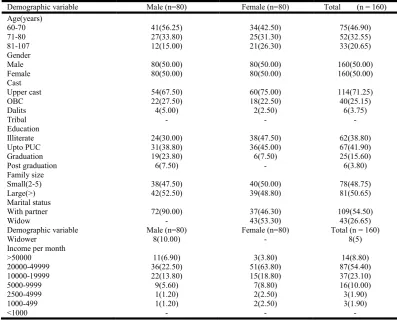
The data (Table 1) regarding demographic characteristics of the respondents demonstrated that age of the elderly people ranged from 60 to 107 years with mean age of 73.08 years. In this study, the 60 to 70 age group (75) was largest age group - more than 2 times larger than the 81 - 107 age group and more than 1½ larger than the 71-80 age group. Trend of distribution of rural and urban elderly people across groups was decreasing as the age of the groups increased. About 5-7 out of 10 elderly people were from to upper caste group. In other words, 3-5 out of 10 elderly people were belonged to OBC and dalits. Half of elderly from rural and ¼ elderly from urban were illiterate. 1/3 of elderly of rural area lived in large family size where as in case of urban area 2/3 of them lived in small family size. Among elderly, more than half of them lived with their partner with an annual income range of Rs. 20,000 to Rs. 50,000. The results of table 2 indicated that status of elderly on social support.
Table 1. Background information of the respondents (N = 160)
Demographic variable Male (n=80) Female (n=80) Total (n = 160) Age(years)
60-70 41(56.25) 34(42.50) 75(46.90) 71-80 27(33.80) 25(31.30) 52(32.55) 81-107 12(15.00) 21(26.30) 33(20.65) Gender
Male 80(50.00) 80(50.00) 160(50.00) Female 80(50.00) 80(50.00) 160(50.00) Cast
Upper cast 54(67.50) 60(75.00) 114(71.25) OBC 22(27.50) 18(22.50) 40(25.15) Dalits 4(5.00) 2(2.50) 6(3.75)
Tribal - - -
Education
Illiterate 24(30.00) 38(47.50) 62(38.80) Upto PUC 31(38.80) 36(45.00) 67(41.90) Graduation 19(23.80) 6(7.50) 25(15.60) Post graduation 6(7.50) - 6(3.80) Family size
Small(2-5) 38(47.50) 40(50.00) 78(48.75) Large(>) 42(52.50) 39(48.80) 81(50.65) Marital status
With partner 72(90.00) 37(46.30) 109(54.50)
Widow - 43(53.30) 43(26.65)
Demographic variable Male (n=80) Female (n=80) Total (n = 160)
Widower 8(10.00) - 8(5)
Income per month
>50000 11(6.90) 3(3.80) 14(8.80) 20000-49999 36(22.50) 51(63.80) 87(54.40) 10000-19999 22(13.80) 15(18.80) 37(23.10) 5000-9999 9(5.60) 7(8.80) 16(10.00) 2500-4999 1(1.20) 2(2.50) 3(1.90) 1000-499 1(1.20) 2(2.50) 3(1.90)
[image:3.595.99.497.96.417.2]<1000 - - -
Table 2. Status of elderly on social support with respect to gender and locality (N = 160)
Number of members Male (n = 40) Female (n = 40) Total (n = 80)
1 - - -
2 2(5.00) 2(5.00) 4(5.00) 3 11(27.50) 6(15.00) 17(21.25) 4 3(7.50) 6(15.00) 9(11.20) 5 7(17.50) 9(22.50) 16(20.00) 6 6(15.00) 10(25.00) 16(20.00) 7 5(12.50) 7(17.05) 12(15.00) 8 and more(>8) 6(15.00) - 6(7.50) X2 10.054NS
[image:3.595.127.470.450.546.2]* Significant at 0.05 level, NS – Not significant. Figures in the parenthesis indicates percentage
Table 3. Status of elderly on mental health with respect to gender and locality (N = 160)
Category Male (n = 40) Female (n = 40) Total (n = 80)
Very good - - -
Good - 1(2.50) 1(1.25) Average 3(7.50) 1(2.50) 4(5.00) Poor 10(25.00) 16(40.00) 26(32.50) Very poor 27(67.50) 22(55.00) 49(61.25) X2 4.123NS
* Significant at 0.05 level NS – Not significant
Figures in the parenthesis indicates percentage
Table 4. Relationship between social support and mental health among elderly (N=160)
[image:3.595.152.445.597.666.2]Among female elderly 23.75 per cent of them had received support from 4 number of members followed by 16.25, 8.75, 7.50 and 1.25 per cent of them had received support from 6, 7, 2 and 8 or more number of members respectively. Equal per cent 21.25 of them had received support from 3 and 5 number of members. On the whole among elderly 25.05 per cent of them had received support from 3 number of members followed by 20.0, 18.13, 13.13, 9.38, 8.75 and 5.63 per cent of them had received support from 5, 4, 7, 8 or more and 2 number of members respectively. The results of frequency classification were subjected to chi square analysis. The chi square value of 16.87 indicates that there is significant association between elderly with social support. The present study is consistent with Sharir et al. (2007) who mentioned that females have higher social support than males. Their results revealed that females received more visits from friends as compared to the male respondents. The significant difference in social support between males and females was in the study of Cashwell (1995). Moreover, Kendler, Myers and Prescott (2005) who studied on 1,057 opposite-sex dizygotic twin pairs stated that females tend to have larger social contacts as compared to males. They also emphasized that the females have higher social support because they seek emotional support in their relationship, while the males only receive social support from their spouses and colleagues. The results concur with Kendler et al. (2005) who reported that females have higher social support because they received the support from friends, relatives and children while males only received support from their spouse and co-workers. Similarly, it was revealed in a study by Cumsille and Epstein (1994) that females have been found to receive more perceived social support from their friends than their male counterparts.
One explanation could be that females are more emotional as compared to males; thus they might be able to share their feelings more freely and readily with friends. By doing so, the females perceive having someone to talk to as having adequate social support. On the other hand, males are expected to live up to certain social expectations that have been set and that if they were to share their feelings, it would be deemed as a sign of weakness. Hence, males tend to perceive lower social support because they are more likely to feel that they have no one to express their feelings to. Nonetheless, it can be concluded that social support is more prevalent in females as compared to males. Females are more emotionally related, personal involved in taking care of others and share personal talks as a result they are more likely to get higher social support compared to males. The results of Table 3 directed that the mental health status among elderly. Totally among male elderly 63.8 per-cent of them had very poor mental health followed by 28.80 and 7.50 of them had poor and average mental health respectively. Among female elderly 48.80 per cent of them had very poor mental health followed by 46.30, 3.80 and 1.30 per-cent of them had poor, good and average mental health respectively. On the whole among elderly 56.30 per cent of them had very poor mental health followed by 37.40, 4.40 and 1.90 per-cent of them had poor, average and good mental health, respectively. The results of frequency classification were subjected to chi square analysis. The chi square value of 11.43 indicates that there is significant association between elderly with environmental mastery.
The results of this study is supported to the results of Carmell and Bernstein (2003) found that elderly men had more significant decline in psychosocial well-being as compared to women because they had significant decline in the sense of control. Nagaratnamma and Vimala (2002) reveal that significant difference was observed in well being and mental health between men and women, they also explained that factors contributing to the well being of males were different from that of females. Bala and Astana (2008) reveal that gender has significant effect on life satisfaction, so life satisfaction of elderly people varied with respect to gender and social support. Asthana (2009) conducted a study on social support and well being among elderly and revealed that no significant difference regarding well being of male and female elderly. Latiffah et al. (2005) showed that gender was significantly associated with psychological well-being and more number of males had good psychological well being compared to female elderly.
The result of table 4 indicates that the Relationship between social support and mental health among elderly. The results of relationship between social support and mental health revealed that the coefficient of correlation between social support and mental health was positively significant. It indicates as a support from number of members increases the mental health status also increases elderly. Here elderly perceive their social support as same because of mainly joint family system. Both the elderly spend equal time with friends, neighbor and family. The results of the study supported to the results of Revicki
et al. (1990) revealed that the amount of contact with
neighbors, friends and relatives lowered the degree of reported emotional distress. Ryan and Willits (2007) revealed that quality of an individual relationship with spouse, children and older family members was associated with personal feeling of well-being but the quantity of such association had little impact on either physical or psychological health. Lahuerta et al. (2002) the results confirmed that mental health was associated with social network and social policies.
Conclusion
Old age is considered as one of the stages where in a person attains wisdom, maturity and emotional stability, but in modern industrial society growing old is a painful process (Talman, 1960).The changing family pattern in the context of the rising complexities of modern India has badly affected the elderly population. Nearly 50 per cent of the elderly had very poor mental health status. Majority of elderly received support from 3-6 number o members. Social support and mental health were significantly related as a social support increased mental health status also increased among elderly.
REFERENCES
Asthana, M., 2009, Social support and well being among elderly. J. Comm. Guid. Res., 26 (2) : 115-121.
Bala, S. and Asthana, M., 2008. Social support and life satisfaction : a cross gender perspective. Indian Psy. Rev., 70 (6) : 153-160
Cashwell, C. S. 1995. Family functioning and self-esteem of middle school students: A matter of perspective? J.
Cohen, S. and Wills, T.A. 1985. Stress, social support and the buffering hypothesis. Psychol. Bull., 98 : 310-357.
Cumsille, P.E. and Epstein, N. 1994. Family cohesion, family adaptability, social support, and adolescent depression symptoms in outpatient clinic families. J. Family Psychol., 8 (2) : 202-214.
Haders, R.M., Mendes, G.L. and Shearin, E.V. 1976. Traditional views at social support and their impact on assessment. American J. Epi., 104 (9) : 107-123.
Heitz Mann, C.A. and Kaplan, R.M. 1988. Assessment of methods far measuring social support. Health Psychology, 1 (1) : 75 – 109
Hurlock, E.B. 1981. Developmental psychology – A life span approach, New Delhi, Tata McGraw Hill Publishing Co. Ltd
Jagdish, S. and Srivastava, A.K. 1983. Manuval for mental health inventory, Published by Manovaigyanik Parikshan Sansthan Varanasi
Kendler, K.S., Myers, J. and Prescott, C.A. 2005. Sex differences in the relationship between social support and risk for major depression: A longitudinal study of opposite-sex twin pairs. Am I. Psychiatrist, 162 : 250-256.
Lahuerta, G.K., Litwin, H. and Mechanic, D. 2002. Influence of the social network on mental health in the elderly. J.
Aging and Health, 3 (4) : 493-51
Latiffah, A.L., Nor Afiah, M. and Shashikala, 2005. Psychological well-being of the elderly people in Peninsular Malaysia. The Intl. Med. J., 4 (2) : 38-43.
Nagaratnamma, B. and Vimala, T.D. 2002. Factors contributing to well being and mental health of the aged men and women. J. Comm. Guid. Res., 19 (1) : 9-14. Revicki, L.L., Lobben, J. and Seman, T.E. 1990. Strain, social
support and mental health in rural elderly. J. Aging and
Health, 18 (6) : 814-836.
Ryan, A.K. and Willits, F.K. 2007. Family ties, physical health and psychological well being. J. Aging and Health, 19 (6) 907-9
Seeman, T.E., Lusignolo, T.M., Albert, M. and Berkman, L. 2011. Social relationship, social support, and patterns of cognitive aging in healthy, high functioning older adults : MacArthur studies of successful. Aging, Health Psychol., 20 (4) : 243-255.
Wethington, E. and Kavey, A. 2000. Neighboring as a form of social integration and support. In P. Moen and K. Pillemer (Eds.). Social integration in the second half of life (pp. 190-210). Baltimore : Johns Hopkins University Press.