Calculation of the pH of Buffer Solution of
2-[N-Morpholino]ethanesulfonic Acid (MES)
from 5˚C to 55˚C
Lakshmi N. Roy, Rabindra N. Roy*, Joshua T. Wollen, Jessica M. Stegner, Meagan A. Harmon, Michael S. Martin, Blake M. Bodendorfer, Isaac B. Henson
Hoffman Department of Chemistry, Drury University, Springfield, USA E-mail: [email protected]
Received June 22, 2011; revised August 7, 2011; accepted September 15, 2011
Abstract
This paper reports the results for the pH of three buffer solutions free of chloride ion. The remaining six buffer solutions have saline media of the ionic strength I = 0.16 mol·kg–1, matching closely to that of the
physiological sample. Conventional paH values for the three buffer solutions without the chloride ion and six
buffer solutions with the chloride ion at I = 0.16 mol·kg–1 from 5˚C to 55˚C have been calculated. The
opera-tional pH values for five buffer solutions at 5˚C and 55˚C have been determined based on the difference in the values of the liquid junction potentials between the blood phosphate standard and the experimental buffer solutions. Five of these buffers are recommended as standards for the physiological pH range 7.5 to 8.5.
Keywords:Buffers, MES, BICINE, Liquid Junction, Ionic Strength, Emf, pH
1. Introduction
The buffer substances recommended by Good et al. [1-3] have proven very useful for the measurement of the pH of blood and the control of pH in a region close to that of physiological solution. In biomedical, biological, and clinical laboratories, knowledge of the pH of blood and physiological fluids is of great importance. Previously, we have reported the pK2 values of 2-[N-morpholino] ethanesulfonic acid (MES) [1] at temperatures from 5˚C to 55˚C, including 37˚C. This zwitterionic buffer system has been recommended by Good and coworkers [2,3] for use as a physiological buffer. The structure of MES is as follows:
Standardization for calibrating electrodes of the pH meter assembly at a point close to the pH of blood (that is, 7.407) can be obtained within the framework of the former National Bureau of Standards (NBS) by using a
O N
S O
O
[image:1.595.119.224.644.702.2]OH
Figure 1. 2-[N-morpholino]ethanesulfonic acid (MES).
physiological phosphate pH buffer as a primary standard [4]. The phosphate buffer has been widely used as a phy- siological pH standard, but it is not an ideal primary pH standard buffer for physiological use at an ionic strength of I = 0.16 mol·kg–1. The disadvantages are as follows: 1) phosphates act as inhibitors to enzymatic processes; 2) phosphate precipitates occur with some polyvalent cations, such as Mg2+ and Ca2+, present in the blood; and 3) the temperature coefficient of the phosphate buffer is –0.0028 pH unit/K as compared to that of whole blood (–0.015 pH unit/K) and plasma (0.01 pH unit/K) [5].
Standards and Technology (NIST) as a primary reference standard [8]. The values of pK2 and pH for 3-(N -mor-pholino)propanesulfonic acid (MOPS) [9] and 3-(N- morpholino)-2-hydroxypropanesulfonic acid (MOPSO) [10] have been reported. The pH of these solutions closely matches that of the common clinical media. In 1973, Bates et al. [11]recommended pH standard for a buffer solution of 0.06 m TRICINE + 0.02 m Na-TRICINEate. Goldberg et al. [12] reported the results of the thermodynamic quantities of about 68 physiological buffers. The comprehensive review article indicated that no results of pH are available in the literature for MES.
We now propose to investigate MES in order to pro-vide very accurate and reproducible pH values in the range of physiological application.
2. Materials and Methodology
MES was obtained from Research Organics (Cleveland, OH). The details of the purification by further crystalli-zation as well as the determination of the assay have been reported in an earlier paper [1]. In the present study, the analyses of the unpurified and purified MES were 99.71% and 99.88% pure, respectively. All mass measurements were made with a mass factor uncertainty of 0.02% including the substance MES, NaCl (ACS re-agent grade dried at 110˚C), a standard solution of NaOH to prepare NaMES, and finally calculated amounts of CO2-free doubly distilled water. Air buoyancy correc-tions were applied for all masses used.
The following buffer compositions on the molality scale are given:
(a) MES (0.04 mol·kg–1) + NaMES (0.04 mol·kg–1),
I = 0.04 mol·kg–1
(b) MES (0.04 mol·kg–1) + NaMES (0.08 mol·kg–1),
I = 0.08 mol·kg–1
(c) MES (0.08 mol·kg–1) + NaMES (0.08 mol·kg–1),
I = 0.08 mol·kg–1
(d) MES (0.04 mol·kg–1) + NaMES (0.04 mol·kg–1) + NaCl (0.12 mol·kg–1), I = 0.16 mol·kg–1
(e) MES (0.05 mol·kg–1) + NaMES (0.05 mol·kg–1) + NaCl (0.11 mol·kg–1), I = 0.16 mol·kg–1
(f) MES (0.06 mol·kg–1) + NaMES (0.06 mol·kg–1) + NaCl (0.10 mol·kg–1), I = 0.16 mol·kg–1
(g) MES (0.08 mol·kg–1) + NaMES (0.08 mol·kg–1) + NaCl (0.08 mol·kg–1), I = 0.16 mol·kg–1
(h) MES (0.04 mol·kg–1) + NaMES (0.08 mol·kg–1) + NaCl (0.08 mol·kg–1), I = 0.16 mol·kg–1
(i) MES (0.03 mol·kg–1) + NaMES (0.06 mol·kg–1) + NaCl (0.10 mol·kg–1), I = 0.16 mol·kg–1
The preparation of the hydrogen electrodes and the sil-ver-silver chloride electrodes of the thermal electrolytic
type [13], the design of the all-glass cells, the purifica-tion of the hydrogen gas, preparapurifica-tion of the solupurifica-tions, control of temperature, and use of digital voltmeter have been reported previously [1,9]. A correction for the re-sidual liquid-junction potential is required if accurate pH values are to be achieved. Thus the cells studied were the following:
Pt(s), H2(g, 1 atm)│MES (m1) + NaMES (m2) + NaCl (m3)│AgCl(s), Ag(s) (A) where m1, m2 and m3 indicate molalities of the respective species, and the pressure of hydrogen in SI units is 1 atm = 101.325 kPa. The flowing junction cell (B), was used for the evaluation of the liquid junction potential at the contact between the buffer solution and the heavier satu-rated KCl solution of the calomel electrode shown with a double vertical line.
Pt(s), H2(g, 1 atm)│MES(m1) + NaMES(m2) + NaCl(m3)││KCl(satd)│Hg2Cl2(s), Hg(l) (B) where the abbreviations (s), (l) and (g) denote solid, liq-uid, and gaseous state, respectively.
For cell (C), the phosphate salts were NIST standard reference materials with the composition KH2PO4 (0.008695 mol·kg–1) + Na
2HPO4 (0.03043 mol·kg–1) and its solutions are recommended for pH measurements in physiological solutions.
Pt(s), H2 (g, 1 atm)│phosphate buffer││
KCl(satd)│Hg2Cl2(s), Hg(l) (C) The values of the liquid junction potential, Ej, for the physiological phosphate solutions and other experimental buffer solutions of MES from cell (B) were obtained [8, 9] using the following equation [9]:
– pH
j SCE
E E E k (1) where E is the emf value in volt dependent on the buffer compositions, SCE= –0.2415 V, k = 0.059156 V, and
pH = 7.415 (physiological phosphate buffer solution) at 25˚C; = –0.2335, k = 0.061538 V, and pH = 7.395 at 37˚C. We have attempted to calculate values of the liquid junction potential for five buffer solutions out of nine buffer solutions. The difference in Ej between the phosphate standard and each experimental buffer solu-tion is an important factor when different standards are selected to obtain the values of the operational pH for an unknown medium. This error can be estimated by the operational definition of pH, indicated as pH(x):
E
SCE
E
Ex Es EpH x pH s
k
j (2)
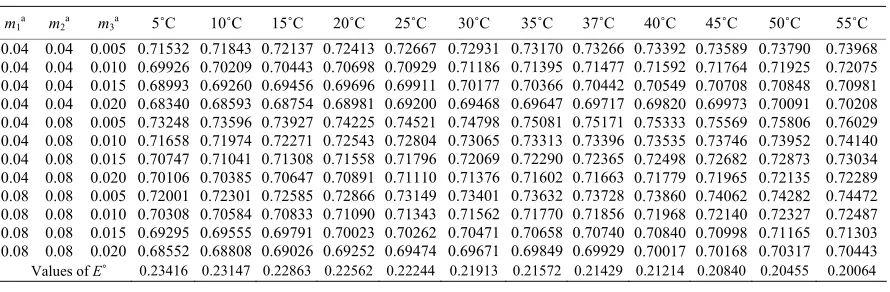
the cell potential (E) listed in Tables 1 and 2, the mo-lality of the chloride ion, and E˚, the standard potential of the silver-silver chloride electrode are listed at the bot-tom of Table 1. The expression for the acidity function [11,13] is given by:
Ej(s) – Ej(x). If δEj = 0, then Equation (2) takes the form:
pH (x) = pH(s) + Ex Es k
(3)
3. Results
10
( H Cl) E E log
p a
k
mCl (4) The cell potential data for cell (A) containing three
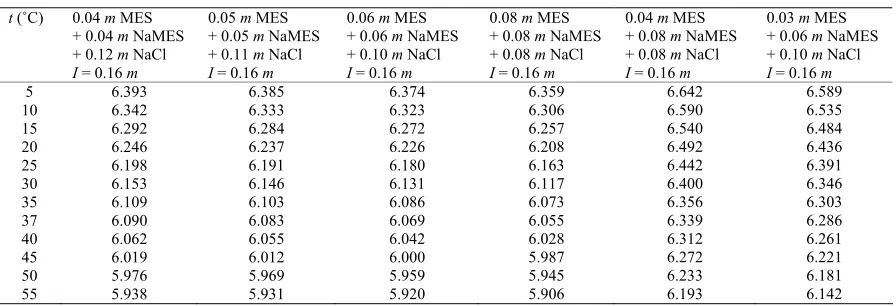
buffer solutions without the presence of the chloride ion, and six buffer solutions in which NaCl has been added to make I = 0.16 mol·kg–1, have been corrected to a hydro-gen pressure of 101.325 kPa. The values of the cell po-tential at 25˚C are the average of two or three readings (at the beginning, in the middle, and sometimes at the end of the temperature run). Duplicate cells usually gave readings on the average within (0.02 ± 0.01) mV in the temperature range 5˚C to 55˚C. All these results are listed in Tables 1 and 2, respectively.
where k is the Nernst slope.
Values of the acidity function p(aHγCl) were derived at each temperature for each buffer solution and were plot-ted as a function of mCl-, straight lines of small slopes were obtained. The values of the intercepts, p(aHγCl)˚, for three buffer solutions without the presence of NaCl listed above from (a) to (c), were calculated using Equation (5) and are given in Table 3. The acidity function, p(aHγCl) for six buffers (d)-(i) listed above are entered in Table 4 from 5˚C to 55˚C. The uncertainty (mean deviation) in-troduced in this type of graphical extrapolation is usually less than 0.002 from the lines drawn. Conventional paH values for the three solutions without the presence of the chloride ion were calculated by the following expression: Conventional paH values have been evaluated by the
method of Bates et al. [11,14-16] for three buffer solu-tions without NaCl and six buffer solusolu-tions in the pres-ence of NaCl. The complete buffer compositions (a)-(i)
are listed in the introduction section. pa
H = p(aHγCl)˚ + log10Cl
(5)
In order to calculate paH values for three buffer solu-tions without NaCl, calculasolu-tions of the values of the acidity function p(aHγCl)˚ in the absence of Cl–, and
p(aHγCl) for the six buffer solutions in the presence of Cl– were made in the temperature range 5˚C to 55˚C, from
where the single-ion activity coefficient, Cl
, cannot be
measured experimentally. A non-thermodynamic conven-tion [4,9] for the estimaconven-tion of Cl
has been adopted for
[image:3.595.77.522.441.587.2]the calculation of paH by Equation (5). The pH values ob-
Table 1. Electromotive force of cell A: Pt(s); H2(g, 1 atm)|MES(m1), NaMES(m2), NaCl(m3)|AgCl(s), Ag(s).
m1a m2a m3a 5˚C 10˚C 15˚C 20˚C 25˚C 30˚C 35˚C 37˚C 40˚C 45˚C 50˚C 55˚C
0.04 0.04 0.04 0.04 0.04 0.04 0.04 0.04 0.08 0.08 0.08 0.08 0.04 0.04 0.04 0.04 0.08 0.08 0.08 0.08 0.08 0.08 0.08 0.08 0.005 0.010 0.015 0.020 0.005 0.010 0.015 0.020 0.005 0.010 0.015 0.020 0.71532 0.69926 0.68993 0.68340 0.73248 0.71658 0.70747 0.70106 0.72001 0.70308 0.69295 0.68552 0.71843 0.70209 0.69260 0.68593 0.73596 0.71974 0.71041 0.70385 0.72301 0.70584 0.69555 0.68808 0.72137 0.70443 0.69456 0.68754 0.73927 0.72271 0.71308 0.70647 0.72585 0.70833 0.69791 0.69026 0.72413 0.70698 0.69696 0.68981 0.74225 0.72543 0.71558 0.70891 0.72866 0.71090 0.70023 0.69252 0.72667 0.70929 0.69911 0.69200 0.74521 0.72804 0.71796 0.71110 0.73149 0.71343 0.70262 0.69474 0.72931 0.71186 0.70177 0.69468 0.74798 0.73065 0.72069 0.71376 0.73401 0.71562 0.70471 0.69671 0.73170 0.71395 0.70366 0.69647 0.75081 0.73313 0.72290 0.71602 0.73632 0.71770 0.70658 0.69849 0.73266 0.71477 0.70442 0.69717 0.75171 0.73396 0.72365 0.71663 0.73728 0.71856 0.70740 0.69929 0.73392 0.71592 0.70549 0.69820 0.75333 0.73535 0.72498 0.71779 0.73860 0.71968 0.70840 0.70017 0.73589 0.71764 0.70708 0.69973 0.75569 0.73746 0.72682 0.71965 0.74062 0.72140 0.70998 0.70168 0.73790 0.71925 0.70848 0.70091 0.75806 0.73952 0.72873 0.72135 0.74282 0.72327 0.71165 0.70317 0.73968 0.72075 0.70981 0.70208 0.76029 0.74140 0.73034 0.72289 0.74472 0.72487 0.71303 0.70443 Values of E˚ 0.23416 0.23147 0.22863 0.22562 0.22244 0.21913 0.21572 0.21429 0.21214 0.20840 0.20455 0.20064
[image:3.595.69.528.625.711.2]aUnits of m, mol·kg–1.
Table 2. Emf of the cell A (in volts): Pt(s); H2(g, 1 atm)|MES(m1), NaMES(m2), NaCl(m3)|AgCl(s), Ag(s).
m1a m2a m3a 5˚C 10˚C 15˚C 20˚C 25˚C 30˚C 35˚C 37˚C 40˚C 45˚C 50˚C 55˚C
0.04 0.05 0.06 0.08 0.04 0.03 0.04 0.05 0.06 0.08 0.08 0.06 0.12 0.11 0.10 0.08 0.08 0.10 0.64471 0.64639 0.64805 0.65259 0.66820 0.65992 0.64654 0.64820 0.64991 0.65443 0.67035 0.66183 0.64819 0.64991 0.65160 0.65626 0.67243 0.66371 0.64973 0.65142 0.65317 0.65779 0.67429 0.66541 0.65107 0.65285 0.65465 0.65941 0.67588 0.66717 0.65228 0.65412 0.65571 0.66068 0.67768 0.66864 0.65337 0.65526 0.65680 0.66189 0.67918 0.67005 0.65358 0.65546 0.65717 0.66229 0.67974 0.67064 0.65401 0.65592 0.65768 0.66283 0.68048 0.67127 0.65462 0.65659 0.65847 0.66375 0.68175 0.67242 0.65509 0.65707 0.65911 0.66443 0.68290 0.67335 0.65578 0.65780 0.65973 0.66515 0.68386 0.67418
Table 3.p(aHγCl)˚ of (MES + NaMES) buffer solutions from 5˚C to 55˚C, computed using Equation (5)a.
t (˚C) + 0.04 m NaMES 0.04 m MES I = 0.08 m
0.04 m MES + 0.08 m NaMES
I = 0.08 m
0.08 m MES + 0.08 m NaMES
I = 0.08 m 5 10 15 20 25 30 35 37 40 45 50 55 6.411 6.360 6.315 6.267 6.218 6.173 6.131 6.115 6.089 6.047 6.010 5.971 6.718 6.669 6.622 6.573 6.529 6.481 6.440 6.422 6.400 6.359 6.323 6.286 6.511 6.456 6.403 6.355 6.311 6.265 6.220 6.203 6.178 6.136 6.100 6.062
[image:4.595.82.513.278.434.2]aUnits of m, mol·kg–1.
Table 4.p(aHγCl) of (MES + NaMES) buffer solutions from 5˚C to 55˚C, computed using Equation (4)a.
t (˚C)
0.04 m MES + 0.04 m NaMES
+ 0.12 m NaCl I = 0.16 m
0.05 m MES + 0.05 m NaMES
0.11 m NaCl I = 0.16 m
0.06 m MES + 0.06 m NaMES
+ 0.10 m NaCl I = 0.16 m
0.08 m MES + 0.08 m NaMES
+ 0.08 m NaCl I = 0.16 m
0.04 m MES + 0.08 m NaMES
+ 0.08 m NaCl I = 0.16 m
0.03 m MES + 0.06 m NaMES
+ 0.10 m NaCl I = 0.16 m 5 10 15 20 25 30 35 37 40 45 50 55 6.518 6.467 6.418 6.371 6.325 6.280 6.237 6.218 6.191 6.148 6.106 6.070 6.511 6.459 6.410 6.362 6.317 6.273 6.230 6.210 6.184 6.141 6.099 6.063 6.499 6.448 6.398 6.351 6.306 6.258 6.214 6.197 6.171 6.130 6.089 6.051 6.485 6.432 6.383 6.333 6.290 6.244 6.200 6.183 6.157 6.116 6.076 6.037 6.768 6.715 6.666 6.617 6.568 6.527 6.483 6.467 6.441 6.402 6.364 6.325 6.715 6.660 6.610 6.561 6.518 6.473 6.431 6.416 6.389 6.351 6.312 6.273
aUnits of m, mol·kg–1.
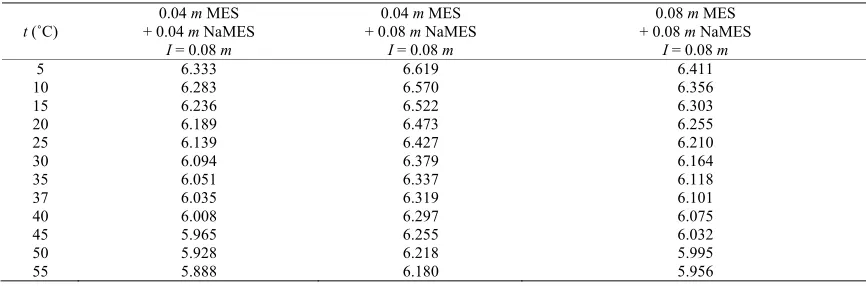
Table 5.paH of (MES + NaMES) buffer solutions from 5˚C to 55˚C, computed using Equations (4)-(6)a.
t (˚C)
0.04 m MES + 0.04 m NaMES
I = 0.08 m
0.04 m MES + 0.08 m NaMES
I = 0.08 m
0.08 m MES + 0.08 m NaMES
I = 0.08 m 5 10 15 20 25 30 35 37 40 45 50 55 6.333 6.283 6.236 6.189 6.139 6.094 6.051 6.035 6.008 5.965 5.928 5.888 6.619 6.570 6.522 6.473 6.427 6.379 6.337 6.319 6.297 6.255 6.218 6.180 6.411 6.356 6.303 6.255 6.210 6.164 6.118 6.101 6.075 6.032 5.995 5.956
aUnits of m, mol·kg–1.
tained from the liquid junction cell are referred by the “operational” pH, whereas the “conventional” pH calcu-lated from Equation (5) is designated as paH.
The convention is reasonable but is not subject to any proof. The Equation (6) of a “pH convention” [4], based on an extended Debye-Hückel equation, has been widely used. In the assignment of paH values and in the
estab-lishment of NIST pH standard [8,10,14-18], the calcula-tion of log10Cl for all of the buffer-chloride solutions
were made by using the following equation:
10 log
1
Cl
A I CI
Ba I
(6)
[image:4.595.80.513.466.609.2]2
B are the Debye-Hückel constants [6-7,13], hydrolysis of the buffer species is negligible, C is an adjustable pa-rameter, Ba˚ was taken to be 1.38 kg½·mol-½ at all tem-peratures [9]. In the Bates-Guggenheim convention [4], the value of Ba° was assigned to be 1.5 kg½·mol-½ and C = 0 for ionic strength I ≤ 0.1 mol·kg–1. The following equation is used for the calculation of the parameter C
[8,9]:
4 6
6.2 10 ( 25) 8.7 10 ( 25)
25
C C T T (7)
where C25 = 0.032 mol·kg–1 at 25˚C and T is the absolute temperature [8].
The values of paH are listed in Table 5 for three buffer solutions of MES without NaCl. These are calculated using Equations (4)-(7) and are expressed as a function of temperature.
For MES (0.04 mol·kg–1) + NaMES (0.04 mol·kg–1) paH = 6.140 – 9.17 10 –3(T – 25) + 2.55 10 –5(T – 25)2
(8) For MES (0.04 mol·kg–1) + NaMES (0.08 mol·kg–1) paH = 6.426 – 9.11 10 –3(T – 25) + 3.04 10 –5(T – 25)2
(9) For MES (0.08 mol·kg–1) + NaMES (0.08 mol·kg–1) paH = 6.208 – 9.39 10 –3(T – 25) + 3.29 10 –5(T – 25)2
(10) where 25˚C ≤ T ≤ 55˚C. The standard deviations of re-gression for the paH of the three chloride-free buffer so-lutions are 0.0014, 0.0013 and 0.0017, respectively.
For the six buffer solutions containing NaCl at an in-dicated ionic strength, I = 0.16 mol·kg–1, the values of paH listed in Table 6 are expressed by the equations:
For MES (0.04 mol·kg–1) + NaMES (0.04 mol·kg–1) +
NaCl (0.12 mol·kg–1)
paH = 6.198 – 9.30 10 –3(T – 25) + 1.89 10 –5(T – 25)2 (11)
For MES (0.05 mol·kg–1) + NaMES (0.05 mol·kg–1) +
NaCl (0.11 mol·kg–1)
paH = 6.191 – 9.2810–3(T – 25) + 1.9310–5(T – 25)2 (12) For MES (0.06 mol·kg–1) + NaMES (0.06 mol·kg–1) +
NaCl (0.10 mol·kg–1)
paH = 6.178 – 9.3310–3(T – 25) + 2.3910–5(T – 25)2 (13) For MES (0.08 mol·kg–1) + NaMES (0.08 mol·kg–1) +
NaCl (0.08 mol·kg–1)
paH = 6.162 – 9.2810–3(T – 25) + 2.4610–5(T – 25)2 (14) For MES (0.04 mol·kg–1) + NaMES (0.08 mol·kg–1) +
NaCl (0.08 mol·kg–1)
paH = 6.444 – 9.2410–3(T – 25) + 3.0610–5(T – 25)2 (15) For MES (0.03 mol·kg–1) + NaMES (0.06 mol·kg–1) +
NaCl (0.10 mol·kg–1)
paH = 6.391 – 9.1710–3(T – 25) + 3.0410–5(T – 25)2 (16) where T is the temperature in ˚C. The standard deviations for regression of the “observed” results from Equations (11) to (16) are 0.0014, 0.0015, 0.0009, 0.0009, 0.0012 and 0.0015, respectively.
4. Discussion
The MES is a zwitterionic buffer material. It is like a neutral molecule and hence makes no contribution to the ionic strength. The values of K2 of MES lie between 10–6 and 10–8 and hence are useful in the preparation of buffer solutions for pH control in the physiological interest. Similar recommendations were made for two other buffer systems, HEPES [19] and HEPPS [20], which are useful for pH measurements in the clinical laboratory.
[image:5.595.75.523.557.710.2]The cell potential data of the cells (B) and (C) at 25˚C and 37˚C are given in Table 7. By means of the flowing
Table 6.paH of (MES + NaMES) buffer solutions from 5˚C to 55˚C, computed using Equations (4)-(6) a
.
t (˚C) 0.04 m MES + 0.04 m NaMES + 0.12 m NaCl I = 0.16 m
0.05 m MES + 0.05 m NaMES + 0.11 m NaCl I = 0.16 m
0.06 m MES + 0.06 m NaMES + 0.10 m NaCl I = 0.16 m
0.08 m MES + 0.08 m NaMES + 0.08 m NaCl I = 0.16 m
0.04 m MES + 0.08 m NaMES + 0.08 m NaCl I = 0.16 m
0.03 m MES + 0.06 m NaMES + 0.10 m NaCl I = 0.16 m 5
10 15 20 25 30 35 37 40 45 50 55
6.393 6.342 6.292 6.246 6.198 6.153 6.109 6.090 6.062 6.019 5.976 5.938
6.385 6.333 6.284 6.237 6.191 6.146 6.103 6.083 6.055 6.012 5.969 5.931
6.374 6.323 6.272 6.226 6.180 6.131 6.086 6.069 6.042 6.000 5.959 5.920
6.359 6.306 6.257 6.208 6.163 6.117 6.073 6.055 6.028 5.987 5.945 5.906
6.642 6.590 6.540 6.492 6.442 6.400 6.356 6.339 6.312 6.272 6.233 6.193
6.589 6.535 6.484 6.436 6.391 6.346 6.303 6.286 6.261 6.221 6.181 6.142
Table 7. Emf of cell B for MES buffer.
m1 m2 m3 E/V
25˚C 37˚C 0.04 0.08 0.00 0.62387 0.62472 0.03 0.06 0.10 0.62004 0.62088 0.04 0.04 0.12 0.60851 0.60883 0.04 0.08 0.08 0.62306 0.62415 0.08 0.08 0.08 0.60655 0.60679 Emf of Cell Ca
Cell C E/V
25˚C 37˚C 0.008695 m KH2PO4 + 0.03043 m Na2HPO4 0.68275 0.69147
aPublished data [7,19] for physiological phosphate buffer solutions; units of m, mol·kg-1.
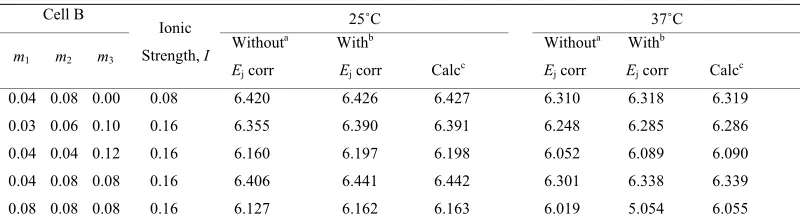
junction cell, the values of Ej listed in Table 8 were esti- mated by using Equation (1). As evident from the pH data at 25˚C and 37˚C from Table 9, there is a wide va- riation in pH (as high as ±0.04 pH units). There is no known experimental method for accurately determining the single-ion activity coefficient, log10Cl
. Partanen
and Minkkinen [19],as well as Covington and Ferra [20], used the Pitzer theory approach for the estimation of the single ion activity coefficient at ionic strengths higher than 0.1 mol·kg–1 in the calculation of the pH standards of the phosphate buffer solutions. In separate publica- tions from this laboratory, the paH values of eight differ-
ent buffer solutions will be reported by using Pitzer for- malism for an ionic strength I = 0.16 mol·kg–1 at 25˚C and 37˚C. The calculation of log10Clleads to uncertain-
ty (±0.001 pH unit) in the paH values. A second source is the error in the liquid junction potential measurement. However, the calculated pH values and the values ob- tained from the Ej corrections are in very good agreement (within ±0.003). The total uncertainties were estimated by combining the various sources of error: 1) assumption for the calculation of the log10Cl
(±0.004 pH unit); 2)
[image:6.595.102.493.425.537.2]extrapolation to p(aHγCl)˚ at mCl- = 0 (within ±0.001 pH unit); 3) liquid junction potential measurement using
Table 8.Values of the liquid junction potentials for MES buffer at 25˚C and 37˚C.
System Eja/mV
25˚C 37˚C Physiological phosphate (0.008695 m KH2PO4 + 0.03043 m NaCl) 2.6 2.9
0.04 m MES + 0.08 m NaMES + 0.00 m NaCl 2.2 2.4 0.03 m MES + 0.06 m NaMES + 0.10 m NaCl 0.5 0.6 0.04 m MES + 0.04 m NaMES + 0.12 m NaCl 0.4 0.6 0.04 m MES + 0.08 m NaMES + 0.08 m NaCl 0.5 0.6 0.08 m MES + 0.08 m NaMES + 0.08 m NaCl 0.5 0.7
aE
j = E + SCE– k˚ pH from Equation (1) is the Emf from Table 7, k = Nernst slope with values 0.059156 at 25˚C, and 0.061538 at 37˚C; the pH of the primary reference standard phosphate buffer is 7.415 and 7.395 at 25˚C and 37˚C; SCE = electrode potential of the saturated calomel electrode = –0.2415 and –0.2335 at 25˚C and 37˚C [14,15], respectively; units of m, mol·kg-1.
E
[image:6.595.98.498.594.706.2]E
Table 9.Values of pH at 25˚C and 37˚C for MES buffer solutions.
Cell B 25˚C 37˚C
m1 m2 m3
Ionic
Strength, I Without
a Withb
Ej corr Ej corr Calcc
Withouta Withb
Ej corr Ej corr Calcc
0.04 0.08 0.00 0.08 6.420 6.426 6.427 6.310 6.318 6.319 0.03 0.06 0.10 0.16 6.355 6.390 6.391 6.248 6.285 6.286 0.04 0.04 0.12 0.16 6.160 6.197 6.198 6.052 6.089 6.090 0.04 0.08 0.08 0.16 6.406 6.441 6.442 6.301 6.338 6.339 0.08 0.08 0.08 0.16 6.127 6.162 6.163 6.019 5.054 6.055
aValues obtained from Equation (3) and data of Table 7; bObtained from Equation (2) and E
the flowing junction cell; 4) error in the experimental emf measurement (±0.02 mV); and 5) standard potential of the Ag-AgCl electrode (±0.03 mV). The overall un-certainty is about ±0.009 pH unit.
5. Conclusions
All emf data are stable, reliable, and accurate. The MES buffer solutions are considered as standards of assigned paH and will be useful when buffer solutions of known conventional paH are required. From Table 9, uncertainty in pH values obtained with and without liquid junction is ±0.001 pH. Thus the operational pH values at 25˚C and 37˚C (Table 9) for one buffer solution with NaCl and four buffer solutions matching the ionic strength of blood serum are recommended as secondary pH standards for the measurement of the pH of blood and other physio-logical fluids.
6. Acknowledgements
The authors are grateful for the funding from the Na-tional Institutes of Health (AREA), under the grant
2 R15 GM 066866-03 and the diversity supplemental grant 3 R15 GM 066866-03 S1. The authors would also like to thank David Jones and Morghan Olson for their dedication and hard work. The content of this paper is the sole responsibility of the authors and does not neces-sarily represent the official views of the National Insti-tutes of Health or the National InstiInsti-tutes of General Medical Sciences.
7. References
[1] R. N. Roy, J. A. Carlsten, J. Niederschmidt, W. S. Good, J. M. Rook, C. Brewe, A. J. Kilker, L. N. Roy and K. M. Kuhler, “Buffers for the Physiological pH Range: Ther-modynamic Constants of Substituted Aminopropanesul-fonic Acids (MES) and (DIPSO) from 278.15˚C to 55˚C,” Journal of Solution Chemistry, Vol. 26, No. 3, 1997, pp. 309-317. doi:10.1007/BF02768001
[2] N. E. Good, G. D. Winget, W. Winter, T. N. Connolly, S. Izawa and R. M. M. Singh, “Hydrogen Ion Buffers for Biological Research,” Biochemistry,Vol. 5, No. 2, 1966, pp. 467-477. doi:10.1021/bi00866a011
[3] W. J. Ferguson, K. I. Braunschweiger, W. R. Braun-schweiger, J. R. Smith, J. J. McCormick, C. C. Wasmann, N. P. Jarvis, D. H. Bell and N. E. Good, “ Hydrogen Ion Buffers for Biological Research,” Analytical Biochemis-try, Vol. 104, 1980, pp. 300-310.
doi:10.1016/0003-2697(80)90079-2
[4] V. E. Bower, M. Paabo and R. G. Bates, “A Standard for the Measurement of the pH of Blood and Other
Physio-logical Media,” Journal of Research of the National Bu-reau of Standards, Vol. 65A, 1961, pp. 267-270. [5] R. A. Durst and B. R. Staples, “Tris/Tris HC1: Standard
Buffer for Use in the Physiological pH Range,” Clinical Chemistry, Vol. 18, 1972, pp. 206-208.
[6] L. N. Roy, R. N. Roy, C. E. Denton, S. R. LeNoue, C. N. Roy, S. Ashkenazi, T. B. Williams, D. R. Church, M. S. Fuge and K. S. Sreepada, “Second Dissociation Constant of Bis-[(2-Hydroxyethyl)amino]acetic Acid (BICINE) and pH of Its Buffer Solutions from 5˚C - 55˚C,” Journal of Solution Chemistry, Vol. 35, 2006, pp. 605-624.
doi:10.1007/s10953-005-9009-6
[7] L. N. Roy, R. N. Roy, C. E. Denton, S. R. LeNoue, C. A. Himes, S. J. Richards, A. N. Simon, C. N. Roy and V. S. Somal, “Buffer Standards for the Physiological pH of the Zwitterionic Compound, TAPS, from 5˚C to 55˚C,”
Journal of Solution Chemistry, Vol. 35, 2006, pp. 551- 565.
[8] D. Feng, W. F. Koch and Y. C. Wu, “Second Dissocia-tion Constant and pH of N-(2-Hydroxyethyl) piperazine-
N’-2-ethanesulfonic Acid from 0˚C to 50˚C,” Analytical Chemistry, Vol. 61, No. 13, 1989, pp. 1400-1405.
doi:10.1021/ac00188a019
[9] R. N. Roy, D. R. Mrad, P. A. Lord, J. A. Carlsten, W. S. Good, P. Allsup, L. N. Roy, K. M. Kuhler, W. F. Koch and Y. C. Wu, “Thermodynamics of the Second Disso-ciation Constant and Standards for pH of 3-(N -Mor-pholino) propanesulfonic Acid (MOPS) from 5˚C to 55˚C,” Journal of Solution Chemistry, Vol. 27, No. 1, 1998, pp. 73-87. doi:10.1023/A:1022692629289
[10] Y. C. Wu, P. A. Berezansky, D. Feng and W. F. Koch, “Second Dissociation Constant of 3-(N-Morpholino)-2 -hydroxypropanesulfonic Acid and pH of Its Buffer Solu-tions,” Analytical Chemistry, Vol. 65, No. 8, 1993, pp. 1084-1087. doi:10.1021/ac00056a023
[11] R. G. Bates, R. N. Roy and R. A. Robinson, “Buffer Standards of Tris(hydroxymethyl)methylglycine (“Tri- cine”) for the Physiological Range pH 7.2 to 8.5,” Ana-lytical Chemistry, Vol. 45, No. 9, 1973, pp. 1663-1666.
doi:10.1021/ac60331a022
[12] R. N. Goldberg, N. Kishore and R. M. Lennen, “Ther-modynamic Quantities for the Ionization Reactions of Buffers,” Journal of Physical and Chemical Reference Data, Vol. 31, No. 2, 2002, pp. 231-370.
doi:10.1063/1.1416902
[13] R. G. Bates, Determination of pH, 2nd Edition, Wiley & Sons, New York, 1973.
[14] R. G. Bates, “Revised Standard Values for pH Measure-ments from 0˚C to 95˚C,”Journal of Research of the Na-tional Bureau of Standards, Vol. 66A, 1962, pp. 179-184. [15] R. G. Bates and E. A. Guggenheim, “Report on the
Stan-dardization of pH and Related Terminology,” Pure and Applied Chemistry, Vol. 1, 1960, pp. 163-168.
doi:10.1351/pac196001010163
Strength I = 0.16,” Analytical Chemistry, Vol. 50, No. 9, 1978, pp. 1295-1300. doi:10.1021/ac50031a026
[17] R. P. Buck, S. Rondinini, A. K. Covington, F. G. K. Baucke, C. M. A. Brett, M. F. Camões, M. J. T. Milton, T. Mussini, R. Naumann, K. W. Pratt, P. Spitzer and G. S. Wilson, “Measurement of pH, Definition, Standards and Procedures,” Pure and Applied Chemistry, Vol. 74, No. 11, 2002, pp. 2169 -2200. doi:10.1351/pac200274112169
[18] Y. C. Wu, D. Feng and W. F. Koch, “Evaluation of Liq-uid Junction Potentials and Determination of pH Values of Strong Acids at Moderate Ionic Strengths,” Journal of Solution Chemistry, Vol. 18, No. 7, 1989, pp. 641-649.
doi:10.1007/BF00651000
[19] R. N. Roy, L. N. Roy, S. Ashkenazi, J. T. Wollen, C. Dunseth, M. S. Fuge, C. N. Roy, H. Hughes, B. Morris and K. Cline, “Buffer Standards for pH Measurement of
N-(2-Hydroxyethyl)piperazine-N’-2-ethanesulfonic Acid (HEPES) for I = 0.16 mol·kg–1 from 5˚C to 55˚C,”
Jour-nal of Solution Chemistry, Vol. 38, No. 4, 2009, pp. 449- 458.doi:10.1007/s10953-009-9378-3
[20] L. N. Roy, R. N. Roy, J. T. Wollen, A. Bwashi, J. M. Stegner, Z. M. Downs, C. J. Mehrhoff, B. M. Bodendor-fer, K. A. Allen, M. A. Harmon and I. B. Henson, “3-[4-(2-Hydroxyethyl)-1-piperazinyl]propanesulfonic Acid (HEPPS) and the pH of Its Buffer Solutions from 278.15 to 328.15 K,” Journal of Chemical & Engineering Data, Vol. 55, 2010, pp. 1327-1332.
doi:10.1021/je9006508
[21] J. I. Partanen and P. O. Minkkinen, “Redetermination of the Second Dissociation Constant of Phosphoric Acid and Calculation of the pH Values of the pH Standards Based on Solutions of Dihydrogen and Hydrogen Phosphate Ions at 25˚C,” Acta Chemica Scandinavica, Vol. 50, 1996, pp. 1081-1086. doi:10.3891/acta.chem.scand.50-1081
![Figure 1. 2-[N-morpholino]ethanesulfonic acid (MES).](https://thumb-us.123doks.com/thumbv2/123dok_us/9234252.410711/1.595.119.224.644.702/figure-n-morpholino-ethanesulfonic-acid-mes.webp)