Proceedings of the Shared Task on Cross-Framework Meaning Representation Parsing at the 2019 CoNLL, pages 76–85 76
HIT-SCIR at MRP 2019:
A Unified Pipeline for Meaning Representation Parsing via
Efficient Training and Effective Encoding
Wanxiang Che, Longxu Dou, Yang Xu, Yuxuan Wang, Yijia Liu, Ting Liu
Research Center for Social Computing and Information Retrieval Harbin Institute of Technology, China
{car,lxdou,yxu,yxwang,yjliu,tliu}@ir.hit.edu.cn
Abstract
This paper describes our system (HIT-SCIR) for the CoNLL 2019 shared task: Cross-Framework Meaning Representation Parsing. We extended the basic transition-based parser with two improvements: a) Efficient Train-ingby realizing stack LSTM parallel training; b)Effective Encodingvia adopting deep con-textualized word embeddings BERT (Devlin et al., 2019). Generally, we proposed a uni-fied pipeline to meaning representation pars-ing, including framework-specific transition-based parsers, BERT-enhanced word represen-tation, and post-processing. In the final evalu-ation, our system was ranked first according to ALL-F1 (86.2%) and especially ranked first in UCCA framework (81.67%).
1 Introduction
The goal of the CoNLL 2019 shared task (Oepen et al., 2019) is to develop a unified parsing sys-tem to process all five semantic graph banks.1 For the first time, this task combines formally and lin-guistically different approaches to meaning repre-sentation in graph form in a uniform training and evaluation setup.
Recently, a lot of semantic graphbanks arise, which differ in the design of graphs (Kuhlmann and Oepen, 2016), or semantic scheme (Abend and Rappoport, 2017). More specifically, SDP (Oepen et al.,2015), including DM, PSD and PAS, treats the tokens as nodes and connect them with semantic relations; EDS (Flickinger et al., 2017) encodes MRS representations (Copestake et al., 1999) as graphs with the many-to-many relations between tokens and nodes; UCCA (Abend and Rappoport, 2013) represents semantic structures with the multi-layer framework; AMR (Banarescu
1See http://mrp.nlpl.eu/ for further technical details, information on how to obtain the data, and official results.
et al.,2013) represents the meaning of each word using a concept graph. Koller et al.(2019) classi-fies these frameworks into three flavors of seman-tic graphs, based on the degree of alignment be-tween the tokens and the graph nodes. In DM and PSD, nodes are sub-set of surface tokens; in EDS and UCCA, graph nodes are explicitly aligned with the tokens; in AMR, the alignments are im-plicit.
Most semantic parsers are only designed for one or few specific graphbanks, due to the differences in annotation schemes. For example, the cur-rently best parser for SDP is graph-based (Dozat and Manning,2018), which assumes dependency graphs but cannot be directly applied to UCCA, EDS, and AMR, due the existence of concept node. Hershcovich et al.(2018) parses across dif-ferent semantic graphbanks (UCCA, DM, AMR), but only works well on UCCA. The system of Buys and Blunsom (2017) is a good data-driven EDS parser, but does poorly on AMR.Lindemann et al.(2019) sets a new SOTA in DM, PAS, PSD, AMR and nearly SOTA in EDS, via represent-ing each graph with the compositional tree struc-ture (Groschwitz et al.,2017), but they do not ex-pand this method to UCCA. Learning from mul-tiple flavors of meaning representation in parallel has hardly been explored, and notable exceptions include the parsers of Peng et al. (2017, 2018); Hershcovich et al.(2018).
as-BERT transition-based parser
with stack LSTM
tagger tagger tagger post-processing
buffer
stack
deque
action history classifier
transition system
[image:2.595.91.513.63.194.2]pos lemma frame
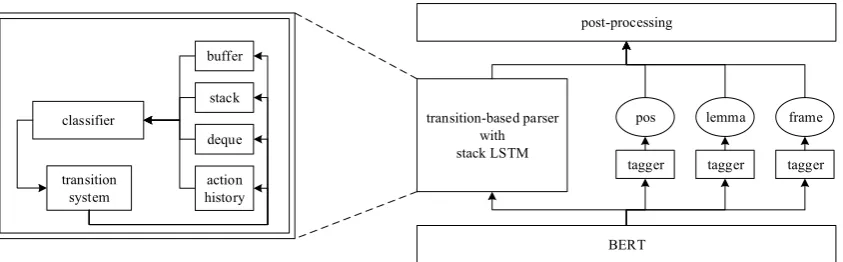
Figure 1: A unified pipeline for meaning representation parsing, including transition-based parser, BERT-enhanced word representation, and post-processing, along with the additional taggers for label the nodes with pos, frame and lemma.
pects: 1)Efficient Training Aligning the homo-geneous operation in stack LSTM within a batch and then computing them simultaneously; 2) Ef-fective EncodingFine-tuning the parser with pre-trained BERT (Devlin et al., 2019) embedding, which enrich the context information to make ac-curate local decisions, and global learning for ex-act search. Together with the post-processing, we developed a unified pipeline for meaning represen-tation parsing.
Our contribution can be summarised as follows:
• We proposed a unified parsing framework for cross-framework semantic parsing.
• We designed a simple but efficient method to realize stack LSTM parallel training.
• We showed that semantic parsing task bene-fits a lot from adopting BERT.
• Our system was ranked first in CoNLL 2019 shared task among 16 teams upon ALL-F1.
2 System Architecture
Our system architecture is shown in Figure1. In this section, we will first introduce the transition-based parser in Section 2.1, which is the central part of our system. Then, to speed up the train-ing of stack LSTM at transition-based parser, we propose a simple method to do batch-training in Section 2.2. And we adopt BERT to extract the contextualized word representation in Section2.3. At last, to label the nodes with pos, frame and lemma, we use additional tagger models to pre-dict these in Section2.4. The framework-specific transition system is presented in Section 3 and post-processing for each framework is discussed in Section4.
2.1 Transition-based Parser
In order to design the unified transition-based parser, we refer to the following framework-specific parsers: Wang et al.(2018b) for DM and PSD,Hershcovich et al.(2017) for UCCA,Buys and Blunsom(2017) for EDS,Liu et al.(2018) for AMR. Those parsers differ in the design of tran-sition system to generate oracle action sequence, but similar in modeling the parsing state.
A tuple (S, L, B, E, V) is used to represent parsing state, whereSis a stack holding processed words, Lis a list holding words popped out of S that will be pushed back in the future, andBis a buffer holding unprocessed words.Eis a set of la-beled dependency arcs. V is a set of graph nodes include concept nodes and surface tokens. The initial state is ([0],[ ],[1,· · ·, n],[ ], V) , where V only contains surface tokens since the concept nodes would be generated during parsing. And the terminal state is([0],[ ],[ ], E, V0). We model the S,L,Band action history with stack LSTM, which supports PUSHand POPoperation.2
Transition classifier takes the parsing state from multiple stack LSTM models as input at once, and outputs a action that maximizes the score. The score of a transition actiona on states is calcu-lated as
p(a|s) = Pexp{ga·STACKLSTM(s) +ba}
a0exp{ga0·STACKLSTM(s) +ba0},
whereSTACKLSTM(s)encodes the statesinto a vector,gaandbaare embedding vector, bias
vec-tor of actionarespectively. The oracle transition action sequence is obtained through transition sys-tem, proposed in in Section3.
a
b
c a
b
c
a
b
c a
b
c
a
b
c a
b
c
state a
state b
state c state a
state b
state c operation buffer
batch
LSTM states
stacks
state a
state b
[image:3.595.153.449.64.198.2]state c
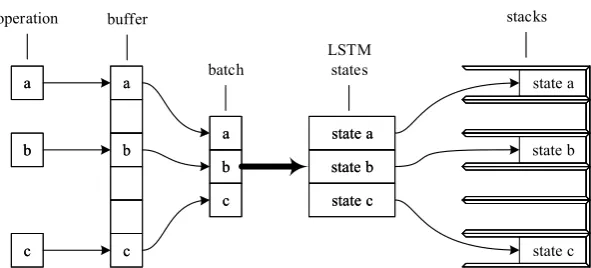
Figure 2: When some new INSERToperations come, the data to be inserted are pushed into corresponding buffers. They will be merged into a batch once batch-processing is triggered. After that, new LSTM states will be pushed to corresponding stacks.
2.2 Batch Training
Kiperwasser and Goldberg (2016) shows that batch training increases the gradient stability and speeds up the training. Delaying the backward to simulate mini-batch update is a simple way to real-ize batch training, but it fails to compute over data in parallel. To solve this, we propose a method of maintaining stack LSTM structure and using oper-ation buffer.
stack LSTM The stack LSTM augments the conventional LSTM with a ‘stack pointer’. And it supports the operation including: a) INSERT
adds elements to the end of the sequence; b) POP
moves the stack pointer to the previous element; c) QUERY returns the output vector where the stack pointer points. Among these three operation, POP
and QUERY only manipulates the stack without complex computing, but INSERTperforms lots of computing.
Batch Data in Operation-Level Like conven-tional LSTM can’t form a batch inside a sequence due to the characteristics of sequential processing, stack LSTM can’t either. Thus, we collect under-computed operations between different pieces of data to form a batch. In other words, we construct batch data on operation-level other than data-level in tradition. After collecting a batch of operation, we compute them simultaneously.
Operation Buffer To be more efficient, we adopt a buffer to collect operations and let it trig-ger the computing of those operations automat-ically (batch-processing), as shown in Figure 2. To ensure correctness, batch-processing will only be triggered when satisfy some conditions. More specifically, when a) operation INSERTcomes and
there is already an INSERTin the buffer; b) oper-ation POPor QUERYcomes. To clarify, the depth of buffer per data is 1.
2.3 BERT-Enhance Word Representation
2.3.1 Deep Contextualized Word Representations
Neural parsers often use pretrained word em-beddings as their primary input, i.e. word2vec (Mikolov et al., 2013) and GloVe (Pennington et al., 2014), which assign a single static repre-sentation to each word so that they cannot capture context-dependent meaning. By contrast, deep contextualized word representations, i.e. ELMo (Peters et al., 2018) and BERT (Devlin et al., 2019), encode words with respect to the con-text, which have been proven to be useful for many NLP tasks, achieving state-of-the-art perfor-mance in standard Natural Language Understand-ing (NLU) benchmarks, such as GLUE (Wang et al.,2018a). Che et al.(2018) adopted ELMo in CoNLL 2018 shared task (Zeman et al.,2018) and achieved first prize in terms of LAS metric. ( Kon-dratyuk and Straka, 2019) exceeds the state-of-the-art in UD with fine-tuning model with BERT.
2.3.2 BERT
We adopt BERT in our model, which uses the language-modeling objective and trained on unan-notated text for getting deep contextualized beddings. BERT differs from ELMo in that it em-ploys a bidirectional Transformer (Vaswani et al., 2017), which benefit from learning potential de-pendencies between words directly. For a token
wkin sentenceS, BERT splits it to several pieces
a single token embedding. Eachsk,i is passed to
anL-layered BiTransformer, which is trained with a masked language modeling objective (i.e. ran-domly masking a percentage of input tokens and only predicting these masked tokens).
To encode the whole sentence, we extract the first piecesk,1 of each tokenwk, with applying a
scalar mix on allLlayers of transformer, to repre-sent the corresponding tokenwk.
2.4 Tagger
Semantic graphs in all frameworks can be bro-ken down into ‘atomic’ component pieces, i.e. tu-ples capturing (a) top nodes, (b) node labels, (c) node properties, (d) node anchoring, (e) unlabeled edges, (f) edge labels, and (g) edge attributes. Not all tuple types apply to all frameworks, however.3 The released dataset and evaluation is annotated by MRP, which consists of the tuple including the graph component mentioned above.
Our transition-based parser can provide the edge information, while the other node informa-tion, such as pos, frame and lemma, require us to use additional tagger models to label the sentence sequence. The tagger we adopted is directly im-ported from AllenNLP library, which only mod-els the dependency between node and label (emis-sion score), not models the dependency between labels (transition score). The details about inte-grating and converting system output into MRP format will be introduced in Section4.
3 Transition Systems
Building on previous work on parsing reentran-cies, discontinuities, and non-terminal nodes, we define an extended set of transitions and features that supports the conjunction of these properties. To solve cross-arc problem, we use list-based arc-eager algorithm for DM, PSD, and EDS frame-work asChoi and McCallum(2013);Nivre(2003, 2008); for UCCA framework, we employ SWAP
operation to generate cross-arc as Hershcovich et al.(2017).4
3.1 DM and PSD
We follow the work of (Wang et al.,2018b) to de-sign transition system for DM and PSD.
3
For further explanation, please visit the official web-site:http://mrp.nlpl.eu/index.php?page=5
4The transition sets for each framework have been intro-duced with table format in supplementary material.
• LEFT-EDGEX and RIGHT-EDGEX add an
arc with labelX betweenwj andwi , where
wi is the top elements of stack andwj is the
top elements of buffer. They are performed only when one of wi andwj is the head of
the other.
• SHIFTis performed when no dependency ex-ists betweenwjand any word in S other than
wi, which pushes all words in list andwjinto
stack S.
• REDUCEis performed only whenwihas head
and is not the head or child of any word in buffer, which popswiout of stack.
• PASS is performed when neither SHIFT nor REDUCEcan be performed, which moveswi
to the front of list.
• FINISH pops the root node and marks the state as terminal.
3.2 UCCA
We follow the work of (Hershcovich et al.,2017) to design transition system for UCCA.
• SHIFTand REDUCEoperations are the same as DM and PSD. REDUCEpops the stack, to allow removing a node once all its edges have been created.
• NODE transition creates new non-terminal
nodes. For every X ∈ L, NODEX creates
a new node on the buffer as a parent of the first element on the stack, with anX-labeled edge.
• LEFT-EDGEX and RIGHT-EDGEX create a
new primary X-labeled edge between the first two elements on the stack, where the par-ent is the left or the right node, respectively.
• LEFT-REMOTEX and RIGHT-REMOTEX do
not have this restriction, and the created edge is additionally marked asremote.
• SWAPpops the second node on the stack and adds it to the top of the buffer, as with the similarly named transition in previous work (Maier,2015;Nivre,2009).
As a UCCA node may only have one incoming primary edge, EDGEtransitions are disallowed if the child node already has an incoming primary edge. To support the prediction of multiple par-ents, node and edge transitions leave the stack un-changed, as in other work on transition-based de-pendency graph parsing (Sagae and Tsujii,2008).
3.3 EDS
Based on the work of (Buys and Blunsom,2017), we extended NODE-STARTLand NODE-END
ac-tions for generating concept node and realizing node alignment.
To clarify,wiis the top element in stack andwj
is the top element in buffer. Moreover, wi could
only be concept node (stack and list only contain concept node), and wj could be concept node or
surface token.
• SHIFTand REDUCEoperations are the same as DM and PSD.
• LEFT-EDGEX and RIGHT-EDGEX add an
arc with labelX betweenwj andwi. (wj is
the concept node)
• DROPpopswj. Then push all elements in list
into stack. (wj is the surface token).
• REDUCEis performed only whenwihas head
and is not the head or child of any node in buffer B, which popswiout of stack S.
• NODE-STARTX generates a new concept
node with labelXand set it’s alignment start-ing fromwj. (wj is the surface token)
• NODE-ENDset the alignment ofwiending in
wj. (wj is the surface token)
• PASS is performed when neither SHIFT nor REDUCElcan be performed, which moveswi
to the front of list .
• FINISH pops the root node and marks the
state as terminal.
3.4 AMR
We extend the basic transition set to obtain the ability to generate graph nodes from the surface string, following previous work (Liu et al.,2018). There are 3 steps to parse graph nodes from the surface string in general. (a) Many concepts ap-pear as phrases rather than single words, so we connect token spans on top of buffer to form
special single tokens if needed using operation MERGE. (b) Then we use operation CONFIRM
to convert a single token on buffer to a graph node(concept). In order to process entity concepts likedate-entitybetter, operation ENTITYis a spe-cial form of CONFIRMwhich also generates prop-erty nodes of the entity concept. (c) The other con-cepts are not derived from surface string but previ-ous concepts. If there is a concept node on top of buffer, operation NEWcan be performed to parse
this kind of concept nodes.
After solving the problem of parsing concept nodes from surface string, the basic transition set used in DM and PSD is able to predict edges be-tween concept nodes.
• REDUCE and PASS operations are the same as DM and PSD.
• SHIFT, LEFT-EDGEX and RIGHT-EDGEX
are similar to operations in DM and PSD, but they can be performed only when the top of buffer is a concept node.
• DROPoperation pops the top of buffer when it is a token.
• MERGEoperation connect the top two tokens in the buffer to a single token which is wait-ing for bewait-ing converted to a concept node.
• CONFIRMX operation convert top of buffer to a concept nodeXif it is a token.
• ENTITYX operation does same things with
CONFIRMX and then adds internal attributes
of entityX, such asyear,monthanddayof a date-entity.
• NEWX operation create a concept node
la-beled withXand push it to the buffer.
• FINISH pops the root node and marks the
state as terminal.
4 Pre-processing and Post-processing
At first, all those framework construct triple in-put is basically the same, which using directed edges, edge labels and node id. About node anchor, we directly derive the anchoring based on segmentation from companion data alignment with each sentence.5
While the other elements, such astop nodes, are a bit different among the frameworks. We will in-troduce these framework-specific work in the fol-lowing.
4.1 DM and PSD
Node Properties Nodes in DM and PSD are la-beled with lemmas and carry two additional prop-erties that jointly determine the predicate sense, viz. pos and frame. We use two taggers to handle this problem.
Top Nodes At first, we construct an artifact node called ROOT. Then we add an edge (node, ROOT, ROOT) where the node is enumerated from top nodes.
Node Label We copy the lemmas from addi-tional companion data and set it as node labels.
4.2 UCCA
Top Nodes There is only one top node in UCCA, which used to initialize the stack. Mean-while, top node is the protect symbol of stack (never be popped out).
Edge Properties UCCA is the only framework with edge properties, used as a sign for remote edges. We treat remote edges the same as primary edge, except the edge label added with a special symbol, i.e. star(*).
Node Anchoring Refer to the original UCCA framework design, we link the the node in layer 0 to the surface token with edge label ’Terminal’. In post-processing, we combine surface token and layer 0 nodes via collapsing ‘Terminal’ edge to ex-tract the alignment or anchor information.
4.3 EDS
Top Nodes The TOP operation will set the first concept node in buffer as top nodes.
5
Organizer released pre-tokenized, PoS-tagged, and lem-matized form for training and evaluation data, besides a se-quence of ’raw’ sentence string. You could download the sample companion data from http://svn.nlpl.eu/ mrp/2019/public/companion.tgz
Node Labels We train a tagger to handle this. Although there are many node labels exists, the result shows our system performs well on this.
Node Properties The only framework-specific property used on EDS nodes is carg (for constant argument), a string-valued parameter that is used with predicates(node label) like named or dofw, for proper names and the days of the week, respec-tively.
We write some rules to convert the surface token into properties value, such as converting million(token) to 1000000(value) whencard(node label).
Node Anchoring We obtain alignment informa-tion through NODE STARTand NODE END oper-ation,
4.4 AMR
Alignment There is no anchor between tokens from surface string and nodes from AMR graph. So we have to know which token aligns to which node, or we cannot train our model. Actually, finding alignment is a quite hard problem so that we could only get approximate solutions through heuristic searching. Although basic alignments have been contained in the companion data, we de-cide to use an enhanced rule-based aligner TAMR (Liu et al.,2018).
TAMR recalls more alignments by matching words and concepts from the view of semantic and morphological. (a) semantic match: Glove em-bedding represents words in some vector space. Considering a word and a concept striping off trailing number, we think them matching if their cosine similarity is small enough. (b) morphologi-cal match: Morphosemantic database in the Word-Net project provides links connecting noun and verb senses, which helps match words and con-cepts.
Top Nodes There is exact one top node in AMR. For the convenience of processing, we add a guard element to the stack and use operation LEFT -EDGEROOT between guard element and concept
nodes to predict top nodes.
Node Labels Node label appears as the name of each concept which is parameter of operation EN
-TITY, CONFIRMand NEW.
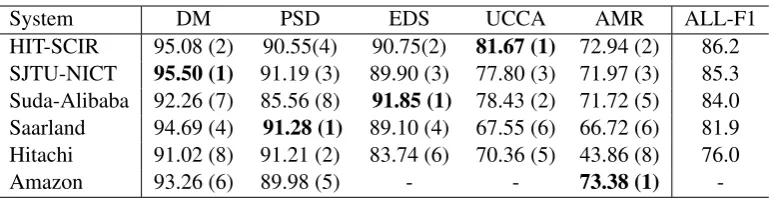
System DM PSD EDS UCCA AMR ALL-F1 HIT-SCIR 95.08 (2) 90.55(4) 90.75(2) 81.67 (1) 72.94 (2) 86.2 SJTU-NICT 95.50 (1) 91.19 (3) 89.90 (3) 77.80 (3) 71.97 (3) 85.3 Suda-Alibaba 92.26 (7) 85.56 (8) 91.85 (1) 78.43 (2) 71.72 (5) 84.0 Saarland 94.69 (4) 91.28 (1) 89.10 (4) 67.55 (6) 66.72 (6) 81.9 Hitachi 91.02 (8) 91.21 (2) 83.74 (6) 70.36 (5) 43.86 (8) 76.0 Amazon 93.26 (6) 89.98 (5) - - 73.38 (1)
-Table 1: The top 5 evaluation results upon cross-framework metric ALL-F1. 95.08 (2) indicates HIT-SCIR system scores 95.08 F1 in DM framework, and it ranks 2nd in DM. Amazon achieves 1st in AMR. We only list the involved results they submitted.
DM PSD UCCA EDS AMR
Feature LF1 MRP LF1 MRP LF1 MRP EDM MRP SMATCH MRP
GloVe 87.1 87.3 74.1 73.7 56.3 87.5 82.5 88.2 64.8 65.3 BERT(base) 94.3 90.5 83.6 76.7 64.3 92.8 87.6 91.5 71.0 71.4
Table 2: HIT-SCIR parser results on MRP split dataset with GloVe or BERT as pretrained word representation. MRP stands for cross-framework evaluation metric. LF1 stands for SDP Labeled F1 (Oepen et al., 2014) in DM/PSD, UCCA Labeled Dependency F1 (Hershcovich et al.,2019) in UCCA. And EDM (Dridan and Oepen,
2011) stands for Elementary Dependency Match in EDS. SMATCH (Cai and Knight,2013) is an evaluation metric for semantic feature structures in AMR.
as nodes and edges, we need an extra procedure to recognize which nodes should be properties in the final result. Once recognized, node along with the corresponding edge will be converted to the property of its parent node, edge label for the key, and node label for the value.
We write some rules to perform the recogniz-ing procedure. Rules come from 2 basic facts. (a) attribute node: Numbers, URLs, and other special tokens like ‘-’(value of ‘polarity’) should be values of properties. (b) constant relation: When an edge has a label like ‘value’, ‘quant’, ‘opx’ and so on, it
is usually a key to property. We treat it as property if there is an edge of constant relation connecting to an attribute node.
5 Experiments
In this section, we will show the basic model setup including BERT fine-tuning, and results including overall evaluation, training speed. More details about training, including model selection, hyper-parameters and so on, are contained in supplemen-tary material.
5.1 Model Setup
Our work uses the AllenNLP library built for the PyTorch framework. We split parameters into two groups, i.e., BERT parameters and the other parameters (base parameters). The two parameter
groups differ in learning rate. For training we use Adam (Kingma and Ba, 2015). Code for our parser and model weights are available at
https://github.com/DreamerDeo/ HIT-SCIR-CoNLL2019.
Fine-Tuning BERT with Parser Based on De-vlin et al. (2019), fine-tuning BERT with super-vised downstream task will receive the most ben-efit. So we choose to fine-tune BERT model to-gether with the original parser. In our prelimi-nary study, gradual unfreezing and slanted trian-gular learning rate scheduler is essential for BERT fine-tuning model. More details are discussed in supplementary material.
5.2 Results
Overall Evaluation We list the evaluation re-sults on Table 1, which is ranked by the cross-framework metric, named ALL-F1, attached with the result of specific framework.6 In final
submis-sion, we only use the single model for prediction. In the follow-up experiments, we get further im-provement via the ensemble model. The related results is listed in supplementary material.
Training Speed To explore the effect of batch-training methods which proposed in Section 2.2
[image:7.595.107.494.60.159.2]DM PAS PSD Parser Feature id F ood F id F ood F id F ood F
Wang et al.(2018b) T word2vec 89.3 83.2 91.4 87.2 76.1 73.2 Dozat and Manning(2018) G GloVe+char 92.7 87.8 94.0 90.6 80.5 78.6
HIT-SCIR T GloVe+char 86.1 79.2 89.8 85.2 72.8 68.5 AllenNLP G GloVe+char 91.6 86.1 93.1 89.6 77.4 73.0
HIT-SCIR T BERT 92.9 89.2 94.4 92.4 81.6 81.0
[image:8.595.78.520.65.193.2]AllenNLP G BERT 94.1 90.8 94.8 92.9 80.7 79.5
Table 3: Semantic parsing accuracies (id = in domain test set; ood = out of domain test set). G and T stand for graph-based parser and transition-based parser. We adopted BERT (base+cased) model here. AllenNLP refers to the graph-based parser (Dozat and Manning,2018) re-implemented by AllenNLP.
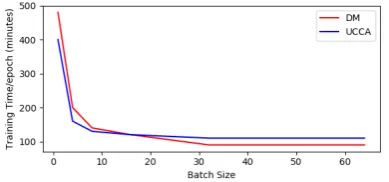
in training process, we conduct several experi-ments through adjusting the batch-size. Since we have adopted two different ways to address the cross-arc problem: list-based (DM, PSD, EDS, AMR) and SWAP operation (UCCA), we try batch-training experiments on DM and UCCA respectively. The result is shown in Figure 3. 5.3x on DM and 2.7x on UCCA speedup could be reached approximately while increasing batch size. We use GloVe pretrained embedding instead of BERT to reduce memory cost and support a larger batch size in the speed test.
Figure 3: The training time per epoch, under different batch-size experiment setting, which indicates the effi-cient of batch-training methods we proposed in2.2.
Improvement through BERT Our parser ben-efits a lot from BERT compared with GloVe as shown in Table2. The improvement is more obvi-ous in the out-of-domain evaluations, illustrating BERT’s ability to transfer across domains.
6 Discussion
In recent years, graph-based parser holds the state-of-the-art in dependency parsing area due to its ability in the global decision, compared with transition-based parser. However, when we con-catenated those models with BERT, we receive
the similar performance, which shows that power-ful representation could eliminate the gap between structure or parsing strategy.
Kulmizev et al.(2019) proposes that deep con-textualized word representations are more effec-tive at reducing errors in transition-based parsing than in graph-based parsing. Their experiments were all about dependency parsing (tree structure), and we found similar results in meaning represen-tation parsing (graph structure), as shown in Table 3. It remains the future work to study this phe-nomenon with the theoretical analysis.
7 Conclusion and Future Work
Our system extends the basic transition-based parser with the following improvements: 1) adopt-ing BERT for better word representation; 2) re-alizing batch-training for stack LSTM to speed up the training process. And we proposed a uni-fied pipeline for meaning representation parsing, suitable for main stream graphbanks. In the final evaluation, we were ranked first place in CoNLL 2019 shared task according to ALL-F1 (86.2%) and especially ranked first in UCCA framework (81.67%).
Acknowledgments
We thank the reviewers for their insightful com-ments and the HIT-SCIR colleagues for the co-ordination on the machine usage. This work was supported by the National Natural Science Foundation of China (NSFC) via grant 61976072, 61632011 and 61772153.
References
[image:8.595.84.279.430.521.2]Omri Abend and Ari Rappoport. 2017. The state of the art in semantic representation. InACL.
Laura Banarescu, Claire Bonial, Shu Cai, Madalina Georgescu, Kira Griffitt, Ulf Hermjakob, Kevin Knight, Philipp Koehn, Martha Palmer, and Nathan Schneider. 2013. Abstract meaning representation for sembanking. InLAWID.
Jan Buys and Phil Blunsom. 2017. Robust incremental neural semantic graph parsing. InACL.
Shu Cai and Kevin Knight. 2013. Smatch: an evalua-tion metric for semantic feature structures. InACL.
Wanxiang Che, Yijia Liu, Yuxuan Wang, Bo Zheng, and Ting Liu. 2018. Towards better UD parsing: Deep contextualized word embeddings, ensemble, and treebank concatenation. InCoNLL.
Jinho D. Choi and Andrew McCallum. 2013.
Transition-based dependency parsing with selec-tional branching. InACL.
Ann Copestake, Dan Flickinger, Ivan A. Sag, and Carl Pollard. 1999. Minimal recursion semantics: an in-troduction.
Jacob Devlin, Ming-Wei Chang, Kenton Lee, and Kristina Toutanova. 2019. BERT: Pre-training of deep bidirectional transformers for language under-standing. InNAACL-HLT.
Timothy Dozat and Christopher D. Manning. 2018. Simpler but more accurate semantic dependency parsing. InACL.
Rebecca Dridan and Stephan Oepen. 2011. Parser eval-uation using elementary dependency matching. In ACL.
Chris Dyer, Miguel Ballesteros, Wang Ling, Austin Matthews, and Noah A. Smith. 2015. Transition-based dependency parsing with stack long short-term memory. InACL and IJCNLP.
Dan Flickinger, Jan Hajiˇc, Angelina Ivanova, Marco Kuhlmann, Yusuke Miyao, Stephan Oepen, and Daniel Zeman. 2017. Open SDP 1.2.
Jonas Groschwitz, Meaghan Fowlie, Mark Johnson, and Alexander Koller. 2017. A constrained graph algebra for semantic parsing with AMRs. InIWCS.
Daniel Hershcovich, Omri Abend, and Ari Rappoport. 2017. A transition-based directed acyclic graph parser for UCCA. InACL.
Daniel Hershcovich, Omri Abend, and Ari Rappoport. 2018. Multitask parsing across semantic representa-tions. InACL.
Daniel Hershcovich, Zohar Aizenbud, Leshem
Choshen, Elior Sulem, Ari Rappoport, and Omri Abend. 2019. SemEval-2019 task 1: Cross-lingual semantic parsing with UCCA. InIWSE.
Diederik P. Kingma and Jimmy Ba. 2015. Adam: A method for stochastic optimization. InICLR.
Eliyahu Kiperwasser and Yoav Goldberg. 2016. Sim-ple and accurate dependency parsing using bidirec-tional LSTM feature representations.TACL.
Alexander Koller, Stephan Oepen, and Weiwei Sun. 2019. Graph-based meaning representations: De-sign and processing. InACL.
Dan Kondratyuk and Milan Straka. 2019. 75 lan-guages, 1 model: Parsing universal dependencies universally. InEMNLP.
Marco Kuhlmann and Stephan Oepen. 2016. Squibs: Towards a catalogue of linguistic graph Banks. Computational Linguistics.
Artur Kulmizev, Miryam de Lhoneux, Johannes Gontrum, Elena Fano, and Joakim Nivre. 2019. Deep contextualized word embeddings in transition-based and graph-transition-based dependency parsing – a tale of two parsers revisited. InEMNLP.
Matthias Lindemann, Jonas Groschwitz, and Alexan-der Koller. 2019. Compositional semantic parsing across graphbanks. InACL.
Yijia Liu, Wanxiang Che, Bo Zheng, Bing Qin, and Ting Liu. 2018. An AMR aligner tuned by transition-based parser. InEMNLP.
Wolfgang Maier. 2015. Discontinuous incremental shift-reduce parsing. InACL and IJCNLP.
Tomas Mikolov, Kai Chen, Greg Corrado, and Jeffrey Dean. 2013. Efficient estimation of word represen-tations in vector space. InICLR.
Joakim Nivre. 2003. An efficient algorithm for projec-tive dependency parsing. InICPT.
Joakim Nivre. 2008. Algorithms for deterministic in-cremental dependency parsing. Computational Lin-guistics.
Joakim Nivre. 2009. Non-projective dependency pars-ing in expected linear time. InACL and AFNLP.
Stephan Oepen, Omri Abend, Jan Hajiˇc, Daniel Her-shcovich, Marco Kuhlmann, Tim O’Gorman, Ni-anwen Xue, and Milan Straka. 2019. MRP 2019: Cross-framework Meaning Representation Parsing. InCoNLL.
Stephan Oepen, Marco Kuhlmann, Yusuke Miyao, Daniel Zeman, Silvie Cinkov´a, Dan Flickinger, Jan Hajiˇc, and Zdeˇnka Ureˇsov´a. 2015. SemEval 2015 task 18: Broad-coverage semantic dependency pars-ing. InSemEval.
Hao Peng, Sam Thomson, and Noah A. Smith. 2017. Deep multitask learning for semantic dependency parsing. InACL.
Hao Peng, Sam Thomson, Swabha Swayamdipta, and Noah A. Smith. 2018. Learning joint semantic parsers from disjoint data. InNAACL-HLT.
Jeffrey Pennington, Richard Socher, and Christo-pher D. Manning. 2014. Glove: Global vectors for word representation. InEMNLP.
Matthew E Peters, Mark Neumann, Mohit Iyyer, Matt Gardner, Christopher Clark, Kenton Lee, and Luke Zettlemoyer. 2018. Deep contextualized word rep-resentations. InNAACL-HLT.
Kenji Sagae and Jun’ichi Tsujii. 2008. Shift-reduce de-pendency DAG parsing. InColing.
Ashish Vaswani, Noam Shazeer, Niki Parmar, Jakob Uszkoreit, Llion Jones, Aidan N Gomez, Ł ukasz Kaiser, and Illia Polosukhin. 2017. Attention is all you need. InNIPS.
Alex Wang, Amanpreet Singh, Julian Michael, Fe-lix Hill, Omer Levy, and Samuel Bowman. 2018a. GLUE: A multi-task benchmark and analysis plat-form for natural language understanding. In EMNLP.
Yuxuan Wang, Wanxiang Che, Jiang Guo, and Ting Liu. 2018b. A neural transition-based approach for semantic dependency graph parsing. InAAAI.
Yonghui Wu, Mike Schuster, Zhifeng Chen, Quoc V. Le, Mohammad Norouzi, Wolfgang Macherey,
Maxim Krikun, Yuan Cao, Qin Gao, Klaus
Macherey, Jeff Klingner, Apurva Shah, Melvin Johnson, Xiaobing Liu, ukasz Kaiser, Stephan
Gouws, Yoshikiyo Kato, Taku Kudo, Hideto
Kazawa, Keith Stevens, George Kurian, Nishant Patil, Wei Wang, Cliff Young, Jason Smith, Jason Riesa, Alex Rudnick, Oriol Vinyals, Greg Corrado, Macduff Hughes, and Jeffrey Dean. 2016. Google’s neural machine translation system: Bridging the gap between human and machine translation. CoRR.