A STUDY TO ASSESS THE EFFECTIVENESS OF VIDEO ASSISTED TEACHING MODULE (VATM) ON
KNOWLEDGE AND PRACTICE AMONG MOTHERS REGARDING IDENTIFICATION AND
MANAGEMENT OF DANGER
1
Research Scholar
2
Guide,
ARTICLE INFO ABSTRACT
Introduction:
almost half within 3days &
about 34 of every 1000 live births result in neonatal death. The primary cause of sepsis(52%) which
(20%)and others(13%).
has been noted, resulting in difficulty in making a definitive diagnosis, de and resultant high mortality. it is necessary for the
danger signs in a sick would reduce mortali Methodology:
the study. Non probability purposive sampling technique 40.structured knowledge
practice. Pretest was done with the tool and on the same day VATM was and one month of pre test, post
Results: The post
was found with age of the
Copyright©2017, Sudha and Selvanayaki. This is an open access article distributed under the Creative Commons Att use, distribution, and reproduction in any medium, provided the original work is properly cited.
INTRODUCTION
Child health has remained as the essential component of most of the national programmes in India. Globally 10 million children die annually before their fifth birthday, most of them in the neonatal period. More than 98%of these deaths occur in developing countries, almost half of the deaths in under five years old occur in infancy. Of the infant deaths, about two third occur in the neonatal period. It has also been noted that one-third of all neonatal deaths occur on the first day of life, almost half within 3days & nearly three-quarters within the first week of life. In developing countries, about 34 of every 1000 live births result in neonatal death. Projections based on the 1996analysis the Global burden of disease indicates that these condition will continue to be the major contributors to child health till the year 2020, unless significan
efforts are made to control them. In response to this, it was
*Corresponding author: Sudha, B.
Research Scholar, VMCON, Puducherry, Vinayaka Mission University
ISSN: 0975-833X
Article History:
Received 16th February, 2017
Received in revised form
20th March, 2017
Accepted 01st April, 2017
Published online 31st May,2017
Citation: B. Sudha and Selvanayaki, 2017. “A study to assess the effectiveness of video assisted teaching module (VATM) on knowledge and practice among mothers regarding identification and management of danger signs (IMNCI) in young infants
Research, 9, (05), 51646-51651. Key words:
Danger signs, Imnci, Mothers, Newborn.
RESEARCH ARTICLE
A STUDY TO ASSESS THE EFFECTIVENESS OF VIDEO ASSISTED TEACHING MODULE (VATM) ON
KNOWLEDGE AND PRACTICE AMONG MOTHERS REGARDING IDENTIFICATION AND
MANAGEMENT OF DANGER SIGNS (IMNCI) IN YOUNG INFANTS - A PILOT STUDY
*,1
B. Sudha and
2Selvanayaki
Scholar, VMCON, Puducherry, Vinayaka Mission University
Guide, Principal, VMACON, VMU, Salem
ABSTRACT
Introduction: It has also been noted that one-third of all neonatal deaths
almost half within 3days & nearly three-quarters within the first week of life. In developing countries, 34 of every 1000 live births result in neonatal death. The primary cause of
sepsis(52%) which includes pneumonia, meningitis, neonatal tetanus, diarrhoea), birth asphyxia (20%)and others(13%). Lack of specificity of the clinical manifestation of various neonatal condition
been noted, resulting in difficulty in making a definitive diagnosis, de and resultant high mortality. it is necessary for the caregivers & health
danger signs in a sick neonate and thereafter seek the appropriate level of health care, which in would reduce mortality.
Methodology: Quantitative research approach with pre and post control group
the study. Non probability purposive sampling technique was used for selecting the sample size of 40.structured knowledge questionnaire was used for assessing the knowledge and checklist was used practice. Pretest was done with the tool and on the same day VATM was
and one month of pre test, post-test was done with the same tool.
Results: The post- test mean knowledge score (31.80) was higher than the pre
The post- test mean practice score (12.20) was higher than the pre test mean score (6.75). Association was found with age of the mother, educational status and order of the child.
is an open access article distributed under the Creative Commons Attribution License, which use, distribution, and reproduction in any medium, provided the original work is properly cited.
Child health has remained as the essential component of most in India. Globally 10 million children die annually before their fifth birthday, most of them in the neonatal period. More than 98%of these deaths occur in developing countries, almost half of the deaths in under
five-fant deaths, about two-third occur in the neonatal period. It has also been noted that
third of all neonatal deaths occur on the first day of life, quarters within the about 34 of every 1000 live births result in neonatal death. Projections based on the 1996analysis the Global burden of disease indicates that these condition will continue to be the major contributors to child health till the year 2020, unless significantly greater
In response to this, it was
Research Scholar, VMCON, Puducherry, Vinayaka Mission
recognized that there was a need for an integrated approach in order to manage the child in a holistic manner.
collaboration with UNICEF responded to this
developing a strategy known as integrated management of childhood illness (IMCI). In order
neonatal morbidity and mortality India’s IMCI adaptation committee developed a strategy as integrated management of neonatal and childhood illness
IMNCI strategy has emerged as a promising approach where neonatal period has identified as an essential entry points for interventions to reduce neonatal mortality rates. IMNCI aims to reduce death, illness and disability and to promote improved growth and development among children who are under five years of age. IMNCI includes both preventive and curative elements that are implemented by families, communities as well as by health facilities. Neonatal illness exhibits a rapid course of progressive and can prove to be fatal if not identified and treated correctly in a timely manner. Inadequate care seeking has been reported for neonates delivered at home. Worldwide the mortality in children less than five years is 7.7 International Journal of Current Research
Vol. 9, Issue, 05, pp.51646-51651, May, 2017
A study to assess the effectiveness of video assisted teaching module (VATM) on knowledge and practice among mothers regarding identification and management of danger signs (IMNCI) in young infants - A pilot study
A STUDY TO ASSESS THE EFFECTIVENESS OF VIDEO ASSISTED TEACHING MODULE (VATM) ON
KNOWLEDGE AND PRACTICE AMONG MOTHERS REGARDING IDENTIFICATION AND
A PILOT STUDY
Vinayaka Mission University
third of all neonatal deaths occur on the first day of life, quarters within the first week of life. In developing countries, 34 of every 1000 live births result in neonatal death. The primary cause of neonatal deaths are neonatal tetanus, diarrhoea), birth asphyxia specificity of the clinical manifestation of various neonatal condition been noted, resulting in difficulty in making a definitive diagnosis, delay in seeking health care caregivers & health-care providers to recognize the neonate and thereafter seek the appropriate level of health care, which in turn
Quantitative research approach with pre and post control group design was chosen for was used for selecting the sample size of sing the knowledge and checklist was used practice. Pretest was done with the tool and on the same day VATM was administered. After 7 days
) was higher than the pre test mean score (18.30). than the pre test mean score (6.75). Association mother, educational status and order of the child.
ribution License, which permits unrestricted
that there was a need for an integrated approach in order to manage the child in a holistic manner. WHO in collaboration with UNICEF responded to this challenge by developing a strategy known as integrated management of In order to address the reduction in neonatal morbidity and mortality India’s IMCI adaptation committee developed a strategy as integrated management of neonatal and childhood illness (IMNCI). In recent times IMNCI strategy has emerged as a promising approach where neonatal period has identified as an essential entry points for interventions to reduce neonatal mortality rates. IMNCI aims to reduce death, illness and disability and to promote improved growth and development among children who are under five age. IMNCI includes both preventive and curative elements that are implemented by families, communities as well as by health facilities. Neonatal illness exhibits a rapid course of progressive and can prove to be fatal if not identified ly in a timely manner. Inadequate care-seeking has been reported for neonates delivered at home. Worldwide the mortality in children less than five years is 7.7
INTERNATIONAL JOURNAL OF CURRENT RESEARCH
A study to assess the effectiveness of video assisted teaching module (VATM) on knowledge and practice
million deaths in 2010, consisting of 3 million neonatal deaths, 2.3 million post neonatal deaths 2.3million childhood deaths (1-4years).Four million neonatal deaths occur globally every. Every year 5.7 million babies die during their first 4 weeks of life. In India neonatal mortality rate is 44per 1000 live births. In Tamilnadu the current neonatal mortality accounts for 49.5 per 1000 live births (WHO 2009).
Need for the study
The primary cause of neonatal deaths are sepsis(52%) which includes pneumonia, meningitis, neonatal tetanus, diarrhoea), birth asphyxia (20%)and others(13%).Lack of specificity of the clinical manifestation of various neonatal condition has been noted, resulting in difficulty in making a definitive diagnosis, delay in seeking health care and resultant high mortality (WHO 2009). However, the integrated management of Neonatal and childhood illness (IMNCI) approach has attempted to provide a standard case definition of various neonatal condition, for e.g. Neonatal sepsis, jaundice and pneumonia, based on the presence of certain clinical sign. For effective implementation of IMNCI strategy it is necessary for the caregivers &health-care providers to recognize the danger signs in a sick neonate and thereafter seek the appropriate level of health care, which in turn would reduce mortality. There is an urgent need to train immediate neonatal caregivers, like mothers under IMNCI programme. This would ensure prompt
recognition of neonatal danger signs &consequently
appropriate medical care seeking.
Statement of the problem
A study to assess the effectiveness of Video Assisted Teaching Module (VATM) on knowledge and practice among mothers regarding identification and management of danger signs (according to IMNCI) in young infants.
Objectives
To assess the knowledge and practice of mothers
regarding identification and management of danger signs in young infants in both groups.
To assess the effectiveness of video assisted teaching
module on knowledge and practice of mothers regarding identification and management of danger signs in young infants in experimental group
To find out the association between knowledge of
mothers regarding identification and management of danger signs in young infants with selected demographic variables.
To find out the correlation between knowledge and
practice of mothers regarding identification and management of danger signs in young infants.
Hypothesis
H1-There will be a significant difference between posttest
knowledge score of mothers in experimental and control group on identification and management of danger signs in young infants.
H2- There will be a significant difference between posttest
practice score of mothers in experimental and control group on identification and management of danger signs in young infants.
H3- There will be a significant association between posttest
knowledge score of mothers and socio demographic variables in experimental group.
H4- There will be a significant correlation between knowledge
and practice of mothers on identification and management of danger signs in young infants in experimental group.
Research approach and design
Quantitative approach with pre and posttest control design will be used for the study. It is a formal, objective, systematic process used to describe variables, test relationships between them and examine cause- and- effect interactions among variables. There is no randomization, only control group will be taken and intervention will be given to the experimental group.
Setting: The setting selected for the study is St. Joseph of
Cluny hospital, Tindivanam.
Population: All mothers having young infants up to 2 months
of age and attending outpatient department of St. Joseph of Cluny hospital, Tindivanam, and also who are admitted in the postnatal wards.
Sampling technique: Non probability purposive sampling
technique was used.
Sample: Mothers having young infant upto two months of age
and meeting the inclusion criteria.
Sample size: 20 in experimental group and 20 in control group
Criteria for sample selection
Inclusion criteria
Young infant (0-2) months
Both male and female child.
Mothers in the post natal ward having young infant
Mothers attending pediatric outpatient department in
selected hospitals.
Mothers who can read and understand Tamil.
Exclusion criteria
Young infant attending well baby clinic
Children who are acutely ill
Development of the tool
The tool was prepared based on review of literature and experts opinion. It consists of 3 sections.
Section A: consisting of demographic data of the young infant
and the mother which includes age ,sex, religion, place of residence, number of children in the family, occupation of the father and mother, order of the child, literacy level of the mother, etc.
Section B: Includes structured knowledge questionnaire on
identification and management of danger signs based on IMNCI guidelines such as questions related to bacterial
infection, jaundice, diarrhea, malnutrition/feeding
all the danger signs. Each question is given a score of 1 for correct response and 0 for wrong answer. Total score is 43.
Section C: Includes a check list to assess the practice of
mothers on ORS preparation, and breastfeeding techniques based on IMNCI guidelines. Totally it has 16 items. Each item is given a score of 1 for correct practice and 0 for wrong practice. Total score is 16.
Consent was obtained from the study participants by explaining the purpose of the study clearly and also by assuring confidentiality of the data that will be collected. Samples were chosen by non-probability purposive sampling technique in experimental and control group. Data collection was carried out using predesigned structured questionnaire for knowledge and checklist for practice.
Step 1: pre and posttest for control group Structured
knowledge questionnaire and practice checklist was administered individually to the control group and after 7 days posttest was assessed by using the same structured knowledge questionnaire and practice checklist. The time taken to complete the pretest is 20 minutes.
Step 2: pre and posttest for experimental group-- Pretest
assessment of knowledge and practice was carried out by using the structured knowledge questionnaire and checklist on practice. Everyday 5samples was chosen and on the same day VATM was administered. After 7 days of VATM posttest assessment was carried out using the same tool which was used for the pretest.
Step 3: posttest2 for experimental group and control group. --
After 1 month posttest 2 was done for both groups. The data obtained were compiled for data analysis.
[image:3.595.34.291.492.781.2]Data analysis and interpretation
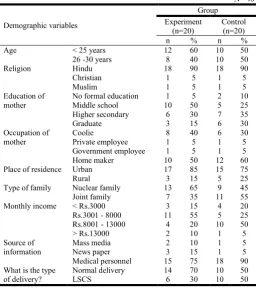
Table 1. Demographic variables of mothers
N= 40
Demographic variables
Group Experiment
(n=20)
Control (n=20)
n % n %
Age < 25 years 12 60 10 50
26 -30 years 8 40 10 50
Religion Hindu 18 90 18 90
Christian 1 5 1 5
Muslim 1 5 1 5
Education of mother
No formal education 1 5 2 10
Middle school 10 50 5 25
Higher secondary 6 30 7 35
Graduate 3 15 6 30
Occupation of mother
Coolie 8 40 6 30
Private employee 1 5 1 5
Government employee 1 5 1 5
Home maker 10 50 12 60
Place of residence Urban 17 85 15 75
Rural 3 15 5 25
Type of family Nuclear family 13 65 9 45
Joint family 7 35 11 55
Monthly income < Rs.3000 3 15 4 20
Rs.3001 - 8000 11 55 5 25
Rs.8001 - 13000 4 20 10 50
> Rs.13000 2 10 1 5
Source of information
Mass media 2 10 1 5
News paper 3 15 1 5
Medical personnel 15 75 18 90
What is the type of delivery?
Normal delivery 14 70 10 50
LSCS 6 30 10 50
Regarding feeding practices, in both groups only 2 mothers initiated breast feeding within ½ hour of birth and 18 in 1 hour. 5mothers in experimental and 4 in control group have fed their infants in 24 hours and 6 mothers in experiment group and 3 in control group fed only on the second day due to respiratory discomfort in the newborn. Prelacteal feeds were given by 7 mothers in experiment group and 5 in control group. Regarding the age of the child, most of them were in the age group of 0-2 weeks and gender distribution was equal (50%) in both groups. Majority of young infants were weighing between 2.5 -3.0 kg and nearly ¾ were second child of their family. During pretest, in experiment group, 70.0% of the mothers were having inadequate level of knowledge, 30% of the mothers were having moderate level of knowledge and none of the mothers were having adequate level of knowledge.
Table 2. Feeding practices
N= 40 Group
Experiment(n=20) Control(n=20)
n % n %
When did you initiate breast feeding?
Within ½ hour 2 10 2 10
Within 1 hour 7 35 11 55
Within 24 hours 5 25 4 20
2nd day 6 30 3 15
Did you give prelacteal feeds?
Yes 7 35 5 25
No 13 65 15 75
Glucose water 3 15 1 5
Honey 1 5 1 5
lactogen 3 15 3 15
Table 3. Children information
N= 40
Variables
Group
Experiment(n=20) Control(n=20)
n % n %
Age of child 0 -2 weeks 17 85 16 80
3 -4 weeks 3 15 4 20
Sex of child Male 10 50 7 35
Female 10 50 13 65
Weight of child < 2.5 kg 6 30 3 15
2.5 -3.0 kg 10 50 12 60
3.0 -3.5 kg 4 20 5 25
Order of child 1st child 5 25 5 25
2nd child 13 65 14 70
3rd child 2 10 1 5
Table 4. Pretest level of knowledge score
N= 40 Group
Chi square value
Experiment Control
n % n %
Inadequate 14 70 15 75 2=0.12 p=0.72 DF=
2 not significant
Moderate 6 30 5 25
Adequate 0 0 0 0
Table 5. Post-test1 level of knowledge score
N= 40 Group
Chi square value
Experiment Control
n % n %
Inadequate 1 5 15 75
2=17.19 p=0.001***
DF= 2 significant
Moderate 15 75 5 25
Adequate 4 20 0 0
Table 6. Post-test2 level of knowledge score
N= 40 Group
Chi square value
Experiment Control
n % n %
Inadequate 0 0 14 70
2=25.06 p=0.001***
DF= 2 significant
Moderate 7 35 6 30
In control group, 75% of the mothers were having inadequate level of knowledge, 25% of the mothers were having moderate level of knowledge and none of the mothers were having adequate level of knowledge. Statistically there was no significant difference in knowledge between experiment and control group.
[image:4.595.91.509.160.243.2]In experiment group, 5.0% of the mothers were having inadequate level of knowledge, 75.0% of the mothers were having moderate level of knowledge and 20% of the mothers were having adequate level of knowledge score. In control group, 75.0% of the mothers were having inadequate level of knowledge, 25.0% of the mothers were having moderate level of knowledge and none of the mothers were having adequate level of knowledge score. Statistically there wasa significant difference in knowledge between experiment and control group. In experimentgroup, none of the mothers were having inadequate level of knowledge, 35% of the mothers were having moderate level of knowledge and 65% of the mothers were having adequate level of knowledge score. In control group, 70.0% of the mothers were having inadequate level of knowledge, 30.0% of the mothers were having moderate level of knowledge and none of the mothers were having adequate level of knowledge score. Statistically there was a significant difference in knowledge level between experiment and control group. The total mean score in pretest was18.30 with the standard deviation of 4.23 and in post test I it was 29.45 with the standard deviation of 4.16 and in posttest II the mean was 31.80 with the standard deviation of 5.03. Mean difference was found to be 13.50. Statistically there is a significant improvement in the knowledge score at p<0.001level of significance. In all domains, mean difference score between base line and post-test2 was small and it is not statistically.
Table 9. Pretest level of practice score
N= 40 Group
Chi square value
Experiment Control
n % n %
Poor 13 65.0% 14 70.0%
2=0.11 p=0.74 DF= 1
not significant
Moderate 7 35.0% 6 30.0%
Good 0 0.0% 0 0.0%
In experiment, 65.0% of the mothers were having poor level of practice, 35% of the mothers were having moderate level of
practice and none of the mothers were having good level of practice score. In control, 70.0% of the mothers were having poor level of practice, 30.0% of the mothers were having moderate level of practice and none of the mothers were having good level of practice score.
[image:4.595.94.504.277.359.2]Statistically there was no significant difference in practice between experiment and control group during the pretest.
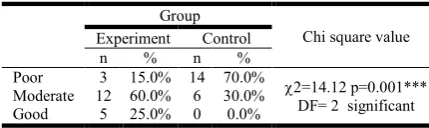
Table 10
.
Post-test1 level of practice scoreN= 40 Group
Chi square value
Experiment Control
n % n %
Poor 3 15.0% 14 70.0%
2=14.12 p=0.001***
DF= 2 significant
Moderate 12 60.0% 6 30.0%
Good 5 25.0% 0 0.0%
In experiment, 15.0% of the mothers were having poor level of practice, 60.0% of the mothers were having moderate level of practice and 25% of the mothers were having good level of practice score. In control, 70.0% of the mothers were having poor level of practice, 30.0% of the mothers were having moderate level of practice and none of the mothers were having good level of practice score. Statistically there was a significant difference in practice between experiment and control group.
Table 11. Post-test2 level of practice score
N= 40 Group
Chi square value
Experiment Control
n % n %
Poor 0 0.0% 14 70.0%
2=26.00 p=0.001***
DF= 2 significant
Moderate 7 35.0% 6 30.0%
Good 13 65.0% 0 0.0%
In experiment, none of the mothers are having poor level of practice, 35% of the mothers are having moderate level of practice and 65% of the mothers are having good level of practice score. In control, 70.0% of the mothers are having poor level of practice, 30.0% of the mothers are having moderate level of practice and none of the mothers are having
Table 7. Pretest, Post_test1 and post-test 2 knowledge score (Experiment group)
N= 40
S. No Domains Pre-test Post-test1 Post-test2 Mean
difference
Repeated measures Fried man test
Mean SD Mean SD Mean SD
1 General information 2.15 .88 2.65 .93 3.30 .86 1.15 2=14.65 P=0.001***
2 Bacterial infection 4.45 1.47 6.80 1.28 7.35 1.98 2.9 2=24.02 P=0.001***
3 Jaundice 2.05 1.36 3.55 .76 3.80 1.01 1.75 2=14.84 P=0.001***
4 Diarrhoea 5.75 2.65 9.65 2.43 9.60 2.66 3.85 2=21.71 P=0.001***
5 Feeding problem 3.90 1.37 6.80 2.46 7.75 1.45 3.85 2=21.94 P=0.001***
Total 18.30 4.23 29.45 4.16 31.80 5.03 13.50 2=32.39 P=0.001***
Table 8. Pretest, Post_test1 and post-test 2 knowledge score (Control group)
N= 40
S. No Domains Pre-test Post-test1 Post-test2 difference Mean Repeated measures Friedman test
Mean SD Mean SD Mean SD
1 General information 2.05 .94 2.25 .72 2.35 .81 0.3 2=4.33 p=0.11
2 Bacterial infection 3.90 1.07 4.15 1.04 4.25 1.62 0.35 2=3.25 p=0.19
3 Jaundice 2.15 .93 2.60 .99 2.75 1.25 0.6 2=4.22 p=0.12
4 Diarrhoea 5.50 1.79 5.75 1.92 5.85 1.84 0.35 2=5.65 p=0.09
5 Feeding problem 4.50 1.70 5.00 1.84 5.10 1.83 0.6 2=3.21p=0.20
[image:4.595.323.538.437.501.2]good level of practice score. Statistically there is a significant difference between experiment and control group. It was confirmed using chi square test. On an average, among
experiment, in posttest, mothers have gained 31.3% of
knowledge after VATM and in control group it is only 5.1%.
On an average, among experiment group, in posttest, mothers
have gained 34.1% of practice score after VATM and in
control group it is only 5.5%.
Association
Significant association was found between knowledge gain score and demographic variables like mothers of increased age, nuclear family, and information from medical personnel, mothers who have given prelacteal feds, and increase in the order of the child at p< 0.05level of significance.
DISCUSSSION
Objective 1
In pretest 70% of mothers in experimental group and 75% in control group had inadequate knowledge and 65% of mothers in experimental group and 70% in control group had poor practice on identification and management of danger signs like bacterial infection, jaundice, diarrhea and feeding problem in young infants. This is similar to the findings of Jacob Sandberg
et al. (2014), who identified “inadequate knowledge of
neonatal danger signs among recently delivered women”. In this study out of 765 recently delivered women, 58.3% of mothers had knowledge on only one of the key danger signs and only 14.8% could name at least two danger signs. The most common danger sign was fast breathing and difficulty feeding which was recognized by 30% of women and only 20% has given the response of fever and difficulty feeding as danger sign.
The least known danger signs were convulsions, movements only when stimulated and hypothermia stated by less than 5% of respondents. The findings showed poor understanding of
danger signs by the mothers. Mohd Haroon Khan et al., (2014)
found the “knowledge of pregnant women about danger signs in newborns requiring medical consultation”. The result showed that correct knowledge about cold to touch was present in 14% mothers whereas correct knowledge of hot to touch and chest in drawing were present in 91% and 74.5% mothers respectively. Only 37% mothers had correct knowledge regarding loose stool, 43% on drainage of pus from umbilicus
and 36% on convulsions, 32.5% on multiple boils and only 25.5% had correct knowledge on palm and sole yellow. It was concluded that there is a poor knowledge of pregnant women about danger signs in newborns requiring medical attention.
Objective 2
The total mean score of knowledge in pretest was18.30 with the standard deviation of 4.23 and in post test I it was 29.45 with the standard deviation of 4.16 and in posttest II the mean was 31.80 with the standard deviation of 5.03. Mean difference was found to be 13.50. Statistically there was a significant improvement in the knowledge score at p<0.001level of
significance. Hence the stated research hypothesis H1 was
accepted. Among experiment group, in posttest, mothers have
gained 34.1% of practice score after VATM and in control
group it is only 5.5% which proved that the research
hypothesis H2 was accepted. Geetarani Nayak (2014) reported
that highly significant difference was found between pre & post test score as evident by “t” value of 5.8 with a mean difference 0.9. She also revealed that 84% mothers had shown correct position following intervention as compared to 30% mothers, whereas 90% of mothers had shown improvement in attachment following intervention, which is similar to the study conducted by Gupta Madhu (2008), where she reported out of 20 mothers with babies under 6 months, 8 mothers (40%) had shown correct position following intervention as compared to 27% mothers with babies over 6 months, with respect to attachment ,50% of mothers with babies under 6 month had shown improvement following intervention.
Balwinder Kaur et al., (2012) reported out of 29, 3 (10 %)
babies were not well attached before administration of IMNCI guideline whereas 29 (100 %) babies were having good attachment after intervention.
Objective 3
Significant association was found between knowledge gain score and demographic variables like mothers of increased age, nuclear family, and information from medical personnel, mothers who have given prelacteal feds, and increase in the order of the child at p< 0.05level of significance. Hence the
research hypothesis H3 was accepted. Nigatu et al. (2015)did a
[image:5.595.93.501.241.292.2]community based study to identify the mothers’ level of knowledge about neonatal danger signs and associated factors in Northwest of Ethiopia. The finding of the study showed that out of 603 mothers, mothers who had knowledge of three or more neonatal danger signs were found to be 18.2% and were
Table 12. Effectiveness of VATM on knowledge
N= 40
Maximum score Mean ±SD Knowledge gain score % of Knowledge gain score
Experiment Pre-test 43 18.30±4.23 13.5 31.3%
Post test 43 31.80±5.03
Control Pre-test 43 18.10±4.24 2.2 5.1%
Post test 43 20.30±2.43
Table 13. Effectiveness of VATM on practice
N= 40
Maximum score Mean ±SD Practice gain score % of Practice gain score
Experiment Pre-test 16 6.75±3.42 5.45 34.1%
Post test 16 12.20±1.61
Control Pre-test 16 6.50±2.12 0.9 5.5%
considered as having good knowledge. Educational level of the parents, mothers who attended antenatal, postnatal clinic and source of information from television was associated with good knowledge of the mother about neonatal danger signs.
Objective 4
In posttest, among experiment group there was a positive moderate correlation between knowledge and practice at (r=0.48) p<0.001. It means as knowledge increases their practice also increases moderately. Hence the research
hypothesis H4 was accepted Ansavi et al. (2012)has done an
interventional study to assess the knowledge, attitude and practice regarding diarrhoea and its management in nine different location of Morang district, Nepal found that the intervention had a positive correlation between knowledge and practice.
Implications
Nursing practice
The nursing staff in the NICU and postnatal ward
should educate the mothers on identification of danger signs in the newborn.
They should also observe the feeding practices of
mothers.
The staff nurses trained in IMNCI guidelines should
implement those practices in the ward for better outcome and to reduce the neonatal mortality and morbidity.
Nursing education
The nurse educator should plan various strategies to
educate the mothers regarding attachment, suckling and positioning during breast feeding
The nurse educator can train the students in identifying
the danger signs in young infants, preparation of ORS, and techniques of breastfeeding.
Nursing administration
In-service training programme to be organized for the
nursing personnel on IMNCI guidelines.
The nurse administrator should develop policies and
protocols to promote breast feeding.
Nursing research
Wider research can be conducted to explore other
aspects of feeding problem & breast feeding practices.
Further studies can utilize the findings in proceding the
study.
Recommendation
A similar study can be done on large sample in a
differentsetting to have a wider applicability by generalization.
An experimental study can be done to evaluate the
effectiveness of implementing IMNCI guidelineson breast feeding practice among mothers.
A study can be conducted to identify the health seeking
behaviour of mothers.
REFERENCES
Operational Manual IPEN-IMNCI Study Phase I (2006-2007) Rakha, M.A., Abdelmoneim, A.N., Farhoud, S., Pieche, S.,
Cousens, S., Delmans, B. and Bahl, R. 2013. Does implementation of the IMCI strategy has an impact on child mortality? A retrospective analysis of routine data
from Egypt. BMJ Open., 3 (1): pii: e001852.
The UN Inter-agency Group for Child Mortality Estimation: Levels & Trends in Child Mortality: Report 2014. New York: UNICEF; 2014 [http://www.data.unicef.org/fckima ges/uploads/1410869227_Child_Mortality_Report_2014. Unicef, 2011. The state of the world’s children 2011:
Adolescence: An age of opportunity: unicef.
UNICEF: Committing to Child Survival: A Promise Renewed Progress Report 2014. New York: UNICEF; 2014 [http://data.unicef.org/corecode/uploads/document6/ uploaded_pdfs/corecode/APR-2014-17Oct14-web_194.pdf]
Wardlaw et al. 2014. UNICEF Report: enormous progress in
child survival but greater focus on newborns urgently needed. Reproductive Health, 11:82.