Sentence Analysis and Collocation Identification
Eric Wehrli, Violeta Seretan, Luka Nerima Language Technology Laboratory
University of Geneva
{Eric.Wehrli, Violeta.Seretan, Luka.Nerima}@unige.ch
Abstract
Identifying collocations in a sentence, in order to ensure their proper processing in subsequent applications, and performing the syntactic analysis of the sentence are interrelated processes. Syntactic informa-tion is crucial for detecting collocainforma-tions, and vice versa, collocational information is useful for parsing. This article describes an original approach in which collocations are identified in a sentence as soon as pos-sible during the analysis of that sentence, rather than at the end of the analysis, as in our previous work. In this way, priority is given to parsing alternatives involving col-locations, and collocational information guide the parser through the maze of alter-natives. This solution was shown to lead to substantial improvements in the perfor-mance of both tasks (collocation identifi-cation and parsing), and in that of a sub-sequent task (machine translation).
1 Introduction
Collocations1 constitute a central language
phe-nomenon and an impressive amount of work has been devoted over the past decades to the automa-tic acquisition of collocational resources – as at-tested, among others, by initiatives like the MWE 2008 shared task aimed at creating a repository of reference data (Gr´egoire et al., 2008). However, little or no reference exist in the literature about 1We adopt the lexicographic understanding for the term collocation (Benson et al., 1986), as opposed to the British contextualist tradition focused on statistical co-occurrence (Firth, 1957; Sinclair, 1991).
the actual use made of these resources in other NLP applications.
In this paper, we consider the particular appli-cation of syntactic parsing. Just as other types of multi-word expressions (henceforth, MWEs), col-locations are problematic for parsing because they have to be recognised and treated as a whole, ra-ther than compositionally, i.e., in a word by word fashion (Sag et al., 2002). The standard approach in dealing with MWEs in parsing is to apply a “words-with-spaces” preprocessing step, which marks the MWEs in the input sentence as units which will later be integrated as single blocks in the parse tree built during analysis.
We argue that such an approach, albeit suffi-ciently appropriate for some subtypes of MWEs2,
is not really adequate for processing colloca-tions. Unlike other expressions that are fixed or semi-fixed3, collocations do not allow a
“words-with-spaces” treatment because they have a high morpho-syntactic flexibility.
There is no systematic restriction, for instance, on the number of forms a lexical item (such as a verb) may have in a collocation, on the order of items in a collocation, or on the number of words that may intervene between these items. Collo-cations are situated at the intersection of lexicon and grammar; therefore, they cannot be accounted for merely by the lexical component of a parsing system, but have to be integrated to the grammati-cal component as well, as the parser has to
consi-2Sag et al. (2002) thoroughly discusses the extend to which a “words-with-spaces” approach is appropriate for dif-ferent kinds of MWEs.
der all the possible syntactic realisations of collo-cations.
Alternatively, a post-processing approach (such as the one we pursued previously in Wehrli et al. (2009b)) would identify collocations after the syntactic analysis has been performed, and out-put a parse tree in which collocational relations are highlighted between the composing items, in order to inform the subsequent processing appli-cations (e.g., a machine translation application). Again, this solution is not fully appropriate, and the reason lies with the important observation that prior collocational knowledge is highly relevant for parsing. Collocational restrictions are, along with other types of information like selectional preferences and subcategorization frames, a major means of structural disambiguation. Collocational relations between the words in a sentence proved very helpful in selecting the most plausible among all the possible parse trees for a sentence (Hindle and Rooth, 1993; Alshawi and Carter, 1994; Ber-thouzoz and Merlo, 1997; Wehrli, 2000). Hence, the question whether collocations should be iden-tified in a sentence before or after parsing is not an easy one. The previous literature on parsing and collocations fails to provide insightful details on how this circular issue is (or can be) solved.
In this paper, we argue that the identification of collocations and the construction of a parse tree are interrelated processes, that must be accounted for simultaneously. We present a processing mo-del in which collocations, if present in a lexicon, are identified in the input sentence during the ana-lysis of that sentence. At the same time, they are used to rank competing parsing hypotheses.
The paper is organised as follows. Section 2 reviews the previous work on the interrelation between parsing and processing of collocations (or, more generally, MWEs). Section 3 introduces our approach, and section 4 evaluates it by compa-ring it against the standard non-simultaneous ap-proach. Section 5 provides concluding remarks and presents directions for future work.
2 Related Work
Extending the lexical component of a parser with MWEs was proved to contribute to a significant improvement of the coverage and accuracy of
par-sing results. For instance, Brun (1998) compared the coverage of a French parser with and wi-thout terminology recognition in the preproces-sing stage. She found that the integration of 210 nominal terms in the preprocessing components of the parser resulted in a significant reduction of the number of alternative parses (from an average of 4.21 to 2.79). The eliminated parses were found to be semantically undesirable. No valid analy-sis were ruled out. Similarly, Zhang and Kor-doni (2006) extended a lexicon with 373 additio-nal MWE lexical entries and obtained a significant increase in the coverage of an English grammar (14.4%, from 4.3% to 18.7%).
In the cases mentioned above, a “words-with-spaces” approach was used. In contrast, Ale-gria et al. (2004) and Villavicencio et al. (2007) adopted a compositional approach to the enco-ding of MWEs, able to capture more morpho-syntactically flexible MWEs. Alegria et al. (2004) showed that by using a MWE processor in the pre-processing stage of their parser (in development) for Basque, a significant improvement in the POS-tagging precision is obtained. Villavicencio et al. (2007) found that the addition of 21 new MWEs to the lexicon led to a significant increase in the grammar coverage (from 7.1% to 22.7%), without altering the grammar accuracy.
An area of intensive research in parsing is concerned with the use of lexical preferences, co-occurrence frequencies, collocations, and contex-tually similar words for PP attachment disambi-guation. Thus, an important number of unsupervi-sed (Hindle and Rooth, 1993; Ratnaparkhi, 1998; Pantel and Lin, 2000), supervised (Alshawi and Carter, 1994; Berthouzoz and Merlo, 1997), and combined (Volk, 2002) methods have been deve-loped to this end.
3 Parsing and Collocations
As argued by many researchers – e.g., Heid (1994) – collocation identification is best performed on the basis of parsed material. This is due to the fact that collocations are co-occurrences of lexi-cal items in a specific syntactic configuration. The collocationbreak record, for instance, is obtained only in the configurations wherebreak is a verb whose direct object is (semantically) headed by the lexical itemrecord. In other words, the collo-cation is not defined in terms of linear proximity, but in terms of a specific grammatical relation.
As the examples in this section show, the rela-tive order of the two items is not relevant, nor is the distance between the two terms, which is unli-mited as long as the grammatical relation holds4.
In our system, the grammatical relations are com-puted by a syntactic parser, namely, Fips (Wehrli, 2007; Wehrli and Nerima, 2009). Until now, the collocation identification process took place at the end of the parse in a so-called “interpretation” procedure applied to the complete parse trees. Al-though quite successful, this way of doing pre-sents a major drawback: it happens too late to help the parser. This section discusses this point and describes the alternative that we are currently developing, which consists in identifying colloca-tions as soon as possible during the parse.
One of the major hurdles for non-deterministic parsers is the huge number of alternatives that must be considered. Given the high fre-quency of lexical ambiguities, the high level of non-determinism of natural language grammars, grammar-based parsers are faced with a number of alternatives which grows exponentially with the length of the input sentence. Various methods have been proposed to reduce that number, and in most cases heuristics are added to the parsing algorithm to limit the number of alternatives. Wi-thout such heuristics, the performance of a parser might not be satisfactory enough for large scale applications such as machine translation or other tasks involving large corpora.
We would like to argue, along the lines of previous work (section 2), that collocations can 4Goldman et al. (2001) report examples in which the dis-tance between the two terms of a collocation can exceed 30 words.
contribute to the disambiguation process so cru-cial for parsing. To put it differently, identifying collocations should not be seen as a burden, as an additional task the parser should perform, but on the contrary as a process which may help the par-ser through the maze of alternatives. Collocations, in their vast majority, are made of frequently used terms, often highly ambiguous (e.g.,break record,
loose change). Identifying them and giving them high priority over alternatives is an efficient way to reduce the ambiguity level. Ambiguity reduc-tion through the identificareduc-tion of collocareduc-tions is not limited to lexical ambiguities, but also applies to attachment ambiguities, and in particular to the well-known problem of PP attachment. Consider the following French examples in which the pre-positions are highlighted:
(1)a. lignedepartagedeseaux (“watershed”) b. syst`emedegestiondebasededonn´ees
(“da-tabase management system”)
c. forcedemaintiende la paix (“peacekeeping force”)
d. organisation de protection de
l’environnement (“environmental protection agency”)
In such cases, the identification of a noun-preposition-noun collocation will prevent or dis-courage any other type of prepositional attach-ment that the parser would otherwise consider.
3.1 The Method
feature [+partOfCollocation], which signals that a given word is associated in our lexical database to one or several collocations, and then searches the collocation database for an adjective-noun collo-cation with those two terms. If successful, the cor-responding parse tree will be given a high priority. With examples such asloose change, the iden-tification of the collocation will immediately re-legate any (partial) analysis based on the verbal reading of either terms.
To take a somewhat more complex example, consider a verb-object collocation such as break record, as in example (2)5.
(2)a. John broke a record.
b. [TP [DPJohn ] broke [DPa [NPrecord ] ] ] Here, it is a right attachment rule which will trigger the identification procedure. To be precise, the right attachment rule in this case concerns the attachment of the noun record as complement of the indefinite determiner (head of the DP direct object of the verb). The identification procedure considers, in turn, all the governing nodes dominating the nounrecord, halting at the first node of category Noun6, Verb or Adjective.
In our example, the determiner node and then the verb node will be considered. Notice that the procedure will, quite correctly, identify a colloca-tion in the French example (3a), but not in (3b), although both structures are identical. The reason has to do with the fact that the noun governing
record in the first example is a [+number] noun, that is a classifier noun which is transparent for the identification procedure7.
(3)a. Jean a battu un grand nombre de records. “Jean broke a large number of records” 5We use the following labels in our phrase-structure re-presentations: TP-Tense phrase, for simple sentence (the S of standard CFG), CP-Complementizer phrase, for a sentence with a conjunction or a complementizer, DP-Determiner phrase for standard noun phrases (we assume the DP hy-pothesis, whereby the determiner constitutes the syntac-tic head of a noun phrase), NP-Noun phrase for nominal projections (nouns with their modifiers/complements), VP-Verb phrase, PP-Prepositional phrase, AP-Adjectival phrase, AdvP-Adverbial phrase, FP-Functional phrase (used for se-condary predicates).
6Unless the node it marked [+number], as we will see shortly.
7See Fontenelle (1999) for a detailed account of transpa-rent nouns.
b. Jean a battu le d´etenteur du record. “Jean has beaten the holder of the record” As in the other examples, an analysis in which a collocation has been found is given high prio-rity over alternatives. In the case of (2), this will relegate potential analyses based on the adjectival reading ofbrokeor the verbal reading ofrecord.
Notice that exactly the same procedure applies when the trace of an extraposed element is (right) inserted, as in the examples (4), which illustrate the case of wh-interrogative (a), relative clause (b),tough-movement (c).
(4)a. Which record will Paul try to break ? b. The record Paul broke was very old. c. This record is difficult to break.
In all such cases, that is, when the right inserted element is a trace, the identification procedure will consider its antecedent, or to be more precise, the semantic head of its antecedent. Finally, the grammatical processes involved in example (4a,c) can combine as in the more complex example (5), for which we give the slightly simplified structure with the chain of elements with indexiextending from the fronted wh-phrase which record to the direct object position of the verb break, via the direct object position of the verbconsiderand the subject position of the secondary predicate (FP) headed by the [+tough] adjectivedifficult.
(5)a. Which record did Paul consider difficult to break ?
b. [CP[
DPwhich record]i [TPdid [DPPaul
] [ VPconsider ][
DPe]i [ FP[DPe]i [ AP
difficult [TPto [VPbreak[
DPe]i] ] ] ] ] ]
3.2 Complex Collocations
As stated, for instance, by (Heid, 1994), colloca-tions can involve more than two (main) terms and it is possible to adopt a recursive definition of col-locations, i.e., complex collocations can be vie-wed as collocations of collocations. The colloca-tion identificacolloca-tion procedure has been extended to handle such cases. Consider examples (6) below. (6)a. La voiture tombera probablement en panne
d’essence.
b. natural language processing c. He broke a world record.
In the French sentence (6a), panne d’essence
(literally, “breakdown of gas”, “out of gas”) is a collocation of type Noun+Prep+Noun, which combines with the verb tomber (literally, “to fall”) to form a larger collocation of type Verb+PrepObjecttomber en panne d’essence(“to run out of gas”). Given the strict left to right processing order assumed by the parser, it will first identify the collocationtomber en panne(“to break down”) when attaching the word panne. Then, reading the last word, essence(“gas”), the parser will first identify the collocation panne d’essence. Since that collocation bears the lexi-cal feature [+partOfCollocation], the identifica-tion procedure goes on, through the governors of that item. The search succeeds with the verb
tomber, and the collocation tomber en panne d’essence(“run out of gas”) is identified.
4 Evaluation Experiments
In this section, we describe the experiments we performed in order to evaluate the precision and recall of the method introduced in section 3, and to compare it against the previous method (fully described in Wehrli et al. (2009b)). We extend this comparison by performing a task-based eva-luation, which investigates the impact that the new method has on the quality of translations produ-ced by a machine translation system relying on our parser (Wehrli et al., 2009a).
4.1 Precision Evaluation
The data considered in this experiment consist of a subpart of a corpus of newspaper articles collec-ted from the on-line version of The Economist8,
containing slightly more that 0.5 million words. On these data, we run two versions of our parser:
• V1: a version implementing the previous me-thod of collocation identification,
• V2: a version implementing the new method described in section 3.
8URL:http://www.economist.com/
(accessed June, 2010).
The lexicon of the parser was kept constant, which is to say that both versions used the same lexicon (which contains slightly more than 7500 English collocation entries), only the parsing mo-dule handling collocations was different. From the output of each parser version, we collected statistics on the number of collocations (present in the lexicon) that were identified in the test cor-pus. More precisely, we traversed the output trees and counted the items that were marked as col-location heads, each time this was the case (note that an item may participate in several colloca-tions, not only one). Table 1 presents the num-ber of collocations identified, both with respect to collocation instances and collocation types.
V1 V2 common V1 only V2 only
Tokens 4716 5412 4347 399 1003
Types 1218 1301 1182 143 368
Table 1. Collocation identification results.
As the results show, the new method (column V2) is more efficient in retrieving collocation ins-tances. It detects 696 more instances, which cor-respond to an increase of 14.8% relative to the previous method (column V1). As we lack the means to compare on a large scale the correspon-ding syntactic trees, we can only speculate that the increase is mainly due to the fact that more appro-priate analyses are produced by the new method.
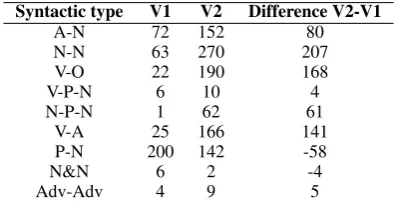
A large number of instances are found by both versions of the parser. The difference between the two methods is more visible for some syn-tactic types than for others. Table 2 details the number of instances of each syntactic type which are retrieved exclusively by one method or by the other.
Syntactic type V1 V2 Difference V2-V1
A-N 72 152 80
N-N 63 270 207
V-O 22 190 168
V-P-N 6 10 4
N-P-N 1 62 61
V-A 25 166 141
P-N 200 142 -58
N&N 6 2 -4
[image:6.595.81.281.70.171.2]Adv-Adv 4 9 5
Table 2. Differences between the two methods: number of tokens retrieved exclusively by each method.
an instance of the verb-object collocationto make a decision, which is an entry in our lexicon. (7)a. Thedecisiontomakean offer to buy or sell
property at price is a management decision that cannot be delegated to staff.
Since judging the correctness of a collocation ins-tance in context is a rather straightforward task, we do not require multiple judges for this evalua-tion. The precision obtained is 90% for V1, and 100% for V2.
The small size of test set is motivated by the fact that the precision is expected to be very high, since the presence of both collocation components in a sentence in the relevant syntactic relation al-most certainly means that the recognition of the corresponding collocation is justified. Exceptions would correspond to a minority of cases in which the parser either wrongly establishes a relation between two items which happen to belong to an entry in the lexicon, or the two items are related but the combination corresponds to a literal usage (examples are provided later in this section).
The errors of V1 correspond, in fact, to cases in which a combination of words used literally was wrongly attributed to a collocation: in example (8a), V1 assigned the words on and business to the lexical entryon business, and in example (8b), it assignedinandcountryto the entryin the coun-try9.
(8)a. It is not, by any means, specific to the countryside, but it falls especially heavilyon
smallbusinesses.
9V1 makes the same error on (8a), but does better on (8b). These expressions are frozen and should not be treated as standard collocations.
b. Industrial labour costs in western Germany are higher thaninany othercountry.
To better pinpoint the difference between V1 and V2, we performed a similar evaluation on an additional set of 20 instances, randomly selected among the collocations identified exclusively by each method. Thus, the precision of V1, when measured on the tokens in ”V1 only”, was 65%. The precision of V2 on ”V2 only” was 90%. The 2 errors of V2 concern the pairin country, found in contexts similar to the one shown in example (8b). The errors of V1 also concerned the same pair, with one exception – the identification of the collocationworld tradefrom the contextthe des-truction of the World Trade Centre. Since World Trade Centreis not in the parser lexicon, V1 ana-lysed it and assigned the first two words to the en-tryworld trade. World was wrongly attached to
Trade, rather than toCentre.
When reported on the totality of the instances tested, the precision of V1 is 77.5% and that of V2 is 95%. Besides the increase in the precision of identified collocations, the new method also contributes to an increase in the parser coverage10,
from 81.7% to 83.3%. The V1 parser version suc-ceeds in building a complete parse tree for 23187 of the total 28375 sentences in the corpus, while V2 does so for 23629 sentences.
4.2 Recall Evaluation
To compare the recall of two methods we perfor-med a similar experiment, in which we run the two versions of the parser, V1 and V2, on a small col-lection of sentences containing annotated colloca-tion instances. These sentences were randomly selected from the Europarl corpus (Koehn, 2005). The collocations they contain are all verb-object collocations. We limit our present investigation to this syntactic type for two reasons: a) anno-tating a corpus with all instances of collocation entries in the lexicon would be a time-consuming task; and b) verb-object collocations are among the most syntactically flexible and therefore diffi-cult to detect in real texts. Thus, this test set pro-vides realistic information on recall.
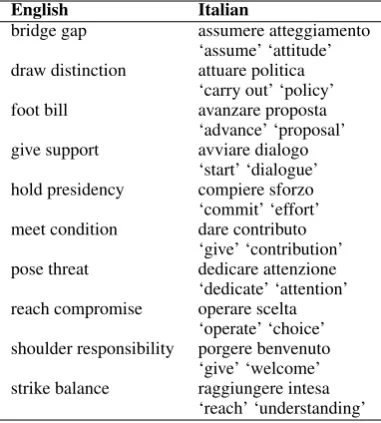
The test set is divided in two parts: 100 sen-tences are in English, and 100 other in Italian, which allows for a cross-linguistic evaluation of the two methods. Each sentence contains one an-notated collocation instance, and there are 10 ins-tances for a collocation type. Table 3 lists the col-location types in the test set (the even rows in co-lumn 2 display the glosses for the words in the Italian collocations).
English Italian
bridge gap assumere atteggiamento ‘assume’ ‘attitude’ draw distinction attuare politica
‘carry out’ ‘policy’ foot bill avanzare proposta
‘advance’ ‘proposal’ give support avviare dialogo
‘start’ ‘dialogue’ hold presidency compiere sforzo
‘commit’ ‘effort’ meet condition dare contributo
‘give’ ‘contribution’ pose threat dedicare attenzione
‘dedicate’ ‘attention’ reach compromise operare scelta
‘operate’ ‘choice’ shoulder responsibility porgere benvenuto
‘give’ ‘welcome’ strike balance raggiungere intesa
[image:7.595.302.522.70.103.2]‘reach’ ‘understanding’
Table 3. Collocation types in the test set.
The evaluation results are presented in table 4. V1 achieves 63% recall performance on the En-glish data, and 44% on the Italian data. V2 shows considerably better results: 76% on English and 66% on Italian data. The poorer performance of both methods on Italian data is explained by the difference in performance between the English and Italian parsers, and more precisely, by the dif-ference in their grammatical coverage. The En-glish parser succeeds in building a complete parse tree for more than 70% of the sentences in the test set, while the Italian parser only for about 60%.
As found in the previous experiment (presen-ted in section 4.1), for both languages considered in this experiment, the new method of processing collocations contributes to improving the parsing coverage. The coverage of the English parser in-creases from 71% to 76%, and that of the Italian parser from 57% to 61%.
V1 V2 Common V1 only V2 only
English 63 76 61 2 15
[image:7.595.85.276.209.421.2]Italian 44 66 42 2 24
Table 4. Recall evaluation results: number of cor-rect collocation instances identified.
4.3 Task-based Evaluation
In addition to reporting the performance results by using the standard measures of precision and re-call, we performed a task-based performance eva-luation, in which we quantified the impact that the newly-proposed method has on the quality of the output of a machine translation system. As the examples in table 3 suggest, a literal translation of collocations is rarely the most appropriate. In fact, as stated by Orliac and Dillinger (2003), know-ledge of collocations is crucial for machine trans-lation systems. An important purpose in iden-tifying collocations with our parser is to enable their proper treatment in our translation system, a rule-based system that performs syntactic transfer by relying on the structures produced by the par-ser.
In this system, the translation of a collocation takes place as follows. When the parser identi-fies a collocation in the source sentence, its com-ponent words are marked as collocation mem-bers, in order to prevent their literal translation. When the transfer module processes the collo-cation head, the system checks in the bilingual lexicon whether an entry exists for that colloca-tion. If not, the literal translation will apply; otherwise, the transfer module projects a target-language structure as specified in the correspon-ding target lexical entry. More precisely, the trans-fer yields a target language abstract representa-tion, to which grammatical transformations and morphological generation will apply to create the target sentence. The identification of collocations in the source text is a necessary, yet not a sufficient condition for their successful translation.
obtai-Task Measure Test set Language Increase
Collocation identification precision 40 instances English 17.5% recall 200 instances English, Italian 17.5%
100 instances English 13%
100 instances Italian 22%
Collocation translation precision 200 instances {English, Italian}-French 13% 100 instances English-French 10% 100 instances Italian-French 16%
Parsing coverage 28375 sentences English 1.6%
200 sentences English 5%
[image:8.595.113.480.70.182.2]200 sentences Italian 4%
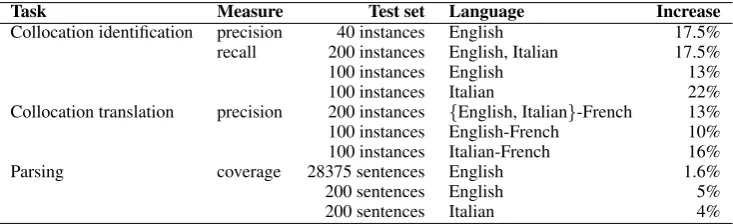
Table 5. Summary of evaluation results.
ned by relying on the versions V1 and V2 of our parser (recall that V2 corresponds to the newly-proposed method and V1 to the previous method). The use of automatic metrics for evaluating the translation output was not considered appropriate in this context, since such n-gram based metrics underestimate the effect that the substitution of a single word (like in our case, the verb in a verb-object collocation) has on the fluency, adequacy, and even on the interpretability of the output sen-tence.
The comparison showed that, for both language pairs considered (English-French and Italian-French), the version of parser which integrates the new method is indeed more useful for the ma-chine translation system than the previous version. When V2 was used, 10 more collocation instances were correctly translated from English to French than when using V1. For the Italian-French pair, V2 helped correctly translating 16 more colloca-tion instances in comparison with V1. This cor-responds to an increase in precision of 13% on the whole test set of 200 sentences. The increase in performance obtained in all the experiments des-cribed in this section is summarized in table 5.
5 Conclusion
In this paper, we addressed the issue of the inter-connection between collocation identification and syntactic parsing, and we proposed an original so-lution for identifying collocations in a sentence as soon as possible during the analysis (rather than at the end of the parsing process). The major advan-tage of this approach is that collocational informa-tion may be used to guide the parser through the maze of alternatives.
The experimental results performed showed that the proposed method, which couples parsing and collocation identification, leads to substan-tial improvements in terms of precision and re-call over the standard identification method, while contributing to augment the coverage of the par-ser. In addition, it was shown that it has a posi-tive impact on the results of a subsequent appli-cation, namely, machine translation. Future work will concentrate on improving our method so that it accounts for all the possible syntactic configu-rations of collocational attachments, and on exten-ding its recall evaluation to other syntactic types.
Acknowledgements
Thanks to Lorenza Russo and Paola Merlo for a thorough reading and comments. Part of the re-search described in this paper has been supported by a grant from the Swiss National Science Foun-dation, grant no 100015-117944.
References
Alegria, I˜naki, Olatz Ansa, Xabier Artola, Nerea Ezeiza, Koldo Gojenola, and Ruben Urizar. 2004. Representation and treatment of multiword expres-sions in basque. InSecond ACL Workshop on Mul-tiword Expressions: Integrating Processing, pages 48–55, Barcelona, Spain.
Alshawi, Hiyan and David Carter. 1994. Training and scaling preference functions for disambigua-tion.Computational Linguistics, 20(4):635–648. Benson, Morton, Evelyn Benson, and Robert Ilson.
edi-tors, Recent Advances in Natural Language Pro-cessing: Selected Papers from RANLP’97, Current Issues in Linguistic Theory, pages 179–186. John Benjamins, Amsterdam/Philadelphia.
Brun, Caroline. 1998. Terminology finite-state pre-processing for computational LFG. InProceedings of the 36th Annual Meeting of the Association for Computational Linguistics and 17th International Conference on Computational Linguistics, pages 196–200, Morristown, NJ, USA.
Firth, John R. 1957.Papers in Linguistics 1934-1951. Oxford Univ. Press, Oxford.
Fontenelle, Thierry. 1999. Semantic resources for word sense disambiguation: a sine qua non? Lin-guistica e Filologia, (9):25–43. Dipartimento di Linguistica e Letterature Comparate, Universit`a de-gli Studi di Bergamo.
Goldman, Jean-Philippe, Luka Nerima, and Eric Wehrli. 2001. Collocation extraction using a syn-tactic parser. In Proceedings of the ACL Work-shop on Collocation: Computational Extraction, Analysis and Exploitation, pages 61–66, Toulouse, France.
Gr´egoire, Nicole, Stefan Evert, and Brigitte Krenn, editors. 2008. Proceedings of the LREC Workshop Towards a Shared Task for Multiword Expressions (MWE 2008). European Language Resources Asso-ciation (ELRA), Marrakech, Morocco.
Heid, Ulrich. 1994. On ways words work together – research topics in lexical combinatorics. In Pro-ceedings of the 6th Euralex International Congress on Lexicography (EURALEX ’94), pages 226–257, Amsterdam, The Netherlands.
Hindle, Donald and Mats Rooth. 1993. Structural am-biguity and lexical relations. Computational Lin-guistics, 19(1):103–120.
Koehn, Philipp. 2005. Europarl: A parallel corpus for statistical machine translation. In Proceedings of The Tenth Machine Translation Summit (MT Sum-mit X), pages 79–86, Phuket, Thailand, September.
Orliac, Brigitte and Mike Dillinger. 2003. Collocation extraction for machine translation. InProceedings of Machine Translation Summit IX, pages 292–298, New Orleans, Lousiana, USA.
Pantel, Patrick and Dekang Lin. 2000. An unsuper-vised approach to prepositional phrase attachment using contextually similar words. In Proceedings of the 38th Annual Meeting of the Association for Computational Linguistics, pages 101–108, Hong Kong, China.
Ratnaparkhi, Adwait. 1998. Statistical models for un-supervised prepositional phrase attachment. In Pro-ceedings of the 36th Annual Meeting of the Associa-tion for ComputaAssocia-tional Linguistics and 17th Inter-national Conference on Computational Linguistics, pages 1079–1085, Montreal, Quebec, Canada. Sag, Ivan A., Timothy Baldwin, Francis Bond, Ann
Copestake, and Dan Flickinger. 2002. Multiword expressions: A pain in the neck for NLP. In Pro-ceedings of the Third International Conference on Intelligent Text Processing and Computational Lin-guistics (CICLING 2002), pages 1–15, Mexico City. Sinclair, John. 1991. Corpus, Concordance,
Colloca-tion. Oxford University Press, Oxford.
Villavicencio, Aline, Valia Kordoni, Yi Zhang, Marco Idiart, and Carlos Ramisch. 2007. Validation and evaluation of automatically acquired multiword ex-pressions for grammar engineering. InProceedings of the 2007 Joint Conference on Empirical Methods in Natural Language Processing and Computatio-nal Natural Language Learning (EMNLP-CoNLL), pages 1034–1043, Prague, Czech Republic, June. Volk, Martin. 2002. Combining unsupervised and
supervised methods for PP attachment disambi-guation. In Proceedings of the 19th Internatio-nal Conference on ComputatioInternatio-nal Linguistics (CO-LING’02), pages 25–32, Taipei, Taiwan.
Wehrli, Eric and Luka Nerima. 2009. L’analyseur syntaxique Fips. InProceedings of the IWPT 2009 ATALA Workshop: What French parsing systems?, Paris, France.
Wehrli, Eric, Luka Nerima, and Yves Scherrer. 2009a. Deep linguistic multilingual translation and bilin-gual dictionaries. In Proceedings of the Fourth Workshop on Statistical Machine Translation, pages 90–94, Athens, Greece. Association for Computa-tional Linguistics.
Wehrli, Eric, Violeta Seretan, Luka Nerima, and Lo-renza Russo. 2009b. Collocations in a rule-based MT system: A case study evaluation of their trans-lation adequacy. InProceedings of the 13th Annual Meeting of the European Association for Machine Translation, pages 128–135, Barcelona, Spain. Wehrli, Eric. 2000. Parsing and collocations. In
Christodoulakis, D., editor,Natural Language Pro-cessing, pages 272–282. Springer Verlag.
Wehrli, Eric. 2007. Fips, a “deep” linguistic multilin-gual parser. InACL 2007 Workshop on Deep Lin-guistic Processing, pages 120–127, Prague, Czech Republic.