HAZARD CLASSIFICATION REDUCTION ASSESSMENT by
Maj Ernest Staubs1 Gary Parsons1 Danny Hayles1 Patrick N. Carlton2
David M. Osborn3 Jane E. Davis3 Robert E. Hester3
Insensitive Munitions & Energetic Materials Symposium Sponsored by the National Defense Industrial Association (NDIA)
November 27-30, 2000 San Antonio, Texas
ABSTRACT
This paper presents results of a study conducted to investigate the cost and operational benefits of changing a select weapons set from standard (hazard classification/division 1.1) to reduced hazard classification (hazard classification/division 1.2.3). The phases of the munitions life cycle were examined for possible cost and accident reduction benefits. Metrics in logistics and accident value were developed. Costs are compared for production, handling, transportation, storage, operations, and disposal. Accident consequences predicted via the Assessment System for Hazard Surveys (ASHS) computer program are compared for the two hazard classifications. These concepts are being applied to several notional airbases composed of munitions storage areas, munitions assembly areas, hardened aircraft shelters, aircraft, flight line, and other airbase associated facilities. Airbase aspects of operations are also being examined for improvement in munitions flow from the munitions storage area to the loaded combat aircraft at the flight line and improved reaction capability to dynamic tasking of combat loaded aircraft.
1. Air Force Research Laboratory, Energetic Materials Branch, AFRL/MNME, Eglin AFB, FL 32542-5000.
2. KBM, Inc., TEAS Group, P.O. Box 1935, Eglin AFB, FL 32542-5000.
INTRODUCTION Goals
The goals of this munitions hazard classification reduction benefits study are to analytically assess the change in the cost and operational effects by using munitions with a reduced hazard classification/division of 1.2.3 as compared with standard munitions with a hazard classification/ division of 1.1. Reduced hazard classification weapons are expected to provide enhancements in survivability, safety, and operational performance effectiveness. The effects are quantified over the life cycle of the munitions using a standard set of metrics. The study analyzed operations and potential improvements at three representative air bases. The process methodology is available for application to different weapons and scenarios.
Assumptions
Specific realistic assumptions are made to render the problem manageable and yet produce useful results.
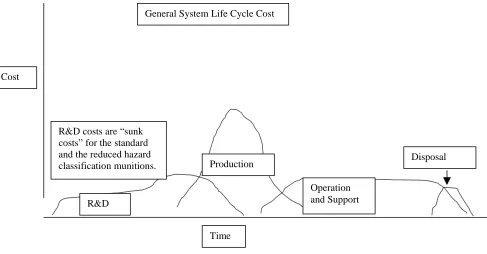
[image:2.612.39.526.357.611.2]The life cycle concept is illustrated in figure 1. [Giadrosich] For the purposes of the present study, it is assumed that the munitions and explosive fills under consideration are past the research and development phase so that the research and development costs are sunk and have no bearing on subsequent decisions. It assumed that mature technology is available for production of the reduced hazard classification munitions as well as the standard munitions.
Figure 1. Typical product life cycle.
The study also assumed that the munitions effectiveness is independent of its hazard classification (i.e. a 1.2.3 weapon is as effective as its .1. counterpart). This means that the essential independent variable in the study is the hazard classification of the munitions.
General System Life Cycle Cost
Time Cost
R&D
Production
Operation and Support
Disposal R&D costs are “sunk
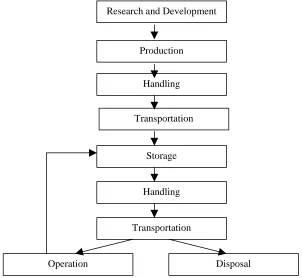
The flow of munitions in the life cycle is from research and development to production, handling, transportation, storage, operational use, and disposal. Munitions are usually moved from storage to operational use and back to storage (for the unexpended items) iteratively over the complete life cycle as shown in figure 2. Eventually, a small portion of the inventory will need to be destroyed.
Figure 2. Life Cycle Flow Chart.
The hazard classification effect is captured in the quantity-distance criterion associated with each type of munitions. Specifically, this criterion refers to the size of a potential hazard zone created by a quantity of munitions. This quantity-distance criterion affects processes in acquisition, logistics and disposal, operations at the airbase, and wing operations levels in the use of the munitions. The approach used in this study applies the concept that standard munitions produce a certain measurable baseline effect and the reduced hazard classification munitions produce a different measurable effect. The study reports the differences.
Decisions, such as whether to switch from standard to reduced hazard classification munitions, are affected by benefits and costs expected to be accrued as a result of the decisions. Benefits and costs can be categorized as follows:
1. Those that can be measured in monetary units, such as production costs and utilization of existing infrastructure.
2. Those that provide other commensurable effects, such as training and handler’s pay scale rates.
3. Those that are not commensurable but are quantifiable, such as improvement in munitions flow rates and improved reaction capability to changing tasking. 4. Those that are not quantifiable, such as morale of operating forces. [McKean]
Production
Handling
Transportation
Storage
Handling
Transportation
Operation Disposal
The present study includes quantification of system life cycle costs associated with considerations in the first three categories.
Weapons Set
The scenario candidates for the study included the expeditionary Air Force, peacetime training and exercises, and depot storage and maintenance with associated transportation. Usually the more stringent quantity-distance requirements are applied in peacetime, with considerable relaxation of the requirements expected in wartime. Although the more exacting requirements are associated with the peacetime scenario, more frequent production, transport, handling, etc. is observed during wartime scenarios.
The notional bases described in this paper have storage, operational, and safety characteristics typical of actual bases. These bases are representative of Expeditionary Aerospace Force locations, have a good selection of weapons, and have munitions storage encroachments and waivers. Many of these bases have munitions structures in place. However, they may not be sited properly and may not be adequately protected. Due to time and funding constraints for the study, the weapon set has been limited to MK-82, MK-84, and BLU-109.
Metrics
A standard set of metrics is needed to assess the value of reducing munitions hazard classification. The metrics must quantify the effects of reduction in hazard classification on changes in the munitions life cycle cost and airbase operations.
The metrics used in the study are included in table 1. These metrics were chosen to satisfy several characteristics. They were required to:
1. Be quantifiable and non-subjective.
2. Provide a comparison to the baseline hazard classification/division 1.1. 3. Provide values developed analytically or through modeling.
4. Apply to more than one area of evaluation.
5. Support analysis of the effects of reduction of hazard classification/division.
The effects examined in the study include: changes in production, transportation and handling costs, changes in clear zones surrounding potential explosion sites, changes in storage quantity at a site, changes in severity of damage should an accident involving an explosion occur, changes in mission cost, changes in munitions throughput and changes in dynamic tasking capability. The probability that an accident may occur is not considered to change due to a switch from standard to reduced hazard classification munitions.
Logistics/Lifecycle Cost Accident Cost Operational Effects
Production Production Munitions Throughput
Handling Handling Dynamic Tasking
Transportation Transportation
Storage Storage
Disposal Operations
Disposal Table 1 Metrics Set.
In the initial stages of the study, we determined that evaluation of airfield availability, aircraft availability and sortie generation would not satisfy our non-subjectivity constraint. Also,
the issue of dynamic tasking. Dynamic tasking provides the capability of rapidly reconfiguring the aircraft munitions load on the flightline in response to changes in the target set.
Tools
Tools used in the study include ASHS and a production flow model, ProModel. Test Cases
The study methodology involved establishing test cases as follows. For selected air bases, the selected munitions mix was evaluated for two operational scenarios. The resulting test cases are summarized in table 2.
Selected Air Bases Selected Munitions Mix Selected Operational Scenarios
Air Base #1 (AB1) MK-82 Scenario #1 (OS1)
Air Base #2 (AB2) MK-84 Scenario #2 (OS2), Notional EAF
Air Base #3 (AB3) BLU-109 Scenario #3 (OS3)
Table 2 Test Cases.
DISCUSSION
The logistics costs for production, handling, transportation, storage and disposal are presented in table 3. These cost estimates were developed using best available information from the Reportable Item Master File (RIMF), the Single Item Manager for Conventional Ammunition (SIMCA), the Hill AFB Item Manager’s Complete Round Guide Dictionary, and accounting information from McAlester Army Ammunition Plant [Sirman]. Prices fluctuate year to year based on factors such as production quantity and inflation rate. Nevertheless, a review of the reported relative costs across the spectrum of weapons types and configurations provides useful planning and program evaluation information.
Life Cycle Phase MK-82 MK-84 BLU-109
Production (munition only)
2.02:1 2.38:1 1.37:1
Production (All up round cost Paveway II configuration)
1.08:1 1.01:1 1.01:1
Handling 1:1 1:1 1:1
Transportation 1:1 1:1 1:1
Storage 0.23:1 0.23:1 0.23:1
Disposal 3:1 3:1 3:1
Table 3 Logistics cost impacts (HC 1.2.3 vs. 1.1).
Production
higher than for current munitions, but in the all up round configuration, when the seeker and guidance costs are included, the impact on the weapon system cost is not very great. Handling/Transportation
The handling cost estimates are based on information provided by the U. S. Army Operations Support Command and the Military Traffic Management Command and are listed as $9,794 per Milvan/International Standards Organization (ISO) standard container. This estimate is based on upload Milvan/ISO at plant, $6,400, offload Milvan/ISO at seaport and upload to ship, $2,235, and offload Milvan/ISO at destination port, $1159. The transportation cost estimates are based on information provided by AMSIO-MAR-TM, Military Traffic Management Command. [Fore and Rohweder] Transportation is usually by road, rail or ship. Rail is the preferred method of
movement when dealing with substantial quantities of munitions. [Fore and Rohweder] Air transport for munitions is extremely costly, seldom used, and normally reserved for rapid re-supply. Rules for munitions shipments are the same without regard to the hazard classification/ division (except hazard classification/division 1.4). Therefore, there is no transportation cost difference between hazard classification/division 1.1 and 1.2.3. [Byrd] [Fore and Rohweder] Although first presumed to present a significant cost saving, investigation indicates there is no cost difference in transporting and handling hazard classification/division 1.2.3 munitions relative to hazard classification/division 1.1 munitions. Munitions are primarily transported over land and sea in Milvan/ISO containers. Generally, handling charges and transportation costs are assessed by the measurement ton of the container. There are no cost savings derived from reduced risk of the contents of the container. In addition, transportation of any hazardous material is governed by Code of Federal Regulations (CFR) 49 and transporting hazard classification/division 1.2.3 munitions will not receive special consideration in the form of relaxation from established transportation routing.
Storage
Annual costs for storage at AB1 have been estimated to be approximately $5M for labor (based on typical skills mix and number of personnel), $0.1M fuel, $0.1M overhead and maintenance, $0.1M equipment replacement, $35K security, and $0.5M for area upgrades. The total annual cost is approximately $6M. Since some 70 percent of the storage structures at AB1 are used for munitions storage, $4.2M is the annual cost for munitions storage. Using a typical present complement of munitions in the weapons set, a peacetime net explosive weight constraint at AB1, and the usual amount of explosive in the MK-82, MK-84, and BLU-109 munitions, some 30 percent of the physical storage capacity is used for standard munitions. For the same
complement of munitions and the net explosive weight constraint for each storage structure at AB1, it is found that only 7 percent of the storage capacity is needed for the reduced hazard classification munitions weapons set. The annual storage cost at AB1 for the standard munitions then is 30 percent of $4.2M or $1.26M. For the reduced hazard classification munitions the annual storage cost is 7 percent of $4.2M or $294K. This indicates that an increased quantity of reduced hazard classification munitions could be stored in the available storage facility, or the required storage facility space could be reduced.
Disposal
Extraction costs for removal of the explosive fill material, and reclamation revenues to be realized from resale of components of the fill material comprise the items available for comparison of disposal of reduced hazard classification munitions relative to standard
munitions. The process required for extraction of the current reduced hazard classification fill material is more extensive, expensive, and time consuming than that for the present standard fill material. The results in table 3 show a value 3:1 for disposal cost of reduced hazard
classification munitions relative to standard munitions.
The current practice is to destroy munitions by burn or detonation rather than through
reclamation. This practice is expected to continue into the future. There are, however, present initiatives underway to extract explosives from the energetic mix. In addition, the open burn open detonation policy may change in the future and demilitarization through a washout process could, most likely, replace detonation of unserviceable bombs. Preliminary investigation in this study indicates that there are a relative few bombs reported unserviceable each year, usually around 0.5%. Thus, it is likely that few munitions of standard or reduced hazard classification type will be disposed of so that disposal costs are expected to be minimal in either case. Accident Cost: AB1: Flight Line
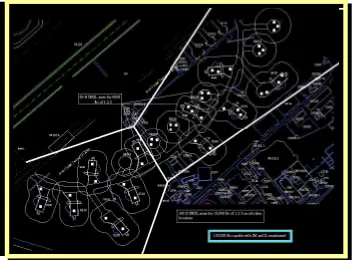
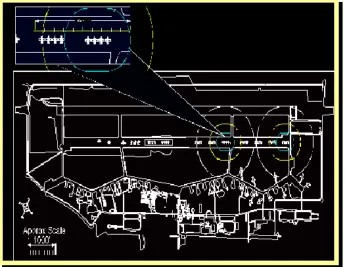
[image:7.612.119.472.419.679.2]A notional parking plan at AB1 is shown in figure 3. Included in the aircraft mix are 16 and F-18 aircraft grouped on one side of the parking ramp, and F-117 aircraft grouped on the adjacent side of the ramp. Due to the restrictive nature of the parking areas relative to the number of aircraft present, inter-magazine distance cannot be achieved between the individual potential explosion sites (PES). Thus, when standard hazard classification/division 1.1 munitions are considered, the entire parking loop is sited as one PES for 50,000 pounds net explosive weight and all munitions on the flightline are at risk of simultaneous detonation. When reduced hazard
classification/division 1.2.3 munitions are considered, only one weapon will detonate. By using the public traffic route distance in ASHS as a range of destruction, at most two aircraft would be affected by accidental detonation of a MK-84 weapon on the F-117 parking ramp, and an average of three on the mixed aircraft ramp. The cost consequence of a mass-detonating hazard classification/division 1.1 event involving all 42 aircraft relative to a two aircraft hazard classification/division 1.2.3 event involving F-117 aircraft is 9:1. The cost consequence of a mass-detonating hazard classification/division 1.1 event involving all 42 aircraft relative to a three aircraft hazard classification/division 1.2.3 event involving a mix of F-16 and F-18 aircraft is 28:1.
Accident Cost: AB1: Munitions Storage Area
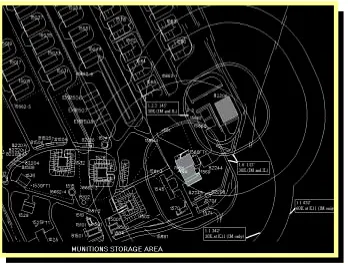
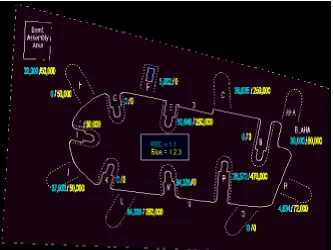
[image:8.612.126.474.407.671.2]A notional munitions storage area at AB1 is shown in figure 4. The cost items included in the munitions storage area include: buildings, utilities, parking lots, weapons stockpiles, and equipment. Each of the two bomb assembly pads is sited for 30,000 pounds net explosive weight at hazard classification/division 1.1. The outer arcs shown on the figure describe the clear zones for standard munitions and the inner arcs are for reduced hazard classification munitions. When standard munitions are considered the bomb assembly pads are within the inter-magazine distance of each other. The potential maximum credible event for standard munitions then involves the entire complement of munitions at 60,000 pounds net explosive weight and all the cost items within the outer arc. When reduced hazard classification munitions are considered, an unplanned detonation during the assembly process would destroy nine MK-84 bombs, the Munitions Assembly Conveyor, and closely positioned equipment. The cost consequence of a mass-detonating hazard classification/division 1.1 event involving all the munitions and the ancillary cost items relative to a nine bomb hazard classification/division 1.2.3 event is some 6:1.
Accident Cost: AB2: Flight Line
A notional parking plan at AB2 is shown in figure 5. The aircraft involved is the A-10. When standard hazard classification/division 1.1 munitions are considered, each four aircraft grouping is sited as one potential explosion site for 8,000 pounds net explosive weight. If the public traffic route distance is used for the range of destruction, a mass detonating 8,000 pounds net
explosive weight hazard classification/division 1.1 event occurring in the last group of aircraft on the southeast side of the parking area, would destroy eight aircraft. This is the immediate group of four aircraft and the adjacent group of four aircraft. A mass detonating hazard
[image:9.612.117.462.282.549.2]classification/division 1.1 event at the center of the aircraft parking area would destroy twelve aircraft. When reduced hazard classification/division 1.2.3 munitions are considered, the public traffic route distance for net explosive weight of one MK-84 is appropriate and at most four aircraft would be affected by accidental detonation of a weapon regardless of the point of detonation. The cost consequences of a mass-detonating hazard classification/division 1.1 event to a non-mass detonating hazard classification/division 1.2.3 event for the two scenarios are 2:1 and 3:1, respectively.
Figure 5. Notional parking plan at AB#2.
Accident Cost: AB2: Munitions Storage Area
A notional munitions storage area at AB2 is shown in figure 6. The cost items included in the munitions storage area include weapons stockpiles and equipment. The bomb assembly pad is presently sited for 32,000 pounds net explosive weight. Unlike AB1, AB2 does not have
Figure 6. Notional munitions storage area at AB#2. Operational Impacts Throughput
The throughput model was prepared by simulating a munitions buildup area under using the ProModel simulation software. This software is used to simulate and analyze production systems. In the first phase of the simulation development, a general framework was designed. This design includes most types of weapons and component assembly holding areas and delivery points. With this framework in place, resources such as trucks, trailers, equipment, and munitions assembly, storage, and line delivery personnel were incorporated into the model. In the next step, logic blocks are built that define the order of component assembly and model the distribution of weapons to the different delivery points. While only one type of weapon has been modeled at present, it is still possible to examine differences in buildup by using hazard
classification/division 1.2.3 in stockpiles rather than hazard classification/division 1.1.
After the model has been verified for one weapon, other weapon types can be incorporated, as well as weapon mixes. Variation in the number of personnel and transport vehicles and
availability of different storage locations will be considered. The baseline time and motion data for this simulation study are obtained from the Air Force Combat Munitions Center.
Operational Impacts: Dynamic Tasking
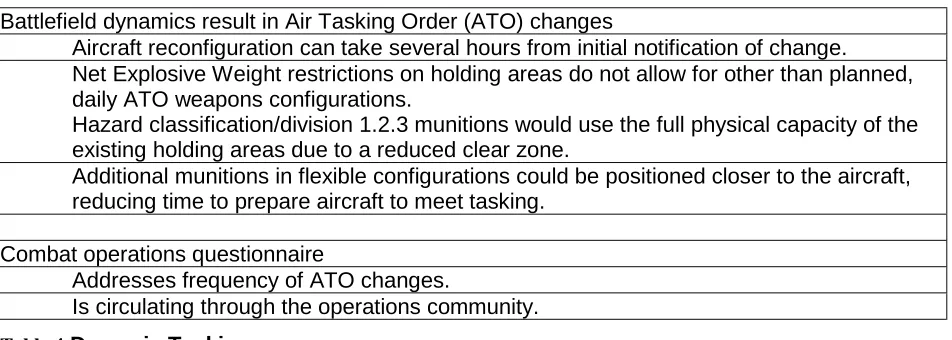
Table 4 shows details of dynamic tasking. All campaigns experience changes in the Air Tasking Orders as the target set changes. The dynamics of the changes are unimportant for the
through the operations community to obtain information to assist in calculating how often tasking changes and the subsequent impact.
Battlefield dynamics result in Air Tasking Order (ATO) changes
Aircraft reconfiguration can take several hours from initial notification of change. Net Explosive Weight restrictions on holding areas do not allow for other than planned, daily ATO weapons configurations.
Hazard classification/division 1.2.3 munitions would use the full physical capacity of the existing holding areas due to a reduced clear zone.
Additional munitions in flexible configurations could be positioned closer to the aircraft, reducing time to prepare aircraft to meet tasking.
Combat operations questionnaire
Addresses frequency of ATO changes.
[image:11.612.72.548.119.289.2]Is circulating through the operations community. Table 4 Dynamic Tasking.
SUMMARY
From the current information developed for this hazard classification reduction assessment several significant facts can be inferred. These inferences can be useful in programmatic decision-making and are listed as follows:
1. For bare bombs, there is a considerable increase in production cost associated with switching from the current standard fill (e.g., tritonal) to a reduced hazard classification fill (e.g., AFX-757).
2. There is only a minor increase in the overall weapon system cost , since the guidance set is a major cost driver.
3. Reduced hazard classification munitions show no cost advantage in handling and transportation compared to standard munitions.
4. Reduced hazard classification munitions present a potential for increased storage capacity for the existing infrastructure, or, for the same number of bombs, reduced storage cost due to reduced infrastructure requirements.
5. Reduced hazard classification munitions present a significant increase in disposal cost per bomb compared to standard munitions. However, few bombs of either type are formally disposed of, so the total disposal cost is expected to be minimal.
6. Reduced hazard classification munitions present a significant reduction in accident cost. 7. Reduced hazard classification munitions present a significant reduction in loss of
operational assets in a single accident event.
8. Reduced hazard classification munitions present a significant increase in munitions capacity at or near the flight line.
REFERENCES
Air Force Combat Munitions Center, Beale AFB, CA, (530) 634-3690. Byrd, DOT Traffic Safety, Hazardous Material Division, (202) 366 4111.
Code of Federal Regulations (CFR) 49—Transportation, Vol. 2, Multiple Parts, National Archives and Records Administration.
Fore, T. T., and M. W. Rohweder, AMSIO-MAR-TM, 12/2/99, Military Traffic Management Command, (703) 681-6589.
Giadrosich, D. L., Operations Research Analysis in Test and Evaluation. Washington, DC: American Institute of Aeronautics and Astronautics, Inc., 1995.
McKean, R., “The Nature of Cost-Benefit Analysis.” Reprinted in Mansfield, Microeconomics, Selected Readings, 5th Edition.