Targeted Paraphrasing on Deep Syntactic Layer for MT Evaluation
Petra Baranˇc´ıkov´a and Rudolf Rosa Charles University in Prague Faculty of Mathematics and Physics Institute of Formal and Applied Linguistics
Czech Republic
{barancikova,rosa}@ufal.mff.cuni.cz
Abstract
In this paper, we present a method of im-proving quality of machine translation (MT) evaluation of Czech sentences via targeted paraphrasing of reference sen-tences on a deep syntactic layer. For this purpose, we employ NLP frame-work Treex and extend it with modules for targeted paraphrasing and word order changes. Automatic scores computed us-ing these paraphrased reference sentences show higher correlation with human judg-ment than scores computed on the original reference sentences.
1 Introduction
Since the very first appearance of machine trans-lation (MT) systems, a necessity for their objec-tive evaluation and comparison has emerged. The traditional human evaluation is slow and unre-producible; thus, it cannot be used for tasks like tuning and development of MT systems. Well-performing automatic MT evaluation metrics are essential precisely for these tasks.
The pioneer metrics correlating well with hu-man judgment were BLEU (Papineni et al., 2002) and NIST (Doddington, 2002). They are com-puted from an n-gram overlap between the trans-lated sentence (hypothesis) and one or more cor-responding reference sentences, i.e., translations made by a human translator.
Due to its simplicity and language indepen-dence, BLEU still remains the de facto standard metric for MT evaluation and tuning, even though other, better-performing metrics exist (Mach´aˇcek and Bojar (2013), Bojar et al. (2014)).
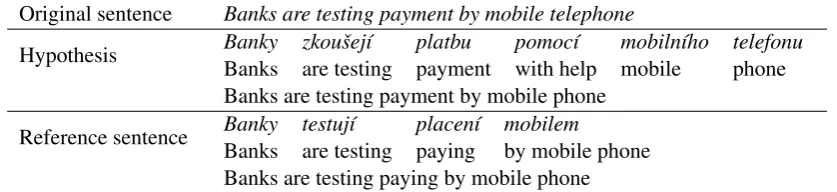
Furthermore, the standard practice is using only one reference sentence and BLEU then tends to perform badly. There are many translations of a single sentence and even a perfectly correct trans-lation might get a low score as BLEU disregards
synonymous expressions and word order variants (see Figure 1). This is especially valid for mor-phologically rich languages with free word order like the Czech language (Bojar et al., 2010).
In this paper, we use deep syntactic layer for targeted paraphrasing of reference sentences. For every hypothesis, we create its own reference sen-tence that is more similar in wording but keeps the meaning and grammatical correctness of the original reference sentence. Using these new para-phrased references makes the MT evaluation met-rics more reliable. In addition, correct paraphrases have additional application in many other NLP tasks.
As far as we know, this is the first rule-based model specifically designed for targeted para-phrased reference sentence generation to improve MT evaluation quality.
2 Related Work
Second generation metrics Meteor (Denkowski and Lavie, 2014), TERp (Snover et al., 2009) and ParaEval (Zhou et al., 2006) still largely focus on an n-gram overlap while including other lin-guistically motivated resources. They utilize para-phrase support in form of their own parapara-phrase ta-bles (i.e. collection of synonymous expressions) and show higher correlation with human judgment than BLEU.
Meteor supports several languages including Czech. However, its Czech paraphrase tables are so noisy (i.e. they contain pairs of non-paraphrastic expressions) that they actually harm the performance of the metric, as it can re-ward mistranslated and even untranslated words (Baranˇc´ıkov´a, 2014).
String matching is hardly discriminative enough to reflect the human perception and there is grow-ing number of metrics that compute their score based on rich linguistic features and matching based on parse trees, POS tagging or textual
Original sentence Banks are testing payment by mobile telephone
Hypothesis Banky zkouˇsej´ı platbu pomoc´ı mobiln´ıho telefonu Banks are testing payment with help mobile phone Banks are testing payment by mobile phone
[image:2.595.90.509.62.158.2]Reference sentence Banky testuj´ıBanks are testing payingplacen´ı mobilemby mobile phone Banks are testing paying by mobile phone
Figure 1: Example from WMT12 - Even though the hypothesis is grammatically correct and the meaning of both sentences is the same, it doesn’t contribute to the BLEU score. There is only one unigram overlapping.
ment (e.g. Liu and Gildea (2005), Owczarzak et al. (2007), Amig´o et al. (2009), Pad´o et al. (2009), Mach´aˇcek and Bojar (2011)).
These metrics shows better correlation with hu-man judgment, but their wide usage is limited by being complex and language-dependent. As a re-sult, there is a trade-off between linguistic-rich strategy for better performance and applicability of simple string level matching.
Our approach makes use of linguistic tools for creating new reference sentences. The advantage of this method is that we can choose among many traditional metrics for evaluation on our new ref-erences while eliminating some shortcomings of these metrics.
Targeted paraphrasing for MT evaluation was introduced by Kauchak and Barzilay (2006). Their algorithm creates new reference sentences by one-word substitution based on WordNet (Miller, 1995) synonymy and contextual evaluation. This solution is not readily applicable to the Czech lan-guage – a Czech word has typically many forms and the correct form depends heavily on its con-text, e.g., morphological cases of nouns depend on verb valency frames. Changing a single word may result in an ungrammatical sentence. There-fore, we do not attempt to change a single word in a reference sentence but we focus on creating one single correct reference sentence.
In Baranˇc´ıkov´a and Tamchyna (2014), we ex-perimented with targeted paraphrasing using the freely available SMT system Moses (Koehn et al., 2007). We adapted Moses for targeted monolin-gual phrase-based translation. However, results of this method was inconclusive. It was mainly due to a high amount of noise in the translation tables and unbalanced targeting feature.
As a result, we rather chose to employ rule-based translation system. This approach has many
advantages, e.g. there is no need for creating a tar-geting feature and we can change only parts of a sentence and thus create more conservative para-phrases. We utilize Treex (Popel and ˇZabokrtsk´y, 2010), highly modular NLP software system de-veloped for machine translation system TectoMT ( ˇZabokrtsk´y et al., 2008) that translates on a deep syntactic layer. We performed our experiment on the Czech language, however, we plan to extend it to more languages, including English and Spanish. Treex is open-source and is available on GitHub,1 including the two blocks that we
con-tributed. In the rest of the paper, we describe the implementation of our approach.
3 Treex
Treex implements a stratificational approach to language, adopted from the Functional Genera-tive Description theory (Sgall, 1967) and its later extension by the Prague Dependency Treebank (Bejˇcek et al., 2013). It represents sentences at four layers:
• w-layer:word layer; no linguistic annotation
• m-layer: morphological layer; sequence of
tagged and lemmatized tokens
• a-layer: shallow-syntax/analytical layer; sentence is represented as a surface syntactic dependency tree
• t-layer:deep-syntax/tectogrammatical layer;
sentence is represented as a deep-syntactic dependency tree, where autosemantic words (i.e. semantically full lexical units) only have their own nodes; t-nodes consist of a t-lemma and a set of attributes – aformeme (informa-tion about the original syntactic form) and a
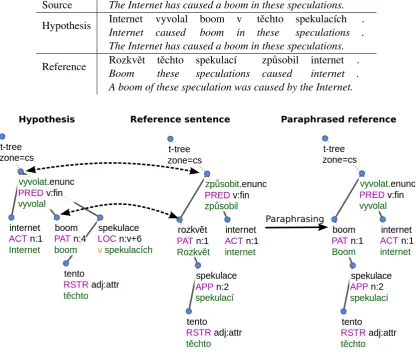
Source The Internet has caused a boom in these speculations. Hypothesis Internet vyvolal boom v tˇechto spekulac´ıch .
Internet caused boom in these speculations . The Internet has caused a boom in these speculations. Reference Rozkvˇet tˇechto spekulac´ıBoom these speculations causedzp˚usobil internet .internet .
[image:3.595.92.509.64.423.2]A boom of these speculation was caused by the Internet.
Figure 2: Example of the paraphrasing. The hypothesis is grammatically correct and has the same meaning as the reference sentence. We analyse both sentences to t-layer, where we create a new reference sentence by substituting synonyms from hypothesis to the reference. In the next step, we will change also the word order to better reflect the hypothesis.
set ofgrammatemes(essential morphological features).
We take the analysis and generation pipeline from the TectoTM system. We transfer both a hy-pothesis and its corresponding reference sentence to the layer, where we integrate a module for t-lemma paraphrasing. After paraphrasing, we per-form synthesis to a-layer, where we plug in a re-ordering module and continue with synthesis to the w-layer.
3.1 Analysis from w-layer to t-layer
The analysis from the w-layer the to a-layer in-cludes tokenization, POS-tagging and lemmatiza-tion using MorphoDiTa (Strakov´a et al., 2014), de-pendency parsing using the MSTParser (McDon-ald et al., 2005) adapted by Nov´ak and ˇZabokrtsk´y (2007), trained on PDT.
In the next step, a surface-syntax a-tree is converted into a deep-syntax t-tree. Auxiliary words are removed, with their function now repre-sented using t-node attributes (grammatemes and formemes) of autosemantic words that they belong to (e.g. two a-nodes of the verb form spal jsem (“I slept”) would be collapsed into one t-nodesp´at (“sleep”) with the tense grammateme set to past;v kvˇetnu(“in May”) would be collapsed intokvˇeten (“May”) with the formemev+X(“in+X”).
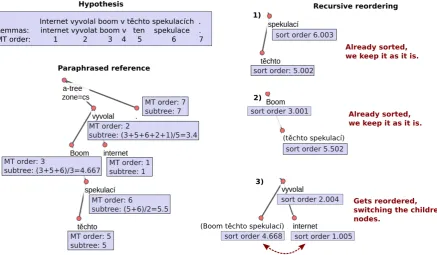
Figure 3: Continuation of Figure 2, reordering of the paraphrased reference sentence.
3.2 Paraphrasing
The paraphrasing module T2T::ParaphraseSimple is freely available at GitHub.2
T-lemma of a reference t-node R is changed from A to B if and only if:
1. there is a hypothesis t-node with lemma B
2. there is no hypothesis t-node with lemma A
3. there is no reference t-node with lemma B
4. A and B are paraphrases according to our paraphrase tables
The other attributes of the t-node are kept un-changed based on the assumption that semantic properties are independent of the t-lemma. How-ever, in practice, there is at least one case where this is not true: t-nodes corresponding to nouns are marked for grammatical gender, which is very often a grammatical property of the given lemma with no effect on the meaning (for example, “a house” can be translated either as a masculine nound˚umor as feminine nounbudova),
Therefore, when paraphrasing a t-node that cor-responds to a noun, we delete the value of the gen-der grammateme, and let the subsequent synthesis
2https://github.com/ufal/treex/
blob/master/lib/Treex/Block/T2T/ ParaphraseSimple.pm
pipeline generate the correct value of the morpho-logical gender feature value (which is necessary to ensure correct morphological agreement of the noun’s dependents, such as adjectives and verbs).
3.3 Synthesis from t-layer to a-layer
In this phase, a-nodes corresponding to auxiliary words and punctuation are generated, morpholog-ical feature values on a-nodes are initialized and set to enforce morphological agreement among the nodes. Correct inflectional forms based on lemma and POS, and morphological features are gener-ated using MorphoDiTa.
3.4 Tree-based reordering
The reordering block A2A::ReorderByLemmas is freely available at GitHub.3
The idea behind the block is to make the word order of the new reference as similar to the word order of the translation, but with some tree-based constraints to avoid ungrammatical sentences.
The general approach is to reorder the subtrees rooted at modifier nodes of a given head node so that they appear in an order that is on average simi-lar to their order in the translation. Figure 3 shows the reordering process of the a-tree from Figure 2.
3https://github.com/ufal/treex/
Our reordering proceeds in several steps. Each a-node has an order, i.e. a position in the sentence. We define theMT orderof a reference a-node as the order of its corresponding hypothesis a-node, i.e. a node with the same lemma.
We set the MT order only if there is exactly one a-node with the given lemma in both the hypoth-esis and the reference. Therefore, the MT order might be undefined for some nodes.
In the next step, we compute thesubtree MT or-derof each reference a-node R as the average MT order of all nodes in the subtree rooted at the a-node R (including the MT order of R itself). Only nodes with a defined MT order are taken into ac-count, so the subtree MT order can be undefined for some nodes.
Finally, we iterate over all a-nodes recursively starting from the bottom. Head a-nodeH and its
dependent a-nodesDiare reordered if they violate
thesorting order. IfDi is a root of a subtree, the
whole subtree is moved and its internal ordering is kept.
The sorting order ofHis defined as its MT
or-der; the sorting order of each dependent nodeDiis
defined as its subtree MT order. If a sorting order of a node is undefined, it is set to the sorting order of the node that precedes it, thus favouring neigh-bouring nodes (or subtrees) to be reordered to-gether in case there is no evidence that they should be brought apart from each other. Additionally, each sorting order is added 1/1000th of the origi-nal order of the node – in case of a tie, the origiorigi-nal ordering of the nodes is preferred to reordering.
We do not handle non-projective edges in any special way, so they always get projectivized if they take part in a reordering process, or kept in their original order otherwise. However, no new non-projective edges are created in the process – this is ensured by always moving the subtrees at once.
Please note that each node can take part in at most two reorderings – once as the H node and once as a Di node. Moreover, the nodes can be
processed in any order, as a reordering does not influence any other reordering.
3.5 Synthesis from a-layer to w-layer
The word forms are already generated on the a-layer, so there is little to be done. Superfluous tokens are deleted (e.g. duplicated commas)the first letter in a sentence is capitalized, and the
to-kens are concatenated (a set of rules is used to de-cide which tokens should be space-delimited and which should not). The example in Figure 3) re-sults in the following sentence: Internet vyvolal boom tˇechto spekulac´ı(“The Internet has caused a boom of these speculations.”), which has the same meaning as the original reference sentence, is grammatically correst and, most importantly, is much more similar in wording to the hypothesis.
4 Data
We perform our experiments on data sets from the English-to-Czech translation task of WMT12 (Callison-Burch et al., 2012), WMT13 (Bojar et al., 2013a). The data sets contain 13/144 files
with Czech outputs of MT systems. Each data set also contains one file with corresponding ref-erence sentences.
Our database of t-lemma paraphrases was cre-ated from two existing sources of Czech para-phrases – the Czech WordNet 1.9 PDT (Pala and Smrˇz, 2004) and the Meteor Paraphrase Tables (Denkowski and Lavie, 2010). Czech WordNet 1.9 PDT is already lemmatized, lemmatization of the Meteor Paraphrase tables was performed using MorphoDiTa (Strakov´a et al., 2014).
We also performed fitering of the lemmatized Meteor Paraphrase tables based on coarse POS, as they contained a lot of noise due to being con-structed automatically.
5 Results
The performance of an evaluation metric in MT is usually computed as the Pearson correlation be-tween the automatic metric and human judgment (Papineni et al., 2002). The correlation estimates the linear dependency between two sets of values. It ranges from -1 (perfect negative linear relation-ship) to 1 (perfect linear correlation).
The official manual evaluation metric of WMT12 and WMT13 provides just a relative ranking: a human judge always compares the per-formance of five systems on a particular sentence. From these relative rankings, we compute the ab-solute performance of every system using the “>
others” method (Bojar et al., 2011). It is computed as wins
wins+loses.
Our method of paraphrasing is independent of an evaluation metric used. We employ three
dif-4We use only 12 of them because two of them (FDA.2878
WMT12 WMT13
[image:6.595.96.501.61.133.2]references original paraphrased reordered original paraphrased paraphrased BLEU 0.751 0.783 0.804 0.834 0.850 0.878 Meteor 0.833 0.864 0.868 0.817 0.871 0.870 Ex.Meteor 0.861 0.900 0.903 0.848 0.893 0.893
Table 1: Pearson correlation of a metric and human judgment on original references, paraphrased refer-ences and paraphrased reordered referrefer-ences. Ex.Meteor represents Meteor metric with exact match only (i.e. no paraphrase support).
ferent metrics - BLEU score, Meteor metric and Meteor metric without the paraphrase support (as it seem redundant to use paraphrases on already paraphrased sentences).
The results are presented in Table 1 as a Pear-son correlation of a metric with human judgment. Paraphrasing clearly helps to reflect the human perception better. Even the Meteor metric that already contains paraphrases is performing better using paraphrased references created from its own paraphrase table. This is again due to the noise in the paraphrase table, which blurs the difference between the hypotheses of different MT systems.
The reordering clearly helps when we evaluate via the BLEU metric, which punishes any word order changes to the reference sentence. Meteor is more tolerant to word order changes and the re-ordering has practically no effect on his scores.
However, manual examination showed that our constraints are not strong enough to prevent creat-ing ungrammatical sentences. The algorithm tends to copy the word order of the hypothesis, even if it is not correct. Most errors were caused by changes of a word order of punctuation.
6 Future Work
In our future work, we plan to extend the para-phrasing module for more complex paraphrases including syntactical paraphrases, longer phrases, diatheses. We will also change only parts of sen-tences that are dependent on paraphrased words, thus keeping the rest of the sentence correct and creating more conservative reference sentences.
We also intend to adjust the reordering function by adding rule-based constrains. Furthermore, we’d like to learn automatically possible word or-der changes from Deprefset (Bojar et al., 2013b), which contains an excessive number of manually created reference translations for 50 Czech sen-tences.
We performed our experiment on Czech
lan-guage, but the procedure is generally language in-dependent, as long as there is analysis and synthe-sis support for particular language in Treex. Cur-rently there is full support for Czech, English, Por-tuguese and Dutch, but there is ongoing work on many more languages within the QTLeap5project.
Acknowledgments
This research was supported by the following grants: SVV project number 260 224 and GAUK 1572314. This work has been using language re-sources developed and/or stored and/or distributed by the LINDAT/CLARIN project of the Ministry of Education, Youth and Sports of the Czech Re-public (project LM2010013).
References
Enrique Amig´o, Jes´us Gim´enez, Julio Gonzalo, and Fe-lisa Verdejo. 2009. The Contribution of Linguistic Features to Automatic Machine Translation Evalua-tion. InProceedings of the Joint Conference of the 47th Annual Meeting of the ACL and the 4th Interna-tional Joint Conference on Natural Language Pro-cessing of the AFNLP: Volume 1 - Volume 1, ACL ’09, pages 306–314.
Petra Baranˇc´ıkov´a. 2014. Parmesan: Meteor without Paraphrases with Paraphrased References. In Pro-ceedings of the Ninth Workshop on Statistical Ma-chine Translation, pages 355–361, Baltimore, MD, USA. Association for Computational Linguistics.
Petra Baranˇc´ıkov´a and Aleˇs Tamchyna. 2014. Ma-chine Translation within One Language as a Para-phrasing Technique. In Proceedings of the main track of the 14th Conference on Information Tech-nologies - Applications and Theory (ITAT 2014), pages 1–6.
Eduard Bejˇcek, Eva Hajiˇcov´a, Jan Hajiˇc, Pavl´ına J´ınov´a, V´aclava Kettnerov´a, Veronika Kol´aˇrov´a, Marie Mikulov´a, Jiˇr´ı M´ırovsk´y, Anna Nedoluzhko, Jarmila Panevov´a, Lucie Pol´akov´a, Magda
ˇSevˇc´ıkov´a, Jan ˇStˇep´anek, and ˇS´arka Zik´anov´a. 2013. Prague Dependency Treebank 3.0.
Ondˇrej Bojar, Kamil Kos, and David Mareˇcek. 2010. Tackling Sparse Data Issue in Machine Translation Evaluation. In Proceedings of the ACL 2010 Con-ference Short Papers, ACLShort ’10, pages 86–91, Stroudsburg, PA, USA. Association for Computa-tional Linguistics.
Ondˇrej Bojar, Miloˇs Ercegovˇcevi´c, Martin Popel, and Omar F. Zaidan. 2011. A Grain of Salt for the WMT Manual Evaluation. In Proceedings of the Sixth Workshop on Statistical Machine Translation, WMT ’11, pages 1–11, Stroudsburg, PA, USA. As-sociation for Computational Linguistics.
Ondˇrej Bojar, Christian Buck, Chris Callison-Burch, Christian Federmann, Barry Haddow, Philipp Koehn, Christof Monz, Matt Post, Radu Soricut, and Lucia Specia. 2013a. Findings of the 2013 Work-shop on Statistical Machine Translation. In Pro-ceedings of the Eighth Workshop on Statistical Ma-chine Translation, pages 1–44, Sofia, Bulgaria, Au-gust. Association for Computational Linguistics. Ondˇrej Bojar, Matouˇs Mach´aˇcek, Aleˇs Tamchyna, and
Daniel Zeman. 2013b. Scratching the Surface of Possible Translations. In Text, Speech and Dia-logue: 16th International Conference, TSD 2013. Proceedings, pages 465–474, Berlin / Heidelberg. Springer Verlag.
Ondˇrej Bojar, Christian Buck, Christian Federmann, Barry Haddow, Philipp Koehn, Matouˇs Mach´aˇcek, Christof Monz, Pavel Pecina, Matt Post, Herve Saint-Amand, Radu Soricut, and Lucia Specia. 2014. Findings of the 2014 Workshop on Statistical Machine Translation. In Proceedings of the Ninth Workshop on Statistical Machine Translation, Bal-timore, USA, June. Association for Computational Linguistics.
Chris Callison-Burch, Philipp Koehn, Christof Monz, Matt Post, Radu Soricut, and Lucia Specia. 2012. Findings of the 2012 Workshop on Statistical Ma-chine Translation. In Seventh Workshop on Statis-tical Machine Translation, pages 10–51, Montr´eal, Canada.
Michael Denkowski and Alon Lavie. 2010. METEOR-NEXT and the METEOR Paraphrase Ta-bles: Improved Evaluation Support For Five Target Languages. In Proceedings of the ACL 2010 Joint Workshop on Statistical Machine Translation and Metrics MATR.
Michael Denkowski and Alon Lavie. 2014. Meteor Universal: Language Specific Translation Evalua-tion for Any Target Language. InProceedings of the EACL 2014 Workshop on Statistical Machine Trans-lation.
George Doddington. 2002. Automatic Evaluation of Machine Translation Quality Using N-gram Co-occurrence Statistics. In Proceedings of the Sec-ond International Conference on Human Language
Technology Research, HLT ’02, pages 138–145, San Francisco, CA, USA. Morgan Kaufmann Publishers Inc.
David Kauchak and Regina Barzilay. 2006. Para-phrasing for Automatic Evaluation. InProceedings of the main conference on Human Language Tech-nology Conference of the North American Chap-ter of the Association of Computational Linguistics, HLT-NAACL ’06, pages 455–462, Stroudsburg, PA, USA. Association for Computational Linguistics.
Philipp Koehn, Hieu Hoang, Alexandra Birch, Chris Callison-Burch, Marcello Federico, Nicola Bertoldi, Brooke Cowan, Wade Shen, Christine Moran, Richard Zens, Chris Dyer, Ondˇrej Bojar, Alexandra Constantin, and Evan Herbst. 2007. Moses: Open Source Toolkit for Statistical Machine Translation. In Proceedings of the 45th Annual Meeting of the ACL on Interactive Poster and Demonstration Ses-sions, ACL ’07, pages 177–180, Stroudsburg, PA, USA. Association for Computational Linguistics.
Ding Liu and Daniel Gildea. 2005. Proceedings of the acl workshop on intrinsic and extrinsic evalua-tion measures for machine translaevalua-tion and/or sum-marization. pages 25–32. Association for Computa-tional Linguistics.
Matouˇs Mach´aˇcek and Ondˇrej Bojar. 2011. Approx-imating a Deep-syntactic Metric for MT Evalua-tion and Tuning. InProceedings of the Sixth Work-shop on Statistical Machine Translation, WMT ’11, pages 92–98, Stroudsburg, PA, USA. Association for Computational Linguistics.
Matouˇs Mach´aˇcek and Ondˇrej Bojar. 2013. Results of the WMT13 Metrics Shared Task. In Proceed-ings of the Eighth Workshop on Statistical Machine Translation, pages 45–51, Sofia, Bulgaria, August. Association for Computational Linguistics.
Ryan McDonald, Fernando Pereira, Kiril Ribarov, and Jan Hajiˇc. 2005. Non-projective Dependency Pars-ing UsPars-ing SpannPars-ing Tree Algorithms. In Proceed-ings of the Conference on Human Language Tech-nology and Empirical Methods in Natural Language Processing, HLT ’05, pages 523–530.
George A. Miller. 1995. WordNet: A Lexical Database for English. COMMUNICATIONS OF THE ACM, 38:39–41.
V´aclav Nov´ak and Zdenˇek ˇZabokrtsk´y. 2007. Fea-ture Engineering in Maximum Spanning Tree De-pendency Parser. In V´aclav Matousek and Pavel Mautner, editors,TSD, Lecture Notes in Computer Science, pages 92–98. Springer.
Sebastian Pad´o, Daniel Cer, Michel Galley, Dan Juraf-sky, and Christopher D. Manning. 2009. Measur-ing Machine Translation Quality as Semantic Equiv-alence: a Metric Based on Entailment Features. Ma-chine Translation, 23(2-3):181–193, September. Karel Pala and Pavel Smrˇz. 2004. Building Czech
WordNet. In Romanian Journal of Information Sci-ence and Technology, 7:79–88.
Kishore Papineni, Salim Roukos, Todd Ward, and Wei-Jing Zhu. 2002. BLEU: A Method for Automatic Evaluation of Machine Translation. InProceedings of the 40th Annual Meeting on Association for Com-putational Linguistics, ACL ’02, pages 311–318, Stroudsburg, PA, USA. Association for Computa-tional Linguistics.
Martin Popel and Zdenˇek ˇZabokrtsk´y. 2010. Tec-toMT: Modular NLP Framework. In Proceedings of the 7th International Conference on Advances in Natural Language Processing, IceTAL’10, pages 293–304, Berlin, Heidelberg. Springer-Verlag.
Petr Sgall. 1967. Generativn´ı popis jazyka a ˇcesk´a deklinace. Number v. 6 in Generativn´ı popis jazyka a ˇcesk´a deklinace. Academia.
Matthew G. Snover, Nitin Madnani, Bonnie Dorr, and Richard Schwartz. 2009. TER-Plus: Paraphrase, Semantic, and Alignment Enhancements to Transla-tion Edit Rate. Machine Translation, 23(2-3):117– 127, September.
Jana Strakov´a, Milan Straka, and Jan Hajiˇc. 2014. Open-Source Tools for Morphology, Lemmatiza-tion, POS Tagging and Named Entity Recognition. In Proceedings of 52nd Annual Meeting of the As-sociation for Computational Linguistics: System Demonstrations, pages 13–18, Baltimore, Mary-land, June. Association for Computational Linguis-tics.
Zdenˇek ˇZabokrtsk´y, Jan Pt´aˇcek, and Petr Pajas. 2008. Tectomt: Highly modular mt system with tec-togrammatics used as transfer layer. InProceedings of the Third Workshop on Statistical Machine Trans-lation, StatMT ’08, pages 167–170.