An agent-based model of a historical word order change
Jelke Bloem Arjen VerslootAmsterdam Center for Language and Communication University of Amsterdam
1012 VB Amsterdam, Netherlands
{j.bloem, a.p.versloot, f.p.weerman}@uva.nl
Fred Weerman
Abstract
We aim to demonstrate that agent-based models can be a useful tool for historical linguists, by modeling the historical devel-opment of verbal cluster word order in Ger-manic languages. Our results show that the current order in German may have de-veloped due to increased use of subordi-nate clauses, while the English order is pre-dicted to be influenced by the grammatical-ization of the verbto have. The methodol-ogy we use makes few assumptions, mak-ing it broadly applicable to other phenom-ena of language change.
1 Introduction
Agent-based modeling is a method for simulating the behaviour of individual agents (i.e. a speaker of a language) in a larger community of agents (i.e. all speakers of the language). While agent-based models have been successfully used as tools in the field of evolutionary linguistics to study how linguistic structures may have emerged, they have not yet spread to the field of historical linguistics, which is more interested in describing and mod-eling change in existing natural languages. Both fields are concerned with changing language mod-els, although the starting assumptions and context are different. In historical linguistics there is data available about structures in earlier and more mod-ern states of the language, while in evolutionary linguistics the structures have to emerge from the implemented mechanisms. Nevertheless, the mech-anisms described, such as grammaticalization, are often similar and lend themselves to study using similar methodology.
In the field of evolutionary linguistics, agent-based models are used to model language as a com-plex dynamic system, whose structure depends on the interactions of its speakers. An early overview
of such work is provided by Steels (1997), who emphasizes the possibilities of modeling various aspects of language in this way. Among this work is a study by Briscoe (1997) on the default word order of languages, though it assumes a framework of universal grammar in which learning consists of setting parameters. Subsequent work included the application of this method to specific domains of linguistics, such as the emergence of vowel systems (De Boer, 2000) and the development of agent-based models specific to language, such as the iterated learning model of Kirby and Hurford (2002). Language change was often only discussed in terms of the emergence of new structures, and lacked comparisons to historical data (de Boer and Zuidema, 2009), or used artificial languages, as noted by Choudhury et al. (2007), whose own work is an exception. A few other studies that re-late to historical linguistics can be found. Daland et al. (2007) and Van Trijp (2012) model some apparent idiosyncrasies in inflectional paradigms of natural languages, Daland et al. (2007) doing so with a model that includes social structure, and Van Trijp (2012) using the Fluid Construc-tion Grammar framework. A further example is Landsbergen et al. (2010)’s study that models some mechanisms of language change from the perspec-tive of cultural evolution. Overall, agent-based lan-guage studies informed by historical data are not widespread, and often involve many assumptions or dependence on a framework. A recent exception to this is a study by Pijpops and Beuls (2015) on Dutch regular and irregular verbs.
Our emphasis in this work is on creating an agent-based model that makes minimal assump-tions, in order for the presented methodology to be useful for any theory of language that allows for functionalism in language change. Our case study, the historical development of verbal cluster order in Germanic languages, involves a word order vari-ation in which multiple constructions are
ical. This kind of phenomenon has not been inves-tigated with an agent-based model before. Besides syntactic analyses (Evers, 1975), recent work on verb clusters has also discussed non-syntactic fac-tors influencing word order, using frequency-based methods (De Sutter, 2005; Arfs, 2007; Bloem et al., 2014) and historical data (Couss´e, 2008). We fol-low up on this line of work with our agent-based model, in which a functional bias induces language change. Using this model, we will show how the current orders of verb clusters in modern West-Germanic languages might have developed and di-verged from the proto-Germanic cluster orders.
In the next section, we briefly outline the phe-nomenon of verbal cluster order variation. We then describe the methodology of the simulation and its initial state, followed by the results and a discus-sion of those results
2 Verbal clusters
Many verbal cluster word orders are attested in different Germanic languages (Wurmbrand, 2006). We will illustrate this with a Dutch example, a lan-guage where the ordering of these verbs is rela-tively free. In two-verb clusters, the finite verb can be positioned before or after the infinitive:
(1) Ik
I denkthinkdatthatikI hetit hebhavebegrepenunderstood. ‘I think that I have understood it’ (2) Ik
I denkthinkdatthatikI hetit begrepenunderstoodhebhave. ‘I think that I have understood it’
In the literature, construction 1 is called the 1-2 order (ascending order or red order), and construc-tion 2 is called the 2-1 order (descending order or green order). Both orders are grammatical in Dutch, and express the same meaning, though there are differences in usage. German and Frisian only allow order (2) for two-verb clusters, while English and Scandinavian languages only allow order (1) 1. Despite these differences, all of these languages evolved from Proto-West-Germanic.
This raises the question of why some of the West Germanic languages ended up with verbal clusters in 2-1 order, and others with the 1-2 order. To study this, we need to select some factors that may have
1English and Scandinavian verb groups are generally not
called verb clusters in the literature because they can be in-terrupted by nonverbal material, but for the purposes of this study the distinction is not important.
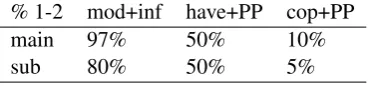
[image:2.595.308.494.63.106.2]% 1-2 mod+inf have+PP cop+PP main 97% 50% 10% sub 80% 50% 5%
Table 1: Reconstructed proto-Germanic probabili-ties for the 1-2 order.
influenced the change, and the best place to look for this is the Dutch language, in which both orders are possible. Language variation often indicates language change, with the variation being a state of transition from one structure to another, in which both structures can be used. Factors that correlate with different word order preferences in modern Dutch may therefore be involved in the change as well.
The order variation in Dutch has been claimed to be an instance of language change in progress. In the 15th century, the 2-1 order was used almost exclusively. After this, the 1-2 order starts appear-ing in texts, and becomes increasappear-ingly frequent, moving towards the current state of the language (Couss´e, 2008). This was not the first time the 1-2 order had been attested though, it also appears in some of the oldest Dutch texts.
3 Methodology
Our simulation consists of a group of agents that can function as speakers and recipients of verbal cluster utterances. Each agent has its own instance of a probabilistic language model that stores and produces such utterances. We will first describe the language model and the linguistic features of ver-bal clusters that it stores, and then we will explain what happens when the simulation is ran and the agents interact.
construc-tional factors, because those are likely to be stored in the lexicon with their own associated word order preferences. The most important of these are the main clause / subordinate clause distinction (there are more 2-1 orders in main clauses), and the type of auxiliary verb (there are more 2-1 orders when a copula verb is used in a cluster). These two factors not only have different order preferences in modern Dutch, but have also undergone historical changes that may have triggered our word order change: subordinate clauses have become more prevalent, and one type of auxiliary verb,to have, grammat-icalized during the time period we are interested in.
We will assume that the two factors, clause type and auxiliary type, are stored as features, each with their own word order preferences. This way of stor-ing features is based on the bidirectional model in Versloot (2008), though our models learn by inter-acting rather than iterating.
Table 1 shows all of the possible combinations of feature values a verbal cluster can have in our model. Our model assumes two clause types (main and subordinate) and three different types of auxil-iary verbs, reflecting the historical sources of verb clusters:
1. Clause type feature (a) Main clause context (b) Subordinate clause context
2. Auxiliary type feature
(a) modal + infinitive: the origin of verb clusters in Germanic
(b) ‘to have’ + participial main verb (PP): arose only later in history to extend the possibilities of expressing temporal and aspectual features
(c) copula + PP: originally a passive, pred-icative, construction — not purely verbal, rather adjectival.
A cluster can have either of two word orders: the 1-2 and the 2-1 order.
The simulation consists of alanguage agents, each starting out withnexemplars of verbal clus-ters, stored in the agent’s language model. An agent’s language model contains the type of infor-mation shown in Table 1: for each possible combi-nation of feature values, exemplars are stored. In addition to their features they have the property of
being either in the 2-1 or 1-2 order (from which a percentage can be calculated, as in the table). The agents’ language models do not contain any other structures. We did not use an existing frame-work in order to have as few parameters as possible. The simulation was implemented in the Python pro-gramming language.
When the model is run, each run consists of
a∗n∗iinteractions. In an interactioni, a random agent is picked as the speaker and another random agent as the recipient. The speaker agent generates a verbal cluster based on its language model, and the recipient agent stores it as an exemplar. When a speaker agent generates a verbal cluster, it picks the features of a random exemplar from its language model, and then assigns word order based on the word order probabilities of both of its features individually. A 1-2 (ascending) realization of a modal subordinate clause cluster may be produced according to the following:
P(asc|x) =P(asc|xsub) +P(asc|xmodinf) (1) where x is a set of feature values. P(asc|xsub) is the probability of a subordinate clause be-ing in 1-2 order, and P(asc|xmodinf) for the modal+infinitive construction type. These proba-bilities are calculated from the stored frequency of the features in 1-2 contexts:
P(asc|xsub) = F(Fsub, asc(sub) ) (2)
So, the probability of a modal subordinate clause cluster being expressed in the 1-2 order depends on how many exemplars the agent has stored in which a subordinate clause cluster was in the 1-2 order (relative to 1-2-1), as well as exemplars in which a modal cluster was in the 1-2 order (rela-tive to 2-1). Example (3) is an example of a modal subordinate clause cluster in 1-2 order, though our language model is more abstract and does not use actual words, only the features.
(3) Ik
I denkthinkdatthatikI hetit wilwanthorenhear ‘I think that I want to hear it’
growth of the agents’ language models. Only when a growth factor applies, this deletion does not hap-pen. The simulation includes two growth factors
g haveandg subto simulate two relevant histor-ical changes: the grammathistor-icalization of ‘to have’ as an auxiliary verb, and an increase in the use of subordinate clauses. When these growth factors are set to 1, after everyainteractions, an exemplar with the relevant feature is kept where it otherwise would have been deleted from the language model. A growth factor of 2 doubles the rate.g have ap-plies while there are fewerhave-clusters than clus-ters of either of the other types, andg sub while there are fewer subordinate clause clusters than main clause clusters.
When an agent is the recipient of a verbal cluster exemplar, it simply stores it in its language model, including the word order. So, when example (3) is perceived, the 1-2 order production probability of subordinate clause clusters and that of modal clus-ters will go up (separately) in the language model of the recipient agent. A critical learning bias is simulated here: the tendency to decompose an ut-terance into features and storing information about the features, rather than storing it as a whole. This is the only assumption we make about the language faculty in this model, and it is a functional one. It simulates the fact that people do not perfectly copy a language from each other.
We initialize each experiment with 30 agents (a = 30), andi = 5000 to simulate a long time course in which simulations will almost always sta-bilize in the end. With fewer agents, some agents lose all of their exemplars during the simulation. Each agent starts with a language model of 73 ex-emplars (n= 73) that follows frequency patterns as reconstructed for 6th century Germanic, based on a comparison of verb cluster frequencies in Old English, Old High German and Old Frisian texts. These figures are also summarized in table 1. For any unattested combination of features and word order a single exemplar is included to simulate noise.
4 Results
Figures (a) and (b) show example results of the agent-based model simulation, with different pa-rameter settings. The graphs show the results of 50 different simulation runs overlaid, each run being a possible language. The X-axis represents time (in number of interactions) and the Y-axis
repre-sents the proportion of 1-2 orders, a value between 0 and 1. The proportions are calculated over all of the agents in the simulation. When the simula-tion is ran for long enough, it will always stabilize into a situation where a language either has only 1-2 or only 2-1 orders, though some feature com-binations stabilize faster than others. Due to space constraints, we only show results for subordinate clause clusters (with any auxiliary type), but the general patterns are similar for all of the features, though some change sooner than others. We can observe that the model correctly predicts both lan-guages with dominant 1-2 orders such as English, and dominant 2-1 orders as in German.
However, a model that predicts everything is not very interesting. We would like to know when a language in the model becomes English-like or German-like. We can do this by changing the growth factors: the rise of subordinate clauses (g sub) and ofto have(g have). Figure (a) shows simulations in which to have grammaticalizes faster, while in Figure (b), subordinate clauses catch on more quickly. A clear difference can be observed — Figure (a) shows more languages gain-ing English-like 1-2 orders (35% 1-2, 56% 2-1 and the rest had not stabilized yet), while Figure (b) shows more German-like 2-1 orders (92% 2-1, 7% 1-2). Different speeds of grammaticalization ofto have and growth of subordinate clauses result in different dominant word orders.
5 Discussion
With this study, we hope to have shown that an agent-based model with just a single learning bias can be used to gain insight into processes of change in natural languages, and generate new hypothe-ses. Specifically, the model makes two predictions: thatto havegrammaticalized faster in English, and that subordinate clauses gained use more quickly in German. These predictions can be tested using his-torical corpora of these languages in future work.
sup-(a) 50 runs with faster growth of have+pp constructions
(g have= 2,g sub= 1) (b) 50 runs with faster growth of subordinate clauses (1,g sub= 2) g have=
ported. This new grammatical verb becomes asso-ciated with the most prevalent word order at the time, and pushes the language further in the direc-tion of that word order. In the beginning this is the 1-2 order, more associated with main clauses in proto-West-Germanic due to V2 movement, but later on the 2-1 order is more prevalent, due to its association with subordinate clauses.
Our model cannot yet account for the current state of the Dutch language, which first moved to-wards mainly 2-1 orders like German, and then shifted towards 1-2 orders again (Couss´e, 2008), a change that is still in progress. There is evidence that the 1-2 order has become the default order (Meyer and Weerman, submitted), and this second change was likely caused by a factor outside the scope of our model, such as language contact.
Nevertheless, we believe that agent-based mod-elling can be a useful tool for historical linguists, particularly those working with frequency-based explanations. The present work and the study of Pijpops and Beuls (2015) show that testing of dif-ferent mechanisms and parameters in a simulation, informed by historical data, can provide additional evidence for theories on what may or may not have been possible in a case of language change, given the assumptions built into the model. We believe it is particularly interesting to test how few assump-tions are necessary to explain the observed histori-cal data, which previous work has not focused on.
We would like to emphasize that this method is applicable to other cases of language change in which the use of structures changed over time. Any processes of historical change that can be cap-tured in terms of frequencies and features may be
used as factors to be investigated, and the fact that the model makes few assumptions also means that no particular social or cultural phenomena need to have happened for the model to be applicable. However, these simplifications also limit the ex-tend of what can be modeled. In future work, con-tact phenomena could be simulated by including non-learning agents, or influxes of agents with dif-ferent language models. Subsequent work on other cases of historical change may need to include such additional assumptions, if they are known to have been historically relevant.
References
Mona Arfs. Rood of groen? De interne woord-volgorde in tweeledige werkwoordelijke eind-groepen met een voltooid deelwoord en een hulp-werkwoord in bijzinnen. G¨oteborg University, 2007.
Jelke Bloem, Arjen Versloot, and Fred Weer-man. Applying automatically parsed cor-pora to the study of language variation. In Proceedings of COLING 2014, the 25th In-ternational Conference on Computational Lin-guistics: Technical Papers, pages 1974–1984, Dublin, Ireland, August 2014. Dublin City Uni-versity and Association for Computational Lin-guistics. URLhttp://www.aclweb.org/
anthology/C14-1186.
pages 418–427. Association for Computational Linguistics, 1997.
Monojit Choudhury, Vaibhav Jalan, Sudeshna Sarkar, and Anupam Basu. Evolution, optimiza-tion, and language change: The case of bengali verb inflections. InProceedings of Ninth Meet-ing of the ACL Special Interest Group in Compu-tational Morphology and Phonology, pages 65– 74. Association for Computational Linguistics, 2007.
Evie Couss´e. Motivaties voor volgordevariatie. Een diachrone studie van werkwoordvolgorde in het Nederlands. Universiteit Gent, 2008. Evie Couss´e, Mona Arfs, and Gert De Sutter.
Vari-abele werkwoordsvolgorde in de Nederlandse werkwoordelijke eindgroep. Een taalgebruiks-gebaseerd perspectief op de synchronie en di-achronie van de zgn. rode en groene woordvol-gorde. Taal aan den lijve. Het gebruik van cor-pora in taalkundig onderzoek en taalonderwijs, pages 29–47, 2008.
Robert Daland, Andrea D Sims, and Janet Pierre-humbert. Much ado about nothing: A social net-work model of russian paradigmatic gaps. In AN-NUAL MEETING-ASSOCIATION FOR COM-PUTATIONAL LINGUISTICS, volume 45, page 936. Citeseer, 2007.
Bart De Boer. Self-organization in vowel systems. Journal of phonetics, 28(4):441–465, 2000. Bart de Boer and Willem Zuidema. Models of
lan-guage evolution: Does the math add up. ILLC Preprint Series PP-2009-49, University of Ams-terdam, 2009.
Gert De Sutter. Rood, groen, corpus! Een taal-gebruiksgebaseerde analyse van woordvolgo-rdevariatie in tweeledige werkwoordelijke eind-groepen. University of Leuven: PhD thesis, 2005.
Arnold Evers.The transformational cycle in Dutch and German, volume 75. Indiana University Lin-guistics Club Bloomington, 1975.
Simon Kirby and James R Hurford. The emer-gence of linguistic structure: An overview of the iterated learning model. InSimulating the evolution of language, pages 121–147. Springer, 2002.
Frank Landsbergen, Robert Lachlan, Carel ten Cate, and Arie Verhagen. A cultural
evolution-ary model of patterns in semantic change. Lin-guistics, 48(2):363–390, 2010.
Caitlin Meyer and Fred Weerman. Cracking the cluster: The acquisition of verb raising in Dutch. Manuscript in preparation, submitted.
Dirk Pijpops and Katrien Beuls. Strong ”island of resilience” in the weak flood. Dutch strate-gies for past tense formation implemented in an agent-based model. Presented at Computa-tional Linguistics in the Netherlands (CLIN) 25, Antwerp, 2015.
Luc Steels. The synthetic modeling of language origins. Evolution of communication, 1(1):1–34, 1997.
Remi Van Trijp. Self-assessing agents for explain-ing language change: A case study in german. InECAI, pages 798–803, 2012.
Arjen Pieter Versloot. Mechanisms of language change: vowel reduction in 15th century West Frisian. 2008.