@AM: Textual Attitude Analysis Model
Alena Neviarouskaya
Helmut Prendinger
Mitsuru Ishizuka
University of Tokyo Nat. Institute of Informatics University of Tokyo 7-3-1 Hongo, Bunkyo-ku 2-1-2 Hitotsubashi Chiyoda 7-3-1 Hongo, Bunkyo-ku
Tokyo 113-8656, Japan Tokyo 101-8430, Japan Tokyo 113-8656, Japan
[email protected] [email protected] [email protected]
Abstract
The automatic analysis and classification of text using fine-grained attitude labels is the main task we address in our research. The de-veloped @AM system relies on compositio-nality principle and a novel approach based on the rules elaborated for semantically distinct verb classes. The evaluation of our method on 1000 sentences, that describe personal expe-riences, showed promising results: average accuracy on fine-grained level was 62%, on middle level – 71%, and on top level – 88%.
1
Introduction and Related Work
With rapidly growing online sources aimed at en-couraging and stimulating people’s discussions concerning personal, public or social issues (news, blogs, discussion forums, etc.), there is a great need in development of a computational tool for the analysis of people’s attitudes. According to the Appraisal Theory (Martin and White, 2005), atti-tude types define the specifics of appraisal being expressed: affect (personal emotional state), judg-ment (social or ethical appraisal of other’s behav-iour), and appreciation (evaluation of phenomena). To analyse contextual sentiment (polarity) of a phrase or a sentence, rule-based approaches (Na-sukawa and Yi, 2003; Mulder et al., 2004; Moila-nen and Pulman, 2007; Subrahmanian and Reforgiato, 2008), a machine-learning method us-ing not only lexical but also syntactic features
(Wilson et al., 2005), and a model of integration of machine learning approach with compositional semantics (Choi and Cardie, 2008) were proposed.
With the aim to recognize fine-grained emotions from text on the level of distinct sentences, re-searchers have employed a keyword spotting tech-nique (Olveres et al., 1998; Chuang and Wu, 2004; Strapparava et al., 2007), a technique calculating emotion scores using Pointwise Mutual Informa-tion (PMI) (Kozareva et al., 2007), an approach inspired by common-sense knowledge (Liu et al., 2003), rule-based linguistic approaches (Boucou-valas, 2003; Chaumartin, 2007), machine-learning methods (Alm, 2008; Aman and Szpakowicz, 2008; Strapparava and Mihalcea, 2008), and an ensemble based multi-label classification technique (Bhowmick et al., 2009).
Early attempts to focus on distinct attitude types in the task of attitude analysis were made by Ta-boada and Grieve (2004), who determined a poten-tial value of adjectives for affect, judgement and appreciation by calculating the PMI with the pro-noun-copular pairs ‘I was (affect)’, ‘He was (judgement)’, and ‘It was (appreciation)’, and Whitelaw et al. (2005), who used machine learning technique (SVM) with fine-grained semantic dis-tinctions in features (attitude type, orientation) in combination with “bag of words” to classify movie reviews. However, the concentration only on ad-jectives, that express appraisal, and their modifiers, greatly narrows the potential of the Whitelaw et al.’s (2005) approach.
In this paper we introduce our system @AM (ATtitude Analysis Model), which (1) classifies
sentences according to the fine-grained attitude labels (nine affect categories (Izard, 1971): ‘anger’, ‘disgust’, ‘fear’, ‘guilt’, ‘interest’, ‘joy’, ‘sadness’, ‘shame’, ‘surprise’; four polarity labels for judg-ment and appreciation: ‘POS jud’, ‘NEG jud’, ‘POS app’, ‘NEG app’; and ‘neutral’); (2) assigns the strength of the attitude; and (3) determines the level of confidence, with which the attitude is ex-pressed. @AM relies on compositionality principle and a novel approach based on the rules elaborated for semantically distinct verb classes.
2
Lexicon for Attitide Analysis
We built the lexicon for attitude analysis that in-cludes: (1) attitude-conveying terms; (2) modifiers; (3) “functional” words; and (4) modal operators.
2.1 The Core of Lexicon
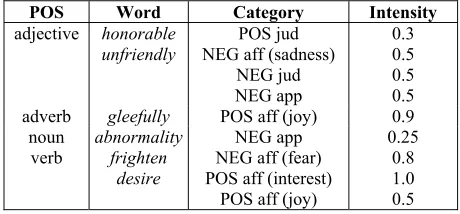
As a core of lexicon for attitude analysis, we em-ploy Affect database and extended version of Sen-tiFul database developed by Neviarouskaya et al. (2009). The affective features of each emotion-related word are encoded using nine emotion labels (‘anger’, ‘disgust’, ‘fear’, ‘guilt’, ‘interest’, ‘joy’, ‘sadness’, ‘shame’, and ‘surprise’) and correspond-ing emotion intensities that range from 0.0 to 1.0. The original version of SentiFul database, which contains sentiment-conveying adjectives, adverbs, nouns, and verbs annotated by sentiment polarity, polarity scores and weights, was manually ex-tended using attitude labels. Some examples of annotated attitude-conveying words are listed in Table 1. It is important to note here that some words could express different attitude types (affect, judgment, appreciation) depending on context; such lexical entries were annotated by all possible categories.
POS Word Category Intensity adjective honorable
unfriendly
POS jud NEG aff (sadness)
NEG jud NEG app
0.3 0.5 0.5 0.5 adverb gleefully POS aff (joy) 0.9 noun abnormality NEG app 0.25
verb frighten desire
NEG aff (fear) POS aff (interest)
POS aff (joy)
[image:2.612.70.300.568.675.2]0.8 1.0 0.5
Table 1. Examples of attitude-conveying words and their annotations.
2.2 Modifiers and Functional Words
The robust attitude analysis method should rely not only on attitude-conveying terms, but also on mod-ifiers and contextual valence shifters (term intro-duced by Polanyi and Zaenen (2004)), which are integral parts of our lexicon.
We collected 138 modifiers that have an impact on contextual attitude features of related words, phrases, or clauses. They include:
1. Adverbs of degree (e.g., ‘significantly’, ‘slightly’ etc.) and adverbs of affirmation (e.g., ‘absolutely’, ‘seemingly’) that have an influence on the strength of attitude of the related words.
2. Negation words (e.g., ‘never’, ‘nothing’ etc.) that reverse the polarity of related statement.
3. Adverbs of doubt (e.g., ‘scarcely’, ‘hardly’ etc.) and adverbs of falseness (e.g., ‘wrongly’ etc.) that reverse the polarity of related statement.
4. Prepositions (e.g., ‘without’, ‘despite’ etc.) that neutralize the attitude of related words.
5. Condition operators (e.g., ‘if’, ‘even though’ etc.) that neutralize the attitude of related words. Adverbs of degree and adverbs of affirmation af-fect on related verbs, adjectives, or another adverb. Two annotators gave coefficients for intensity de-gree strengthening or weakening (from 0.0 to 2.0) to each of 112 collected adverbs, and the result was averaged (e.g., coeff(‘perfectly’) = 1.9, coeff(‘slightly’) = 0.2).
We distinguish two types of “functional” words that influence contextual attitude and its strength:
1. Intensifying adjectives (e.g., ‘rising’, ‘ rap-idly-growing’), nouns (e.g., ‘increase’, ‘up-tick’), and verbs (e.g., ‘to grow’, ‘to rocket’), which in-crease the strength of attitude of related words.
2. Reversing adjectives (e.g., ‘reduced’), nouns (e.g., ‘termination’, ‘reduction’), and verbs (e.g., ‘to decrease’, ‘to limit’, ‘to diminish’), which re-verse the prior polarity of related words.
2.3 Modal Operators
We collected modal operators of two categories: 1. Modal verbs (13 verbs).
2. Modal adverbs (61 adverbs).
Three human annotators assigned the confidence level, which ranges from 0.0 to 1.0, to each modal verb and adverb; these ratings were averaged (e.g., conf(‘vaguely’) = 0.17, conf(‘may’) = 0.27, conf(‘arguably’) = 0.63, conf(‘would’) = 0.8, conf(‘veritably’) = 1.0).
3
Compositionality Principle
Words in a sentence are interrelated and, hence, each of them can influence the overall meaning and attitudinal bias of a statement. The algorithm for the attitude classification is designed based on the compositionality principle, according to which we determine the attitudinal meaning of a sentence by composing the pieces that correspond to lexical units or other linguistic constituent types governed by the rules of polarity reversal, aggregation (fu-sion), propagation, domination, neutralization, and intensification, at various grammatical levels.
Polarity reversal means that phrase or statement containing attitude-conveying term/phrase with prior positive polarity becomes negative, and vice versa. The rule of polarity reversal is applied in three cases: (1) negation word-modifier in relation with attitude-conveying statement (e.g., ‘never’ & POS(‘succeed’) => NEG(‘never succeed’)); (2) adverb of doubt in relation with attitude-conveying statement (e.g., ‘scarcely’ & POS(‘relax’) => NEG(‘scarcely relax’)); (3) functional word of reversing type in relation with attitude-conveying statement (e.g., adjective ‘reduced’ & POS(‘enthusiasm’) => NEG(‘reduced enthusi-asm’)). In the case of judgment and appreciation, the use of polarity reversal rule is straightforward (‘POS jud’ <=> ‘NEG jud’, ‘POS app’ <=> ’NEG app’). However, it is not trivial to find pairs of op-posite emotions in the case of a fine-grained classi-fication, except for ‘joy’ and ‘sadness’. Therefore, we assume that (1) opposite emotion for three posi-tive emotions, such as ‘interest’, ‘joy’, and ‘sur-prise’, is ‘sadness’ (‘POS aff’ => ‘sadness’); and (2) opposite emotion for six negative emotions, such as ‘anger’, ‘disgust’, ‘fear’, ‘guilt’, ‘sadness’, and ‘shame’, is ‘joy’ (‘NEG aff’ => ‘joy’).
The rules of aggregation (fusion) are as follows: (1) if polarities of attitude-conveying terms in ad-jective-noun, noun-noun, adjective,
adverb-verb phrases have opposite directions, mixed po-larity with dominant popo-larity of a descriptive term is assigned to the phrase (e.g., POS(‘beautiful’) & NEG(‘fight’) => POS-neg(‘beautiful fight’); NEG(‘shamelessly’) & POS(‘celebrate’) => NEG-pos(‘shamelessly celebrate’)); otherwise (2) the resulting polarity is based on the equal polarities of terms, and the strength of attitude is measured as a maximum between polarity scores (intensities) of terms (max(score1,score2)).
The rule of propagation is useful, as proposed in (Nasukawa and Yi, 2003), for the task of detection of local sentiments for given subjects. “Propaga-tion” verbs propagate the sentiment towards the arguments; “transfer” verbs transmit sentiments among the arguments. The rule of propagation is applied when verb of “propagation” or “transfer” type is used in a phrase/clause and sentiment of an argument that has prior neutral polarity needs to be investigated (e.g., PROP-POS(‘to admire’) & ‘his behaviour’ => POS(‘his behaviour’); ‘Mr. X’ & TRANS(‘supports’) & NEG(‘crime business’) => NEG(‘Mr. X’)).
The rules of domination are as follows: (1) if po-larities of verb (this rule is applied only for certain classes of verbs) and object in a clause have oppo-site directions, the polarity of verb is prevailing (e.g., NEG(‘to deceive’) & POS(‘hopes’) => NEG(‘to deceive hopes’)); (2) if compound sen-tence joints clauses using coordinate connector ‘but’, the attitude features of a clause following after the connector are dominant (e.g., ‘NEG(It was hard to climb a mountain all night long), but POS(a magnificent view rewarded the traveler at the morning).’ => POS(whole sentence)).
The rule of neutralization is applied when preposition-modifier or condition operator relate to the attitude-conveying statement (e.g., ‘despite’ & NEG(‘worries’) => NEUT(‘despite worries’)).
The rule of intensification means strengthening or weakening of the polarity score (intensity), and is applied when:
1. adverb of degree or affirmation relates to at-titude-conveying term (e.g., Pos_score(‘extremely happy’) > Pos_score(‘happy’));
and complex-compound sentences. To understand how words and concepts relate to each other in a sentence, we employ Connexor Machinese Syntax parser (http://www.connexor.eu/) that returns lemmas, parts of speech, dependency func-tions, syntactic function tags, and morphological tags. When handling the parser output, we repre-sent the repre-sentence as a set of primitive clauses. Each clause might include Subject formation, Verb for-mation and Object forfor-mation, each of which may consist of a main element (subject, verb, or object) and its attributives and complements. For the processing of complex or compound sentences, we build a so-called “relation matrix”, which contains information about dependences (e.g., coordination, subordination, condition, contingency, etc.) be-tween different clauses in a sentence.
The annotations of words are taken from our at-titude-conveying lexicon. The decision on most appropriate label, in case of words with multiple annotations (e.g., word ‘unfriendly’ in Table 1), is made based on (1) the analysis of morphological tags of nominal heads and their premodifiers in the sentence (e.g., first person pronoun, third person pronoun, demonstrative pronoun, nominative or genitive noun, etc.); (2) the analysis of the se-quence of hypernymic semantic relations of a par-ticular noun in WordNet (Miller, 1990), which allows to determine its conceptual domain (e.g., “person, human being”, “artifact”, “event”, etc.). For ex., ‘I feel highly unfriendly attitude towards me’ conveys ‘NEG aff’ (‘sadness’), while ‘Shop assistant’s behavior was really unfriendly’ and ‘Plastic bags are environment unfriendly’ express ‘NEG jud’ and ‘NEG app’, correspondingly.
While applying the compositionality principle, we consecutively assign attitude features to words, phrases, formations, clauses, and finally, to the whole sentence.
4
Consideration of the Semantics of Verbs
All sentences must include a verb, because the verb tells us what action the subject is performing and object is receiving. In order to elaborate rules for attitude analysis based on the semantics of verbs, we investigated VerbNet (Kipper et al., 2007), the largest on-line verb lexicon that is orga-nized into verb classes characterized by syntactic and semantic coherence among members of a class. Based on the thorough analysis of 270
first-level classes of VerbNet and their members, 73 verb classes (1) were found useful for the task of attitude analysis, and (2) were further classified into 22 classes differentiated by the role that mem-bers play in attitude analysis and by rules applied to them. Our classification is shown in Table 2.
Verb class (verb samples) 1 Psychological state or emotional reaction
1.1 Object-centered (oriented) emotional state (adore, re-gret)
1.2 Subject-driven change in emotional state (trans.) (charm, inspire, bother)
1.3 Subject-driven change in emotional state (intrans.) ( ap-peal to, grate on)
2 Judgment
2.1 Positive judgment (bless, honor) 2.2 Negative judgment (blame, punish) 3 Favorable attitude (accept, allow, tolerate)
4 Adverse (unfavorable) attitude (discourage, elude, forbid) 5 Favorable or adverse calibratable changes of state (grow,
decline)
6 Verbs of removing
6.1 Verbs of removing with neutral charge (delete, remove) 6.2 Verbs of removing with negative charge (deport, expel) 6.3 Verbs of removing with positive charge (evacuate,
cure)
7 Negatively charged change of state (break, crush, smash) 8 Bodily state and damage to the body (sicken, injure) 9 Aspectual verbs
9.1 Initiation, continuation of activity, and sustaining ( be-gin, continue, maintain)
9.2 Termination of activity (quit, finish) 10 Preservation (defend, insure)
11 Verbs of destruction and killing (damage, poison) 12 Disappearance (disappear, die)
13 Limitation and subjugation (confine, restrict) 14 Assistance (succor, help)
15 Obtaining (win, earn)
16 Communication indicator/reinforcement of attitude (guess,
complain, deny)
17 Verbs of leaving (abandon, desert)
18 Changes in social status or condition (canonize, widow) 19 Success and failure
19.1 Success (succeed, manage) 19.2 Failure (fail, flub)
20 Emotional nonverbal expression (smile, weep) 21 Social interaction (marry, divorce)
22 Transmitting verbs (supply, provide)
Table 2. Verb classes defined for attitude analysis.
of removing with positive charge”, “Negatively charged change of state”, “Bodily state and dam-age to the body”, “Preservation”, and others. The attitude features of phrases, which involve posi-tively or negaposi-tively charged verbs from such classes, are context-sensitive, and are defined by means of rules designed for each of the class.
As an example, below we provide short descrip-tion and rules elaborated for the subclass “ Object-centered (oriented) emotional state”.
Features: subject experiences emotions towards some stimulus; verb prior polarity: positive or neg-ative; context-sensitive.
Verb-Object rules (subject is ignored):
1. “Interior perspective” (subject’s inner emotion state or attitude):
S & V+(‘admires’) & O+(‘his brave heart’) => (fusion, max(V_score,O_score)) => ‘POS aff’.
S & V+(‘admires’) & O-(‘mafia leader’) => (verb valence dominance, V_score) => ‘POS aff’.
S & V-(‘disdains’) & O+(‘his honesty’) => (verb valence dominance, V_score) => ‘NEG aff’.
S & V-(‘disdains’) & O-(‘criminal activities’) => (fusion, max(V_score,O_score)) => ‘NEG aff’. 2. “Exterior perspective” (social/ethical judgment):
S & V+(‘admires’) & O+(‘his brave heart’) => (fusion, max(V_score,O_score)) => ‘POS jud’.
S & V+(‘admires’) & O-(‘mafia leader’) => (verb valence reversal, max(V_score,O_score)) => ‘NEG jud’.
S & V-(‘disdains’) & O+(‘his honesty’) => (verb valence dominance, max(V_score,O_score)) => ‘NEG jud’.
S & V-(‘disdains’) & O-(‘criminal activities’) => (verb valence reversal, max(V_score,O_score)) => ‘POS jud’.
3. In case of neutral object => attitude type and prior polarity of verb, verb score (V_score).
Verb-PP (prepositional phrase) rules:
1. In case of negatively charged verb and PP start-ing with ‘from’ => verb valence dominance:
S & V-(‘suffers’) & PP-(‘from illness’) => inte-rior: ‘NEG aff’; exteinte-rior: ‘NEG jud’.
S & V-(‘suffers’) & PP+ (‘from love’) => inte-rior: ‘NEG aff’; exteinte-rior: ‘NEG jud’.
2. In case of positively charged verb and PP start-ing with ‘in’/‘for’, treat PP same as object (see above):
S & V+(‘believes’) & PP-(‘in evil’) => interior: ‘POS aff’; exterior: ‘NEG jud’.
S & V+(‘believes’) & PP+(‘in kindness’) => in-terior: ‘POS aff’; exin-terior: ‘POS jud’.
In the majority of rules the strength of attitude is measured as a maximum between attitude scores of a verb and an object (max(V_score,O_score)), be-cause strength of overall attitude depends on both scores. For example, attitude conveyed by ‘to suf-fer from grave illness’ is stronger than that of ‘to suffer from slight illness’.
In contrast to the rules of “Object-centered (oriented) emotional state” subclass, which ignore attitude features of a subject in a sentence, the rules elaborated for the “Subject-driven change in emo-tional state (trans.)” disregard the attitude features of object, as in sentences involving members of this subclass object experiences emotion, and sub-ject causes the emotional state. For example (due to limitation of space, here and below we provide only some cases):
S(‘Classical music’) & V+(‘calmed’) & O-(‘disobedient child’) => interior: ‘POS aff’; exte-rior: ‘POS app’.
S-(‘Fatal consequences of GM food intake’) & V-(‘frighten’) & O(‘me’) => interior: ‘NEG aff’; exterior: ‘NEG app’.
The Verb-Object rules for the subclasses “Positive judgment” and “Negative judgment” (verbs from “Judgment” class relate to a judgment or opinion that someone may have in reaction to something) are very close to those defined for the subclass “Object-centered (oriented) emotional state”. However, Verb-PP rules have some specifics: for both positive and negative judgment verbs, we treat PP starting with ‘for’/‘of’/‘as’ same as object in Verb-Object rules. For example:
S(‘He’) & V-(‘blamed’) & O+(‘innocent per-son’) => interior: ‘NEG jud’; exterior: ‘NEG jud’.
S(‘They’) & V-(‘punished’) & O(‘him’) & PP-(‘for his misdeed’) => interior: ‘NEG jud’; exte-rior: ‘POS jud’.
Verbs from classes “Favorable attitude” and “ Ad-verse (unfavorable) attitude” have prior neutral polarity and positive or negative reinforcement, correspondingly, that means that they only impact on the polarity and strength of non-neutral phrase (object in a sentence written in active voice, or subject in a sentence written in passive voice, or PP in case of some verbs).
Rules:
attitude score of the phrase is intensified (we use symbol ‘^’ to indicate intensification):
S(‘They’) & [V pos. reinforcement](‘elected’) & O+(‘fair judge’) => ‘POS app’; O_score^.
S(‘They’) & [V pos. reinforcement](‘elected’) & O-(‘corrupt candidate’) => ‘NEG app’; O_score^. 2. If verb belongs to the “Adverse (unfavorable) attitude” class and the polarity of phrase is not neu-tral, then the polarity of phrase is reversed and score is intensified:
S(‘They’) & [V neg. reinforcement](‘prevented’) & O-(‘the spread of disease’) => ‘POS app’; O_score^.
S+(‘His achievements’) & [V neg. reinforce-ment](‘were overstated’) => ‘NEG app’; S_score^. Below are examples of processing the sentences with verbs from “Verbs of removing” class.
“Verbs of removing with neutral charge”:
S(‘The tape-recorder’) & [V neutral rem.](‘automatically ejects’) & O-neutral(‘the tape’) => neutral.
S(‘The safety invention’) & [V neutral rem.](‘ejected’) & O(‘the pilot’) & PP-(‘from burning plane’) => ‘POS app’; PP_score^.
“Verbs of removing with negative charge”:
S(‘Manager’) & [V neg. rem.](‘fired’) & O-(‘careless employee’) & PP(‘from the company’) => ‘POS app’; max(V_score,O_score).
“Verbs of removing with positive charge”:
S(‘They’) & [V pos. rem.](‘evacuated’) & O(‘children’) & PP-(‘from dangerous place’) => ‘POS app’; max(V_score,PP_score).
Along with modal verbs and modal adverbs, mem-bers of the “Communication indica-tor/reinforcement of attitude” verb class also indicate the confidence level or degree of certainty concerning given opinion.
Features: subject (communicator) expresses state-ment with/without attitude; statestate-ment is PP starting with ‘of’, ‘on’, ‘against’, ‘about’, ‘concerning’, ‘regarding’, ‘that’, ‘how’ etc.; ground: positive or negative; reinforcement: positive or negative. Rules:
1. If the polarity of expressed statement is neutral, then the attitude is neutral:
S(‘Professor’) & [V pos. ground, pos. rein-forcement, confidence:0.83](‘dwelled’) & PP-neutral(‘on a question’) => neutral.
2. If the polarity of expressed statement is not neu-tral and the reinforcement is positive, then the po-larity score of the statement (PP) is intensified:
S(‘Jane’) & [V neg. ground, pos. reinforcement, confidence:0.8](‘is complaining’) & PP-(‘of a headache again’) => ‘NEG app’; PP_score^; con-fidence:0.8.
3. If the polarity of expressed statement is not neu-tral and reinforcement is negative, then the polarity of the statement (PP) is reversed and score is inten-sified:
S(‘Max’) & [V neg. ground, neg. reinforcement, confidence:0.2](‘doubt’) & PP-{‘that’ S+(‘his good fortune’) & [V termination](‘will ever end’)} => ‘POS app’; PP_score^; confidence:0.2.
In the last example, to measure the sentiment of PP, we apply rule for the verb ‘end’ from the “Termination of activity” class, which reverses the non-neutral polarity of subject (in intransitive use of verb) or object (in transitive use of verb). For example, the polarity of the following sentence with positive PP is negative: ‘They discontinued helping children’.
5
Evaluation
In order to evaluate the performance of our algo-rithm, we conducted experiment on the set of sen-tences extracted from personal stories about life experiences that were anonymously published on the social networking website Experience Project (www.experienceproject.com). This web-site represents an interactive platform that allows people to share personal experiences, thoughts, opinions, feelings, passions, and confessions through the network of personal stories. With over 4 million experiences accumulated (as of February 2010), Experience Project is a perfect source for researchers interested in studying different types of attitude expressed through text.
5.1 Data Set Description
We considered three hierarchical levels of atti-tude labels in our experiment (see Figure 1). Three independent annotators labeled the sentences with one of 14 categories from ALL level and a corres-ponding score (the strength or intensity value). These annotations were further interpreted using labels from MID and TOP levels. Fleiss’ Kappa coefficient was used as a measure of reliability of human raters’ annotations. The agreement coeffi-cient on 1000 sentences was 0.53 on ALL level, 0.57 on MID level, and 0.73 on TOP level.
Only those sentences, on which at least two out of three human raters completely agreed, were in-cluded in the “gold standard” for our experiment. Three “gold standards” were created according to the hierarchy of attitude labels. Fleiss’ Kappa coef-ficients are 0.62, 0.63, and 0.74 on ALL, MID, and TOP levels, correspondingly. Table 3 shows the distributions of labels in the “gold standards”.
ALL level MID level
Label Number Label Number
anger 45 POS aff 233 disgust 21 NEG aff 332
fear 54 POS jud 66
guilt 22 NEG jud 78 interest 84 POS app 100
joy 95 NEG app 29
sadness 133 neutral 87 shame 18 total 925
surprise 36
POS jud 66 TOP level
NEG jud 78 Label Number POS app 100 POS 437
NEG app 29 NEG 473
neutral 87 neutral 87
[image:7.612.76.537.74.135.2]total 868 total 997
Table 3. Label distributions in the “gold standards”.
5.2 Results
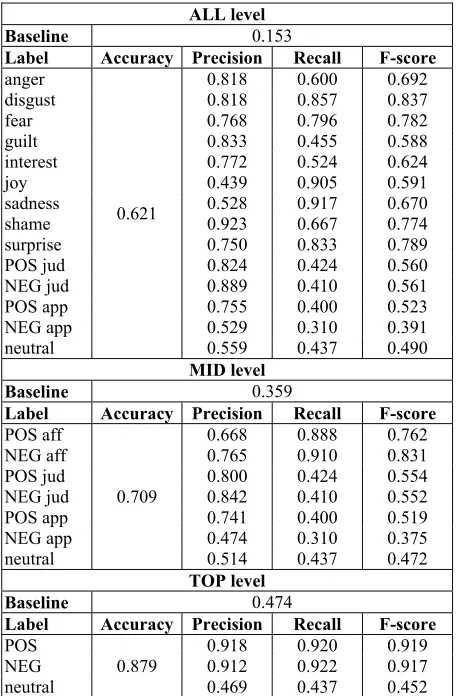
After processing each sentence from the data set by our system, we measured averaged accuracy, pre-cision, recall, and F-score for each label within ALL, MID, and TOP levels. The results are shown in Table 4. The ratio of the most frequent attitude
label in the “gold standard” was considered as the baseline. As seen from the obtained results, our algorithm performed with high accuracy signifi-cantly surpassing the baselines on all levels of atti-tude hierarchy (except ‘neutral’ category on the TOP level, which is probably due to the unbal-anced distribution of labels in the “gold standard”, where ‘neutral’ sentences constitute less than 9%).
ALL level
Baseline 0.153
Label Accuracy Precision Recall F-score
anger
0.621
0.818 0.600 0.692
disgust 0.818 0.857 0.837
fear 0.768 0.796 0.782
guilt 0.833 0.455 0.588 interest 0.772 0.524 0.624
joy 0.439 0.905 0.591
sadness 0.528 0.917 0.670 shame 0.923 0.667 0.774 surprise 0.750 0.833 0.789 POS jud 0.824 0.424 0.560
NEG jud 0.889 0.410 0.561 POS app 0.755 0.400 0.523 NEG app 0.529 0.310 0.391
neutral 0.559 0.437 0.490 MID level
Baseline 0.359
Label Accuracy Precision Recall F-score
POS aff
0.709
0.668 0.888 0.762 NEG aff 0.765 0.910 0.831 POS jud 0.800 0.424 0.554 NEG jud 0.842 0.410 0.552 POS app 0.741 0.400 0.519 NEG app 0.474 0.310 0.375
neutral 0.514 0.437 0.472 TOP level
Baseline 0.474
Label Accuracy Precision Recall F-score
POS
0.879 0.918 0.920 0.919
NEG 0.912 0.922 0.917
neutral 0.469 0.437 0.452
Table 4. Results of the system performance evaluation.
In the case of fine-grained attitude recognition (ALL level), the highest precision was obtained for ‘shame’ (0.923) and ‘NEG jud’ (0.889), while the highest recall was received for ‘sadness’ (0.917)
TOP POS NEG neutral
MID POS aff POS jud POS app NEG aff NEG jud NEG app neutral
[image:7.612.313.542.283.631.2]ALL interest joy surprise POS jud POS app anger disgust fear guilt sadness shame NEG jud NEG app neutral
[image:7.612.72.299.422.603.2]and ‘joy’ (0.905) emotions at the cost of low preci-sion (0.528 and 0.439, correspondingly). The algo-rithm performed with the worst results in recognition of ‘NEG app’ and ‘neutral’.
The analysis of a confusion matrix for the ALL level revealed the following top confusions of our system (see Table 5): (1) ‘anger’, ‘fear’, ‘guilt’, ‘shame’, ‘NEG jud’, ‘NEG app’ and ‘neutral’ were predominantly incorrectly predicted as ‘sadness’ (for ex., @AM resulted in ‘sadness’ for the sen-tence ‘I know we have several months left before the election, but I am already sick and tired of see-ing the ads on TV’, while human annotations were ‘anger’/‘anger’/‘disgust’); (2) ‘interest’, ‘POS jud’ and ‘POS app’ were mostly confused with ‘joy’ by our algorithm (e.g., @AM classified the sentence ‘It’s one of those life changing artifacts that we must have in order to have happier, healthier lives’ as ‘joy’(-ful), while human annotations were ‘POS app’/‘POS app’/‘interest’).
Actual label
Incorrectly predicted labels (%), in descending order
anger sadness (28.9%), joy (4.4%), neutral (4.4%), NEG app (2.2%)
disgust anger (4.8%), sadness (4.8%), NEG jud (4.8%) fear sadness (13%), joy (5.6%), POS app (1.9%) guilt sadness (50%), anger (4.5%)
interest joy (33.3%), neutral (7.1%), sadness (3.6%), POS app (2.4%), fear (1.2%)
joy interest (3.2%), POS app (3.2%), sadness (1.1%), surprise (1.1%), neutral (1.1%)
sadness neutral (3.8%), joy (1.5%), anger (0.8%), fear (0.8%), guilt (0.8%), NEG app (0.8%)
shame sadness (16.7%), fear (5.6%), guilt (5.6%), NEG jud (5.6%)
surprise fear (5.6%), neutral (5.6%), joy (2.8%), POS jud (2.8%)
POS jud joy (37.9%), POS app (9.1%), interest (4.5%), sadness (1.5%), surprise (1.5%), NEG jud (1.5%), neutral (1.5%)
NEG jud sadness (37.2%), anger (3.8%), disgust (3.8%), neutral (3.8%)
POS app joy (37%), neutral (9%), surprise (7%), interest (3%), POS jud (3%), sadness (1%)
NEG app sadness (44.8%), fear (13.8%), disgust (3.4%), surprise (3.4%), neutral (3.4%)
[image:8.612.75.299.343.642.2]neutral sadness (29.9%), joy (13.8%), interest (3.4%), fear (2.3%), POS jud (2.3%), NEG app (2.3%), NEG jud (1.1%), POS app (1.1%)
Table 5. Data from a confusion matrix for ALL level.
Our system achieved high precision for all cate-gories on the MID level (Table 4), with the excep-tion of ‘NEG app’ and ‘neutral’, although high recall was obtained only in the case of categories
related to affect (‘POS aff’, ‘NEG aff’). These re-sults indicate that affect sensing is easier than rec-ognition of judgment or appreciation from text.
TOP level results (Table 4) show that our algo-rithm classifies sentences that convey positive or negative sentiment with high accuracy (92% and 91%, correspondingly). On the other hand, ‘neu-tral’ sentences still pose a challenge.
The analysis of errors revealed that system re-quires common sense or additional context to deal with sentences like ‘All through my life I’ve felt like I’m second fiddle’ (“gold standard”: ‘sadness’; @AM: ‘neutral’) or ‘For me every minute on my horse is alike an hour in heaven!’ (“gold stan-dard”: ‘joy’; @AM: ‘neutral’).
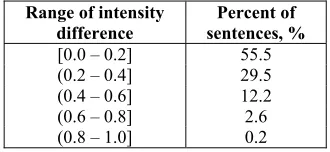
We also evaluated the system performance with regard to attitude intensity estimation. The percen-tage of attitude-conveying sentences (not consider-ing neutral ones), on which the result of our system conformed to the fine-grained “gold standard” (ALL level), according to the measured distance between intensities given by human raters (aver-aged values) and those obtained by our system is shown in Table 6. As seen from the table, our sys-tem achieved satisfactory results in estimation of the strength of attitude expressed through text.
Range of intensity difference
[image:8.612.344.509.413.489.2]Percent of sentences, % [0.0 – 0.2] 55.5 (0.2 – 0.4] 29.5 (0.4 – 0.6] 12.2 (0.6 – 0.8] 2.6 (0.8 – 1.0] 0.2
Table 6. Results on intensity.
6
Conclusions
References
Cecilia O. Alm. 2008. Affect in Text and Speech. PhD Dissertation. University of Illinois at Urbana-Champaign.
Saima Aman and Stan Szpakowicz. 2008. Using Roget's Thesaurus for Fine-Grained Emotion Recognition. Proceedings of the Third International Joint Confe-rence on Natural Language Processing IJCNLP 2008, Hyderabad, India, pp. 296-302.
Plaban Kumar Bhowmick, Anupam Basu, and Pabitra Mitra. 2009. Reader Perspective Emotion Analysis in Text through Ensemble based Multi-Label Classifi-cation Framework. Computer and Information Science, 2 (4): 64-74.
Anthony C. Boucouvalas. 2003. Real Time Text-to-Emotion Engine for Expressive Internet Communica-tions. Being There: Concepts, Effects and Measure-ment of User Presence in Synthetic EnvironMeasure-ments, Ios Press, pp. 306-318.
Francois-Regis Chaumartin. 2007. UPAR7: A Know-ledge-based System for Headline Sentiment Tagging. Proceedings of the Fourth International Workshop on Semantic Evaluations (SemEval-2007), Prague, Czech Republic, pp. 422-425.
Yejin Choi and Claire Cardie. 2008. Learning with Compositional Semantics as Structural Inference for Subsentential Sentiment Analysis. Proceedings of the Conference on Empirical Methods in Natural Lan-guage Processing, pp. 793-801.
Ze-Jing Chuang and Chung-Hsien Wu. 2004. Multi-modal Emotion Recognition from Speech and Text. Computational Linguistic and Chinese Language Processing, 9(2): 45-62.
Leo Hoye. 1997. Adverbs and Modality in English. New York: Addison Wesley Longman Inc.
Carroll E. Izard. 1971. The Face of Emotion. New York: Appleton-Century-Crofts.
Karin Kipper, Anna Korhonen, Neville Ryant, and Mar-tha Palmer. 2007. A Large-scale Classification of English Verbs. Language Resources and Evaluation, 42 (1): 21-40.
Zornitsa Kozareva, Borja Navarro, Sonia Vazquez, and Andres Montoyo, A. 2007. UA-ZBSA: A Headline Emotion Classification through Web Information. Proceedings of the Fourth International Workshop on Semantic Evaluations, pp. 334-337.
Hugo Liu, Henry Lieberman, and Ted Selker. 2003. A Model of Textual Affect Sensing Using Real-World Knowledge. Proceedings of the International Confe-rence on Intelligent User Interfaces, pp. 125-132. James R. Martin and Peter R.R. White. 2005. The
Lan-guage of Evaluation: Appraisal in English. Palgrave, London, UK.
George A. Miller. 1990. WordNet: An On-line Lexical
Database. International Journal of Lexicography, Special Issue, 3 (4): 235-312.
Karo Moilanen and Stephen Pulman. 2007. Sentiment Composition. Proceedings of the Recent Advances in Natural Language Processing International Confe-rence, pp. 378-382.
Matthijs Mulder, Anton Nijholt, Marten den Uyl, and Peter Terpstra. 2004. A Lexical Grammatical Imple-mentation of Affect. Proceedings of the Seventh In-ternational Conference on Text, Speech and Dialogue, pp. 171-178.
Tetsuya Nasukawa and Jeonghee Yi. 2003. Sentiment Analysis: Capturing Favorability using Natural Lan-guage Processing. Proceedings of the 2nd Interna-tional Conference on Knowledge Capture, pp. 70-77. Alena Neviarouskaya, Helmut Prendinger, and Mitsuru
Ishizuka. 2009. SentiFul: Generating a Reliable Lex-icon for Sentiment Analysis. Proceedings of the In-ternational Conference on Affective Computing and Intelligent Interaction, IEEE, Amsterdam, Nether-lands, pp. 363-368.
J. Olveres, M. Billinghurst, J. Savage, and A. Holden. 1998. Intelligent, Expressive Avatars. Proceedings of the First Workshop on Embodied Conversational Characters, pp. 47-55.
Livia Polanyi and Annie Zaenen. 2004. Contextual Va-lence Shifters. Working Notes of the AAAI Spring Symposium on Exploring Attitude and Affect in Text: Theories and Applications.
Carlo Strapparava and Rada Mihalcea. 2008. Learning to Identify Emotions in Text. Proceedings of the 2008 ACM Symposium on Applied Computing, Forta-leza, Brazil, pp. 1556-1560.
Carlo Strapparava, Alessandro Valitutti, and Oliviero Stock. 2007. Dances with Words. Proceedings of the International Joint Conference on Artificial Intelli-gence, Hyderabad, India, pp. 1719-1724.
V.S. Subrahmanian and Diego Reforgiato. 2008. AVA: Adjective-Verb-Adverb Combinations for Sentiment Analysis. Intelligent Systems, IEEE, 23 (4): 43-50. Maite Taboada and Jack Grieve. 2004. Analyzing
Ap-praisal Automatically. Proceedings of American As-sociation for Artificial Intelligence Spring Symposium on Exploring Attitude and Affect in Text, pp.158-161.
Casey Whitelaw, Navendu Garg, and Shlomo Argamon. 2005. Using Appraisal Groups for Sentiment Analy-sis. Proceedings of the 14th ACM International Con-ference on Information and Knowledge Management, CIKM, Bremen, Germany, pp. 625-631.