Dynamic Topic Adaptation for SMT using Distributional Profiles
Eva Hasler1 Barry Haddow1 Philipp Koehn1,2 1School of Informatics, University of Edinburgh
2Center for Language and Speech Processing, Johns Hopkins University [email protected], {bhaddow,pkoehn}@inf.ed.ac.uk
Abstract
Despite its potential to improve lexical selection, most state-of-the-art machine translation systems take only minimal con-textual information into account. We cap-ture context with a topic model over dis-tributional profiles built from the context words of each translation unit. Topic dis-tributions are inferred for each transla-tion unit and used to adapt the translatransla-tion model dynamically to a given test context by measuring their similarity. We show that combining information from both lo-cal and global test contexts helps to im-prove lexical selection and outperforms a baseline system by up to 1.15 BLEU. We test our topic-adapted model on a diverse data set containing documents from three different domains and achieve competitive performance in comparison with two su-pervised domain-adapted systems.
1 Introduction
The task of lexical selection plays an important role in statistical machine translation (SMT). It strongly depends on context and is particularly dif-ficult when the domain of a test document is un-known, for example when translating web doc-uments from diverse sources. Selecting transla-tions of words or phrases that preserve the sense of the source words is closely related to the field ofword sense disambiguation(WSD), which has been studied extensively in the past.
Most approaches to WSD model context at the sentence level and do not take the wider context of a word into account. Some of the ideas from the field of WSD have been adapted for machine translation (Carpuat and Wu, 2007b; Carpuat and Wu, 2007a; Chan et al., 2007). For example, Carpuat and Wu (2007a) extend word sense dis-ambiguation to phrase sense disdis-ambiguation and
show improved performance due to the better fit with multiple possible segmentations in a phrase-based system. Carpuat (2009) test the “one sense per discourse” hypothesis (Gale et al., 1992) for MT and find that enforcing it as a constraint at the document level could potentially improve transla-tion quality. Our goal is to make correct lexical choices in a given context without explicitly en-forcing translation consistency.
More recent work in SMT uses latent repre-sentations of the document context to dynam-ically adapt the translation model with either monolingual topic models (Eidelman et al., 2012; Hewavitharana et al., 2013) or bilingual topic models (Hasler et al., 2014), thereby allowing the translation system to disambiguate source phrases using document context. Eidelman et al. (2012) also apply a topic model to each test sentence and find that sentence context is sufficient for pick-ing good translations, but they do not attempt to combine sentence and document level informa-tion. Sentence-level topic adaptation for SMT has also been employed by Hasler et al. (2012). Other approaches to topic adaptation for SMT include Zhao and Xing (2007) and Tam et al. (2008), both of which use adapted lexical weights.
In this paper, we present a topic model that learns latent distributional representations of the context of a phrase pair which can be applied to both local and global contexts at test time. We introduce similarity features that compare latent representations of phrase pair types to test con-texts to disambiguate senses for improved lexi-cal selection. We also propose different strate-gies for combining local and global topical context and show that using clues from both levels of con-texts is beneficial for translation model adaptation. We evaluate our model on a dynamic adaptation task where the domain of a test document is un-known and hence the problem of lexical selection is harder.
2 Related work
Most work in the WSD literature has modelled disambiguation using a limited window of con-text around the word to disambiguate. Cai et al. (2007), Boyd-graber and Blei (2007) and Li et al. (2010) further tried to integrate the notion of la-tent topics to address the sparsity problem of the lexicalised features typically used in WSD classi-fiers. The most closely related work in the area of sense disambiguation is by Dinu and Lapata (2010) who propose a disambiguation method for solving lexical similarity and substitution tasks. They measure word similarity in context by learn-ing distributions over senses for each target word in the form of lower-dimensional distributional representations. Before computing word similar-ities, they contextualise the global sense distribu-tion of a word using the sense distribudistribu-tion of words in the test context, thereby shifting the sense distri-bution towards the test context. We adopt a simi-lar distributional representation, but argue that our representation does not need this disambiguation step because at the level of phrase pairs the ambi-guity is already much reduced.
Our model performs adaptation using similar-ity features which is similar to the approach of Costa-juss`a and Banchs (2010) who learn a vec-tor space model that captures the source context of every training sentence. In Banchs and Costa-juss`a (2011), the vector space model is replaced with representations inferred by Latent Seman-tic Indexing. However, because their latent rep-resentations are learned over training sentences, they have to compare the current test sentence to the latent vector of every training instance associ-ated with a translation unit. The highest similar-ity value is then used as a feature value. Instead, our model learns latent distributional representa-tions of phrase pairs that can be directly compared to test contexts and are likely to be more robust. Because context words of a phrase pair are tied to-gether in the distributional representations, we can use sparse priors to cluster context words associ-ated with the same phrase pair into few topics.
Recently, Chen et al. (2013) have proposed a vector space model for domain adaptation where phrase pairs are assigned vectors that are defined in terms of the training corpora. A similar vector is built for an in-domain development set and the similarity to the development set is used as a fea-ture during translation. While their vector repre-sentations are similar to our latent topic
represen-tations, their model has no notion of structure be-yond corpus boundaries and is adapted towards a single target domain (cross-domain). Instead, our model learns the latent topical structure automati-cally and the translation model is adapted dynam-icallyto each test instance.
We are not aware of prior work in the field of MT that investigates combinations of local and global context. In their recent work on neural lan-guage models, Huang et al. (2012) combine the scores of two neural networks modelling the word embeddings of previous words in a sequence as well as those of words from the surrounding dument by averaging over all word embeddings oc-curring in the same document. The score of the next word in a sequence is computed as the sum of the scores of both networks, but they do not con-sider alternative ways of combining contextual in-formation.
3 Phrase pair topic model (PPT)
Our proposed model aims to capture the relation-ship betweenphrase pairs andsource wordsthat frequently occur in the local context of a phrase pair, that is, context words occurring in the same sentence. It therefore follows the distributional hypothesis(Harris, 1954) which states that words that occur in the same contexts tend to have sim-ilar meanings. For a phrase pair, the idea is that words that occur frequently in its context are in-dicative of the sense that is captured by the target phrase translating the source phrase.
We assume that all phrase pairs share a global set of topics and during topic inference the distri-bution over topics for each phrase pair is induced from the latent topic of its context words in the training data. In order to learn topic distributions for each phrase pair, we represent phrase pairs as documents containing all context words from the source sentence context in the training data. These distributional profiles of phrase pairs are the in-put to the topic modelling algorithm which learns topic clusters over context words.
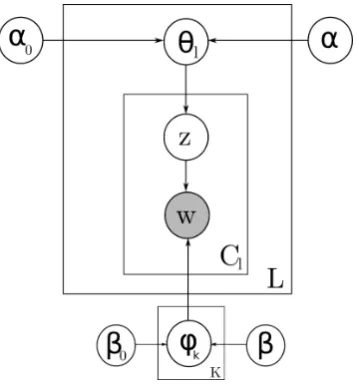
Figure 1a shows a graphical representation of the following generative process for training. For each ofP phrase pairsppiin the collection
1. Draw a topic distribution from an asymmetric Dirichlet prior,θp ∼Dirichlet(α0, α . . . α).
2. For each positioncin the distributional pro-file ofppi, draw a topic from that distribution,
(a) Inference on phrase pair documents (training).
[image:3.595.93.273.276.469.2](b) Inference on local test contexts (test).
Figure 1: Graphical representation of the phrase pair topic (PPT) model.
3. Conditioned on topic zp,c, choose a context
wordwp,c ∼Multinomial(ψzp,c).
αandβare parameters of the Dirichlet distribu-tions andφkdenotes topic-dependent vocabularies
over context words. Test contexts are generated similarly by drawing topic mixturesθlfor each test
context1 as shown in Figure 1b, drawing topicsz
for each context position and then drawing context wordswfor eachz. The asymmetric prior on topic distributions (α0for topic 0 andαfor all other
top-ics) encodes the intuition that there are words oc-curring in the context of many phrase pairs which
1A local test context is defined as all words in the test sentence excluding stop words, while contexts of phrase pairs in training do not include the words belonging to the source phrase. The naming in the figure refers to local test contexts
L, but global test contexts will be defined similarly.
can be grouped under a topic with higher a priori probability than the other topics. Figure 1a shows the model for training inference on the distribu-tional representations for each phrase pair, where
Cl−all denotes the number of context words in all
sentence contexts that the phrase pair was seen in the training data,P denotes the number of phrase pairs andK denotes the number of latent topics. The model in Figure 1b has the same structure but shows inference on test contexts, whereCl
de-notes the number of context words in the test sen-tence context andLdenotes the number of test in-stances. θp andθldenote the topic distribution for
a phrase pair and a test context, respectively.
3.1 Inference for PPT model
We use collapsed variational Bayes (Teh et al., 2006) to infer the parameters of the PPT model. The posterior distribution over topics is computed as shown below
P(zp,c=k|z−(p,c),wc, p, α, β)∝ (Eqˆ[n−.,k,w(p,cc)] +β)
(Eqˆ[n.,k,.−(p,c)] +Wc·β)
·(Eqˆ[n−d,k,.(p,c)] +α)
(1)
where zp,c denotes the topic at position c in
the distributional profile p, wc denotes all
con-text word tokens in the collection,Wc is the total
number of context words and Eqˆ is the
expecta-tion under the variaexpecta-tional posterior. n−.,k,w(p,cc) and
n−p,k,.(p,c)are counts of topics occurring with context words and distributional profiles, respectively, and
n−.,k,.(p,c)is a topic occurrence count.
Before training the topic model, we remove stop words from all documents. When inferring top-ics for test contexts, we ignore unseen words be-cause they do not contribute information for topic inference. In order to speed up training inference, we limit the documents in the collection to those corresponding to phrase pairs that are needed to translate the test set2. Inference was run for 50
it-erations on the distributional profiles for training and for 10 iterations on the test contexts. The out-put of the training inference step is a model file with all the necessary statistics to compute pos-terior topic distributions (which are loaded before running test inference), and the set of topic vectors for all phrase pairs. The output of test inference is
the set of induced topic vectors for all test con-texts.
3.2 Modelling local and global context
At training time, our model has access to context words only from the local contexts of each phrase pair in their distributional profiles, that is, other words in the same source sentence as the phrase pair. This is useful for reducing noise and constraining the semantic space that the model considers for each phrase pair during training. At test time, however, we are not limited to applying the model only to the immediate surroundings of a source phrase to disambiguate its meaning. We can potentially take any size of test context into account to disambiguate the possible senses of a source phrase, but for simplicity we consider two sizes of context here which we refer to as local and global context.
Local context Words appearing in the sentence
around a test source phrase, excluding stop words.
Global contextWords appearing in the document
around a test source phrase, excluding stop words.
4 Similarity features
We define similarity features that compare the topic vector θp assigned to a phrase pair3 to the
topic vector assigned to a test context, The fea-ture is defined for each source phrase and all its possible translations in the phrase table, as shown below
sim(ppi, test context) =cosine(θpi, θc),
∀ppi ∈ {ppi|¯s→t¯i} (2)
Unlike Banchs and Costa-juss`a (2011), we do not learn topic vectors for every training sentence which results in a topic vector per phrase pair to-ken, but instead we learn topic vectors for each phrase pair type. This is more efficient but also more appealing from a modelling point of view, as the topic distributions associated with phrase pairs can be thought of as expected latent contexts. The application of the similarity feature is visualised in Figure 2. On the left, there are two applicable phrase pairs for the source phrase noyau, noyau →kernelandnoyau→nucleus, with their distri-butional representations (words belonging to the
3The mass of topic 0 is removed from the vectors and the vectors are renormalised before computing similarity fea-tures.
ITtopic versus the scientific topic) and assigned topic vectorsθp. The local and global test contexts
are similarly represented by a document contain-ing the context words and a resultcontain-ing topic vector
θlorθg. The test context vectorθccan be one of
θl and θg or a combination of both. In this
[image:4.595.308.530.206.365.2]ex-ample, the distributional representation of noyau →kernelhas a larger topical overlap with the test context and will more likely be selected during de-coding.
Figure 2: Similarity between topic vectors of two applicable phrase pairsθpand the topic vectorsθl
andθg from the local and global test context
dur-ing test time.
While this work focuses on exploring vec-tor space similarity for adaptation, mostly for computational ease, it may be possible to derive probabilistic translation features from the PPT model. This could be a useful addition to the model and we leave this as an avenue for future work.
Types of similarity features
motivated by the observation that there are cases where the local and global features have an op-posite preference for one translation over another, but the log-linear combination can only learn a global preference for one of the features. Com-bining the topic vectors allows us to potentially encode a preference for one of the contexts that depends on each test instance.
For similarity features derived from combined topic vectors,⊕denotes the additive combination of topic vectors,⊗denotes the multiplicative com-bination of topic vectors and~denotes a combina-tion that favours the local context for longer sen-tences and backs off incrementally to the global context for shorter sentences.5 The intuition
be-hind this combination is that if there is already suf-ficient evidence in the local context, the local topic mixture may be more reliable than the global mix-ture.
We also experiment with a combination of the phrase pair similarity features derived from the PPT model with a document similarity feature from the pLDA model described in Hasler et al. (2014). The motivation is that their model learns topic mixtures for documents and uses phrases in-stead of words to infer the topical context. There-fore, it might provide additional information to our similarity features.
5 Data and experimental setup
Our experiments were carried out on a mixed French-English data set containing the TED cor-pus (Cettolo et al., 2012), parts of the News Com-mentary corpus (NC) and parts of the Common-crawl corpus (CC) from the WMT13 shared task (Bojar et al., 2013) as described in Table 1. To ensure that the baseline model does not have an implicit preference for any particular domain, we selected subsets of the NC and CC corpora such that the training data contains 2.7M English words per domain. We were guided by two constraints in chosing our data set in order to simulate an environment where very diverse documents have to be translated, which is a typical scenario for web translation engines: 1) the data has ment boundaries and the content of each docu-ment is assumed to be topically related, 2) there is some degree of topical variation within each data set. This setup allows us to evaluate our dynamic
5The interpolation weights between local and global topic vectors were set proportional to sentence lengths between 1 and 30. The length of longer sentences was clipped to 30.
topic adaptation approach because the test docu-ments are from different domains and also differ within each domain, which makes lexical selec-tion a much harder problem. The topic adaptaselec-tion approach does not make use of the domain labels in training or test, because it infers topic mixtures in an unsupervised way. However, we compare the performance of our dynamic approach to domain adaptation methods by providing them the domain labels for each document in training and test.
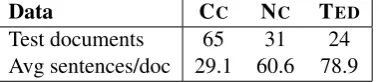
In order to abstract away from adaptation ef-fects that concern tuning of length penalties and language models, we use a mixed tuning set con-taining data from all three domains and train one language model on the concatenation of the tar-get sides of the training data. Word alignments are trained on the concatenation of all training data and fixed for all models. Table 2 shows the aver-age length of a document for each domain. While a CC document contains 29.1 sentences on aver-age, documents from NCand TEDare on average more than twice as long. The length of a document could have an influence on how reliable global topic information is but also on how important it is to have information from both local and global test contexts.
Data Mixed CC NC TED
Train 354K (6450) 110K 103K 140K
Dev 2453 (39) 818 817 818
[image:5.595.307.522.423.479.2]Test 5664 (112) 1892 1878 1894
Table 1: Number of sentence pairs and documents (in brackets) in the data sets.
Data CC NC TED
Test documents 65 31 24
Avg sentences/doc 29.1 60.6 78.9
Table 2: Average number of sentences per docu-ment in the test set (per domain).
5.1 Unadapted baseline system
[image:5.595.309.499.538.579.2]noyau→kernel noyau→nucleus noyau→core
Figure 3: Topic distributions for source phrasenoyauand three of its translations (20 topics without topic 0). Colored bars correspond to topicsIT,politics,science,economywith topic proportions≥10%.
mteval-v13a.pl script to compute case-insensitive BLEUscores.
5.2 Domain-adapted benchmark systems
As domain-aware benchmark systems, we use the linear mixture model (DOMAIN1) of Sen-nrich (2012) and the phrase table fill-up method (DOMAIN2) of Bisazza et al. (2011) (both avail-able in the Moses toolkit). For both systems, the domain labels of the documents are used to group documents of the same domain together. We build adapted tables for each domain by treating the remaining documents as out-of-domain data and combining in-domain with out-of-domain ta-bles. For development and test, the domain labels are used to select the respective domain-adapted model for decoding. Both systems have an advan-tage over our model because of their knowledge of domain boundaries in the data. This allows for much more confident lexical choices than using an unadapted system but is not possible without prior knowledge about each document.
5.3 Implementation of similarity features
After all topic vectors have been computed, a fea-ture generation step precomputes the similarity features for all pairs of test contexts and applica-ble phrase pairs for translating source phrases in a test instance. The phrase table of the baseline model is filtered for every test instance (a sentence or document, depending on the context setting) and each entry is augmented with features that ex-press its semantic similarity to the test context. We use a wrapper around the Moses decoder to reload the phrase table for each test instance, which en-ables us to run parameter optimisation (PRO) in the usual way to get one set of tuned weights for all test sentences. It would be conceivable to use
topic-specific weights instead of one set of global weights, but this is not the focus of this work.
6 Qualitative evaluation of phrase pair topic distributions
In order to verify that the topic model is learning useful topic representations for phrase pairs, we inspect the inferred topic distributions for three phrase pairs where the translation of the same source word differs depending on the topical context: noyau → kernel, noyau → nucleus and noyau → core. Figure 3 shows the topic distributions for a PPT model with 20 topics (with topic 0 removed) and highlights the most prominent topics with labels describing their content (politics, IT, science, economy)6. The
most peaked topic distribution was learned for the phrase pairnoyau → kernel which would be expected to occur mostly in an IT context and the topic with the largest probability mass is in fact related to IT. The most prominent topic for the phrase pair noyau → nucleus is the science topic, though it seems to be occurring in with the political topic as well. The phrase pair noyau → core was assigned the most ambiguous topic distribution with peaks at the politics, economy and IT topics. Note also that its topic distribution overlaps with those of the other translations, for example, like the phrase pair noyau → kernel, it can occur in IT contexts. This shows that the model captures the fact that even within a given topic there can still be ambiguity about the correct translation (both target phrases kernel and core are plausible translations in an IT context).
Ambiguity of phrase pair topic vectors
The examples in the previous section show that the level of ambiguity differs between phrase pairs that constitute translations of the same source phrase. It is worth noting that introducing bilin-gual information into topic modelling reduces the sense ambiguity present in monolingual text by preserving only the intersection of the senses of source and target phrases. For example, the distri-butional profiles of the source phrasenoyauwould contain words that belong to the senses IT, poli-tics,scienceandeconomy, while the words in the context of the target phrase kernelcan belong to the sensesITandfood(with source context words such as grain, prot´eines, produire). Thus, the monolingual representations would still contain a relatively high level of ambiguity while the distri-butional profile of the phrase pairnoyau→kernel preserves only theITsense.
7 Results and discussion
In this section we present experimental results of our model with different context settings and against different baselines. We used bootstrap re-sampling (Koehn, 2004) to measure significance on the mixed test set and marked all statistically significant results compared to the respective base-lines with asterisk (*: p≤0.01).
7.1 Local context
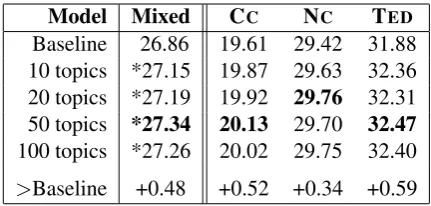
In Table 3 we compare the results of the con-catenation baseline and a model containing the phrSim-local feature in addition to the baseline features, for different numbers of latent topics. We show results for the mixed test set containing doc-uments from all three domains as well as the in-dividual results on the documents from each do-main. While all topic settings yield improvements over the baseline, the largest improvement on the mixed test set (+0.48 BLEU) is achieved with 50 topics. Topic adaptation is most effective on the TED portion of the test set where the increase in BLEUis 0.59.
7.2 Global context
Table 4 shows the results of the baseline plus the phrSim-globalfeature that takes into account the whole document context of a test sentence. While the largest overall improvement on the mixed test set is equal to the improvement of the local feature, there are differences in performance for the indi-vidual domains. For Commoncrawl documents,
Model Mixed CC NC TED
Baseline -26.86 19.61 29.42 31.88
10 topics *27.15 19.87 29.63 32.36 20 topics *27.19 19.92 29.76 32.31 50 topics *27.34 20.13 29.70 32.47
100 topics *27.26 20.02 29.75 32.40
>Baseline +0.48 +0.52 +0.34 +0.59
Table 3: BLEU scores of baseline system + phrSim-localfeature for different numbers of top-ics.
the results vary slightly but the largest improve-ment is still achieved with 50 topics and is al-most the same for both. For News Commentary, the scores with the local feature are consistently higher than the scores with the global feature (0.20 and 0.22 BLEU higher for 20 and 50 topics). For TED, the trend is opposite with the global feature performing better than the local feature for all top-ics (0.28 and 0.40 BLEUhigher for 10 and 20 top-ics). The best improvement over the baseline for TED is 0.83 BLEU, which is higher than the im-provement with the local feature.
Model Mixed CC NC TED
Baseline -26.86 19.61 29.42 31.88
10 topics *27.30 20.01 29.61 32.64 20 topics *27.34 20.07 29.56 32.71
50 topics *27.27 20.12 29.48 32.55 100 topics *27.24 19.95 29.66 32.52
>Baseline +0.48 +0.51 +0.24 +0.83 Table 4: BLEU scores of baseline system + phrSim-global feature for different numbers of topics.
7.3 Relation to properties of test documents
[image:7.595.308.524.61.164.2] [image:7.595.308.525.403.507.2]because the longer a document is, the more likely it is that the content of a given sentence diverges from the overall topical structure of the document. While this can explain why for CCdocuments us-ing local or global context results in similar perfor-mance, it does not explain the better performance of the local feature for NC documents. The last row of Table 5 shows that sentences in the NC documents are on average the longest and longer sentences would be expected to yield more reli-able topic estimates than shorter sentences. Thus, we assume that local context yields better perfor-mance for NC because on average the sentences are long enough to yield reliable topic estimates. When local context provides reliable information, it may be more informative than global context be-cause it can be more specific.
For TED, we see the largest topical drift per document, which could lead us to believe that the document topic mixtures do not reflect the topical content of the sentences too well. But considering that the sentences are on average shorter than for the other two domains, it is more likely that the local context in TEDdocuments can be unreliable when the sentences are too short. TEDdocuments contain transcribed speech and are probably less dense in terms of information content than News commentary documents. Therefore, the global context may be more informative for TED which could explain why relying on the global topic mixtures yields better results.
Property CC NC TED
Per document
Avg number of sentences 29.1 60.6 78.9 Avg topical divergence 0.35 0.43 0.49
[image:8.595.309.523.61.183.2]Avg sentence length 26.2 31.5 21.7
Table 5: Properties of test documents per domain. Average topical divergence is defined as the aver-age cosine distance of local to global topic distri-butions in a document.
7.4 Combinations of local and global context
In Table 6 we compare a system that already con-tains the global feature from a model with 50 top-ics to the combinations of local and global simi-larity features described in Section 4.
Of the four combinations, the additive combi-nation of topic vectors (⊕) yields the largest im-provement over the baseline with +0.63 BLEUon
Model Mixed CC NC TED
Baseline -26.86 19.61 29.42 31.88
+ global -27.27 20.12 29.48 32.55
+ local *27.43 20.18 29.65 32.79
⊕local *27.49 20.30 29.66 32.76
⊗local -27.34 20.24 29.61 32.50
~local *27.45 20.22 29.51 32.79
[image:8.595.72.290.501.572.2]⊕>BL +0.63 +0.69 +0.24 +0.88
Table 6: BLEU scores of baseline and combina-tions of phrase pair similarity features with local and global context (significance compared to base-line+global). All models were trained with 50 top-ics.
the mixed test set and +0.88 BLEUon TED. The improvements of the combined model are larger than the improvements for each context on its own, with the only exception being the NC portion of the test set where the improvement is not larger than using just the local context. A possible reason is that when one feature is consistently better for one of the domains (local context for NC), the log-linear combination of both features (tuned on data from all domains) would result in a weaker overall model for that domain. However, if both features encode similar information, as we assume to be the case for CCdocuments, the presence of both fea-tures would reinforce the preference of each and result in equal or better performance. For the ad-ditive combination, we expect a similar effect be-cause adding together two topics vectors that have peaks at different topics would make the resulting topic vector less peaked than either of the original vectors.
Source: Lenoyaucontient de nombreux pilotes, afin de fonctionner chez la plupart des utilisateurs. Reference: The precompiledkernelincludes a lot of drivers, in order to work for most users.
Source: Il est prudent de consulter les pages de manuel ou les faq sp´ecifiques `a votreos. Reference: It’s best to consult the man pages or faqs for youros.
Source: Nous fournissons nano (un petit ´editeur), vim (vi am´elior´e), qemacs (clone de emacs),elvis, joe . Reference: Nano (a lightweight editor), vim (vi improved), qemacs (emacs clone),elvisand joe.
Source: Elle a introduit des politiques [..] `a cot´e desrelationsde gouvernement `a gouvernement traditionnelles. Reference: She has introduced policies [..] alongside traditional government-to-governmentrelations.
Figure 4: Examples of test sentences and reference translations with the ambiguous source words and their translations in bold.
depending on sentence length (~) performs well for CC and TED but less well for NC where we would expect that it helps to prefer the local information. This indicates that the rather ad-hoc way in which we encoded dependency on the sentence length may need further refinement to make better use of the local context information.
Model noyau→ os→
Baseline nucleus bones
global kernel* os*
local nucleus bones
[image:9.595.99.264.358.428.2]global⊕local kernel* os*
Table 7: Translations of ambiguous source words where global context yields the correct translation (* denotes the correct translation).
Model elvis→ relations→
Baseline elvis* relations*
global the king relationship
local elvis* relations*
global⊕local the king relations*
Table 8: Translations of ambiguous source words where local context yields the correct translation (* denotes the correct translation).
7.5 Effect of contexts on translation
To give an intuition of how lexical selection is af-fected by contextual information, Figure 4 shows four test sentences with an ambiguous source word and its translation in bold. The corresponding translations with the baseline, the global and lo-cal similarity features and the additive combina-tion are shown in Table 7 for the first two examples where the global context yields the correct
transla-tion (as indicated by *) and in Table 8 for the last two examples where the local context yields the correct translation.7 In Table 7, the additive
com-bination preserves the choice of the global model and yields the correct translations, while in Table 8 only the second example is translated correctly by the combined model. A possible explanation is that the topical signal from the global context is stronger and results in more discriminative simi-larity values. In that case, the preference of the global context would be likely to have a larger in-fluence on the similarity values in the combined model. A useful extension could be to try to de-tect for a given test instance which context pro-vides more reliable information (beyond encoding sentence length) and boost the topic distribution from that context in the combination.
[image:9.595.90.275.499.570.2]7.6 Comparison with domain adaptation
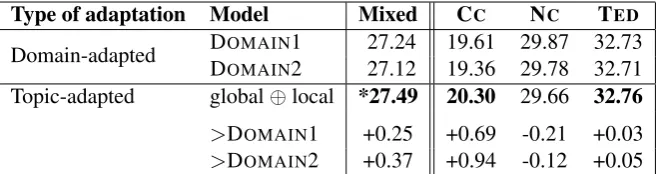
Table 9 compares the additive model (⊕) to the two domain-adapted systems that know the do-main label of each document during training and test. Our topic-adapted model yields overall com-petitive performance with improvements of +0.37 and +0.25 BLEU on the mixed test set, respec-tively. While it yields slightly lower performance on the NC documents, it achieves equal perfor-mance on TEDdocuments and improves by up to +0.94 BLEU on Commoncrawl documents. This can be explained by the fact that Commoncrawl is the most diverse of the three domains with docu-ments crawled from all over web, thus we expect topic adaptation to be most effective in compari-son to domain adaptation in this scenario. Our dy-namic approach allows us to adapt the similarity features to each test sentence and test document individually and is therefore more flexible than
Type of adaptation Model Mixed CC NC TED
Domain-adapted DDOMAINOMAIN12 -27.24-27.12 19.61 29.87 32.7319.36 29.78 32.71
Topic-adapted global⊕local *27.49 20.30 29.66 32.76
>DOMAIN1 +0.25 +0.69 -0.21 +0.03
[image:10.595.135.466.62.149.2]>DOMAIN2 +0.37 +0.94 -0.12 +0.05
Table 9: BLEUscores of translation model using similarity features derived from PPT model (50 topics) in comparison with two (supervised) domain-adapted systems.
Model Mixed CC NC TED
Baseline -26.86 19.61 29.42 31.88
+ docSim -27.22 20.11 29.63 32.40
+ phrSim-global⊕phrSim-local *27.58 20.34 29.71 32.96 + phrSim-global~phrSim-local *27.60 20.35 29.70 33.03
[image:10.595.138.461.195.285.2]global~local>BL +0.74 +0.74 +0.38 +1.15
Table 10: BLEU scores of baseline, baseline + document similarity feature and additional phrase pair similarity features (significance compared to baseline+docSim). All models were trained with 50 topics.
cross-domain adaptation approaches while requir-ing no information about the domain of a test in-stance.
7.7 Combination with an additional document similarity feature
To find out whether similarity features derived from different types of topic models can provide complementary information, we add the phrSim features to a system that already includes a docu-ment similarity feature (docSim) derived from the pLDA model (Hasler et al., 2014) which learns topic distributions at the document level and uses phrases instead of words as the minimal units. The results are shown in Table 10. Adding the two best combinations of local and global context from Table 6 yields the best results on TED documents with an increase of 0.63 BLEUover the baseline + docSim model and 1.15 BLEU over the baseline. On the mixed test set, the improvement is 0.38 BLEUover the baseline +docSimmodel and 0.74 BLEUover the baseline. Thus, we show that com-bining different scopes and granularities of sim-ilarity features consistently improves translation results and yields larger gains than using each of the similarity features alone.
8 Conclusion
We have presented a new topic model for dynamic adaptation of machine translation systems that learns topic distributions for phrase pairs. These
latent topic representations can be compared to la-tent representations of local or global test contexts and integrated into the translation model via simi-larity features.
Our experimental results show that it is ben-eficial for adaptation to use contextual informa-tion from both local and global contexts, with BLEU improvements of up to 1.15 over the base-line system on TED documents and 0.74 on a large mixed test set with documents from three do-mains. Among four different combinations of lo-cal and global information, we found that the ad-ditive combination of topic vectors performs best. We conclude that information from both contexts should be combined to correct potential topic de-tection errors in either of the two contexts. We also show that our dynamic adaptation approach performs competitively in comparison with two supervised domain-adapted systems and that the largest improvement is achieved for the most di-verse portion of the test set.
Acknowledgements
This work was supported by funding from the Scottish Informatics and Computer Science Al-liance (Eva Hasler) and funding from the Eu-ropean Union Seventh Framework Programme (FP7/2007-2013) under grant agreement 287658 (EU BRIDGE) and grant agreement 288769 (AC-CEPT). Thanks to Annie Louis for helpful com-ments on a draft of this paper and thanks to the anonymous reviewers for their useful feedback.
References
Rafael E Banchs and Marta R Costa-juss`a. 2011. A Se-mantic Feature for Statistical Machine Translation. InSSST-5 Proceedings of the Fifth Workshop on Syn-tax, Semantics and Structure in Statistical Transla-tion, pages 126–134.
Arianna Bisazza, Nick Ruiz, and Marcello Federico. 2011. Fill-up versus Interpolation Methods for Phrase-based SMT Adaptation. In Proceedings of IWSLT.
Ondrej Bojar, Christian Buck, Chris Callison-Burch, Christian Federmann, Barry Haddow, Philipp Koehn, Christof Monz, Matt Post, Radu Soricut, and Lucia Specia. 2013. Findings of the 2013 workshop on statistical machine translation. InProceedings of WMT 2013.
Jordan Boyd-graber and David Blei. 2007. A Topic Model for Word Sense Disambiguation. In Proceed-ings of EMNLP-CoNLL, pages 1024–1033.
Jun Fu Cai, Wee Sun Lee, and Yee Whye Teh. 2007. Improving Word Sense Disambiguation Using Topic Features. In Proceedings of EMNLP, pages 1015– 1023.
Marine Carpuat and Dekai Wu. 2007a. How Phrase Sense Disambiguation outperforms Word Sense Dis-ambiguation for Statistical Machine Translation. In International Conference on Theoretical and Methodological Issues in MT.
Marine Carpuat and Dekai Wu. 2007b. Improving Sta-tistical Machine Translation using Word Sense Dis-ambiguation. InProceedings of EMNLP, pages 61– 72.
Marine Carpuat. 2009. One Translation per Discourse. InProceedings of the NAACL HLT Workshop on Se-mantic Evaluations: Recent Achievements and Fu-ture Directions, pages 19–27.
Mauro Cettolo, Christian Girardi, and Marcello Fed-erico. 2012. WIT3: Web Inventory of Transcribed and Translated Talks. InProceedings of EAMT. Yee Seng Chan, Hwee Tou Ng, and David Chiang.
2007. Word Sense Disambiguation Improves Statis-tical Machine Translation. InProceedings of ACL.
Boxing Chen, Roland Kuhn, and George Foster. 2013. Vector Space Model for Adaptation in Statistical Machine Translation. InProceedings of ACL, pages 1285–1293.
Marta R. Costa-juss`a and Rafael E. Banchs. 2010. A vector-space dynamic feature for phrase-based sta-tistical machine translation. Journal of Intelligent Information Systems, 37(2):139–154, August.
Georgiana Dinu and Mirella Lapata. 2010. Measuring Distributional Similarity in Context. InProceedings of EMNLP, pages 1162–1172.
Vladimir Eidelman, Jordan Boyd-Graber, and Philip Resnik. 2012. Topic Models for Dynamic Trans-lation Model Adaptation. InProceedings of ACL. William A Gale, Kenneth W Church, and David
Yarowsky. 1992. One Sense Per Discourse. In Proceedings of the workshop on Speech and Natu-ral Language.
Zellig Harris. 1954. Distributional structure. Word, 10(23):146–162.
Eva Hasler, Barry Haddow, and Philipp Koehn. 2012. Sparse Lexicalised Features and Topic Adaptation for SMT. InProceedings of IWSLT.
Eva Hasler, Phil Blunsom, Philipp Koehn, and Barry Haddow. 2014. Dynamic Topic Adaptation for Phrase-based MT. InProceedings of the 14th Con-ference of the European Chapter of the Association for Computational Linguistics, Gothenburg, Swe-den.
Sanjika Hewavitharana, Dennis N Mehay, and Sankaranarayanan Ananthakrishnan. 2013. Incre-mental Topic-Based Translation Model Adaptation for Conversational Spoken Language Translation. InProceedings of ACL, pages 697–701.
Mark Hopkins and Jonathan May. 2011. Tuning as ranking. InProceedings of the Conference on Em-pirical Methods in Natural Language Processing, Edinburgh, United Kingdom.
Eric H Huang, Richard Socher, Christopher D Man-ning, and Andrew Y Ng. 2012. Improving Word Representations via Global Context and Multiple Word Prototypes. In Proceedings of ACL, pages 873–882.
Philipp Koehn, Hieu Hoang, Alexandra Birch, Chris Callison-Burch, Marcello Federico, Nicola Bertoldi, Brooke Cowan, Wade Shen, Christine Moran, Richard Zens, Chris Dyer, Ondrej Bojar, Alexandra Constantin, and Evan Herbst. 2007. Moses: Open source toolkit for SMT. In Proceedings of ACL: Demo and poster sessions.
Linlin Li, Benjamin Roth, and Caroline Sporleder. 2010. Topic Models for Word Sense Disambigua-tion and Token-based Idiom DetecDisambigua-tion. In Proceed-ings of ACL, pages 1138–1147.
Rico Sennrich. 2012. Perplexity Minimization for Translation Model Domain Adaptation in Statistical Machine Translation. InProceedings of EACL. Yik-Cheung Tam, Ian Lane, and Tanja Schultz. 2008.
Bilingual LSA-based adaptation for statistical ma-chine translation. Machine Translation, 21(4):187– 207, November.
Yee Whye Teh, David Newman, and Max Welling. 2006. A collapsed variational Bayesian inference algorithm for LDA. InProceedings of NIPS. B Zhao and E P Xing. 2007. HM-BiTAM: Bilingual