Melt Casting of Ammonium Dinitramine (ADN)
A. Hahma, H. Edvinsson, H. Östmark
Energetic Materials Department FOA, Defence Research Establishment
S-14725 Tumba, SWEDEN
A
BSTRACTA melt casting technique for ADN and ADN/aluminum was developed. ADN proved to be relatively easy to cast, if 1 % of magnesium oxide is used as a stabilizer and kernel builder. Densities for ADN/MgO 99/1 were 92 to 97 % of the theoretical mean density (TMD) and those of ADN/Al/MgO 64/35/1 were between 95 and 99 % of TMD. The cooling process and careful temperature control were found to be the most critical factors. Charges up to 6 kg were cast of ADN/Al/MgO and enclosed into PVC tubes for underwater bubble energy measurements.
B
ACKGROUNDADN is an energetic oxidizer, that can find a number of different uses. One potential application is a melt castable explosive, especially in combination with active metals such as aluminum. Previously, only little has been published1 on melt casting ADN, thus, we decided to investigate it and develop a
method to cast ADN. As ADN is energetic as such and consists of gaseous, low molecular weight elements, it gives access to more powerful underwater explosives than are known to date. In addition, the manufacturing process and combustion/detonation products from ADN are environmentally friendly.
So far, ADN has only been applied to composite propellants2, which could also be used as an
explosive in analogy to present formulations based on ammonium perchlorate, Al, RDX and HTPB. However, such formulations require extensive processing and control of many factors such as particle size distribution, viscosity of the polymer, compatibility, aging, etc. Melt casting was thought to solve more problems than it introduces. Even though the mechanical properties of a melt cast explosive are not as good as those of a polymer formulation, the ease of processing outweighs the drawbacks in many cases. Additionally, one can get highest possible performance out of ADN by using it as such with active metals.
P
HYSICAL PROPERTIESADN has a relatively low melting point at 91..93°C and low viscosity in a molten state. The thermal expansion of volume is high3. The expansion in the phase transition liquid-solid is also large (Table
well known problem from casting TNT and formulations thereof. The heat of fusion is also relatively large, which in combination with an apparently low coefficient of heat conduction makes it slow to melt down ADN in large amounts.
Table 1. Some physical and chemical properties of NEXPLO Bofors manufactured ADN.
Property Value and Method
Melting point 91..93°C (DSC)
Decomposition 150°C (onset) to 230°C (end of exotherm),
determined by DSC
Heat of fusion 130 ± 5 J/g (DSC)
Heat capacity, Cp, solid 1.8 ± 0.2 J/g/K (DSC) Coefficient of thermal expansion, volume, solid 1.91 10-4 1/K
Density, solid, 25ûC 1820 kg/m3 (X-ray diffraction)
Density, liquid, 100ûC 1560 kg/m3 (pycnometer)
Shrinkage on solidification 14.0 %
Moisture 0.1..0.2 %(Karl-Fisher)
E
XPERIMENTALS
MALLC
HARGES ANDP
RELIMINARYE
XPERIMENTSSmall charges out of pure ADN, ADN/MgO and ADN/Al/MgO were both pressed and cast and the densities measured. The charges were first manufactured to 25+ mm in diameter and 25+ mm in length. Thereafter, they were turned in a remotely controlled lathe to 25.00 ± 0.01 mm diameter and 25.00 ± 0.01 mm length to be able to measure the volume with high precision. ADN was pressed with and without additives. Densities varied between 87 and 97 % of TMD depending on method. Previously, densities up to 95 % of TMD have been obtained by pressing4.
C
ASTINGP
UREADN. G
ASG
ENERATION. T
EMPERATURE.
Pure ADN both as such and in admixture with Al cannot be melt cast due to excessive gas generation, while ADN can be easily pressed to relatively high density without any additives. The gas evolution is probably due to decomposition reactions, which makes it even more undesirable.
When magnesium oxide (MgO) was added to ADN as a stabilizer and kernel builder, the problem was solved. There os some gas evolution with MgO -stabilized ADN as well, but the gas os mainly ammonia released from ADN by the basic material MgO. Thus, most of the gas generation was not dangerous per se, but it is still advisable to minimize it as part of the gas still originates from
requirements to the equipment, but is perfectly manageable.
Table 2 Densities of Pressed and Cast ADN.
Sample Density (kg/m3) % of TMD
Pure ADN, cast, ambient pressure 1660 92
Pure ADN, cast, under vacuum 1640 90
ADN/MgO 99/1, cast, ambient pressure 1760 97
ADN/MgO 99/1, cast, under vacuum 1740 95
Pure ADN, pressed, 80 MPa, 25 mm diameter 1580 87
Pure ADN, pressed, 80 MPa, 40 mm diameter 1660 92
Pure ADN, pressed, 90 MPa, 10 mm diameter 1670 93
L
ARGE CHARGESThe casting process was scaled up to 6 kg charges. There are a number of factors to take into account when scaling up, mostly because of the physical properties of ADN. Each factor is discussed below.
H
EAT OF FUSION AND HEAT CAPACITYADN has a relatively high heat of fusion (130 kJ/kg), which makes ADN slow to melt down. Also, the heat capacity (1.8 kJ/(kg K)) is also high compared to most other melt castable explosives. This means the heat transfer has to be very effective to the ADN in order to get it melt in a reasonable amount of time. We found, that it was not possible to melt more than 1 kg in a 15 liter rotating kettle or the melting time was extended too much, i.e. over an hour giving rise to more gas evolution than desired. With TNT, one can load the same vessel about half full, i.e. up to 5..8 kg of TNT and still get it to melt within an hour.
This problem is mostly due to the small allowable temperature difference between the melting pot and the melt, since one cannot exceed 100°C at any location of the pot either. This leaves only 7..9°C temperature difference between the pot wall and ADN opposed to almost 20°C for TNT under the same conditions. .
T
HERMALS
TABILITYThermal stability of ADN was measured with DSC and microcalorimetry. The decomposition starts at 150°C in DSC and continues3 up to about 230°C. In the microcalorimeter, decomposition turns
F
ROTHINGThe gas evolution causes ADN to froth and some foam will be collected on the surface (Figure 1). This porous part has to be cut away after the charge has solidified. If the charge is very long, there may not be enough time for the bubbles to rise on the surface and a low density is obtained at the upper part of the material. Therefore, the gas generation probably limits the thickness of ADN, that can be cast. We cast charges up to 300 mm long without problems, though. At that length, 0.5..1 diameters has to be cut away from the top to remove the foam and the funnel shaped recess formed. This is less than the recess formed in TNT castings and much less material is wasted than with TNT due to very low density in the frothed part of the casting.
S
OLIDIFICATION RATE AND FREEZING PROCESS [image:4.612.73.559.238.552.2]exactly opposite to most other materials. We believe the effect is based on finer crystal structure. If ADN has time to crystallize as large crystals, shrinkage will cause air to enter between such
crystals. Instead, if one freezes the material very fast, smaller crystals do not develop such high local stresses, that the material would crack and air would enter. Another reason for better density is probably the shorter time available for decomposition and gas generation, if ADN is frozen quickly.
S
HRINKAGEADN shrinks 14 % of its volume upon solidification. This gives rise to a large cavity in the center of the castings as material there solidifies last. Such a cavity is unacceptable in most cases and it becomes necessary to control the cooling process. In practice, one has to have a layer of molten ADN on top of solid during the entire solidification process to prevent any cavities from forming.
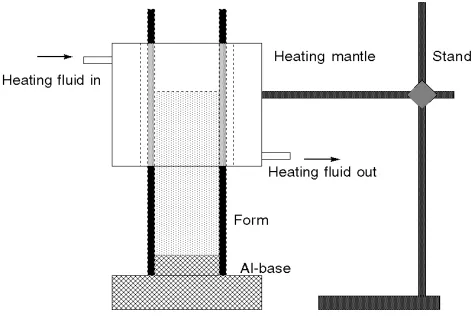
We accomplished this by placing a heating mantle around the tubular forms we used (Figure 2). The mantle was heated up to 105°C and lifted slowly during the solidification process. This effected kind of a zone smelting, which filled in all voids, that could possibly form. The system proved very functional and the final cavity at the top was less than half the diameter of the charge in depth. Without any heating mantle, the cavity would extend down to three quarters of the charge length or more.
T
HERMAL CONDUCTIVITYADN appears to have a low coefficient of thermal conductivity based on experiences with it. It is difficult to cast large diameter charges out of ADN, since the center takes too long to solidify. One can not apply the same practice as with TNT using heaters in the melt to delay the freezing on the top to fill up the central funnel. Such heaters get stuck in the material as only a very thin layer of ADN stays molten around them the rest being solid. Instead, one has to use external heating of the mold or thermal isolation in order to restrict cooling to a wanted location of the mold only.
M
OISTUREC
OMPATIBILITYADN is very reactive with most other materials, which either react with ADN or catalyze the
decomposition of ADN. Some compatible materials are stainless steel (SS2434), aluminium, PTFE, polyethylene, RDX, HMX, zinc oxide, magnesium oxide, Sylgard silicone resin, plexiglass (as polymer only). On the other hand, common materials like iron, nickel, copper, silver, cyanoacrylate glue are totally incompatible with ADN. The inherent incompatibility of ADN with other substances restricted our choices of materials, that we could use to handle ADN. A more thorough study on the compatibility of ADN will be published later as more data has been collected.
ADN
ANDA
LUMINIUM [image:6.612.71.546.379.702.2]Molten ADN has a very high surface tension, which sets some limits for possible aluminium powders. In addition, ADN is a very polar molecule, which effectively removes the possibility of using grease or wax coated aluminium powders. Surface active agents were not used because of unknown compatibility with ADN. We tried several different types of aluminium powders and found spherical and smooth particles worked best at 10 µm size while irregular particles are best at 50 µm
average size. 3 micrometer Al-powder (Valimet H-3) would not blend with ADN at all, but would only float on top of the melt. This was obviously due to a wetting problem of the small particles. 10 micrometer powder of the same type (Valimet H-10) was easy to blend in and had no such wetting problems.
At the coarse end, 100 micrometer powder (Carlfors A-80) would simply sink onto the bottom of the melting kettle and casting form. Thus, it was not possible to use such a coarse powders without some thickeners in the ADN melt. 50 micrometer, irregular shaped Al-powder (Carlfors A-100) worked very well and gave the best densities. This powder was also easiest to handle and blend into ADN melts in addition to being the cheapest and easiest available. The 50 µm powder was selected for all larger charges. A 10 µm irregularly shaped powder (Mepura 10 µm) was also well blending, but the the mixture became so viscous it would not even flow out of the kettle under its own weight. The density of the casting was also very bad, only 50 % of theoretical, probably due to trapped air.
The best Al powder particle size range is 10 to 50 micrometers. The best particle shape was found to be irregular, since such particles do not sediment as quickly as as spherical particles do.
However, spherical Al is also perfectly usable, if a smaller particle size is selected.
P
ROCEDUREADN and ADN/Al -mixture were melted in a stainless steel rotating kettle, thermostated to about 100°C. The exact temperature at the surface of the kettle interior was not measured, but it was between 108°C (heating fluid in) and 90°C (heating fluid out). As the kettle was located in the middle of the heating fluid circulation loop, it is reasonable to assume its temperature is a mean value of the inflow and outflow, i.e. about 100°C.
The molds were made out of steel coated with PTFE. The form itself is a tube, which can be split into two parts to remove the bar. An aluminium ring was turned and fitted on the top to hold the halves together and a hose crimper was placed at the lower part to tighten the the assembly. An aluminium plug was machined and an O-ring fitted to it as a seal. The plug worked both as a plug and as a stand to hold the form in an upright position on the table. A heating mantle around the form was manufactured of aluminium and fitted with heating fluid circulation. The mantle was attached to a stand, that allowed shifting it up and down (Figure 2).
R
ESULTS [image:8.612.70.559.94.468.2]Several blocks of ADN and ADN/Al were cast for detonation velocity and radius of curvature measurements. The final length for all bars was 200 mm. Final diameters for the charges were 25, 40, 60, 100 mm and 120 mm. We cast the charges in the next sized form suitable, which were 26 mm, 44 mm, 66 mm, 100 mm and 120 mm. The 100 mm and 120 mm blocks were cast in two 150 mm long pieces and the excess at the top was sawed off, because the form available was not long enough to cast the required >300 mm long bar in one run. All the other sizes were cast in a single run, though.
C
ONCLUSIONSWe found, that:
* ADN can be melt casted easily, but the technique from melt casting TNT cannot be directly
applied.
* Unstabilized ADN cannot be melt cast.
* ADN has a low coefficient of thermal conductivity, which limits the size of the charges to be
casted due to gas evolution from the melted substance.
* ADN shrinks more than TNT while solidifying making it more difficult to obtain a void-free
casting. The same technique as with TNT cannot be used but the molds need be heated
externally instead.
* Casting ADN produces better density than pressing ADN, contrary to TNT.
* ADN must contain some moisture to make it melt castable and mechanically stable.
* Too dry ADN will crack down to pieces by itself after a few days of storage.
* Aluminium can be mixed into ADN at least up to 35 % content without problems, in fact,
AND-Al-mixtures are easier to cast than ADN without Al, contrary to TNT.
* ADN with aluminium gives significantly better mechanical properties than pure ADN.
* ADN with aluminium gives same or better quality of casting as with pure ADN, i.e. the
proportional density of TMD is approximately the same for both.
* Aluminium functions as crystallizing kernels for ADN producing much finer crystalline
material than ADN without Al.
* MgO is an effective stabilizer for and.
* MgO works as crystal nucleation kernels in molten ADN during solidification.
R
EFERENCES1. R. M. Doherty, J. W. Forbes, G.W. Lawrence, J. S. Deiter, R. N. Baker, K.D. Ashwell and G. T. Sutherland, Detonation Velocity of Melt-Cast ADN and ADN/nanodiamond Cylinders, Meeting of the APS Topical Group on the Shock Compression of Condensed Matter, Amherst, 27th of July - 1st of
August 1997, MA, USA
2. N. Latypov, FOA 21, personal communication
3. H.Östmark, U. Bemm, A. Langlet, R. Sandén and N. Wingborg, Journal of Energetic Materials,
The Properties of Ammonium Dinitramide (ADN): Part 1, Basic Properties and Spectroscopic Data, in press