Annotating ESL Errors: Challenges and Rewards
Alla Rozovskaya and Dan Roth University of Illinois at Urbana-Champaign
Urbana, IL 61801
{rozovska,danr}@illinois.edu
Abstract
In this paper, we present a corrected and error-tagged corpus of essays written by non-native speakers of English. The corpus contains 63000 words and includes data by learners of English of nine first language backgrounds. The annotation was performed at the sentence level and involved correcting all errors in the sentence. Error classification includes mis-takes in preposition and article usage, errors in grammar, word order, and word choice. We show an analysis of errors in the annotated corpus by error categories and first language backgrounds, as well as inter-annotator agree-ment on the task.
We also describe a computer program that was developed to facilitate and standardize the an-notation procedure for the task. The program allows for the annotation of various types of mistakes and was used in the annotation of the corpus.
1 Introduction
Work on automated methods for detecting and cor-recting context dependent mistakes (e.g., (Golding and Roth, 1996; Golding and Roth, 1999; Carlson et al., 2001)) has taken an interesting turn over the last few years, and has focused on correcting mis-takes made by non-native speakers of English. Non-native writers make a variety of errors in grammar and word usage. Recently, there has been a lot of effort on building systems for detecting mistakes in article and preposition usage (DeFelice, 2008; Eeg-Olofsson, 2003; Gamon et al., 2008; Han et al.,
2006; Tetreault and Chodorow, 2008b). Izumi et al. (2003) consider several error types, including article and preposition mistakes, made by Japanese learn-ers of English, and Nagata et al. (2006) focus on the errors in mass/count noun distinctions with an ap-plication to detecting article mistakes also made by Japanese speakers. Article and preposition mistakes have been shown to be very common mistakes for learners of different first language (L1) backgrounds (Dagneaux et al., 1998; Gamon et al., 2008; Izumi et al., 2004; Tetreault and Chodorow, 2008a), but there is no systematic study of a whole range of er-rors non-native writers produce, nor is it clear what the distribution of different types of mistakes is in learner language.
In this paper, we describe a corpus of sentences written by English as a Second Language (ESL) speakers, annotated for the purposes of developing an automated system for correcting mistakes in text. Although the focus of the annotation were errors in article and preposition usage, all mistakes in the sentence have been corrected. The data for anno-tation were taken from two sources: The Interna-tional Corpus of Learner English (ICLE, (Granger et al., 2002a)) and Chinese Learners of English Cor-pus (CLEC, (Gui and Yang, 2003)). The annotated corpus includes data from speakers of nine first lan-guage backgrounds. To our knowledge, this is the first corpus of non-native English text (learner cor-pus) of fully-corrected sentences from such a diverse group of learners1. The size of the annotated corpus is 63000 words, or 2645 sentences. While a corpus
1
Possibly, except for the Cambridge Learner Corpus
http://www.cambridge.org/elt
of this size may not seem significant in many natu-ral language applications, this is in fact a large cor-pus for this field, especially considering the effort to correct all mistakes, as opposed to focusing on one language phenomenon. This corpus was used in the experiments described in the companion paper (Ro-zovskaya and Roth, 2010).
The annotation schema that we developed was motivated by our special interest in errors in arti-cle and preposition usage, but also includes errors in verbs, morphology, and noun number. The cor-pus contains 907 article corrections and 1309 prepo-sition corrections, in addition to annotated mistakes of other types.
While the focus of the present paper is on anno-tating ESL mistakes, we have several goals in mind. First, we present the annotation procedure for the task, including an error classification schema, anno-tation speed, and inter-annotator agreement. Sec-ond, we describe a computer program that we de-veloped to facilitate the annotation of mistakes in text. Third, having such a diverse corpus allows us to analyze the annotated data with respect to the source language of the learner. We show the anal-ysis of the annotated data through an overall break-down of error types by the writer’s first language. We also present a detailed analysis of errors in arti-cle and preposition usage. Finally, it should be noted that there are currently very few annotated learner corpora available. Consequently, systems are eval-uated on different data sets, which makes perfor-mance comparison impossible. The annotation of the data presented here is available2 and, thus, can be used by researchers who obtain access to these respective corpora3.
The rest of the paper is organized as follows. First, we describe previous work on the annotation of learner corpora and statistics on ESL mistakes. Section 3 gives a description of the annotation pro-cedure, Section 4 presents the annotation tool that was developed for the purpose of this project and used in the annotation. We then present error statis-tics based on the annotated corpus across all error types and separately for errors in article and preposi-tion usage. Finally, in Secpreposi-tion 6 we describe how we
2
Details about the annotation are accessible from
http://L2R.cs.uiuc.edu/˜cogcomp/
3The ICLE and CLEC corpora are commercially available.
evaluate inter-annotator agreement and show agree-ment results for the task.
2 Learner Corpora and Error Tagging
In this section, we review research in the annota-tion and error analysis of learner corpora. For a review of learner corpus research see, for exam-ple, (D´ıaz-Negrillo, 2006; Granger, 2002b; Pravec, 2002). Comparative error analysis is difficult, as there are no standardized error-tagging schemas, but we can get a general idea about the types of errors prevalent with such speakers. Izumi et al. (2004a) describe a speech corpus of Japanese learners of En-glish (NICT JLE). The corpus is corrected and anno-tated and consists of the transcripts (2 million words) of the audio-recordings of the English oral profi-ciency interview test. In the NICT corpus, whose error tag set consists of 45 tags, about 26.6% of er-rors are determiner related, and 10% are preposition related, which makes these two error types the most common in the corpus (Gamon et al., 2008). The Chinese Learners of English corpus (CLEC, (Gui and Yang, 2003)) is a collection of essays written by Chinese learners of beginning, intermediate, and advanced levels. This corpus is also corrected and error-tagged, but the tagging schema does not allow for an easy isolation of article and preposition errors. The International Corpus of Learner English (ICLE, (Granger et al., 2002a)) is a corpus of argumenta-tive essays by advanced English learners. The cor-pus contains 2 million words of writing by European learners from 14 mother tongue backgrounds. While the entire corpus is not error-tagged, the French sub-part of the corpus along with other data by French speakers of a lower level of proficiency has been an-notated (Dagneaux et al., 1998). The most com-mon errors for the advanced level of proficiency were found to be lexical errors (words) (15%), regis-ter (10%), articles (10%), pronouns (10%), spelling (8%) , verbs (8%).
languages, the most common error types among 24 different error types were errors in article us-age (28%), vocabulary error (20-25%) (word choice and idioms), prepositions (18%), and verb-subject agreement (15%). He also noted that the speakers of languages without article system made considerably more article errors, but the breakdown of other error types across languages was surprisingly similar.
3 Annotation
3.1 Data Selection
Data for annotation were extracted from the ICLE corpus (Granger et al., 2002a) and CLEC (Gui and Yang, 2003). As stated in Section 2, the ICLE con-tains data by European speakers of advanced level of proficiency, and the CLEC corpus contains es-says by Chinese learners of different levels of pro-ficiency. The annotated corpus includes sentences written by speakers of nine languages: Bulgarian, Chinese, Czech, French, German, Italian, Polish, Russian, and Spanish. About half of the sentences for annotation were selected based on their scores with respect to a 4-gram language model built using the English Gigaword corpus (LDC2005T12). This was done in order to exclude sentences that would require heavy editing and sentences with near-native fluency, sentences with scores too high or too low. Such sentences would be less likely to benefit from a system on preposition/article correction. The sen-tences for annotation were a random sample out of the remaining 80% of the data.
To collect more data for errors in preposition us-age, we also manually selected sentences that con-tained such errors. This might explain why the pro-portion of preposition errors is so high in our data.
3.2 Annotation Procedure
The annotation was performed by three native speakers of North American English, one under-graduate and two under-graduate students, specializing in foreign languages and Linguistics, with previous ex-perience in natural language annotation. A sentence was presented to the annotator in the context of the essay from which it was extracted. Essay context can become necessary, especially for the correction of article errors, when an article is acceptable in the context of a sentence, but is incorrect in the context
of the essay. The annotators were also encouraged to propose more than one correction, as long as all of their suggestions were consistent with the essay context.
3.3 Annotation Schema
While we were primarily interested in article and preposition errors, the goal of the annotation was to correct all mistakes in the sentence. Thus, our er-ror classification schema4, though motivated by our interest in errors in article and preposition usage, was also intended to give us a general idea about the types of mistakes ESL students make. A better understanding of the nature of learners’ mistakes is important for the development of a robust automated system that detects errors and proposes corrections. Even when the focus of a correction system is on one language phenomenon, we would like to have information about all mistakes in the context: Error information around the target article or preposition could help us understand how noisy data affect the performance.
But more importantly, a learner corpus with er-ror information could demonstrate how mistakes in-teract in a sentence. A common approach to de-tecting and correcting context-sensitive mistakes is to deal with each phenomenon independently, but sometimes errors cannot be corrected in isolation. Consider, for example, the following sentences that are a part of the corpus that we annotated.
1. ”I should know all important aspects of English.”→”I should know all of the important aspects of English.”
2. ”But some of the people thought about him as a parodist of a rhythm-n-blues singer.”→”But some people considered him to be a parodist of a rhythm-n-blues singer.”
3. ”...to be a competent avionics engineer...”→...”to become com-petent avionics engineers...”
4. ”...which reflect a traditional female role and a traditional attitude to a woman...”→”...which reflect a traditional female role and a traditional attitude towards women...”
5. ”Marx lived in the epoch when there were no entertainments.”
→”Marx lived in an era when there was no entertainment.”
In the examples above, errors interact with one an-other. In example 1, the context requires a definite article, and the definite article, in turn, calls for the
4
preposition ”of”. In example 2, the definite article after ”some of” is used extraneously, and deleting it also requires deleting preposition ”of”. Another case of interaction is caused by a word choice error: The writer used the verb ”thought” instead of ”consid-ered”; replacing the verb requires also changing the syntactic construction of the verb complement. In examples 3 and 4, the article choice before the words ”engineer” and ”woman” depends on the number value of those nouns. To correctly determine which article should be used, one needs to determine first whether the context requires a singular noun ”engi-neer” or plural ”engineers”. Finally, in example 5, the form of the predicate in the relative clause de-pends on the number value of the noun ”entertain-ment”.
For the reasons mentioned above, the annotation involved correcting all mistakes in a sentence. The errors that we distinguish are noun number, spelling, verb form, and word form, in addition to article and preposition errors . All other corrections, the major-ity of which are lexical errors, were marked as word replacement, word deletion, and word insertion. Ta-ble 1 gives a description of each error type.
4 Annotation Tool
In this section, we describe a computer program that was developed to facilitate the annotation process. The main purpose of the program is to allow an an-notator to easily mark the type of mistake, when cor-recting it. In addition, the tool allows us to provide the annotator with sufficient essay context. As de-scribed in Section 3, sentences for annotation came from different essays, so each new sentence was usu-ally extracted from a new context. To ensure that the annotators preserved the meaning of the sentence being corrected, we needed to provide them with the essay context. A wider context could affect the an-notator’s decision, especially when determining the correct article choice. The tool allowed us to effi-ciently present to the annotator the essay context for each target sentence.
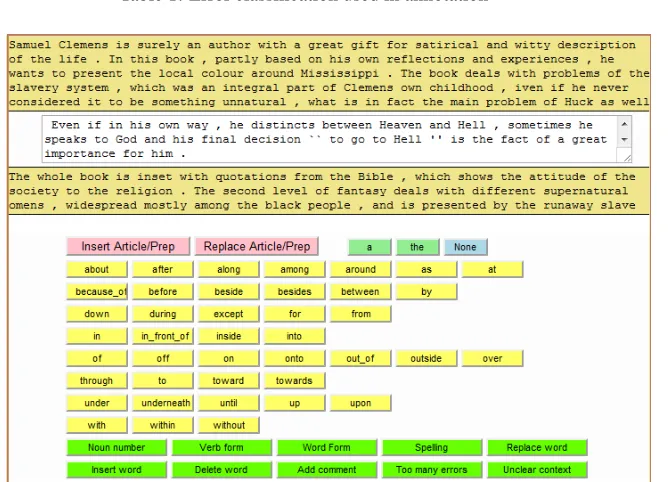
Fig. 1 shows the program interface. The sentence for annotation appears in the white text box and the annotator can type corrections in the box, as if work-ing in a word processor environment. Above and be-low the text box we can see the context boxes, where
the rest of the essay is shown. Below the lower con-text box, there is a list of buttons. The pink buttons and the dark green buttons correspond to different error types, the pink buttons are for correcting arti-cle and preposition errors, and the dark green but-tons – for correcting other errors. The annotator can indicate the type of mistake being corrected by plac-ing the cursor after the word that contains an error and pressing the button that corresponds to this er-ror type. Pressing on an erer-ror button inserts a pair of delimiters after the word. The correction can then be entered between the delimiters. The yellow buttons and the three buttons next to the pink ones are the shortcuts that can be used instead of typing in arti-cles and common preposition corrections. The but-ton None located next to the article butbut-tons is used for correcting cases of articles and prepositions used superfluously. To correct other errors, the annotator needs to determine the type of error, insert the corre-sponding delimiters after the word by pressing one of the error buttons and enter the correction between the delimiters.
The annotation rate for the three annotators varied between 30 and 40 sentences per hour.
Table 2 shows sample sentences annotated with the tool. The proposed corrections are located inside the delimiters and follow the word to which the cor-rection refers. When replacing a sequence of words, the sequence was surrounded with curly braces. This is useful if a sequence is a multi-word expression, such as at last.
5 Annotation Statistics
In this section, we present the results of the anno-tation by error type and the source language of the writer.
Error type Description Examples
Article error Any error involving an article ”Women were indignant at [None/the] inequality from men.”
Preposition error Any error involving a preposition ”...to change their views [to/for] the better.”
Noun number Errors involving plural/singular confusion of a noun
”Science is surviving by overcoming the mistakes not by uttering the [truths/truth] .”
Verb form Errors in verb tense and verb inflec-tions
”He [write/writes] poetry.”
Word form Correct lexeme, but wrong suffix ”It is not [simply/simple] to make professional army .”
Spelling Error in spelling ”...if a person [commited/committed] a crime...”
Word insertion, deletion, or replacement
Other corrections that do not fall into any of the above categories
[image:5.612.105.508.70.196.2]”There is a [probability/possibility] that today’s fan-tasies will not be fanfan-tasies tomorrow.”
[image:5.612.154.489.214.455.2]Table 1: Error classification used in annotation
Figure 1: Example of a sentence for annotation as it appears in the annotation tool window. The target sentence is shown in the white box. The surrounding essay context is shown in the brown boxes. The buttons appear below the boxes with text: pink buttons (for marking article and preposition errors), dark green (for marking other errors), ligh t green (article buttons) and yellow (preposition buttons).
Annotated sentence Corrected errors
1. Television becomes their life , and in many cases it replaces their real life /lives/ noun number (life→lives)
2. Here I ca n’t $help$ but mention that all these people were either bankers or the Heads of companies or something of that kind @nature, kind@.
word insertion (help); word replacement (kind→kind, nature)
3. We exterminated *have exterminated* different kinds of animals verb form (exterminated→have exterminated)
4. ... nearly 30000 species of plants are under the<a>serious threat of disappear-ance|disappearing|
article replacement (the→a); word form (disappear-ance→disappearing)
5. There is &a& saying that laziness is the engine of the<None>progress article insertion (a); article deletion (the)
6. ...experience teaches people to strive to<for>the<None>possible things preposition replacement (to →for); article deletion
(the)
[image:5.612.79.537.548.647.2]Source Total Total Errors per Corrections by Error Type
language sent. words 100 words Articles Prepo- Verb Word Noun Word Spell. Word Punc. sitions form form number order repl.
Bulgarian 244 6197 11.9 10.3% 12.1% 3.5% 3.1% 3.0% 2.0% 5.0% 46.7% 14.2%
Chinese 468 9327 15.1 12.7% 27.2% 7.9% 3.1% 4.6% 1.4% 5.4% 26.2% 11.3%
Czech 296 6570 12.9 16.3% 10.8% 5.2% 3.4% 2.7% 3.2% 8.3% 32.5% 17.5%
French 238 5656 5.8 6.7% 17.4% 2.1% 4.0% 4.6% 3.1% 9.8% 12.5% 39.8%
German 198 5086 11.4 4.0% 13.0% 4.3% 2.8% 1.9% 2.9% 4.7% 15.4% 51.0%
Italian 243 6843 10.6 5.9% 16.6% 6.4% 1.4% 3.0% 2.4% 4.6% 20.5% 39.3%
Polish 198 4642 10.1 15.1% 16.3% 4.0% 1.3% 1.3% 2.3% 2.1% 12.3% 45.2%
Russian 464 10844 13.0 19.2% 17.8% 3.7% 2.5% 2.5% 2.1% 5.0% 28.3% 18.8%
Spanish 296 7760 15.0 11.5% 14.2% 6.0% 3.8% 2.6% 1.6% 11.9% 37.7% 10.7%
[image:6.612.78.536.61.190.2]All 2645 62925 12.2 12.5% 17.1% 5.2% 2.9% 3.0% 2.2% 6.5% 28.2% 22.5%
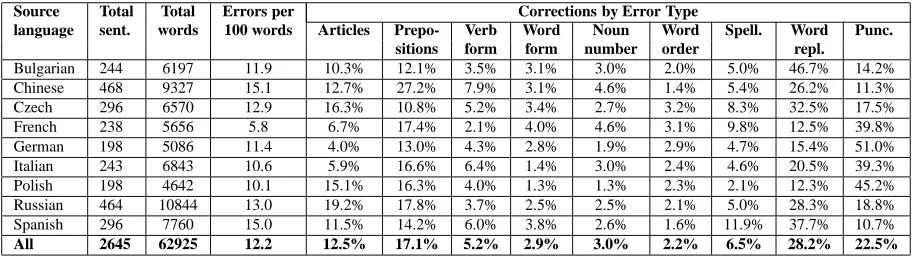
Table 3: Error statistics on the annotated data by source language and error type
the punctuation category, which comprises 22% of all corrections. About 12% of all errors involve ar-ticles, and prepositions comprise 17% of all errors. We would expect the preposition category to be less significant if we did not specifically look for such er-rors, when selecting sentences for annotation. Two other common categories are spelling and verb form. Verb form combines errors in verb conjugation and errors in verb tense. It can be observed from the table that there is a significantly smaller proportion of article errors for the speakers of languages that have articles, such as French or German. Lexical errors (word replacement) are more common in lan-guage groups that have a higher rate of errors per 100 words. In contrast, the proportion of punctua-tion mistakes is higher for those learners that make fewer errors overall (cf. French, German, Italian, and Polish). This suggests that punctuation errors are difficult to master, maybe because rules of punc-tuation are not generally taught in foreign language classes. Besides, there is a high degree of variation in the use of punctuation even among native speak-ers.
5.1 Statistics on Article Corrections
As stated in Section 2, article errors are one of the most common mistakes made by non-native ers of English. This is especially true for the speak-ers of languages that do not have articles, but for ad-vanced French speakers this is also a very common mistake (Dagneaux et al., 1998), suggesting that ar-ticle usage in English is a very difficult language fea-ture to master.
Han et al. (2006) show that about 13% of noun phrases in TOEFL essays by Chinese, Japanese, and
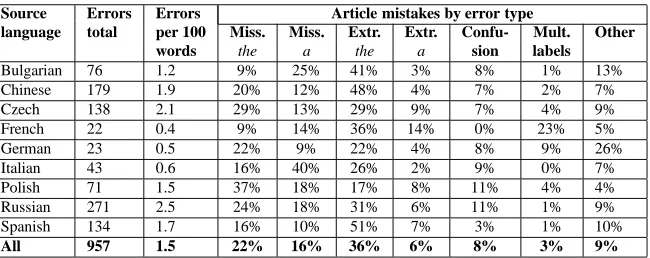
Russian speakers have article mistakes. They also show that learners do not confuse articles randomly and the most common article mistakes are omissions and superfluous article usage. Our findings are sum-marized in Table 4 and are very similar. We also distinguish between the superfluous use of a and the, we allows us to observe that most of the cases of extraneously used articles involve article the for all language groups. In fact, extraneous the is the most common article mistake for the majority of our speakers. Superfluous the is usually followed by the omission of the and the omission of a. An-other statistic that our table demonstrates and that was shown previously (e.g. (Dalgish, 1985)) is that learners whose first language does not have articles make more article mistakes: We can see from col-umn 3 of the table that the speakers of German, French and Italian are three to four times less likely to make an article mistake than the speakers of Chi-nese and all of the Slavic languages. The only ex-ception are Spanish speakers. It is not clear whether the higher error rate is only due to a difference in overall language proficiency (as is apparent from the average number of mistakes by these speakers in Ta-ble 3) or to other factors. Finally, the last column in the table indicates that confusing articles with pro-nouns is a relatively common error and on average accounts for 10% of all article mistakes5. Current article correction systems do not address this error type.
5
Source Errors Errors Article mistakes by error type
language total per 100 Miss. Miss. Extr. Extr. Confu- Mult. Other words the a the a sion labels
Bulgarian 76 1.2 9% 25% 41% 3% 8% 1% 13%
Chinese 179 1.9 20% 12% 48% 4% 7% 2% 7%
Czech 138 2.1 29% 13% 29% 9% 7% 4% 9%
French 22 0.4 9% 14% 36% 14% 0% 23% 5%
German 23 0.5 22% 9% 22% 4% 8% 9% 26%
Italian 43 0.6 16% 40% 26% 2% 9% 0% 7%
Polish 71 1.5 37% 18% 17% 8% 11% 4% 4%
Russian 271 2.5 24% 18% 31% 6% 11% 1% 9%
Spanish 134 1.7 16% 10% 51% 7% 3% 1% 10%
[image:7.612.147.472.60.189.2]All 957 1.5 22% 16% 36% 6% 8% 3% 9%
Table 4: Distribution of article mistakes by error type and source language of the writer. Confusion error type refers to confusing articles a and the. Multiple labels denotes cases where the annotator specified more than one article choice, one of which was used by the learner. Other refers to confusing articles with possessive and demonstrative pronouns.
[image:7.612.314.542.257.384.2]5.2 Statistics on Preposition Corrections
Table 5 shows statistics on errors in preposition us-age. Preposition mistakes are classified into three categories: replacements, insertions, and deletions. Unlike with article errors, the most common type of preposition errors is confusing two prepositions. This category accounts for more than half of all er-rors, and the breakdown is very similar for all lan-guage groups. The fourth category in the table, with original, refers to the preposition usages that were found acceptable by the annotators, but with a bet-ter suggestion provided. We distinguish this case as a separate category because preposition usage is highly variable, unlike, for example, article usage. Tetreault and Chodorow (Tetreault and Chodorow, 2008a) show that agreement between two native speakers on a cloze test targeting prepositions is about 76%, which demonstrates that there are many contexts that license multiple prepositions.
6 Inter-annotator Agreement
Correcting non-native text for a variety of mistakes is challenging and requires a number of decisions on the part of the annotator. Human language allows for many ways to express the same idea. Furthermore, it is possible that the corrected sentence, even when it does not contain clear mistakes, does not sound like a sentence produced by a native speaker. The latter is complicated by the fact that native speakers differ widely with respect to what constitutes acceptable usage (Tetreault and Chodorow, 2008a).
To date, a common approach to annotating non-native text has been to use one rater (Gamon et al.,
Source Errors Errors Mistakes by error type language total per 100 Repl. Ins. Del. With
words orig.
Bulgarian 89 1.4 58% 22% 11% 8%
Chinese 384 4.1 52% 24% 22% 2%
Czech 91 1.4 51% 21% 24% 4%
French 57 1.0 61% 9% 12% 18%
German 75 1.5 61% 8% 16% 15%
Italian 120 1.8 57% 22% 12% 8%
Polish 77 1.7 49% 18% 16% 17%
Russian 251 2.3 53% 21% 17% 9%
Spanish 165 2.1 55% 20% 19% 6%
All 1309 2.1 54% 21% 18% 7%
Table 5: Distribution of preposition mistakes by error type and source language of the writer. With orig refers to prepositions judged as acceptable by the annotators, but with a better suggestion provided.
2008; Han et al., 2006; Izumi et al., 2004; Na-gata et al., 2006). The output of human annota-tion is viewed as the gold standard when evaluating an error detection system. The question of reliabil-ity of using one rater has been raised in (Tetreault and Chodorow, 2008a), where an extensive reliabil-ity study of human judgments in rating preposition usage is described. In particular, it is shown that inter-annotator agreement on preposition correction is low (kappa value of 0.63) and that native speakers do not always agree on whether a specific preposi-tion constitutes acceptable usage.
cor-Agreement set Rater Judged Judged correct incorrect
Agreement set 1 Rater #2 37 63
Rater #3 59 41
Agreement set 2 Rater #1 79 21
Rater #3 73 27
Agreement set 3 Rater #1 83 17
[image:8.612.96.281.61.139.2]Rater #2 47 53
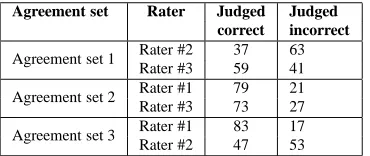
Table 6: Annotator agreement at the sentence level. The number next to the agreement set denotes the annotator who corrected the sentences on the first pass. Judged cor-rect denotes the proportion of sentences in the agreement set that the second rater did not change. Judged incorrect denotes the proportion of sentences, in which the second rater made corrections.
rections were applied. This corrected set was mixed with new sentences and given to the other two anno-tators. In this manner, each annotator received two hundred sentences corrected by the other two anno-tators. For each pair of the annotators, we compute agreement based on the 100 sentences on which they did a second pass after the initial corrections by the third rater. To compute agreement at the sentence level, we assign the annotated sentences to one of the two categories: ”correct” and ”incorrect”: A sen-tence is considered ”correct” if a rater did not make any corrections in it on the second pass 6. Table 6 shows for each agreement set the number of sen-tences that were corrected on the second pass. On average, 40.8% of the agreement set sentences be-long to the ”incorrect” category, but the proportion of ”incorrect” sentences varies across annotators.
We also compute agreement on the two cate-gories, ”correct” and ”incorrect”. The agreement and the kappa values are shown in Table 7. Agree-ment on the sentences corrected on the second pass varies between 56% to 78% with kappa values rang-ing from 0.16 to 0.40. The low numbers reflect the difficulty of the task and the variability of the na-tive speakers’ judgments about acceptable usage. In fact, since the annotation requires looking at sev-eral phenomena, we can expect a lower agreement, when compared to agreement rate on one language phenomenon. Suppose rater A disagrees with rater B on a given phenomenon with probability 1/4, then, when there are two phenomena, the probabil-ity that he will disagree with at least on of them is
6We ignore punctuation corrections.
Agreement set Agreement kappa
Agreement set 1 56% 0.16
Agreement set 2 78% 0.40
[image:8.612.350.500.61.102.2]Agreement set 3 60% 0.23
Table 7: Agreement at the sentence level. Agreement shows how many sentences in each agreement set were assigned to the same category (”correct”, ”incorrect”) for each of the two raters.
1−9/16 = 7/16. And the probability goes down
with the number of phenomena.
7 Conclusion
In this paper, we presented a corpus of essays by stu-dents of English of nine first language backgrounds, corrected and annotated for errors. To our knowl-edge, this is the first fully-corrected corpus that con-tains such diverse data. We have described an anno-tation schema, have shown statistics on the error dis-tribution for writers of different first language back-grounds and inter-annotator agreement on the task. We have also described a program that was devel-oped to facilitate the annotation process.
While natural language annotation, especially in the context of error correction, is a challenging and time-consuming task, research in learner corpora and annotation is important for the development of robust systems for correcting and detecting errors.
Acknowledgments
We thank the anonymous reviewers for their helpful comments. This research is partly supported by a grant from the U.S. Department of Education.
References
J. Bitchener, S. Young and D. Cameron. 2005. The Ef-fect of Different Types of Corrective Feedback on ESL Student Writing. Journal of Second Language Writ-ing.
A. J. Carlson and J. Rosen and D. Roth. 2001. Scaling Up Context Sensitive Text Correction. IAAI, 45–50. M. Chodorow, J. Tetreault and N-R. Han. 2007.
De-tection of Grammatical Errors Involving Prepositions. Proceedings of the Fourth ACL-SIGSEM Workshop on Prepositions.
G. Dalgish. 1985. Computer-assisted ESL Research. CALICO Journal, 2(2).
G. Dalgish. 1991. Computer-Assisted Error Analysis and Courseware Design: Applications for ESL in the Swedish Context. CALICO Journal, 9.
R. De Felice and S. Pulman. 2008. A Classifier-Based Approach to Preposition and Determiner Error Correc-tion in L2 English. In Proceedings of COLING-08. A. D´ıaz-Negrillo and J. Fern´andez-Dom´ınguez. 2006.
Error Tagging Systems for Learner Corpora. RESLA, 19:83-102.
J. Eeg-Olofsson and O. Knuttson. 2003. Automatic Grammar Checking for Second Language Learners -the Use of Prepositions. In Nodalida.
M. Gamon, J. Gao, C. Brockett, A. Klementiev, W. Dolan, D. Belenko and L. Vanderwende. 2008. Using Contextual Speller Techniques and Language Model-ing for ESL Error Correction. ProceedModel-ings of IJCNLP. A. R. Golding and D. Roth. 1996. Applying Winnow to Context-Sensitive Spelling Correction. ICML, 182– 190.
A. R. Golding and D. Roth. 1999. A Winnow based ap-proach to Context-Sensitive Spelling Correction. Ma-chine Learning, 34(1-3):107–130.
S. Granger, E. Dagneaux and F. Meunier. 2002. Interna-tional Corpus of Learner English
S. Granger. 2002. A Bird’s-eye View of Learner Cor-pus Research. Computer Learner Corpora, Second Language Acquisition and Foreign Language Teach-ing, Eds. S. Granger, J. Hung and S. Petch-Tyson, Amsterdam: John Benjamins. 3–33.
S. Gui and H. Yang. 2003. Zhongguo Xuexizhe Yingyu Yuliaohu. (Chinese Learner English Corpus). Shang-hai Waiyu Jiaoyu Chubanshe. (In Chinese).
N. Han, M. Chodorow and C. Leacock. 2006. Detect-ing Errors in English Article Usage by Non-native Speakers. Journal of Natural Language Engineering, 12(2):115–129.
E. Izumi, K. Uchimoto, T. Saiga and H. Isahara. 2003. Automatic Error Detection in the Japanese Leaners English Spoken Data. ACL.
E. Izumi, K. Uchimoto and H. Isahara. 2004. The Overview of the SST Speech Corpus of Japanese Learner English and Evaluation through the Exper-iment on Automatic Detection of Learners’ Errors. LREC.
E. Izumi, K. Uchimoto and H. Isahara. 2004. The NICT JLE Corpus: Exploiting the Language Learner’s Speech Database for Research and Education. Inter-national Journal of the Computer, the Internet and Management, 12(2):119–125.
R. Nagata, A. Kawai, K. Morihiro, and N. Isu. 2006. A Feedback-Augmented Method for Detecting Errors in the Writing of Learners of English. ACL/COLING.
N. Pravec. 2002. Survey of learner corpora. ICAME Journal, 26:81–114.
A. Rozovskaya and D. Roth 2010. Training Paradigms for Correcting Errors in Grammar and Usage. In Pro-ceedings of the NAACL-HLT, Los-Angeles, CA. J. Tetreault and M. Chodorow. 2008. Native Judgments