Dialogue Systems for Virtual Environments
Luciana Benotti, Paula Estrella, Carlos Areces Grupo de Procesamiento de Lenguaje Natural (PLN)
Secci´on de Ciencias de la Computaci´on
Facultad de Matem´atica, Astronom´ıa y F´ısica (FaMAF) Universidad Nacional de C´ordoba, Argentina
Abstract
We present an on-going research project car-ried out at the Universidad Nacional de C´ordo-ba in Argentina. This project investigates the-oretical and practical research questions re-lated to the development of a dialogue system situated in a virtual environment. We describe the PLN research group in which this project is being developed and, in particular, we spell out the areas of expertise of the authors. More-over, we discuss relevant past, current and fu-ture collaborations of the research group.
1 Introduction
The goal of this project is to implement a dialogue system which automatically generates instructions in order to help a user to fulfill a given task in a 3D virtual environment. In this context, we will investi-gate fundamental issues about human-computer in-teraction. The expected results of the project can be classified in three areas: pragmatics of interaction; information representation and inference; and eval-uation of dialogue systems. Once a working proto-type is finished, we will adapt it to the specific task of language learning, using the system as a virtual language teacher. Our prototype will teach English to native Spanish speakers. Hence, it will need to understand and produce both languages.
Initially, we will investigate a model of unidirec-tional linguistic interaction (i.e., linguistic informa-tion flows only from the system to the user). In sub-sequent stages, the model will be extended to allow bidirectional language exchange. For example, the
user may ask clarifications to the system or redefine the goal of the interaction.
The architecture of the envisioned dialogue sys-tem presents both theoretical and practical chal-lenges. On the theoretical side, heuristics are needed in order to govern decisions such as what to say, when, and how (given the current context). In addi-tion, the system should implement inference meth-ods in order to figure out how to modify the cur-rent situation and reach the task goal. The complex-ity of the theoretical issues is reflected, in practice, in a system of multiple components: a natural lan-guage generator, a planner, a 3D interactive envi-ronment, to mention a few. Designing and imple-menting all these components from scratch would require a prohibitive effort. Instead we will adapt tools already implemented and freely available for prototyping this kind of systems, such as the plat-formGIVE1, Generating Instructions in Virtual En-vironments(Byron et al., 2009).
The quality of each of the components of the sys-tem affects the perception users have of it. It is im-perative to carry out extensive evaluation. We plan to adapt and apply different evaluation techniques and metrics from the area of Machine Translation to assess the performance of the system.
The plan of the paper is as follows. Section 2 describes the project in detail. Section 3 spells out the expected results as well as their foreseen impact in the Argentinean socio-economic landscape. Sec-tion 4 presents the PLN research group including its lines of research. Section 5 discuss past, current and future collaborations that are relevant to the project.
1http://www.give-challenge.org
2 Description of the Project
This section first introduces the virtual environ-ment in which our dialogue system will be situated, namely the GIVE platform, which is the basic ar-chitecture of our dialogue system. Then we explain in detail the tasks that our situated dialogue system will implement, and we spell out the evaluation chal-lenges that such a system poses. We close the sec-tion discussing the applicasec-tion of our dialogue sys-tem for the task of second language learning.
2.1 The Virtual Environment
In the scenario proposed by GIVE (Byron et al., 2009), a human user carries out a “treasure hunt” in a 3D virtual environment and the task of the genera-tion system is to provide real-time, natural language instructions that help the user find the hidden trea-sure.
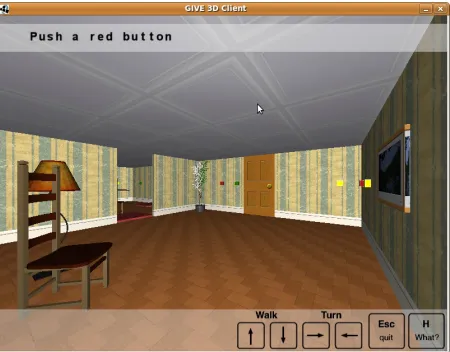
[image:2.612.74.299.431.607.2]In the GIVE setup, the instruction giving system must guide the user through interconnected rooms. The final goal is to get a trophy which is hidden in a safe. In order to achieve this goal, the system in-structs the user to perform several subtasks such as deactivating alarms and opening the safe combina-tion by pressing a sequence of buttons on the walls of the rooms.
Figure 1: The user’s view of the 3D world
Figure 1 shows a screen-shot of the user’s view on the 3D world. On the top of the picture, the current instruction generated by the dialogue system is dis-played. The picture shows a closed door and an open
door that has an activated alarm (that looks like a red tile) in the doorway. There are five visible buttons in this room (two yellow, two red and one green) and the instruction giver is instructing the user to press a red button. Pressing a button can have different effects such as opening a door, moving an object, deactivating an alarm, etc.
The characteristics of the world, including the functions of the buttons, are described in the world specification by the world designers. The user can move freely around the world (using the direction keys as indicated in the bottom of the screen) but she can loose the game if she triggers an alarm. The user can also ask for help pressing ‘H’ if she did not manage to read or understand the last instruction.
For the correct definition of the interaction poli-cies of our prototype we need a corpus that pro-vides examples of typical interactions in the domain. GIVE provides tools for collecting such a corpus in the form of a Wizard of Oz platform that records all details of the interaction, thus allowing to easily ob-tain a corpus of interaction in virtual environments annotated automatically.
2.2 The Dialogue System Tasks
From the collected corpus we will begin the design, implementation and testing of our dialogue system. The main components that we will have to design and implement can be organized using the tradi-tional four tasks that a dialogue system should ad-dress: (1) content planning, (2) generation of refer-ring expressions, (3) management of the interaction context, and (4) interpretation of user responses.
aggregation policies (e.g., aggregating actions that manipulate similar objects) and innovative ways in which to navigate the task tree (e.g., moving to a lower level of abstraction in case of misunderstand-ings). Plan computation can be solved using clas-sical planners (Kautz and Selman, 1999; Hoffmann and Nebel, 2001; Nau et al., 2004). However, while there are planners that work well when optimized for certain applications, none provides services such as the generation of alternative plans, or the generation of incomplete plans in case of the absence of plan. One of the goals of the project is to design and im-plement these extensions to classical planning algo-rithms. We will also study the theoretical behavior (e.g., complexity) of these new algorithms.
(2) Generation of Referring Expressions: Once content planning is complete, the next step is to gen-eration adequate referring expressions. This task involves producing a phrase that describes a refer-able entity so that the user can identify it (e.g., “the vase on the table”). To be acceptable, these expres-sions should be “natural:” they should be at the same time sufficiently but not overly constrained, and they should not impose on the user a heavier cognitive load than necessary. For example, producing the expression “the vase that is not above the chair or sofa or under the table” would probably not be ac-ceptable. Areces et al. (2008b) propose to use sym-bolic minimization of the model that represents the state of the world, in order to obtain a logical repre-sentation that describe each object uniquely. In our project we will implement this method and evaluate it within the dialogue system.
(3) Management of the Interaction Context: To manage the use of the interaction context we will use existing knowledge maintenance systems such as RACER2 or Pellet3, which support inference tasks such as definition, maintenance and querying of on-tologies. These systems have been used as infer-ence engines in numerous applications in the area and, in particular, in dialogue systems for text ad-ventures (Benotti, 2009b). Once we have studied the behavior of these inference engines on the task, we will analyze its limitations and investigate the re-quired extensions.
2
http://www.racer-systems.com
3http://clarkparsia.com/pellet
(4) Interpretation of User Responses: The inter-pretation of user responses in the unidirectional sys-tem is relatively simple: it amounts to discretizing the continuous flow of user behavior in the 3D world into actions meaningful for the domain task. In a first stage, we will use the discretizer provided by GIVE. After evaluating it we can determine whether or not this module meets the requirements of our task and what are its limitations. In the bidirectional system, however, the interpretation of user responses is the task that will require more attention. To start with, the bidirectional system should be expanded with capabilities for processing statements coming from the user (namely, parsing, semantic construc-tion, resolution of references, etc.). We will study, in particular, two types of user contributions: re-quests for clarification of the instruction given (what we call ‘short-term repairs’), and for redefinition of goals (what we call ‘long-term repairs’). We will implement short-term repairs using the approach de-scribed in (Purver, 2006). For long-term repairs we will use the guidelines of (Blaylock, 2005).
A sample interaction with the unidirectional sys-tem guiding the player in the identification of a par-ticular blue button is as follows:
(1) System says: Push a blue button.
The user focuses a blue button.
System says: Not this one.
Look for another one.
The user turns and focuses another blue button.
System says: Yes this one!
The user pushes the button.
contributions but can change the context by perform-ing physical acts, the correct interpretation of such acts is essential if the system is to react coherently.
2.3 Evaluation
To determine the quality of the obtained prototypes we propose to create a quality model following the ISO/IEC 9126 and 14528 standards for the evalua-tion of software products (ISO/IEC, 2001; ISO/IEC, 1999). These standards were successfully applied to the Machine Translation domain, resulting in the
FEMTI4, Framework for the Evaluation of Machine Translation (Estrella et al., 2005). FEMTI guides evaluators towards creating parameterized evalua-tion plans that include various aspects of the to-be-evaluated system and offer a relevant set of met-rics. The identification of relevant metrics can be performed using various methods, e.g., based on previous experience (Hajdinjak and Mihelic, 2006; Litman and Pan, 2002), conducting surveys or re-quirement specifications (Lecoeuche et al., 1998), or collecting such data through Wizard of Oz experi-ments (Dahlb¨ack et al., 1998). After developing a quality model, several methodologies to assess vari-ous aspects of the system can be applied: automatic metrics, subjective metrics or metrics based on the task (to evaluate both the contribution of each com-ponent and the quality of the whole system).
The GIVE platform is used every year as a uni-fied framework for evaluating generation systems. Systems have to generate natural language instruc-tions and be able to participate in a real-time interac-tion situated in a 3D environment. The GIVE Chal-lenge is one of the shared tasks endorsed by ACL’s special interests groups in generation, dialogue and semantics. We plan to participate in the challenge, which will serve as an additional source of informa-tion about aspects of the system that need improve-ment. The evaluation metrics used in the Challenge (such as average reference identification time) are described in (Byron et al., 2009). In (Amoia et al., 2010) we extended such metrics in order to measure alingment between system and user. Once the pro-totype is evaluated and improved using the results of the challenge, we will investigate its use as a virtual language tutor as described in the next section.
4http://www.issco.unige.ch/femti/
2.4 An Application: A Virtual Tutor
The project outcome will be a system capable of giv-ing natural language instructions situated in a virtual 3D environment. The technology and theoretical ad-vances of the project could be used in various appli-cations, but one of the most interesting character-istics we plan to investigate is that, a priori, by just changing the linguistic resources, the language of in-teraction with the system (input and output) can be changed as desired. After obtaining a first prototype of an instruction giving dialogue system, we will in-vestigate its use for distance learning, adapting the system to operate as a foreign language tutor (Wik and Hjalmarsson, 2009).
A one-way system that generates instructions in English can be used to test the user understanding of a foreign language. The correct interpretation of the instructions can be evaluated from the proper ex-ecution of the instructions. The two-way system will allow the user to formulate clarifications (ei-ther in their native language or in the foreign lan-guage). The user may also redefine the objective to be achieved during the interaction, and thus select the type of vocabulary he wants to practice.
Virtual worlds (like Second Life) are being rapidly incorporated into education, both initial and superior (Doswell, 2005; Molka-Danielsen and Deutschmann, 2009). The use of a virtual tutor has certain advantages over a human tutor. Eng-wall (2004) mentioned the following. (1) Amount of practice: the chance to practice the new language is essential for learning, and a virtual tutor provides opportunities only limited by the technological re-sources. (2) Prestige: a student may feel embar-rassed about making mistakes with a human tutor, and this might limit his willingness to speak in the foreign language. (3) Augmented Reality: a virtual tutor can provide additional material (e.g., examples in context, explanatory images, etc.) with less effort than a human tutor.
for non-experts uses whose knowledge evolves dur-ing the interaction. Moreover, the system must be able to properly represent both the information con-cerning the course material, and information about the evolution of the user. For example, the system must be able to diagnose what part of the course ma-terial should be reviewed from the wrong answers of the user. Finally, the system must be able to evaluate the user interaction in order to decide which learning objectives have been achieved. The theoretical and practical results of the project contribute to solving these difficult problems.
3 Impact of the Project
This project aims to achieve a balance between a system which is sufficiently generic to be applica-ble in different areas, and specific enough to ben-efit from the efficient use of existing techniques for knowledge management, planning and natural language processing. Designing and implementing such a system is a multidisciplinary effort leading to research in diverse scientific areas:
Pragmaticsis an interdisciplinary field which inte-grates insights from linguistics (e.g., conversational implicatures (Grice, 1975)), sociology (e.g., conver-sational analysis (Schegloff, 1987)) and philosophy (e.g., theory of speech acts (Austin, 1962)). It aims to explore how the context (in which a conversation is situated) contributes to the meaning (of everything that is said during that conversation). The meaning conveyed during a conversation depends not only on linguistic information (entities in focus, grammati-cal and morphologigrammati-cal rules, etc.) but also on extra-linguistic information (physical situation of conver-sation, previous experiences of speakers, etc.). As a result, the same sentence may mean different things in different contexts. The area of pragmatics studies the process by which a sentence is disambiguated using its context. A dialogue system needs to have pragmatic capabilities in order to interact in a nat-ural way with its users. In particular, it must define what kind of contextual information should be repre-sented; and what inference tasks on a sentence and context are necessary in order to interpret an utter-ance. In such a system it is important that sentences makes explicit the right amount of information: too much information will delay and bore the user, but if
the information is not enough the user will not know how to perform the task and make mistakes.
One of the major contributions of the project in this area will be a virtual laboratory for pragmatic theories: a controlled environment for studying in-teraction set in a world where physical actions and language intermingle. The prototype will let us in-vestigate the impact that different instruction giving policies (e.g., post order on the tree structure of the task) have on successful achievement of the goal. Similar studies have been done before (e.g., (Fos-ter et al., 2009)) but they usually assume a prede-termined task. Since our prototype allows for the specification of the virtual world, the available ac-tions, and the goal, we will be able to determine when the impact associated to a particular policy is dependent on the task or not. We will also investi-gate short and long term repairs. Repairs are usu-ally caused by conversational implicatures (Benotti, 2009a). Modeling these implicatures in a generic di-alogue system is difficult because they are too open ended. However, since the present prototype pro-vides a situated interaction, restricted to the virtual world, it will be possible to test the relationship be-tween implicatures, the type of repairs they give rise to, and the inference tasks needed to predict them.
Inferencecan be understood as any operation that
the cost of the required inference methods.
The main contribution of the project in this area is in the design, development and study of planning algorithms. A typical planning system takes three inputs –initial state, possible actions and expected goal– and returns a sequence of actions (a plan) that when sequentially applied to the initial state, ends in a state that satisfies the goal. Different methods to obtain a plan have been studied (forward chain-ing, backward chainchain-ing, coding in terms of proposi-tional satisfiability, etc.), and they are currently im-plemented in systems that can solve many planning tasks efficiently. However, most of these systems make assumptions that simplify the problem (deter-ministic atomic time, complete information, absence of a background theory, etc.). And most of them re-turn a single plan. We will investigate algorithms that eliminate some of these simplifications (in par-ticular, we will study planning with incomplete in-formation and based on a background theory). We will also provide extended planning services: alter-native plans, minimal plans, conditional plans, in-complete plans, affordability of a given state, etc.
Evaluationof natural language generation systems
is one of the most difficult tasks in the area of NLP. A given concept can be expressed in many different ways, all of them correct. Hence, it is not possible to determining the quality of a generated sentence simply by, for example, comparing the result with a gold standard. The problem of absence of gold stan-dards is shared with another area of the NLP, namely Machine Translation, for which various evaluation methodologies, both direct and indirect, have been proposed. Direct methods applies a metric to the text generated by the system, while indirect meth-ods evaluates the performance of the system through the use of the generated text to perform some task. But none of these methods is a standard and gener-ally accepted methodology, which has been proven to be effective in all cases. Since what is being eval-uated in this project is a system that interacts via the generation of natural language instructions, we can determine its performance through quantitative met-rics (e.g., average task completion time), qualitative metrics (e.g., general user satisfaction) and metrics based on the context (e.g., how well the system ad-dressed the user needs in particular situations). We
will study the portability of evaluation techniques from the domain of machine translation and multi-modal human-computer interaction to the evaluation of the system proposed in this project.
One of the main contributions of our project at this respect is the integration of assessment tech-niques from different areas into a methodology for evaluating dialog systems for virtual environments, aiming to estimate their usability and effectiveness. This methodology could be used both to determine whether a system is suitable for a task type and user, and to compare the performance of different systems of the same type. Another contribution will be the study and application of software eval-uation standards to the developed systems, creat-ing a standardized quality model and proposcreat-ing a set of appropriate metrics to assess each of the as-pects of the model. Finally, the annotated corpus of human-human interaction, together with the cor-pus of human-machine interaction collected during the project will be made public. Such corpora will serve, for example, to design more general platforms for evaluating dialog systems, going beyond the as-pects evaluated by existing platforms like GIVE.
Impact in the Argentinean Landscape: Natural
language processing, and in particular the field of dialogue systems is a rapidly growing area in devel-oped countries. The automatic processing of natu-ral language has become a strategic capability for companies and the wider community. However, this area is extremely underdeveloped in Argentina. This can be attributed to several factors. (a) The relative youth of the area of NLP, which implies a relative dearth of trained professionals throughout the world. (b) The underdevelopment of the area of research in Artificial Intelligence and Formal Linguistics in Ar-gentina, for historical reasons and lack of industry demand. (c) Poor interaction between the few re-searchers in NLP that are in the region.
the growth and diversification of the critical mass in the area. (c) Improving interaction between various groups and individual researchers in NLP, through the organization of workshops, courses, visits, co-tutoring, coordinated specialization programs, etc.
The particular topics investigated in the frame-work of this project are of relevance in the current Argentinean landscape for at least two reasons. On the one hand, the project integrates and develops var-ious key aspects of the area of computational lin-guistics (syntax, semantics, pragmatics, representa-tion, inference, evaluation); an area which, as we mentioned, is today almost nonexistent in Argentina. This project will be a step towards reversing this sit-uation. On the other hand, the ultimate goal of the project is to investigate the use of the developed plat-form for distance education (specifically, as a tool for language learning). Distance education is a valu-able resource to overcome the problem of centraliza-tion of educacentraliza-tional resources in the country.
4 Introducing the Research Group
The PLN5 research group, in which the describe
scientific project will be carried out, was funded in 2005. Te group is developing an important role in human resource training, delivering courses to undergraduate and postgraduate student at the Universidad de C´ordoba and other universities. It also works in the development of various research projects and integration with other groups in the re-gion, both within Argentina and with neighboring countries (Chile, Brazil and Uruguay).
The current project pools together many of the key areas of expertise of the members of the group. To begin with, some members of the group special-ize in computational logic, particularly in the theo-retical and applied study of languages for knowledge representation (e.g., modal, hybrid and description logics). They have also developed automated theo-rem provers for these languages6. In relation with the study of knowledge representation, they have also investigated and developed algorithms for gen-erating referring expressions (Areces et al., 2008b).
The second line of research of the PLN group that is relevant for this project is context-based
evalua-5
http://www.cs.famaf.unc.edu.ar/˜pln
6http://www.glyc.dc.uba.ar/intohylo/
tion. Members of the group have proposed an eval-uation model for machine translation systems which relates the context of use to potentially important quality characteristics (Estrella et al., 2008; Estrella et al., 2009). This model is general enough to be applied to other systems that produce natural lan-guage like the ones proposed in this paper. Thanks to the background on machine translation systems the team has experience evaluating and comparing natu-ral language output produced in different languages (Spanish and English in particular), which will be relevant for the development of the language tutor described in Section 2.4. Finally, the team has ex-perience developing and evaluating multimodal cor-pora like those described in Section 2 (Estrella and Popescu-Belis, 2008).
The third line of research that is relevant for this project is pragmatics. In this area the team has im-plemented a conversational agent which is able to infer and negotiate conversational implicatures us-ing inference tasks such as classical plannus-ing and planning under incomplete information (Benotti, 2009b). We have also investigated how to infer conversational implicatures triggered by compara-tive utterances (Benotti and Traum, 2009). Recently we have done corpus-based work, which shows what kinds of implicatures are inferred and negotiated by human dialogue participants during a task situated in a 3D virtual environment (Benotti, 2009a).
Other lines of research in the PLN group are not directly related to the project at this stage, but might become relevant in the future. They include gram-mar induction, text mining, statistical syntactic anal-ysis and ontology population from raw text.
5 Ongoing and Future Collaborations
The members of the PLN in general and the authors of this paper in particular have several collaborations with national and international research groups in computational linguistics and related fields that are relevant for this project.
At the international level, we have ongoing col-laboration with the TIM/ISSCO7 Multilingual In-formation Processing Departmentat the University of Geneva, with the Idiap Research Institute8 and
7
http://www.issco.unige.ch/en
with some members of the PAI9, Pervasive Artifi-cial Intelligencegroup of the University of Fribourg. These collaborations include the evaluation of NLP systems and the development of multilingual and multimodal human language technology systems.
Members of the group have a long standing col-laboration with the TALARIS10 group of the Labo-ratoire Lorrain de Recherche en Informatique et ses Applications (LORIA). The main research topic at TALARIS is computational linguistics with strong emphasis on semantics and inference. In the frame-work of this collaboration we are participating in the 2010 edition of the GIVE Challenge. In the pro-cess of designing the systems that will participate in the challenge we jointly investigated the use of dif-ferent referring strategies in situated instruction giv-ing (Amoia et al., 2010).
We have also collaborated with the Virtual Hu-mans group of the Institute for Creative Technolo-gies11 from the University of Southern California. In particular we computationally modeled the in-ference of conversational implicatures triggered by comparative utterances (Benotti and Traum, 2009). The Institute for Creative Technologies offers In-ternship programs every year that we plan to use in order to strengthen our collaboration.
All these collaborations are directly related to the main theme of the project described in this arti-cle. The PLN group has also research collaborations with other international research teams in the frame-work of other scientific programs. For example, the PLN group has being part of a recently finished in-ternational project MICROBIO12on ontology popu-lation from raw text. The project was funded by the Stic-Amsud13 program, a scientific-technological cooperation program integrated by France, Argen-tine, Brazil, Chile, Paraguay, Peru and Uruguay. The expertise obtained during this project might be use-ful in the future when trying to extend our GIVE on-tologies to new domains. Similarly, the team main-tain scientific relations with the University of Texas at Austin (mainly with Dr. J. Moore in projects
re-9http://diuf.unifr.ch/pai/wiki 10http://talaris.loria.fr 11
http://ict.usc.edu/projects/virtual_humans
12
http://www.microbioamsud.net
13http://www.sticamsud.org
lated to the development of the ACL214prover); and with the Research team Symbiose15of the Institut de Recherche en Informatique et Syst´emes Al´eatoires (working on the use of linguistic techniques for the modelisation of genomic sequences).
At the national level, the group has inten-sively collaborated with GLyC16,Grupo de L´ogica, Lenguaje y Computabilidadon knowledge represen-tation and inference (see, e.g. (Areces and Gor´ın, 2005; Areces et al., 2008a)). GLyC is part of the Computer Science Department of the Universidad de Buenos Aires. During 2010, teams PLN and GLyC will join forces and collaborate in the organi-zation of ELiC17, theFirst School in Computational Linguistics in Argentina, which will take place in July at the Universidad de Buenos Aires. ELiC 2010 will be co-located with the ECI18, Escuela de Cien-cias Inform´aticas which has a long standing repu-tation as a high-quality winter school in Computer Science in Argentina, and is being organized yearly since 1987. With ELiC we aim at creating, for the first time, a space to introduce the field of computa-tional linguistics to graduate students in Argentina. Thanks to the support of the North American Chap-ter of the Association for Computational Linguis-tics (NAACL) and of the Universidad de Buenos Aires, ELiC is offering student travel grants and fee waivers to encourage participation.
The PLN group is also contacting other groups working in computational linguistics in Argentina like the research group in Artificial Intelligence from the Universidad Nacional del Comahue19. Taking advantage of previous co-participation in different project we plan to organize exchange programs in the framework of a research network.
Finally, the PLN group is planning to orga-nize a workshop on Computational Linguistics as a satellite event of IBERAMIA 201020, the Ibero-American Conference on Artificial Intelligence, that will be organized by the Universidad del Sur, in the city of Bah´ıa Blanca, Argentina.
14
http://www.cs.utexas.edu/users/moore/acl2
15http://www.irisa.fr/symbiose 16http://www.glyc.dc.uba.ar
17http://www.glyc.dc.uba.ar/elic2010 18
http://www.dc.uba.ar/events/eci/2009/eci2009
19
http://www.uncoma.edu.ar/
References
M. Amoia, A. Denis, L. Benotti, and C. Gardent. 2010. Evaluating referring strategies in situated instruction giving.Topics in Cognitive Science. Submitted. C. Areces and D. Gor´ın. 2005. Ordered resolution with
selection for H(@). In F. Baader and A. Voronkov, editors, Proc. of LPAR 2004, volume 3452 of LNCS, pages 125–141. Springer.
C. Areces, D. Figueira, S. Figueira, and S. Mera. 2008a. Expressive power and decidability for memory log-ics. InLogic, Language, Information and Computa-tion, volume 5110 ofLNCSs, pages 56–68. Springer. C. Areces, A. Koller, and K. Striegnitz. 2008b. Referring
expressions as formulas of description logic. InProc. of INLG-08.
J. Austin. 1962. How to do Things with Words. Oxford University Press.
L. Benotti and D. Traum. 2009. A computational ac-count of comparative implicatures for a spoken dia-logue agent. InProc. of IWCS-8.
L. Benotti. 2009a. Clarification potential of instructions. InSIGDIAL-09.
L. Benotti. 2009b. Frolog: An accommodating text-adventure game. InProc. of EACL-09.
N. Blaylock. 2005. Towards tractable agent-based dia-logue. Ph.D. thesis, University of Rochester, Depart-ment of Computer Science.
D. Byron, A. Koller, K. Striegnitz, J. Cassell, R. Dale, J. Moore, and J. Oberlander. 2009. Report on the 1st GIVE challenge. InProc. of ENLG, pages 165–173. N. Dahlb¨ack, A. J¨onsson, and L. Ahrenberg. 1998.
Wiz-ard of Oz studies—why and how. InReadings in intel-ligent user interfaces, pages 610–619. Morgan Kauf-mann Publishers Inc.
J. Doswell. 2005. It’s virtually pedagogical: pedagogi-cal agents in mixed reality learning environments. In
Proc. of SIGGRAPH-05, page 25. ACM.
O. Engwall, P. Wik, J. Beskow, and G. Granstr¨om. 2004. Design strategies for a virtual language tutor. In S. Kim and D. Young, editors,Proc. of ICSLP-04, vol-ume 3, pages 1693–1696.
P. Estrella and A. Popescu-Belis. 2008. Multi-eval: an evaluation framework for multimodal dialogue anno-tations. Poster at the Joint IM2 and ASSI.
P. Estrella, A. Popescu-Belis, and N. Underwood. 2005. Finding the system that suits you best: Towards the normalization of MT evaluation. InProc. of ASLIB-05, pages 23–34.
P. Estrella, A. Popescu-Belis, and M. King. 2008. Im-proving contextual quality models for MT evaluation based on evaluators’ feedback. InProc. of LREC-08.
P. Estrella, A. Popescu-Belis, and M. King. 2009. The femti guidelines for contextual mt evaluation: princi-ples and tools. In W. Daelemans and V. Hoste, ed-itors, Evaluation of Translation Technology. Linguis-tica Antverpiensia.
M. Foster, M. Giuliani, A. Isard, C. Matheson, J. Ober-lander, and A. Knoll. 2009. Evaluating description and reference strategies in a cooperative human-robot dialogue system. InProc. of IJCAI-09.
P. Grice. 1975. Logic and conversation. In P. Cole and J. Morgan, editors,Syntax and Semantics: Vol. 3: Speech Acts, pages 41–58. Academic Press.
M. Hajdinjak and F. Mihelic. 2006. The paradise evalu-ation framework: Issues and findings. Computational Linguistics, 32(2):263–272.
J. Hoffmann and B. Nebel. 2001. The FF planning system: Fast plan generation through heuristic search.
JAIR, 14:253–302.
ISO/IEC. 1999. 14598-1:1999 (E) – Information Tech-nology – Software Product Evaluation – Part 1: Gen-eral Overview.
ISO/IEC. 2001. 9126-1:2001 (E) – Software Engineer-ing – Product Quality – Part 1:Quality Model. H. Kautz and B. Selman. 1999. Unifying SAT-based
and graph-based planning. InProc of the IJCAI, pages 318–325.
R. Lecoeuche, C. Mellish, and D. Robertson. 1998. A framework for requirements elicitation through mixed-initiative dialogue. InProc. ICRE-98. IEEE.
D. Litman and S. Pan. 2002. Designing and evaluating an adaptive spoken dialogue system. User Modeling and User-Adapted Interaction, 12(2-3):111–137. J. Molka-Danielsen and M. Deutschmann, editors. 2009.
Learning and Teaching in the Virtual World of Second Life. Tapir Academic Press.
D. Nau, M. Ghallab, and P. Traverso. 2004. Automated Planning: Theory & Practice. Morgan Kaufmann Publishers Inc.
M. Purver. 2006. CLARIE: Handling clarification re-quests in a dialogue system. Research on Language and Computation, 4(2-3):259–288.
E. Schegloff. 1987. Some sources of misunderstanding in talk-in-interaction. Linguistics, 8:201–218.
P. Wik and A. Hjalmarsson. 2009. Embodied conversa-tional agents in computer assisted language learning.