A Naive Bayes classifier for automatic correction of preposition
and determiner errors in ESL text
Gerard Lynch, Erwan Moreau and Carl Vogel Centre for Next Generation Localisation Integrated Language Technology Group School of Computer Science and Statistics
Trinity College Dublin, Ireland
gplynch,moreaue,[email protected]
Abstract
This is the report for the CNGL ILT team en-try to the HOO 2012 shared task. A Naive-Bayes-based classifier was used in the task which involved error detection and correction in ESL exam scripts. The features we use in-clude n-grams of words and POS tags together with features based on the external Google N-Grams corpus. Our system placed 11th out of 14 teams for the detection and recognition tasks and 11th out of 13 teams for the correc-tion task based on F-score for both preposicorrec-tion and determiner errors.
1 Introduction
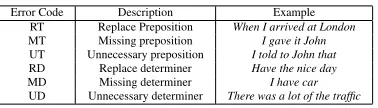
The HOO 2012 shared task seeks to apply compu-tational methods to the correction of certain types of errors in non-native English texts. The previous year’s task, (Dale and Kilgarriff, 2011), focused on a larger scale of errors and a corpus of academic ar-ticles. This year’s task focuses on six error types in a corpus of non-native speaker text. The scope of the errors is as follows:1
Error Code Description Example RT Replace Preposition When I arrived at London
MT Missing preposition I gave it John
UT Unnecessary preposition I told to John that
RD Replace determiner Have the nice day
MD Missing determiner I have car
[image:1.612.75.264.563.617.2]UD Unnecessary determiner There was a lot of the traffic
Table 1: Error types for HOO 2012 Shared Task
In Section 2, we give a brief summary of the data for the shared task and in Section 3 we explain the
1http://correcttext.org/hoo2012/
errortypes.htmllast verified, May 10, 2012
individual steps in the system. Section 4 details the different configurations for each of the runs submit-ted and finally, Section 5 presents the results.
2 Training data
The training data for this shared task has been pro-vided by Cambridge University Press and consists of scripts from students sitting the Cambridge ESOL First Certificate in English (FCE) exams. The top-ics of the texts are comparable as they have been drawn from two consecutive exam years. The data is provided in XML format and contains 1000 original exam scripts, together with a standoff file containing edits of the type described in Section 1 above, also in XML format. These edits consist of offset infor-mation, edit type information and before and after text for correction. The results for the shared task were presented in this format.
The test data consists of 100 exam scripts drawn from a new corpus of exam scripts.
Some extra metadata is present in the source files, including information about the student’s mother tongue and the age-range of the student, however the mother tongue data is not present in the test set.
3 Approach
The approach we have chosen for this task involves the use of supervised machine-learning algorithms in a four-part classification task.
3.1 Overview of the system
The first part of the task involvesidentification of
edits in the training data, perhaps the most
ing given the large imbalance of edits vs non-edits in the data.
The next step concernsclassificationof edits into
the six types described above, and the final task
involves correction of edits, replacing or adding
prepositions and determiners, and possibly in some cases removal of same.
There is a fourth step involved which reassesses the classification and correction based on some sim-ple heuristics, using POS tags of the head word of each instance. If the headword is not a preposition and the system has marked a replace preposition er-ror at that position, this erer-ror will be removed from the system. Likewise when the headword is not a determiner and a replace determiner error has been marked. If the replacement suggested is the same as the original text (in some cases this occurs), the edit is also removed. Another case for removal in this fashion includes an error type involving a miss-ing determiner error where the head word is neither a noun or an adjective. In some cases the system reported and corrected an error suggesting the same text as was originally there, i.e no change. These cases are also removed from the end result.
3.2 Classification
We utilise the freely available Weka machine learn-ing toolkit (Hall et al., 2009), and the algorithm used for classification in each step is Naive Bayes.
3.2.1 Representing the data
We represent each word in the training data as a vector of features. There are 39 basic features used in the detection process, and 42 in the classification and training step. The first 7 features contain in-formation which is not used for classification but is used to create the edit structures, such as start offset, end offset, native language, age group and source filename and part information. These features in-clude the current word plus the four preceding and following words, POS and spell-checked versions of each, together with bigrams of the two following and two preceding words with spell-checked and POS versions for these. Information on speaker age and native language is also included although native lan-guage information is not present in the test set.
3.2.2 Additional processing
All tokens have been lower-cased and punctuation has been removed. POS information for each token has been added. The open-source POS tagger from the OpenNLP tools package (OpenNLP, 2012) has been used to this end. Spell correction facility has been provided using the basic spellchecker in the Lucene information retrieval API(Gospodnetic and Hatcher, 2005) and the top match string as provided by this spell correcting software is used in addition to each feature. The basic maximum entropy model for English is used for the POS tagger.
We had also planned to include features based on the Google Books n-gram corpus, (Michel et al., 2011) which is freely available on the web, but un-fortunately did not get to include them in the ver-sion submitted due to errors which were found in the scripts for generating the features late in the process. Nevertheless, we describe these features in Section 3.3 and present some cross-validation results from the training data for the detection step in Section 5.1.
3.3 Google N-grams Features
3.3.1 Motivation
The Google Books N-Grams2 is a collection of
datasets which consist of all the sequences of words (n-grams) extracted from millions of books (Michel et al., 2011). The “English Million” dataset contains
more more than 500 millions distinct n-grams3, from
size 1 to 5. for every n-gram, its frequency, page frequency (number of pages containing it) and book frequency (number of books containing it) are pro-vided.
In this Shared Task, we aim to use the Google N-grams as a reference corpus to help detecting the errors in the input. The intuition is the following: if an error occurs, comparing the frequency of the input n-grams against the frequency of other possi-bilities in the Google N-grams data might provide useful indication on the location/type of the error.
For example, given the input “I had to go in a
li-brary”, The Google N-grams contain only 36,716
occurrences of the trigram“go in a”, but 244,098
occurrences of“go to a”, which indicates that the
latter is more likely.
2http://books.google.com/ngrams/datasets 3
However there are several difficulties in using such a dataset:
• Technical limitations. Extracting information from the dataset can take a lot of time because of the size of the data, thus the range of ap-proaches is restricted by efficiency constraints.
• Quality of the data.The Google N-grams were extracted automatically using OCR, which means that the dataset can contain errors or un-expected data (for example, the English dataset contains a significant number of non-English words).
This is why the Google N-grams must be used cautiously, and only as an indication among others.
3.3.2 Method
Our goal is to add features extracted from the Google N-grams dataset to the features described above, and feed the supervised classification process
with these. Before computing the features, a listL
of “target expressions” is extracted from the train-ing data, which contains all the words or sequences of words (determiners and prepositions) which oc-cur in a correction. Then, given an input sentence
A1. . . Am and a position n in this sentence, two
types of information are extracted from the Google data:
• Specific indications of whether an error exists
at this position:
1. No change: the frequency of the input se-quenceAn−1AnandAn−1AnAn+1;
2. Unnecessary word(s): the frequency of the sequenceAn−1An+1ifA∈L;
3. Missing word(s): the frequency of the
se-quence XAn (resp. An−1XAn for
tri-grams) for any target expressionX ∈L;
4. Replacement: ifA ∈ L, the frequency of
XAn+1(resp. An−1XAn+1for trigrams)
for any target expressionX ∈L;
• Generic indications taking the context into
ac-count: for length N from 1 to 5 in a window
An−4. . . An+4, 16 combinations are computed
based only on the fact the n-grams appear in the
Google data; for example, one of these combi-nations is the normalized sum for the 4 5-grams in this window of 0 or 1 (the n-gram occurs or does not).
Additionally, several variants are considered:
• bigrams or trigrams for “specific” features;
• binary values for “specific” features: 1 if the
n-gram appears, 0 otherwise;
• keep only the “generic” features and the first
three features.
4 Run configurations
Ten runs were submitted to the organisers based on different configurations. Modification of the data was carried out using both instance reduction and feature selection techniques. The system facilitated the use of different training data for each of the three main classification steps.
4.1 Least frequent words filter
Before classification, the data is preprocessed by re-placing all the least frequent words with a default value (actually treated as missing values by the clas-sifier). This is intended to help the classifier focus on the most relevant indications and to prevent over-specification of the classification model.
4.2 Instance reduction filters
4.2.1 POSTrigrams filter
The POS trigrams filter works as follows: during the training stage, the sequences of POS tags for the
wordscurrent-1.current.current+1are extracted for
each instance, together with its corresponding class. Every POS trigram is then associated with the fol-lowing ratio:
Frequency of true instances Frequency of false instances
Run Detection Classification Correction
0 R1 Normal Normal 1 R20 Normal Normal
2 Full F12 Normal
3 R10 Normal Normal 4 R30 Normal Normal
5 F12 F12 Normal
6 R4new Normal Normal 7 R4 + F12 F12 Normal 8 R4 Normal Normal 9 R2 Normal Normal
Table 2: Run configurations
2, the label RN refers to the percentage (N) used as cut-off in the experiments.
This filter is intended to reduce the impact of the fact that the classes are strongly unbalanced. It per-mits discarding a high number of false instances, while removing only a small number of true in-stances. However, as a side effect, it can cause the classifier to miss some clues which were in the dis-carded instances.
4.2.2 CurrentPlusOrMinusOne filter
The current plusorminus one filter works as
fol-lows: A list of allcurrent.current+1 word bigrams
is made from the error instances in the training data,
along with allcurrent-1.currentbigrams. The
non-error instances in the training data are then filtered based on whether an instance contains an
occur-rence of anycurrent.current+1orcurrent-1.current
bigram in the list.
4.3 Feature selection filters
4.3.1 F12
During preliminary experiments, selecting a sub-set of 12 features produced classification accuracy gains in the detection and classification steps of the process using ten-fold cross validation on the
train-ing set. These twelve features were: current,
cur-rent+1.current+2, current-1.current-2, currentSC, currentPOS, current-1, current-2, current+1, cur-rent+2, current+1SC, and current-1SC. The SC postfix refers to the spell-corrected token, with POS referring to the part-of-speech tag. The F12 config-uration filter removes all other features except these.
[image:4.612.99.277.60.171.2]5 Results
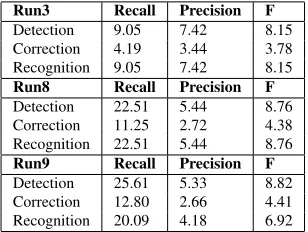
Table 3 displays the results for both preposition and determiner errors which were obtained by the sys-tem on the preliminary test set before teams sub-mitted their revisions. Table 4 refers to the results obtained by the system after the revised errors were removed/edited.
Task Rank Run Precision Recall F-Score Detection 11 9 5.33 25.61 8.82 Recognition 11 9 4.18 20.09 6.92 Correction 11 9 2.66 12.8 4.41
Table 3: Overall results on original data: TC
Task Rank Run Precision Recall F-Score Detection 11 8 6.56 26.0 10.48 Recognition 11 8 4.91 19.45 7.84
Correction 11 8 3.09 12.26 4.94
Table 4: Overall results on revised data: TC
5.1 Some detailed results (detection)
The results reported here were obtained on the train-ing data only, ustrain-ing 5-fold cross-validation, and only for the detection task. We have studied various set-tings for the parameters; figure 1 shows a global overview of the performance depending on several parameters (we show only a few different values in order to keep the graph readable).
The results show that the Google features con-tribute positively to the performance, but only slightly: the F1 score is 0.6% better on average. This overview also hides the fact that some combinations of values work better together; for instance, contrary to the fact that not filtering the POS trigrams
per-Run3 Recall Precision F
Detection 9.05 7.42 8.15 Correction 4.19 3.44 3.78 Recognition 9.05 7.42 8.15
Run8 Recall Precision F
Detection 22.51 5.44 8.76 Correction 11.25 2.72 4.38 Recognition 22.51 5.44 8.76
Run9 Recall Precision F
[image:4.612.349.503.562.678.2]Detection 25.61 5.33 8.82 Correction 12.80 2.66 4.41 Recognition 20.09 4.18 6.92
Figure 1: Average F-score depending on several parameters.
10
11
12
13
14
15
16
mean of f1 20
50 100 500 1000
POS−trigrams.0 POS−trigrams.1
POS−trigrams.10 POS−trigrams.3 2−3−binary
2−binary 3−binary none
window0 window2 window4
factor(minFreq) filter googleFeatures attributes
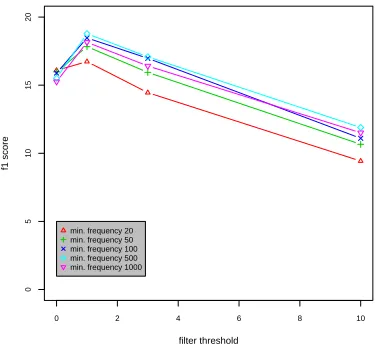
forms better on average, the best performances are obtained when filtering, as shown in figure 2.
Figure 2: F-score (%) w.r.t POS trigrams filter threshold. Parameters: window 2, Google features with bigrams and trigrams.
0 2 4 6 8 10
0
5
10
15
20
filter threshold
f1 score
min. frequency 20 min. frequency 50 min. frequency 100 min. frequency 500 min. frequency 1000
• Minimum frequency4 (preprocessing, see 4.1).
4Remark: the values used as “minimum frequencies”
re-ported in this paper can seem unusually high. This is due to the fact that, for technical reasons, the thresholds were applied globally to the data after it had been formatted as individual in-stances, each instance containing a context window of 9 words. As a consequence a threshold of N means that a given word must occur at least N/9 times in the original input data.
As shown in Figure 2, using a high threshold helps the classifier build a better model.
• POS trigrams filter(see 4.2.1.) Even if not fil-tering at all performs better on average, the best cases are obtained with a low threshold. Addi-tionally, this parameter can be used to balance between recall and precision (when one wants to favor one or the other).
• Size of the context window. Results can show important differences depending on the size of the window, but no best configuration was found in general for this parameter.
• Google features (see 3.3.2.) The Google fea-tures help slightly in general, and are used in the best cases that we have obtained. How-ever there is no significantly better approach between using the original frequencies, simpli-fying these to binary values, or even not using the list of target expressions.
6 Conclusions
[image:5.612.88.278.407.582.2]was a general one and this resulted in many spelling corrections which were out of context. A more tai-lored dictionary employing contextual awareness in-formation could be beneficial for the preprocessing step.
Multi-word corrections were not supported by the system due to how the instances were constructed and these cases were simply ignored, to the detri-ment of the results.
In the basic feature set, the majority of features were based on word unigrams, however more n-gram features could improve results as these were found to perform well during classification.
There were many different ways to exploit the Google N-Grams features and it may be the case that better combinations of features can be found for each of the classification steps.
Finally, very little time was spent tuning the datasets for the classification and correction step as opposed to the detection phase, this is another part of the system where fine-tuning parameters could im-prove performance.
Acknowledgments
This material is based upon works supported by the Science Foundation Ireland under Grant No.[SFI 07/CE/I 1142.].
References
Robert Dale and Adam Kilgarriff. 2011. Helping Our Own: The HOO 2011 pilot shared task. In Proceed-ings of the 13th European Workshop on Natural Lan-guage Generation, Dublin, Ireland.
Robert Dale, Ilya Anisimoff, and George Narroway. 2012. HOO 2012: A Report on the Preposition and Determiner Error Correction Shared Task. In Pro-ceedings of the Seventh Workshop on Innovative Use of NLP for Building Educational Applications, Mon-treal, Canada.
O. Gospodnetic and E. Hatcher. 2005. Lucene. Man-ning.
M. Hall, E. Frank, G. Holmes, B. Pfahringer, P. Reute-mann, and I.H. Witten. 2009. The WEKA data min-ing software: an update. ACM SIGKDD Explorations Newsletter, 11(1):10–18.
J.B. Michel, Y.K. Shen, A.P. Aiden, A. Veres, M.K. Gray, J.P. Pickett, D. Hoiberg, D. Clancy, P. Norvig, J. Orwant, et al. 2011. Quantitative analysis of
culture using millions of digitized books. Science, 331(6014):176.