Combining Different Features of Idiomaticity for the Automatic
Classification of Noun+Verb Expressions in Basque
Antton Gurrutxaga
Elhuyar Foundation
Zelai Haudi 3, Osinalde industrialdea Usurbil 20170. Basque Country [email protected]
I ˜naki Alegria
IXA group, Univ. of the Basque Country Manuel Lardizabal 1
Donostia 20018. Basque Country [email protected]
Abstract
We present an experimental study of how dif-ferent features help measuring the idiomatic-ity of noun+verb (NV) expressions in Basque. After testing several techniques for quantify-ing the four basic properties of multiword ex-pressions or MWEs (institutionalization, se-mantic non-compositionality, morphosyntac-tic fixedness and lexical fixedness), we test different combinations of them for classifica-tion into idioms and collocaclassifica-tions, using Ma-chine Learning (ML) and feature selection. The results show the major role of distribu-tional similarity, which measures composi-tionality, in the extraction and classification of MWEs, especially, as expected, in the case of idioms. Even though cooccurrence and some aspects of morphosyntactic flexibility contribute to this task in a more limited mea-sure, ML experiments make benefit of these sources of knowledge, allowing to improve the results obtained using exclusively distribu-tional similarity features.
1 Introduction
Idiomaticity is considered the defining feature of the concept of multiword expressions (MWE). It is de-scribed as a non-discrete magnitude, whose “value” depends on a combination of features like in-stitutionalization, non-compositionality and lexico-syntactic fixedness (Granger and Paquot, 2008).
Idiomaticity appears as a continuum rather than as a series of discrete values. Thus, the classification of MWEs into discrete categories is a difficult task. A very schematic classification that has achieved a fair
degree of general acceptance among experts distin-guishes two main types of MWEs at phrase-level: idioms and collocations.
This complexity of the concept of idiomaticity has posed a challenge to the development of methods addressing the measurement of the aforementioned four properties. Recent research has resulted in this issue nowadays being usually addressed through measuring the following phenomena: (i) cooccur-rence, for institutionalization; (ii) distributional sim-ilarity, for non-compositionality; (iii) deviation from the behavior of free combinations, for morphosyn-tactic fixedness; and (iv) substitutability, for lexical fixedness. This is the broad context of our experi-mental work on the automatic classification of NV expressions in Basque.
2 Related Work
2.1 Statistical Idiosyncrasy or Institutionalization
Using the cooccurrence of the components of a com-bination as a heuristic of its institutionalization goes back to early research on this field (Church and Hanks, 1990), and is computed using association measures (AM), usually in combination with lin-guistic techniques, which allows the use of lemma-tized and POS-tagged corpora, or the use of syntac-tic dependencies (Seretan, 2011). In recent years, the comparative analysis of AMs (Evert, 2005) and the combination of them (Lin et al., 2008; Pecina, 2010) have aroused considerable interest.
This approach has been recently explored in Basque (Gurrutxaga and Alegria, 2011).
2.2 Compositionality
The central concept in characterizing compositional-ity is the hypothesis of distributional similarcompositional-ity (DS) As proposed by Baldwin and Kim (2010), “the un-derlying hypothesis is that semantically idiomatic MWEs will occur in markedly different lexical con-texts to their component words.”
Berry-Rogghe (1974) proposed R-value to mea-sure the compositionality of verb-particle construc-tions (VPCs), by dividing the overlap between the sets of collocates associated with the particle by the total number of collocates of the VPC. Wulff (2010) proposes two extensions to the R-value in her research on verb-preposition-noun construc-tions, combining and weighting in different ways in-dividual R-values of each component.
The Vector Space Model (VSM) is applied, among others, by Fazly and Stevenson (2007), who use the cosine as a similarity measure. The shared task Distributional Semantics and Compositionality (DiSCo) at ACL-HLT 2011 shows a variety of tech-niques for this task, mainly association measures and VSM (Biemann and Giesbrecht, 2011). LSA (Latent Semantic Analysis) is used in several stud-ies (Baldwin et al., 2003; Katz and Gstud-iesbrecht, 2006; Schone and Jurafsky, 2001).
Those approaches have been applied recently to Basque (Gurrutxaga and Alegria, 2012)
2.3 Morphosyntactic Flexibility (MSFlex)
Morphosyntactic fixedness is usually computed in terms of relative flexibility, as the statistical dis-tance between the behavior of the combination and (i) the average behavior of the combinations with equal POS composition (Fazly and Stevenson, 2007; Wulff, 2010), or (ii) the average behavior of the combinations containing each one of the compo-nents of the combination (Bannard, 2007).
Fazly and Stevenson (2007) use Kullback-Leibler divergence (KL-div) to compute this dis-tance. They analyze a set of patterns: determination (a/the), demonstratives, possessives, singular/plural and passive. They compute two additional measure-ments (dominant pattern and presence of absence of adjectival modifiers preceding the noun).
Wulff (2010) considers (i) tree-syntactic, (ii) lexico-syntactic and (iii) morphological flexibilities,
and implements two metrics for these features: (i) an extension of Barkema proposal (NSSD, normalized sum of squared deviations), (ii) a special conception of “relative entropy” (Hrel).
Bannard (2007), using CPMI (conditional point-wise mutual information), analyses these variants: (i) variation, addition or dropping of a determiner; (ii) internal modification of the noun phrase; and (iii) verb passivation.
2.4 Lexical Flexibility (LFlex)
The usual procedure for measuring lexical flexibility is to compute the substitutability of each component of the combination using as substitutes its synony-mous, quasi-synonyms, related words, etc.
The pioneering work in this field is Lin (1999), who uses a thesaurus automatically built from text. This resource is used in recent research (Fazly and Stevenson, 2007). They assume that the target pair is lexically fixed to the extent that its PMI deviates from the average PMI of its variants generated by lexical substitution. They compute flexibility using thez-score.
In Van de Cruys and Moir´on (2007), a technique based on KL-div is used for Duch. They defineRnv as the ratio of noun preference for a particular verb (its KL-div), compared to the other nouns that are present in the cluster of substitutes. Similarly for
Rvn. The substitute candidates are obtained from the corpus using standard distributional similarity techniques.
2.5 Other Methods
Fazly and Stevenson (2007) consider two other fea-tures: (i) the verb itself; and (ii) the semantic cate-gory of the noun according to WordNet.
2.6 Combined Systems
In order to combine several sources of knowledge, several studies have experimented with using Ma-chine Learning methods (ML).
For Czech, Pecina (2010) combines only AMs us-ing neural networks, logistic regression and SVM (Support Vector Machine). Lin et al. (2008) employ logistic linear regression model (LLRM) to combine scores of AMs.
incorpo-rates a variety of features to group verb-noun combi-nations. Their features drawn from AM and DS, but some of each type are tested and combined. They compute ranking correlation using SVM, achieving results of about 0.45.
Fazly and Stevenson (2007) use all the types of knowledge, and decision trees (C5.0) as a learning method, and achieve average results (F-score) near to 0.60 for 4 classes (literal, abstract, light verbs and idioms). The authors claim that the syntactic and combined fixedness measures substantially outper-form measures of collocation extraction.
3 Experimental Setup
3.1 Corpus and Preprocessing
We use a journalistic corpus of 75 million words (MW) from two sources: (1) Issues published in 2001-2002 by the newspaper Euskaldunon Egunkaria (28 MW); and (2) Issues published in 2006-2010 by the newspaperBerria(47 MW).
The corpus is annotated with lemma, POS, fine grained POS (subPOS), case and number informa-tion using Eustagger developed by the IXA group of the University of the Basque Country. A precision of 95.42% is reported for POS + subPOS + case analy-sis (Oronoz et al., 2010).
3.2 Extraction of Bigram Candidates
The key data for defining a Basque NV bigram are lemma and case for the noun, and lemma for the verb. Case data is needed to differentiate, for exam-ple, kontu hartu(“to ask for an explanation”) from
kontuan hartu(“to take into account”), wherekontu
is a noun lemma in the inessive case.
In order to propose canonical forms, we need, for nouns, token, case and number annotations in bi-gram data. Those canonical forms can be formulated using number normalization, as described in Gur-rutxaga and Alegria (2011). Bigrams belonging to the same key noun lemma/noun case+verb lemma are normalized; a single bigram with the most fre-quent form is created, and the frequencies of bi-grams and those of the noun unibi-grams summed.
We use the Ngram Statistics Package-NSP (Banerjee and Pedersen, 2010) to generate NV bigrams from a corpus generated from the output of Eustagger. Taking into account our previous results
(Gurrutxaga and Alegria, 2011), we use a window span of ±1 and a frequency threshold of f > 30. Before generation, some surface-grammar rules are applied to correct annotations that produce noise. For example, in most Basque AdjN combinations, the adjetive is a verb in a participe form (eg. indar armatuak, ‘armed forces’). Similarly, those kind of participles can function as nouns (gobernuaren aliatuak, ‘the allies of the government’). Not tagging those participles properly would introduce noise in the extraction of NV combinations.
3.3 Experiments Using Single Knowledge Sources
3.3.1 Cooccurrence
The cooccurrence data provided by NSP in the bi-gram extraction step is processed to calculate AMs. To accomplish this, we use Stefan Evert’s UCS toolkit (Evert, 2005). The most common AMs are calculated:f, t-score, log-likelihood ratio, MI, MI3, and chi-square (χ2).
3.3.2 Distributional Similarity
The idea is to compare the contexts of each NV bigram with the contexts of its corresponding com-ponents, by means of different techniques. The more similar the contexts, the more compositional the combination.
Context Generation We extract the context words of each bigram from the sentences with contiguous cooccurrences of the components. The noun has to occur in the grammatical case in which it has been defined after bigram normalization.
The contexts of the corresponding noun and verb are extracted separately from sentences where they did not occur together. Only content-bearing lem-mas are included in the contexts (nouns, verbs and adjectives).
Context Comparison We process the contexts in two different ways:
LLR and PMI). We experiment with different per-centages of the vector and different numbers of col-locates, using the aforementioned measures to rank the collocates. The 100 most frequent words in the corpus are stopped.
Second, we represent the same contexts as doc-uments, and compare them by means of differ-ent indexes using the Lemur Toolkit (Allan et al., 2003). The contexts of the bigrams are used as queries against a document collection containing the context-documents of all the members of the bi-grams. This can be implemented in different ways; the best results were obtained using the following:
• Lemur 1 (L1): As with vectors, the contexts of a bigram are included in a single query docu-ment, and the same is done for the contexts of its members
• Lemur 2 (L2): The context sentences of bi-grams are treated as individual documents, but the contexts of each one of its members are rep-resented in two separate documents
Due to processing reasons, the number of context sentences used in Lemur to generate documents is limited to 2,000 (randomly selected from the whole set of contexts).
We further tested LSA (using Infomap1), but the above methods yielded better results.
3.3.3 Morphosyntactic Flexibility
We focus on the variation of the N slot, dis-tinguishing the main type of extensions and num-ber inflections. Among left-extensions, we take into account relative clauses. In addition, we con-sider the order of components as a parameter. We present some examples of the free combination libu-rua irakurri(“to read a book”)
• Determiner: liburu bat irakurri dut (“I have read one book”),zenbat liburu irakurri dituzu?
(“how many books have you read?”)
• Postnominal adjective: liburu interesgarria irakurri nuen(“I read an interesting book”)
• Prenominal adjective: italierazko liburua irakurri(“to read a book in Italian”)
1http://infomap-nlp.sourceforge.net/
• Relative clause: irakurri dudan liburua (“the book I have read”),anaiak irakurritako liburu batzuk(“some books read by my brother”)
• Number inflection: liburua/liburuak/ liburu/liburuok irakurri (“to read a/some/∅/these book(s)”)
• Order of components (NV / VN): liburua irakurri dut/irakurri dut liburua(“I have read a book”)
We count the number of variations for each bi-gram, for all NV bigrams, and for each combination of the type bigram component+POS of the other component (e.g, forliburua irakurri, the variations of all the combinationsliburua+V and N+irakurri). To calculate flexibility, we experiment with all the measures described in section 2.3: Fazly’s KL-div, Wulff’s NSSD and Hrel (relative entropy), and Ban-nard’s CPMI.
3.3.4 Lexical Flexibility
In order to test the substitutability of the compo-nents of bigrams, we use two resources: (i) ELH:
Sinonimoen Kutxa, a Basque dictionary of syn-onyms, published by the Elhuyar Foundation (for nouns and verbs, 40,146 word-synomyn pairs); (ii) WN: the Basque version of WordNet2(68,217 word-synomyn pairs). First, we experimented with both resources on their own, but the results show that in many cases there either was no substitute candi-date, or the corpus lacked combinations containing a substitute. In order to ensure a broader coverage, we combined both resources (ELHWN), and we ex-panded the set of substitutes including the siblings retrieved from Basque WordNet (ELHWNexpand).
To calculate flexibility, we experiment with the two measures described in section 2.4: z-score and KL-div based R.
3.4 Combining Knowledge Sources Using Machine Learning
We use some ML methods included in the Weka
toolkit (Hall et al., 2009) in order to combine re-sults obtained in experiments using single knowl-edge sources (described in section 3.3). The values
of the different measures obtained in those experi-ments were set as features.
We have selected five methods corresponding to different kind of techniques which have been used successfully in this field: Naive Bayes, C4.5 deci-sion tree (j48), Random Forest, SVM (SMO algo-rithm) and Logistic Regression. Test were carried out using either all features, the features from each type of knowledge, and some subsets, obtained af-ter manual and automatic selection. Following Fa-zly and Stevenson (2007), verbs are also included as features.
Since, as we will see in section 3.5, the amount of instances in the evaluation dataset is not very high (1,145), cross-validation is used in the experiments for model validation (5 folds). In the case of auto-matic attribute selection, we use AttributeSelected-Classifier, which encapsulates the attribute selection process with the classifier itself, so the attribute se-lection method and the classifier only see the data in the training set of each fold.
3.5 Evaluation
3.5.1 Reference Dataset and Human Judgments
As an evaluation reference, we use a subset of 1,200 combinations selected randomly from a ex-tracted set of 4,334 bigrams, that is the result of merging the 2,000-best candidates of each AM rank-ing from the w =±1andf >30 extraction set.
The subset has been manually classified by three lexicographers into idioms, collocations and free combinations. Annotators were provided with an evaluation manual, containing the guidelines for classification and illustrative examples.
The agreement among evaluators was calculated using Fleiss’κ. We obtained a value of 0.58, which can be considered moderate, close to fair, agree-ment. Although this level of agreement is relatively low when compared to Krenn et al. (2004), it is comparable to the one reported by Pecina (2010), who attributed his “relatively low” value to the fact that “the notion of collocation is very subjective, domain-specific, and also somewhat vague.” Street et al. (2010) obtain quite low inter-annotator agree-ment for annotation of idioms in the ANC (Ameri-can National Corpus). Hence, we consider that the
level of agreement we have achieved is acceptable. For the final classification of the evaluation set, cases where agreement was two or higher were au-tomatically adopted, and the remaining cases were classified after discussion. We removed 55 combina-tions that did not belong to the NV category, or that were part of larger MWEs. The final set included 1,145 items, out of which 80 were idioms 268 collo-cations, and 797 free combinations.
3.5.2 Procedure
In order to compare the results of the individual techniques, we based our evaluation on the rank-ings provided by each measure. If we were to have an ideal measure, the set of bigram categories (‘id’, ‘col’ and ‘free’) would be an ordered set, with ‘id’ values on top of the ranking, ‘col’ in the middle, and ‘free’ at the bottom. Thus, the idea is to compute the distance between a rank derived from the ideally ordered set, which contains a high number of ties, and the rank yielded by each measure. To this end, we use Kendall’sτB as a rank-correlation measure. Statistical significance of the Kendall’s τB correla-tion coefficient is tested with the Z-test. The realistic topline, yielded by a measure that ranks candidates ideally, but without ties, would be 0.68.
In addition, average precision values (AP) were calculated for each ranking.
In the case of association measures, similarity measures applied to VSM, and measures of flexibil-ity, the bigrams were ranked by means of the val-ues of the corresponding measure. In the case of ex-periments with Lemur, the information used to rank the bigrams consisted of the positions of the docu-ments corresponding to each member of the bigram in the document list retrieved (‘rank’ in Table 1). For the experiments in which the context sentences have been distributed in different documents, average po-sitions were calculated and weighted, in relation to the amount of documents for each bigram analysis (‘rank weight’). The total number of documents in the list (or ‘hits’) is weighted in the same manner (‘hit rel’).
measure τB AP MWE AP id AP col
random rank (-0.02542) 0.30879 0.0787 0.23358
AM
f 0.18853 0.43573 0.07391 0.37851
t-score 0.19673 0.45461 0.08442 0.38312
log-likelihood 0.15604 0.42666 0.10019 0.33480
PMI (-0.12090) 0.25732 0.08648 0.18234
chi-squared (-0.03699) 0.30227 0.11853 0.20645
DS
RBR NV (MI -50%) 0.27034 0.47343 0.21738 0.30519
RW1(2000 MI f3 50%) 0.26206 0.47152 0.19664 0.30967
L1 Indri rankNV 0.31438 0.53536 0.22785 0.35299
L1 KL rankNV 0.29559 0.51694 0.23558 0.33607
L2 Indri hit rel NV 0.32156 0.56612 0.29416 0.35389
L2 KL hit rel NV 0.30848 0.55146 0.31977 0.33241
L2 Indri rankN weight 0.21387 0.45567 0.26148 0.28025
L2 Indri rankV weight 0.31398 0.55208 0.12837 0.43143
MSFlex
Hrel Det 0.07295 0.38995 0.12749 0.27704
Hrel PostAdj (-0.05617) 0.31673 0.04401 0.29597
Hrel PreAdj 0.11459 0.38561 0.09897 0.29223
Hrel Rel 0.09115 0.40502 0.12913 0.29012
Hrel Num 0.11861 0.43381 0.13387 0.31318
Hrel ord (0.02319) 0.31661 0.08124 0.24052
CPMI (components) 0.05785 0.41917 0.12630 0.30831
LFlex
Rnv ELHWN (0.08998) 0.36717 0.07521 0.29896
Rvn ELHWN (0.03306) 0.31752 0.08689 0.24369
z-score V ELHWNexpand 0.10079 0.35687 0.12232 0.25019
[image:6.612.100.516.52.408.2]z-score N ELHWNexpand 0.08412 0.35534 0.07245 0.29005
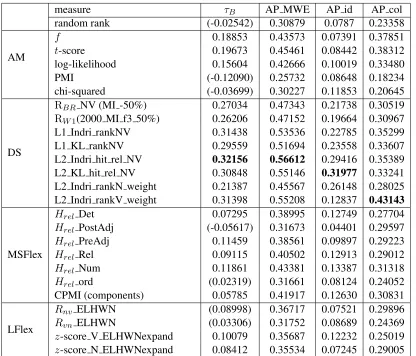
Table 1: Kendall’sτB rank-correlations relative to an ideal idiomaticity ranking, obtained by different idiomaticity
measures. Non-significant values ofτB in parentheses (p >0.05). Average precisions for MWEs in general, and
specific values for idioms and collocations.
4 Experimental Results
4.1 Single Knowledge Experiments
The results for Kendall’sτBand AP for MWEs and separate AP values for idioms and collocations are summarized in Table 1 (only the experiments with the most noteworthy results are included).
The best results are obtained in the Lemur exper-iments, most notably in the Lemur 2 type, using ei-ther Indri or KL-div indexes. In the MWE rankings, measures of the R-value type only slightly outper-form AMs.
In the case of idioms, DS measures obtain signif-icantly better ranks than the other measures. Idioms being the least compositional expressions, his result is expected, and supports the hypothesis that seman-tic compositionality can better be characterized
us-ing measures of DS than usus-ing AMs.
Regarding collocations, no such claim can be made, as the AP values for t-score and f outper-form DS values, with a remarkable exception: the best AP is obtained by an Indri index that com-pares the semantic similarity between the verb in combination with the noun and the verb in contexts without the noun (L2 Indri rankV weight), accord-ingly with the claim that the semantics of the verb contribute to the semicompositionality of colloca-tions. By contrast, the corresponding measure for the noun (L2 Indri rankN weight) works quite a bit better with idioms than the previous verb measure.
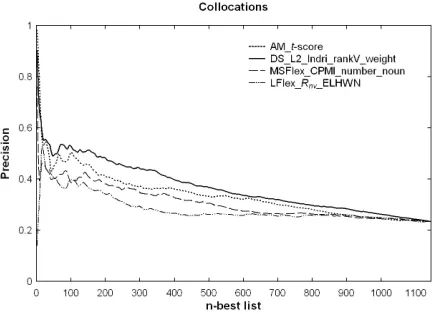
Figure 1 shows the precision curves for the extrac-tion of MWEs by the best measure of each compo-nent of idiomaticity.
preci-Figure 1: Precision results for the compositionality rank-ings of MWEs.
[image:7.612.74.292.54.213.2]sion curves for idioms and collocations. We plot the measures with the best precision values.
Figure 2: Precision results for the compositionality rank-ings of idioms.
Regarding the precision for collocations in Fig-ure 3, the differences are not obviously significant. Even though the DS measure has the better perfor-mance, precision values for the t-score are not too much lower, and the t-score has a similar perfor-mance at the beginning of the ranking (n<150).
4.2 Machine Learning Experiments
We report only the results of the three methods with the best overall performance: Logistic Regression (LR), SMO and RandomForest (RF).
In Table 2, we present the results obtained with datasets containing only DS attributes (the source of knowledge with the best results in single
ex-Figure 3: Precision results for the compositionality rank-ings of collocations.
periments); datasets containing all features corre-sponding to the four properties of idiomaticity; and datasets obtained adding the verb of the bigram as a string-type attribute.
As the figures show, it is difficult to improve the results obtained using only DS. The results of SMO are better when the features of the four components of idiomaticity are used, and even better when the verb is added, especially for idioms. The verb causes the performance of RF be slightly worse; in the case of LR, it generates considerable noise.
It can be observed that the figures for LR are more unstable. Using SMO and RF, convergence does not depend on how many noisy variables are present (Biau, 2012). Thus, feature selection could improve the results when LR is used.
In a complementary experiment, we observed the impact of removing the attributes of each source of knowledge (without including verbs). The most ev-ident result was that the exclusion of LFlex features contributes the most to improving F. This was an ex-pected effect, considering the poor results for LFlex measures described in section 4.1. More interest-ing is the fact that removinterest-ing MSFlex features had a higher negative impact on F than not taking AMs as features.
[image:7.612.315.533.55.212.2] [image:7.612.74.292.308.463.2]Features Method CCI F id F col F free F W.Av. F Av.
DS
LR 72.489 0.261 0.453 0.838 0.707 0.517
SMO 74.061 0.130 0.387 0.824 0.575 0.447
RF 71.441 0.295 0.440 0.821 0.695 0.519
all idiom. properties
LR 71.703 0.339 0.514 0.821 0.716 0.558
SMO 76.507 0.367 0.505 0.857 0.740 0.576
RF 74.498 0.323 0.486 0.844 0.724 0.551
all+verb
LR 60.000 0.240 0.449 0.726 0.627 0.472
SMO 75.808 0.400 0.540 0.848 0.744 0.596
[image:8.612.114.499.53.192.2]RF 74.061 0.243 0.459 0.846 0.713 0.516
Table 2: Results of Machine Learning experiments combining knowledge sources in three ways: (i) DS: distributional similarity features; (ii) knowledge related to the four components of idiomaticity (AM+DS+MSFlex+LFlex); (iii) previous features+verb components of bigrams.
section presents the results obtained with AttributeS-electedClassifierusingCfsSubsetEval(CS) as evalu-ator3andBestFirst(BS) as search method. Looking at the results of the selection process in each fold, we saw that the attributes selected in more than 2 folds are 36: 1 AM, 20 from DS, 7 from MSFlex, 1 from LFlex and 7 verbs.
Features Method F W.Av. F Av.
manual 1
LR 0.709 0.525
SMO 0.585 0.304
RF 0.680 0.485
manual 2
LR 0.696 0.518
SMO 0.581 0.286
RF 0.688 0.519
CS-BF
LR 0.727 0.559
SMO 0.693 0.485
RF 0.704 0.531
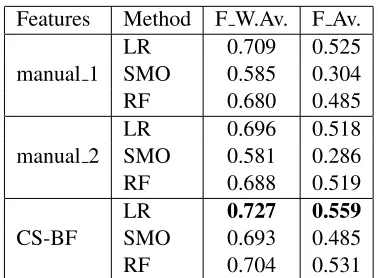
Table 3: F Weighted average and F average results for ex-periments using: (1) the 20 attributes with best AP aver-age results; (2) a manual selection of the 3 best attributes from each knowledge source; and (3) AttributeSelected-Classifier with automatic attribute selection using Cfs-SubsetEvalas evaluator andBestFirstas search method
The results show that, for each method, auto-matic selection outperforms the two manual selec-tions. Most of the attributes automatically selected are DS measures, but it is interesting to observe that MSFlex and the verb slot contribute to improving the results. Using automatic attribute selection and
3
http://wiki.pentaho.com/display/ DATAMINING/CfsSubsetEval
LR, the results are close to the best figure of F W.Av. using SMO and all the features (0.727 vs 0.744).
5 Discussion
The most important conclusions from our experi-ments are the following:
• In the task of ranking the candidates, the best results are obtained using DS measures, and, in particular, Indri and KL-div in L2 experi-ments. This is true for both type of MWEs, and is ratified in ML experiments when automatic attribute filtering is carried out. It is, however, particularly notable with regard to idioms; in the case of collocations, the difference between the performance of DS and that of and MS and AM were not that significant.
• MSFlex contributes to the classification task when used in combination with DS, but get poor results by themselves. The most relevant parameter MSFlex is number inflection.
• SMO is the most precise method when a high amount of features is used. It gets the best over-all F-score. The other methods need feature se-lection to obtain similar results.
[image:8.612.91.280.358.497.2]Some of these conclusions differ from those reached by earlier works. In particular, the claims in Fazly and Stevenson (2007) and Van de Cruys and Moir´on (2007) that syntactic as well as lexical flexibility out-perform other techniques of MWE characterization are not confirmed in this work for Basque. Some hypothesis could be formulated to explain those differences: (1) Basque idioms could be syntacti-cally more flexible, whereas some free combinations could present a non-negligible level of fixedness; (2) Basque, especially in the journalistic register, could be sociolinguistically less fixed than, say, English or Spanish; thus, the lexical choice of the collocate could be not so clearly established; (3) the Basque lexical resources to test substitutability could have insufficient coverage; and (4) Fazly and Stevenson (2007) use the cosine for DS, a measure which in our experiments is clearly below other measures. Those hypotheses require experimental testing and deeper linguistic analysis.
6 Conclusions and Future Work
We have presented an in-depth analysis of the per-formance of different features of idiomaticity in the characterization of NV expressions, and the results obtained combining them using ML methods. The results confirm the major role of DS, especially, as expected, in the case of idioms. It is remarkable that the best results have been obtained using Lemur, an IR tool. ML experiments show that other features contribute to improve the results, especially some aspects of MSFlex, the verb of the bigram and, to a more limited extent, AMs. The performance of DS being the best one for idioms confirm previous research on other languages, but MSFlex and LFlex behave below the expected. The explanations pro-posed for this issue require further verification.
We are planning experiments using these tech-niques for discriminating between literal and id-iomatic occurrences of MWEs in context. Work on parallel corpora is planned for the future.
Acknowledgments
This research was supported in part by the Span-ish Ministry of Education and Science (TACARDI-TIN2012-38523-C02-011) and by the Basque Government (Berbatek project, Etortek-IE09-262;
KONBITZ project, Saiotek 2012). Ainara Estar-rona and Larraitz Uria (IXA group) and Ainara On-darra and Nerea Areta (Elhuyar) are acknowledged for their work as linguists in the manual evaluation. Maddalen Lopez de la Calle and I˜naki San Vicente (Elhuyar) and Oier Lopez de la Calle (IXA group) have contributed with their expertise to the design of the experiments with Lemur and Infomap. Finally, special thanks goes to Olatz Arregi (IXA group) for having guided us in the experiments with Weka, and to Yosu Yurramendi from the University of the Basque Country, for his advice on the statistics in the evaluation step.
References
Allan, J., J. Callan, K. Collins-Thompson, B. Croft, F. Feng, D. Fisher, J. Lafferty, L. Larkey, T. Truong, P. Ogilvie, et al. (2003). The Lemur Toolkit for language modeling and information retrieval.
Baldwin, T., C. Bannard, T. Tanaka, and D. Wid-dows (2003). An empirical model of multi-word expression decomposability. In Proceed-ings of the ACL 2003 workshop on Multiword expressions: analysis, acquisition and treatment-Volume 18, pp. 96.
Baldwin, T. and S. Kim (2010). Multiword expres-sions. Handbook of Natural Language Process-ing, second edition. Morgan and Claypool.
Banerjee, S. and T. Pedersen (2010). The design, implementation, and use of the Ngram Statistics Package. Computational Linguistics and Intelli-gent Text Processing, 370–381.
Bannard, C. (2007). A measure of syntactic flexi-bility for automatically identifying multiword ex-pressions in corpora. InProceedings of the Work-shop on a Broader Perspective on Multiword Ex-pressions, pp. 1–8.
Berry-Rogghe, G. (1974). Automatic identification of phrasal verbs. Computers in the Humanities, 16–26.
Biau, G. (2012). Analysis of a random forests model. The Journal of Machine Learning Re-search 98888, 1063–1095.
Shared task description and results. Workshop on Distributional semantics and compositionality 2011. ACL HLT 2011, 21.
Church, K. and P. Hanks (1990). Word associa-tion norms, mutual informaassocia-tion, and lexicogra-phy. Computational linguistics 16(1), 22–29.
Evert, S. (2005). The statistics of word cooccur-rences: Word pairs and collocations. Ph. D. the-sis, University of Stuttgart.
Fazly, A. and S. Stevenson (2007). Distinguish-ing subtypes of multiword expressions usDistinguish-ing linguistically-motivated statistical measures. In
Proceedings of the Workshop on A Broader Per-spective on Multiword Expressions, pp. 9–16. As-sociation for Computational Linguistics.
Granger, S. and M. Paquot (2008). Disentangling the phraseological web. Phraseology. An inter-disciplinary perspective, 27–50.
Gurrutxaga, A. and I. Alegria (2011). Automatic extraction of NV expressions in Basque: basic issues on cooccurrence techniques. Proc. of the Workshop on Multiword Expressions. ACL HLT 2011, 2–7.
Gurrutxaga, A. and I. Alegria (2012). Measuring the compositionality of nv expressions in basque by means of distributional similarity techniques.
LREC2012.
Hall, M., E. Frank, G. Holmes, B. Pfahringer, P. Reutemann, and I. H. Witten (2009). The weka data mining software: an update. Volume 11, pp. 10–18. ACM.
Katz, G. and E. Giesbrecht (2006). Automatic identification of non-compositional multi-word expressions using latent semantic analysis. In
Proceedings of the Workshop on Multiword Ex-pressions: Identifying and Exploiting Underlying Properties, pp. 12–19. Association for Computa-tional Linguistics.
Krenn, B., S. Evert, and H. Zinsmeister (2004). De-termining intercoder agreement for a collocation identification task. InProceedings of KONVENS, pp. 89–96.
Lin, D. (1999). Automatic identification of non-compositional phrases. InProceedings of the 37th
annual meeting of the ACL, pp. 317–324. Associ-ation for ComputAssoci-ational Linguistics.
Lin, J., S. Li, and Y. Cai (2008). A new colloca-tion extraccolloca-tion method combining multiple asso-ciation measures. InMachine Learning and Cy-bernetics, 2008 International Conference on, Vol-ume 1, pp. 12–17. IEEE.
Oronoz, M., A. D. de Ilarraza, and K. Gojenola (2010). Design and evaluation of an agreement er-ror detection system: testing the effect of ambigu-ity, parser and corpus type. InAdvances in Natu-ral Language Processing, pp. 281–292. Springer.
Pecina, P. (2010). Lexical association measures and collocation extraction. Language resources and evaluation 44(1), 137–158.
Schone, P. and D. Jurafsky (2001). Is knowledge-free induction of multiword unit dictionary head-words a solved problem. In Proc. of the 6th EMNLP, pp. 100–108. Citeseer.
Seretan, V. (2011). Syntax-Based Collocation Ex-traction. Text, Speech and Language Technology. Dordrecht: Springer.
Street, L., N. Michalov, R. Silverstein, M. Reynolds, L. Ruela, F. Flowers, A. Talucci, P. Pereira, G. Morgon, S. Siegel, et al. (2010). Like finding a needle in a haystack: Annotating the american na-tional corpus for idiomatic expressions. InProc. of LREC’2010.
Van de Cruys, T. and B. Moir´on (2007). Semantics-based multiword expression extraction. In Pro-ceedings of the Workshop on A Broader Perspec-tive on Multiword Expressions, pp. 25–32. Asso-ciation for Computational Linguistics.
Venkatapathy, S. and A. Joshi (2005). Measuring the relative compositionality of verb-noun (vn) collo-cations by integrating features. InProceedings of HLT/EMNLP, pp. 899–906. Association for Com-putational Linguistics.