Using Learner Data to Improve Error Correction
in Adjective–Noun Combinations
Ekaterina Kochmar Alta Institute Computer Laboratory University of Cambridge
Ted Briscoe Alta Institute Computer Laboratory University of Cambridge
Abstract
This paper presents a novel approach to error correction in content words in learner writing focussing on adjective–noun (AN) combina-tions. We show how error patterns can be used to improve the performance of the error cor-rection system, and demonstrate that our ap-proach is capable of suggesting an appropri-ate correction within the top two alternatives in half of the cases and within top10 alterna-tives in71%of the cases, performing with an MRRof0.5061. We then integrate our error correction system with a state-of-the-art con-tent word error detection system and discuss the results.
1 Introduction
The task of error detection and correction (EDC) on non-native texts, as well as research on learner lan-guage in general, has attracted much attention re-cently (Leacock et al., 2014; Ng et al., 2014; Ng et al., 2013; Dale et al., 2012). The field has been dom-inated by EDC for grammatical errors and errors in the use of articles and prepositions (Ng et al., 2013; Rozovskaya and Roth, 2011; Chodorow et al., 2010; Gamon et al., 2008; Brockett et al., 2006; Han et al., 2006).
More recently, however, the need to address other error types has been recognised (Kochmar and Briscoe, 2014; Ng et al., 2014; Rozovskaya et al., 2014; Sawai et al., 2013; Dahlmeier and Ng, 2011). Among these, errors in content words are the third most frequent error type after errors in articles and prepositions (Leacock et al., 2014; Ng et al., 2014).
The correct use of content words is notoriously hard for language learners to master, while importance of the correct word choice for successful writing has long been recognised (Leacock and Chodorow, 2003; Johnson, 2000; Santos, 1988).
The major difficulty is that correct word choice is not governed by any strictly defined rules: native speakers know thatpowerful computer is preferred overstrong computer, whilestrong teais preferred over powerful tea (Leacock et al., 2014), but lan-guage learners often find themselves unsure of how to choose an appropriate word. As a result, they often confuse words that are similar in meaning or spelling, overuse words with general meaning, or se-lect words based on their L1s (Kochmar and Briscoe, 2014; Dahlmeier and Ng, 2011).
Previous work on EDC for content words has also demonstrated that since these error types are sub-stantially different from errors with function words, they require different approaches. The most widely adopted approach to EDC for function words relies on availability of finite confusion sets. The task can then be cast as multi-class classification with the number of classes equal to the number of pos-sible alternatives. Detection and correction can be done simultaneously: if the alternative chosen by the classifier is different from the original word, this is flagged as an error. However, content word errors cannot be defined in terms of a general and finite set of confusion pairs, and the set of alternatives in each case depends on the choice of original word. More-over, it has been argued that error detection for con-tent words should be performed independently from error correction (Kochmar and Briscoe, 2014).
In this work, we focus on error correction in con-tent words and, in particular, investigate error cor-rection in adjective–noun (AN) combinations using several publicly-available learner error datasets for this type of construction. At the same time, we be-lieve that a similar approach can be applied to other types of content word combinations. Specifically, we make the following contributions:
1. We explore different ways to construct the cor-rection sets and to rank the alternatives with re-spect to their appropriateness. We report the coverage of different resources and assess the ranked lists of suggestions.
2. We show that learner text is a useful source of possible corrections for content words. In ad-dition, we demonstrate how error patterns ex-tracted from learner text can be used to improve the ranking of the alternatives.
3. We present an EDC system for AN combina-tions which compares favourably to the pre-vious published approaches of which we are aware.
4. We explore the usefulness of self-propagating for an error correction system.
2 Related work
Leacock et al. (2014) note that the usual approach to EDC in content words relies on the idea of com-paring the writer’s choice to possible alternatives, so that if any of the alternatives score higher than the original combination then the original combination is flagged as a possible error and one or more alter-natives are suggested as possible corrections. The performance of an EDC algorithm that uses this ap-proach depends on:
• the choice of the source of alternatives;
• the choice of the metric for ranking the alterna-tives.
The source of alternatives defines thecoverageof the error correction algorithm, while the quality of the system suggestions depends on the choice of an appropriate metric for ranking the alternatives.
Early work on EDC for content words (Wible et al., 2003; Shei and Pain, 2000) relied on the use of reference databases of known learner errors and their corrections. While such approaches can achieve good quality, they cannot provide good cov-erage.
Previous research considered semantically related confusions between content words as the most fre-quent type of confusion in learner writing and used WordNet (Miller, 1995), dictionaries and thesauri to search for alternatives ( ¨Ostling and Knutsson, 2009; Futagi et al., 2008; Shei and Pain, 2000). Since these resources cannot cover alternatives that are not semantically related to the original words, other re-sources have been considered as well: for example, Dahlmeier and Ng (2011) consider spelling alterna-tives and homophones as possible corrections.
L1-specific confusions have been reported to cover a substantial portion of errors in content words for some groups of language learners (Chang et al., 2008; Liu, 2002), and some previous EDC ap-proaches have considered using parallel corpora and bilingual dictionaries to generate and rank alterna-tives (Dahlmeier and Ng, 2011; Chang et al., 2008). L1-specific approaches have shown the best results in EDC for content words so far, but it should be noted that their success relies on availability of high-quality L1-specific resources which is hard to guar-antee for the full variety of learner L1s.
At the same time, good performance demon-strated by L1-specific approaches shows the impor-tance of taking learner background into considera-tion. In contrast to the other resources like Word-Net and thesauri, which can only cover confusions between words in the L2, use of parallel corpora and bilingual dictionaries gives access to the types of confusions which cannot be captured by any L2 resources. Learner corpora and databases of text re-visions can be used to similar effect.
use a corpus of Wikipedia revisions containing an-notated errors in the use of prepositions and their corrections to improve the ranking of the sugges-tions.
Finally, we note that a number of previous ap-proaches to errors in content words have combined error detection and correction, flagging an original choice as an error if an EDC algorithm is able to find a more frequent or fluent combination ( ¨Ostling and Knutsson, 2009; Chang et al., 2008; Futagi et al., 2008; Shei and Pain, 2000), while some focussed on error correction only (Dahlmeier and Ng, 2011; Liu et al., 2009). Kochmar and Briscoe (2014) argue that error detection and correction should be per-formed separately. They show that an EDC algo-rithm is prone to overcorrection, flagging originally correct combinations as errors, if error detection is dependent on the set of alternatives and if some of these alternatives are judged to be more fluent than the original combination.
We follow Kochmar and Briscoe (2014) and treat error detection and error correction in content words as separate steps. We focus on the correction step, and first implement a simple error correction algo-rithm that replicates previous approaches to EDC for content words. We believe that performance of this algorithm on our data reflects the state-of-the-art in content error correction. Next, we show how learner data and distribution of confusion pairs can be used to improve the performance of this algorithm.
3 Data
In our experiments, we use three publicly-available datasets of learner errors in AN combinations: the AN dataset extracted from theCambridge Learner Corpus (CLC)1 and annotated with respect to the
learner errors in the choice of adjectives and nouns;2 the AN dataset extracted from the
CLC-FCE dataset;3 and the set of errors in ANs that we
have extracted for the purposes of this work from the
1http://www.cup.cam.ac.uk/gb/elt/
catalogue/subject/custom/item3646603/ Cambridge-International-Corpus-Cambridge-Learner-Corpus/
2http://ilexir.co.uk/media/an-dataset.
xml
3http://ilexir.co.uk/applications/
adjective-noun-dataset/
training and development sets used in the CoNLL-2014 Shared Task on Grammatical Error Correc-tion.4 We discuss these datasets below.
3.1 Annotated dataset
We use the dataset of AN combinations released by Kochmar and Briscoe (2014). This dataset presents typical learner errors in the use of61adjectives that are most problematic for language learners. The ex-amples are annotated with respect to the types of er-rors committed in the use of adjectives and nouns, and corrections are provided.
Kochmar and Briscoe note that learners often con-fuse semantically related words (e.g., synonyms, near-synonyms, hypo-/hypernyms). Examples (1) and (2) from Kochmar and Briscoe (2014) illustrate the confusion between the adjectivebigand seman-tically similar adjectiveslargeandgreat:
(1) big*/large
quantity (2) big*portance/great im-In addition, in Kochmar and Briscoe (2014) we note that the adjectives with quite general meaning likebig,largeandgreatare often overused by lan-guage learners instead of more specific ones, as is illustrated by examples (3) to (6):
(3) big*/long
history
(4) bigger*/wider
variety
(5)
greatest*/highest
revenue
(6) large*/broad
knowledge
Words that seem to be similar in form (either re-lated morphologically or through similar pronuncia-tion) are also often confused by learners. Examples (7) and (8) illustrate this type of confusions:
(7)
classic*/classical
dance
(8)
economical*/economic
crisis
The dataset contains798annotated AN combina-tions, with340unique errors.
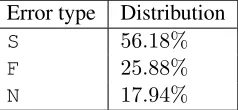
Table 1 presents the statistics on the error types detected in this dataset. The majority of the errors
4http://www.comp.nus.edu.sg/˜nlp/
Error type Distribution
S 56.18%
F 25.88%
[image:4.612.321.527.61.117.2]N 17.94%
Table 1: Distribution of error types in the annotated dataset.
involve semantically related words (typeS). Form-related confusions occur in 25.88% of the cases (typeF); while17.94%are annotated as errors com-mitted due to other reasons (typeN), possibly related to learners’ L1s.
3.2 CLC-FCE dataset
The CLC-FCE AN dataset is extracted from the publicly-available CLC-FCE subset of the CLC re-leased by Yannakoudakis et al. (2011). The CLC error coding (Nicholls, 2003) has been used to ex-tract the correctly used ANs and those that are an-notated as errors due to inappropriate choice of an adjective or/and noun, but the error subtypes for the AN errors are not further specified. We have ex-tracted456 combinations that have adjective–noun combinations as corrections.
3.3 NUCLE dataset
We have also used the training and development sets from the CoNLL-2014 Shared Task on Grammatical Error Correction (Ng et al., 2014) to extract the in-correct AN combinations. The data for the shared task has been extracted from theNUCLEcorpus, the
NUS Corpus of Learner English (Dahlmeier et al., 2013). Unlike the other two datasets it represents a smaller range of L1s, and similarly to the CLC-FCE dataset the errors are not further annotated with re-spect to their subtypes.
We have preprocessed the data using the RASP parser (Briscoe et al., 2006), and used the error an-notation provided to extract the AN combinations that contain errors in the choice of either one or both words. Additionally, we have also checked that the suggested corrections are represented by AN combi-nations. The extracted dataset contains369ANs.
Table 2 reports the distribution of the errors with respect to the incorrect choice of an adjective, noun or both words within AN combinations in all three datasets.
Word Ann. data CLC-FCE NUCLE A 63.24% 43.20% 34.15% N 30.29% 52.63% 60.16% Both 6.47% 4.17% 5.69% Table 2: Distribution of errors in the choice of adjectives (A), nouns (N) or both words in the datasets.
4 Error Correction Algorithm
First, we implement a basic error correction algo-rithm that replicates the previous approaches to er-ror correction overviewed in§2, and investigate the following aspects of the algorithm:
1. We explore different resources to retrieve alter-natives for the adjectives and nouns within in-correct ANs and report the coverage of these resources;
2. The alternative ANs are generated by crossing the sets of alternatives for the individual words, and ranked using a metric assessing AN fre-quency or fluency in native English. We assess the quality of the ranking usingmean recipro-cal rank(MRR) by comparing the system sug-gestions to the gold standard corrections; 3. Finally, we also show how the confusion sets
extracted from the learner data can help im-prove the ranking and the quality of the sug-gested corrections.
When reporting the results, we specifically focus on two aspects of the error correction algorithm: the
coverage estimated as the proportion of gold stan-dard corrections that can be found in any of the re-sources considered, and the ability of the algorithm to rank the more appropriate corrections higher than the less appropriate ones measured by MRRof the gold standard corrections in the system output. 4.1 Word alternatives
We extract word alternatives using three resources: 1. We use the notion of Levenshtein distance
[image:4.612.126.245.62.117.2]to the original words, we only consider alter-natives that differ from the original words by no more than1/3of the characters in the orig-inal word and that start with the same letter as the original word. The generated alternatives are checked against the British National Cor-pus (BNC)5 and the ukWaC corpus6 to avoid
generating non-words. This allows the algo-rithm to find alternatives likecustomerfor cos-tumer(in*important costumer),metropolisfor
metropole(in*whole metropole), orelectronic
forelectric(in*electric society).
2. We look for further alternatives in WordNet (henceforth,WN) (Miller, 1995), which has pre-viously been widely used to find semantically related words. For each original noun, we ex-tract a set of synonyms and hypo-/hypernyms. For each original adjective, we extract syn-onyms and the adjectives related via theWN re-lation similar-to. This allows us to cover se-mantically related confusions, and find alterna-tives such asluck for fate(in*good fate) and
steepforheavy(in*heavy decline).
3. Both Lv and WN cover confusions that occur in L2, but none of them can cover confusions that occur due to L1-transfer. Therefore, we extract the corrections provided by the annota-tors in theCambridge Learner Corpus (hence-forth,CLC). This approach is similar to that of Madnani and Cahill (2014), but it uses learner data as the database. We believe that the confu-sion pairs extracted this way cover a substantial portion of errors committed due to L1-transfer, while, computationally, it is much less expen-sive than the use of bilingual dictionaries or parallel corpora as in Dahlmeier and Ng (2011) or Changet al. (2008). This approach allows us to extract confusion pairs that are covered by theCLConly, for example,novelforroman
(in*historical roman),narrow,shortandbrief
forsmall (in *small interruption) orbig, high
andloudforstrong(in*strong noise).
5http://www.natcorp.ox.ac.uk
6http://wacky.sslmit.unibo.it/doku.php?
id=corpora
Setting Ann. data CLC-FCE NUCLE
Lv 0.1588 0.0833 0.0897 WN 0.4353 0.3904 0.2880 CLC 0.7912 0.8684 0.5625 CLC+Lv 0.7971 0.8706 0.5951 CLC+WN 0.8558 0.8904 0.6141
[image:5.612.316.538.61.158.2]All 0.8618 0.8925 0.6467
Table 3: Coverage of different sets of alternatives.
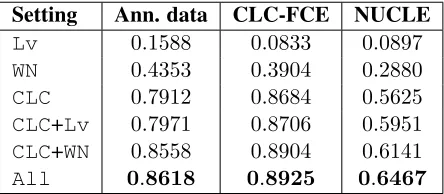
We assess how many of the gold standard correc-tions can be found in each of these confusion sets as well as in different combinations of these sets. Cov-erage of the different resources is reported in Table 3. We note that theCLC as a single source of cor-rections provides the highest coverage: for example, 79% of erroneous ANs from the annotated dataset and87%of erroneous ANs in the CLC-FCE can po-tentially be corrected using only the previous cor-rections for the content words from the CLC. We note that although the ANs in the annotated dataset have been extracted from the CLC, they have been error-annotated independently. The lower figure of 56% on the NUCLE dataset can be explained by the difference between the CLC and NUCLE pora since the distribution of errors in these cor-pora is also different (see Table 2). Nevertheless, we note that the corrections extracted from the CLC still cover a substantial amount of the errors in the NU-CLE dataset. A combination of the corrections from the CLC and semantically related words from Word-Net covers an additional6%of ANs in the annotated dataset, 5%in the NUCLE dataset, and 2%in the CLC-FCE dataset, which demonstrates that the ma-jority of the semantically related confusions are al-ready covered by the corrections extracted from the CLC, so WordNet improves the coverage of this re-source only marginally. Addition of the form related words (Lv) does not improve coverage significantly.
4.2 Alternative ANs ranking
We apply two simple methods to rank the alterna-tives: we use the frequency of the generated ANs in a combined BNC and ukWaC corpus, and we also measure collocational strength of the alterna-tive combinations using normalised pointwise mu-tual information (NPMI) since PMI-based metrics have been widely used before (see§2):
NP MI(AN) = P MI(AN)
−log2(P(AN)) (1) where
P MI(AN) =log2PP(A(AN)P(N) ) (2)
We have noticed that when the full sets of al-ternatives for the adjectives and nouns are used to generate the AN alternatives, the resulting sets of ANs contain many combinations, with both origi-nal words changed to alternative suggestions, that are dissimilar in meaning to the original ANs while often being quite frequent or fluent. As a result, such alternatives are ranked higher than the appro-priate corrections. To avoid this, we only consider the alternative ANs where one of the original words is kept unchanged, i.e.:
{alternative ANs} = ({alternative adjs} × noun)∪(adj× {alternative nouns})
We evaluate the ranking using themean recipro-cal rank(MRR):
MRR= |N1|X|N|
i=1
1
ranki (3)
where N is the total number of erroneous ANs considered by our algorithm. MRRshows how high the gold standard alternative is ranked in the whole set of alternatives provided.
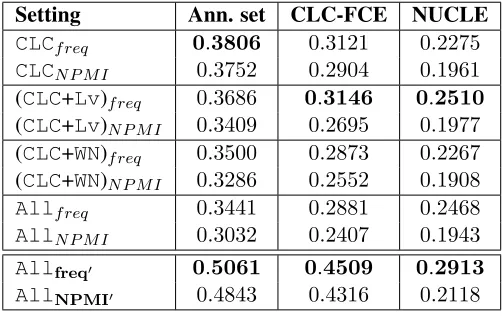
The results are reported in the upper half of the Table 4. We note that often the wider sets of alter-natives for the individual words yield lower ranks for the gold standard corrections since some other frequent AN alternatives are ranked higher by the algorithm.
4.3 Exploitation of confusion probabilities Next, we consider a novel approach to ranking the alternative ANs. Since we are using the CLC correc-tions for the adjectives and nouns within the ANs, in
Setting Ann. set CLC-FCE NUCLE
CLCfreq 0.3806 0.3121 0.2275
CLCNP MI 0.3752 0.2904 0.1961
(CLC+Lv)freq 0.3686 0.3146 0.2510
(CLC+Lv)NP MI 0.3409 0.2695 0.1977
(CLC+WN)freq 0.3500 0.2873 0.2267
(CLC+WN)NP MI 0.3286 0.2552 0.1908
Allfreq 0.3441 0.2881 0.2468
AllNP MI 0.3032 0.2407 0.1943
Allfreq0 0.5061 0.4509 0.2913
[image:6.612.312.563.62.220.2]AllNPMI0 0.4843 0.4316 0.2118
Table 4:MRRfor the alternatives ranking.
addition to the possible corrections themselves we can also use the confusion probabilities – probabil-ities associated with the words used as corrections given the incorrect word choice – for the pairs of words that we extract from the CLC.
We use a refined formula to rank the possible cor-rections:
M0 = M × CP(aorig →aalt)
× CP(norig →nalt) (4)
whereM is the measure for ranking the alterna-tives (frequency orNPMI, as before), andCP is the confusion probability of using the alternative word (possible correction) instead of the original one (er-ror) estimated from the examples in the CLC. We set
CP(a/norig →a/norig)to1.0.
For instance, consider an incorrect AN *big en-joymentand its gold standard correctiongreat plea-sure. Table 5 shows some alternatives for the words
big and enjoyment with the corresponding correc-tions and their probabilities extracted from the CLC. If we use these sets of confusion pairs to generate the alternative ANs and rank them with raw frequency, the algorithm will choosegreat fun(7759in the na-tive corpus) over the gold standard correctiongreat pleasure(2829in the native corpus). However, if we use the confusion probabilities with the new mea-sure (4) the gold standard correctiongreat pleasure
(F req0 = 3.8212) will be ranked higher thangreat
fun(F req0 = 1.1620). The new measure helps take
Original Alternatives CP(orig→alt)
big great 0.0144
large 0.0141
wide 0.0043
... ...
significant 5.1122∗10−5
enjoyment pleasure 0.0938
entertainment 0.0313
fun 0.0104
[image:7.612.80.298.61.204.2]happiness 0.0052
Table 5: CLC confusion pairs
particular correction given a learner error.
In addition, this algorithm allows us to consider both words as possibly incorrectly chosen: equation (4) ensures that the alternative combinations where both original words are changed are only ranked higher if they are both very frequent in the native corpus and very likely as a confusion pair since
CP(a/norig→a/norig)is set to1.0.
Finally, if no confusion pairs are found for either an adjective or a noun in the CLC, the algorithm con-siders the alternatives from other resources and uses standard measures to rank them.
The lower half of Table 4 presents the results of this novel algorithm and compares them to the pre-vious results from§4.2. The new metric consistently improves performance across all three datasets, with the difference in the results being significant at the 0.05level.
5 Discussion
5.1 Analysis of the results
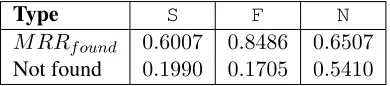
AnMRRof0.4509and0.5061reported in§4.3 im-plies that for a high number of the ANs from the CLC-FCE and annotated dataset the gold standard correction is ranked first or second in the list of all possible corrections considered by the system. Table 6 presents the breakdown of the results and reports the proportion of ANs for which the gold standard correction is covered by the topN alternatives.
We note the small difference between the num-ber of cases covered by the top 10 system alter-natives for the annotated dataset (71.18%) and the upper bound – the total number of corrections that can potentially be found by the system (74.71%)
TopN Ann. data CLC-FCE NUCLE 1 41.18 34.21 21.20 2 49.12 45.18 27.99 3 56.77 50.88 33.70 4 61.77 55.04 38.04 5 65.29 58.55 40.49 6 66.18 61.40 42.39 7 67.35 62.28 43.21 8 68.53 63.60 44.29 9 69.71 65.35 45.38 10 71.18 66.45 46.20 Not found 25.29 19.96 48.64
Table 6: Results breakdown: % of errors covered.
Type S F N
MRRfound 0.6007 0.8486 0.6507
[image:7.612.297.538.62.227.2]Not found 0.1990 0.1705 0.5410
Table 7: Subtype error analysis for the annotated dataset.
– which shows that the system reaches its poten-tial around the top 10 suggestions. These results also compare favourably to those reported in pre-vious research (Chang et al., 2008; Dahlmeier and Ng, 2011), although direct comparison is not possi-ble due to the differences in the data used.
[image:7.612.330.525.266.309.2]Corpus MRRadj MRRnoun
[image:8.612.107.264.61.117.2]Ann 0.5188 0.4312 CLC 0.3986 0.4665 NUCLE 0.3191 0.2608
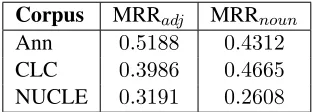
Table 8: AverageMRRon the sets of ANs with the errors in the choice of adjectives and nouns.
the adjective for form related alternativeselderly or
older.
At the same time, we note that the results on the NUCLE dataset are lower than on the two other datasets. In Table 3 we report that about 35% of the gold standard corrections from this dataset are not covered by any of the available sets of alterna-tives for adjecalterna-tives and nouns, while the confusion sets extracted from the CLC can only cover about 56%of the cases. We conclude that there might be a substantial difference between the two learner cor-pora in terms of topics, vocabulary used, learner lev-els and the distribution of the L1s. We assume that a high number of errors in NUCLE dataset can be caused by reasons other than semantic or form sim-ilarity of the words in L2. For example, our system does not suggest the gold standard correctionbillfor
*debtin*medical debt, orinfrastructuralfor *archi-tecturalin*architectural developmentbecause these suggestions are not originally covered by any of the sets of alternatives, including the set of confusion pairs extracted from the CLC.
Table 8 reports the average MRR on the sets of ANs involving errors in the choice of adjectives and nouns separately. The NUCLE dataset contains ANs with 105adjectives and185nouns, with 76 adjec-tives and 145nouns occurring in the NUCLE ANs only. The low overlap between the sets of individ-ual words explains the differences in performance. Since the annotated dataset contains ANs within a set of frequent adjectives, the algorithm achieves highest performance in correcting adjective-specific errors in this dataset.
5.2 Augmenting sets of alternatives
We investigate whether self-propagation of the sys-tem can mitigate the problem of gold standard sug-gestions not covered by the original sets of alterna-tives. Some previous research (Shei and Pain, 2000;
Setting Ann. set CLC-FCE NUCLE
CLC 0.3806 0.3121 0.2275 CLC+Lv 0.3686 0.3146 0.2510
Augm 0.4420 0.3533 0.2614
Table 9: Augmented sets of alternatives.
Chang et al., 2008) has suggested that if an error cor-rection system is implemented in an interactive way, learners can be asked to accept the suggested correc-tions so that the error–correction pairs can be added to the error database for future reference. We add the gold standard suggestions for the adjectives and nouns from all three datasets to the sets of alterna-tives and run our error correction system using the augmented sets. For example, we addbillto the set of alternatives fordebtandinfrastructuralto the set of alternatives forarchitectural and check whether the results of the error correction system improve.
Table 9 reports the results. Since we focus on the effect of the sets of alternatives, we run the experi-ments using one setting of the system only. We note that, since the datasets contain only a few examples for each adjective and noun, we cannot expect to see a significant change in the results if we updated the confusion probabilities and used the refined measure from§4.3. Therefore, we rank the AN alternatives using frequency of occurrence in the corpus of na-tive English. For ease of comparison, we copy the relevant results from Table 4.
The best results obtained in experiments in §4.2 with the original sets of alternatives are underlined, while the results obtained with the augmented sets of alternatives are marked in bold. We note that the results improve, although the difference is not statis-tically significant across the three datasets.
5.3 Error Detection and Correction System Finally, we combine the error correction algorithm from §4.3 with the error detection algorithm from Kochmar and Briscoe (2014): the error correction algorithm is applied to the set of erroneous ANs cor-rectly detected by the error detection algorithm.
[image:8.612.321.530.62.118.2]al-gorithm since the corrections are longer than two words. MRR of the error correction system ap-plied to the set of detected errors is 0.2532, while for 24.28% of the cases the system does not find a gold standard correction. If these cases are not considered, MRRfound = 0.6831. We believe that
these results reflect state-of-the-art performance for the combined EDC system for AN combinations.
6 Conclusion
In this paper, we have addressed error correction in adjective–noun combinations in learner writing us-ing three publicly available datasets. In particular, we have explored different ways to construct the cor-rection sets and to rank the suggested corcor-rections, and showed that the confusion patterns extracted di-rectly from the learner data not only provide the highest coverage for the system, but can also be used to derive confusion probabilities and improve the overall ranking of the suggestions. We have shown that an error correction system can reach an MRR
of0.5061which compares favourably to the results reported previously.
Further analysis shows that the majority of er-rors not covered by the algorithm involve confusion between words that are not related semantically or in form and, therefore, cannot be found in L2 re-sources like WordNet. Our experiments with the augmented sets of alternatives, where we use known learner confusion pairs to further extend the sets of correction candidates, show improvement in the re-sults and suggest that extension of the learner corpus can help system find appropriate corrections. At the same time, the difference in the results obtained on the datasets extracted from the CLC and the NU-CLE corpora can be explained by the difference in the topics, learner levels and L1s represented by the two learner corpora. Future research should explore further ways to extend the learner data.
We also note that in the current work we do not consider the wider context for error detection and correction in ANs. In future work we plan to inves-tigate the use of surrounding context for EDC for ANs.
Finally, we have integrated our error correction system with a state-of-the-art content word error de-tection system. To the best of our knowledge, this
is the first attempt to combine two such systems, and we believe that the results obtained – anMRR
of0.2532on the set of errors identified by the error detection algorithm – reflect state-of-the-art perfor-mance on the EDC task for AN combinations. Our future work will also extend this approach to other types of content word combinations.
Acknowledgments
We are grateful to Cambridge English Language As-sessment and Cambridge University Press for sup-porting this research and for granting us access to the CLC for research purposes. We also thank the anonymous reviewers for their valuable comments.
References
Ted Briscoe, John Carroll, and Rebecca Watson. 2006.
The second release of the RASP system. In ACL-Coling06 Interactive Presentation Session, pp. 77–80. Chris Brockett, William B. Dolan, and Michael Gamon.
2006.Correcting ESL errors using phrasal SMT tech-niques. In Proceedings of the 21st International Con-ference on Computational Linguistics and the 44th an-nual meeting of the Association for Computational Linguistics, pp. 249–256.
Yu-Chia Chang, Jason S. Chang, Hao-Jan Chen, and Hsien-Chin Liou. 2008. An automatic collocation writing assistant for Taiwanese EFL learners: A case of corpus-based NLP technology. Computer Assisted Language Learning, 21(3), pp. 283–299.
Martin Chodorow, Michael Gamon, and Joel Tetreault. 2010. The utility of grammatical error detection sys-tems for English language learners: Feedback and As-sessment. Language Testing, 27(3):335–353.
Daniel Dahlmeier, Hwee Tou Ng, and Siew Mei Wu. 2012. Building a large annotated corpus of learner English: The NUS Corpus of Learner English. In Pro-ceedings of the Eighth Workshop on Innovative Use of NLP for Building Educational Applications, pp. 22– 31.
Daniel Dahlmeier and Hwee Tou Ng. 2011. Correcting Semantic Collocation Errors with L1-induced Para-phrases. In Proceedings of the EMNLP-2011, pp. 107–117.
Yoko Futagi, Paul Deane, Martin Chodorow and Joel Tetreault. 2009. A computational approach to de-tecting collocation errors in the writing of non-native speakers of English. Computer Assisted Language Learning, 21(4), pp. 353–367.
Michael Gamon, Jianfeng Gao, Chris Brockett, Alexan-der Klementiev, William Dolan, Dmitriy Be- lenko, and Lucy Vanderwende. 2008. Using contextual speller techniques and language modeling for ESL er-ror correction. In Proceedings of IJCNLP, pp. 491– 511.
Na-Rae Han, Martin Chodorow, and Claudia Leacock. 2006. Detecting errors in English article usage by non-native speakers. Journal of Natural Language En-gineering, 12(2):115–129.
Dale D. Johnson. 2000.Just the Right Word: Vocabulary and Writing. In R. Indrisano & J. Squire (Eds.), Per-spectives on Writing: Research, Theory, and Practice, pp. 162–186.
Ekaterina Kochmar and Ted Briscoe. 2014. Detecting Learner Errors in the Choice of Content Words Using Compositional Distributional Semantics. In Proceed-ings of COLING 2014, the 25th International Confer-ence on Computational Linguistics: Technical Papers, pp. 1740–1751.
Claudia Leacock and Martin Chodorow. 2003. Auto-mated Grammatical Error Detection. In M. D. Sher-mis and J. C. Burstein (eds.),Automated Essay Scor-ing: A Cross-Disciplinary Perspective, pp. 195–207. Claudia Leacock, Martin Chodorow, Michael Gamon and
Joel Tetreault. 2014. Automated Grammatical Er-ror Detection for Language Learners, Second Edi-tion. Synthesis Lectures on Human Language Tech-nologies, Morgan & Claypool Publishers.
Vladimir I. Levenshtein. 1966. Binary codes capable of correcting deletions, insertions, and reversals. Soviet Physics Doklady, 10(8):707–710.
Anne Li-E Liu. 2002. A corpus-based lexical semantic investigation of verb-noun miscollocations in Taiwan learners English. Masters thesis, Tamkang University, Taipei.
Anne Li-E Liu, David Wible and Nai-Lung Tsao. 2009.
Automated suggestions for miscollocations. In Pro-ceedings of the 4th Workshop on Innovative Use of NLP for Building Educational Applications, pp. 47– 50.
Nitin Madnani and Aoife Cahill. 2014. An Explicit Feedback System for Preposition Errors based on Wikipedia Revisions. In Proceedings of the Ninth Workshop on Innovative Use of NLP for Building Ed-ucational Applications, pp. 79–88.
George A. Miller. 1995. WordNet: A Lexical Database for English. Communications of the ACM, 38(11):39– 41.
Hwee Tou Ng, Siew Mei Wu, Yuanbin Wu, Chris-tian Hadiwinoto, and Joel Tetreault. 2013. The CoNLL- 2013 Shared Task on Grammatical Error Cor-rection. In Proceedings of the Seventeenth Conference on Computational Natural Language Learning: Shared Task (CoNLL-2013 Shared Task), pp. 1–12.
Hwee Tou Ng, Siew Mei Wu, Ted Briscoe, Chris-tian Hadiwinoto, Raymond Hendy Susanto, and Christopher Bryant. 2014. The CoNLL-2014 Shared Task on Grammatical Error Correction. In Proceed-ings of the Eighteenth Conference on Computational Natural Language Learning: Shared Task, pp. 1–14. Diane Nicholls. 2003. The Cambridge Learner Corpus:
Error coding and analysis for lexicography and ELT. In Proceedings of the Corpus Linguistics 2003 confer-ence, pp. 572–581.
Robert ¨Ostling and Ola Knutsson. 2009.A corpus-based tool for helping writers with Swedish collocations. In Proceedings of the Workshop on Extracting and Using Constructions in NLP, pp. 28–33.
Alla Rozovskaya and Dan Roth. 2011. Algorithm Selec-tion and Model AdaptaSelec-tion for ESL CorrecSelec-tion Tasks. In Proceedings of the 49th Annual Meeting of the As-sociation for Computational Linguistics: Human Lan-guage Technologies - Volume 1, pp. 924–933. Alla Rozovskaya, Kai-Wei Chang, Mark Sammons, Dan
Roth, and Nizar Habash. 2014. Correcting Grammat-ical Verb Errors. In Proceedings of the 14th Confer-ence of the European Chapter of the Association for Computational Linguistics, pp. 358–367.
Terry Santos. 1988.Professors’ reaction to the academic writing of nonnative speaking students. TESOL Quar-terly, 22(1):69–90.
Yu Sawai, Mamoru Komachi, and Yuji Matsumoto. 2013.A Learner Corpus-based Approach to Verb Sug-gestion for ESL. In Proceedings of the 51st Annual Meeting of the Association for Computational Lin-guistics, pp. 708–713.
Chi-Chiang Shei and Helen Pain. 2000.An ESL Writer’s Collocation Aid. Computer Assisted Language Learn-ing, 13(2), pp. 167–182.
David Wible, Chin-Hwa Kuo, Nai-Lung Tsao, Anne Liu and H.-L. Lin. 2003. Bootstrapping in a language-learning environment. Journal of Computer Assisted Learning, 19(4), pp. 90–102.