Combining Word Patterns and Discourse Markers
for Paradigmatic Relation Classification
Michael Roth
ILCC, School of Informatics University of Edinburgh [email protected]
Sabine Schulte im Walde
Institut f¨ur Maschinelle Sprachverarbeitung Universit¨at Stuttgart
Abstract
Distinguishing between paradigmatic rela-tions such as synonymy, antonymy and hy-pernymy is an important prerequisite in a range of NLP applications. In this paper, we explore discourse relations as an alter-native set of features to lexico-syntactic patterns. We demonstrate that statistics over discourse relations, collected via ex-plicit discourse markers as proxies, can be utilized as salient indicators for paradig-matic relations in multiple languages, out-performing patterns in terms of recall and F1-score. In addition, we observe that
markers and patterns provide complemen-tary information, leading to significant classification improvements when applied in combination.
1 Introduction
Paradigmatic relations (such as synonymy, antonymy and hypernymy; cf. Murphy, 2003) are notoriously difficult to distinguish automatically, as first-order co-occurrences of the related words tend to be very similar across the relations. For example, in The boy/girl/person loves/hates the cat, the nominal co-hyponymsboy, girl and their hypernymperson as well as the verbal antonyms
loveandhate occur in identical contexts, respec-tively. Vector space models, which represent words by frequencies of co-occurring words to enable comparisons in terms of distributional similarity (Sch¨utze, 1992; Turney and Pantel, 2010), hence perform below their potential when inferring the type of relation that holds between two words. This distinction is crucial, however, in a range of tasks: in sentiment analysis, for example, words of the same and opposing polarity need to be distinguished; in textual entailment, systems further need to identify hypernymy because of directional inference requirements.
Accordingly, while there is a rich tradition on identifying word pairs of a single paradigmatic re-lation, there is little work that has addressed the distinction between two or more paradigmatic re-lations (cf. Section 2 for details). In more gen-eral terms, previous approaches to distinguish-ing between several semantic relations have pre-dominantly relied on manually created knowledge sources, or lexico-syntactic patterns that can be automatically extracted from text. Each option comes with its own shortcomings: knowledge bases, on the one hand, are typically developed for a single language or domain, meaning that they might not generalize well; word patterns, on the other hand, are noisy and can be sparse for infre-quent word pairs.
In this paper, we propose to strike a balance between availability and restrictedness by mak-ing use ofdiscourse markers. This approach has several advantages: markers are frequently found across genres (Webber, 2009), they exist in many languages (Jucker and Yiv, 1998), and capture various semantic properties (Hutchinson, 2004). We implement discourse markers within a vector space model that aims to distinguish between the three paradigmatic relationssynonymy, antonymy
andhypernymyin German and in English, across the three word classes of nouns, verbs, adjectives. We examine the performance of discourse markers as vector space dimensions in isolation and also explore their contribution in combination with lex-ical patterns.
2 Related Work
As mentioned above, there is a rich tradition of research on identifying a single paradigmatic rela-tions. Work onsynonymsincludes Edmonds and Hirst (2002), who employed a co-occurrence net-work and second-order co-occurrence, and Cur-ran (2003), who explored word-based and syntax-based co-occurrence for thesaurus construction.
Van der Plas and Tiedemann (2006) compared a standard distributional approach against cross-lingual alignment; Erk and Pad´o (2008) defined a vector space model to identify synonyms and the substitutability of verbs. Most computational work onhypernymswas performed for nouns, cf. the lexico-syntactic patterns by Hearst (1992) and an extension of the patterns by dependency paths (Snow et al., 2004). Weeds et al. (2004), Lenci and Benotto (2012) and Santus et al. (2014) identi-fied hypernyms in distributional spaces. Computa-tional work onantonymsincludes approaches that tested the co-occurrence hypothesis (Charles and Miller, 1989; Fellbaum, 1995), and approaches driven by text understanding efforts and contradic-tion frameworks (Harabagiu et al., 2006; Moham-mad et al., 2008; de Marneffe et al., 2008).
Among the few approaches that distinguished
betweenparadigmatic semantic relations, Lin et al. (2003) used patterns and bilingual dictionaries to retrieve distributionally similar words, and relied on clear antonym patterns such as ‘either X or Y’ in a post-processing step to distinguish synonyms from antonyms. The study by Mohammad et al. (2013) on the identification and ranking of oppo-sites also included synonym/antonym distinction. Yih et al. (2012) developed an LSA approach in-corporating a thesaurus, to distinguish the same two relations. Chang et al. (2013) extended this approach to induce vector representations that can capture multiple relations. Whereas the above mentioned approaches rely on additional knowl-edge sources, Turney (2006) developed a corpus-based approach to model relational similarity, ad-dressing (among other tasks) the distinction be-tween synonyms and antonyms. More recently, Schulte im Walde and K¨oper (2013) proposed to distinguish between the three relations antonymy, synonymy and hyponymy based on automatically acquired word patterns.
Regarding pattern-based approaches to iden-tify and distinguish lexical semantic relations in more general terms, Hearst (1992) was the first to propose lexico-syntactic patterns as empirical pointers towards relation instances, focusing on hyponymy. Girju et al. (2003) applied a sin-gle pattern to distinguish pairs of nouns that are in a causal relationship from those that are not, and Girju et al. (2006) extended the work to-wards part–whole relations, applying a super-vised, knowledge-intensive approach. Chklovski and Pantel (2004) were the first to apply
pattern-based relation extraction to verbs, distinguish-ing five non-disjoint relations (similarity, strength, antonymy, enablement, happens-before). Pantel and Pennacchiotti (2006) developed Espresso, a weakly-supervised system that exploits patterns in large-scale web data to distinguish between five noun-noun relations (hypernymy, meronymy, suc-cession, reaction, production). Similarly to Girju et al. (2006), they used generic patterns, but relied on a bootstrapping cycle combined with reliability measures, rather than manual resources. Whereas each of the aforementioned approaches considers only one word class and clearly disjoint categories, we distinguish between paradigmatic relations that can be distributionally very similar and propose a unified framework for nouns, verbs and adjectives.
3 Baseline Model and Data Set
S&K Reimplemented
P R F1 P R F1
Nouns
SYN–ANT 77.4 65.0 70.7 76.7 62.2 68.7 SYN–HYP 75.0 57.0 64.8 73.3 59.5 65.7
Verbs
SYN–ANT 70.6 40.0 51.1 84.6 36.7 51.2 SYN–HYP 42.0 26.7 32.6 52.6 33.3 40.8 Adjectives
[image:3.595.73.295.64.231.2]SYN–ANT 88.9 66.7 76.2 94.1 66.7 78.0 SYN–HYP 68.4 54.2 60.5 65.0 54.2 59.1
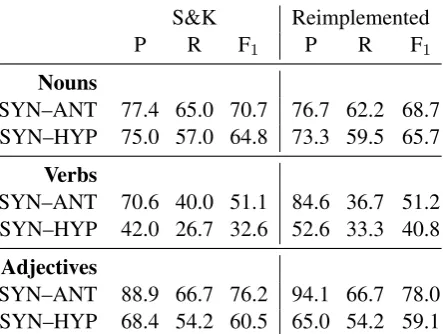
Table 1: 2-way classification results by Schulte im Walde and K¨oper (2013) and our re-implementation. All numbers in percent.
data set consists of 692 pairs of instances, dis-tributed over three word classes (nouns, verbs, adjectives) and three paradigmatic relations (syn-onymy, ant(syn-onymy, hypernymy).
Intermediate Evaluation. We compare our re-implementation to the model by S&K using their 80% training and 20% test split, focusing on 2-way classifications involving synonymy. The sults, summarized in Table 1, confirm that our re-implementation achieves similar results. Observed differences are probably an effect of the distinct corpora applied to induce patterns and counts.
We notice that the performance of both models strongly depends on the affected pair of relations and word category. For example, precision varies in the 2-way classification between synonymy and antonymy from 70.6% to 94.1%. Given the small amount of test data, some of the 80/20 splits might be better suited for the model than others. To avoid resulting bias effects, we perform our final evalua-tion using 5-fold cross-validaevalua-tion on a merged set of all training and test instances. To illustrate the performance of models in multiple languages, we further conduct experiments on a data set for En-glish relation pairs that has been collected by Giu-lia Benotto and Alessandro Lenci, following the same methodology as the German collection. The English data set consists of 648 pairs of instances, also distributed over nouns, verbs, adjectives, and covering synonymy, antonymy, hypernymy. 4 Markers for Relation Classification The aim of this work is to establish corpus statis-tics over discourse relations as a salient source of
CONTRAST but, altough, rather . . . RESTATEMENT indeed, specifically, . . . INSTANTIATION (for) example, instance, . . .
Table 2: Examples of discourse relations/markers.
information to distinguish between paradigmatic relations. Our approach is motivated by linguis-tic studies that indicated a connection between dis-course relations and lexical relations of words oc-curring in the respective discourse segments: Mur-phy et al. (2009) have shown, for example, that antonyms frequently serve as indicators for con-trast relations in English and Swedish. More gen-erally, pairs of word tokens have been identified as strong features for classifying discourse relations when no explicit discourse markers are available (Pitler et al., 2009; Biran and McKeown, 2013).
Whereas word pairs have frequently been used as features for disambiguating discourse relations, to the best of our knowledge, our approach is novel in that we are the first to apply discourse relations as features for classifying lexical relations. One reason for this might be that discourse relations in general are only available in manually annotated corpora. Previous work has shown, however, that such relations can be classified reliably given the presence of explicit discourse markers.1We hence
rely on such markers as proxies for discourse rela-tions (for examples, cf. Table 2).
4.1 Model and Hypothesis
We propose a vector space model that represents pairs of words using as features the discourse markers that occur between them. The under-lying hypothesis of this model is as follows: if two phrases frequently co-occur with a specific discourse marker, then the discourse relation ex-pressed by the corresponding marker should also indicate the relation between the words in the af-fected phrases. Following this hypothesis, contrast relations might indicate antonymy, whereas elab-orations may indicate synonymy or hyponymy. Although such relations will not hold between every pair of words in two connected discourse segments, we hypothesize that correct instances (of all considered word classes) can be identified based on high relative frequency.
In our model, frequency statistics are com-puted over sentence-internal co-occurrences of
word pairs and discourse markers. Since discourse relations are typically directed, we take into con-sideration whether a word occurs to the left or to the right of the respective marker. Accord-ingly, the features of our model are special cases of single-word patterns with an arbitrary number of wild card tokens (e.g., the marker feature ‘though’ corresponds to the pattern “X ∗ though ∗ Y”). Yet, our specific choice of features has several ad-vantages: Whereas strict and potentially long pat-terns can be rare in text, discourse markers such as “however”, “for example” and “additionally” are frequently found across genres (Webber, 2009). Although combinations of tokens could also be re-placed by wild cards in any automatically acquired pattern, this would generally lead to an exponen-tially growing feature space. In contrast, the set of discourse markers in our work is fixed: for En-glish, we use 61 markers annotated in the Penn Discourse TreeBank 2.0 (Prasad et al., 2008); for German, we use 155 one-word translations of the English markers, as obtained from an online dic-tionary.23 Taking directionality into account, our
vector space model consists of 2x61 and 2x155 features, respectively.
4.2 Development Set and Hyperparameters We select the hyperparameters of our model using an independent development set, which we extract from the lexical resource GermaNet (Hamp and Feldweg, 1997). For each considered word cate-gory, we extract instances of synonymy, antonymy and hypernymy. In total, 1502 instances are iden-tified, with 64 of them overlapping with the evalu-ation data set described in Section 3. Note though that the development set is not used for evaluation but only to select the following hyperparameters.
We experimented with different vector values (absolute frequency, log frequency, pointwise mu-tual information (PMI)), distance measures (co-sine, euclidean) and normalization schemes. In contrast to S&K, who did not observe any im-provements using PMI, we found it to perform best, combined with euclidean distance and no additional normalization. This finding might be an immediate effect of discourse markers being
2http://dict.leo.org
3We also experimented with larger sets of markers, in-cluding conjunctions and adverbials in sentence-initial posi-tions, but did not notice any considerable effect. Future work could use manual sets of markers, e.g. those by Pasch et al. (2003), though such sets are only available in few languages.
generally more frequent than strict word patterns, which also leads to more reliable PMI values.
5 Evaluation
In our evaluation, we assess the performance of the marker-based model and demonstrate the benefits of incorporating discourse markers into a pattern-based model, which we apply as a baseline. We evaluate on several data sets: the collection of target-response pairs in German from previous work, and a similar data set that was collected for English target words (cf. Section 3); for compari-son reacompari-sons, we also apply our models to the bal-anced data set of related and unrelated noun pairs by Yap and Baldwin (2009).4 We perform 3-way
and 2-way relation classification experiments, us-ing 5-fold cross-validation and a nearest centroid classifier (as applied by S&K).
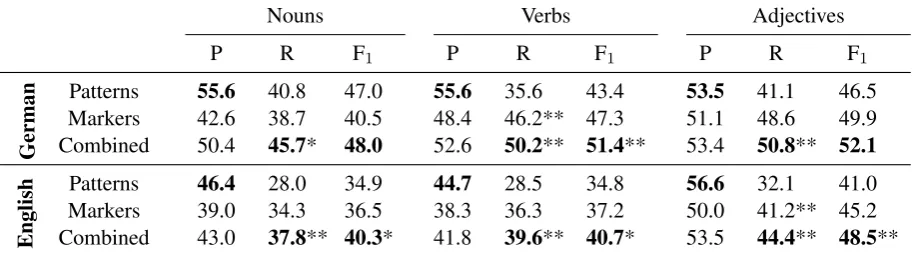
Results. The 3-way classification results of the baseline and our marker-based model are summa-rized in Table 3, with best results for each set-ting marked in bold. On the German data set, our model always outperforms a random baseline (33% F1-score). The results on the English data
set are overall a bit lower, possibly due to corpus size. In almost all classification tasks, our marker-based model achieves a higher recall and F1-score
than the pattern-based approach. The precision results of the marker-based model are overall be-low the pattern-based model. This drop in perfor-mance does not come as a surprise though, con-sidering that the model only makes use of 122 and 310 features, in comparison to tens of thousands of features in the pattern approach.
A randomized significance test over classified instances (cf. Yeh, 2000) revealed that only two differences in results are significant. We hypoth-esize that one reason for this outcome might be that both models cover complementary sets of in-stances. To verify this hypothesis, we apply a combined model, which is based on a weighted linear combination of distances computed by the two individual models.5 As displayed in Table 3,
this combined model yields further improvements 4Note that we could, in principle, also apply our models to unbalanced data. Our main focus lies however on examining the direct impact of different feature sets. We hence decided to keep the evaluation setup simple and used a classifier that does not take into account class frequency.
Nouns Verbs Adjectives
P R F1 P R F1 P R F1
German
Patterns 55.6 40.8 47.0 55.6 35.6 43.4 53.5 41.1 46.5
Markers 42.6 38.7 40.5 48.4 46.2** 47.3 51.1 48.6 49.9
Combined 50.4 45.7* 48.0 52.6 50.2** 51.4** 53.4 50.8** 52.1
English
Patterns 46.4 28.0 34.9 44.7 28.5 34.8 56.6 32.1 41.0
Markers 39.0 34.3 36.5 38.3 36.3 37.2 50.0 41.2** 45.2
[image:5.595.72.530.66.193.2]Combined 43.0 37.8** 40.3* 41.8 39.6** 40.7* 53.5 44.4** 48.5**
Table 3: 3-way classification results using 5-fold cross-validation. All numbers in percent. Asterisks indicate significant differences to the pattern-based baseline model (* p<0.10, ** p<0.05).
Combined model
German English
P R F1 P R F1
Nouns
SYN–ANT 61.7 55.7 58.5 52.9 44.2 48.2 SYN–HYP 66.5 60.4 63.3 62.2 58.6 60.4 ANT–HYP 70.9 64.6 67.6 59.1 50.6 54.5
Verbs
SYN–ANT 58.9 55.0 56.8 49.6 45.8 47.6 SYN–HYP 67.6 64.0 65.8 66.4 63.0 64.7 ANT–HYP 67.3 66.4 66.9 62.9 60.7 61.8
Adjectives
[image:5.595.72.291.248.481.2]SYN–ANT 74.8 69.4 72.0 67.0 56.6 61.3 SYN–HYP 58.0 56.1 57.0 56.4 46.0 50.7 ANT–HYP 73.7 70.7 72.2 69.8 57.8 63.2
Table 4: 2-way results of the combined model. Bold numbers indicate improvements over both individual models. All numbers in percent.
in recall and F1-score, leading to the best 3-way
classification results. All gains in recall are sig-nificant, confirming that the single models in-deed contribute complementary information. For example, only the pattern-based model classifies “intentional”–“accidental” as antonyms, and only the marker-based model predicts the correct rela-tion for “double”–“multiple” (hypernymy). The combined model classifies both pairs correctly.
Table 4 further assesses the strength of the com-bined model on the 2-way classifications. The table highlights results indicating improvements overbothindividual models. We observe that the combined model achieves the best recall and F1
-score in 15 out of 18 cases.
Relation SYN ANT HYP
Patterns 0.97 0.97 0.94 Markers 0.77* 0.82* 0.91* Combined 0.93* 0.98 0.96* Table 5: Results in F1-score on the balanced data
set by Yap and Baldwin (* p<0.05).
A final experiment is performed on the data set by Yap and Baldwin (2009) to see whether our models can also distinguish word pairs of individ-ual relations from unrelated pairs of words. The results, listed in Table 5, show that the marker-based model cannot perform this task as well as the pattern-based model. The combined model, however, outperforms both individual models in 2 out of 3 cases. Despite their simplicity, our models achieve results close to the F1-scores reported by
Yap and Baldwin (0.98–0.99), who employed syn-tactic pre-processing and an SVM-based classifier, and experimented with different corpora.
6 Conclusions
In this paper, we proposed to use discourse mark-ers as indicators for paradigmatic relations be-tween words and demonstrated that a small set of such markers can achieve higher recall than a pattern-based model with tens of thousands of fea-tures. Combining patterns and markers can further improve results, leading to significant gains in re-call and F1. As our new model only relies on a raw
corpus and a fixed list of discourse markers, it can easily be extended to other languages.
Acknowledgments
References
Marco Baroni, Silvia Bernardini, Adriano Ferraresi, and Eros Zanchetta. 2009. The wacky wide web: a collection of very large linguistically pro-cessed web-crawled corpora. Language resources and evaluation, 43(3):209–226.
Or Biran and Kathleen McKeown. 2013. Aggre-gated word pair features for implicit discourse rela-tion disambiguarela-tion. InProceedings of the 51st An-nual Meeting of the Association for Computational Linguistics (Volume 2: Short Papers), pages 69–73, Sofia, Bulgaria, August.
Kai-Wei Chang, Wen-tau Yih, and Christopher Meek. 2013. Multi-relational latent semantic analysis. In
Proceedings of the 2013 Conference on Empirical Methods in Natural Language Processing, pages 1602–1612, Seattle, Washington, USA, October. Walter G. Charles and George A. Miller. 1989.
Con-texts of antonymous adjectives. Applied Psycholin-guistics, 10(3):357–375.
Tim Chklovski and Patrick Pantel. 2004. VerbOcean: Mining the Web for fine-grained semantic verb re-lations. InProceedings of the 2004 Conference on Empirical Methods in Natural Language Process-ing,Barcelona, Spain, 25–26 July 2004, pages 33– 40.
James Curran. 2003. From Distributional to Semantic Similarity. Ph.D. thesis, Institute for Communica-tion and Collaborative Systems, School of Informat-ics, University of Edinburgh.
Marie-Catherine de Marneffe, Anna N. Rafferty, and Christopher D. Manning. 2008. Finding contra-dictions in text. In Proceedings of the 46th An-nual Meeting of the Association for Computational Linguistics: Human Language Technologies, pages 1039–1047, Columbus, Ohio, USA.
Philip Edmonds and Graeme Hirst. 2002. Near-synonymy and lexical choice. Computational Lin-guistics, 28(2):105–144.
Katrin Erk and Sebastian Pad´o. 2008. A structured vector space model for word meaning in context. In
Proceedings of the 2008 Conference on Empirical Methods in Natural Language Processing,Waikiki, Honolulu, Hawaii, 25-27 October 2008.
Christiane Fellbaum. 1995. Co-occurrence and antonymy. International Journal of Lexicography, 8(4):281–303.
Roxana Girju, Adriana Badulescu, and Dan Moldovan. 2003. Learning semantic constraints for the auto-matic discovery of part-whole relations. In Proceed-ings of the Human Language Technology Confer-ence of the North American Chapter of the Associ-ation for ComputAssoci-ational Linguistics,Edmonton, Al-berta, Canada, 27 May –1 June 2003, pages 80–87.
Roxana Girju, Adriana Badulescu, and Dan Moldovan. 2006. Automatic discovery of part-whole relations.
Computational Linguistics, 32(1):83–135.
Birgit Hamp and Helmut Feldweg. 1997. GermaNet -a lexic-al-sem-antic net for Germ-an. InProceedings of the Workshop on Automatic Information Extrac-tion and Building of Lexical Semantic Resources for NLP Applications at ACL/EACL-97,Madrid, Spain, 12 July 1997, pages 9–15.
Sanda Harabagiu, Andrew Hickl, and Finley Lacatusu. 2006. Negation, contrast and contradiction in text processing. InIn Proceedings of the 21st National Conference on Artificial Intelligence, pages 755– 762.
Marti A. Hearst. 1992. Automatic acquisition of hy-ponyms from large text corpora. In Proceedings of the 15th International Conference on Computa-tional Linguistics, Nantes, France, 23-28 August 1992, pages 539–545.
Ben Hutchinson. 2004. Acquiring the meaning of dis-course markers. InProceedings of the 42nd Annual Meeting of the Association for Computational Lin-guistics, Barcelona, Spain, 21–26 July 2004, pages 685–692.
Andreas H. Jucker and Zael Yiv, editors. 1998. Dis-course Markers: Descriptions and Theory, vol-ume 57 ofDiscourse & Beyond New Series. John Benjamin Publishing Company.
Alessandro Lenci and Giulia Benotto. 2012. Identify-ing hypernyms in distributional semantic spaces. In
Proceedings of the First Joint Conference on Lexical and Computational Semantic, pages 75–79.
Dekang Lin, Shaojun Zhao, Lijuan Qin, and Ming Zhou. 2003. Identifying synonyms among distri-butionally similar words. InProceedings of the 18th International Joint Conference on Artificial Intelli-gence, pages 1492–1493. Morgan Kaufmann Pub-lishers Inc.
Saif M. Mohammad, Bonnie Dorr, and Graeme Hirst. 2008. Computing word-pair antonymy. In Proceed-ings of the 2008 Conference on Empirical Methods in Natural Language Processing, pages 982–991, Honolulu, Hawaii, USA.
Saif M. Mohammad, Bonnie J. Dorr, Graeme Hirst, and Peter D. Turney. 2013. Computing lexical contrast.
Computational Linguistics, 39(3):555–590.
M. Lynne Murphy, Carita Paradis, Caroline Will-ners, and Steven Jones. 2009. Discourse func-tions of antonymy: A cross-linguistic investigation of Swedish and English. Journal of Pragmatics, 41(11):2159–2184.
Patrick Pantel and Marco Pennacchiotti. 2006. Espresso: Leveraging generic patterns for automati-cally harvesting semantic relations. InProceedings of the 21st International Conference on Computa-tional Linguistics and 44th Annual Meeting of the Association for Computational Linguistics,Sydney, Australia, 17–21 July 2006, pages 113–120. Renate Pasch, Ursula Brausse, Eva Breindl, and Ulrich
Wassner. 2003. Handbuch der deutschen Konnek-toren. Walter de Gruyter, Berlin.
Emily Pitler and Ani Nenkova. 2008. Revisiting readability: A unified framework for predicting text quality. In Proceedings of the 2008 Conference on Empirical Methods in Natural Language Process-ing, pages 186–195, Honolulu, Hawaii, October. Emily Pitler, Annie Louis, and Ani Nenkova. 2009.
Automatic sense prediction for implicit discourse re-lations in text. InProceedings of the Joint Confer-ence of the 47th Annual Meeting of the ACL and the 4th International Joint Conference on Natural Lan-guage Processing of the AFNLP, pages 683–691, Suntec, Singapore, August.
Rashmi Prasad, Nikhil Dinesh, Alan Lee, Eleni Milt-sakaki, Livio Robaldo, Aravind K Joshi, and Bon-nie L Webber. 2008. The Penn Discourse Tree-Bank 2.0. InProceedings of the Sixth International Conference on Language Resources and Evaluation (LREC-2008), Marrakesh, Marocco, May.
Enrico Santus, Alessandro Lenci, Qin Lu, and Sabine Schulte im Walde. 2014. Chasing hypernyms in vector spaces with entropy. In Proceedings of the 14th Conference of the European Chapter of the As-sociation for Computational Linguistics, volume 2: Short Papers, pages 38–42, Gothenburg, Sweden. Roland Sch¨afer and Felix Bildhauer. 2012.
Build-ing large corpora from the web usBuild-ing a new effi-cient tool chain. InProceedings of the Eighth In-ternational Conference on Language Resources and Evaluation (LREC-2012), pages 486–493, Istanbul, Turkey, May.
Sabine Schulte im Walde and Maximilian K¨oper. 2013. Pattern-based distinction of paradigmatic relations for German nouns, verbs, adjectives. InLanguage Processing and Knowledge in the Web, pages 184– 198. Springer.
Hinrich Sch¨utze. 1992. Dimensions of meaning. InIn Proceedings of Supercomputing, pages 787–796. Rion Snow, Daniel Jurafsky, and Andrew Y Ng. 2004.
Learning syntactic patterns for automatic hypernym discovery. InAdvances in Neural Information Pro-cessing Systems, volume 17, pages 1297–1304. Peter D. Turney and Patrick Pantel. 2010. From
frequency to meaning: Vector space models of se-mantics. Journal of Artificial Intelligence Research, 37(1):141–188.
Peter D. Turney. 2006. Similarity of semantic rela-tions.Computational Linguistics, 32(3):379–416. Lonneke Van der Plas and J¨org Tiedemann. 2006.
Finding synonyms using automatic word alignment and measures of distributional similarity. In Pro-ceedings of the COLING/ACL on Main conference poster sessions, pages 866–873.
Bonnie Webber. 2009. Genre distinctions for dis-course in the Penn TreeBank. InProceedings of the Joint Conference of the 47th Annual Meeting of the ACL and the 4th International Joint Conference on Natural Language Processing of the AFNLP, pages 674–682, Suntec, Singapore, August.
Julie Weeds, David Weir, and Diana McCarthy. 2004. Characterising measures of lexical distributional similarity. InProceedings of the 20th International Conference on Computational Linguistics, pages 1015–1021.
Willy Yap and Timothy Baldwin. 2009. Experiments on pattern-based relation learning. InProceedings of the 18th ACM Conference on Information and Knowledge Management, pages 1657–1660. Alexander Yeh. 2000. More accurate tests for
the statistical significance of result differences. In Proceedings of the 18th International Confer-ence on Computational Linguistics, pages 947–953, Saarbr¨ucken, Germany, August.