Seven Basic Tools of Quality Control:
The Appropriate Techniques for Solving
Quality Problems in the Organizations
Neyestani, Behnam
March 2017
Seven Basic Tools of Quality Control: The
Appropriate Techniques for Solving Quality
Problems in the Organizations
Behnam Neyestani
Abstract: Dr. Kaoru Ishikawa was first total quality management guru, who has been associated with the development and advocacy of using the seven quality control (QC) tools in the organizations for problem solving and process improvements. Seven old quality control tools are a set of the QC tools that can be used for improving the performance of the production processes, from the first step of producing a product or service to the last stage of production. So, the general purpose of this paper was to introduce these 7 QC tools. This study found that these tools have the significant roles to monitor, obtain, analyze data for detecting and solving the problems of production processes, in order to facilitate the achievement of performance excellence in the organizations.
Keywords: Seven QC Tools; Check Sheet; Histogram; Pareto Analysis; Fishbone Diagram; Scatter Diagram; Flowcharts, and Control Charts.
INTRODUCTION
There are seven basic quality tools, which can assist an organization for
problem solving and process improvements. The first guru who proposed
seven basic tools was Dr. Kaoru Ishikawa in 1968, by publishing a book
entitled “Gemba no QC Shuho” that was concerned managing quality through
techniques and practices for Japanese firms. It was intended to be applied for
“self-study, training of employees by foremen or in QC reading groups in
Japan. It is in this book that the seven basic quality control tools were first
proposed. valuable resource when applying the seven basic tools (Omachonu
Neyestani B. (2017, March). “Seven Basic Tools of Quality Control: The Appropriate
Quality Techniques for Solving Quality Problems in the Organizations.”
https://doi.org/10.5281/zenodo.400832
and Ross, 2004). These seven basic quality control tools, which introduced by
Dr. Ishikawa, are : 1) Check sheets; 2) Graphs (Trend Analysis); 3)
Histograms; 4) Pareto charts; 5) Cause-and-effect diagrams; 6) Scatter
diagrams; 7) Control charts. Figure 1 indicates the relationships among these
seven tools and their utilizations for the identification and analysis of
improvement of quality (Kerzner, 2009).
Figure 1: The seven quality control tools (Kerzner, 2009).
Check Sheet
Check sheets are simple forms with certain formats that can aid the user
to record data in an firm systematically. Data are “collected and tabulated” on
the check sheet to record the frequency of specific events during a data
collection period. They prepare a “consistent, effective, and economical
approach” that can be applied in the auditing of quality assurance for reviwing
and to follow the steps in a particular process. Also, they help the user to
arrange the data for the utilization later (Montgomery, 2009; Omachonu and
Ross, 2004). The main advantages of check sheets are to be very easily to
apply and understand, and it can make a clear picture of the situation and
condition of the organization. They are efficient and powerful tools to identify
frequently problems, but they dont have effective ability to analyze the
quality problem into the workplace. The chech sheets are in several, three
major types are such as Defect-location check sheets; tally check sheets,
and; defect-cause check sheets (Kerzner, 2009). Figure 2 is depicted a tally
Neyestani B. (2017, March). “Seven Basic Tools of Quality Control: The Appropriate
Quality Techniques for Solving Quality Problems in the Organizations.”
https://doi.org/10.5281/zenodo.400832
check sheet that cn be used for collecting data during production process.
Figure 2: Check sheet (Tally) for telephone interruptions
Histogram
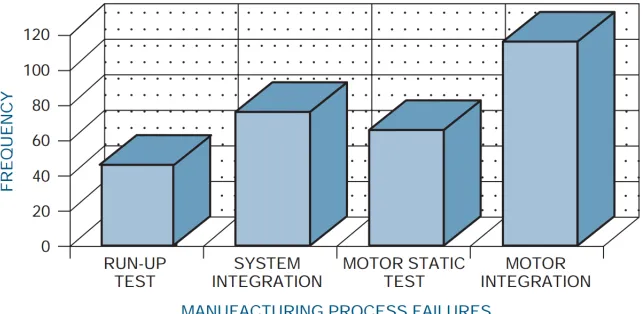
Histogram is very useful tool to describe a sense of the frequency
distribution of observed values of a variable. It is a type of bar chart that
visualizes both attribute and variable data of a product or process, also
assists users to show the distribution of data and the amount of variation
within a process. It displays the different measures of central tendency
(mean, mode, and average). It should be designed properly for those working
into the operation process can easily utilize and understand them. Also, a
histogram can be applied to investigate and identify the underlying
distribution of the variable being explored (Omachonu and Ross, 2004;
Forbes and Ahmed, 2011). Figure 3 illustrates a histogram of the frequency of
defects in a manufacturing process.
Figure 3: Histogram for variables
Neyestani B. (2017, March). “Seven Basic Tools of Quality Control: The Appropriate
Quality Techniques for Solving Quality Problems in the Organizations.”
https://doi.org/10.5281/zenodo.400832
Pareto Analysis
It introduced by an Italian economist, named Vilfredo Pareto, who
worked with income and other unequal distributions in 19th century, he
noticed that 80% of the wealth was owned by only 20% of the population.
later, Pareto principle was developed by Juran in 1950. A Pareto chart is a
special type of histogram that can easily be apply to find and prioritize quality
problems, conditions, or their causes of in the organization (Juran and
Godfrey, 1998).. On the other hand, it is a type of bar chart that shows the
relative importance of variables, prioritized in descending order from left to
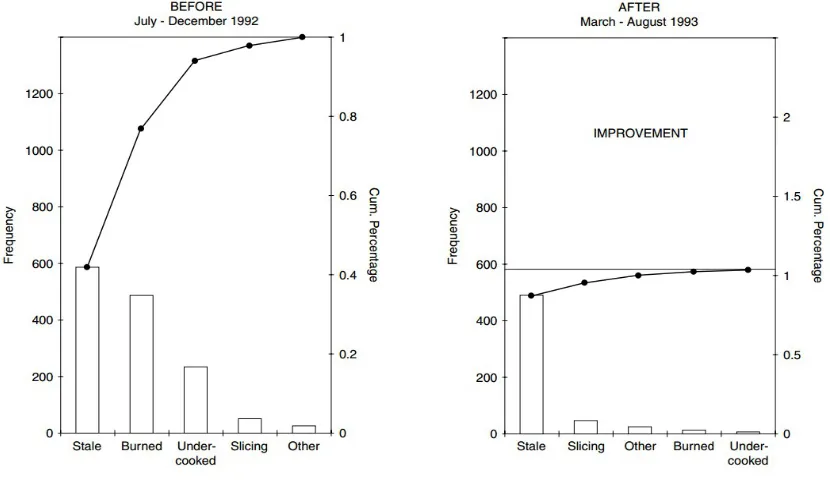
right side of the chart. The aim of Pareto chart is to figure out the different
kind of “nonconformity” from data figures, maintenance data, repair data,
parts scrap rates, or other sources. Also, Pareto chart can generate a mean
for investigating concerning quality improvement, and improving efficiency,
“material waste, energy conservation, safety issues, cost reductions”, etc., as
Figure 4 demonstrated concerning Pareto chart, it can able to improve the
production before and after changes (Montgomery, 2009; Kerzner, 2009;
Omachonu and Ross, 2004).
Figure 4: Pareto Charts
Neyestani B. (2017, March). “Seven Basic Tools of Quality Control: The Appropriate
Quality Techniques for Solving Quality Problems in the Organizations.”
https://doi.org/10.5281/zenodo.400832
[image:5.612.95.510.438.680.2]Fishbone Diagram
Kaoru Ishikawa is considered by many researchers to be the founder and
first promoter of the ‘Fishbone’ diagram (or Cause-and-Effect Diagram) for
root cause analysis and the concept of Quality Control (QC) circles . Cause
and effect diagram was developed by Dr. Kaoru Ishikawa in 1943. It has also
two other names that are Ishikawa diagram and fishbone because the shape
of the diagram looks like the skeleton of a fish to identify quality problems
based on their degree of importance (Neyestani, 2017). The cause and effect
diagram is a problem-solving tool that investigates and analizes
systematically all the potential or real causes that result in a single effect. On
the other hand, it is an efficient tool that equips the organization's
management to explore for the possible causes of a problem (Juran and
Godfrey, 1998). This diagram can provide the problem-solving efforts by
“gathering and organizing the possible causes, reaching a common
understanding of the problem, exposing gaps in existing knowledge, ranking
the most probable causes, and studying each cause” (Omachonu and Ross,
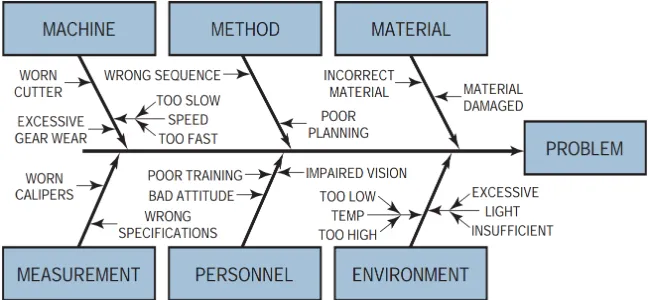
2004). The generic categories of the cause and effect diagram are usually six
elements (causes) such as environment, materials, machine, measurement,
man, and method, as indicated in Figure 5. Furthermore, “potential causes”
[image:6.612.162.486.519.669.2]can be indicated by arrows entering the main cause arrow (Neyestani, 2017).
Figure 5: The cause and effect diagram (Fishbone Diagram)
Neyestani B. (2017, March). “Seven Basic Tools of Quality Control: The Appropriate
Quality Techniques for Solving Quality Problems in the Organizations.”
https://doi.org/10.5281/zenodo.400832
Scatter Diagram
Scatter diagram is a powerful tool to draw the distribution of information
in two dimensions, which helps to detect and analyze a pattern relationships
between two quality and compliance variables (as an independent variable
and a dependent variable), and understanding if there is a relationship
between them, so what kind of the relationship is (Weak or strong and
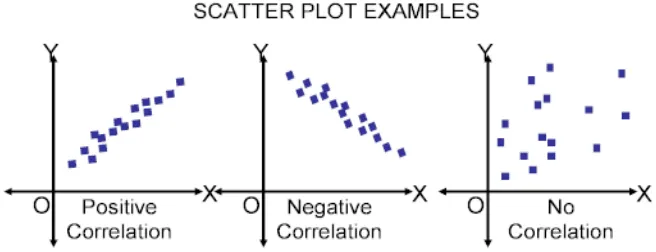
positive or negative). The shape of the scatter diagram often shows the
degree and direction of relationship between two variables, and the
correlation may reveale the causes of a problem. Scatter diagrams are very
useful in regression modeling (Montgomery, 2009; Oakland, 2003). The
scatter diagram can indicate that there is which one of these following
correlation between two variables: a) Positive correlation; b) Negative
[image:7.612.151.479.374.500.2]correlation, and c) No correlation, as demonstrated in Figure 6.
Figure 6: Scatter Diagrams
Flowchart
Flowchart presents a diagrammatic picture that indicats a series of
symbols to describe the sequence of steps exist in an operation or process.
On the other hand, a flowchart visualize a picture including the inputs,
activities, decision points, and outputs for using and understanding easily
concerning the overall objective through process. This chart as a problem
solving tool can apply methodically to detect and analyze the areas or points
of process may have had potential problems by “documenting” and explaining
Neyestani B. (2017, March). “Seven Basic Tools of Quality Control: The Appropriate
Quality Techniques for Solving Quality Problems in the Organizations.”
https://doi.org/10.5281/zenodo.400832
an operation, so it is very useful to find and improve quality into process
(Forbes and Ahmed, 2011), as shown in Figure 7.
Figure 7: Flow chart of review process
Control Chart
Control chart or Shewhart control chart was introduced and developed
by Walter A. Shewhart in the 1920s at the Bell Telephone Laboratories, and is
likely the most “technically sophisticated” for quality management
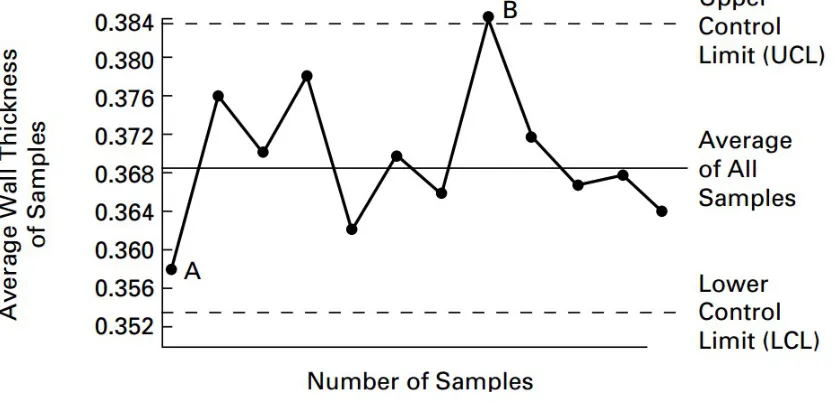
(Montgomery, 2009). Control charts is a special form of “run chart that it
illustrates the amount and nature of variation in the process over time”. Also,
it can draw and describe what has been happning in the process. Therefore, it
is very important to apply control chart, becaust it can observe and moniter
process to study process that is in “statistical control” (No problem with
quality) accordant to the samplings or samplings are betwwen UCL and LCL
(upper control limit (UCL) and the lower control limit (LCL)). “statistical
control” is not between UCL and LCL, so it means the process is out of
control, then control can be applied to finde causes of quality problem, as
shown in Figure 8 that A point is in control and B point is out of control. In
Neyestani B. (2017, March). “Seven Basic Tools of Quality Control: The Appropriate
Quality Techniques for Solving Quality Problems in the Organizations.”
https://doi.org/10.5281/zenodo.400832
addition, this chart can be utilized for estimating “the parameters” and “
reducing the variability” in a process (Omachonu and Ross, 2004). The main
aim of control chart is to prevent the defects in process. Itt is very
essentialiy for different businesses and industries, the reason is that
unsatisfactories products or services are more costed than spending expenses
of prevention by some tools like controlcharts (Juran and Godfrey, 1998). A
[image:9.612.97.517.243.447.2]Control Chart is presented in the following Figure.
Figure 8: The Shewhart control chart
CONCLUSION
This study identified that is very essential to apply all seven QC tools for
troubleshooting issues within production processes in the organizations.
Doubtlessly, all of the aforementioned quality tools should be considered and
used by management for identifying and solving quality problems during
producing the products and services. Thus, the production processes can be
affected and improved by multiple factors of these statistical QC tools. Also,
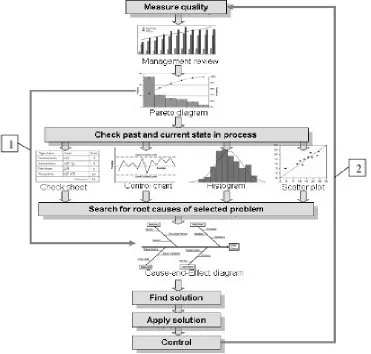
Mirko et al. (2009) designed and developed an effective layout for using these
QC in the organizations based on the performance of them, in order to apply
appropriately these quality tools for solving quality problems and quality
Neyestani B. (2017, March). “Seven Basic Tools of Quality Control: The Appropriate
Quality Techniques for Solving Quality Problems in the Organizations.”
https://doi.org/10.5281/zenodo.400832
improvement, as demonstrated in Figure 9. Accordingly, the following Figure
interprets how the 7 QC should be employed from firs step to end of
production processes for identifying the problems of quality performance and
[image:10.612.123.494.181.535.2]controlling them.
Figure 9: An appropriate layout for using 7QC tools with the aim of improving extremely quality performance (Mirko et al., 2009)
References
1. Forbes, L H. & Ahmed S. M. (2011). Modern construction : lean project
delivery and integrated practices. Boca Raton, Fly: Taylor and Francis Group.
2. Juran, M., and Godfrey, A. (1998). Juran’s quality handbook (5th ed.).
Washington, DC: McGraw-Hill Companies, Inc.
3. Kerzner, H. (2009). Project Management: A Systems Approach to Planning,
Neyestani B. (2017, March). “Seven Basic Tools of Quality Control: The Appropriate
Quality Techniques for Solving Quality Problems in the Organizations.”
https://doi.org/10.5281/zenodo.400832
Scheduling, and Controlling (10th ed.). Hoboken, New Jersey: John Wiley &
Sons, Inc.
4. Mirko S., Jelena J., Zdravko K., & Aleksandar V. (2009). Basic Quality Tools in
Continuous Improvement. Journal of Mechanical Engineering, 55(5), pp. 1-9.
5. Montgomery, D. C. (2009). Introduction to Statistical Quality Control (6th ed.).
Danvers, MA: John Wiley & Sons, Inc.
6. Neyestani B. (2017, February). “Principles and Contributions of Total Quality
Mangement (TQM) Gurus on Business Quality Improvement.” https://doi.org/10.5281/zenodo.345428
7. Oakland, J. S. (2003). Total Quality Management: text with cases (3rd ed.).
Jordan Hill, Oxford, UK: Butterworth-Heinemann, an imprint of Elsevier.
8. Oberlender, G. D. (2000). Project Management for Engineering and
Construction (2nd ed.). New York, USA: McGraw-Hill Companies, Inc.
9. Omachonu, V. K. & Ross, J. E. (2004). Principles of total quality (3rd ed.). Boca
Raton, Florida: Taylor & Francis.
Neyestani B. (2017, March). “Seven Basic Tools of Quality Control: The Appropriate
Quality Techniques for Solving Quality Problems in the Organizations.”
https://doi.org/10.5281/zenodo.400832