Error mining in parsing results
Benoît Sagot and Éric de la Clergerie Projet ATOLL - INRIA
Domaine de Voluceau, B.P. 105 78153 Le Chesnay Cedex, France
{benoit.sagot,eric.de_la_clergerie}@inria.fr
Abstract
We introduce an error mining technique for automatically detecting errors in re-sources that are used in parsing systems. We applied this technique on parsing re-sults produced on several million words by two distinct parsing systems, which share the syntactic lexicon and the pre-parsing processing chain. We were thus able to identify missing and erroneous informa-tion in these resources.
1 Introduction
Natural language parsing is a hard task, partly be-cause of the complexity and the volume of infor-mation that have to be taken into account about words and syntactic constructions. However, it is necessary to have access to such information, stored in resources such as lexica and grammars, and to try and minimize the amount of missing and erroneous information in these resources. To achieve this, the use of these resources at a large-scale in parsers is a very promising approach (van Noord, 2004), and in particular the analysis of sit-uations that lead to a parsing failure: one can learn from one’s own mistakes.
We introduce a probabilistic model that allows to identify forms and form bigrams that may be the source of errors, thanks to a corpus of parsed sentences. In order to facilitate the exploitation of forms and form bigrams detected by the model, and in particular to identify causes of errors, we have developed a visualization environment. The whole system has been tested on parsing results produced for several multi-million-word corpora and with two different parsers for French, namely SXLFGandFRMG.
However, the error mining technique which is the topic of this paper is fully system- and language-independent. It could be applied with-out any change on parsing results produced by any system working on any language. The only infor-mation that is needed is a boolean value for each sentence which indicates if it has been success-fully parsed or not.
2 Principles
2.1 General idea
The idea we implemented is inspired from (van Noord, 2004). In order to identify missing and er-roneous information in a parsing system, one can analyze a large corpus and study with statistical tools what differentiates sentences for which pars-ing succeeded from sentences for which it failed.
The simplest application of this idea is to look for forms, called suspicious forms, that are found more frequently in sentences that could not be parsed. This is what van Noord (2004) does, with-out trying to identify a suspicious form in any sen-tence whose parsing failed, and thus without tak-ing into account the fact that there is (at least) one cause of error in each unparsable sentence.1 On the contrary, we will look, in each sentence on which parsing failed, for the form that has the highest probability of being the cause of this failure: it is the main suspect of the sentence. This form may be incorrectly or only partially de-scribed in the lexicon, it may take part in construc-tions that are not described in the grammar, or it may exemplify imperfections of the pre-syntactic processing chain. This idea can be easily extended to sequences of forms, which is what we do by
tak-1Indeed, he defines the suspicion rate of a formf as the rate of unparsable sentences among sentences that containf.
ing form bigrams into account, but also to lemmas (or sequences of lemmas).
2.2 Form-level probabilistic model
We suppose that the corpus is split in sentences, sentences being segmented in forms. We denote by si thei-th sentence. We denote byoi,j, (1 ≤
j ≤ |si|)the occurrences of forms that constitute
si, and by F(oi,j) the corresponding forms.
Fi-nally, we callerrorthe function that associates to each sentencesieither1, ifsi’s parsing failed, and
0if it succeeded.
LetOf be the set of the occurrences of a form
f in the corpus: Of = {oi,j|F(oi,j) = f}. The
number of occurrences off in the corpus is there-fore|Of|.
Let us define at first the mean global suspicion rateS, that is the mean probability that a given oc-currence of a form be the cause of a parsing fail-ure. We make the assumption that the failure of the parsing of a sentence has a unique cause (here, a unique form. . . ). This assumption, which is not necessarily exactly verified, simplifies the model and leads to good results. If we call occtotal the
total amount of forms in the corpus, we have then:
S = Σierror(si) occtotal
Let f be a form, that occurs as the j-th form of sentencesi, which means thatF(oi,j) =f. Let us
assume thatsi’s parsing failed: error(si) = 1. We
call suspicion rate of thej-th formoi,jof sentence
sithe probability, denoted bySi,j, that the
occur-rence oi,j of form formf be the cause of thesi’s
parsing failure. If, on the contrary, si’s parsing
succeeded, its occurrences have a suspicion rate that is equal to zero.
We then define the mean suspicion rateSf of
a form f as the mean of all suspicion rates of its occurrences:
Sf =
1
|Of|
· X
oi,j∈Of
Si,j
To compute these rates, we use a fix-point al-gorithm by iterating a certain amount of times the following computations. Let us assume that we just completed the n-th iteration: we know, for each sentence si, and for each occurrence oi,j of
this sentence, the estimation of its suspicion rate Si,j as computed by then-th iteration, estimation
that is denoted bySi,j(n). From this estimation, we
compute then+ 1-th estimation of the mean sus-picion rate of each formf, denoted bySf(n+1):
Sf(n+1) = 1
|Of|
· X
oi,j∈Of
S(i,jn)
This rate2 allows us to compute a new estima-tion of the suspicion rate of all occurrences, by giving to each occurrence if a sentence si a
sus-picion rate Si,j(n+1) that is exactly the estimation
Sf(n+1)of the mean suspicion rate ofSf of the
cor-responding form, and then to perform a sentence-level normalization. Thus:
Si,j(n+1)= error(si)·
SF(n(+1)o
i,j)
P
1≤j≤|si|S
(n+1)
F(oi,j)
At this point, then+1-th iteration is completed, and we can resume again these computations, un-til convergence on a fix-point. To begin the whole process, we just say, for an occurrenceoi,jof
sen-tence si, that Si,j(0) = error(si)/|si|. This means
that for a non-parsable sentence, we start from a baseline where all of its occurrences have an equal probability of being the cause of the failure.
After a few dozens of iterations, we get stabi-lized estimations of the mean suspicion rate each form, which allows:
• to identify the forms that most probably cause errors,
• for each formf, to identify non-parsable sen-tencessiwhere an occurrenceoi,j ∈ Of off
is a main suspect and where oi,j has a very
2We also performed experiment in which S
f was
esti-mated by an other estimator, namely the smoothed mean
sus-picion rate, denoted byS˜(fn), that takes into account the num-ber of occurrences off. Indeed, the confidence we can have in the estimationSf(n)is lower if the number of occurrences offis lower. Hence the idea to smoothSf(n)by replacing it with a weighted meanS˜(fn) betweenSf(n)andS, where the weightsλand1−λdepend on|Of|: if|Of|is high,S˜(fn)
will be close fromSf(n); if it is low, it will be closer fromS:
˜
Sf(n)=λ(|Of|)·Sf(n)+ (1−λ(|Of|))·S.
In these experiments, we used the smoothing function
λ(|Of|) = 1−e−β|Of| withβ = 0.1. But this model,
used with the ranking according toMf =Sf ·ln|Of|(see
high suspicion rate among all occurrences of formf.
We implemented this algorithm as a perl script, with strong optimizations of data structures so as to reduce memory and time usage. In particu-lar, form-level structures are shared between sen-tences.
2.3 Extensions of the model
This model gives already very good results, as we shall see in section 4. However, it can be extended in different ways, some of which we already im-plemented.
First of all, it is possible not to stick to forms. Indeed, we do not only work on forms, but on cou-ples made out of a form (a lexical entry) and one or several token(s) that correspond to this form in the raw text (a token is a portion of text delimited by spaces or punctuation tokens).
Moreover, one can look for the cause of the fail-ure of the parsing of a sentence not only in the presence of a form in this sentence, but also in the presence of a bigram3of forms. To perform this, one just needs to extend the notions of form and occurrence, by saying that a (generalized) form is a unigram or a bigram of forms, and that a (gen-eralized) occurrence is an occurrence of a gener-alized form, i.e., an occurrence of a unigram or a bigram of forms. The results we present in sec-tion 4 includes this extension, as well as the previ-ous one.
Another possible generalization would be to take into account facts about the sentence that are not simultaneous (such as form unigrams and form bigrams) but mutually exclusive, and that must therefore be probabilized as well. We have not yet implemented such a mechanism, but it would be very interesting, because it would allow to go be-yond forms orn-grams of forms, and to manipu-late also lemmas (since a given form has usually several possible lemmas).
3 Experiments
In order to validate our approach, we applied these principles to look for error causes in pars-ing results given by two deep parspars-ing systems for French,FRMGand SXLFG, on large corpora.
3One could generalize this to n-grams, but as n gets higher the number of occurrences of n-grams gets lower, hence leading to non-significant statistics.
3.1 Parsers
Both parsing systems we used are based on deep non-probabilistic parsers. They share:
• the Lefff 2 syntactic lexicon for French (Sagot et al., 2005), that contains 500,000 en-tries (representing 400,000 different forms) ; each lexical entry contains morphological in-formation, sub-categorization frames (when relevant), and complementary syntactic infor-mation, in particular for verbal forms (con-trols, attributives, impersonals,. . . ),
• the SXPipe pre-syntactic processing chain (Sagot and Boullier, 2005), that converts a raw text in a sequence of DAGs of forms that are present in the Lefff ; SXPipe contains, among other modules, a sentence-level seg-menter, a tokenization and spelling-error cor-rection module, named-entities recognizers, and a non-deterministic multi-word identifier.
ButFRMGand SXLFGuse completely different parsers, that rely on different formalisms, on dif-ferent grammars and on difdif-ferent parser builder. Therefore, the comparison of error mining results on the output of these two systems makes it possi-ble to distinguish errors coming from the Lefff or from SXPipe from those coming to one grammar
or the other. Let us describe in more details the characteristics of these two parsers.
The FRMG parser (Thomasset and Villemonte
de la Clergerie, 2005) is based on a compact TAG for French that is automatically generated from a meta-grammar. The compilation and execution of the parser is performed in the framework of the DYALOGsystem (Villemonte de la Clergerie, 2005).
The SXLFGparser (Boullier and Sagot, 2005b; Boullier and Sagot, 2005a) is an efficient and ro-bust LFG parser. Parsing is performed in two steps. First, an Earley-like parser builds a shared forest that represents all constituent structures that satisfy the context-free skeleton of the grammar. Then functional structures are built, in one or more bottom-up passes. Parsing efficiency is achieved thanks to several techniques such as compact data representation, systematic use of structure and computation sharing, lazy evaluation and heuristic and almost non-destructive pruning during pars-ing.
corpus #sentences #success (%) #forms #occ S(%) Date MD/FRMG 330,938 136,885 (41.30%) 255,616 10,422,926 1.86% Jul. 05 MD/SXLFG 567,039 343,988 (60.66%) 327,785 14,482,059 1.54% Mar. 05 EASy/FRMG 39,872 16,477 (41.32%) 61,135 878,156 2.66% Dec. 05
[image:4.595.88.511.62.134.2]EASy/SXLFG 39,872 21,067 (52.84%) 61,135 878,156 2.15% Dec. 05
Table 1: General information on corpora and parsing results
useless for the experiments described here, since we want only to distinguish sentences that receive a full parse (without any recovery technique) from those that do not.
3.2 Corpora
We parsed with these two systems the following corpora:
MD corpus : This corpus is made out of 14.5
million words (570,000 sentences) of general journalistic corpus that are articles from the Monde diplomatique.
EASy corpus : This is the 40,000-sentence
cor-pus that has been built for the EASy parsing evaluation campaign for French (Paroubek et al., 2005). We only used the raw corpus (without taking into account the fact that a manual parse is available for 10% of all sen-tences). The EASy corpus contains several sub-corpora of varied style: journalistic, lit-eracy, legal, medical, transcription of oral, e-mail, questions, etc.
Both corpora are raw in the sense that no clean-ing whatsoever has been performed so as to elimi-nate some sequences of characters that can not re-ally be considered as sentences.
Table 1 gives some general information on these corpora as well as the results we got with both parsing systems. It shall be noticed that both parsers did not parse exactly the same set and the same number of sentences for the MD corpus, and that they do not define in the exactly same way the notion of sentence.
3.3 Results visualization environment
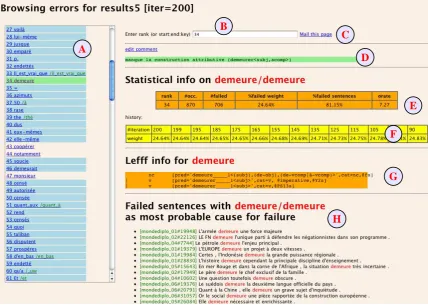
We developed a visualization tool for the results of the error mining, that allows to examine and an-notate them. It has the form of an HTML page that uses dynamic generation methods, in particu-lar javascript. An example is shown on Figure 1.
To achieve this, suspicious forms are ranked ac-cording to a measureMf that models, for a given
formf, the benefit there is to try and correct the (potential) corresponding error in the resources. A user who wants to concentrate on almost certain errors rather than on most frequent ones can visu-alize suspicious forms ranked according toMf =
Sf. On the contrary, a user who wants to
concen-trate on most frequent potential errors, rather than on the confidence that the algorithm has given to errors, can visualize suspicious forms ranked ac-cording to4 M
f = Sf|Of|. The default choice,
which is adopted to produce all tables shown in this paper, is a balance between these two possi-bilities, and ranks suspicious forms according to Mf =Sf ·ln|Of|.
The visualization environment allows to browse through (ranked) suspicious forms in a scrolling list on the left part of the page (A). When the suspi-cious form is associated to a token that is the same as the form, only the form is shown. Otherwise, the token is separated from the form by the sym-bol “ / ”. The right part of the page shows various pieces of information about the currently selected form. After having given its rank according to the ranking measureMf that has been chosen (B), a
field is available to add or edit an annotation as-sociated with the suspicious form (D). These an-notations, aimed to ease the analysis of the error mining results by linguists and by the developers of parsers and resources (lexica, grammars), are saved in a database (SQLITE). Statistical informa-tion is also given aboutf (E), including its number of occurrencesoccf, the number of occurrences of
f in non-parsable sentences, the final estimation of its mean suspicion rateSf and the rateerr(f)
of non-parsable sentences among those where f appears. This indications are complemented by a brief summary of the iterative process that shows the convergence of the successive estimations of Sf. The lower part of the page gives a mean to
identify the cause off-related errors by showing
4Letfbe a form. The suspicion rateS
fcan be considered
as the probability for a particular occurrence off to cause a parsing error. Therefore, Sf|Of|models the number of
A
B
C
D
E
F
G
[image:5.595.86.515.65.370.2]H
Figure 1: Error mining results visualization environment (results are shown for MD/FRMG).
f’s entries in the Lefff lexicon (G) as well as non-parsable sentences where f is the main suspect and where one of its occurrences has a particularly high suspicion rate5(H).
The whole page (with annotations) can be sent by e-mail, for example to the developer of the lex-icon or to the developer of one parser or the other (C).
4 Results
In this section, we mostly focus on the results of our error mining algorithm on the parsing results provided by SXLFG on the MD corpus. We first present results when only forms are taken into ac-count, and then give an insight on results when both forms and form bigrams are considered.
5
Such an information, which is extremely valuable for the developers of the resources, can not be obtained by global (form-level and not occurrence-level) approaches such as the
err(f)-based approach of (van Noord, 2004). Indeed, enu-merating all sentences which include a given form f, and which did not receive a full parse, is not precise enough: it would show at the same time sentences wich fail be-cause off(e.g., because its lexical entry lacks a given sub-categorization frame) and sentences which fail for an other independent reason.
4.1 Finding suspicious forms
The execution of our error mining script on MD/SXLFG, withimax = 50 iterations and when
only (isolated) forms are taken into account, takes less than one hour on a 3.2 GHz PC running Linux with a 1.5 Go RAM. It outputs 18,334 rele-vant suspicious forms (out of the 327,785 possible ones), where a relevant suspicious form is defined as a form f that satisfies the following arbitrary constraints:6 S(imax)
f >1,5·Sand|Of|>5.
We still can not prove theoretically the conver-gence of the algorithm.7 But among the 1000 best-ranked forms, the last iteration induces a mean variation of the suspicion rate that is less than 0.01%.
On a smaller corpus like the EASy corpus, 200 iterations take 260s. The algorithm outputs less than 3,000 relevant suspicious forms (out of the 61,125 possible ones). Convergence information
6These constraints filter results, but all forms are taken into account during all iterations of the algorithm.
is the same as what has been said above for the MD corpus.
Table 2 gives an idea of the repartition of sus-picious forms w.r.t. their frequency (forFRMG on
MD), showing that rare forms have a greater prob-ability to be suspicious. The most frequent suspi-cious form is the double-quote, with (only)Sf =
9%, partly because of segmentation problems.
4.2 Analyzing results
Table 3 gives an insight on the output of our algo-rithm on parsing results obtained by SXLFGon the MD corpus. For each formf (in fact, for each cou-ple of the form (token,form)), this table displays its suspicion rate and its number of occurrences, as well as the rate err(f) of non-parsable sentences among those wheref appears and a short manual analysis of the underlying error.
In fact, a more in-depth manual analysis of the results shows that they are very good: errors are correctly identified, that can be associated with four error sources: (1) the Lefff lexicon, (2) the SXPipe pre-syntactic processing chain, (3) imper-fections of the grammar, but also (4) problems re-lated to the corpus itself (and to the fact that it is a raw corpus, with meta-data and typographic noise).
On the EASy corpus, results are also relevant, but sometimes more difficult to interpret, because of the relative small size of the corpus and because of its heterogeneity. In particular, it contains e-mail and oral transcriptions sub-corpora that in-troduce a lot of noise. Segmentation problems (caused both by SXPipe and by the corpus itself, which is already segmented) play an especially important role.
4.3 Comparing results with results of other algorithms
In order to validate our approach, we compared our results with results given by two other relevant algorithms:
• van Noord’s (van Noord, 2004) (form-level and non-iterative) evaluation of err(f) (the rate of non-parsable sentences among sen-tences containing the formf),
• a standard (occurrence-level and iterative) maximum entropy evaluation of each form’s contribution to the success or the failure of a sentence (we used the MEGAM package (Daumé III, 2004)).
As done for our algorithm, we do not rank forms directly according to the suspicion rate Sf
com-puted by these algorithms. Instead, we use theMf
measure presented above (Mf =Sf·ln|Of|).
Us-ing directly van Noord’s measure selects as most suspicious words very rare words, which shows the importance of a good balance between suspi-cion rate and frequency (as noted by (van Noord, 2004) in the discussion of his results). This remark applies to the maximum entropy measure as well.
Table 4 shows for all algorithms the 10 best-ranked suspicious forms, complemented by a man-ual evaluation of their relevance. One clearly sees that our approach leads to the best results. Van Noord’s technique has been initially designed to find errors in resources that already ensured a very high coverage. On our systems, whose develop-ment is less advanced, this technique ranks as most suspicious forms those which are simply the most frequent ones. It seems to be the case for the stan-dard maximum entropy algorithm, thus showing the importance to take into account the fact that there is at least one cause of error in any sentence whose parsing failed, not only to identify a main suspicious form in each sentence, but also to get relevant global results.
4.4 Comparing results for both parsers
We complemented the separated study of error mining results on the output of both parsers by an analysis of merged results. We computed for each form the harmonic mean of both measures Mf =Sf ·ln|Of|obtained for each parsing
sys-tem. Results (not shown here) are very interest-ing, because they identify errors that come mostly from resources that are shared by both systems (the Lefff lexicon and the pre-syntactic processing chain SXPipe). Although some errors come from common lacks of coverage in both grammars, it is nevertheless a very efficient mean to get a first repartition between error sources.
4.5 Introducing form bigrams
As said before, we also performed experiments where not only forms but also form bigrams are treated as potential causes of errors. This approach allows to identify situations where a form is not in itself a relevant cause of error, but leads often to a parse failure when immediately followed or pre-ceded by an other form.
em-#occ >100 000 >10 000 >1000 >100 >10
#forms 13 84 947 8345 40 393
[image:7.595.83.520.83.127.2]#suspicious forms (%) 1 (7.6%) 13 (15.5%) 177 (18.7%) 1919 (23%) 12 022 (29.8%)
Table 2: Suspicious forms repartition for MD/FRMG
Rank Token(s)/form Sf(50) |Of| err(f) Mf Error cause
1 _____/_UNDERSCORE 100% 6399 100% 8.76 corpus: typographic noise
2 (...) 46% 2168 67% 2.82 SXPipe: should be treated as skippable words 3 2_]/_NUMBER 76% 30 93% 2.58 SXPipe: bad treatment of list constructs
4 privées 39% 589 87% 2.53 Lefff : misses as an adjective
5 Haaretz/_Uw 51% 149 70% 2.53 SXPipe: needs local grammars for references
6 contesté 52% 122 90% 2.52 Lefff : misses as an adjective
7 occupés 38% 601 86% 2.42 Lefff : misses as an adjective
8 privée 35% 834 82% 2.38 Lefff : misses as an adjective
9 [...] 44% 193 71% 2.33 SXPipe: should be treated as skippable words
[image:7.595.122.473.383.516.2]10 faudrait 36% 603 85% 2.32 Lefff : can have a nominal object
Table 3: Analysis of the 10 best-ranked forms (ranked according toMf =Sf ·ln|Of|)
this paper global maxent
Rank Token(s)/form Eval Token(s)/form Eval Token(s)/form Eval
1 _____/_UNDERSCORE ++ * + pour
-2 (...) ++ , - )
-3 2_]/_NUMBER ++ livre - à
-4 privées ++ . - qu’il/qu’
-5 Haaretz/_Uw ++ de - sont
-6 contesté ++ ; - le
-7 occupés ++ : - qu’un/qu’ +
8 privée ++ la - qu’un/un +
9 [...] ++ ´étrangères - que
-10 faudrait ++ lecteurs - pourrait
-Table 4: The 10 best-ranked suspicious forms, according the theMf measure, as computed by different
algorithms: ours (this paper), a standard maximum entropy algorithm (maxent) and van Noord’s rate
err(f)(global).
Rank Tokens and forms Mf Error cause
4 Toutes/toutes les 2.73 grammar: badly treated pre-determiner adjective 6 y en 2,34 grammar: problem with the construction il y en a. . .
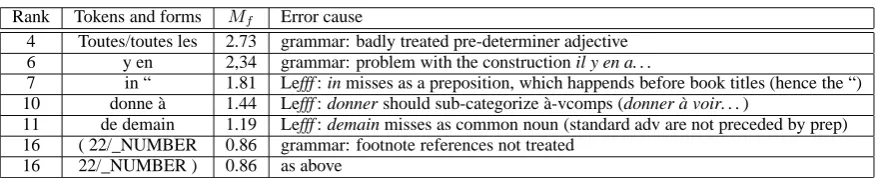
7 in “ 1.81 Lefff : in misses as a preposition, which happends before book titles (hence the “) 10 donne à 1.44 Lefff : donner should sub-categorize à-vcomps (donner à voir. . . )
11 de demain 1.19 Lefff : demain misses as common noun (standard adv are not preceded by prep) 16 ( 22/_NUMBER 0.86 grammar: footnote references not treated
16 22/_NUMBER ) 0.86 as above
Table 5: Best ranked form bigrams (forms ranked inbetween are not shown; ranked according toMf =
[image:7.595.79.523.613.702.2]phasize bigram results), with the same data as in table 3.
5 Conclusions and perspectives
As we have shown, parsing large corpora allows to set up error mining techniques, so as to identify missing and erroneous information in the differ-ent resources that are used by full-featured pars-ing systems. The technique described in this pa-per and its implementation on forms and form bi-grams has already allowed us to detect many errors and omissions in the Lefff lexicon, to point out in-appropriate behaviors of the SXPipe pre-syntactic processing chain, and to reveal the lack of cover-age of the grammars for certain phenomena.
We intend to carry on and extend this work. First of all, the visualization environment can be enhanced, as is the case for the implementation of the algorithm itself.
We would also like to integrate to the model the possibility that facts taken into account (to-day, forms and form bigrams) are not necessar-ily certain, because some of them could be the consequence of an ambiguity. For example, for a given form, several lemmas are often possible. The probabilization of these lemmas would thus allow to look for most suspicious lemmas.
We are already working on a module that will allow not only to detect errors, for example in the lexicon, but also to propose a correction. To achieve this, we want to parse anew all non-parsable sentences, after having replaced their main suspects by a special form that receives under-specified lexical information. These infor-mation can be either very general, or can be com-puted by appropriate generalization patterns ap-plied on the information associated by the lexicon with the original form. A statistical study of the new parsing results will make it possible to pro-pose corrections concerning the involved forms.
References
A. Berger, S. Della Pietra, and V. Della Pietra. 1996. A maximun entropy approach to natural language pro-cessing. Computational Linguistics, 22(1):pp. 39– 71.
Pierre Boullier and Benoît Sagot. 2005a. Analyse syn-taxique profonde à grande échelle: SXLFG.
Traite-ment Automatique des Langues (T.A.L.), 46(2).
Pierre Boullier and Benoît Sagot. 2005b. Efficient
and robust LFG parsing: SxLfg. In Proceedings of
IWPT’05, Vancouver, Canada, October.
Hal Daumé III. 2004. Notes on CG and LM-BFGS optimization of logistic regression. Paper available
at http://www.isi.edu/~hdaume/docs/
daume04cg-bfgs.ps, implementation
avail-able at http://www.isi.edu/~hdaume/
megam/.
Patrick Paroubek, Louis-Gabriel Pouillot, Isabelle Robba, and Anne Vilnat. 2005. EASy : cam-pagne d’évaluation des analyseurs syntaxiques. In
Proceedings of the EASy workshop of TALN 2005,
Dourdan, France.
Benoît Sagot and Pierre Boullier. 2005. From raw cor-pus to word lattices: robust pre-parsing processing. In Proceedings of L&TC 2005, Pozna´n, Pologne.
Benoît Sagot, Lionel Clément, Éric Villemonte de la Clergerie, and Pierre Boullier. 2005. Vers un méta-lexique pour le français : architecture, acqui-sition, utilisation. Journée d’étude de l’ATALA sur l’interface lexique-grammaire et les lexiques syntax-iques et sémantsyntax-iques, March.
François Thomasset and Éric Villemonte de la Clerg-erie. 2005. Comment obtenir plus des méta-grammaires. In Proceedings of TALN’05, Dourdan, France, June. ATALA.
Gertjan van Noord. 2004. Error mining for wide-coverage grammar engineering. In Proc. of ACL
2004, Barcelona, Spain.
Éric Villemonte de la Clergerie. 2005. DyALog: a tabular logic programming based environment for NLP. In Proceedings of 2nd International